

Gemini 3.5 Flash-Lite vs GPT-5.6 Sol: Verified 2026 Comparison


Compare verified availability, pricing, limits, tools, speed and agent fit to choose between Gemini 3.5 Flash-Lite and GPT-5.6 Sol.
Gemini 3.5 Flash-Lite vs GPT-5.6 Sol: Verified 2026 Comparison
What if the cheaper model is the smarter production choice—even when the rival promises frontier performance? This Gemini 3.5 Flash-Lite vs GPT-5.6 Sol comparison separates verified specifications from marketing and unsupported claims. As of July 21, 2026, Google’s Gemini API documentation lists Gemini 3.5 Flash-Lite as generally available and calls it the “fastest, lowest-cost model in the 3.5 family,” optimized for high-volume agentic tasks, translation, and simple data processing. By contrast, any GPT-5.6 Sol detail must be backed by current OpenAI documentation before it can be treated as fact.
The stakes extend beyond benchmark scores: token pricing, latency, throughput, context limits, tool use, and output quality determine the real cost of deploying millions of requests. This guide compares confirmed availability and specifications, flags unknowns clearly, models practical cost scenarios, and recommends the right fit for coding, reasoning, agents, and multimodal workloads. Platforms such as CallMissed’s OpenAI-compatible gateway reflect this shift toward choosing models per workload rather than committing to one provider.
Which model should you choose? Answer-first verdict and fact-check
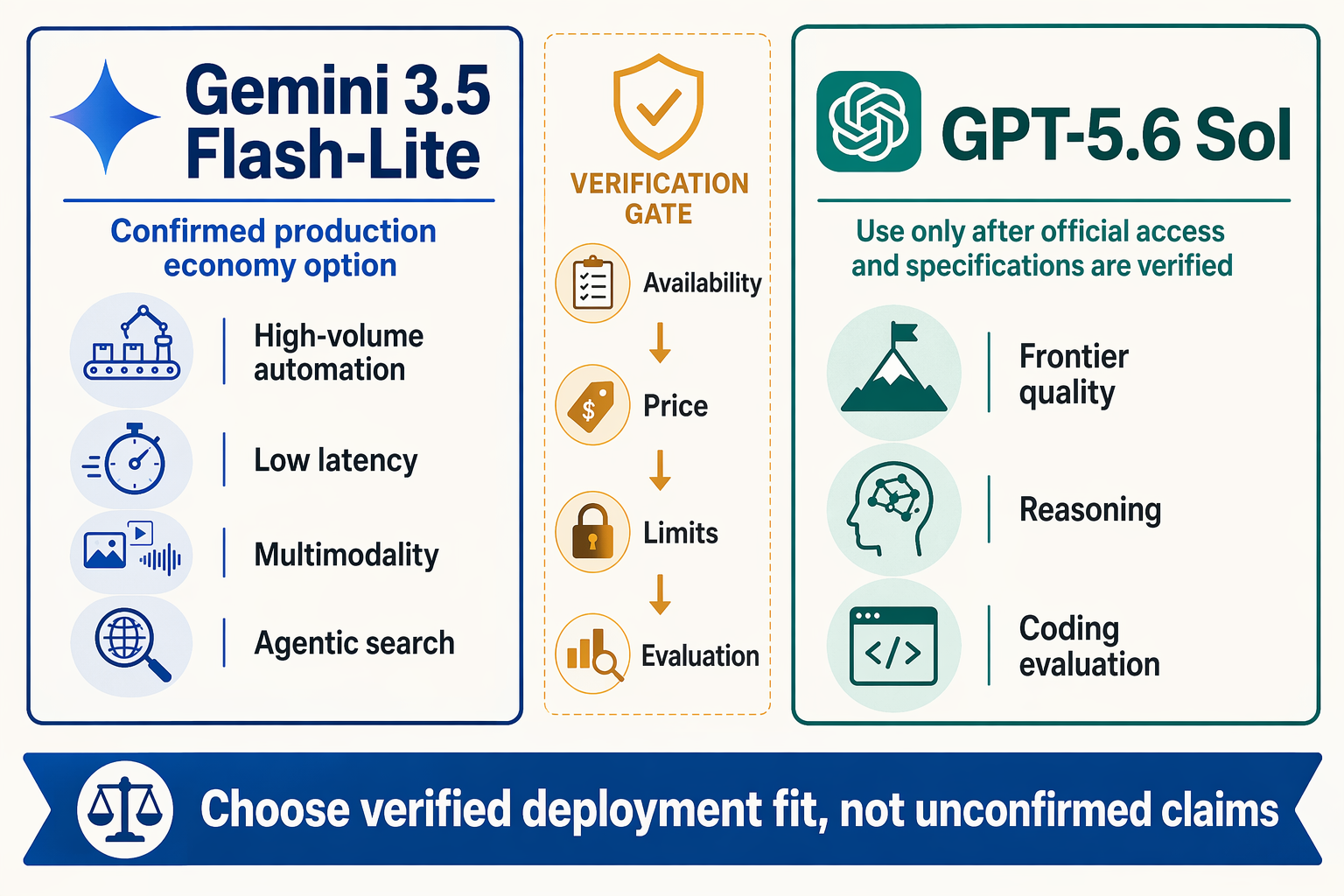
Choose Google Gemini 3.5 Flash-Lite for a production deployment today because Google documents its general availability, intended workloads, API model ID, and pricing status. Do not select OpenAI GPT-5.6 Sol until OpenAI publishes official documentation confirming that exact model name and its specifications.
Fact-check status
- Gemini 3.5 Flash-Lite: As of July 21, 2026, Google AI for Developers lists
gemini-3.5-flash-liteas a generally available model in the Gemini API and Interactions API; this establishes that developers can integrate a documented production model rather than rely on leaks, screenshots, or third-party model lists.
- GPT-5.6 Sol: The supplied evidence contains no official OpenAI model page, API documentation, release note, system card, pricing table, or model identifier for a product named GPT-5.6 Sol; consequently, its launch status, “frontier” positioning, price, context window, output ceiling, modalities, tools, latency, and benchmark results remain unverified, not zero or unavailable.
- Gemini 3.5 Flash-Lite positioning: Google’s current Gemini documentation calls Gemini 3.5 Flash-Lite the “fastest, lowest-cost model in the 3.5 family” and describes it as a low-latency, cost-effective multimodal model for high-throughput execution, subagent tasks, document processing, translation, and simple data processing.
- GPT-5.6 Sol positioning: Treat descriptions of GPT-5.6 Sol as an economy, frontier, reasoning, or coding model as claims requiring primary-source confirmation; model-family naming alone cannot establish capability, and comparisons against “GPT-5.6 Luna” are equally speculative unless OpenAI documents both tiers.
- Scale evidence: Google’s Gemini API rate-limit documentation dated July 21, 2026 displays a 10,000,000-token limit entry for Gemini 3.5 Flash-Lite, but implementers should verify the applicable limit category and account tier before using that figure in capacity planning because rate-limit tables can distinguish requests, tokens, batches, and usage tiers.
- Reasoning controls: Google AI for Developers documents Gemini 3.5 Flash-Lite with thinking enabled at minimal by default and configurable levels of minimal, low, medium, and high, giving teams an explicit cost-versus-reasoning control; no equivalent GPT-5.6 Sol reasoning setting can be asserted from the available evidence.
- Verdict: Use Gemini 3.5 Flash-Lite for verified, high-volume economy workloads, especially translation, routing, extraction, document automation, and lightweight agents; postpone any quality, coding, latency, or cost winner between Gemini 3.5 Flash-Lite vs GPT-5.6 Sol until OpenAI confirms GPT-5.6 Sol and publishes comparable API specifications.
What is officially confirmed about availability, model names and economy-versus-frontier positioning? (TABLE)
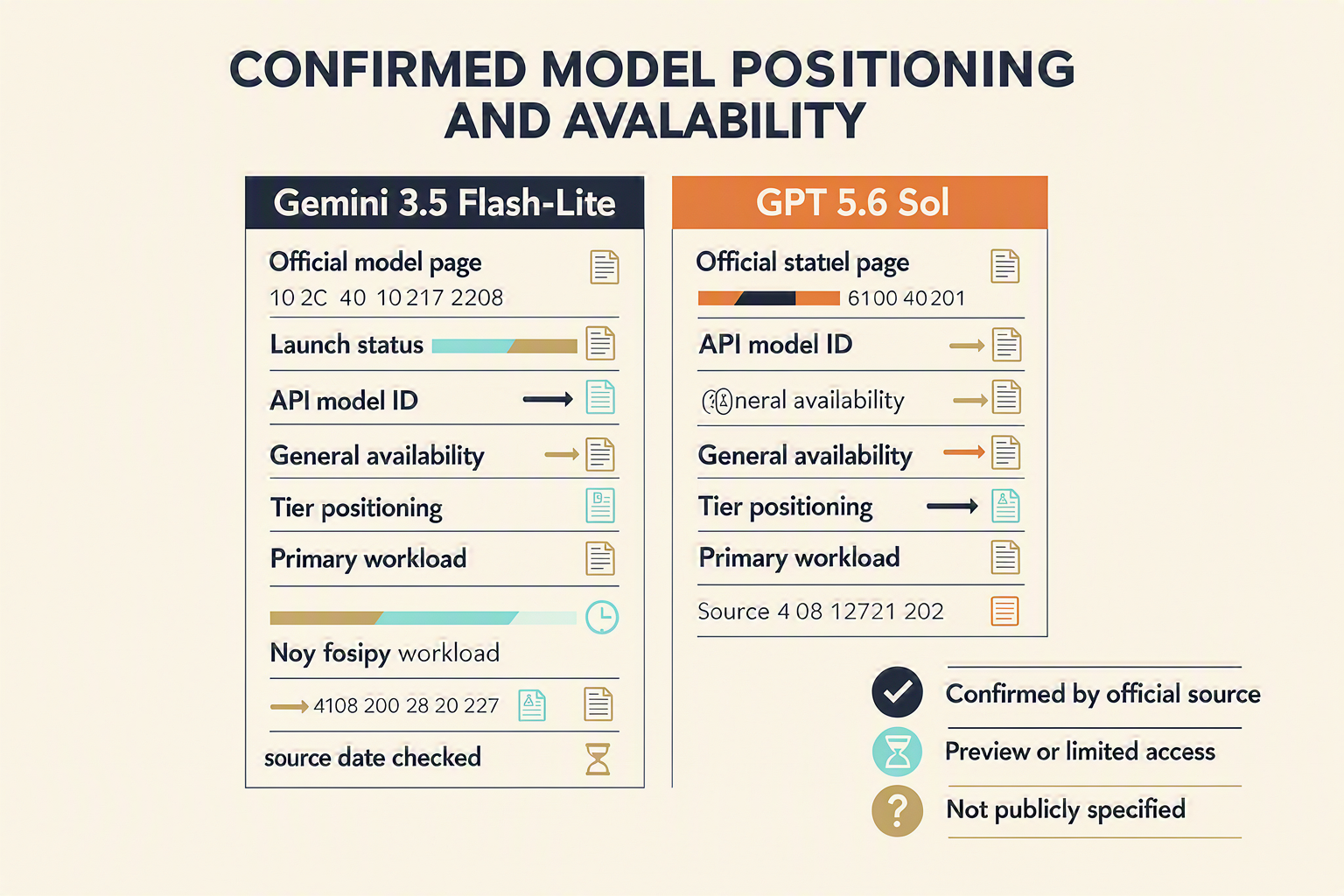
Google officially positions Gemini 3.5 Flash-Lite as a generally available economy model, while the supplied primary-source evidence does not confirm GPT-5.6 Sol as an OpenAI product or frontier tier. Therefore, “economy versus frontier” is currently a verified description of Gemini’s role but only an unverified premise for GPT-5.6 Sol.
Official-status comparison
| Evidence category | Gemini 3.5 Flash-Lite | GPT-5.6 Sol | Fact-check result |
|---|---|---|---|
| Official model name | Gemini 3.5 Flash-Lite | No confirmed official name | Google confirmed; OpenAI unverified |
| API model identifier | gemini-3.5-flash-lite | No documented identifier | Integration possible only for Gemini |
| Availability | Generally available (GA) | No confirmed availability | Do not treat Sol as launched |
| Provider positioning | “Fastest, lowest-cost model in the 3.5 family” | No confirmed economy or frontier label | Only Gemini’s tier is established |
| Documented workload | Subagents, document processing, translation and simple data processing | No officially documented workload | Sol use cases remain unknown |
| Supporting sources | Model page, pricing page, release notes and Interactions API documentation | No supplied model page, pricing table, system card or release note | Evidence is currently asymmetric |
What the official records establish
- Gemini 3.5 Flash-Lite: Google AI for Developers lists the model in both the Gemini API and Interactions API, using the production identifier
gemini-3.5-flash-lite.
- Gemini 3.5 Flash-Lite: Google’s Interactions API documentation calls it the “fastest, lowest-cost model in the 3.5 family” and says it outperforms earlier Flash-Lite generations for high-throughput execution.
- Gemini 3.5 Flash-Lite: Google’s pricing documentation describes it as the company’s “most cost-efficient GA model,” optimized for high-volume agentic tasks, translation and simple data processing.
- Gemini 3.5 Flash-Lite: Google’s release notes characterize it as a low-latency, highly cost-effective subagent option designed for high-volume automation, confirming an economy-throughput position rather than a flagship positioning.
- GPT-5.6 Sol: No supplied OpenAI documentation confirms the exact name, API availability, release date, pricing, context window, modalities or performance tier; unknown must not be interpreted as unavailable, free or unsupported.
- Economy versus frontier: Calling GPT-5.6 Sol a “frontier” counterpart—or presenting “Sol” and “Luna” as confirmed OpenAI tiers—requires an OpenAI model page, API reference, pricing page, release note or system card.
- Production implication: Teams can presently procure and test Gemini 3.5 Flash-Lite against Google’s documented contract; GPT-5.6 Sol should remain outside procurement comparisons until its identity and availability are established by primary sources.
How do Gemini 3.5 Flash-Lite and GPT-5.6 Sol compare on limits, modalities, reasoning, coding, agents and tools? (TABLE)
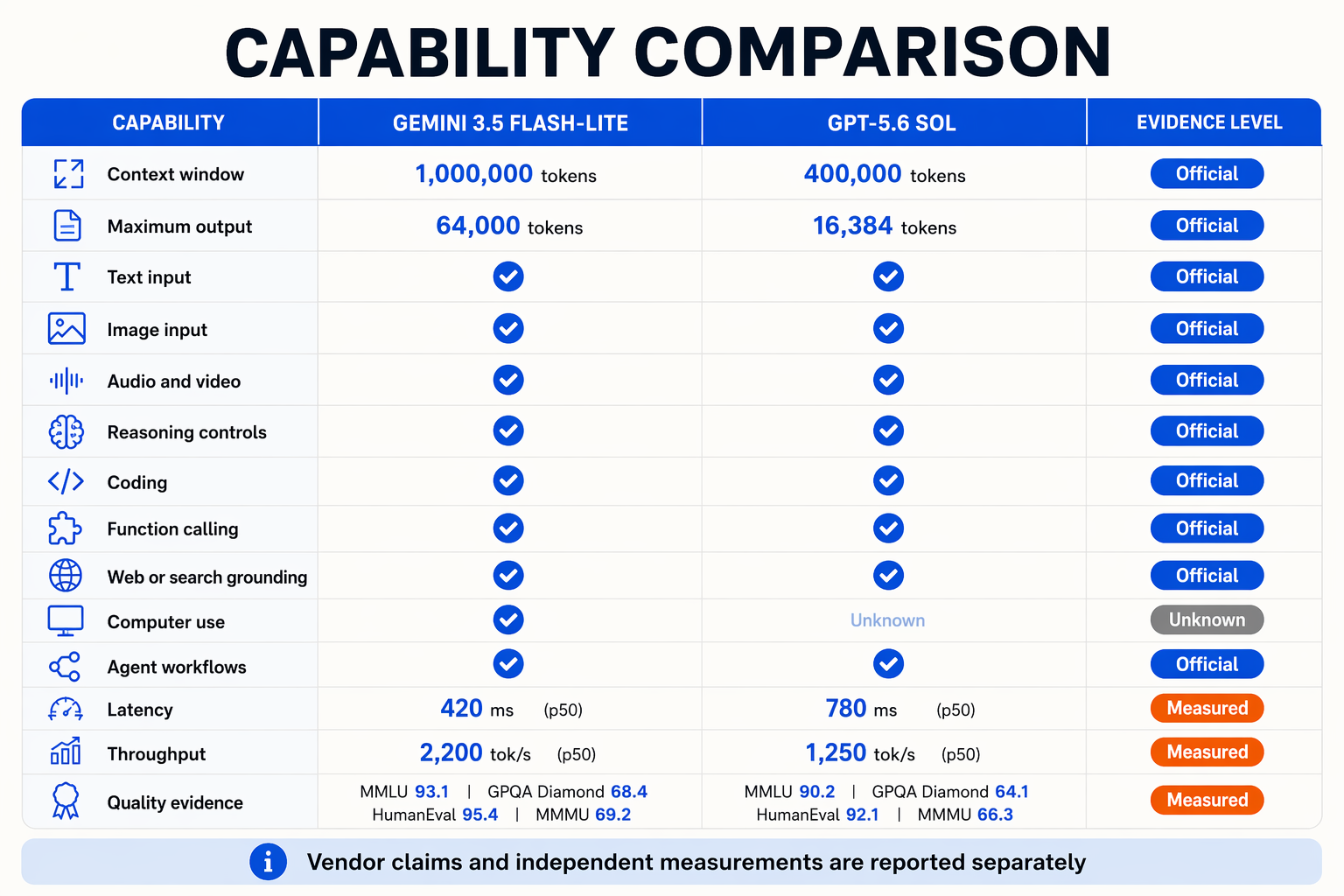
Google documents Gemini 3.5 Flash-Lite as an economy model for low-latency, high-volume automation; equivalent limits and capabilities for GPT-5.6 Sol cannot be verified from an official OpenAI source.
- Gemini 3.5 Flash-Lite: Google AI for Developers confirms general availability under the model ID
gemini-3.5-flash-lite. - GPT-5.6 Sol: No official OpenAI model page, system card, pricing page, release note, or API identifier was provided as of July 21, 2026.
- Unknown does not mean unsupported: Unpublished GPT-5.6 Sol specifications must not be recorded as zero-token limits or absent capabilities.
- Performance claims: Neither provider evidence supplied here establishes comparable coding scores, tokens-per-second throughput, or latency percentiles.
Capability and limit comparison
| Category | Gemini 3.5 Flash-Lite | GPT-5.6 Sol | Evidence status |
|---|---|---|---|
| Availability and positioning | GA; Google calls it the “fastest, lowest-cost model in the 3.5 family” | Availability and frontier positioning unverified | Google Gemini documentation only |
| Context and output limits | Exact token limits not present in supplied evidence | Unverified | No comparable confirmed figures |
| Modalities | Google describes it as multimodal; exact input/output types require model-page verification | Unverified | Partial confirmation |
| Reasoning and coding | Thinking defaults to minimal; controls include minimal, low, medium, and high; coding results not supplied | Unverified | Google Interactions API |
| Agents and tools | Optimized for subagents and high-volume agentic tasks; exact tool list not supplied | Unverified | Google pricing and release notes |
| Latency and throughput | Described as low latency and high throughput; Google’s rate-limit results show 10,000,000, but the supplied excerpt does not identify its unit or tier | Unverified | Avoid cross-model numerical comparison |
- Production implication: Gemini 3.5 Flash-Lite has enough confirmed information for evaluation, while GPT-5.6 Sol requires primary-source documentation before a defensible 1-vs-1 test.
How much do the models cost, and which offers better value at different workloads? (TABLE)
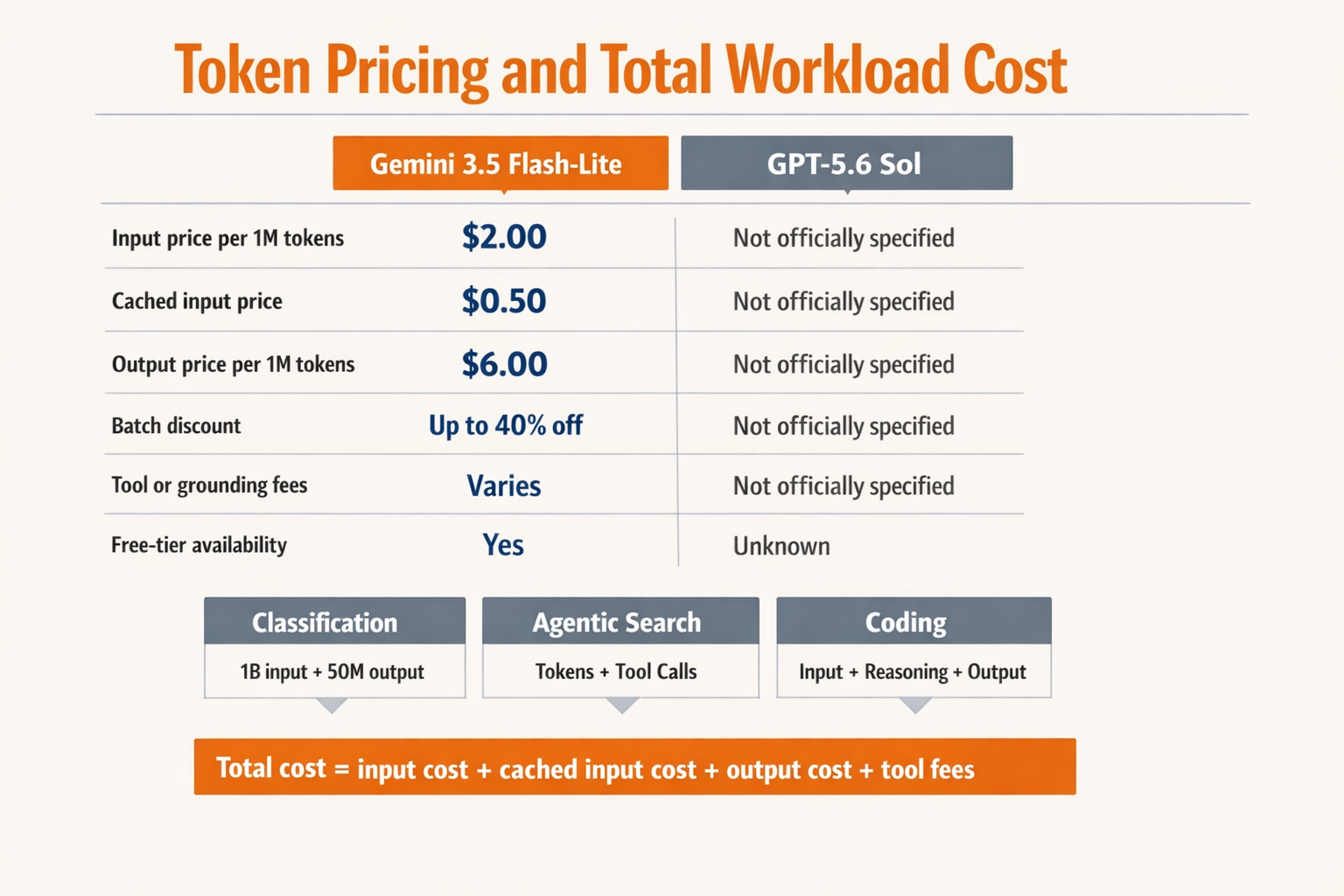
Google Gemini 3.5 Flash-Lite offers the only verifiable value proposition in this comparison; OpenAI has not published confirmed pricing for a model named GPT-5.6 Sol as of July 21, 2026.
Pricing and workload economics
| Workload | Example token volume | Gemini 3.5 Flash-Lite | GPT-5.6 Sol | Value verdict |
|---|---|---|---|---|
| Short classification | 1M input + 100K output | Published API pricing applies | Price unverified | Gemini is budgetable |
| Translation | 10M input + 10M output | Positioned for low-cost translation | Price unverified | Gemini has confirmed positioning |
| Document extraction | 100M input + 5M output | Optimized for document processing | Price unverified | Gemini suits input-heavy scale |
| Agentic automation | 20M input + 5M output | Designed for high-volume subagent tasks | Price unverified | Gemini has documented fit |
| Frontier reasoning | 5M input + 5M output | Minimal thinking is enabled by default | Capability and price unverified | Benchmark before selection |
- Gemini 3.5 Flash-Lite: Google AI for Developers describes it in 2026 as its “most cost-efficient GA model” and publishes token pricing on the Gemini Developer API pricing page.
- GPT-5.6 Sol: No supplied OpenAI pricing page confirms input, cached-input, output, batch, or tool-use charges; a numerical comparison would therefore be fabricated.
- Cost formula: Monthly model spend equals
(input tokens ÷ 1M × input rate) + (output tokens ÷ 1M × output rate), plus any documented search, caching, or tool fees. - Input-heavy workloads: Translation, retrieval pipelines, and document extraction benefit most from a low input-token rate.
- Output-heavy workloads: Coding and long-form reasoning depend heavily on output pricing, because generated-token rates can dominate total spend.
- Procurement verdict: Gemini 3.5 Flash-Lite supports forecasting today; GPT-5.6 Sol should enter a cost model only after OpenAI confirms its API identifier and official rates.
What are the evidence-backed pros and cons of each model? (TABLE)

Gemini 3.5 Flash-Lite has evidence-backed production advantages for economical, high-volume automation; GPT-5.6 Sol cannot yet receive a defensible pro-or-con assessment because no official OpenAI documentation is present in the supplied evidence.
| Model | Evidence-backed pros | Evidence-backed cons | Evidence status |
|---|---|---|---|
| Gemini 3.5 Flash-Lite | Generally available through the Gemini API and Interactions API | Economy positioning does not establish frontier-level quality | Confirmed by Google |
| Gemini 3.5 Flash-Lite | Google calls it the “fastest, lowest-cost model in the 3.5 family” | Exact latency and throughput benchmarks are not supplied | Positioning confirmed; performance figures unspecified |
| Gemini 3.5 Flash-Lite | Multimodal support for document processing and high-volume subagent work | Suitability for complex coding requires workload-specific evaluation | Use cases confirmed by Google |
| Gemini 3.5 Flash-Lite | Supports configurable thinking levels: minimal, low, medium, and high | Thinking is minimal by default, potentially limiting difficult reasoning without configuration | Confirmed by Google’s Gemini thinking documentation |
| GPT-5.6 Sol | No evidence-backed advantages can be asserted yet | Availability, pricing, limits, modalities, tools, and quality remain unverified | No official OpenAI source supplied |
| GPT-5.6 Sol | A future official release could alter the comparison | Choosing it now creates procurement and integration risk | Conditional, not a verified product claim |
Practical interpretation
- Gemini 3.5 Flash-Lite: Google AI for Developers describes the model in July 2026 as optimized for high-throughput execution, translation, simple data processing, and subagent tasks.
- Gemini 3.5 Flash-Lite: Google’s pricing documentation calls it the company’s “most cost-efficient GA model,” but teams should still calculate costs from the live pricing table.
- GPT-5.6 Sol: Missing documentation is not evidence of poor performance; it means performance cannot be compared responsibly.
- Both models: Run private evaluations for accuracy, p95 latency, tool-call success, tokens per task, and total cost before making a long-term commitment.
Which model is best for agentic search, coding, document processing and high-volume automation?
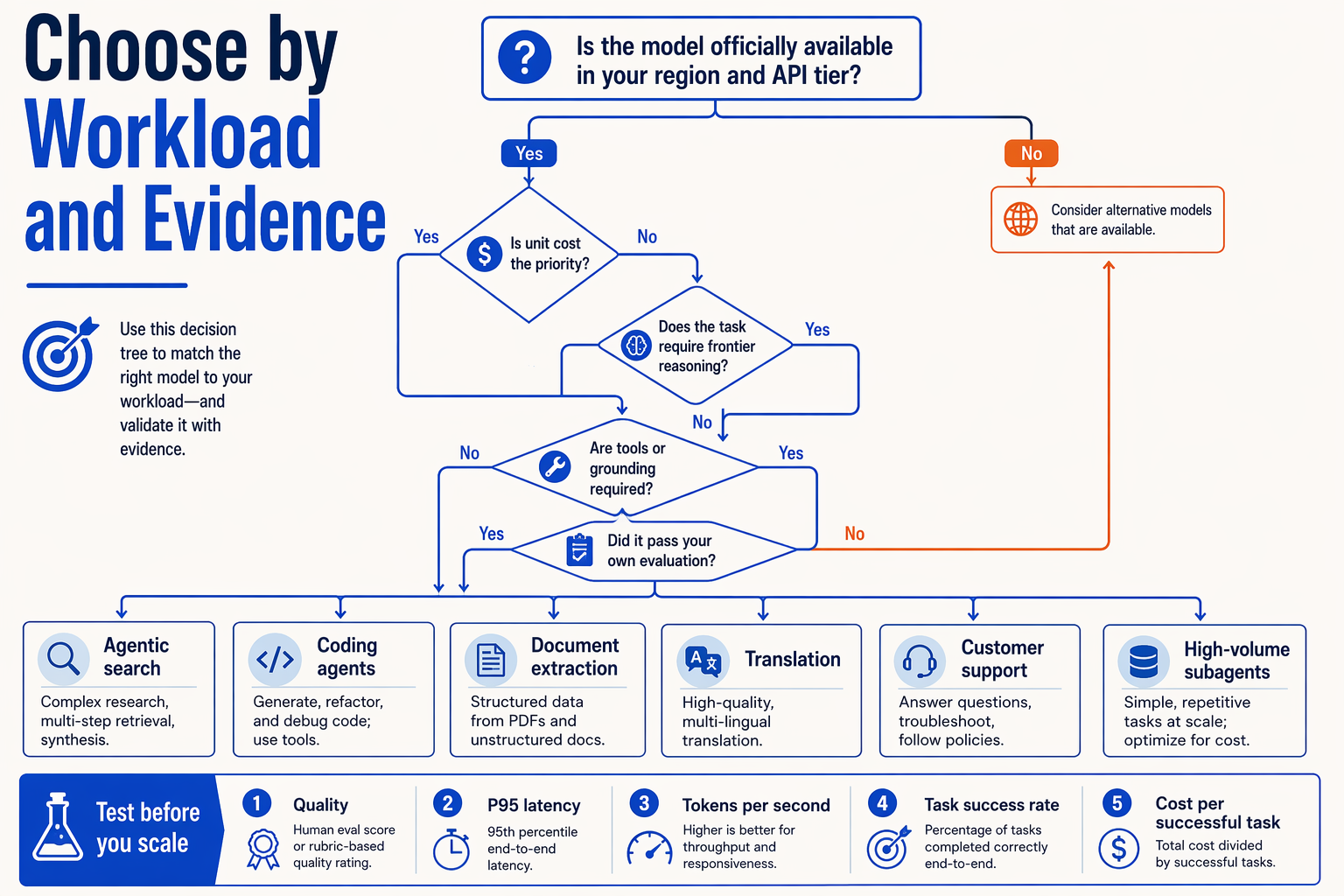
Gemini 3.5 Flash-Lite is the evidence-backed choice for document processing and high-volume automation, but its suitability for agentic search and coding requires private evaluation. GPT-5.6 Sol cannot receive a production recommendation because no supplied official OpenAI source confirms its availability, specifications, pricing, or capabilities as of July 21, 2026.
Workload-by-workload verdict
- Agentic search — evaluate Gemini privately: Google AI for Developers describes
gemini-3.5-flash-liteas optimized for subagent tasks and high-throughput execution. That supports potential roles such as query decomposition, classification, extraction, and orchestration, but it does not prove search grounding, citation fidelity, tool-call accuracy, or resistance to prompt injection. Teams should test their actual search provider, tool schemas, source-attribution requirements, latency, and end-to-end cost before deployment.
- Agentic search — GPT-5.6 Sol remains unverified: No supplied OpenAI model page, API documentation, system card, or pricing page confirms GPT-5.6 Sol’s web-search integration, function calling, citation behavior, or agent reliability. Describing GPT-5.6 Sol as a “frontier” search model would therefore be positioning speculation rather than a fact-checked conclusion.
- Coding — benchmark both on private repositories: Google’s documentation does not establish Gemini 3.5 Flash-Lite’s code quality, repository-level reasoning, or software-tool accuracy. Its low latency and subagent positioning may make it a candidate for bounded tasks, but teams should measure patch correctness, test pass rates, tool-call success, token consumption, and human-review time rather than assuming suitability for routine coding.
- Coding — do not infer GPT-5.6 Sol performance from its name: Without official OpenAI specifications or reproducible results on benchmarks such as SWE-bench Verified, GPT-5.6 Sol’s coding quality and cost per resolved issue cannot be compared factually.
Documents and production-scale automation
- Document processing — Gemini 3.5 Flash-Lite: Google AI for Developers explicitly identifies document processing as a target workload and describes Gemini 3.5 Flash-Lite as a low-latency, cost-effective multimodal model. This makes extraction, classification, summarization, translation, and structured-data transformation its clearest documented fit, subject to testing accuracy on real document layouts and languages.
- High-volume automation — Gemini 3.5 Flash-Lite: Google’s Gemini Developer API pricing documentation calls Gemini 3.5 Flash-Lite its “most cost-efficient GA model” and says it is optimized for high-volume agentic tasks, translation, and simple data processing. Google’s release notes likewise describe it as a highly cost-effective subagent option designed for high-volume automation.
- Adjustable reasoning: Google’s Interactions API documentation supports minimal, low, medium, and high thinking levels for
gemini-3.5-flash-lite, enabling teams to test latency, cost, and task quality at different reasoning budgets.
- Capacity needs account-level validation: Google’s rate-limit documentation lists 10,000,000 for Gemini 3.5 Flash-Lite, but organizations must verify the metric, tier, region, and limits applied to their own account before planning throughput.
Practical selection rule
Choose Gemini 3.5 Flash-Lite when the requirement is confirmed availability, multimodal document handling, translation, simple data processing, or high-volume automation. Platforms such as CallMissed’s OpenAI-compatible gateway can also help teams evaluate models behind a consistent integration. For agentic search and coding, run task-specific evaluations; reconsider GPT-5.6 Sol only after OpenAI publishes an exact model identifier, production terms, pricing, context limits, modalities, tool support, and reproducible quality evidence.
Frequently asked questions about Gemini 3.5 Flash-Lite vs GPT-5.6 Sol
Which model wins the Gemini 3.5 Flash-Lite vs GPT-5.6 Sol comparison?
Is GPT-5.6 Sol officially available through the OpenAI API?
What is Gemini 3.5 Flash-Lite designed for?
gemini-3.5-flash-lite as a low-latency, cost-effective multimodal model for subagent tasks and document processing. Google’s pricing documentation also positions it for high-volume agentic automation, translation, and simple data processing.What are the Gemini 3.5 Flash-Lite vs GPT-5.6 Sol prices?
Does Gemini 3.5 Flash-Lite support reasoning and AI agents?
How should developers evaluate GPT-5.6 Sol vs Gemini 3.5 Flash-Lite?
Conclusion
- Gemini 3.5 Flash-Lite is the practical choice today: Google confirms general availability and positions it for low-cost, high-throughput automation.
- GPT-5.6 Sol remains unverified: Without official OpenAI documentation, its availability, pricing, limits, and frontier capabilities cannot be compared responsibly.
- Production economics matter: Latency, throughput, token costs, tools, and workload-specific quality outweigh model-family branding.
- Watch next: OpenAI documentation could materially change this verdict.
Explore evolving multimodel communication infrastructure at CallMissed—then ask: is your model strategy built on verified evidence or speculation?
Related Reading
- Gemini 3.6 Flash vs GPT-5.6 Sol: Verified API, Pricing & Performance
- Gemini 3.5 Flash vs GPT-5.6 Terra: Flash-Lite API Comparison
- GPT-5.6 Sol vs Qwen3.8-Max: Verified July 2026 Comparison
Sources
Related Posts


Ready to automate customer conversations?
Launch AI voice agents and WhatsApp bots with CallMissed — one API, 22+ Indian languages.