

Claude Sonnet 5 vs Qwen3.8-Max: July 2026 Availability, Price and Benchmark Reality



Compare Claude Sonnet 5 vs Qwen3.8-Max on access, pricing, coding, context and deployment, with a clear guide to Qwen preview unknowns.
Claude Sonnet 5 vs Qwen3.8-Max: July 2026 Availability, Price and Benchmark Reality
A reported 2.4 trillion parameters may make Alibaba’s previewed Qwen3.8-Max sound like an automatic winner—but parameter count alone does not tell buyers which model will reason better, write safer production code, or cost less to run. This Claude Sonnet 5 vs Qwen3.8-Max comparison July 2026 separates confirmed product facts from preview-stage claims, because the gap between a headline model announcement and an independently testable API can be decisive for engineering teams.
The timing matters. Anthropic has made Claude Sonnet 5 commercially actionable now: Anthropic lists introductory Claude Sonnet 5 API pricing at $2 per million input tokens and $10 per million output tokens through August 31, 2026. Anthropic’s Claude Platform documentation also positions Sonnet 5 for reasoning, coding, multilingual work, long-context tasks, and agentic workflows, while its model-selection guidance says Sonnet-class models support an effort parameter that lets teams trade speed and cost against more intensive reasoning.
Qwen3.8-Max, by contrast, demands more caution. Alibaba’s newly previewed model is reported to use 2.4 trillion parameters, an extraordinary scale, but a parameter figure is not a benchmark score, an API availability guarantee, an open-weights license, or a published price. Until Alibaba publishes official model documentation, evaluation results, context-window limits, modality support, deployment terms, and rate-card details, those fields should be treated as unknowns—not assumptions.
That distinction matters because modern model selection is no longer a single leaderboard contest. A useful comparison must ask:
- Can developers access the model today through a stable API or downloadable weights?
- What does it cost at real input/output ratios, including long prompts and agent loops?
- Which benchmark results are official, independently reproduced, and disclosed with the exact test configuration?
- Does the model support the required context window, image inputs, tool use, coding environment, and language coverage?
- Can the organization meet its privacy, data-residency, and deployment requirements?
Anthropic’s official Claude Platform documentation states that the introductory Sonnet 5 rate ends on August 31, 2026, so price-sensitive teams should also plan for post-introductory economics rather than treating the launch rate as permanent. Likewise, a previewed Qwen3.8-Max should not be labeled “cheaper,” “open,” or “better at coding” before Alibaba substantiates those claims with a release and reproducible evidence.
This article examines the confirmed availability, pricing, context, agentic and coding claims around Claude Sonnet 5, then maps exactly what is—and is not—verifiable about Qwen3.8-Max in July 2026. For developers who need optionality while model releases move quickly, platforms such as CallMissed, the OpenAI-compatible AI gateway, reflect the broader shift toward accessing multiple AI models through one integration rather than rebuilding an application around every new launch.
Is Claude Sonnet 5 or Qwen3.8-Max the better choice in July 2026?
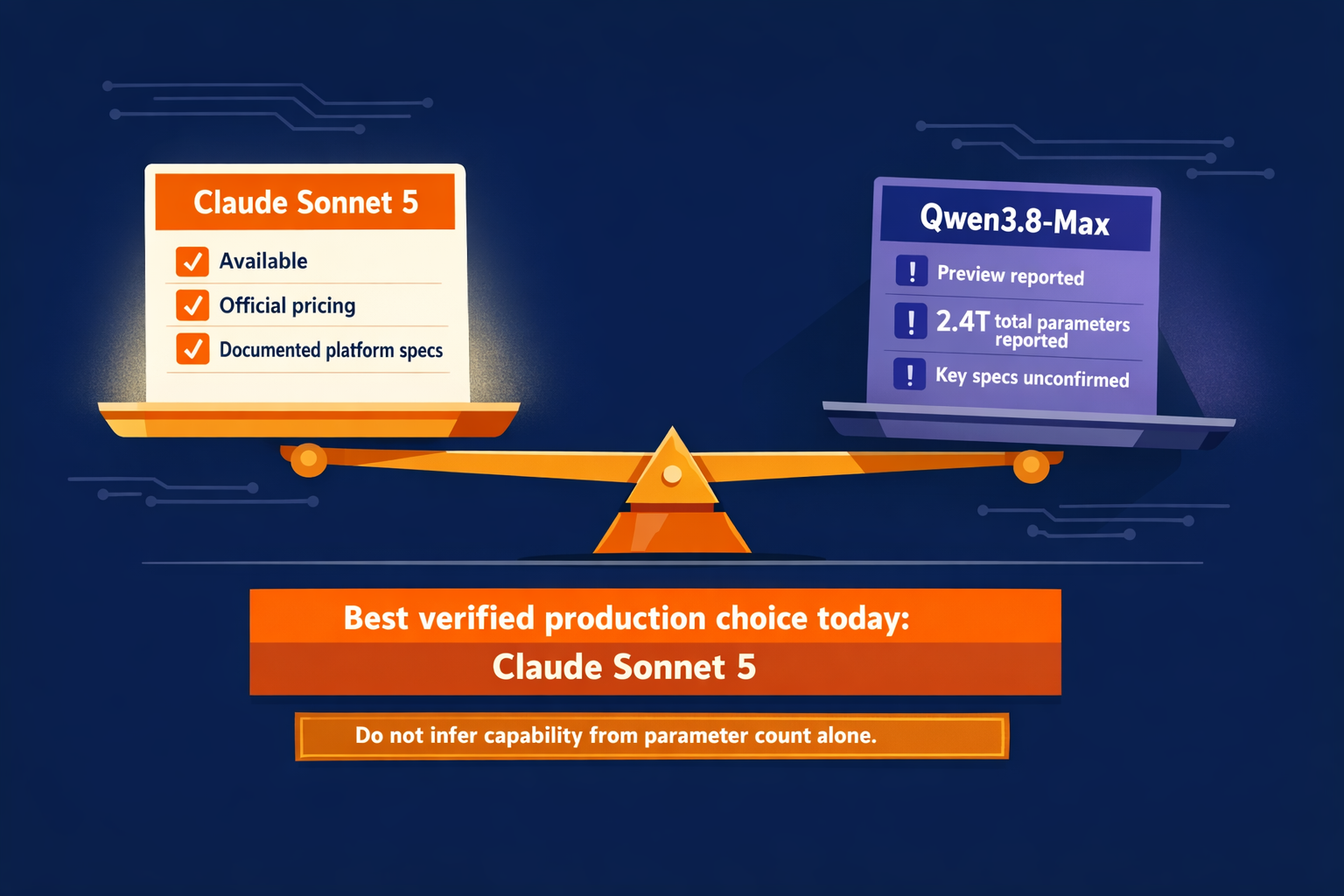
Claude Sonnet 5 is the better choice in July 2026 for teams that need a documented, production-accessible model today; Qwen3.8-Max is a model to monitor, not yet a model that can be responsibly declared better. Alibaba’s reported 2.4 trillion-parameter Qwen3.8-Max preview signals major ambition, but parameter count does not establish real-world reasoning quality, coding reliability, cost, latency, safety, or deployment readiness.
The July 2026 verdict: choose evidence over scale
Anthropic has published an actionable product path for Claude Sonnet 5, including API availability, use-case positioning, and a time-bounded price. Anthropic states that Claude Sonnet 5 costs $2 per million input tokens and $10 per million output tokens until August 31, 2026. Its Claude Platform documentation also identifies Sonnet 5 as a model for reasoning, coding, multilingual work, long-context workloads, and agentic applications.
For Qwen3.8-Max, the reported 2.4T parameter figure is not enough to fill in the operational details buyers need. As of July 2026, teams should not infer that Qwen3.8-Max has:
- A public API, stable SDK, or defined rate limits
- Downloadable open weights or a confirmed license
- Published input/output pricing
- A documented context window, vision capability, or tool-use interface
- Reproducible benchmark results with disclosed prompts and evaluation settings
- Enterprise privacy, data-handling, regional hosting, or self-deployment terms
Claude Sonnet 5 vs Qwen3.8-Max at a glance
| Decision factor | Claude Sonnet 5 | Qwen3.8-Max |
|---|---|---|
| Availability | Commercially actionable through Anthropic’s documented platform | Newly previewed; public production availability is unconfirmed |
| Published price | $2/M input and $10/M output tokens through August 31, 2026, according to Anthropic | Unknown |
| Reasoning and coding | Anthropic positions Sonnet 5 for reasoning, coding, and agentic work | No official, reproducible evidence supplied in the available preview context |
| Parameters | Anthropic’s model-selection decision should rely on workload evaluation, not parameter count alone | Reported at 2.4 trillion parameters; architecture and active-parameter details are unknown |
| Deployment and licensing | API product documentation is available | API, open-weights, and deployment terms remain unconfirmed |
Why 2.4 trillion parameters cannot decide the winner
A parameter total measures model capacity, not guaranteed task performance. Two models with different architectures can vary dramatically in how many parameters are active per token, how efficiently they retrieve information, how well they use tools, and whether they were trained for software engineering or multilingual dialogue.
For a coding agent, the more relevant measures are repository-level task completion, test-pass rate, tool-call accuracy, context retention, latency, and cost per completed task. For customer-facing AI, teams should evaluate instruction following, hallucination behavior, regional-language quality, and escalation reliability—not a single headline number.
Anthropic’s Claude Platform documentation adds a practical control: Sonnet-class models support an effort parameter, allowing teams to trade off response speed and cost against more intensive reasoning within the same model. That is an operational feature a buyer can test now; Qwen3.8-Max’s equivalent controls, if any, have not been confirmed.
A practical decision guide
- Choose Claude Sonnet 5 now if your project needs a documented API, known introductory pricing, and immediate evaluation for coding, reasoning, multilingual, or agentic workflows.
- Track Qwen3.8-Max if Alibaba’s eventual release could meet your requirements for deployment model, regional availability, pricing, or ecosystem fit.
- Do not commit based on parameters alone. Wait for Alibaba’s official documentation, exact model configuration, benchmark methodology, and commercial terms.
- Keep model portability in the architecture. Solutions such as CallMissed’s OpenAI-compatible AI gateway reflect a sensible strategy: use one integration to evaluate multiple LLM options as fast-moving releases become verifiable.
What is officially confirmed about Claude Sonnet 5 and Alibaba's Qwen3.8-Max preview?

As of July 20, 2026, Anthropic has officially documented Claude Sonnet 5 as an available model with published API pricing and platform capabilities, while Alibaba’s Qwen3.8-Max remains a reported preview with several critical specifications unconfirmed in official material provided for this comparison. The reported 2.4 trillion-parameter figure is noteworthy, but it does not establish real-world quality, availability, cost, or deployment options.
Claude Sonnet 5: confirmed product information
Anthropic’s public announcement and Claude Platform documentation provide a concrete starting point for evaluating Claude Sonnet 5:
- Availability: Anthropic presents Claude Sonnet 5 as a current Claude Platform model rather than a future research preview.
- Pricing: Anthropic states that Claude Sonnet 5 has introductory API pricing of $2 per million input tokens and $10 per million output tokens through August 31, 2026.
- Primary workloads: Anthropic’s model overview describes Claude Sonnet 5 as delivering top-tier results for reasoning, coding, multilingual tasks, long-context work, and agentic workflows.
- Reasoning control: Anthropic’s “Choosing the right model” documentation says Sonnet-class models support an effort parameter, allowing developers to tune the speed-and-cost trade-off within the same model.
- Context and agents: Anthropic’s model-selection documentation states that both relevant models in its current guidance support a 1 million-token context window. Teams should still confirm the applicable endpoint, beta status, and feature limits before deploying a production workload.
These are meaningful confirmations because they give engineering teams something operational: an API-access path, a dated rate card, documented capabilities, and implementation controls. They are not, however, proof that Sonnet 5 will win every benchmark or fit every data-governance requirement.
Qwen3.8-Max: what remains unverified
The key fact circulating about Alibaba Qwen3.8-Max is a reported 2.4 trillion parameters. Until Alibaba publishes a primary announcement, technical report, model card, API documentation, or downloadable release, that reported scale should be handled as a preview claim, not a completed product specification.
The following fields remain unknown based on the supplied official-source research:
- Public access: Whether Qwen3.8-Max is accessible through Alibaba Cloud, Qwen Chat, a stable developer API, or another channel.
- Open weights and license: A parameter count does not indicate whether weights will be released, under what license, or whether commercial self-hosting will be allowed.
- Pricing: There is no confirmed input-token, output-token, batch, caching, or enterprise rate card.
- Benchmarks: No official evaluation table, test configuration, prompt policy, or third-party reproduction has been supplied.
- Capabilities: Reasoning mode, coding performance, tool use, image and audio support, context-window size, and supported languages should all be marked unconfirmed.
- Privacy and deployment: Data retention, regional hosting, VPC deployment, on-premises support, and compliance documentation are not established by the reported preview.
Why 2.4 trillion parameters cannot decide the comparison
Parameter count measures model scale, not automatically usable intelligence. Architecture, active-versus-total parameters in mixture-of-experts systems, training data quality, post-training, inference-time reasoning, tool integration, latency, context handling, and evaluation methodology can all materially affect outcomes.
A large model may excel in some tasks yet be impractical if it lacks published pricing, predictable latency, or an accessible API. Conversely, Claude Sonnet 5’s confirmed commercial details make it easier to test now against a real workload. For developers seeking multi-model flexibility as Qwen’s release details emerge, CallMissed’s OpenAI-compatible AI gateway illustrates the value of integrating through a single interface rather than rebuilding an application around every fast-moving model announcement.
What are the key July 2026 developments for Claude Sonnet 5 and Qwen3.8-Max? (TABLE)
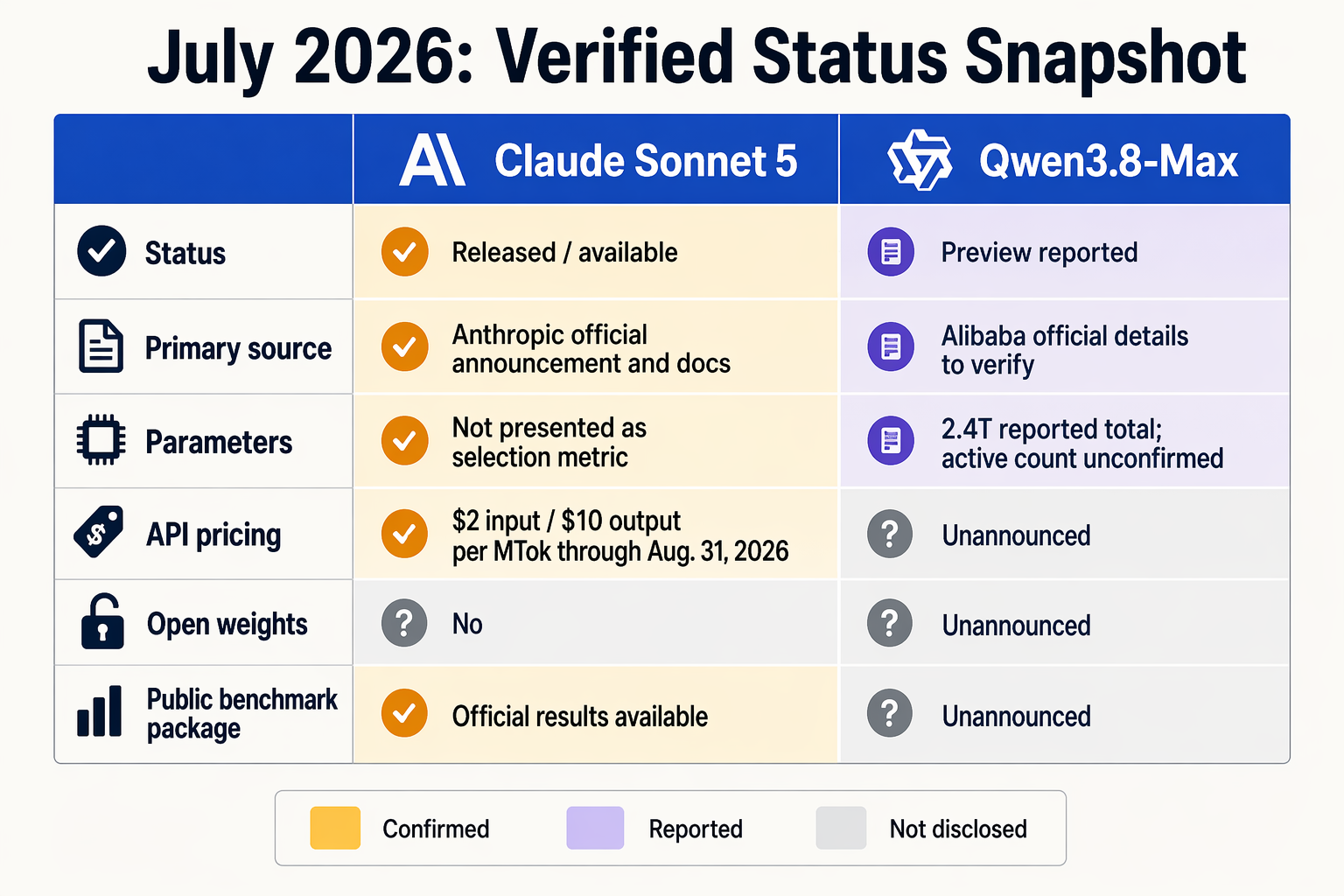
As of July 20, 2026, Claude Sonnet 5 is a documented, commercially available Anthropic model, while Qwen3.8-Max remains a reported Alibaba preview with a claimed 2.4 trillion parameters but without enough official technical disclosure for a like-for-like production comparison. The practical development is not simply model scale—it is the difference between an API teams can evaluate today and a model whose specifications, access terms, and test results still need confirmation.
| Area | Claude Sonnet 5 | Qwen3.8-Max | What it means for teams |
|---|---|---|---|
| July 2026 status | Anthropic officially introduced and documents Claude Sonnet 5. | Reported as an Alibaba preview. | Sonnet 5 can enter a controlled evaluation now; Qwen3.8-Max should remain on a watchlist until Alibaba publishes release details. |
| Parameter count | Anthropic has not presented parameter count as its primary selection metric in the cited documentation. | Reportedly 2.4 trillion parameters. | Parameters do not directly establish reasoning quality, coding accuracy, latency, context capacity, or cost. |
| API and pricing | Anthropic lists introductory pricing of $2 per million input tokens and $10 per million output tokens through August 31, 2026. | No verified API rate card in the available official context. | Teams can model Sonnet 5 spend today, but cannot responsibly label Qwen3.8-Max cheap or expensive yet. |
| Reasoning and coding | Anthropic’s Claude Platform documentation positions Sonnet 5 for reasoning, coding, multilingual work, long-context tasks, and agentic workflows. | No official Qwen3.8-Max benchmark suite or capability documentation is available in the provided research. | Evaluate Sonnet 5 against workload-specific tests; wait for reproducible Qwen evidence rather than inferring ability from scale. |
| Reasoning control | Anthropic says Sonnet-class models support an effort parameter to trade speed and cost for more intensive reasoning. | Unknown. | Effort controls can help production teams tune quality and latency by task type; Qwen3.8-Max’s equivalent controls are unconfirmed. |
| Open weights and deployment | The cited Anthropic materials describe platform access, not downloadable Sonnet 5 weights. | Open-weights status, license, self-hosting, and regional deployment options are unconfirmed. | Neither model should be assumed self-hostable based on current information. |
| Context and multimodality | Anthropic documents long-context and multimodal use cases, but teams should confirm exact limits and supported inputs in the current model documentation. | Context-window size and modality support are undisclosed in the available Qwen3.8-Max material. | These details can be decisive for document analysis, vision workflows, and tool-using agents. |
Why the 2.4T figure is not a verdict
A 2.4-trillion-parameter claim is significant because it signals Alibaba’s ambition to compete at the frontier. But parameter totals are an incomplete proxy: architecture, mixture-of-experts routing, training data, post-training, inference-time reasoning, tool-use reliability, quantization, and serving infrastructure all affect real-world results.
A model buyer should therefore ask for evidence that can be reproduced:
- Named benchmarks with test version, prompting method, and scoring rules.
- Coding-agent evaluations that report pass rate, tool environment, runtime, and cost.
- Latency and throughput at realistic prompt sizes—not only short benchmark prompts.
- Safety, privacy, and deployment documentation suited to the organization’s compliance requirements.
The immediate July 2026 takeaway
Anthropic’s official announcement gives Claude Sonnet 5 a concrete near-term advantage in procurement readiness: a documented product, stated introductory pricing, and configurable reasoning effort. Anthropic also states that the $2/$10 per-million-token introductory rate expires after August 31, 2026, so forecasts should include possible post-introductory pricing.
Qwen3.8-Max may become a major option once Alibaba releases official specifications and access pathways, but “previewed” should not be translated into “available,” “open,” or “benchmark-leading.” For teams maintaining flexibility as releases change, an OpenAI-compatible multi-model gateway such as CallMissed can reduce integration rework while evaluation evidence catches up with announcements.
How do availability, API access and open-weights options differ?

Claude Sonnet 5 is commercially usable through Anthropic’s documented platform in July 2026, while Qwen3.8-Max should be treated as a preview-stage, unverified option until Alibaba publishes official access, licensing and deployment documentation. The reported 2.4-trillion-parameter figure does not establish whether developers can call Qwen3.8-Max via an API, download weights, or run it in a private environment.
Availability and access at a glance
| Access question | Claude Sonnet 5 | Qwen3.8-Max | Buyer implication |
|---|---|---|---|
| Production API | Listed in Anthropic’s Claude Platform documentation | No official API endpoint or rate limits confirmed in the supplied research | Teams with immediate deadlines have clearer implementation information for Sonnet 5 |
| Public pricing | $2 input / $10 output per million tokens through August 31, 2026 | No official price card confirmed | Qwen3.8-Max total cost cannot yet be modeled |
| Downloadable open weights | Anthropic’s documentation presents Sonnet 5 as a hosted Claude Platform model, not a downloadable-weights release | No official weights release or license confirmed | Neither model should be assumed self-hostable |
| Private deployment terms | API usage and applicable Anthropic terms require review | No official deployment, data-handling or residency terms confirmed | Regulated buyers need written vendor terms before adopting either model |
Anthropic states that Claude Sonnet 5’s introductory API price is $2 per million input tokens and $10 per million output tokens until August 31, 2026. That creates a concrete, if time-limited, basis for estimating prompt, retrieval-augmented generation (RAG), and agent-loop spend. Anthropic’s Claude Platform model documentation is also the appropriate source for implementation details such as supported features and model-selection guidance.
By contrast, the Qwen3.8-Max situation is fundamentally an evidence problem. Reports describe Alibaba’s model as a 2.4-trillion-parameter preview, but the supplied research does not establish:
- an Alibaba Cloud Model Studio or other official API model ID;
- public availability date, regions, authentication method, quotas, or service-level commitments;
- input, output, cached-token, batch, or tool-use pricing;
- downloadable checkpoint files, a model card, or an open-weights license;
- data retention, training-use, privacy, data-residency, or enterprise deployment terms.
API access is not the same as open weights
An API model runs on the provider’s infrastructure: developers send prompts, receive outputs, and pay per usage. This route can accelerate adoption because the provider operates the inference stack, updates and safety controls. It can also limit control over model versioning, data location, custom fine-tuning, and offline operation.
Open weights mean an organization can obtain model parameters under a stated license and run them on compatible infrastructure. Even then, “open weights” is not synonymous with unrestricted commercial use: teams must inspect the license, acceptable-use terms, redistribution conditions, and any requirements tied to hosted derivatives.
Anthropic’s official Claude Platform materials position Claude Sonnet 5 as an API-accessible model family; they do not, in the supplied documentation, announce Sonnet 5 downloadable weights. For Qwen3.8-Max, buyers should not infer an open release from Alibaba’s earlier Qwen ecosystem or from the model’s parameter count. A new model requires its own release terms.
Practical decision guide
- Choose Claude Sonnet 5 for an immediate API evaluation when documented pricing and platform guidance matter more than self-hosting.
- Put Qwen3.8-Max on a watchlist if its reported scale is strategically interesting, but do not commit architecture or budget until Alibaba publishes first-party specifications.
- Require a deployment checklist for either model: data-processing terms, geographic availability, retention controls, version pinning, rate limits, and exit options.
- Avoid treating “2.4T parameters” as an access advantage. A model’s usable value depends on the API, license, latency, reliability, cost and governance controls available to the team—not parameter count alone.
How do reasoning, coding, agents, multimodality and context window compare? (TABLE)
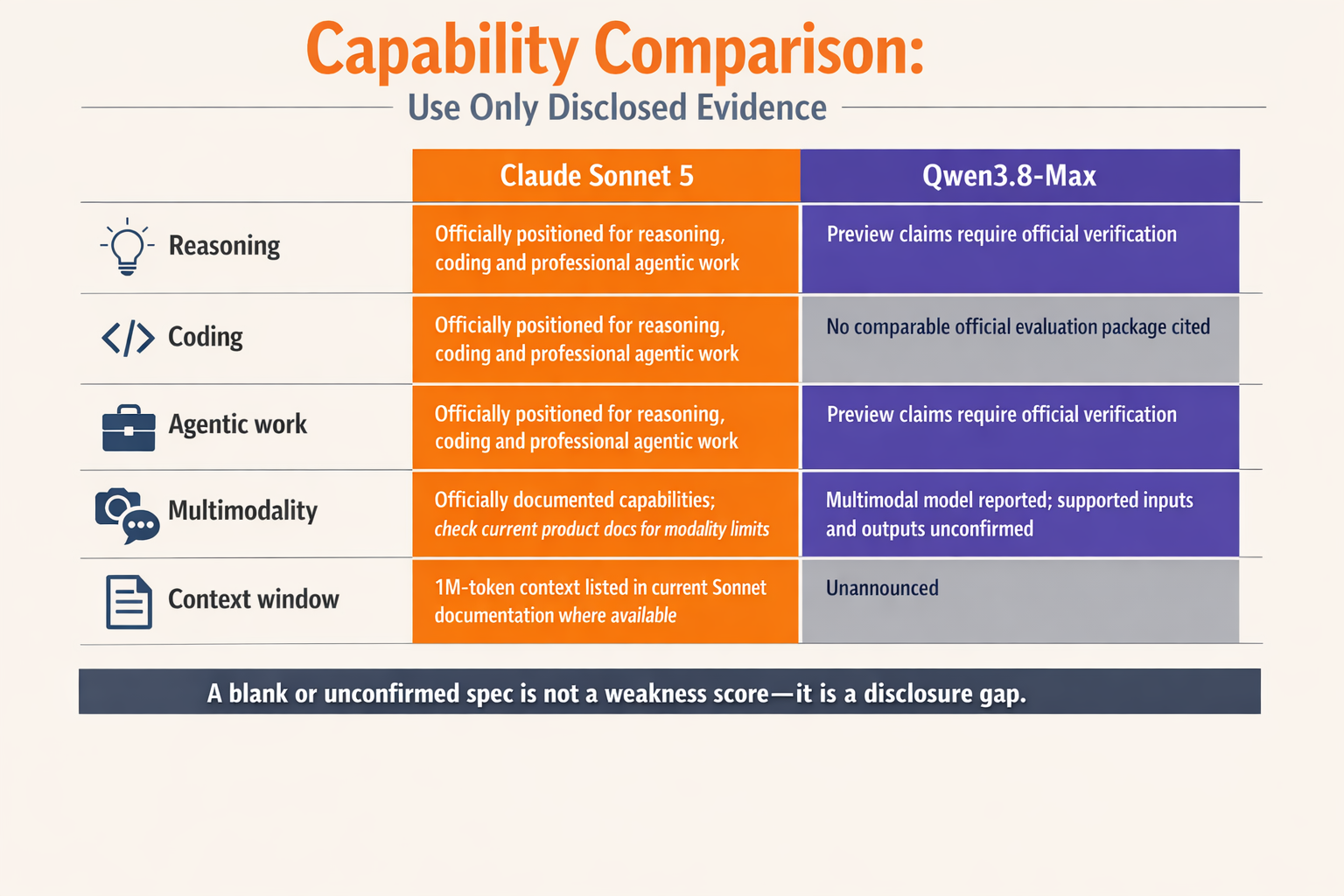
Claude Sonnet 5 is the more verifiable choice for reasoning, coding and agent workflows in July 2026 because Anthropic documents its capabilities and controls today. Qwen3.8-Max may prove highly capable after release, but Alibaba’s reported 2.4-trillion-parameter preview does not yet establish its context length, modalities, tool use, coding results or agent reliability.
| Capability | Claude Sonnet 5 | Qwen3.8-Max | What buyers can conclude in July 2026 |
|---|---|---|---|
| Reasoning controls | Anthropic’s Claude Platform documentation says Sonnet-class models support an effort parameter, allowing teams to trade response speed and cost for more intensive reasoning. | No official reasoning-mode, test-time-compute, or controllability documentation has been provided in the available Qwen3.8-Max preview information. | Claude offers a documented runtime control; Qwen3.8-Max reasoning behavior remains unverified. |
| Coding | Anthropic describes Claude Sonnet 5 as delivering top-tier results for coding and professional work, and positions it for production-oriented development tasks. | No official coding benchmark table, software-engineering evaluation configuration, or API trial is available for Qwen3.8-Max. | Do not infer coding leadership from the reported parameter count. Test Qwen only after reproducible evaluations are published. |
| Agentic workflows | Anthropic calls Claude Sonnet 5 its “most agentic Sonnet yet,” while its model documentation identifies Sonnet 5 for agentic workflows. | No confirmed tool-calling schema, computer-use support, agent framework integration, or tool-use benchmark has been published for Qwen3.8-Max. | Claude has a documented agent positioning; Qwen3.8-Max agent readiness is an open question. |
| Context window | Anthropic’s model-selection documentation says the relevant Claude models support a 1 million-token context window. | No official maximum context-window figure has been disclosed for Qwen3.8-Max. | Long-document and repository-scale use cases can be scoped around Claude now; Qwen’s fit cannot yet be calculated. |
| Multimodality | Anthropic lists Sonnet 5 for multilingual and long-context tasks, but teams should confirm the exact input/output modalities in the current Claude API documentation for their workflow. | No official confirmation of image, audio, video, document, or other modality support has been supplied for Qwen3.8-Max. | “Multimodal” should not be assumed for the previewed Qwen model without a model card or API specification. |
| Published evidence | Anthropic has published product and platform documentation covering Sonnet 5’s intended reasoning, coding, multilingual, long-context and agentic roles. | The 2.4 trillion parameters figure is a reported preview claim; it is not a substitute for disclosed benchmarks, model-card details, or independent replication. | Documentation and reproducibility matter more than scale headlines when selecting a production model. |
Why parameters do not decide reasoning quality
A parameter count measures model scale, not the full system that users experience. Training-data quality, architecture, mixture-of-experts routing, post-training, reinforcement learning, inference-time reasoning, tool integration, context management and safety tuning can all materially change outcomes.
That is why a 2.4-trillion-parameter claim cannot answer practical questions such as:
- Can the model resolve a multi-file pull request correctly?
- Does it reliably call tools over a 20-step customer-support workflow?
- How does accuracy change with a 100,000-token document set?
- What are latency, rate limits, regional availability and total token costs?
- Can an enterprise deploy it under its privacy and data-governance requirements?
Practical interpretation for engineering teams
Anthropic’s official documentation makes Claude Sonnet 5 suitable for teams that need to evaluate a model now, particularly where configurable reasoning effort, coding, long-context analysis and agent workflows are requirements. Anthropic’s stated 1 million-token context support is especially relevant for large codebases, policy libraries and lengthy research corpora.
For Qwen3.8-Max, the responsible position is watchlist, not verdict. Wait for Alibaba to publish the API or weights status, supported modalities, context limit, benchmark methodology, deployment terms and pricing. Once those details exist, run the same task set, prompt format and cost model against both systems rather than treating parameter count as a winner declaration.
Why can't 2.4 trillion parameters or early benchmark claims decide the winner?

No—neither a reported 2.4 trillion-parameter total nor launch-stage benchmark headlines can establish that Qwen3.8-Max is better than Claude Sonnet 5 for a real workload. Parameters measure model scale, while production value depends on architecture, training, inference configuration, tool reliability, cost, safety behavior, and independently reproducible task results.
Parameters are not a direct capability score
Alibaba’s previewed Qwen3.8-Max is reported to contain 2.4 trillion parameters, but that figure alone leaves critical engineering questions unanswered. For mixture-of-experts (MoE) models especially, teams need to know not only total parameters but also how many parameters are activated per token, routing behavior, memory requirements, latency, and serving hardware.
A larger parameter count can support greater representational capacity, but it does not reveal:
- Whether the model is dense or MoE, or its active-parameter count.
- The quality, freshness, licensing, and multilingual breadth of training data.
- Post-training quality: reinforcement learning, instruction tuning, tool-use training, and safety alignment.
- Whether the model maintains accuracy across long contexts, multi-step agent loops, or adversarial inputs.
- API throughput, rate limits, uptime, caching options, and actual cost per completed task.
This is why “2.4 trillion parameters” should be treated as a scale signal, not a purchasing verdict. Until Alibaba releases official Qwen3.8-Max technical documentation, its architecture, active compute, context window, supported modalities, API terms, open-weights status, and production pricing remain unknown.
Early benchmarks need configuration, not just a score
Benchmark claims are useful only when readers can inspect how the result was produced. A model can score differently based on prompt format, few-shot examples, chain-of-thought or tool access, sampling settings, test-set filtering, and whether the evaluation used a base model or a specialized reasoning mode.
Before treating an early Qwen3.8-Max result as decisive, ask for:
- The exact benchmark version and evaluation date. Older test sets may be present in web-scale training data or optimized heavily during post-training.
- A reproducible configuration. Reports should disclose model version, temperature, token budget, system prompt, tool access, and number of runs.
- Comparable conditions. Claude Sonnet 5 and Qwen3.8-Max must use the same task definition, language, budget, and scoring method.
- Real-task validation. Repository-level bug fixing, retrieval accuracy, customer-support resolution, and structured-output reliability often matter more than a single aggregate leaderboard.
Anthropic’s official Claude Platform documentation positions Claude Sonnet 5 for reasoning, coding, multilingual tasks, long-context work, and agentic workflows, while Anthropic’s model-selection guidance says Sonnet-class models offer an effort parameter to trade speed and cost for more intensive reasoning. Those are actionable product claims—but they still require evaluation against a team’s own prompts and acceptance criteria.
What a defensible July 2026 decision looks like
For now, Claude Sonnet 5 has a clearer commercial baseline: Anthropic lists introductory pricing of $2 per million input tokens and $10 per million output tokens through August 31, 2026. Qwen3.8-Max may prove highly capable after release, but preview claims cannot yet establish its cost-performance ratio or deployment fit.
The practical winner is the model that passes a controlled pilot on your data. Test both—once Qwen3.8-Max is officially accessible—on multilingual quality, tool-call success, coding tests, long-document accuracy, latency, and total token spend. For teams that want to keep that evaluation portable, CallMissed’s OpenAI-compatible AI gateway represents the growing multi-model approach: one integration can support model comparison without making every application dependent on a single provider.
How do pricing, privacy and deployment trade-offs affect the comparison?
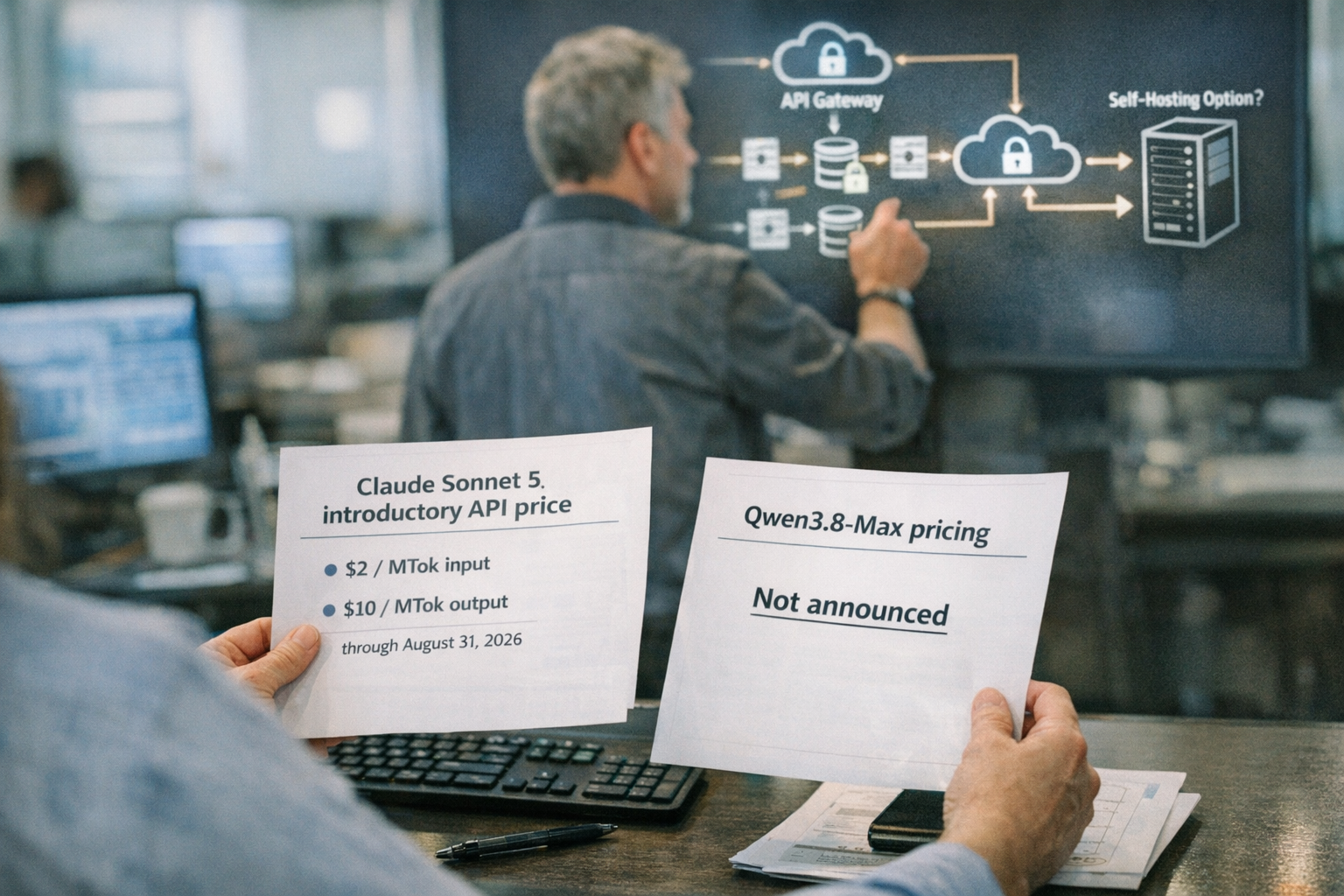
Claude Sonnet 5 has a published, time-bounded API price today, while Qwen3.8-Max cannot yet be evaluated on total cost of ownership, privacy controls, or deployment flexibility because Alibaba has not published official commercial terms for the preview. For procurement teams, that makes Sonnet 5 the measurable option in July 2026—not necessarily the universally better model.
Pricing: model rates matter less than workload shape
Anthropic lists introductory Claude Sonnet 5 pricing at $2 per million input tokens and $10 per million output tokens through August 31, 2026, according to Anthropic’s Sonnet 5 announcement and Claude Platform documentation. The 5:1 output-to-input price ratio means agentic and coding workloads—which can generate long tool plans, patches, and explanations—may cost materially more than retrieval-heavy chat.
For example, at the introductory rate:
- 1 million input tokens + 1 million output tokens costs $12.
- 10 million input tokens + 1 million output tokens costs $30.
- A high-output workflow should measure completion length, retries, tool-call loops, and human-review rates—not just the advertised per-token rate.
Anthropic’s Claude Platform documentation also says Sonnet-class models support an effort parameter, enabling teams to trade speed and cost against more intensive reasoning. A sensible rollout tests low, medium, and high effort on real tasks, then compares cost per successful outcome rather than cost per request.
By contrast, the reported 2.4 trillion-parameter Qwen3.8-Max preview has no confirmed API price, input/output rate, batch rate, caching policy, free allowance, or post-preview pricing in the official material available for this comparison. It should therefore be marked pricing unknown, rather than assumed inexpensive because it comes from Alibaba or assumed expensive because of its reported scale.
Privacy and deployment: require contractual evidence
Privacy requirements often decide a model choice before benchmark scores do. Teams handling customer conversations, source code, health information, financial records, or India-specific personal data should verify the following for each deployment route:
- Data retention: Are prompts and outputs retained, and for how long?
- Training use: Is customer data excluded from model training by default or contract?
- Data residency: Which regions process and store data?
- Access controls: Are encryption, audit logs, role-based access, and enterprise identity controls available?
- Deployment: Is the model API-only, available through a cloud marketplace, deployable in a private environment, or released as downloadable weights?
Anthropic’s supplied Sonnet 5 materials establish a commercially usable API and price, but buyers should still obtain the applicable Anthropic privacy documentation, data-processing agreement, and regional service terms before sending regulated data. A stable API does not automatically answer residency or retention questions.
For Qwen3.8-Max, API availability, open-weight status, license terms, self-hosting feasibility, and data-handling commitments remain unverified preview-stage fields. Do not confuse the wider Qwen ecosystem’s history of releases with a confirmed right to download, fine-tune, or privately deploy this specific model.
Practical decision rule
Choose Claude Sonnet 5 when a team needs a published API rate and can evaluate production economics before the introductory pricing ends on August 31, 2026. Keep Qwen3.8-Max on an evaluation watchlist until Alibaba releases official access, pricing, privacy, and deployment documentation; only then can organizations compare the real trade-off between vendor-managed convenience, data governance, and potential infrastructure control.
What do official sources and independent researchers say—and which claims need caution?
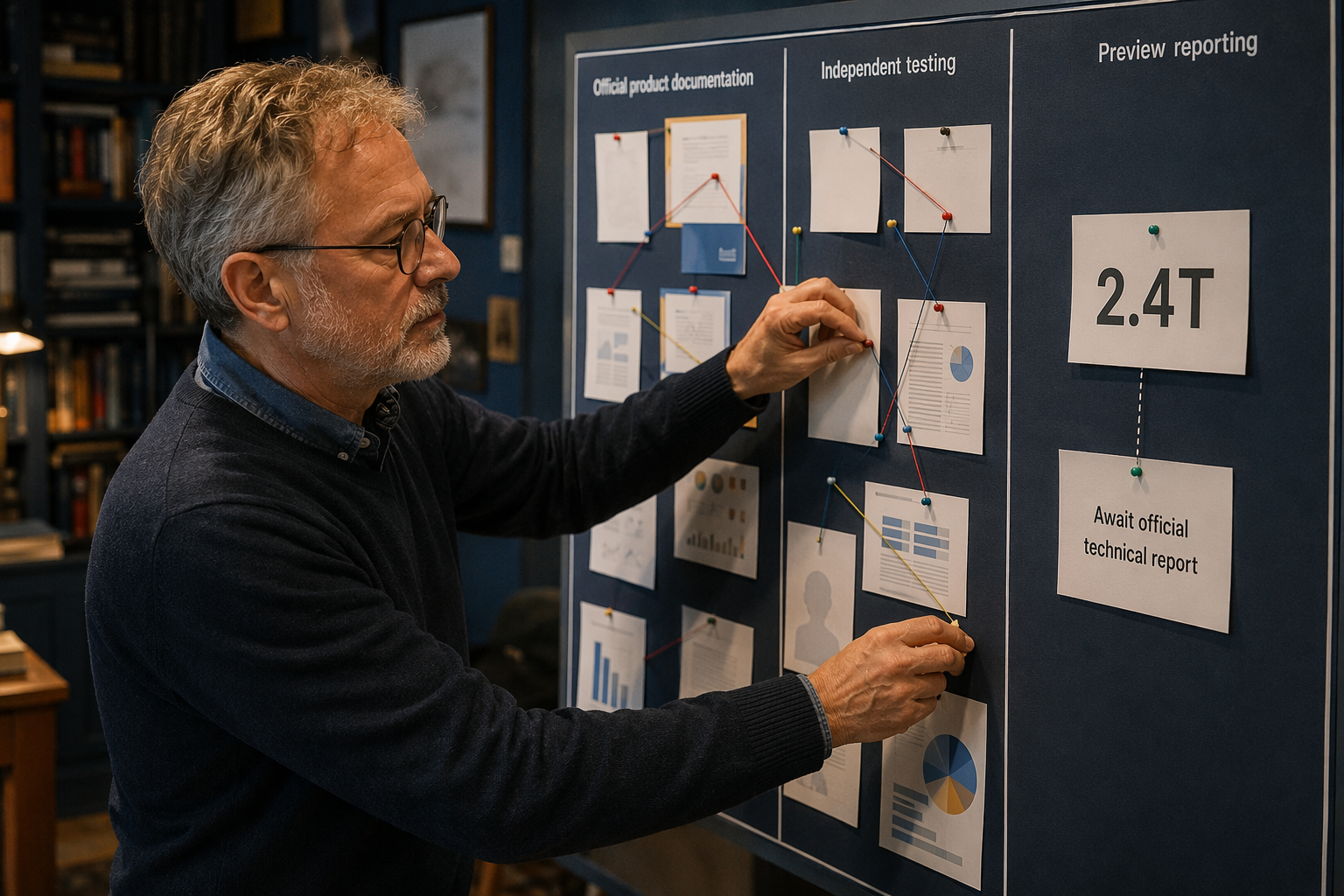
Official Anthropic documentation makes Claude Sonnet 5’s commercial terms and intended capabilities verifiable in July 2026; Qwen3.8-Max’s reported 2.4 trillion parameters remain a preview-stage claim that requires an Alibaba primary-source release and independent reproduction before teams can treat it as a purchasing signal.
What Anthropic officially documents
Anthropic’s Claude Platform documentation lists Claude Sonnet 5 as available with introductory API pricing of $2 per million input tokens and $10 per million output tokens until August 31, 2026. Anthropic also describes Sonnet 5 as a model for reasoning, coding, multilingual tasks, long-context work, and agentic workflows.
Several official statements are actionable, but should still be read as vendor claims rather than universal proof:
- Anthropic calls Claude Sonnet 5 its “most agentic Sonnet yet” for coding and professional work in its July 2026 product messaging.
- Anthropic’s model-selection documentation says Sonnet-class models support an effort parameter, allowing developers to choose a lower- or higher-effort reasoning configuration according to latency and cost needs.
- Anthropic’s published introductory price has an explicit expiry date: August 31, 2026. Any total-cost model should therefore include a scenario for post-introductory pricing.
Official documentation is the right source for API availability, supported product features, rate-card terms, and configuration controls. It is not, on its own, sufficient evidence that Claude Sonnet 5 will outperform every alternative on a company’s codebase, languages, tools, or safety requirements.
What remains unverified for Qwen3.8-Max
The 2.4 trillion-parameter figure reported for Alibaba’s previewed Qwen3.8-Max is notable, but it does not yet answer the implementation questions a production team needs answered. As of July 2026, the comparison should label the following items unknown unless Alibaba publishes primary documentation:
- Availability: Whether Qwen3.8-Max is broadly API-accessible, limited to a preview, region-restricted, or available through a specific Alibaba Cloud service.
- Access model: Whether Alibaba will release open weights, offer only hosted inference, or use a mixed licensing approach.
- Technical specifications: The architecture, active-versus-total parameters if it uses mixture-of-experts routing, context window, supported languages, image/audio capabilities, tool use, and structured-output support.
- Economics and operations: Token pricing, rate limits, batching, prompt-caching terms, data-retention policy, deployment regions, and enterprise controls.
- Performance evidence: Exact benchmark scores, prompts, inference settings, test dates, and independently reproducible evaluations.
Why independent evaluation matters
Parameter count is an incomplete proxy for real-world quality. A 2.4 trillion-parameter model may use sparse routing, meaning only a portion of its parameters are active for a given token; moreover, data quality, post-training, tool-use reliability, inference-time reasoning, and serving infrastructure can materially affect results.
Independent researchers should disclose more than a headline score. A credible Claude Sonnet 5 vs Qwen3.8-Max evaluation needs:
- the exact model version and API date;
- benchmark version and contamination safeguards;
- temperature, reasoning/effort settings, and tool configuration;
- latency, failure rate, and cost per completed task; and
- representative tests from the buyer’s own domain.
For teams avoiding premature lock-in, CallMissed’s OpenAI-compatible AI gateway illustrates a practical multi-model strategy: preserve a stable integration layer while model availability, pricing, and independently validated performance change.
Which model should you choose for coding, enterprise agents, research or future Qwen evaluation? (TABLE)
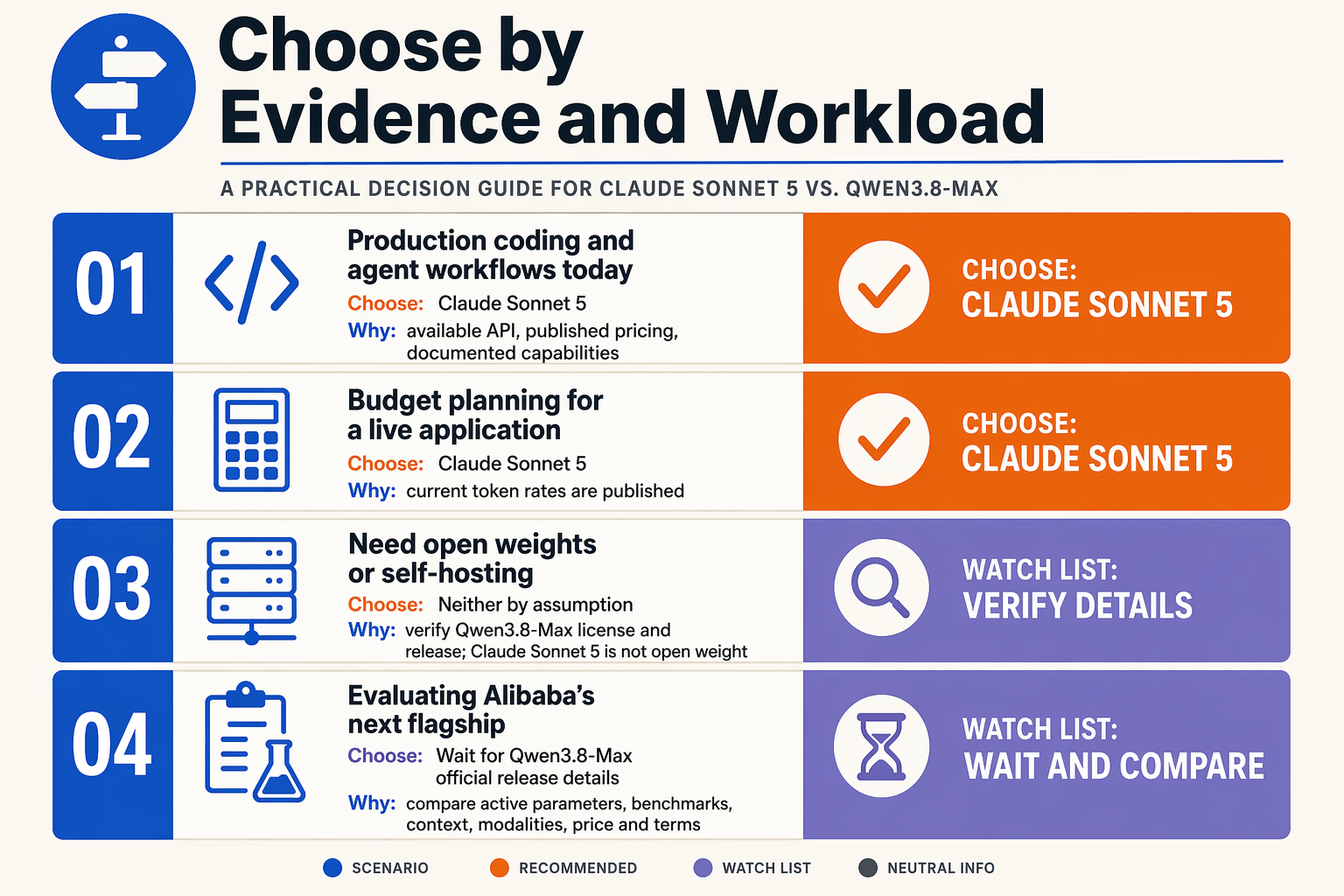
Choose Claude Sonnet 5 for documented, deployable workflows now. Treat Qwen3.8-Max only as a preview-evaluation candidate until Alibaba publishes official production availability, pricing, architecture, context limits, licensing or deployment terms, and reproducible benchmarks. That is the practical conclusion of this Claude Sonnet 5 vs Qwen3.8-Max comparison as of July 2026.
| Workload or requirement | Choose now | When to consider Qwen3.8-Max | Why |
|---|---|---|---|
| Production coding | Claude Sonnet 5 | After production access and coding evaluations are documented | Sonnet 5 has vendor-published access, pricing, and integration documentation. Qwen3.8-Max lacks enough official evidence for a production decision. |
| Enterprise agents | Claude Sonnet 5 | After Alibaba documents API behavior, tool use, rate limits, security controls, and support | Agent reliability depends on operational controls and recovery behavior—not parameter-count claims. |
| Research synthesis | Claude Sonnet 5, with source verification | When context limits, citation or tool capabilities, and benchmark methods are public | Neither vendor claims nor leaderboard scores remove the need to verify research outputs against primary sources. |
| Budget-sensitive pilot | Claude Sonnet 5 under the published introductory offer | After official Qwen pricing permits a like-for-like cost test | Anthropic lists introductory Sonnet 5 pricing of $2/MTok input and $10/MTok output through August 31, 2026. Future Sonnet pricing and Qwen3.8-Max pricing must be checked separately. |
| Private or on-premises deployment | Verify Anthropic’s applicable terms | Only after Alibaba publishes weights, licensing, hardware requirements, and deployment rights | Do not infer that Qwen3.8-Max will be downloadable, openly licensed, or suitable for private deployment. |
| Future model evaluation | Use Claude Sonnet 5 as a documented baseline | Yes—preview evaluation only | Qwen3.8-Max may merit testing, but not production pre-selection, until its identity and capabilities are officially documented. |
What is established and what remains a vendor claim
For Claude Sonnet 5, Anthropic’s documentation establishes the commercial facts it controls: model access, API guidance, stated product features, and the introductory price schedule. Anthropic also positions Sonnet 5 for coding, reasoning, multilingual, long-context, and agentic work. Those capability descriptions are vendor claims, not independent proof that the model will outperform alternatives on a particular repository or business process.
For Qwen3.8-Max, reported details—including the frequently cited 2.4 trillion-parameter figure—should not be treated as independently established unless Alibaba publishes a model card, technical report, API or weight documentation, and reproducible evaluation results for the exact model version. Parameter count alone does not establish coding accuracy, latency, tool-use reliability, security, context quality, or operating cost.
This evidence gap is central to the Claude Sonnet 5 vs Qwen3.8-Max comparison: one model can currently be assessed against published commercial documentation, while the other should remain in a controlled preview track.
Decision guide by workload
For production coding, choose Claude Sonnet 5 when the team needs a documented integration path today. Do not rely solely on Anthropic’s coding claims. Test the model on representative repositories and measure:
- build and test pass rates;
- accepted patches versus reverted patches;
- security findings and dependency mistakes;
- review time and human rework;
- latency, token consumption, and total cost per completed task.
For enterprise agents, prefer the model for which access terms and operational behavior can be tested before launch. Anthropic documents controls for adjusting reasoning effort on supported Sonnet workflows, but teams should validate their effect on quality, latency, and cost. A production agent evaluation should also cover:
- tool-call accuracy and recovery from failed calls;
- resistance to prompt injection in retrieved content;
- authorization boundaries and handling of sensitive data;
- consistency across long, multi-step sessions;
- audit logs, retention, regional processing, uptime, and support terms.
Do not select Qwen3.8-Max for an enterprise agent based on scale reports or preview demonstrations. Wait for Alibaba to document production endpoints, tool interfaces, quotas, data handling, security controls, and contractual terms.
For research and analysis, Claude Sonnet 5 is the actionable option when outputs are checked against primary sources. Model-generated citations and summaries should never be assumed accurate. Qwen3.8-Max becomes comparable only after Alibaba specifies its context window, supported modalities, retrieval or tool capabilities, and benchmark methodology.
A rigorous Qwen3.8-Max preview evaluation
Once authorized access and adequate documentation exist, run the Claude Sonnet 5 vs Qwen3.8-Max comparison on your own workload:
- Confirm the exact model name, version, endpoint, release status, and terms of use.
- Build a blinded task set covering coding, agents, multilingual work, and document analysis.
- Use identical prompts, tools, context, stopping rules, and scoring criteria where the APIs permit.
- Measure factual accuracy, test-pass rate, tool success, latency, token use, and human rework.
- Repeat tasks to measure variance rather than reporting only the best response.
- Calculate end-to-end cost, including retries, agent loops, long prompts, storage, and review labor.
- Record vendor-reported benchmark results separately from independently reproduced results.
- Approve production use only after security, privacy, licensing, reliability, and support reviews.
Anthropic’s published $2/MTok input and $10/MTok output introductory offer is scheduled to end on August 31, 2026, so buyers should not assume that rate will continue. Model post-offer costs separately and verify the current terms before procurement.
The defensible July 2026 recommendation is therefore straightforward: deploy and evaluate Claude Sonnet 5 where a documented model is required now; keep Qwen3.8-Max limited to preview evaluation until Alibaba publishes the information needed for a reproducible technical and commercial decision.
Frequently asked questions about Claude Sonnet 5 vs Qwen3.8-Max
What is the main difference in the Claude Sonnet 5 vs Qwen3.8-Max comparison July 2026?
Is Claude Sonnet 5 available through an API, and is Qwen3.8-Max available yet?
What is Claude Sonnet 5 pricing compared with Qwen3.8-Max pricing?
Does Qwen3.8-Max’s reported 2.4 trillion parameter count make it better than Claude Sonnet 5?
Which model is better for coding, reasoning, and AI agents in July 2026?
What should enterprises verify before choosing Claude Sonnet 5 or Qwen3.8-Max?
Conclusion
In July 2026, Claude Sonnet 5 is the actionable choice for teams that need a documented API, published introductory pricing, and production-oriented capabilities today, while Qwen3.8-Max remains a high-interest preview whose reported 2.4 trillion parameters require official validation before procurement decisions.
- Availability matters more than scale alone: Anthropic documents Claude Sonnet 5 for reasoning, coding, multilingual tasks, long-context work, and agentic workflows; Qwen3.8-Max still needs confirmed API, weights, and deployment terms from Alibaba.
- Price is currently measurable for Sonnet 5: Anthropic lists $2 per million input tokens and $10 per million output tokens through August 31, 2026—but teams should model pricing beyond the introductory period.
- Benchmarks need reproducibility: A parameter count is not evidence of better coding, reasoning, safety, or tool use. Buyers should require disclosed test configurations and independent replication.
- Operational fit decides the winner: Context limits, multimodality, privacy controls, data residency, and stable rate limits can outweigh leaderboard results for real applications.
Watch for Alibaba’s official Qwen3.8-Max documentation, pricing, context-window details, licensing, and independently testable evaluations. To explore how multi-model AI communication is evolving, check out CallMissed, an AI infrastructure platform powering voice agents and multilingual chatbots for businesses. Will your next model decision be driven by a headline—or by evidence you can deploy and measure?
Related Reading
- Best AI Models of July 2026: Grok 4.5 vs GPT-5.6 vs Claude Sonnet 5
- Anthropic's Claude Sonnet 5 Undercuts GPT-5.5 on Price: The 2026 AI Agent Price War Is Here
- Claude Sonnet 5 vs GPT-5.6: July 2026 Verification Guide
Sources
Related Posts



Ready to automate customer conversations?
Launch AI voice agents and WhatsApp bots with CallMissed — one API, 22+ Indian languages.