

CallMissed Call Routing: Buyer and Setup Guide for AI Business Phone Numbers


Learn how CallMissed call routing turns an AI business phone number into reliable AI voice agent routing for hours, teams, overflow, and testing.
CallMissed Call Routing: Buyer and Setup Guide for AI Business Phone Numbers
What happens when a customer calls after hours and your “smart” business number has nowhere intelligent to send them? CallMissed call routing turns an AI business phone number into an operational system: calls can reach an AI voice agent, follow business-hour rules, move between departments, trigger overflow paths, or capture structured follow-up details instead of falling into a generic voicemail box.
The timing matters because customer expectations and workplace AI adoption are converging. Salesforce’s 2023 State of the Connected Customer reported that 77% of customers expect to interact with someone immediately when they contact a company. Meanwhile, Microsoft and LinkedIn’s 2024 Work Trend Index found that 75% of knowledge workers already used AI at work. For businesses, the practical question is no longer simply whether to adopt AI; it is how to design reliable AI voice agent routing without creating dead ends, confusing transfers, or compliance risks.
A phone number alone does not solve that problem. Effective routing requires decisions about who—or what—answers each call, how intent is identified, when a conversation should escalate, and what happens when every preferred destination is unavailable. Platforms such as CallMissed combine business phone numbers with AI voice agents and omnichannel customer-engagement workflows, making routing design part of the deployment rather than a separate telephony project.
This buyer and setup guide will explain how to:
- Choose and purchase a suitable number, while checking geographic availability, identity-verification requirements, inbound capabilities, and any local calling restrictions.
- Assign an AI voice agent with the correct language, knowledge base, greeting, actions, transfer rules, and escalation boundaries.
- Configure business-hours and after-hours routing, including holidays, time zones, emergency exceptions, and scheduled callbacks.
- Build department paths for sales, support, billing, appointments, or regional teams without forcing every caller through a long menu.
- Define overflow logic when an agent, department, or human operator cannot answer.
- Replace passive voicemail with AI-assisted message capture, qualification, summaries, tickets, or callback requests.
- Test caller identification, audio quality, latency, transfers, failure paths, language handling, and analytics before publishing the number.
- Confirm recurring number charges, call rates, AI usage, transfers, recordings, taxes, and other costs before committing.
The emphasis is deliberately on routing design and day-to-day operations, not merely the mechanics of buying a number. By the end, you will have a practical framework for evaluating an AI business phone number and a deployment checklist for ensuring every call has a defined destination—even outside office hours or during unexpected demand.
How do you set up CallMissed call routing from number purchase to live operation?
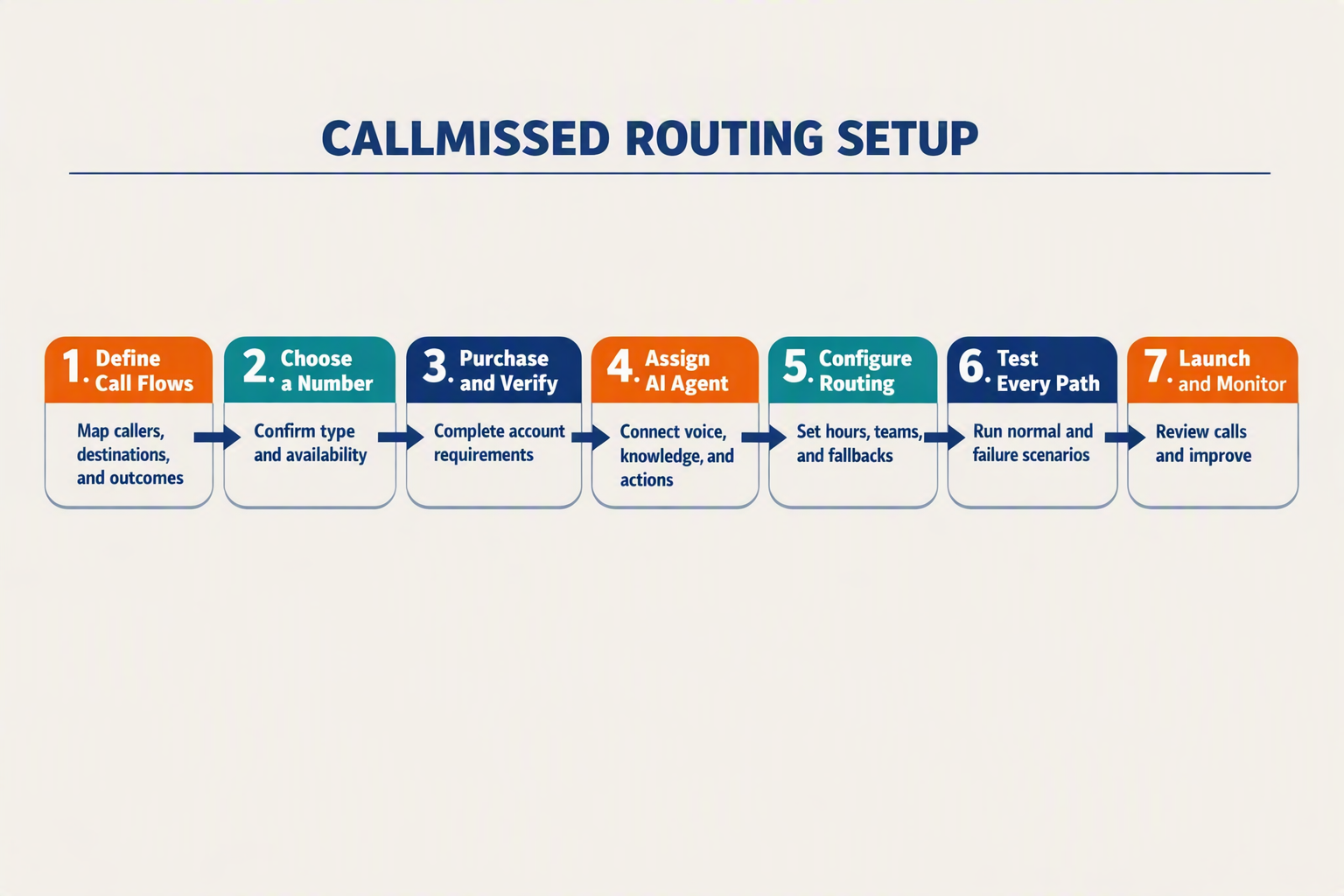
Setting up CallMissed call routing requires six operational steps: select and activate a suitable number, configure an AI voice agent, define schedules and destinations, add overflow paths, test every call outcome, and then publish the number. Treat the process as a routing deployment—not simply a number purchase—so every inbound call has a valid destination and fallback.
1. Choose and purchase the business number
Start by defining where customers are located and how they will use the number. Before purchasing an AI business phone number, confirm:
- Number type and geography: local, mobile, national, or toll-free availability for the intended country or region.
- Inbound capability: whether the number supports the expected call volume, caller identification, transfers, and concurrent calls.
- Verification requirements: business registration, address, authorized-representative identification, or other documents required by local telecom rules.
- Calling restrictions: permitted use cases, geographic reach, emergency-calling limitations, and restrictions on forwarding or outbound calls.
- Commercial terms: recurring rental, setup fees, inbound and outbound call rates, taxes, and cancellation or renewal conditions.
Availability and regulatory requirements can differ by country and number category. Do not advertise a newly selected number until activation, verification, and inbound calling have all been confirmed.
2. Assign and prepare the AI voice agent
Once the number is active, connect it to the agent that should answer first. CallMissed combines business numbers with AI voice agents, allowing the answering experience and routing logic to be managed as one customer-engagement workflow.
Configure the agent’s:
- Name, role, greeting, and supported languages
- Knowledge base, approved answers, and prohibited topics
- Intent categories such as sales, support, billing, and appointments
- Required information, including name, phone number, account reference, or preferred callback time
- Transfer triggers and boundaries for sensitive, urgent, or unsupported requests
- Recording, disclosure, and consent messages where applicable
For Indian businesses serving regional audiences, CallMissed supports speech workflows across 22 Indian languages. Test each enabled language independently because recognition quality, pronunciation, and escalation behavior can vary by caller and acoustic environment.
3. Build the primary routing map
Effective AI voice agent routing should translate caller intent into a specific action. Document the routing tree before configuring it:
- The AI agent answers and identifies the caller’s purpose.
- Supported requests are resolved through the approved knowledge base or business action.
- Department-specific calls move to sales, support, billing, appointments, or another defined queue.
- High-risk or explicitly requested escalations transfer to an authorized human.
- Failed transfers proceed to an overflow destination rather than ending abruptly.
Keep paths short. Callers should not have to repeat information after transfer; pass the transcript, summary, identified intent, and captured contact details wherever the receiving workflow supports them.
4. Add schedules, after-hours handling, and overflow
Create business hours using the organization’s actual time zone, then add weekends, holidays, and temporary closures. After-hours calls can remain with the AI agent, create a callback request, capture a structured message, or route urgent cases to an on-call destination.
Every destination also needs an overflow rule. A practical sequence is primary department → alternate team → AI-assisted message capture → confirmed callback workflow. This replaces passive voicemail with usable information and a clear next step.
5. Test before going live
Run test calls from multiple carriers, regions, languages, and caller-ID states. Verify:
- Greetings, intent detection, and knowledge responses
- Business-hours and after-hours branches
- Department transfers and unanswered-call timeouts
- Overflow, disconnection, and provider-failure behavior
- Audio quality, latency, recordings, transcripts, and notifications
- Usage reporting and expected charges
Only publish CallMissed call routing after normal, after-hours, transfer, and failure scenarios all produce an intentional outcome.
Why is routing design different from simply buying an AI business phone number?

An AI business phone number is the entry point for calls; routing design determines what happens from answer to resolution. Buying a number establishes reachability, while AI voice agent routing defines business hours, caller intent, departments, transfers, escalation limits, and fallback actions.
A number is an asset; routing is an operating policy
Number selection typically answers procurement questions: Is the number available? Does it support inbound calling? What identity verification, geographic eligibility, recurring rental, and usage charges apply?
Routing design answers operational questions:
- Who answers first: an AI voice agent, department, receptionist, or queue.
- How intent is detected: conversationally, through keypad input, or from known customer context.
- When the route changes: after hours, on holidays, during peak demand, or when an endpoint fails.
- When humans take over: for sensitive, regulated, high-value, or explicitly requested interactions.
- What happens when nobody is available: callback scheduling, ticket creation, structured message capture, or another approved destination.
This distinction matters because answering is not the same as resolving. Salesforce’s 2023 State of the Connected Customer found that 77% of customers expect to interact with someone immediately when contacting a company. A number may satisfy the ability to call, but only a designed route can provide an immediate and useful response.
Routing is a sequence of decisions
A production call flow should behave like a decision tree rather than a single forwarding rule. A typical CallMissed call routing design might follow this sequence:
- Accept the inbound call and identify the dialled number, caller ID, time zone, and current schedule.
- Apply business-hour rules, including holidays and temporary closures.
- Assign the AI voice agent with the correct greeting, language, knowledge base, and permitted actions.
- Classify the caller’s intent as sales, support, billing, appointment management, or another defined category.
- Resolve or transfer the conversation according to confidence, urgency, and escalation policy.
- Trigger an overflow path if the department, human agent, or external destination does not answer.
- Record the outcome as a summary, callback request, lead, ticket, or follow-up task where appropriate.
CallMissed connects business phone numbers with AI voice agents and omnichannel engagement workflows, allowing the route to continue beyond the call—for example, by capturing details for follow-up rather than sending the caller to an unstructured voicemail box.
Good routing defines failure before success
A simple setup describes the ideal journey: “The AI answers, understands the request, and resolves it.” A dependable setup also defines what happens when speech recognition is uncertain, the caller requests a person, a transfer fails, or an integration becomes unavailable.
Before launch, specify:
- A maximum number of clarification attempts
- Topics the agent must never handle autonomously
- Transfer timeout and no-answer behavior
- After-hours handling for urgent and non-urgent calls
- A fallback if the AI agent or destination is unavailable
- Whether recordings, transcripts, and summaries require disclosure or consent
- Who reviews routing analytics and updates the flow
Microsoft and LinkedIn’s 2024 Work Trend Index reported that 75% of knowledge workers were already using AI at work, but adoption alone does not establish operational reliability. The buying decision should therefore evaluate both the phone number and the routing controls surrounding it: a reachable number creates the doorway, while a tested routing design creates the customer experience.
Which number type, location, and regulatory conditions should you verify before purchasing?
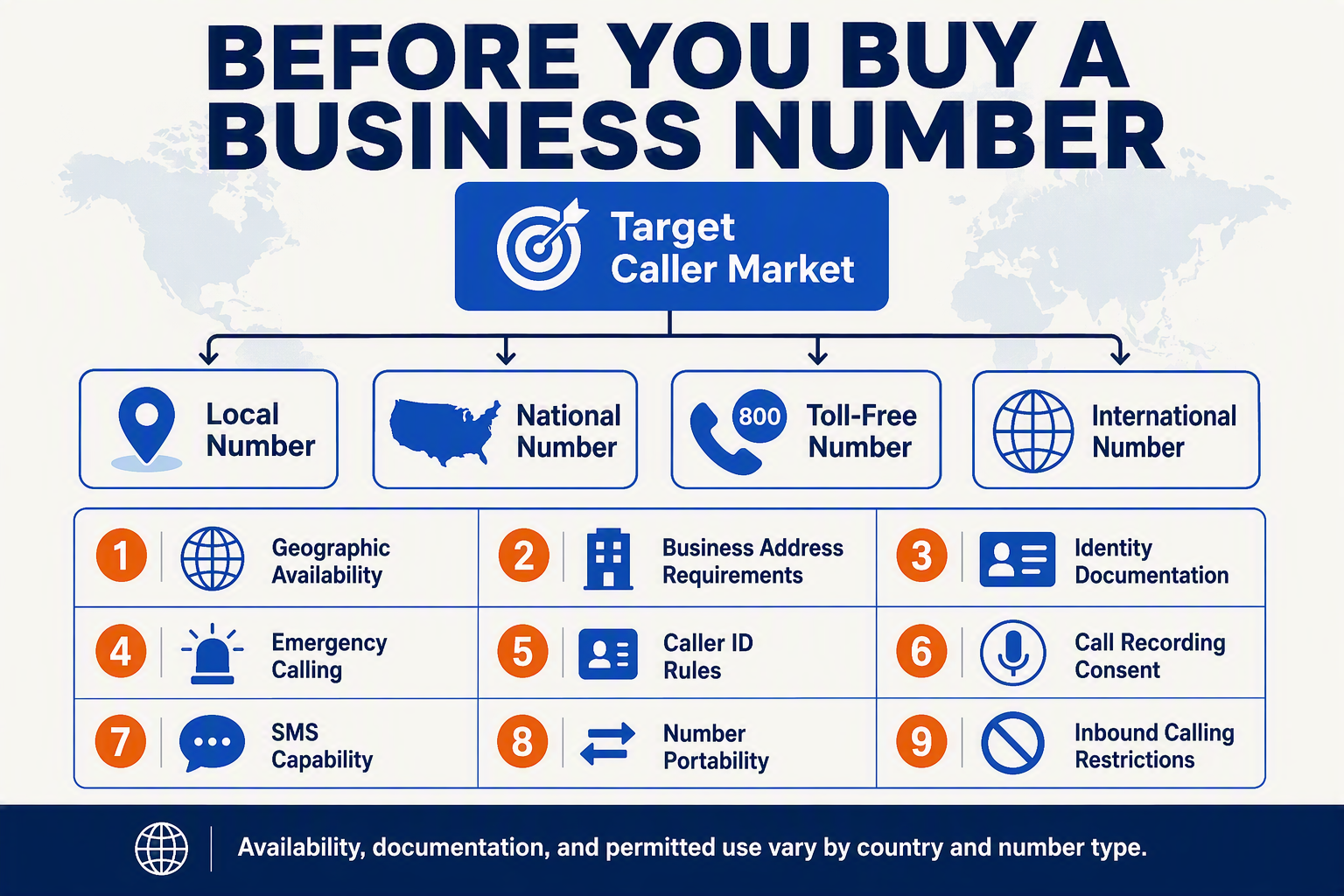
The right number must support the intended inbound calling, routing, transfer, and geographic use case before purchase. Buyers should verify number type, provisioning location, identity requirements, AI or automated-call restrictions, recording rules, and recurring costs rather than assuming every available number has identical capabilities.
Choose the number type around caller behaviour
Start with how customers will discover and use the number:
- Local or geographic number: Useful when a recognizable area code builds regional trust. Confirm whether purchasing the number requires a local address, business registration, or proof of presence.
- Mobile-format number: Familiar to callers and potentially suitable for messaging, but voice, SMS, and WhatsApp capabilities must be verified separately. A number that receives telephone calls does not automatically qualify for WhatsApp Business.
- Toll-free number: Appropriate for centralized sales or support because the business generally pays for inbound calls. Check caller accessibility, per-minute charges, and whether calls from mobile networks or outside the home country are accepted.
- National or non-geographic number: Provides a country-wide identity without implying a specific city. Availability, portability, and pricing vary by jurisdiction.
- Existing ported number: Preserves a published customer contact, but porting can involve authorization documents, carrier coordination, downtime planning, and feature revalidation.
For CallMissed call routing, confirm that the selected inventory can receive calls, connect to the assigned AI agent, transfer to required destinations, and retain the intended caller-ID information. Do not assume that inbound service includes outbound calling or that the purchased number can be presented as outbound caller ID.
Verify location and reachability
A number’s country or area code does not guarantee universal reach. Before purchasing an AI business phone number, test or obtain written confirmation of:
- Supported caller origins, including domestic mobile, landline, international, and roaming callers.
- Emergency-service limitations, because cloud or AI-routed numbers may not provide the same emergency-location functions as fixed telephone lines.
- Transfer destinations, especially international numbers, SIP endpoints, contact centres, and employee mobiles.
- Number portability, renewal rules, dormancy conditions, and what happens to the number if the account closes.
- Time-zone mapping, which determines when business-hours and after-hours rules activate.
Where regional presence matters, ensure that the number’s apparent location matches the business’s actual service footprint. A local-looking number should not be used to create a misleading claim of physical presence.
Check regulatory and identity conditions
Telecommunications providers commonly require Know Your Customer or Know Your Business verification before activating numbers. Depending on the country and number class, requested evidence may include government-issued identification, incorporation documents, tax registration, an authorization letter, and proof of a local address.
Indian buyers should account for the Telecommunications Act, 2023, applicable Department of Telecommunications requirements, and Telecom Regulatory Authority of India rules governing commercial communications. The Digital Personal Data Protection Act, 2023 also matters when call recordings, transcripts, summaries, phone numbers, or routing histories contain personal data.
For cross-border deployments, verify rules at both the number location and the caller’s location. Examples include the United States Telephone Consumer Protection Act, the United Kingdom’s Privacy and Electronic Communications Regulations, and European Union privacy requirements under the General Data Protection Regulation.
Before enabling AI voice agent routing, document:
- Whether callers must be told they are speaking with AI.
- Whether recording or transcription requires one-party or all-party consent.
- Whether automated outbound calls require prior consent.
- How opt-outs, retention periods, deletion requests, and human escalation are handled.
- Whether recordings and transcripts may be stored or processed outside the caller’s country.
CallMissed can connect a business number to an AI voice agent, but regulatory eligibility remains dependent on the selected number, carrier, jurisdiction, calling purpose, and the buyer’s verification documents. Confirm these conditions before payment, not after routing workflows have been built.
Which CallMissed call routing design best fits your callers? (TABLE)
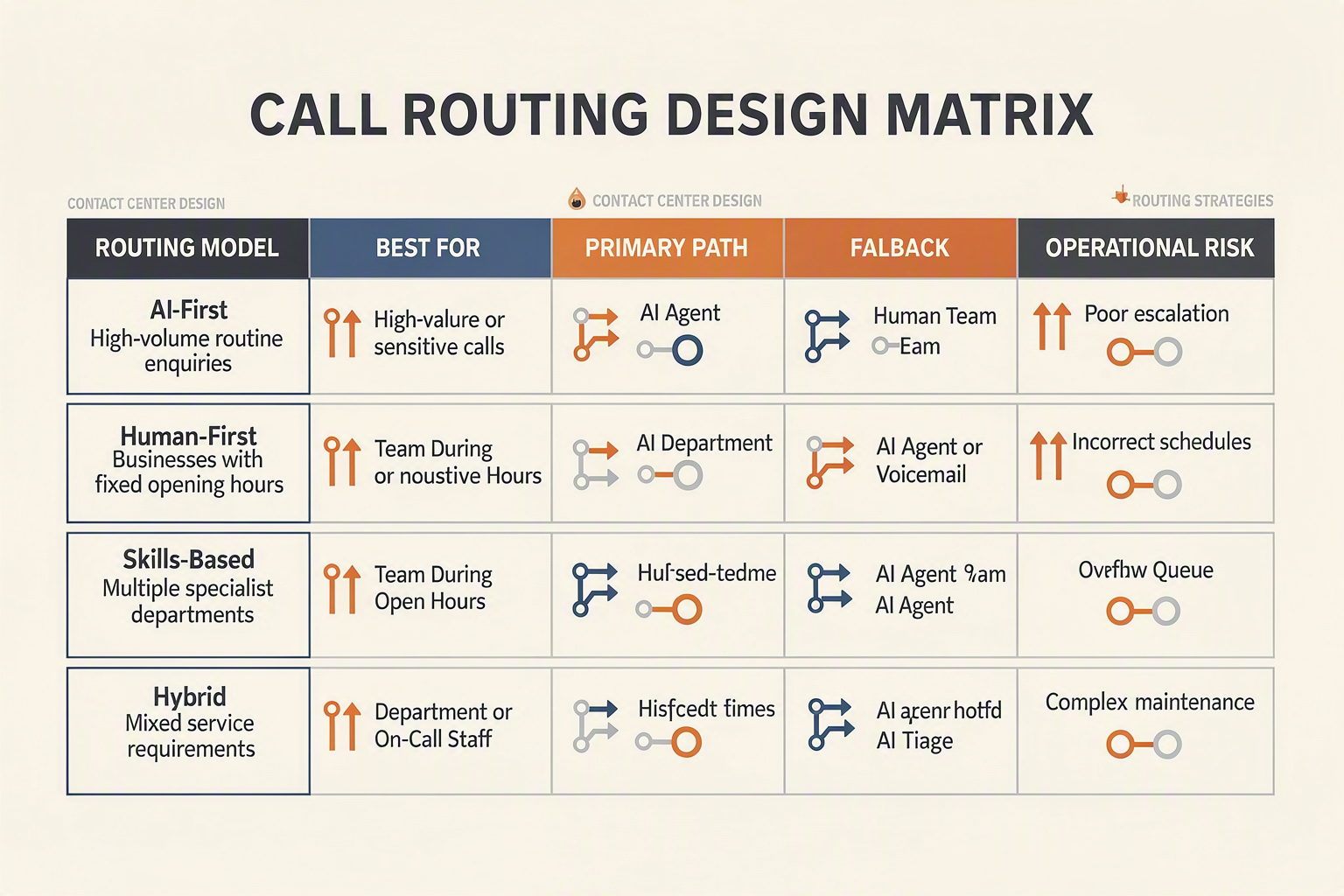
The right CallMissed call routing design depends on call intent, volume patterns, language needs, staff availability, and the cost of a missed escalation. Most businesses should begin with the simplest design that gives every call a defined primary destination, timeout, overflow path, and final outcome.
Compare common routing designs
| Routing design | Best fit | Primary call path | Overflow or after-hours outcome | Main trade-off |
|---|---|---|---|---|
| AI-first receptionist | SMBs with mixed enquiries | AI identifies intent, answers routine questions, then transfers when needed | AI captures a callback request or creates a structured follow-up | Requires clear escalation boundaries |
| Department-by-intent | Sales, support, billing, and appointment teams | AI classifies the request and routes it to the relevant department | Another team, AI resolution, or a department-specific callback queue | Incorrect intent classification can misroute callers |
| Human-first with AI overflow | High-value sales or relationship-led service | A person or ring group answers first | AI answers after a defined no-answer or busy timeout | Peak periods can produce inconsistent wait times |
| Business-hours split | Teams with predictable opening times | Daytime calls reach staff, departments, or an AI-human combination | After-hours AI handles FAQs, qualification, and callback scheduling | Holiday and time-zone calendars need maintenance |
| Language-aware routing | Businesses serving multilingual Indian audiences | Caller selects a language or the AI detects and confirms it | Route to a suitable agent or capture follow-up in the caller’s language | Language detection should be tested with accents and code-switching |
| Priority or account-based routing | Clinics, logistics, financial services, or B2B support | Known callers or urgent intents receive a dedicated path | Escalation to an on-call person, priority queue, or scheduled response | Caller identification and privacy controls must be reliable |
Match the design to caller expectations
Choose AI-first routing when a large share of calls involves repeatable tasks such as order status, appointment booking, lead qualification, opening hours, or policy questions. The AI voice agent should resolve supported intents directly and transfer only when human judgement or authorization is necessary.
Choose human-first routing when trust, negotiation, safeguarding, or revenue value makes immediate personal attention more important than automation. In this model, the AI is not the front door; it is the safety net that prevents unanswered calls from becoming abandoned opportunities.
A department-by-intent model is preferable to a long keypad menu when callers may not know which team owns their issue. Keep a confirmation step for consequential transfers—for example: “It sounds like you need billing support. Is that correct?”
CallMissed supports Speech-to-Text and Text-to-Speech across 22 Indian languages, making language-aware AI voice agent routing practical for regional audiences. However, buyers should still test local accents, mixed-language speech, names, addresses, and industry terminology before publishing a route.
Define a complete path, not just a first answer
For every route attached to an AI business phone number, document these five decisions:
- Primary destination: AI agent, person, department, or ring group.
- Answer window: How long the destination has before overflow begins.
- Escalation trigger: Caller request, detected intent, failed verification, urgency, or repeated misunderstanding.
- Fallback destination: Alternate team, on-call contact, callback workflow, or structured message capture.
- Final confirmation: Tell the caller what happens next and provide a realistic response window.
Avoid routing loops, transfers back to the same unavailable destination, and generic voicemail as the default endpoint. A robust design always produces a clear result: resolution, successful transfer, booked callback, recorded request, or tracked follow-up task.
How do you assign and prepare an AI voice agent for reliable routing?
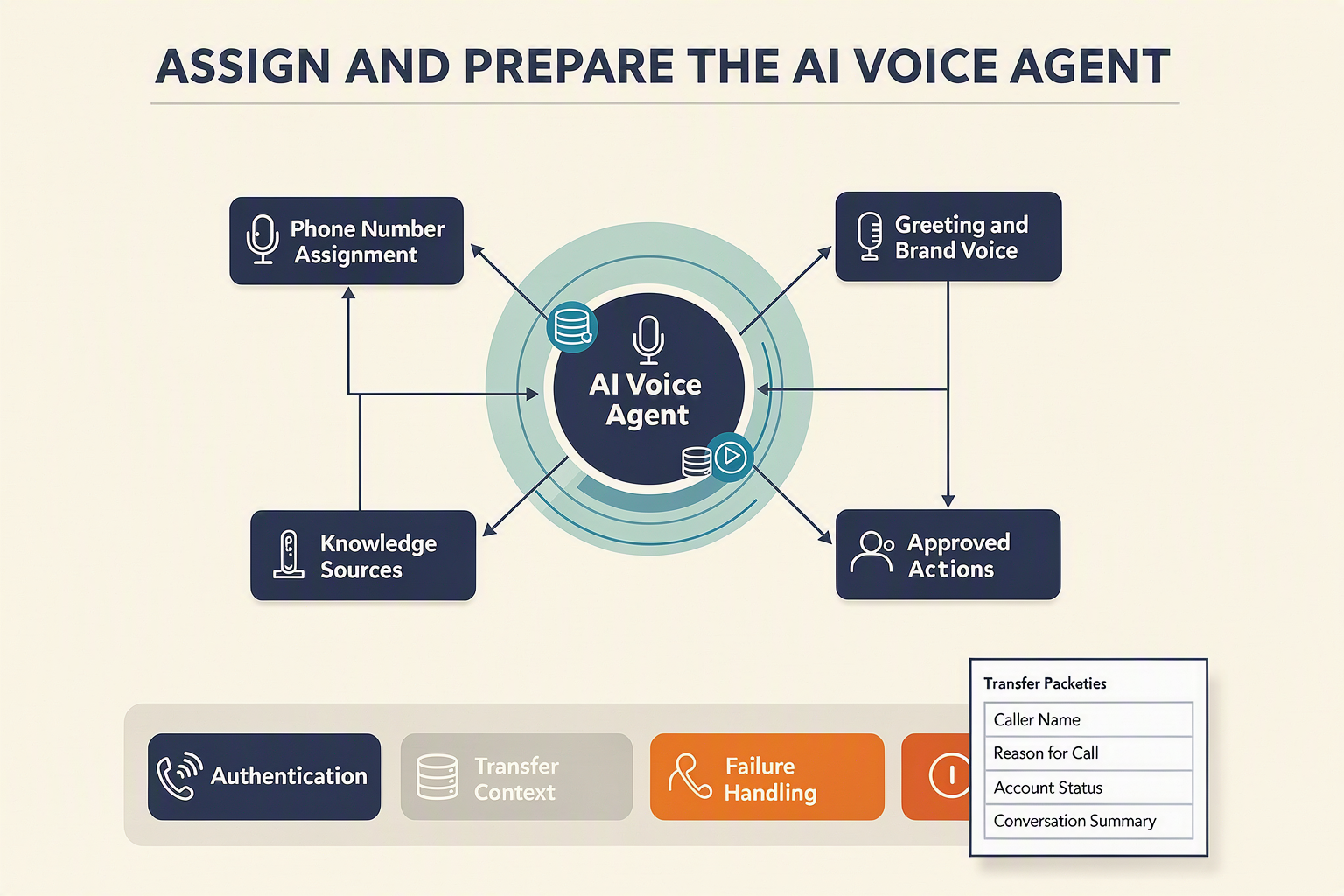
Assign the selected AI business phone number to one production-ready voice agent, then configure that agent’s identity, language, knowledge, actions, and escalation boundaries before accepting live calls. Reliable AI voice agent routing depends less on a clever prompt than on giving the agent precise authority and a safe path for every request it cannot complete.
1. Connect the number to the correct agent
In the CallMissed business platform, associate the purchased or connected number with the intended AI voice agent. Use separate agents—or clearly separated configurations—when sales, support, billing, or regional operations require different knowledge and permissions.
Before activation, confirm:
- Inbound call ownership: Verify which agent answers the number by default.
- Caller context: Decide what caller ID, customer record, campaign, or previous interaction should be available.
- Time zone: Set the operating time zone used by greetings and availability checks.
- Outbound identity: If callbacks are enabled, confirm which approved number appears to recipients.
- No-answer destination: Define a fallback rather than allowing an unassigned call to terminate.
Document the assignment using a recognizable name such as “India Support—English/Hindi—Production.” Avoid labels such as “Agent 1,” which make routing changes difficult to audit.
2. Define the agent’s role and conversational boundaries
Write an operational instruction set covering who the agent represents, what it may do, and when it must escalate. A useful configuration should explicitly state:
- The business name and purpose of the line.
- Supported caller intents, such as booking, order status, lead qualification, or basic troubleshooting.
- Information the agent must collect before taking an action.
- Topics it must not answer without human review.
- Conditions requiring an immediate transfer, callback, or emergency notice.
The opening greeting should identify the business and, where appropriate, disclose that the caller is speaking with an AI assistant. Keep the first turn short: confirm intent before requesting account numbers or lengthy explanations.
3. Prepare language, voice, and knowledge
Select the voice and languages that match the expected caller base. CallMissed supports Speech-to-Text and Text-to-Speech across 22 Indian languages, enabling Indic-language deployments without treating regional speech as an optional extension. For multilingual lines, specify whether the agent should detect language automatically or ask callers to choose.
Connect only approved knowledge sources, then organize them around common call intents:
- Product, pricing, and eligibility information
- Support procedures and troubleshooting steps
- Appointment availability and cancellation rules
- Service areas, office locations, and opening times
- Refund, privacy, and escalation policies
Knowledge retrieval should produce grounded answers rather than permissions. For example, reading a refund policy is different from authorizing a refund.
4. Configure actions and fail-safe outcomes
Give the agent the minimum system access needed to complete its role. Validate every action—such as creating a lead, scheduling an appointment, checking an order, or raising a ticket—with required fields and confirmation language.
For dependable CallMissed call routing, every intent should end in one of four outcomes: resolved by AI, transferred to a person, scheduled for follow-up, or captured as a structured message. Also define behavior for silence, low-confidence transcription, unsupported languages, unavailable integrations, repeated misunderstanding, and caller requests for a human. Save the configuration as a draft or staging version until these paths have been reviewed by the relevant department owner.
How should AI voice agent routing change during business hours and after hours?
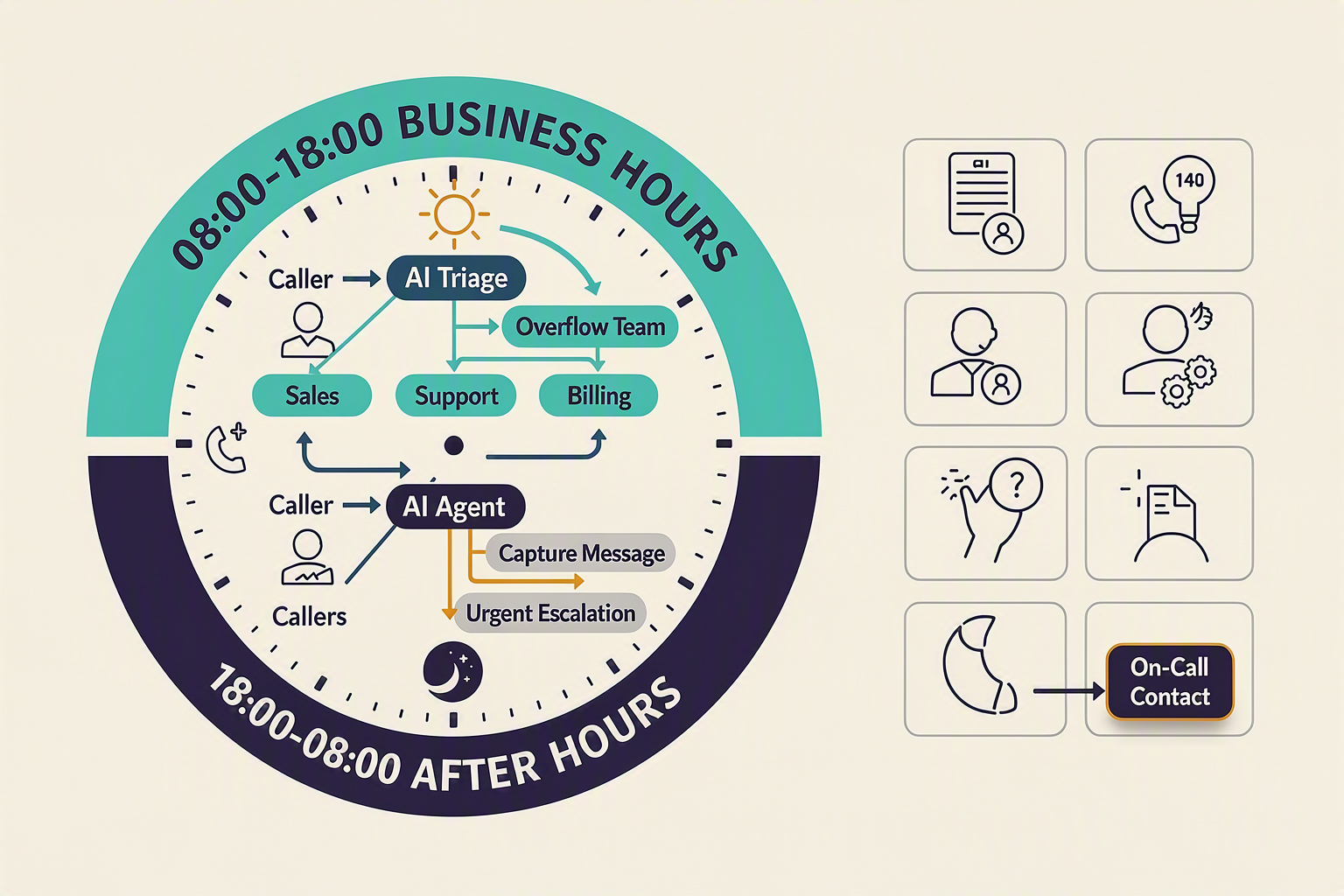
Business-hours routing should prioritize fast access to the right human team, with an AI voice agent handling identification, qualification, and overflow. After hours, the AI should become the primary responder, complete permitted tasks, capture structured details, and offer a defined escalation or callback path rather than sending every caller to voicemail.
Build schedules around the customer’s location
Configure CallMissed call routing with an explicit time zone, weekly opening hours, break periods, public holidays, and temporary closures. Do not rely on the phone number’s country code to determine operating hours; the team answering the number may work in another region.
Create at least four schedule states:
- Open: Human departments are available, with AI-assisted intent detection and transfer.
- Busy or overflow: The business is open, but the preferred destination does not answer within a defined period.
- Closed: The AI handles supported requests and schedules follow-up.
- Holiday or emergency: A special greeting and restricted escalation policy override the normal timetable.
For businesses operating across India, holiday routing may need regional calendars rather than one nationwide list. Temporary schedule overrides should also have start and expiry dates so an emergency rule does not remain active accidentally.
Use AI to shorten the business-hours path
During open hours, AI voice agent routing should reduce transfers—not add another menu. The agent can ask why the customer is calling, identify language preference, collect an account or order reference, and route the call to sales, support, billing, or appointments.
A practical open-hours sequence is:
- AI answers and discloses that the caller is interacting with an automated agent.
- The agent detects intent, urgency, language, and customer identity where permitted.
- Routine requests are completed using approved knowledge and actions.
- Calls requiring human judgment transfer to the relevant department with a concise summary.
- If nobody answers after the configured timeout, the call enters an overflow path instead of restarting.
CallMissed supports voice and chat across 22 Indian languages, which is particularly relevant when an AI business phone number serves callers who may switch between English, Hindi, and regional languages. Language detection should still be tested with real accents, code-switching, noise, and industry terminology.
Make after-hours routing useful but bounded
After hours, let the AI answer FAQs, check approved information, qualify leads, book available appointments, create support tickets, or collect callback requests. Clearly tell callers when humans will return and avoid promising an immediate response if no team is staffed.
Define exceptions carefully:
- Urgent operational issues: Transfer only to an approved on-call destination.
- High-value sales enquiries: Capture requirements and schedule the earliest available callback.
- Billing or account changes: Authenticate the caller before exposing information or initiating actions.
- Emergencies: State the agent’s limitations and direct callers to the appropriate emergency service where relevant.
- Failed automation: Record a structured message, transcript, preferred language, consent status, and callback window.
Test the boundary between schedules
Place test calls immediately before opening, exactly at closing, during holidays, and while departments are unavailable. Verify the greeting, destination, timeout, transfer summary, recording notice, callback creation, and fallback behavior.
The core rule is simple: every schedule state needs a successful route and a failure route. A closed office should change who resolves the call, not whether the caller receives a useful outcome.
How should departments, overflow, and voicemail alternatives work together?
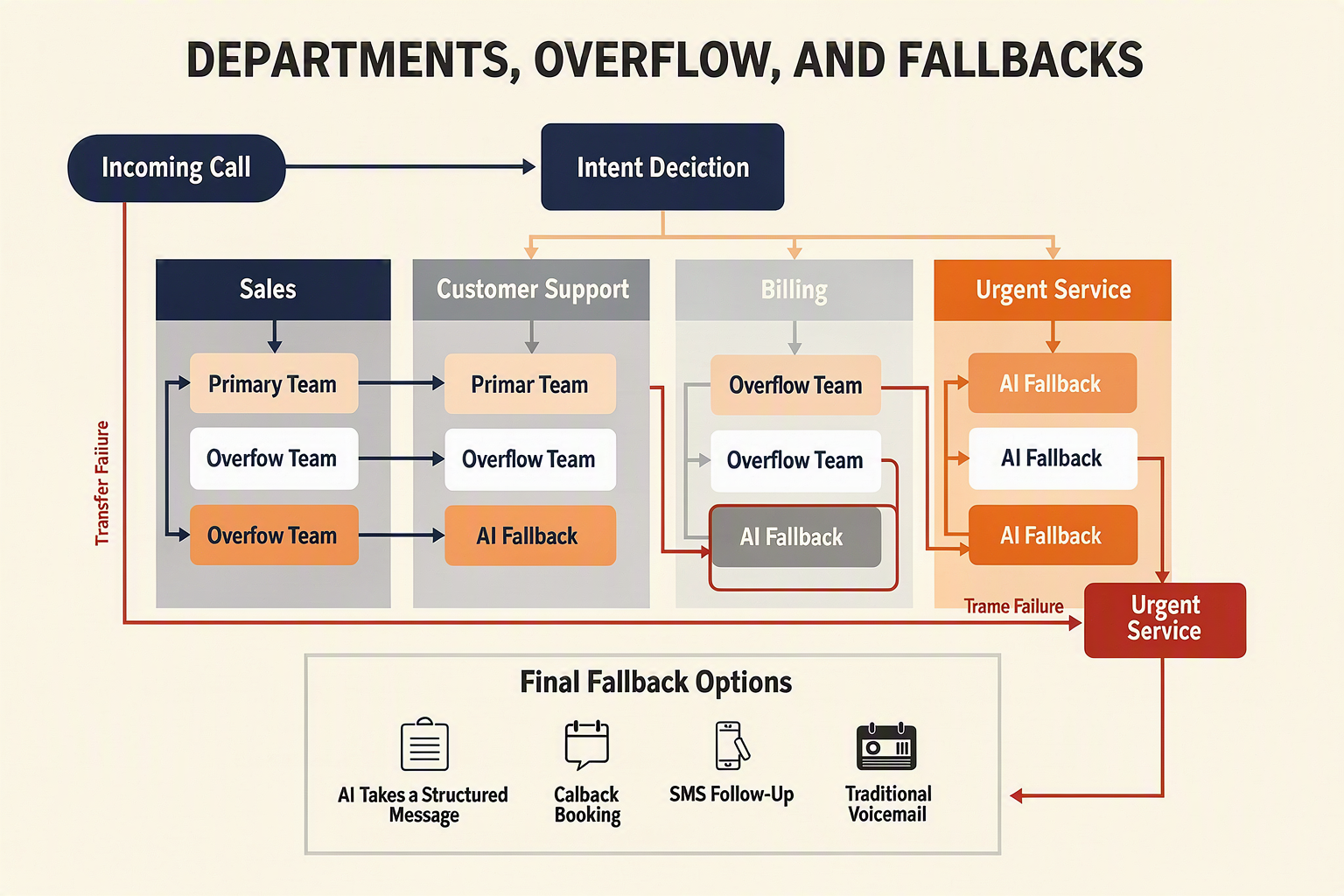
Departments, overflow, and voicemail alternatives should form one ordered routing chain: send the caller to the best-matched department, activate overflow when that destination cannot respond, and use structured AI capture only as the final fallback. Every branch needs a defined owner, timeout, and next action so callers never reach a dead end.
Route by intent before asking callers to choose
An AI business phone number should identify intent conversationally rather than forcing every caller through a long “press 1, press 2” menu. The AI voice agent can ask a concise opening question—“How can we help today?”—and classify the request as sales, support, billing, appointments, or another approved department.
Configure each department with:
- Accepted intents: Topics the department owns.
- Primary destination: An AI agent, human queue, extension, or external number.
- Transfer criteria: Conditions that justify escalation from AI to a person.
- Operating schedule: Department-specific hours, holidays, and time zone.
- Fallback owner: The team responsible if the primary destination fails.
- Context package: Caller identity, detected intent, transcript summary, and information already collected.
CallMissed call routing can use an AI voice agent as the initial conversational layer, reducing unnecessary transfers while preserving escalation paths for sensitive, complex, or explicitly requested human interactions.
Make overflow conditional, not indiscriminate
Overflow is a capacity-control mechanism, not simply a second ringing number. It should activate only after measurable events such as no answer within 20 seconds, a full queue, agent unavailability, transfer failure, or a department being closed.
A practical sequence is:
- Attempt the primary department for a defined period.
- Offer AI assistance if the caller’s request can be completed automatically.
- Try a secondary queue or authorised backup team when human handling is required.
- Offer a scheduled callback with a clear expected response window.
- Capture a structured message if no live or automated resolution is possible.
Avoid routing every unanswered call to a general reception queue. That design merely relocates congestion and can send billing, technical, and urgent requests to people without the necessary permissions.
Replace generic voicemail with actionable capture
Traditional voicemail produces an audio file that someone must discover, interpret, and assign. A better alternative is an AI-guided interaction that collects the exact details needed for follow-up.
Depending on the department, the agent might capture:
- Sales: Product interest, company size, location, and preferred callback time.
- Support: Account identifier, affected service, symptoms, and urgency.
- Billing: Invoice reference and request category—without collecting prohibited payment credentials.
- Appointments: Service type, preferred slot, location, and contact confirmation.
The system should then create a transcript or summary, assign an owner, set priority, and send confirmation through an approved channel. CallMissed combines voice workflows with an omnichannel inbox and CRM capabilities, allowing captured requests to become follow-up work rather than isolated recordings.
Test the complete chain as one workflow
Validate AI voice agent routing with calls for every department during open, closed, busy, and transfer-failure conditions. Confirm that context survives each handoff, callback promises are realistic, emergency requests follow a dedicated policy, and every final fallback creates a visible, owned task. The operational test is simple: for any caller intent and availability state, the routing map must produce a clear next action.
How should you test, monitor, and improve routing before and after launch?
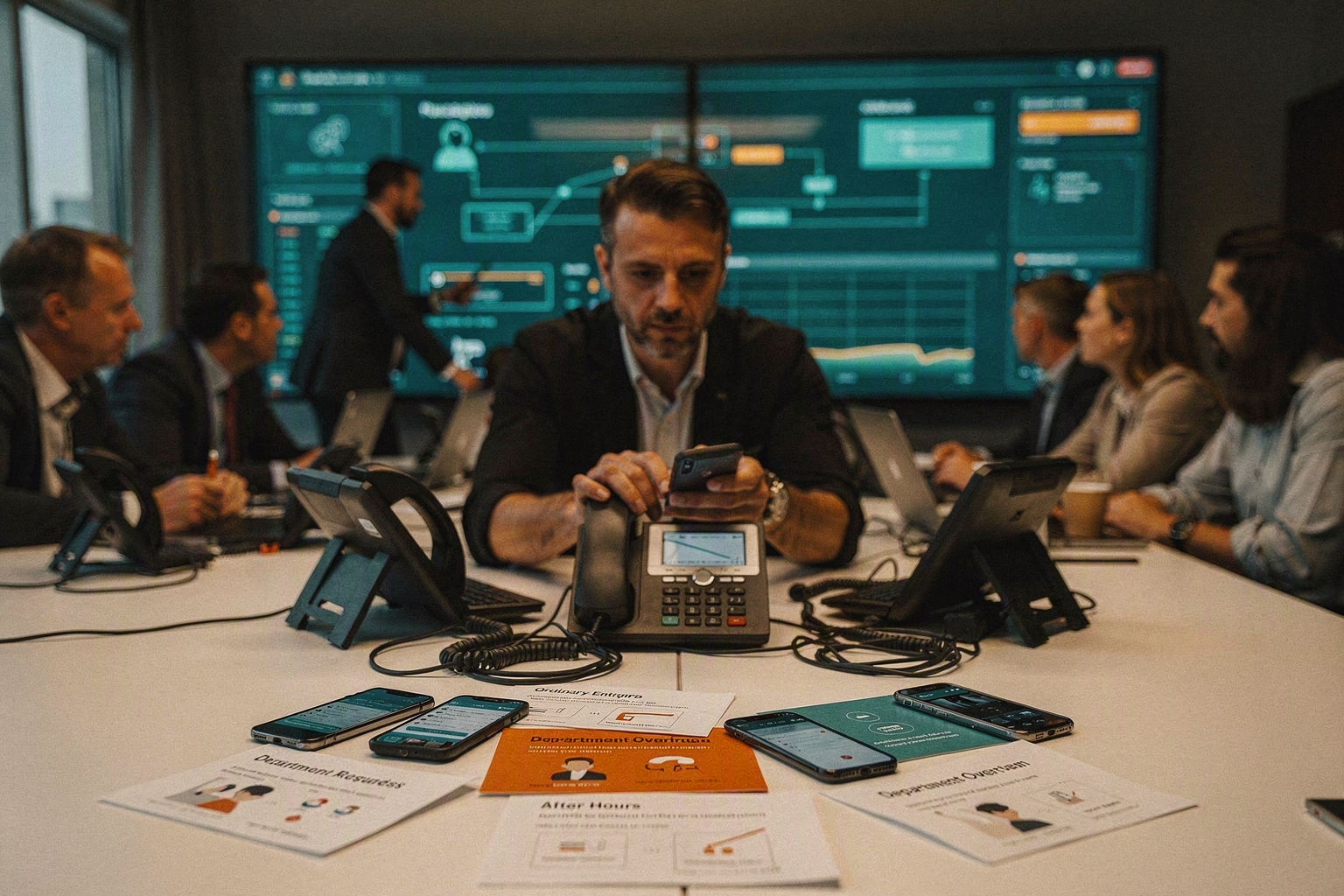
Test CallMissed call routing with a written scenario matrix before publishing the number, then monitor outcomes rather than merely counting calls. Every route should be validated under normal, after-hours, overloaded, and failure conditions, with failed conversations feeding a controlled improvement cycle.
Build a pre-launch test matrix
Use test callers who were not involved in configuring the AI business phone number; they are more likely to phrase requests unpredictably. Cover each combination of intent, schedule, language, and destination.
- Test core intents: sales, support, billing, appointments, cancellations, complaints, and requests for a person.
- Simulate timing conditions: business hours, closing time, after hours, weekends, holidays, and time-zone boundaries.
- Exercise destination states: human available, line busy, no answer, transfer rejected, and department unavailable.
- Vary caller behaviour: silence, interruptions, background noise, accents, ambiguous requests, and incorrect information.
- Force failures: disconnect a destination, make a tool or knowledge source unavailable, and confirm that the fallback still captures a callback request.
For every scenario, record the expected greeting, selected route, transfer target, information captured, fallback action, and caller-facing confirmation. A test passes only when the end result is correct—not simply because the AI understood the first sentence.
Measure voice and routing performance
Create a launch dashboard with metrics that identify where callers encounter friction:
- Routing accuracy: Percentage of evaluated calls sent to the correct agent, department, or workflow.
- Transfer success rate: Percentage of attempted transfers that connect to the intended destination.
- Fallback completion rate: Percentage of unavailable-route calls that successfully produce a message, ticket, or callback request.
- Containment rate: Percentage of calls resolved by the AI without human transfer; review this alongside customer outcomes so that containment does not become a goal by itself.
- Abandonment rate: Percentage of callers who disconnect before resolution or successful handoff.
- Response latency: Track median and 95th-percentile time to the first spoken response and between conversational turns.
- Repeat-contact rate: Calls from the same customer about the same issue within a defined period.
For audio evaluation, the International Telecommunication Union’s ITU-T P.800 standard uses subjective listening methods, including the familiar Mean Opinion Score scale from 1 to 5. Teams can supplement listening tests with checks for clipping, echo, transcription errors, and delayed turn-taking.
Launch gradually and review real conversations
Begin with a limited number, department, region, or percentage of traffic rather than switching every caller simultaneously. During the first week, review routing exceptions daily and compare transcripts, recordings where legally permitted, summaries, and final dispositions.
Platforms such as CallMissed can connect an AI voice agent with customer-engagement workflows, but reliable AI voice agent routing still depends on operational review. Flag calls where:
- The caller repeats an intent multiple times.
- The AI transfers to the wrong department.
- A human receives insufficient context.
- A fallback promises an action that is not completed.
- Regional-language transcription changes the meaning.
Improve through controlled changes
Maintain a versioned change log for prompts, knowledge sources, hours, transfer rules, and fallback destinations. Change one major variable at a time, replay a fixed set of “golden call” scenarios, and compare results before deployment.
Set alerts for sudden increases in failed transfers, abandonment, latency, or fallback usage. Review trends weekly after stabilization and retest every route after schedule changes, number migration, agent updates, or telephony-provider incidents. Routing is production infrastructure: improvement should be measurable, reversible, and continuously tested.
What costs, limits, and operating decisions should buyers confirm? (TABLE)
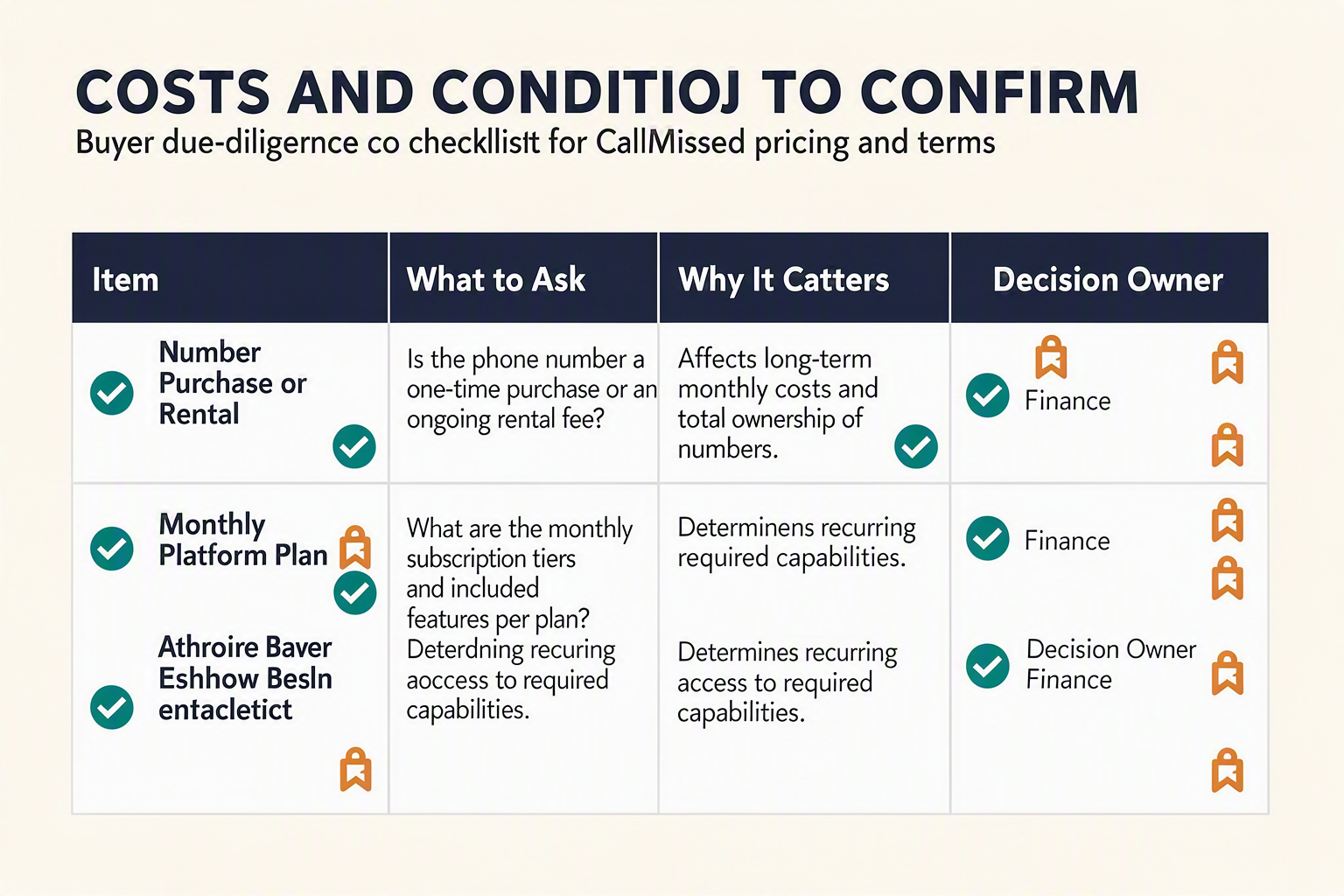
Buyers should confirm the total cost per handled call, not merely the phone-number rental fee. For reliable CallMissed call routing, document usage rates, concurrency limits, transfer charges, retention policies, regulatory conditions, and the fallback action when a paid service or operational limit is reached.
Cost and limit checklist
CallMissed uses transparent credit-based pricing, where 1 credit equals ₹1, with free-tier and pay-as-you-go options where applicable. However, buyers should verify the current dashboard or order summary because number rental, calling rates, taxes, geographic availability, and AI consumption can vary by destination and configuration.
| Cost or decision | What to confirm before purchase | Typical cost trigger | Limit or failure to plan for | Recommended control |
|---|---|---|---|---|
| Number rental and activation | Monthly rental, setup fee, minimum term, renewal date, and cancellation process | Reserving or renewing the number | Number release after failed renewal or inactivity | Enable balance alerts and assign a billing owner |
| Inbound telephony | Per-minute rate, billing increments, included usage, and caller geography | Every connected inbound call | Unsupported origins, long calls, or carrier restrictions | Track minutes by number, department, and country |
| AI voice-agent usage | Speech-to-text, model, text-to-speech, and orchestration charges | Each AI-handled conversation | Credit exhaustion, model limits, latency, or language mismatch | Set budgets, call-duration rules, and a safe fallback |
| Transfers and outbound legs | Charges for transfers, callbacks, conference legs, and external destinations | AI transfers a caller or initiates follow-up | Failed destination, repeated transfer loops, or international rates | Cap retries and define an alternate queue |
| Recording and data retention | Recording, transcription, storage, download, deletion, and consent settings | Saving audio, transcripts, summaries, or analytics | Storage growth, privacy exposure, or retention conflicts | Apply role-based access and a deletion schedule |
| Taxes and optional services | GST or other applicable taxes, premium numbers, integrations, support, and add-ons | Invoice issuance or optional feature use | Final invoice exceeding the displayed usage subtotal | Review the complete tax-inclusive estimate |
An AI business phone number may create several billable components during one interaction. For example, an inbound call can consume telephony minutes and AI processing; transferring it to a mobile or external line may then create another call leg. Buyers should ask whether billing continues while callers are on hold, during transfer attempts, or after the AI agent leaves the call.
Operating decisions that affect spend
Before publishing the number, assign accountable owners and make these decisions explicit:
- Concurrency: Determine how many simultaneous calls the deployment must support during normal operations and peak campaigns.
- Budget exhaustion: Decide whether calls should reach a human, capture a callback request, play an informational message, or terminate safely when credits are unavailable.
- Maximum duration: Set thresholds for silence, hold time, repeated questions, and unusually long conversations.
- Human escalation: Specify which departments accept transfers, their operating hours, and what happens when nobody answers.
- Data governance: Define recording consent, transcript access, retention periods, deletion requests, and prohibited information.
Final commercial verification
Before approving AI voice agent routing, obtain a written or dashboard-visible confirmation of:
- The first-month, normal-month, and peak-month cost estimates.
- Included usage versus metered usage.
- Soft warnings and hard service limits.
- Refund, cancellation, number-porting, and renewal conditions.
- Geographic, identity-verification, and calling restrictions for every intended market.
Recheck these assumptions after the first billing cycle using actual call duration, transfer rate, concurrency, and AI-handling data. This converts pricing from a one-time purchasing question into an ongoing routing-operations discipline.
Frequently asked questions about CallMissed business numbers and AI call routing
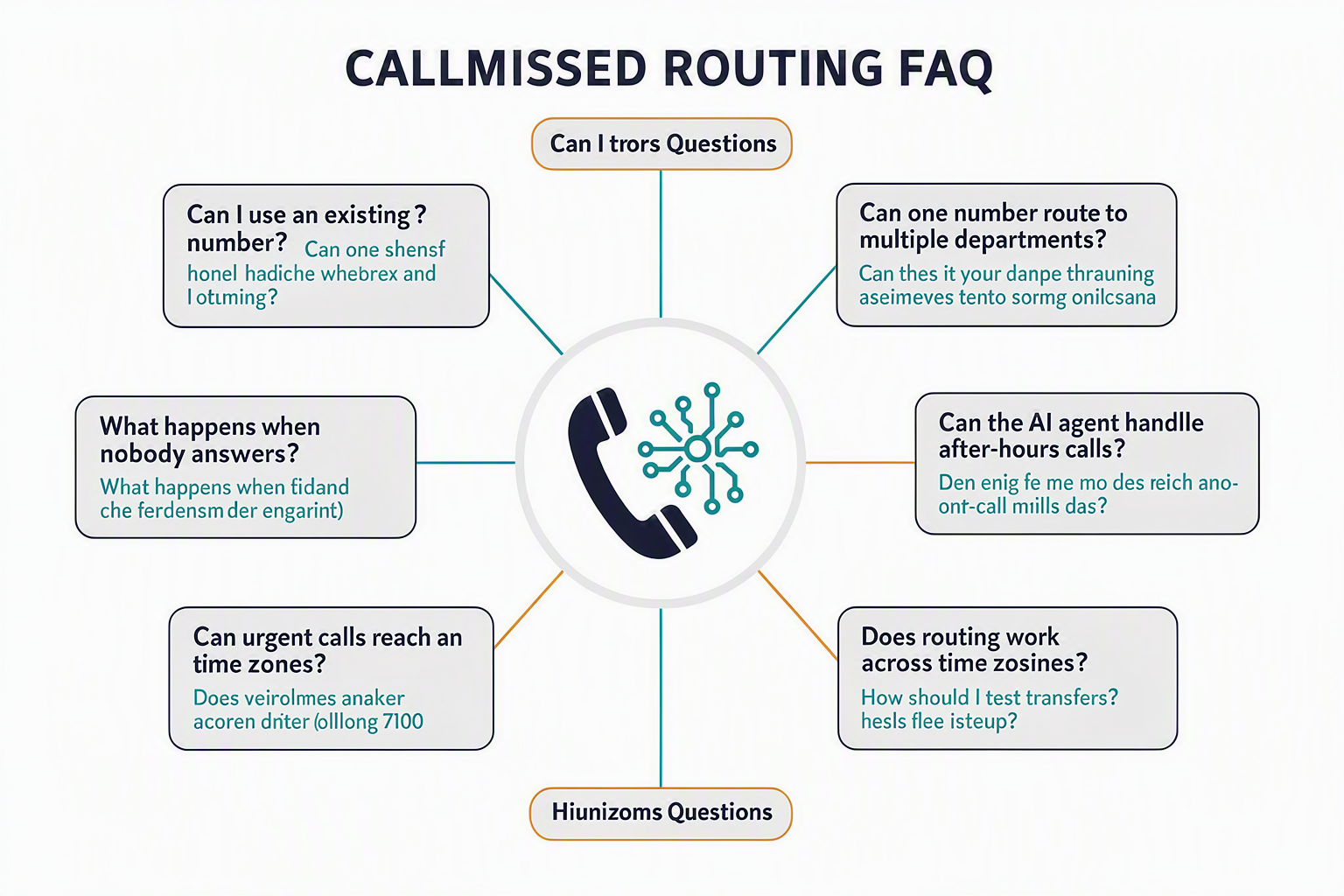
How does CallMissed call routing work with a business phone number?
Can an AI business phone number answer calls outside normal business hours?
What should I configure before enabling AI voice agent routing?
Can CallMissed route callers to different departments or regional teams?
Which languages can a CallMissed AI voice agent support?
What costs and regulatory requirements should I check before buying a CallMissed business number?
Conclusion
CallMissed call routing works best when every inbound call has a defined destination, escalation path, and fallback—not merely a purchased number. A well-configured AI business phone number can provide immediate assistance, route callers by intent, and capture structured follow-up information when employees are unavailable.
Key takeaways include:
- Choose carefully: Confirm number availability, geographic and regulatory conditions, identity verification, inbound capabilities, recurring charges, call rates, AI usage fees, transfers, recordings, and taxes.
- Design the agent before launch: Configure language, greeting, knowledge base, permitted actions, department transfers, and clear boundaries for human escalation.
- Plan for every operating state: Build business-hours, after-hours, holiday, overflow, emergency, and callback paths so callers never reach an unintended dead end.
- Test real scenarios: Validate caller identification, audio quality, latency, transfers, failure handling, multilingual conversations, and analytics before publishing the number.
As customer expectations for immediate service continue to rise, watch for AI voice agent routing to become more adaptive across departments, schedules, and omnichannel workflows. Reliable deployment, however, will still depend on disciplined routing rules and ongoing operational review.
To stay ahead, explore CallMissed and ask: Does every possible call to your business already have a useful next step?
Related Reading
Related Posts

Ready to automate customer conversations?
Launch AI voice agents and WhatsApp bots with CallMissed — one API, 22+ Indian languages.