

CallMissed Shared Customer Memory: Why Voice, WhatsApp, and Email Need One Context Layer



Learn how CallMissed shared customer memory can coordinate voice, WhatsApp, and email while preserving channel expertise, consent, and control.
CallMissed Shared Customer Memory: Why Voice, WhatsApp, and Email Need One Context Layer
What happens when a customer explains a problem on a voice call, adds evidence on WhatsApp, and receives an email response—yet every channel treats the customer as a stranger? CallMissed Shared Customer Memory is the proposed answer: one governed context layer that authorized CallMissed agents across voice, WhatsApp, and email can consult without collapsing those agents into one generic bot.
Three channels, one customer
This matters because the three channels create fundamentally different interactions:
- Voice demands real-time turn-taking, rapid retrieval, and spoken clarification.
- WhatsApp supports asynchronous conversations, concise replies, images, documents, and voice notes.
- Email is better suited to detailed summaries, formal quotations, and structured follow-ups.
CallMissed already brings voice, WhatsApp, email, and web engagement into one AI-native platform, while its Indic-first speech capabilities cover 22 Indian languages. The practical architectural question is therefore not merely how to connect more channels, but how to preserve continuity as customers move among them.
A shared memory layer should not mean storing every transcript forever. It should retain useful, permissioned context such as verified identity, current intent, consent, active case status, stated preferences, prior commitments, unresolved next steps, confidence, freshness, and provenance. A voice agent could then understand that a customer has already sent a damaged-product photograph on WhatsApp, while an email agent could prepare a quote based on requirements gathered during the call.
Continuity without uniformity
The objective is coordination, not sameness. CallMissed should retain distinct channel agents because each interface has different latency, formatting, policy, and user-experience requirements. Shared context gives those specialists a common operational picture while allowing each to communicate appropriately.
Consider a missed call that continues on WhatsApp, an after-hours chat handed to a human the next morning, or a WhatsApp inquiry that requires an emailed proposal. In each case, the customer should not have to restate identity, intent, previous commitments, and the next expected action—provided identity resolution and channel permissions are reliable.
This article treats CallMissed shared customer memory as a design thesis, not as a claim about an independently verified current implementation. It will examine what the common context layer should remember, how distinct agents should use it, and where cross-channel continuity can fail. It will also explore responsible controls for consent, retention, correction, deletion, access, sensitive information, and human escalation.
Finally, the article will provide observable tests and procurement questions: Where did a remembered fact come from? How are conflicting or stale details handled? What happens when identity is uncertain? Can staff and customers correct or delete memory? Shared context may improve operational continuity, but businesses should measure outcomes against their own baselines rather than assume faster service, lower costs, or higher conversion.
Why does CallMissed shared customer memory matter across voice, WhatsApp, and email? A concise answer: it should give distinct channel agents one governed context layer so customers can continue a conversation while each agent retains channel-specific behavior

CallMissed shared customer memory matters because it should let specialized voice, WhatsApp, and email agents act from the same governed understanding of the customer. The customer gains continuity, while each agent preserves the timing, format, permissions, and communication style appropriate to its channel.
A coordination layer, not a universal agent
The proposed memory layer should operate as a context contract among distinct CallMissed agents. Instead of exposing complete cross-channel transcripts by default, it should provide a concise, permission-aware record of what another agent needs to continue the interaction safely.
That record might include:
- Identity: verified customer identifiers and the confidence of the match.
- Intent: the customer’s current objective, not merely an inferred topic.
- Case state: open, awaiting evidence, escalated, quoted, resolved, or reopened.
- Commitments: actions promised by the business or accepted by the customer.
- Preferences and consent: approved channels, language, contact times, and opt-in status.
- Next action: who must do what, through which channel, and by when.
- Provenance: the message, call, staff action, or system event behind each remembered fact.
Each channel agent should interpret that context differently. A voice agent may convert an open issue into a brief spoken confirmation; a WhatsApp agent may request the missing photograph; an email agent may turn approved requirements into a structured proposal. Shared memory supplies common facts, not identical responses.
Continuity is an operational property
Cross-channel continuity should be observable in the decisions agents make. If a customer explains a billing discrepancy by phone and later sends the invoice through WhatsApp, the next agent should connect those events only when identity, authorization, and case matching meet defined thresholds.
A robust interaction could follow four steps:
- The voice agent records the disputed charge as an unverified customer claim.
- The WhatsApp agent associates the submitted invoice with the same case.
- The memory layer updates the case status and preserves both sources.
- The email agent drafts a resolution using verified outcomes rather than replaying or improvising from raw conversations.
This architecture reduces contradictory handoffs and repeated questions in principle, but those are potential benefits to measure, not guaranteed results. Businesses should compare repetition rates, incorrect handoffs, resolution time, and correction frequency against a pre-deployment baseline.
Governance determines whether memory is useful
The central design question is not how much CallMissed can remember; it is which facts an agent is permitted to use for a specific purpose. A delivery address relevant to an active order may be useful, while retaining an unrelated personal disclosure could be unnecessary and risky.
Every memory item should therefore carry operational metadata:
- Source and timestamp
- Verification and confidence status
- Permitted purposes and channels
- Retention or expiry rule
- Sensitivity classification
- Correction, deletion, and audit history
When facts conflict, freshness alone should not automatically win. A newly inferred preference should not overwrite a previously verified instruction without confirmation. When identity remains uncertain, CallMissed agents should ask a clarifying question, restrict context retrieval, or escalate to a human rather than silently merging records.
The result is a practical separation of responsibilities: channel agents manage conversations; shared memory manages continuity; governance controls whether continuity is legitimate.
Why should CallMissed use distinct channel agents instead of copying one generic bot into every interface? Background and context for AI communication memory
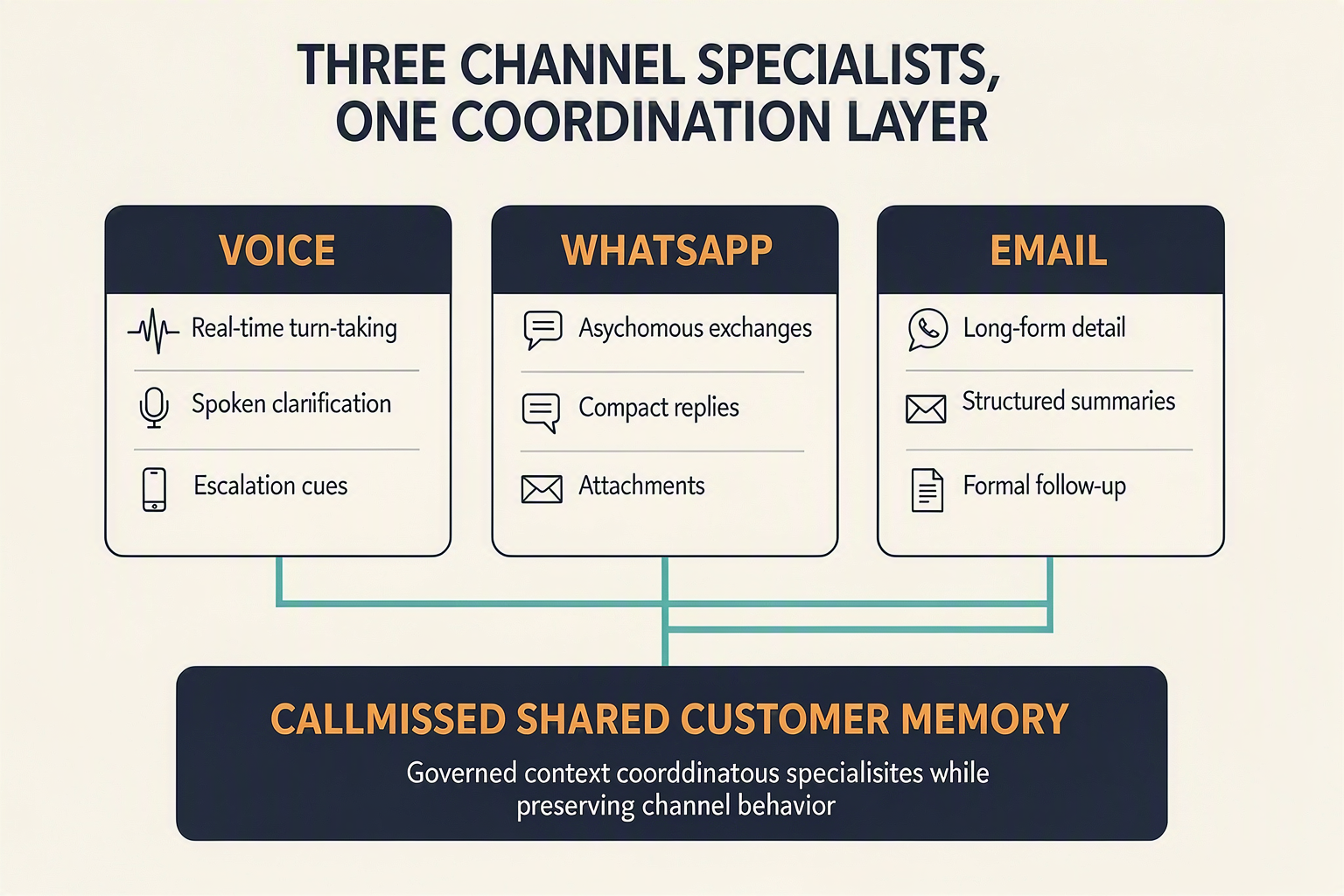
CallMissed should use distinct voice, WhatsApp, and email agents because each channel imposes different interaction constraints, tools, and customer expectations. A shared customer memory should coordinate these specialists—not turn them into copies of one channel-agnostic bot.
Channel agents are execution specialists
A generic bot typically applies the same prompting, response style, and decision logic everywhere. That approach ignores how communication changes by interface.
For CallMissed, each channel agent should have a specialized operating policy:
- The voice agent must handle interruptions, silence, speech-recognition uncertainty, pronunciation, and real-time clarification. It should retrieve only the context needed for the next spoken turn rather than narrating an entire case history.
- The WhatsApp agent should manage asynchronous replies, short message sequences, voice notes, photographs, documents, and channel-specific consent. It may need to acknowledge an attachment before another system has inspected it.
- The email agent should produce longer, structured material such as quotations, case summaries, instructions, and formal follow-ups. It also needs subject-line continuity, recipient controls, and careful treatment of forwarded content.
These differences become especially important for CallMissed’s Indic-first communication model. Supporting speech across 22 Indian languages is not simply a translation task: spoken clarification, code-switching, transliteration, and written formality can vary by language and channel.
Shared memory supplies facts, not identical behaviour
Under the proposed architecture, CallMissed Shared Customer Memory would sit between channel-specific agents and operational systems. An authorized agent could request a purpose-limited context package containing facts such as:
- The customer identity and how confidently it was matched.
- The active request, case state, and unresolved next action.
- Relevant preferences and valid channel permissions.
- Commitments already made by the business or customer.
- The source, timestamp, confidence, and retention status of each fact.
The memory layer should not dictate one universal response. If a customer sent product requirements through WhatsApp, the voice agent might confirm one ambiguous detail aloud; the email agent might use the same requirements to draft a structured proposal. The remembered fact remains consistent, while its presentation changes with the channel.
This separation also limits unnecessary disclosure. A voice agent may need to know that a document was verified without reading its sensitive contents aloud. An email agent may need an approved delivery address but not the full transcript from a prior support call.
The architecture follows separation of concerns
The underlying design principle is familiar in software engineering: separate shared state from channel-specific execution. CallMissed’s common context layer would manage identity, provenance, freshness, permissions, and conflicts, while each agent would manage interaction timing, formatting, tools, and escalation rules.
This model creates three practical boundaries:
- Memory decides what context is eligible for retrieval.
- The channel agent decides how to use that context appropriately.
- Governance controls decide whether the action is permitted and auditable.
This remains a proposed CallMissed design thesis rather than a verified description of the current product. Its value should therefore be tested through observable outcomes: whether handoffs preserve the correct next action, whether stale facts are challenged, and whether an agent responds safely when identity or memory confidence is uncertain.
Which key design developments define the proposed CallMissed model? (TABLE: design layer, purpose, observable behavior, internal verification needed)
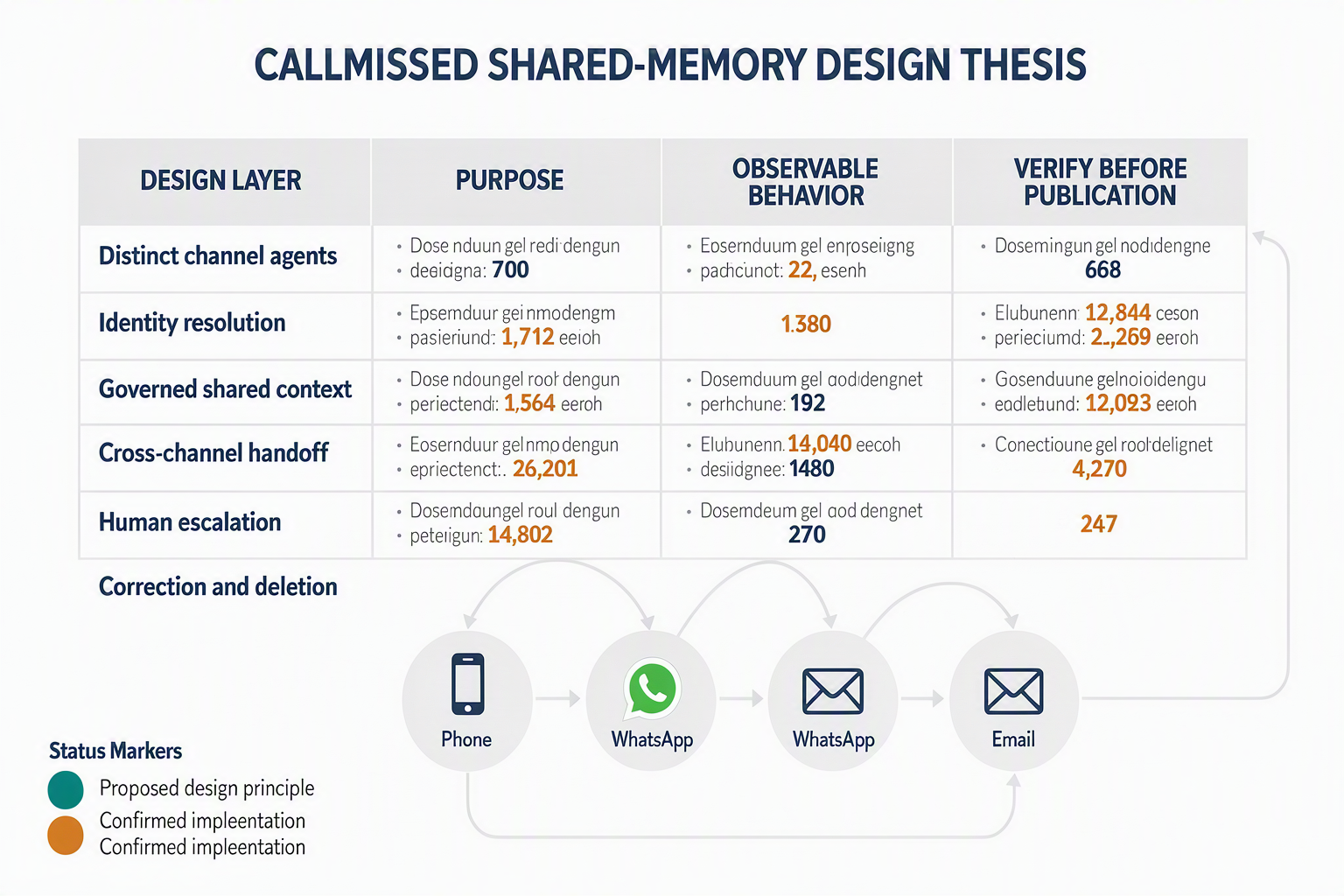
The proposed CallMissed model is defined by six coordinated design layers: identity resolution, provenance-aware event capture, structured memory, policy-controlled retrieval, channel-specific execution, and lifecycle governance. Together, these layers would let distinct voice, WhatsApp, and email agents share relevant customer context without treating raw conversation history as permanent truth.
Proposed shared-memory architecture
| Design layer | Purpose | Observable behavior | Internal verification needed |
|---|---|---|---|
| Identity resolution | Connect channel identifiers to the correct customer profile | CallMissed links a phone call, permitted WhatsApp account, and email address only when matching confidence satisfies policy | Matching rules, confidence thresholds, merge controls, and false-match rates |
| Provenance-aware ingestion | Record where each memory item originated | Staff can see whether an address, preference, or commitment came from voice, WhatsApp, email, a human, or an external system | Event schema, timestamp handling, source preservation, and attachment-processing behavior |
| Structured customer memory | Convert interactions into usable facts, intents, cases, commitments, and next actions | An agent retrieves “replacement photo received” rather than replaying an entire WhatsApp conversation | Supported memory types, extraction accuracy, confidence scoring, and treatment of unverified statements |
| Policy-controlled retrieval | Limit context by purpose, role, consent, channel, and case | An email agent can use quotation requirements while unrelated or restricted information remains unavailable | Authorization model, consent enforcement, tenant isolation, and sensitive-data filters |
| Channel-agent coordination | Give each specialist agent shared context without standardizing its behavior | Voice asks concise clarifying questions, WhatsApp handles attachments, and email produces a structured follow-up from the same case state | Agent boundaries, latency, prompt construction, fallback behavior, and human-handoff payloads |
| Memory lifecycle and audit | Keep context correct, current, reviewable, and removable | Authorized users can inspect provenance, correct a stale preference, delete eligible data, and review access history | Retention schedules, deletion propagation, audit logs, conflict resolution, and legal-policy alignment |
What changes at the design level
The important development is the separation of memory, reasoning, and channel presentation. CallMissed’s proposed common context layer should maintain a governed record, while each channel agent decides how to act on the context within its own latency and formatting constraints.
That separation requires several explicit rules:
- Facts are not summaries: A model-generated summary should remain distinguishable from a customer-confirmed fact.
- Freshness is queryable: Every durable item should carry a timestamp or validity state so that an old delivery preference cannot silently override a new instruction.
- Conflicts remain visible: If a customer provides different addresses over voice and WhatsApp, CallMissed should request confirmation rather than selecting one without explanation.
- Uncertainty changes behavior: Low-confidence identity or context should trigger clarification, restricted retrieval, or human escalation.
- Memory access is purposeful: An agent should receive only the minimum context needed for the current interaction.
Verification before product claims
Because the editorial research found no independent CallMissed documentation validating this shared-memory implementation, these layers must remain a proposed architecture until internally confirmed. Publication should depend on three verification steps:
- Inspect system behavior using test customers, conflicting facts, uncertain identities, and cross-channel handoffs.
- Review technical controls for permissions, retention, correction, deletion, provenance, and tenant isolation.
- Document measurable boundaries, including what is stored, which agents can retrieve it, and what happens when memory is missing or unreliable.
The resulting model is not “one bot on three channels.” It is a governed coordination system in which specialized CallMissed agents share only the context they are authorized—and sufficiently confident—to use.
What should CallMissed remember—and how is useful shared context different from raw conversation history?
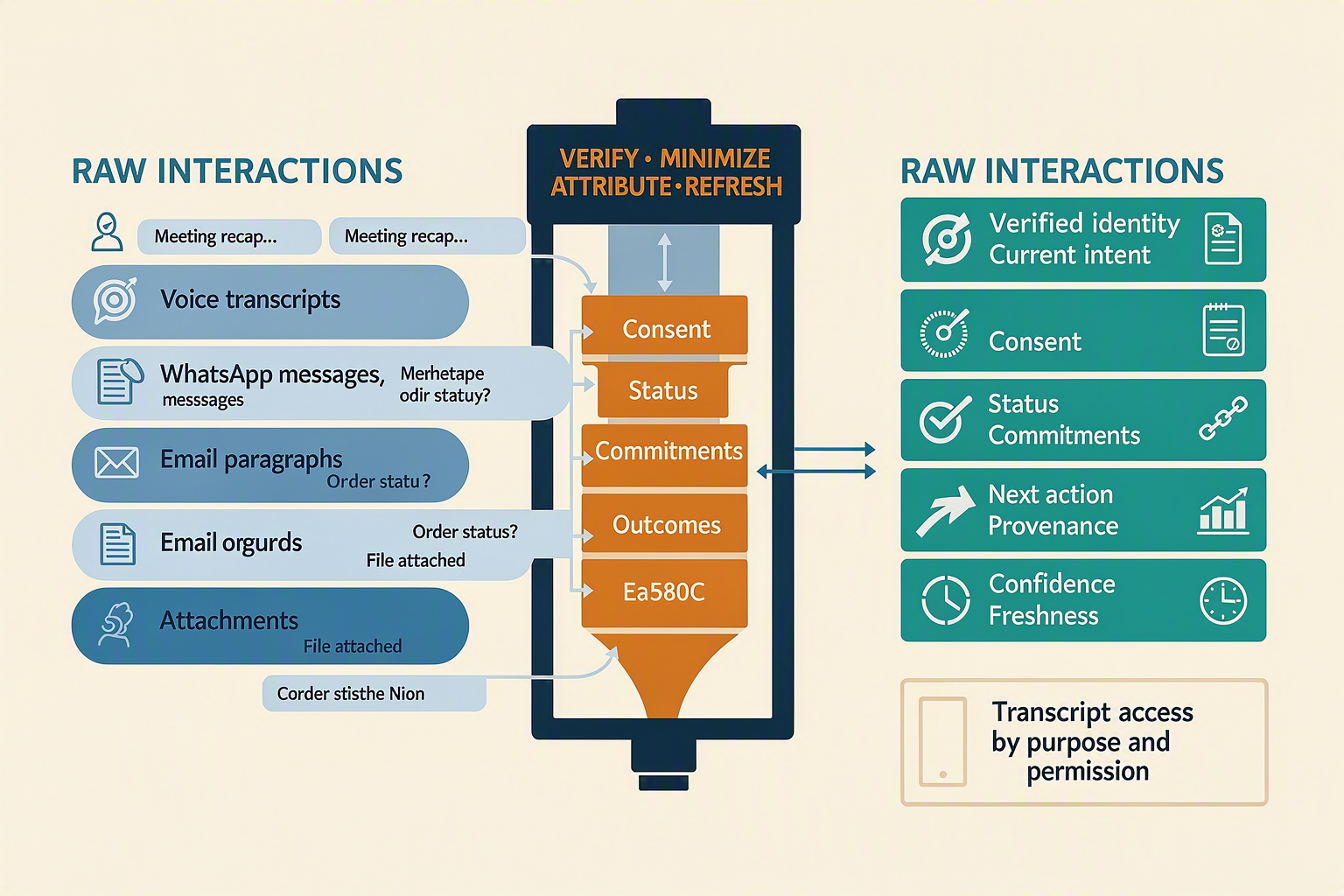
CallMissed should remember the smallest set of verified, current, and permissioned facts needed to continue the customer’s journey. Raw transcripts may serve as controlled evidence, but useful shared context is a structured operational record with provenance, confidence, ownership, and an expiry rule.
CallMissed should store decisions, not conversational noise
A ten-minute call or a long WhatsApp thread may contain repetition, corrections, speculation, and sensitive details unrelated to the eventual outcome. Copying that entire history into every AI prompt would increase privacy exposure and make stale or contradictory statements easier to misuse.
Instead, the proposed CallMissed memory layer should extract discrete records such as:
- Identity: verified customer ID, account reference, and the method used to establish identity.
- Current intent: the latest confirmed objective, such as replacing a damaged order or requesting a quotation.
- Case state: open, awaiting documents, escalated, resolved, or closed.
- Commitments: who promised what, by when, and through which channel.
- Consent and permissions: whether the business may initiate a WhatsApp call, send email, or retain particular information.
- Preferences: language, contact channel, and suitable calling time—with a freshness limit.
- Artifacts: references to a photograph, invoice, recording, or quotation without unnecessarily duplicating the file.
- Next action: the responsible agent or employee, required action, deadline, and escalation condition.
Each record should include source, timestamp, confidence, verification status, retention class, and last-updated time. “Customer prefers Hindi” is unsafe as a timeless fact; “customer selected Hindi for this support case during a verified call on 2 August 2026” is bounded and auditable.
Raw history should remain evidence, not become automatic truth
CallMissed should distinguish at least three layers:
- Source events: messages, call transcripts, email content, attachments, and agent actions.
- Derived memory: structured facts or summaries extracted from those events.
- Current working context: the minimum subset supplied to a particular agent for a particular task.
This separation matters because customers change their minds. If a WhatsApp message requests delivery on Friday but a later voice call confirms Monday, CallMissed should not expose both dates as equally valid. The memory layer should preserve both source events while marking Monday as the current instruction and recording why it superseded Friday.
An AI-generated summary must also remain a derived interpretation, not a verified customer statement. High-impact details—payment instructions, addresses, legal acceptance, health information, or account ownership—may require explicit confirmation or human review.
CallMissed agents need purpose-specific views
Shared memory does not mean unrestricted access. CallMissed should construct a task-scoped context view for each channel agent:
- A voice agent may need the active issue, prior troubleshooting, and the next clarification question.
- A WhatsApp agent may need the requested document and permission to continue asynchronously.
- An email agent may need approved commercial terms and the recipient’s verified address.
When confidence is low, identity is ambiguous, or records conflict, the agent should ask rather than assume. The governing principle is simple: remember enough to continue responsibly, retain enough to explain decisions, and expose only what the present interaction requires.
How can CallMissed preserve customer continuity when conversations move between channels? Practical workflows for missed calls, quotes, escalations, after-hours handoffs, and recurring service
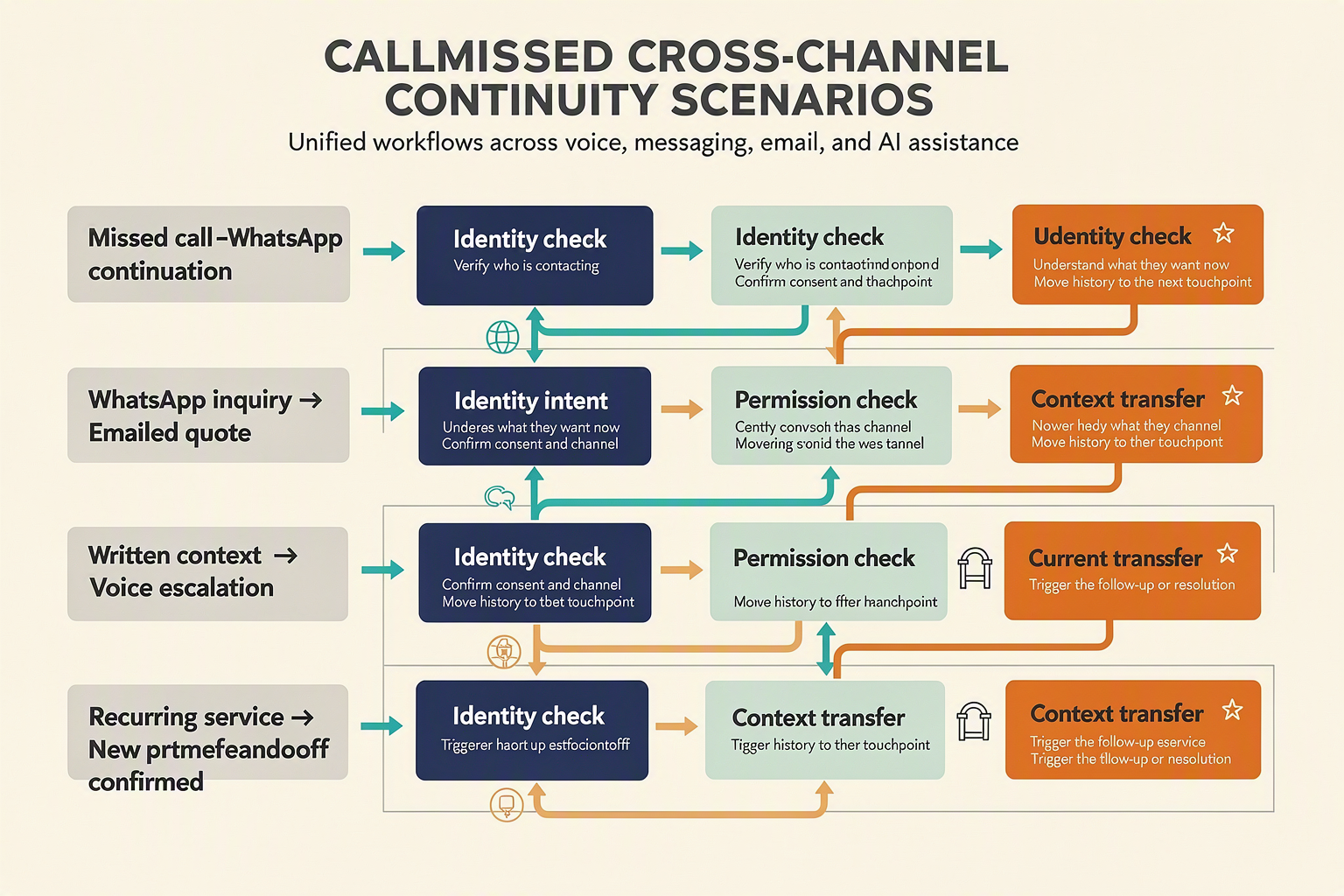
CallMissed can preserve continuity by turning each channel transition into a structured handoff, not a transcript dump. The proposed shared memory layer should pass verified identity, current intent, case status, commitments, permissions, evidence references, and the next action to the appropriate voice, WhatsApp, email, or human agent.
Missed call to WhatsApp continuation
When a business misses a call, CallMissed should create a provisional interaction record rather than assume the caller’s identity or intent.
- The customer receives a policy-compliant WhatsApp message acknowledging the missed call.
- Identity is matched using verified signals, with uncertainty explicitly recorded.
- The WhatsApp agent gathers the reason for contact and any useful attachments.
- Shared memory records a concise outcome: “Installation issue reported; invoice image received; callback requested after 16:00.”
- A later voice agent sees the issue and next step, but only accesses the invoice if its role permits it.
If identity cannot be established reliably, CallMissed should start a fresh thread and ask the customer to verify relevant details. Continuity must never come at the cost of context leaking to the wrong person.
WhatsApp inquiry to emailed quote
For quotation workflows, WhatsApp is effective for gathering compact requirements, while email is better for delivering a formal proposal. CallMissed should transfer structured fields rather than ask the email agent to interpret an entire chat repeatedly.
The shared record might include:
- Requested product or service
- Quantity, location, and delivery window
- Confirmed commercial requirements
- Unresolved pricing questions
- Customer consent to receive email
- Source and timestamp for every material fact
The email agent can then draft a quote while clearly marking assumptions for staff approval. Sending the email should write the quote version, validity period, and promised follow-up back into memory, preventing another agent from referring to an obsolete proposal.
Written context to voice escalation
When a customer requests a call after a difficult WhatsApp exchange, CallMissed’s voice agent should receive a short escalation brief: the verified problem, troubleshooting already attempted, customer sentiment where confidently inferred, and the resolution being sought.
It should not recite private internal notes or pretend to remember uncertain details. A useful opening would confirm context—“I understand you have already tried resetting the device”—and then invite correction. Any corrected fact should supersede the earlier summary while preserving provenance for auditability.
After-hours interaction to human handoff
An after-hours agent should leave the morning team with an operational package, not merely an unread conversation:
- Customer identity and verification status
- Issue severity and active case status
- Attachments or evidence received
- Actions already taken
- Promises made and deadlines stated
- Recommended next action
- Confidence, freshness, and consent indicators
CallMissed should show the human agent what was said by the customer, what was inferred by AI, and what was verified by a system or employee. That distinction reduces the risk of an AI-generated summary becoming an unquestioned fact.
Recurring service without stale-memory errors
For recurring maintenance, deliveries, or appointments, CallMissed should treat preferences as time-bounded. A previous preference such as “weekday mornings” must not override a new request for Saturday service.
The workflow should prioritize the latest verified instruction, flag conflicts, and ask for clarification when necessary. Businesses can then measure whether shared memory reduces repetition or handoff errors against their own baselines—without assuming that continuity automatically guarantees faster service, lower cost, or higher satisfaction.
What potential impact could CallMissed shared customer memory have—and which failure modes must businesses test before relying on it?
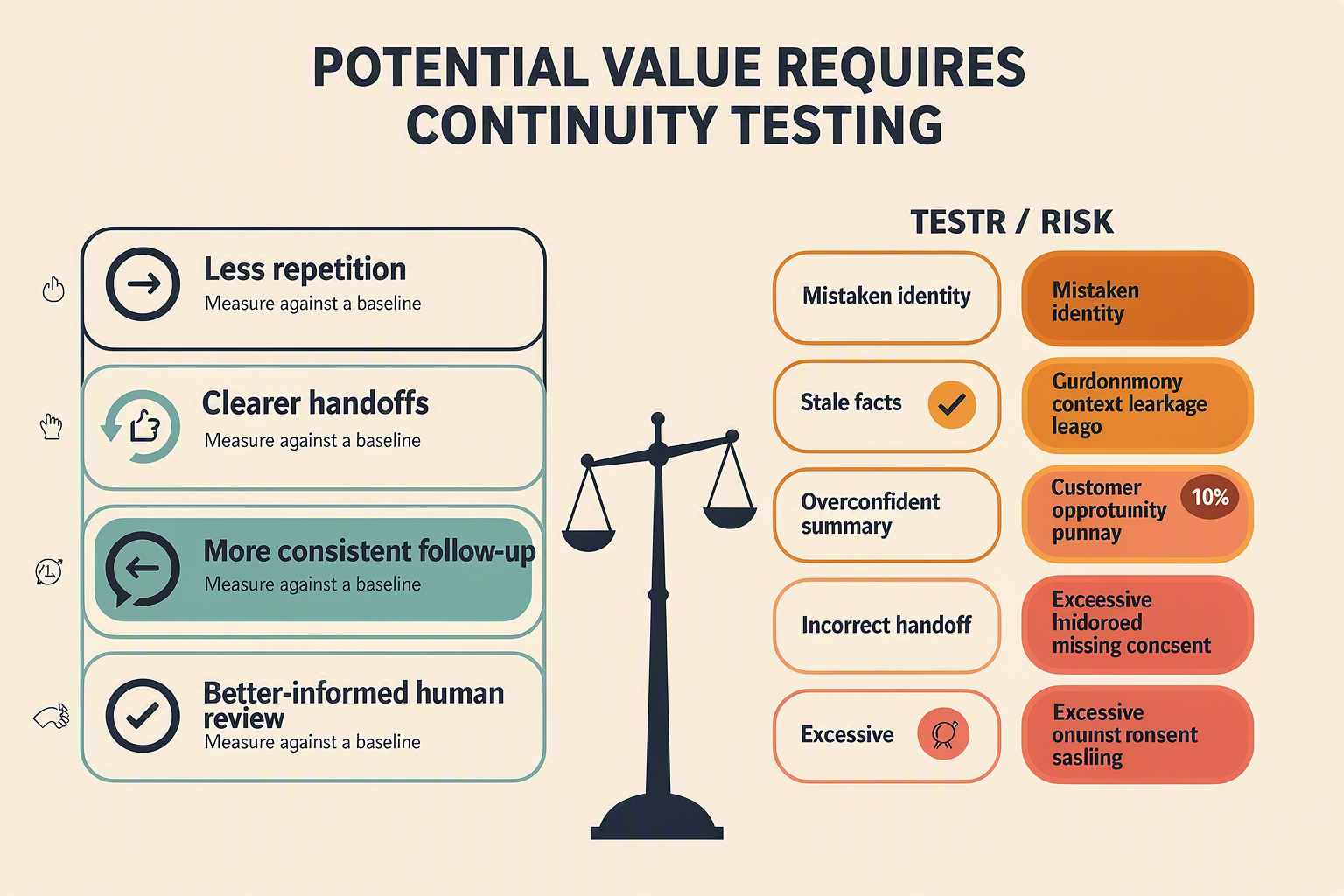
CallMissed shared customer memory could reduce avoidable repetition, preserve commitments across channels, and give human teams a clearer operational picture. These are potential outcomes, not guaranteed performance claims; businesses should validate them against existing service baselines before depending on the memory layer.
Potential operational impact for CallMissed workflows
A governed memory layer could improve continuity without requiring voice, WhatsApp, and email agents to behave identically. Its value should be measured through observable workflow changes:
- Fewer repeated questions: Track how often verified identity, order details, or issue descriptions must be collected again after a channel change.
- More complete handoffs: Measure whether agents receive the customer’s current intent, evidence submitted, previous commitments, and next expected action.
- Lower handoff abandonment: Compare the percentage of customers who complete a journey after moving from voice to WhatsApp or from WhatsApp to email.
- Fewer commitment errors: Audit whether promised callbacks, quotations, refunds, or documents are completed within the stated timeframe.
- Reduced human reconstruction work: Measure how long staff spend reading transcripts and rebuilding case history before acting.
CallMissed should test these indicators against a pre-deployment baseline. A shorter interaction is not automatically better: an agent that acts quickly on incorrect memory can create a faster but more damaging failure.
High-risk failure modes CallMissed must expose
Businesses should test shared memory adversarially before using it for consequential actions:
- Mistaken identity resolution: Two customers may share a phone, email address, device, family account, or similar name. When identity confidence is insufficient, CallMissed should ask for verification rather than merge records automatically.
- Cross-customer context leakage: A WhatsApp agent must never disclose another customer’s order, complaint, address, or conversation summary. Tests should deliberately create similar identities and concurrent cases to detect boundary failures.
- Stale facts overriding new instructions: A remembered language, delivery address, preferred contact time, or recurring order must not supersede a customer’s latest request. Every material fact needs freshness, provenance, and an update timestamp.
- Overconfident summarization: Generated summaries can omit qualifications or convert uncertain statements into facts. CallMissed should preserve links to source messages and distinguish verified facts from model inferences.
- Incorrect handoff state: A voice agent may believe a document was received when the WhatsApp upload failed, or an email agent may treat a draft quote as approved. State transitions should depend on confirmed events, not conversational assumptions.
- Consent and retention failures: Permission to message on one channel should not silently authorize another channel or indefinite storage. Businesses must test consent withdrawal, retention expiry, deletion, and purpose restrictions.
- Uncorrectable memory: Staff and customers need a defined way to challenge inaccurate records. Corrections should propagate to authorized agents without erasing the audit trail showing what changed.
A practical reliability gate
Before production reliance, a business should run controlled journeys covering:
- known, unknown, duplicated, and partially verified identities;
- conflicting facts submitted through different channels;
- missing memory and unavailable retrieval services;
- sensitive data that agents should redact or avoid retaining;
- revoked consent and completed deletion requests;
- human escalation where confidence falls below policy thresholds.
The safest CallMissed design would fail closed on identity and permissions, but fail gracefully on missing context. An agent should say that it cannot verify prior information and ask a targeted question—not fabricate continuity. Shared memory becomes dependable only when uncertainty is visible, corrections are possible, and every consequential remembered fact can be traced to its source.
Which expert questions should shape responsible CallMissed memory design? Legal, security, operations, customer-service, and AI-governance perspectives

A responsible CallMissed shared customer memory should be designed through multidisciplinary review, not treated as an ordinary transcript database. Legal, security, operations, customer-service, and AI-governance experts should each be able to challenge what is remembered, why it is retained, who can use it, and how errors are corrected.
Legal and privacy questions
Legal reviewers should begin with purpose and permission, particularly when customer information moves between voice, WhatsApp, and email.
- What lawful and clearly communicated purpose justifies each memory field?
- Does consent or another applicable basis cover reuse across channels, or only collection on the original channel?
- How will CallMissed handle customer requests to access, correct, or delete remembered information?
- Which retention period applies to identity, consent, case status, recordings, attachments, and generated summaries?
- Could data cross geographic or organizational boundaries when models, communication providers, or subprocessors are involved?
A customer agreeing to receive an emailed quotation does not automatically authorize indefinite reuse of every voice-call detail. Channel access and memory access should be evaluated separately.
Security questions
Security experts should assume that identity matching can fail and design containment accordingly. CallMissed memory must prevent one customer’s context from appearing in another customer’s conversation.
- How are phone numbers, WhatsApp identities, email addresses, account IDs, and verified attributes linked?
- What confidence threshold permits an automatic match, and when must CallMissed ask for verification?
- Are access rights scoped by role, tenant, case, channel, and purpose?
- Are memory reads, writes, corrections, exports, and deletions auditable?
- How are sensitive attachments, payment details, credentials, and authentication answers excluded or protected?
Security testing should explicitly simulate account reassignment, shared family phone numbers, forwarded emails, compromised inboxes, and duplicate CRM records.
Operations and reliability questions
Operations leaders should determine how CallMissed behaves when memory is incomplete, unavailable, conflicting, or stale.
- What happens if the shared context service times out during a live voice call?
- Can channel agents continue safely without inventing continuity?
- How are conflicts resolved when a customer gives different instructions on WhatsApp and email?
- Which facts expire automatically, and which require human confirmation?
- Can teams measure failed handoffs, uncertain identity matches, stale-memory use, and correction rates?
Outdated preferences must never silently override a customer’s current request. Fresh, verified instructions should take precedence over older inferred context.
Customer-service questions
Customer-service specialists should review what agents and customers actually experience.
- Does a human receive the issue, evidence, commitments, and next action at handoff?
- Can staff see the source and date of each remembered fact?
- Can customers challenge a summary without repeating the entire interaction?
- Does each CallMissed channel agent adapt the same context appropriately for speech, compact WhatsApp replies, or structured email?
- When should an agent say, “I may have outdated information—can you confirm?”
These questions keep continuity transparent rather than making memory feel like hidden surveillance.
AI-governance questions
AI-governance reviewers should distinguish reported facts, model-generated summaries, and inferences.
- Is every memory item labelled with provenance, confidence, freshness, and verification status?
- Can a model-generated summary become durable memory without review?
- Are sensitive attributes inferred unnecessarily?
- How are hallucinated commitments detected before another agent acts on them?
- Who approves material changes to extraction, summarization, and retrieval policies?
Before deployment, CallMissed should require three observable gates: authorized purpose, reliable identity resolution, and reversible memory. If any gate fails, the safer behavior is to ask, escalate, or proceed without remembered context.
What should your business evaluate before trusting CallMissed? (TABLE: buyer question, evidence to request, continuity test, acceptable fallback)
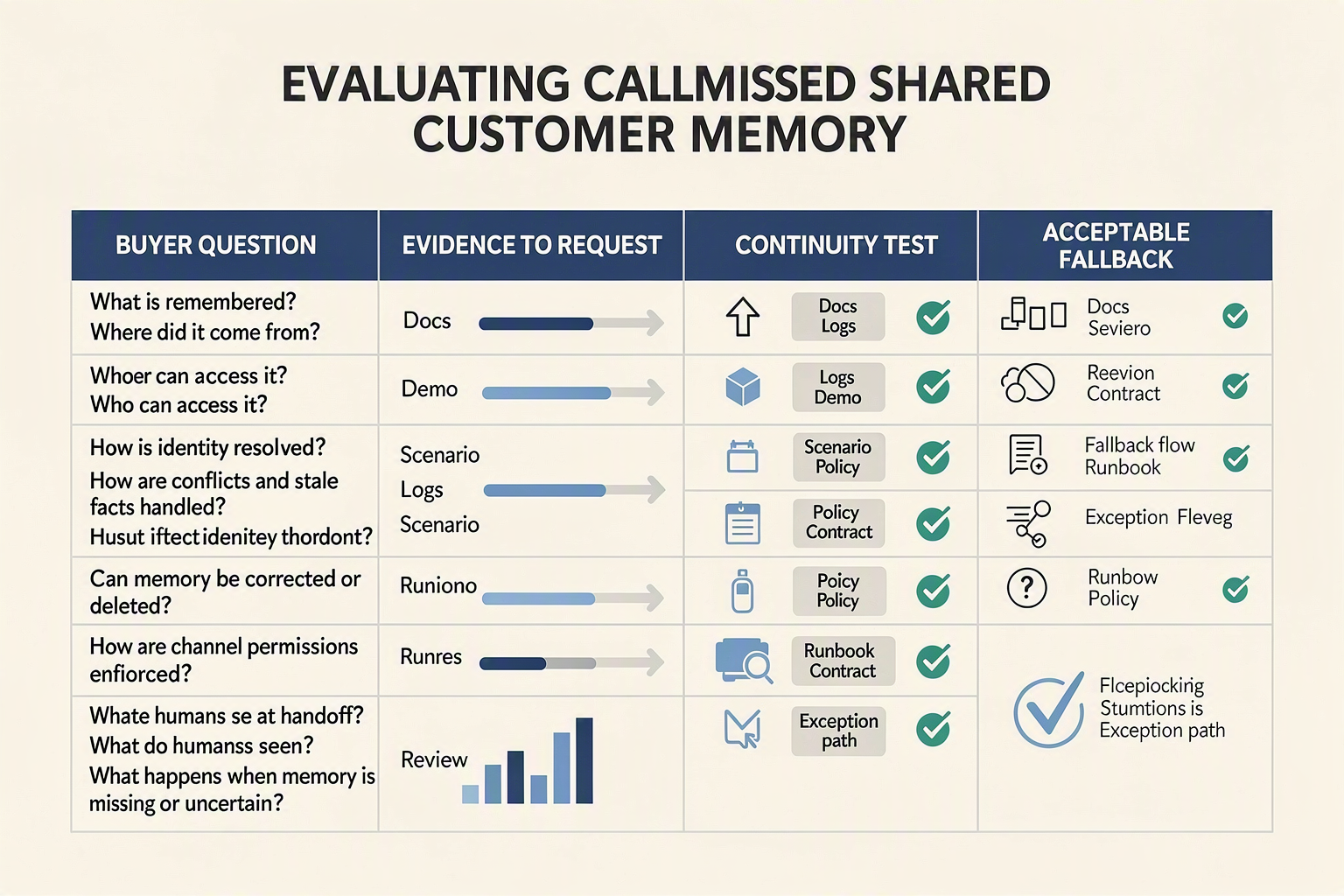
Before trusting CallMissed Shared Customer Memory, a business should require observable proof that the proposed context layer preserves continuity without confusing identities, exposing data, or treating uncertain information as fact. Because no independent product documentation was available in the research supplied for this article, every product-specific control below should be demonstrated by CallMissed and verified internally before deployment.
Buyer evaluation matrix
| Buyer question | Evidence to request | Continuity test | Acceptable fallback |
|---|---|---|---|
| How does CallMissed resolve identity across channels? | Matching rules for phone numbers, WhatsApp identities, email addresses, verified account IDs, and household or shared-device cases | Start on voice, continue through a different WhatsApp number, and send an email from an unrecognized address | Keep records separate, ask the customer to verify identity, and route ambiguous matches for human review |
| What enters shared customer memory? | Field-level schema showing intent, consent, case status, commitments, preferences, confidence, freshness, and provenance | Mention a preference casually, then explicitly change it on another channel | Prefer the newer verified instruction; do not promote casual conversation into a durable fact automatically |
| Can every remembered fact be traced? | An interface or audit record showing source channel, timestamp, originating message, extraction method, and subsequent edits | Ask a voice agent where a remembered delivery instruction came from | State the source or acknowledge uncertainty rather than presenting an unsupported summary as confirmed |
| How are permissions and sensitive data enforced? | Role-based access controls, channel-consent rules, masking policies, retention schedules, and audit logs | Share sensitive information by email, then contact an unrelated sales workflow through WhatsApp | Withhold restricted context, reveal only the minimum necessary information, and escalate when authorization is unclear |
| Can memory be corrected, deleted, or expired? | Staff and customer correction workflows, deletion procedures, retention configuration, and downstream propagation records | Correct an outdated address and request deletion of an old preference | Mark disputed data as unusable immediately, process deletion according to policy, and prevent stale copies from resurfacing |
| What happens when continuity fails? | Failure-state designs, human-handoff payloads, confidence thresholds, monitoring, and incident procedures | Interrupt a WhatsApp-to-email handoff or make the memory service unavailable during a call | Continue with channel-local context, explain that prior details are unavailable, avoid guessing, and transfer to a human with available evidence |
Require demonstrations, not architecture slides
A credible evaluation should use scripted adversarial journeys, not only ideal demonstrations. CallMissed should be tested with mistaken identity matches, contradictory preferences, absent consent, deleted facts, shared phone numbers, delayed messages, and unavailable memory services.
For each journey, evaluators should record:
- What the channel agent knew and what it correctly withheld.
- Which source supported each fact, including its timestamp and confidence.
- Whether the customer had to repeat information, and whether repetition was justified by security or uncertainty.
- What the human agent received at escalation: verified issue, actions completed, unresolved next step, and uncertainty—not merely a full transcript.
- Whether corrections propagated across voice, WhatsApp, and email.
Define acceptance criteria before procurement
Continuity should be measured against the business’s existing baseline rather than assumed to improve service automatically. Useful measures include the rate of incorrect identity merges, unsupported factual claims, repeated-information requests, failed handoffs, correction completion, and unauthorized context exposure.
The decisive principle is safe degradation. If CallMissed cannot verify identity, provenance, consent, or freshness, the acceptable behavior is to narrow access, ask for clarification, use channel-local information, or involve a human. A shared memory system earns trust not when it remembers everything, but when it reliably knows what not to remember, disclose, or assume.
Why should CallMissed treat accurate, bounded, explainable, and controllable memory as the foundation of voice, WhatsApp, and email AI?
CallMissed should treat accurate, bounded, explainable, and controllable memory as foundational infrastructure because every cross-channel response depends on whether the retrieved context is trustworthy and appropriate to use. A fluent answer built on the wrong customer, expired preference, or unverified summary can make continuity more harmful than starting again.
Four properties of trustworthy memory
For the proposed CallMissed shared-memory architecture, these properties should operate as enforceable requirements:
- Accurate: Memory should distinguish verified facts from customer claims, agent interpretations, and model-generated summaries. Conflicting information should remain visible rather than being silently merged.
- Bounded: Each agent should retrieve only the minimum context needed for its task, customer, channel, and authorization level. An email-drafting agent may need quotation requirements but not an unrelated voice transcript containing sensitive information.
- Explainable: Every remembered item should carry provenance, timestamp, confidence, verification status, and source channel. Staff should be able to ask, “Why does the system believe this?”
- Controllable: Authorized users and customers should have practical mechanisms to correct, suppress, export, or delete information where applicable. Retention and access policies must be enforceable rather than merely documented.
These safeguards matter especially for voice. A live AI agent has little time to inspect ambiguous context before speaking, while an incorrect statement can immediately influence the conversation. CallMissed should therefore make retrieval conservative: uncertainty should trigger clarification or human escalation, not confident improvisation.
Make governance part of the response path
Memory controls should run before and after generation, not sit in a separate compliance dashboard. A dependable interaction could follow this sequence:
- Resolve identity using permitted signals and assign an explicit confidence level.
- Check whether the agent and channel are authorized to use the relevant information.
- Retrieve purpose-specific facts within freshness and retention limits.
- expose conflicts, uncertainty, and provenance to the agent.
- Generate the voice, WhatsApp, or email response using channel-specific rules.
- Write back only a structured outcome or approved fact—not every inference made by the model.
- Record access, changes, handoffs, and deletion events in an auditable log.
No independently validated CallMissed benchmark for shared-memory accuracy, conversion uplift, or service-cost reduction was available in the research supplied for this article. Businesses should therefore evaluate any proposed implementation against their own baselines rather than treating continuity as an automatic performance guarantee.
Turn principles into release gates
Before CallMissed shared customer memory influences production conversations, teams should test observable failure conditions:
- Can one customer’s context ever appear in another customer’s response?
- Does a changed delivery preference override an older, previously verified preference?
- Will the agent disclose when a remembered fact is uncertain or outdated?
- Can staff trace a summary back to the originating call, WhatsApp message, or email?
- Does revoking consent stop future retrieval across every affected channel?
- Can a human correct a false memory without editing multiple disconnected systems?
- Does the agent proceed safely when no memory is available?
The central design principle is simple: memory should earn the right to influence each response. For CallMissed, that means making governance inseparable from retrieval, generation, and handoff—so continuity remains useful without becoming invisible, permanent, or uncontrollable.
Frequently asked questions about CallMissed shared customer memory: Is it one generic bot? What information should it retain? How should identity be matched? Can customers correct or delete memory? What happens when context is uncertain?
Is CallMissed shared customer memory one generic bot used across voice, WhatsApp, and email?
What information should CallMissed shared customer memory retain?
How should CallMissed match customer identity across phone calls, WhatsApp, and email?
Can customers correct or delete information in CallMissed shared customer memory?
What should a CallMissed agent do when shared customer context is missing, stale, or uncertain?
How can a business evaluate whether CallMissed shared customer memory is safe and useful?
Conclusion
CallMissed Shared Customer Memory should become a governed coordination layer—not a permanent transcript archive or one generic bot replicated across channels. Its purpose is to help distinct voice, WhatsApp, and email agents preserve continuity while respecting each channel’s format, latency, permissions, and customer expectations.
The central takeaways are:
- Continuity depends on trusted context. Authorized agents should share verified identity, current intent, consent, case status, commitments, preferences, unresolved actions, freshness, confidence, and provenance.
- Specialized agents should remain specialized. Voice needs real-time clarification, WhatsApp handles asynchronous messages and attachments, and email supports detailed, structured follow-ups.
- Governance is part of the architecture. CallMissed should support data minimization, retention limits, access controls, correction, deletion, auditability, sensitive-data handling, and human escalation.
- Performance must be observable. Businesses should test mistaken identity, stale facts, context leakage, unsupported summaries, missing consent, and uncertain handoffs rather than assuming shared memory improves outcomes.
What to watch next
The decisive development will be whether cross-channel memory systems can explain what they remember, where each fact originated, who may use it, and what happens when context conflicts or confidence is low. Any operational benefits should be measured against established service baselines.
To follow this evolution, explore CallMissed, an AI-native communication platform spanning voice, WhatsApp, email, and Indic-first speech across 22 Indian languages. The practical question is: Will your next AI agent merely answer—or remember responsibly enough to continue the customer’s journey?
Related Reading
Related Posts

Ready to automate customer conversations?
Launch AI voice agents and WhatsApp bots with CallMissed — one API, 22+ Indian languages.