

AI Voice Agent vs Answering Service: 2026 Small-Business Buyer’s Guide


Compare AI voice agent vs answering service options by cost, privacy, integrations, and virtual receptionist fit for your small business.
AI Voice Agent vs Answering Service: 2026 Small-Business Buyer’s Guide
What happens to the call that arrives at 2:17 a.m.—does it become a booked customer or tomorrow’s missed opportunity? In 2026, the AI voice agent vs answering service decision matters because customers can call during any of the week’s 168 hours, while a small business must balance responsiveness against staffing costs, consistency, and privacy.
An AI agent can provide always-on, standardized conversations and connect directly with calendars, customer relationship management systems, and messaging channels. A traditional virtual receptionist adds human judgment and empathy, especially when requests are sensitive or unpredictable. Platforms such as CallMissed extend the AI model with WhatsApp Business calling, AI voice agents, and support for 22 Indian languages.
This guide compares cost structures, availability, quality control, integrations, escalation paths, and data handling—then provides a practical framework for deciding whether AI, human answering, or a hybrid approach fits your business.
AI voice agent vs answering service: Which is better for a small business in 2026?
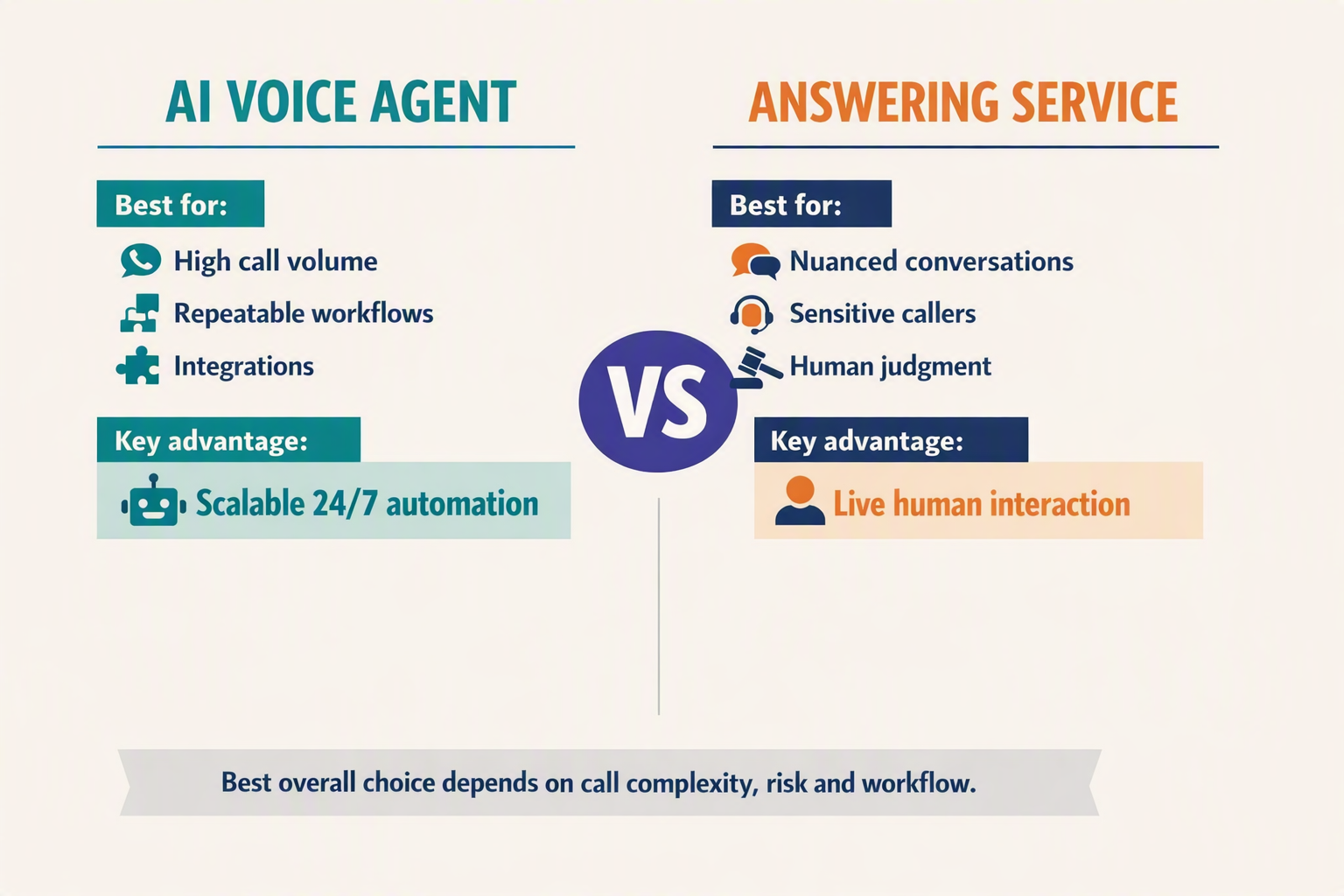
Neither option wins universally: an AI voice agent suits repeatable, high-volume workflows, while a human virtual receptionist is stronger for emotional, ambiguous, or high-stakes conversations. For many small businesses, a hybrid model offers the safest balance.
2026 decision snapshot
- Cost: AI typically uses subscription-plus-usage pricing per minute or call; answering services commonly charge a base plan plus minutes, message taking, transfers, or after-hours surcharges.
- Availability: AI can answer concurrent calls without shift scheduling; a traditional service’s coverage, holiday support, queue limits, and overflow handling depend on the contracted plan.
- Quality control: AI provides consistent scripts and can make every recording, transcript, and outcome auditable; human quality varies by receptionist, training, account notes, and QA frequency.
- Integrations: AI agents can write structured data directly to calendars, CRM systems, ticketing tools, and WhatsApp workflows; human services may rely on messages, email summaries, or supported connectors.
- Escalation: AI works best when rules define when to transfer, create a callback, or contact an on-call employee; humans handle exceptions more naturally but still need clear escalation authority.
- Privacy: Both options require call notices, role-based access, retention limits, and vendor agreements aligned with applicable rules such as India’s Digital Personal Data Protection Act, 2023 or the European Union’s GDPR.
- Best fit: In the AI voice agent vs answering service choice, select AI for booking, FAQs, qualification, and status checks; choose humans for complaints, emergencies, sensitive intake, and unpredictable requests.
How do availability, call handling, integrations, escalation, quality control and privacy compare? (TABLE)
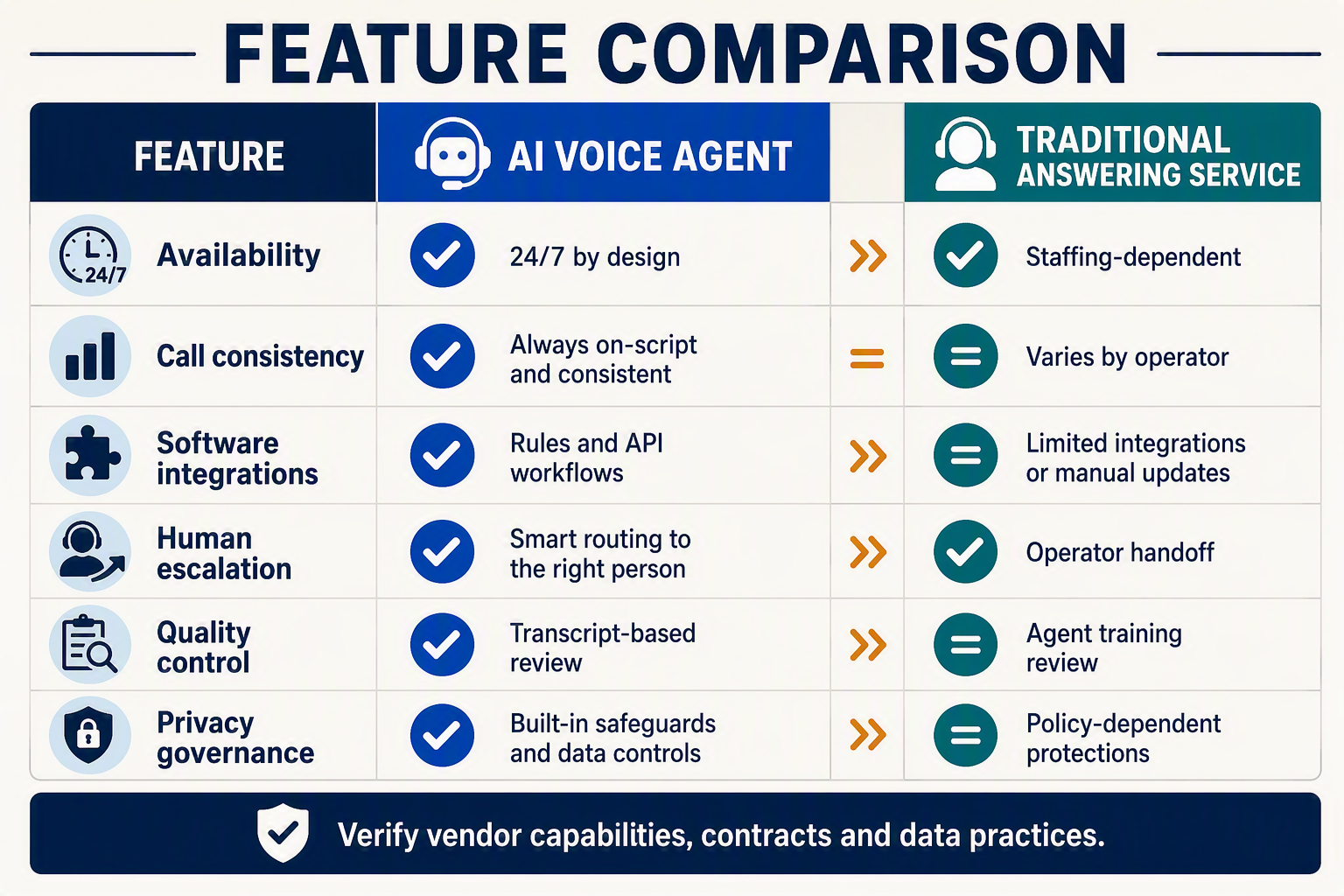
The AI voice agent vs answering service comparison comes down to configurability versus human judgment. AI offers programmable, auditable handling at any hour, while a virtual receptionist can interpret unfamiliar or emotionally sensitive situations more naturally.
| Criterion | AI voice agent | Traditional answering service | Buyer verification |
|---|---|---|---|
| Availability | Software can operate across all 168 hours per week and handle simultaneous calls, subject to telephony and platform limits. | Coverage depends on contracted hours, receptionist capacity, queues, holidays and overflow policies. | Test midnight, weekend, holiday and concurrent-call scenarios. |
| Call handling | Follows defined prompts for FAQs, qualification, booking, payments and status checks; accuracy depends on speech recognition and knowledge quality. | Handles accents, interruptions and unexpected questions with human discretion; performance varies by agent and account familiarity. | Review recordings from at least 10 representative call scenarios, including noisy and multilingual calls. |
| Integrations | Can send structured fields to CRM, calendar, ticketing, email, webhooks and messaging workflows in real time. | Often delivers messages by email, SMS or portal; direct CRM updates depend on supported connectors or manual entry. | Confirm field mapping, duplicate prevention, retry logic and API rate limits in writing. |
| Escalation | Uses explicit triggers such as caller intent, failed authentication, negative sentiment or repeated misunderstanding. | A receptionist can recognize nuance but needs documented transfer authority and an accurate on-call roster. | Run warm-transfer, unavailable-agent, voicemail and emergency-routing tests. |
| Quality control | Central prompts, knowledge bases, transcripts and disposition codes make changes repeatable and measurable. | Requires recruitment, scripts, coaching, call sampling and periodic QA across individual receptionists. | Define monthly targets for answer rate, booking accuracy, transfer success and complaint rate. |
| Privacy | May process audio, transcripts, summaries and extracted personal data across several technology providers. | Exposes caller information to the answering company’s staff, systems and subcontractors. | Map data locations, subprocessors, access roles, encryption, deletion periods and breach procedures. |
Practical procurement checks
- AI: Ask how the system behaves when confidence is low; a safe workflow should clarify, transfer or create a callback rather than invent an answer.
- Answering service: Request contractual details for queue limits, abandoned calls, holiday coverage, bilingual staffing and the number of businesses each receptionist may represent.
- Small business integrations: Require a live demonstration that creates, updates and retrieves a real CRM contact or calendar appointment—not merely an emailed call summary.
- Multilingual coverage: CallMissed documents Speech-to-Text and Text-to-Speech support across 22 Indian languages, a concrete consideration for businesses serving regional Indian audiences.
- WhatsApp workflows: CallMissed can bridge inbound and business-initiated WhatsApp Business calls to an AI voice agent, allowing voice, chat and CRM context to share one engagement workflow.
- Escalation design: Set no more than two failed-understanding attempts before transfer, and define separate paths for emergencies, complaints, cancellations and high-value leads.
- Quality evidence: Compare transcription accuracy, completed-task rate and transfer success by language and call type; an overall average can conceal failures affecting specific customer groups.
- Privacy governance: India’s Digital Personal Data Protection Act, 2023 and the European Union’s General Data Protection Regulation require context-specific controls; buyers should document lawful processing, notices, retention, access and deletion with qualified counsel.
How much do AI voice agents and answering services cost, and which offers better value? (TABLE)
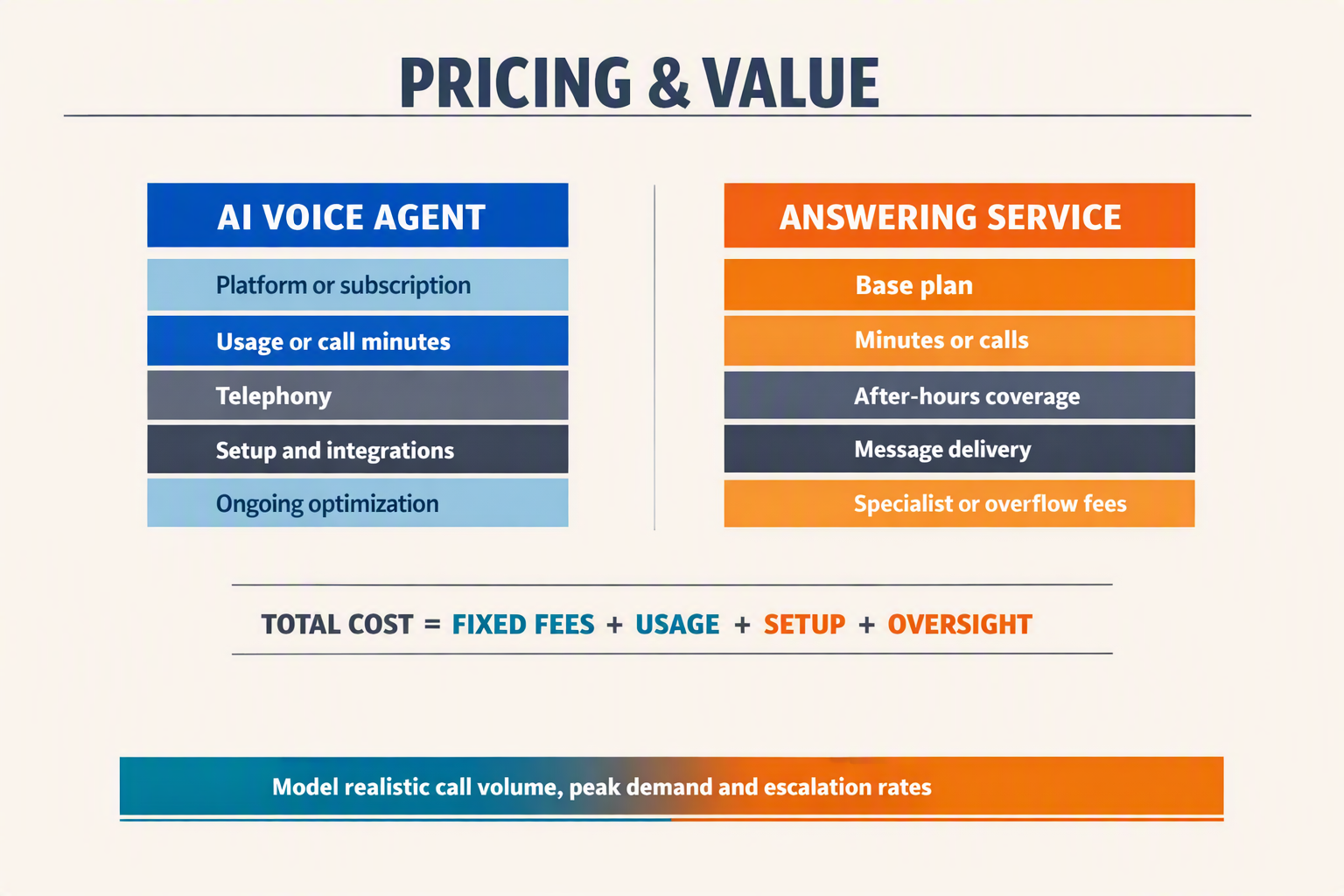
The better value depends on total cost per successfully resolved call, not the cheapest advertised plan. AI usually becomes more economical as repeatable call volume grows, while a human service can justify higher costs for complex or sensitive conversations.
Cost structure comparison
| Cost factor | AI voice agent | Traditional answering service | What to verify |
|---|---|---|---|
| Base fee | Platform or agent subscription | Monthly package or retainer | Included numbers, users, and workflows |
| Usage | Per minute, call, token, or credit | Included minutes, then overage | Billing increments and rounding |
| Setup | Prompting, knowledge base, integrations | Scripts, account notes, receptionist training | One-time onboarding charges |
| Extras | Telephony, model usage, transfers, storage | Transfers, messages, holidays, after-hours | Itemized surcharge schedule |
| Scaling | Handles concurrent calls computationally | May require a larger minute or staffing plan | Concurrency and queue limits |
| Maintenance | Testing, prompt updates, integration support | Script revisions and recurring training | Support tier and change fees |
Calculate value before signing
- AI voice agent: Calculate monthly cost as platform fee + usage + telephony + integration and monitoring costs.
- Virtual receptionist: Calculate the base plan + overage minutes + transfer, message-taking, holiday, and after-hours fees.
- Small business benchmark: Divide total monthly spend by completed bookings, qualified leads, resolved requests, or recovered revenue—not merely inbound calls.
- Break-even test: If AI costs ₹15,000 monthly and completes 500 useful outcomes, its effective cost is ₹30 per outcome; compare that figure with a human quote using the same definition.
- Hidden-cost check: Include abandoned calls, staff callbacks, incorrect bookings, implementation time, and charges for retaining recordings or transcripts.
- Hybrid model: Route routine FAQs and scheduling to AI, then reserve paid human minutes for complaints, emergencies, and exceptions.
- CallMissed: CallMissed uses transparent credits where 1 credit equals ₹1, with free-tier and pay-as-you-go access; buyers should still confirm workflow-specific voice, telephony, and model consumption.
- Final comparison: For an AI voice agent vs answering service, request a 30-day forecast at low, expected, and peak call volumes before committing.
What are the pros and cons of an AI virtual receptionist and a human answering service? (TABLE)
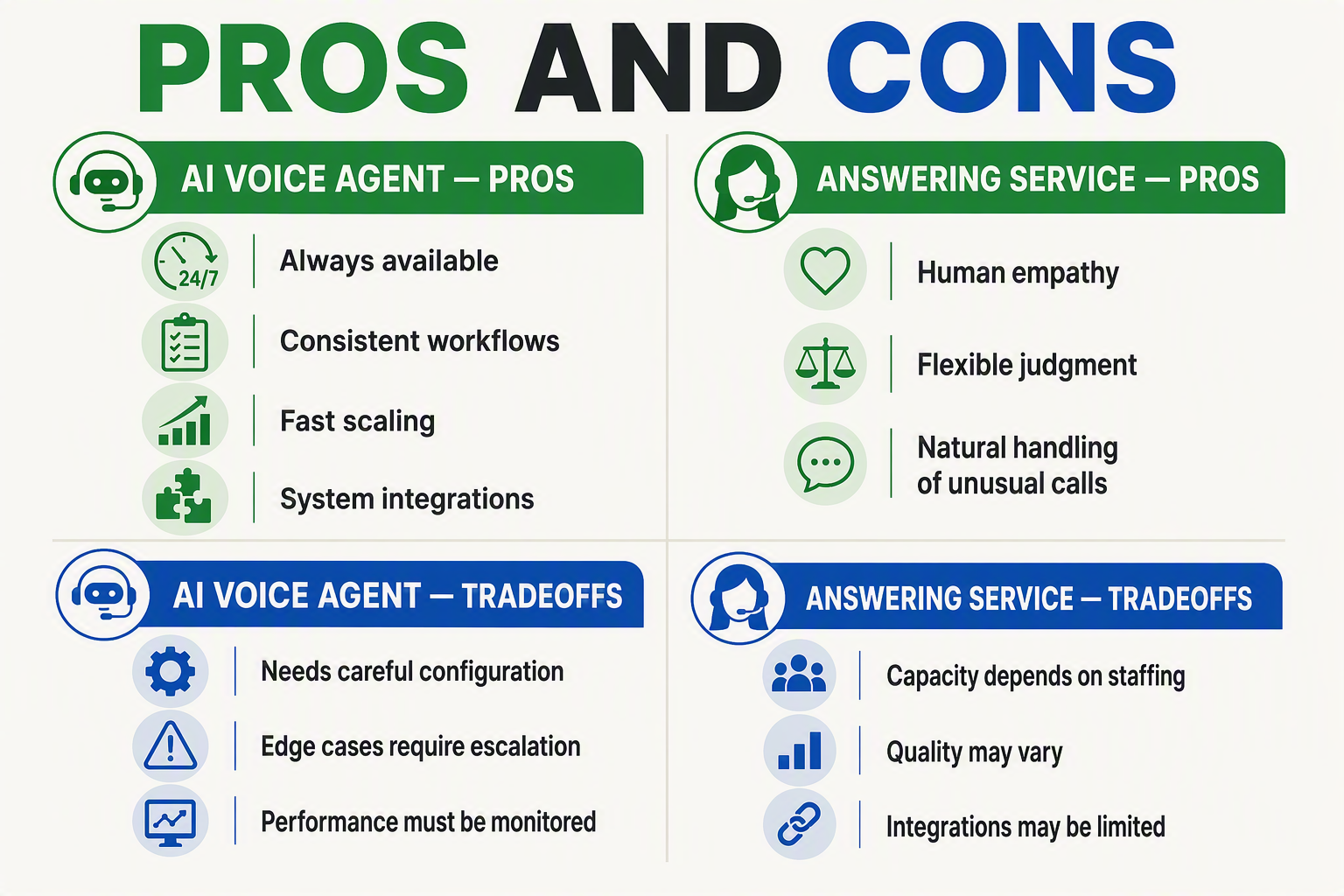
An AI virtual receptionist delivers consistency, scale, and automation, while a human answering service contributes judgment and empathy. The right AI voice agent vs answering service choice depends on call complexity, acceptable failure modes, and escalation design.
Pros-and-cons comparison
| Decision factor | AI virtual receptionist | Human answering service | Buyer check |
|---|---|---|---|
| Call consistency | Follows approved prompts and workflows on every call; changes can be deployed centrally | Can adapt wording naturally, but performance may vary by agent, shift, and training | Review 20–30 recordings across routine and difficult calls |
| Handling ambiguity | Strong for defined intents; unexpected requests can trigger incorrect classifications or generic replies | Better at interpreting incomplete explanations, emotion, sarcasm, and unusual circumstances | Test at least 10 off-script scenarios before signing |
| Capacity | Can support multiple simultaneous conversations when infrastructure and account limits permit | Concurrency depends on staffing, queue capacity, and the contracted service level | Obtain written queue, overflow, and peak-volume limits |
| Workflow automation | Can create structured CRM records, book appointments, open tickets, and trigger messages automatically | May take accurate messages, but structured updates depend on supported integrations or manual entry | Demonstrate one complete call-to-CRM workflow |
| Quality assurance | Transcripts, tool calls, transfer decisions, and outcomes can be reviewed systematically | Recordings and supervisor scoring may be available, depending on the provider and plan | Confirm recording access, QA frequency, and correction procedures |
| Customer sensitivity | Requires explicit safeguards for distress, complaints, medical issues, and other high-risk subjects | Human empathy and judgment can improve sensitive conversations, although scripts and authority still matter | Define mandatory human-transfer conditions in writing |
Practical advantages and limitations
- AI voice agent: A small business can revise one prompt or knowledge source centrally, but every change should be regression-tested against bookings, cancellations, transfers, and unsupported questions.
- Human answering service: Receptionists can recover naturally when callers change topics, but buyers should confirm how account notes are updated across shifts and how quickly retraining occurs.
- AI voice agent: Multilingual coverage can be broader than a local team; for example, CallMissed supports speech-to-text and text-to-speech across 22 Indian languages, although each target language and accent still requires testing.
- Human answering service: A fluent receptionist may understand regional expressions better, but guaranteed language availability can depend on schedules and staffing.
- AI voice agent: Deterministic rules can block prohibited actions and force escalation, yet generative responses require monitoring because an agent can misunderstand intent or produce an unsupported answer.
- Human answering service: People can exercise discretion, but they can also mistype names, overlook account instructions, or promise actions outside their authority.
- Both options: Privacy controls should cover consent notices, least-privilege access, deletion schedules, recordings, transcripts, and subprocessors under applicable rules such as India’s Digital Personal Data Protection Act, 2023 and the European Union’s GDPR.
- Hybrid model: Use AI for repetitive intake and routing, then transfer low-confidence, emotional, emergency, or high-value calls to an authorized human virtual receptionist with the transcript and caller context attached.
Which option should you choose based on call volume, complexity, risk and customer expectations?
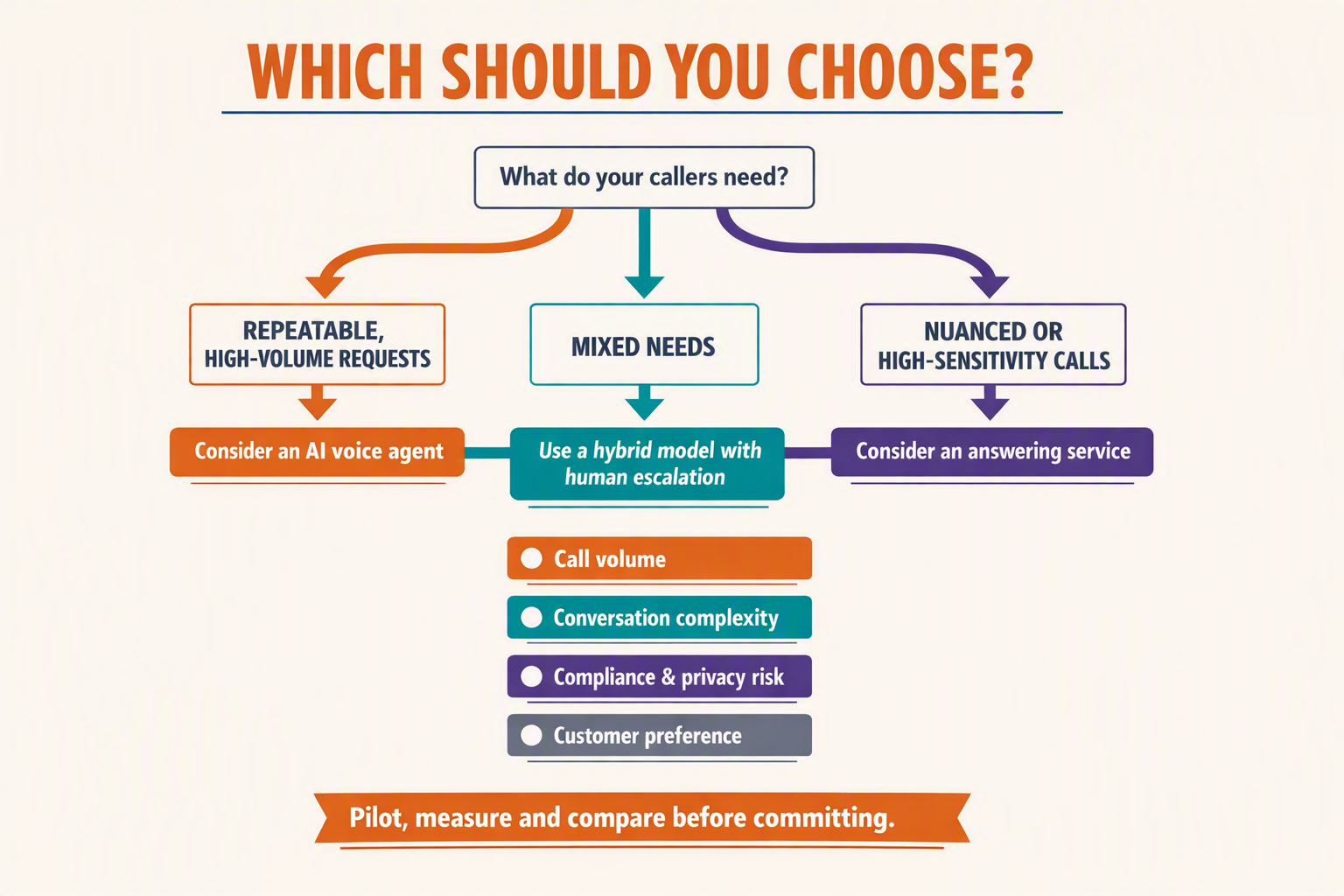
Choose based on the calls you cannot afford to mishandle—not simply the lowest advertised rate. In the AI voice agent vs answering service decision, use measurable thresholds for volume, workflow complexity, risk, and caller expectations.
- Low-volume small business: Choose a virtual receptionist when call traffic is below roughly 10–20 calls per day, requests vary widely, and each conversation requires judgment; compare the minimum monthly plan with your actual minutes, transfers, messages, weekend coverage, and overage charges.
- High or unpredictable volume: Choose an AI voice agent when campaigns, seasonality, or after-hours demand can create concurrent calls; validate performance at 2× your expected peak, including response latency, booking accuracy, fallback behavior, and what occurs when an integration is unavailable.
- Structured conversations: Prefer AI when at least 80% of calls follow 5–10 defined intents—such as appointment booking, order status, lead qualification, opening hours, or payment reminders—and success can be measured through fields completed, appointments confirmed, or tickets created.
- Complex or emotional conversations: Prefer humans when callers frequently dispute bills, describe unusual circumstances, report bereavement, or expect negotiation and reassurance; if more than 20% of sampled calls cannot be resolved safely through approved scripts, a fully automated deployment is premature.
- Regulated or high-risk intake: Use a human-led or hybrid model for medical triage, legal intake, financial instructions, emergencies, and vulnerable customers; define prohibited actions, obtain appropriate consent, minimise collected data, and document retention under applicable rules such as India’s Digital Personal Data Protection Act, 2023.
- Multilingual customer base: Test language coverage against real accents, code-switching, names, addresses, and noisy mobile calls—not a feature-list checkbox; CallMissed supports speech recognition and synthesis across 22 Indian languages, making it relevant where a regional-language caller journey must continue into WhatsApp or an employee escalation.
- Premium customer expectations: Use a trained receptionist when customers expect a named relationship, nuanced product advice, or immediate authority to make exceptions; use AI when they primarily value zero hold time, consistent answers, instant confirmations, and service across all 168 hours of the week.
- Hybrid default for uncertain teams: Route the first 60–80% of repeatable intents to AI, transfer low-confidence, sensitive, or high-value calls to humans, and review 50–100 conversations before expanding automation; set explicit triggers for silence, repeated questions, negative sentiment, authentication failure, emergency language, and two unsuccessful attempts to complete a task.
Where does CallMissed fit, and when should you consider a hybrid voice and WhatsApp workflow?
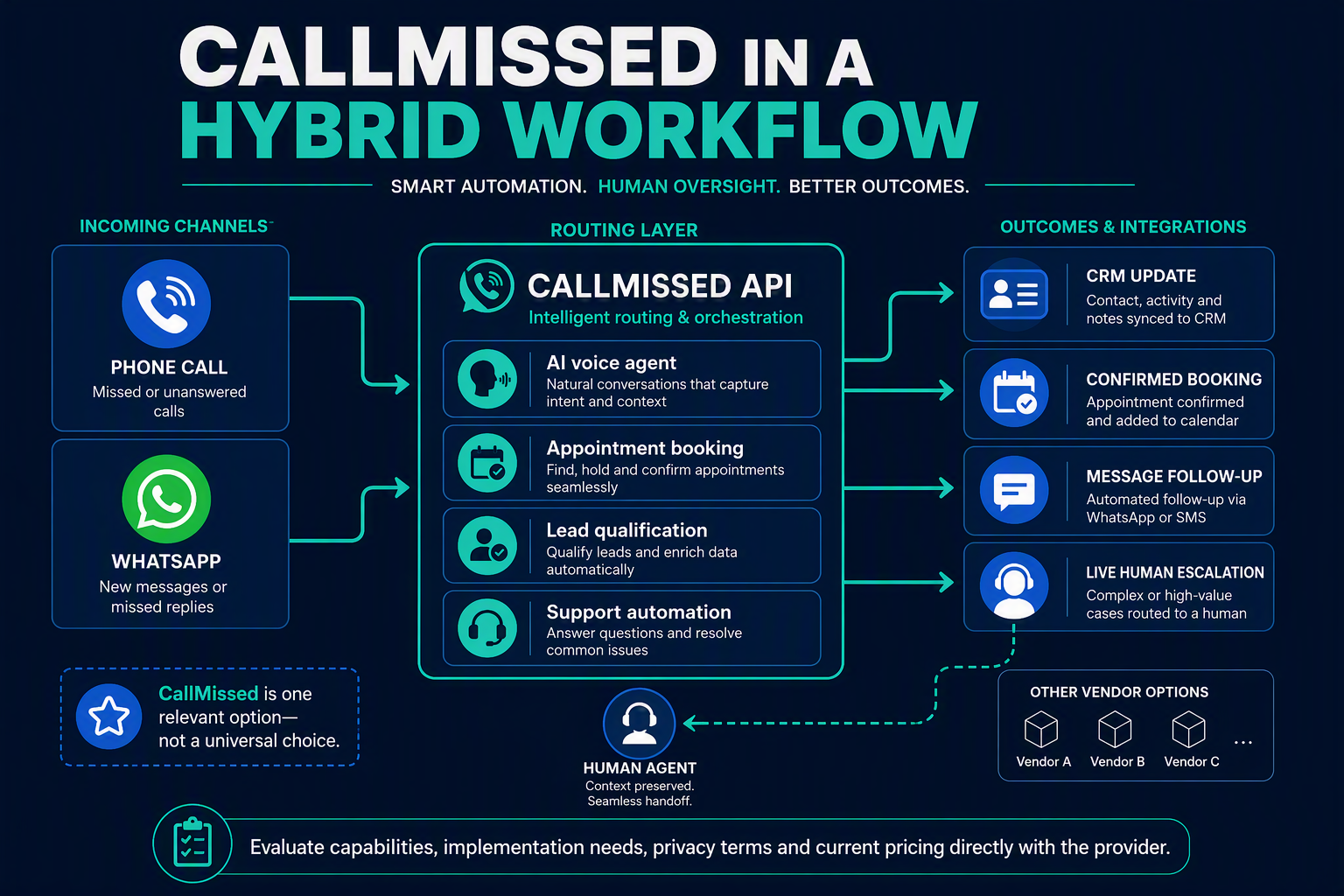
CallMissed fits a small business that wants automated calling and WhatsApp engagement in one workflow, especially when serving multilingual Indian customers. A hybrid design should let AI resolve predictable requests while routing sensitive, complex, or urgent conversations to a person.
Where CallMissed fits
- Regional-language engagement: CallMissed supports Speech-to-Text and Text-to-Speech across 22 Indian languages, enabling callers to speak in their preferred language rather than navigate an English-only interactive voice response menu or wait for a matching virtual receptionist.
- WhatsApp Business calling: CallMissed can bridge inbound and business-initiated WhatsApp Business voice calls to an AI voice agent, then continue the interaction through WhatsApp messages; this supports journeys that a telephone-only answering service cannot complete within the same customer channel.
- Omnichannel operations: The CallMissed business platform combines AI voice agents, WhatsApp chatbots, email, a shared inbox, customer relationship management tools, and knowledge-base retrieval-augmented generation, giving employees one place to review conversations and take over unresolved cases.
- Developer flexibility: The CallMissed API gateway uses an OpenAI-compatible endpoint for large language models, Speech-to-Text, Text-to-Speech, image generation, and web search; automatic same-tier fallbacks can reduce the integration work involved in supporting multiple model providers.
What a hybrid workflow can look like
- Step 1—AI answers: Let the voice agent identify intent, answer approved frequently asked questions, qualify leads, or gather booking details; disclose automation clearly and avoid allowing the model to improvise policies, medical guidance, financial promises, or emergency instructions.
- Step 2—WhatsApp continues: After consent, send a WhatsApp confirmation containing the appointment, quotation request, ticket number, location, or required documents; customers gain a written record while employees avoid repeating information already collected during the call.
- Step 3—Humans handle exceptions: Transfer complaints, vulnerable callers, negotiation requests, safety issues, and low-confidence responses to an employee or answering-service partner; when nobody is available, create a prioritized callback with the transcript, summary, caller language, and stated urgency.
When to shortlist—and when not to
- Consider CallMissed: Shortlist it when regional-language coverage, WhatsApp calling, cross-channel continuity, or API-based automation materially affects conversion or service quality; pricing uses transparent credits where 1 credit equals ₹1, with free-tier and pay-as-you-go options, but buyers should model actual call and model usage before committing.
- Choose a human-led model: In the AI voice agent vs answering service decision, retain human-first handling when most calls require empathy, discretionary judgment, regulated intake, or unpredictable exception management; AI can still collect basic context or send WhatsApp follow-ups without owning the substantive conversation.
Frequently Asked Questions About AI Voice Agents vs Answering Services
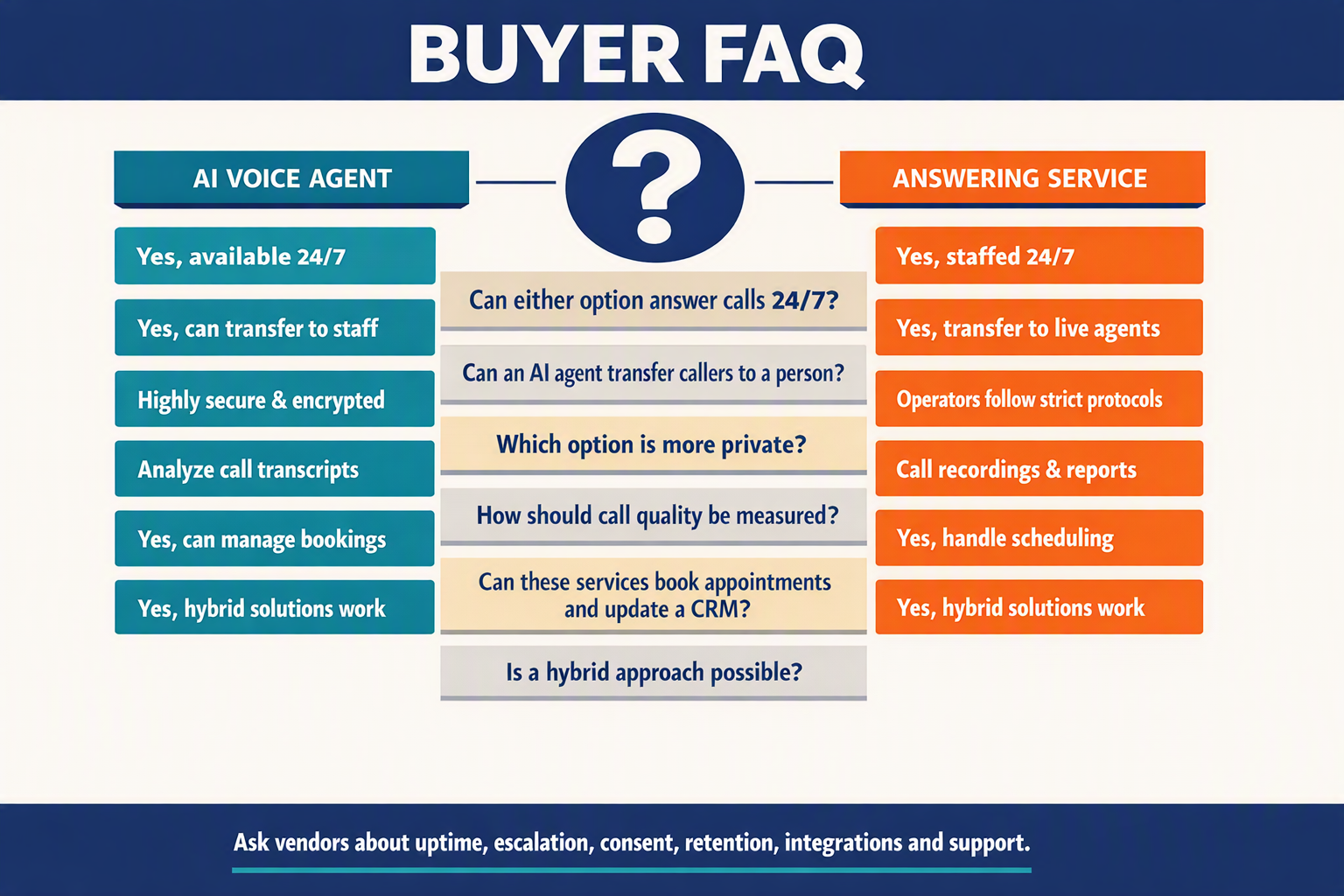
Frequently Asked Questions About AI Voice Agents vs Answering Services
- Q: How do the cost structures compare?
A: AI voice agents may combine subscription, usage, setup, integration, and escalation costs. Answering services may charge by minute, call, transfer, message, or coverage window. Compare the total cost per successfully resolved call rather than headline rates.
- Q: Which option is better for 24/7 coverage?
A: AI agents can answer simultaneous calls around the clock without shift scheduling. Human services can also offer 24/7 coverage, but businesses should confirm holiday availability, queue limits, overflow procedures, and after-hours fees.
- Q: When should a call be handed off to a human?
A: Use human escalation for sensitive complaints, emergencies, emotional callers, unusual requests, negotiation, or highly ambiguous situations. A good handoff should preserve the caller’s details, transcript, and conversation summary.
- Q: How should businesses evaluate privacy and security?
A: Review consent notices, encryption, access controls, data retention, deletion procedures, subprocessors, and applicable laws, including India’s Digital Personal Data Protection Act, 2023. Businesses remain responsible for configuring lawful call recording and data handling.
- Q: Can an AI voice agent connect with existing business tools?
A: Depending on the platform and available integrations, an AI agent may update CRMs, book calendar appointments, qualify leads, trigger workflows, or send follow-ups. Test field mapping, duplicate handling, authentication, and failure recovery before launch.
- Q: Do AI voice agents support multilingual callers?
A: Support varies by provider, language, accent, and use case. CallMissed supports AI voice and WhatsApp engagement across 22 Indian languages, making it suitable for many multilingual Indian customer journeys. Businesses should still test real callers, mixed-language conversations, names, and regional accents.
- Q: Can an AI voice agent fully replace an answering service?
A: It can automate repeatable workflows such as FAQs, lead qualification, appointment booking, routing, and status checks. Human receptionists remain valuable when calls require empathy, discretion, interpretation, or complex judgment.
- Q: When is CallMissed a good fit?
A: CallMissed is a strong option for businesses with repeatable voice workflows, multilingual Indian use cases, WhatsApp continuity, and defined escalation paths. A human-led or hybrid approach may be better when most calls are sensitive, unpredictable, or difficult to standardize.
Conclusion
In 2026, the AI voice agent vs answering service choice depends on workflow complexity, risk, and customer expectations—not hype.
- Choose AI for 24/7 availability, consistent handling, and direct integrations.
- Choose a virtual receptionist for sensitive, ambiguous, or high-stakes calls.
- Use hybrid escalation to combine automation with human judgment.
- Evaluate total cost, quality controls, privacy, and data retention before committing.
Watch for better multilingual accuracy and tighter omnichannel integration. To stay ahead, explore CallMissed, which supports AI voice agents, WhatsApp Business calling, and 22 Indian languages. Which model best protects every small business opportunity?
Related Reading
- How to Automate Missed Calls with AI: The Ultimate Multilingual WhatsApp & Voice Playbook for Indian Businesses (2026)
- Stop Bleeding Leads: The 2026 Guide to AI Voice Agents, Call Analytics, and Missed-Call Recovery for Small Business
- Best AI Voice Agent for Small Businesses in 2026: 6 Platforms Compared
Related Posts
CallMissed.com: أفضل وكيل صوتي بالذكاء الاصطناعي للشركات الصغيرة في عام 2026
وكيل صوتي بالذكاء الاصطناعي لخدمات المنازل: دليل السباكة والتدفئة والتهوية وتكييف الهواء والكهرباء لعام 2026

وكيل صوتي متعدد اللغات بالذكاء الاصطناعي في الهند: دليل الشركات الصغيرة لعام 2026
Ready to automate customer conversations?
Launch AI voice agents and WhatsApp bots with CallMissed — one API, 22+ Indian languages.