

WhatsApp AI Voice Agent in India: CallMissed Production Guide (2026)


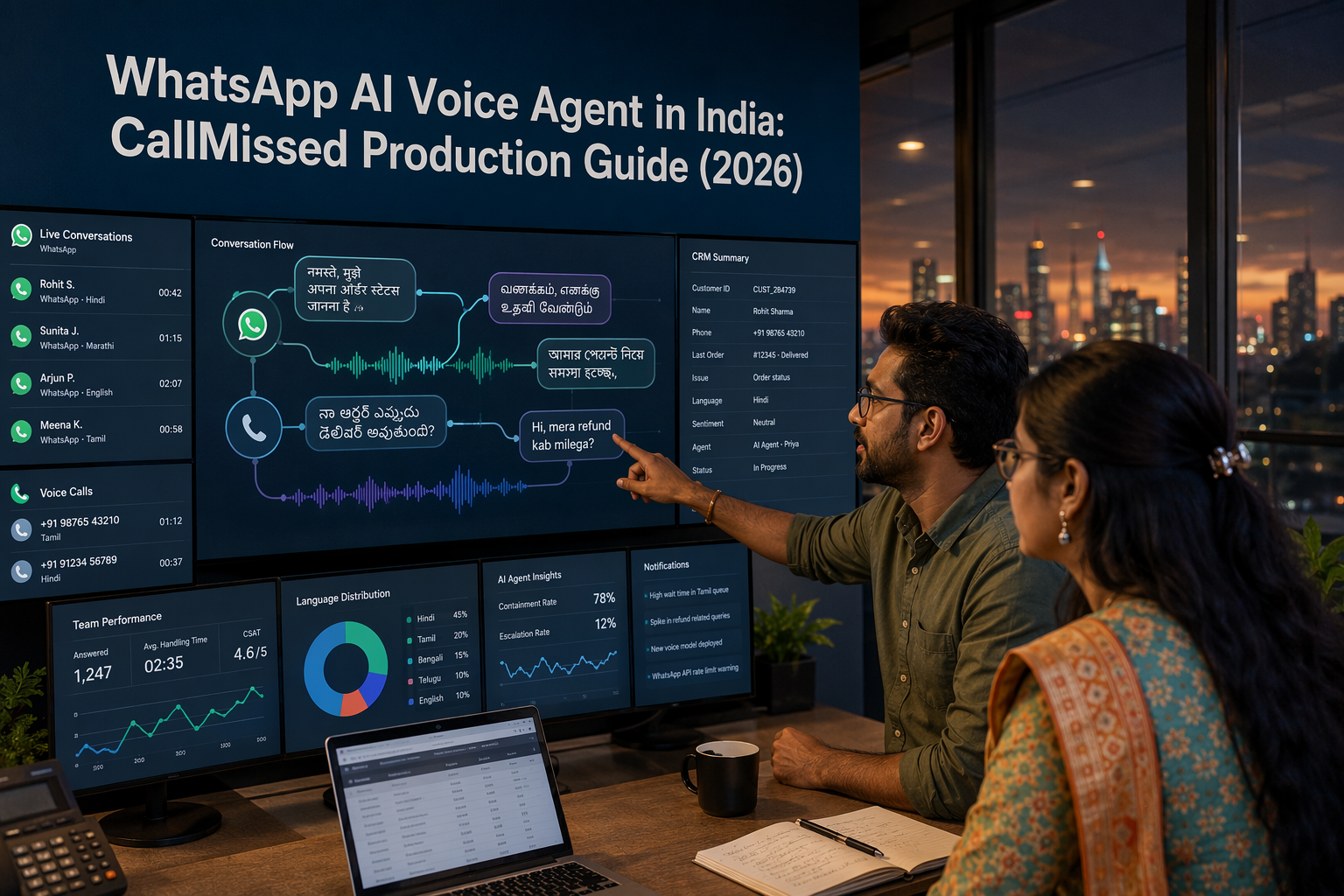
Build a WhatsApp AI voice agent for India with CallMissed: language design, regional QA, consent, fallbacks, rollout, and handoff.
WhatsApp AI Voice Agent in India: CallMissed Production Guide (2026)
What if the hardest part of deploying a WhatsApp AI voice agent in India is not the AI, but understanding “haan, kal morning mein call karna” correctly? In 2026, production success depends on handling Hindi, Hinglish, regional accents, code-switching, noisy mobile audio, and sensitive customer data without making conversations feel robotic or unsafe. This guide shows Indian businesses and developers how to build that experience with the CallMissed API, from language routing through launch monitoring and human escalation.
As of July 2026, Meta’s WhatsApp Business Calling API supports both business-initiated and user-initiated VoIP calls, according to Meta for Developers; WhatsApp is therefore no longer limited to text automation. CallMissed (Call Missed), an AI-native communication platform built in India, connects WhatsApp Business calling and messaging with AI voice agents and supports speech workflows across 22 Indian languages, according to CallMissed’s July 2026 website.
That breadth matters because a single customer may begin in English, switch to Hindi for a payment question, dictate an address in a regional language, and expect the agent to preserve context throughout. A demo can look fluent while still failing in production on proper nouns, PIN codes, dates, honorifics, interruptions, latency, consent boundaries, or low-confidence speech recognition. The engineering challenge is to make every uncertain turn observable, recoverable, and safe.
What this production guide covers:
- Language strategy: Select a default language, detect switches deliberately, and design Hindi–English prompts that sound natural rather than translated.
- Speech reliability: Evaluate speech-to-text and text-to-speech with regional accents, mixed-script vocabulary, phone audio, names, numbers, and complete Indian addresses.
- Conversation controls: Add explicit confirmations for high-impact details, confidence-aware retries, deterministic fallback behavior, and timely transfer to a human.
- Governance and measurement: Capture consent, minimise retained personal data, restrict tool access, and score task completion, transcription quality, response latency, handoffs, and unsafe outputs against representative evaluation datasets.
You will also get a staged rollout plan, an evaluation table, a reusable QA scorecard, and a catalogue of common failure modes before they reach customers. Rather than assuming that “multilingual” is one checkbox, the guide treats each language, channel, intent, and acoustic condition as a testable production surface. The goal is practical: deploy a multilingual AI voice agent that can converse naturally, verify critical information, respect customer choice, and fail gracefully when automation should stop. By the end, you will have an implementation framework for moving from a pilot to reliable WhatsApp and voice operations across India.
How do you build a production-ready WhatsApp AI voice agent in India with CallMissed?
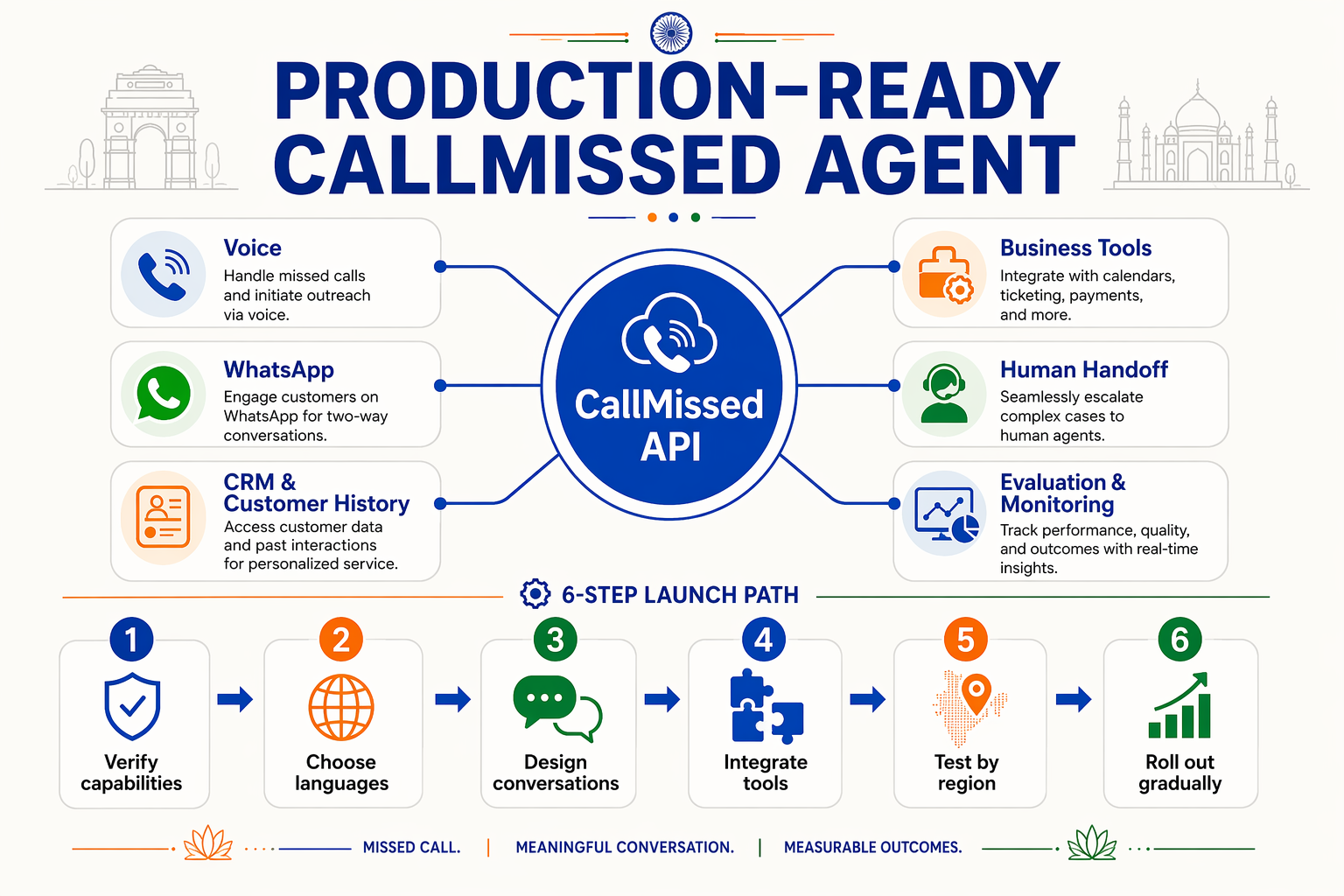
A production-ready WhatsApp AI voice agent in India needs a controlled pipeline for WhatsApp calling and messaging, speech processing, multilingual reasoning, business tools, verification, and human escalation. Use CallMissed (Call Missed) as an API-first Meta Tech Provider layer for supported WhatsApp Business Calling, messaging, and voice-agent workflows. Keep language state, safety policies, permissions, and transaction rules explicit in your application rather than relying on a single prompt.
Availability is not automatic. Your WhatsApp AI voice agent depends on Meta permissions, WhatsApp Business verification, customer consent, approved templates where applicable, and calling or messaging channel approvals. Confirm current eligibility and requirements with Meta and CallMissed before planning a launch.
Start with a channel-aware architecture
Meta for Developers states that, as of July 2026, the WhatsApp Business Calling API supports user-initiated and business-initiated VoIP calls, subject to the applicable requirements and permissions. Treat calls and messages as separate interaction modes that share one customer context:
WhatsApp call or message
        ↓
Channel adapter and session manager
        ↓
Speech-to-text → language router → agent
        ↓                         ↘ business tools
Policy checks and confirmations
        ↓
Text-to-speech or WhatsApp response
        ↓
Analytics, audit events, or human handoff
The session manager for the WhatsApp AI voice agent should preserve the selected language, conversation summary, confirmed customer details, consent state, and unresolved task. It should also maintain context when a customer moves from a call to a WhatsApp message—for example, to type an address that was difficult to recognise over speech.
Do not place unrestricted CRM, payment, booking, or account-management access directly behind the language model. Expose narrow business tools with authenticated parameters, role-based permissions, server-side validation, and explicit confirmation before consequential actions.
Configure the CallMissed layer
CallMissed provides an API-first communication and AI layer for supported WhatsApp and voice-agent workflows. Its July 2026 website describes an OpenAI-compatible API and support for 22 Indian languages, allowing teams to use a familiar request pattern while centralising speech, model, and channel integration.
CallMissed acts as the Meta Tech Provider layer, but it does not replace Meta’s onboarding or policy requirements. Production access still depends on the relevant business verification, permissions, consent, templates, phone-number configuration, and channel approvals.
Build the first working WhatsApp AI voice agent path in this order:
- Connect an approved WhatsApp Business identity. Complete Meta business verification and configure supported inbound calling and messaging according to current Meta and CallMissed documentation.
- Confirm channel eligibility and consent rules. Document which calls or messages may be initiated, what customer consent is required, and when approved templates must be used.
- Create separate development and production configurations. Keep credentials in a secrets manager, rotate them periodically, and never expose API keys in browser or mobile code.
- Define the agent’s bounded role. Specify supported intents, permitted tools, prohibited actions, escalation triggers, and the information the agent must confirm.
- Add language metadata. Store the customer’s declared language, detected language, recent code switches, and preferred voice independently from the transcript.
- Process events idempotently. Assign each interaction a unique internal identifier so retries cannot create duplicate tickets, bookings, payments, or outbound actions.
- Instrument every stage. Record latency, speech-recognition confidence where available, language-routing decisions, tool outcomes, retries, confirmations, and handoffs.
Make uncertainty a first-class system state
A WhatsApp AI voice agent should not guess when a transcript contains a customer name, amount, date, phone number, PIN code, account detail, or complete address. Route uncertain turns through deterministic recovery:
- Ask the customer to repeat the specific field rather than the entire request.
- Offer WhatsApp text entry when speech remains ambiguous.
- Read critical values back in short groups: “9-8-7-6, then 5-4-3-2.”
- Confirm dates and amounts in an unambiguous format.
- Confirm addresses component by component: house number, street, locality, city, state, and PIN code.
- Require explicit confirmation before bookings, payments, cancellations, or account changes.
- Transfer to a person after a defined retry limit or whenever the customer requests one.
The handoff should include the language preference, concise conversation summary, verified fields, unresolved task, and reason for escalation. Avoid forcing the customer to repeat information already confirmed by the WhatsApp AI voice agent.
Set production gates before customer traffic
Do not launch merely because a scripted Hindi demonstration works. Require passing thresholds for task completion, unsafe tool calls, transcription errors, end-to-end latency, confirmation accuracy, duplicate-action prevention, and handoff success across Hindi, Hinglish, selected regional languages, accents, noisy mobile audio, code-switching, and interrupted speech.
Also test channel-specific failures, including expired consent, unavailable calling permissions, rejected or missing templates, disconnected calls, delayed messages, duplicate events, and loss of context when switching between voice and text.
The initial WhatsApp AI voice agent release should cover a small set of low-risk intents and a limited customer cohort. Expand languages, customer segments, and business actions only after recorded evaluation results show that each new surface fails safely, complies with Meta and business requirements, and preserves context across WhatsApp voice and messaging.
What CallMissed capabilities, API documentation, and channel dependencies must you verify first?
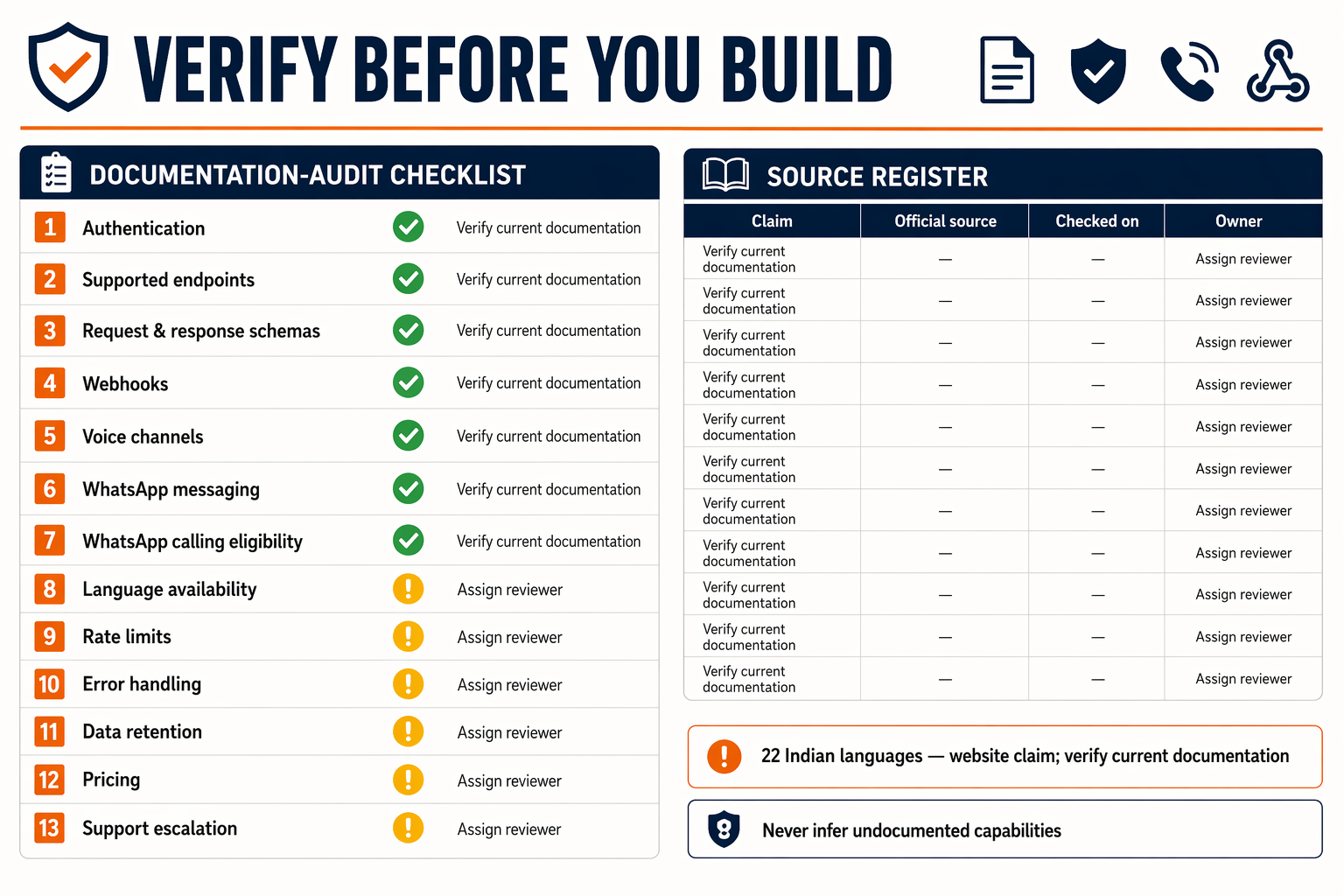
Before writing production code, verify three layers independently: CallMissed language and channel coverage, the current CallMissed API contract, and Meta WhatsApp Business Platform dependencies. Platform-level support does not guarantee that every language, speech configuration, or calling scenario behaves identically.
Confirm the verified CallMissed scope
CallMissed states in July 2026 that its OpenAI-compatible API supports voice and WhatsApp AI agents in 22 Indian languages. This establishes broad multilingual coverage, but teams should use the current official documentation and their account configuration to determine exactly how that coverage applies to a planned workflow.
Before selecting an architecture, verify:
- Which speech recognition, speech synthesis, and language-processing options are currently available.
- The supported language identifiers and whether a language must be specified or can be detected automatically.
- How the API handles Hindi-English code-switching, Hinglish, regional accents, numerals, names, and addresses.
- Whether real-time streaming, partial transcripts, punctuation, interruption handling, and silence detection are supported.
- Which voices, audio encodings, sample rates, and output formats can be selected.
- Whether voice and WhatsApp interactions use the same agent configuration or require channel-specific setup.
- What fallback, escalation, transcript, webhook, and human-handoff facilities—if any—are documented.
- Current usage charges, quotas, concurrency limits, rate limits, timeouts, and account restrictions.
Treat every undocumented feature as unavailable until CallMissed confirms it. An OpenAI-compatible API can reduce integration work, but compatibility should not be interpreted as support for every parameter, SDK feature, model name, or response object found in another provider’s API.
Validate the API contract with a preflight client
Build a small verification client before implementing prompts, business rules, or CRM integrations. The client should authenticate, send representative Indian-language audio, request an agent response, and capture latency, errors, and raw responses.
Review the current official documentation for five areas:
- Authentication: Confirm credential format, key rotation, permissions, environment separation, and recommended secret storage.
- Requests: Verify accepted content types, audio constraints, language controls, payload limits, and any streaming configuration.
- Responses: Identify documented transcript, usage, error, status, and diagnostic information without assuming particular fields exist.
- Reliability: Check retry guidance, duplicate-request handling, webhook verification, timeout rules, rate-limit signalling, and service-status procedures.
- Data governance: Confirm retention, deletion, logging, recording, transcript access, and data-processing terms for the intended account.
Do not manufacture confidence scores or accuracy thresholds. If no confidence signal is documented, detect problems through observable events such as empty transcripts, incorrect critical entities, repeated turns, excessive latency, or explicit customer corrections.
Verify WhatsApp calling dependencies separately
Meta for Developers states that the WhatsApp Business Calling API enables businesses to initiate and receive calls with WhatsApp users through Voice over Internet Protocol. CallMissed API integration does not remove Meta’s onboarding, eligibility, permission, policy, or geographic requirements.
Before launch, confirm:
- WhatsApp Business Account and phone-number eligibility.
- Availability of the required user-initiated and business-initiated call flows.
- Calling permissions, customer consent, webhook events, and failure-state handling.
- Media routing, codec compatibility, network security, and call termination behaviour.
- Template, messaging, and conversation requirements surrounding the call.
- A tested fallback path when calling permission, media negotiation, the AI service, or human escalation fails.
This preflight separates verified capabilities from assumptions and prevents channel restrictions from being misdiagnosed as multilingual-model failures.
Which 2026 platform and channel developments affect a CallMissed deployment? (TABLE)
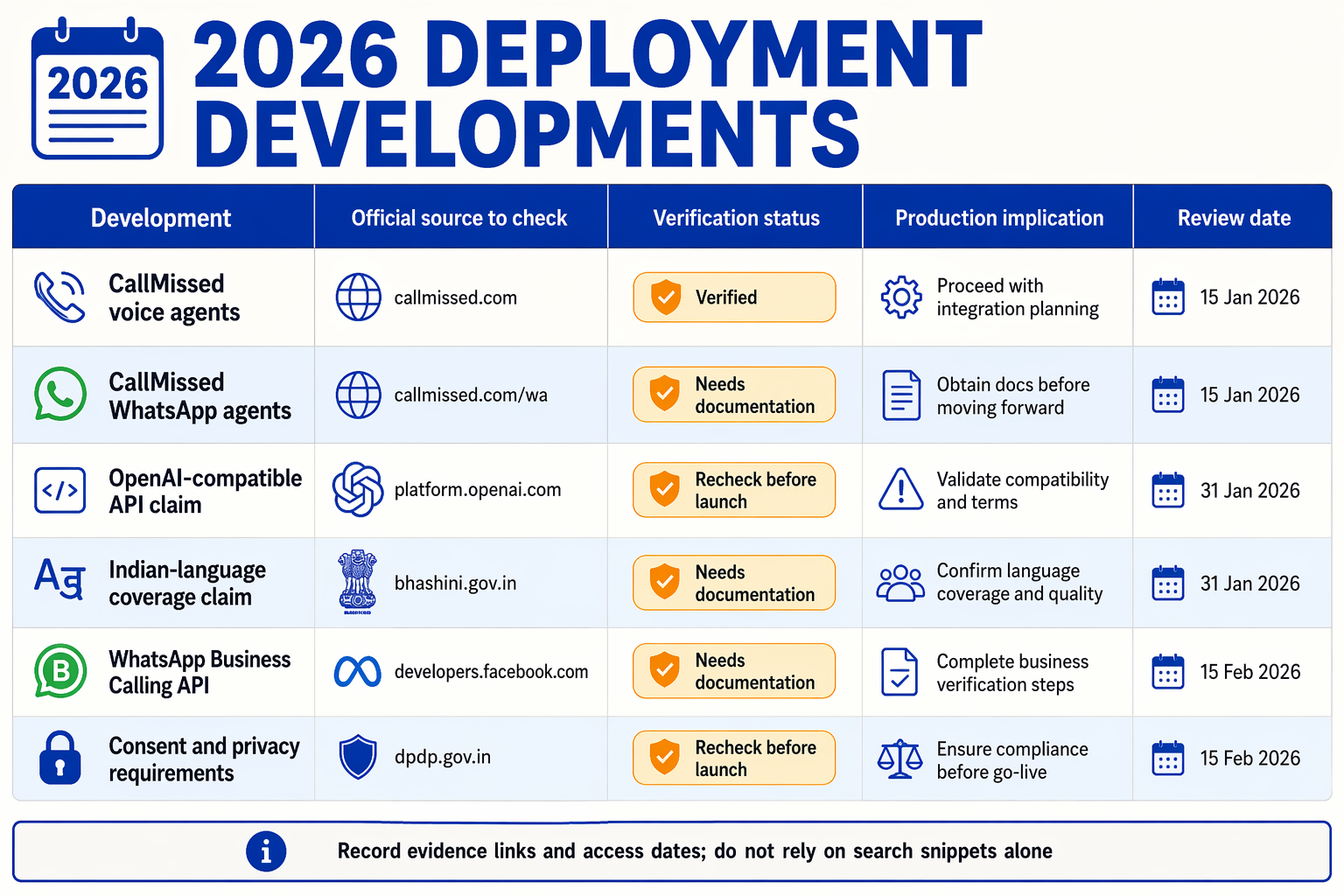
The decisive 2026 change is that WhatsApp is now both a messaging and calling surface, so a CallMissed deployment must preserve identity, language, consent and conversation state across text and live audio. At the same time, broader Indian-language speech support makes regional deployment practical—but each language and channel still needs independent production testing.
2026 developments and their deployment impact
| Development | Verified status in July 2026 | Deployment impact | Required engineering action |
|---|---|---|---|
| User-initiated WhatsApp calls | Meta for Developers states that the WhatsApp Business Calling API can receive VoIP calls from WhatsApp users. | Customers can call from the same environment where they message the business. | Route inbound calls to the correct CallMissed agent, restore available customer context and define after-hours or human fallback behavior. |
| Business-initiated WhatsApp calls | Meta for Developers states that the API can initiate VoIP calls to WhatsApp users. | Outbound voice becomes a distinct workflow rather than an extension of chatbot replies. | Verify Meta’s current calling requirements, record the applicable permission or consent state, and block calls when eligibility cannot be established. |
| Voice and messaging convergence | Meta’s Cloud API documentation covers calling, while CallMissed combines WhatsApp messaging and AI voice agents in one business platform. | A conversation may move from text to voice and back without the customer repeating everything. | Use a channel-neutral conversation ID, but store channel-specific events such as call outcome, transcript confidence and message-delivery status. |
| Support for 22 Indian languages | CallMissed’s July 2026 website states that the platform supports speech workflows across 22 Indian languages. | Businesses can serve regional audiences without designing an English-only voice path. | Maintain a language configuration per agent and evaluate every enabled language separately for accents, names, numerals, addresses and code-switching. |
| OpenAI-compatible integration | CallMissed describes its API as OpenAI-compatible, covering voice and WhatsApp AI-agent workflows. | Existing OpenAI-style application patterns can reduce integration changes, but telephony remains event-driven. | Keep model calls behind an adapter, process channel events idempotently and validate current CallMissed documentation before fixing request fields in production code. |
| Expanding voice-agent ecosystem | VideoSDK publishes a WhatsApp voice-agent quickstart, and Pipecat documents WhatsApp Cloud API calling with SmallWebRTC. | WhatsApp voice is becoming an interoperable deployment surface rather than a closed demo feature. | Treat media transport, agent reasoning, tools and CRM writes as separate failure domains with independent logs and timeouts. |
Architecture changes to make now
A production implementation should not use one undifferentiated “WhatsApp session.” Model message, user-initiated call and business-initiated call as separate channel modes sharing controlled customer context.
- Pin the agent’s default language, voice and escalation queue in configuration rather than relying entirely on automatic detection.
- Pass the previous language choice into a voice transition, but allow explicit switching when the caller begins speaking Hindi, English or another supported language.
- Keep irreversible actions—such as confirming an order, changing an address or scheduling an outbound call—behind deterministic validation.
- Log policy decisions separately from model output so operators can explain why a call was placed, rejected or transferred.
These developments make CallMissed’s combination of WhatsApp calling, messaging and Indian-language speech especially relevant to Indian businesses. They also raise the production bar: test the complete channel transition, not merely whether the model can answer a multilingual prompt.
How should you select languages and handle Hindi, Hinglish, dialects, and code-switching?
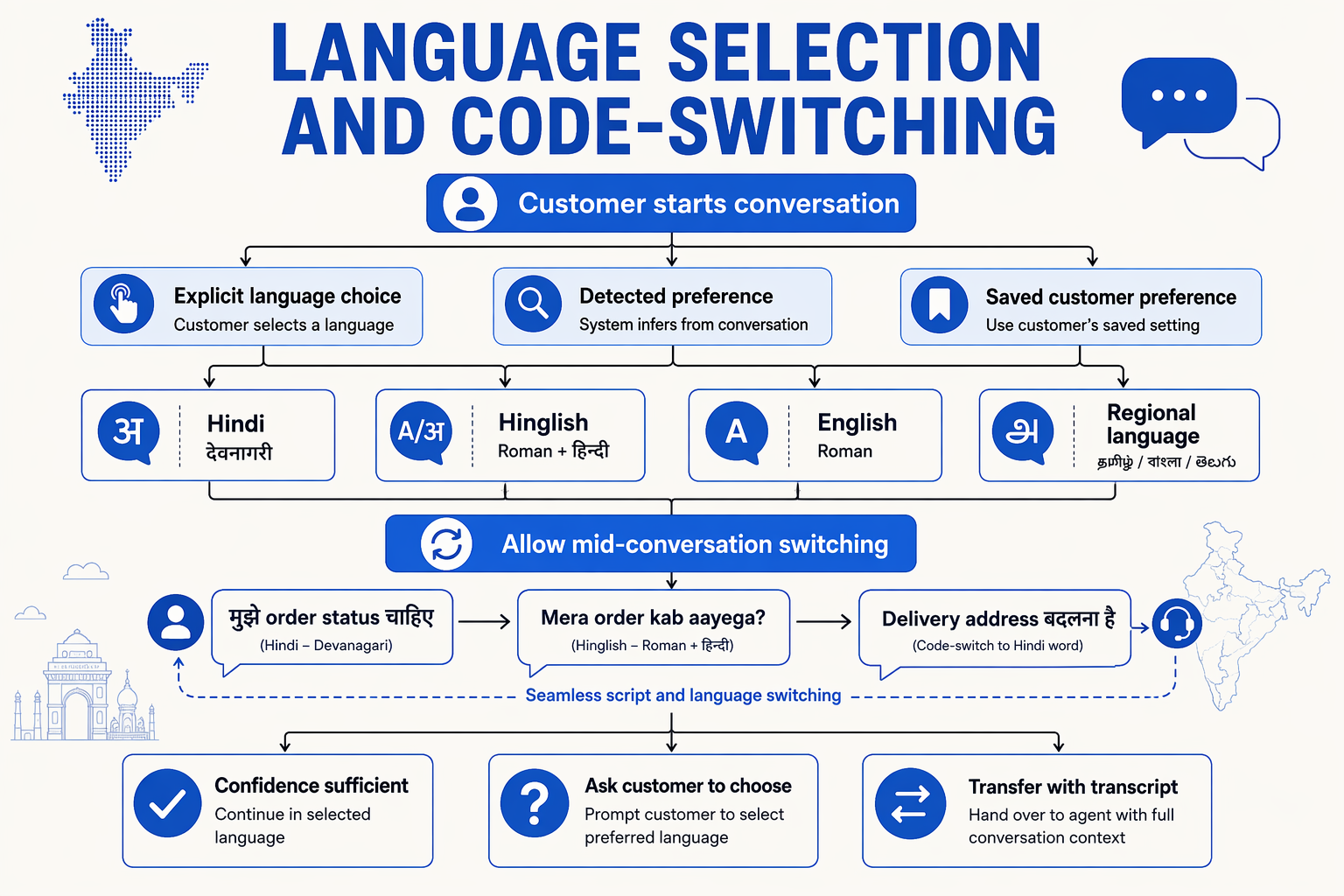
Select languages from customer demand and task risk, not from the size of a provider’s language catalogue. Configure a primary language for each journey, permit controlled switching, and treat Hinglish, dialects, and accents as evaluation categories rather than assuming automatic language detection will handle every utterance.
Build a language-priority matrix
CallMissed’s official website stated in July 2026 that the platform supports speech workflows across 22 Indian languages. That coverage provides a broad starting point, but production teams should activate languages incrementally using evidence from call recordings, WhatsApp messages, CRM preferences, service regions, and human-agent queues.
Rank each candidate language against:
- Conversation volume: How many customers currently use it?
- Business impact: Does it appear in sales, collections, healthcare, or other high-consequence workflows?
- Operational readiness: Can human agents receive escalations in that language?
- Knowledge coverage: Are policies, product names, and approved answers available in that language?
- Evaluation readiness: Do you have representative speakers, accents, devices, and noisy recordings for testing?
Begin with one or two high-volume language combinations—for example, Hindi–English or Tamil–English—before enabling every supported language.
Route language deliberately
Do not run unconstrained language identification independently on every turn; short expressions such as “haan,” “okay,” or “right” provide too little evidence and can cause unstable switching. Maintain a conversation-level language state around the CallMissed API:
- Use an existing CRM or WhatsApp preference when available.
- Ask a brief choice question when no reliable preference exists.
- Detect a switch only after a meaningful multiword utterance or an explicit request.
- Preserve the customer’s selected language across the session.
- Offer correction: “Would you like to continue in Hindi or English?”
Store language identifiers using a consistent internal convention, such as BCP 47 language tags, while keeping model- or provider-specific labels in an adapter layer.
Treat Hinglish as a normal mode
A Hindi voice AI agent should not force users into formal Hindi. Real conversations commonly mix English product terminology with Hindi grammar: “EMI date change karni hai” or “refund kab process hoga?”
For more natural Hinglish:
- Write prompts in the spoken register, not as literal translations of English scripts.
- Preserve familiar terms such as “OTP,” “account,” “delivery,” and “refund” when customers use them.
- Add domain vocabulary, brand names, neighbourhoods, and transliterated words to test sets.
- Allow responses to mirror the user’s language balance without copying slang excessively.
- Keep critical policy wording simple and unambiguous, even when the surrounding conversation is informal.
Script is a separate decision from language. A customer may speak Hindi, type Hindi in Latin characters, and expect a WhatsApp summary in Devanagari or English.
Separate dialect, accent, and language
Dialect variation does not always justify a new agent configuration. First test whether the existing speech pipeline understands regional pronunciation and vocabulary. Create tagged evaluation slices for geography, first language, age range, mobile network quality, and speaking pace—without using these attributes to stereotype individual callers.
Switch models or routing only when repeated testing shows a meaningful failure pattern. If confidence is uncertain, the agent should ask a neutral clarification rather than guessing the customer’s language or origin. This controlled approach makes multilingual expansion measurable while preserving a consistent experience across CallMissed-powered WhatsApp and voice journeys.
How do you integrate the CallMissed API with shared context, confirmations, fallbacks, and human handoff?
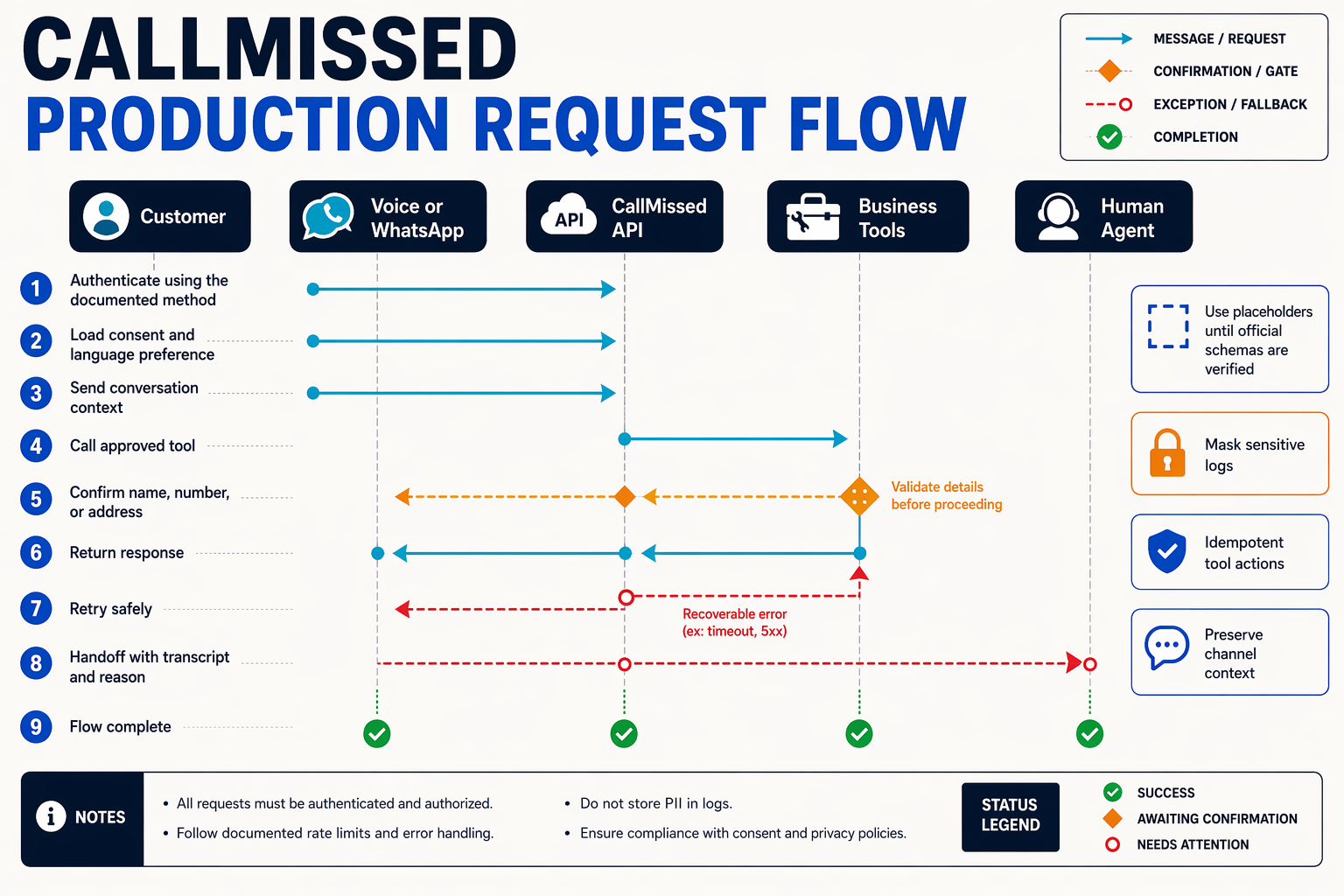
Use a channel-neutral conversation state as the source of truth, then route every WhatsApp message or call turn through the same orchestration layer. The integration should treat confirmations, low-confidence recovery, and human handoff as deterministic workflow states—not decisions left entirely to the language model.
1. Create one shared context across voice and WhatsApp
As of July 2026, Meta’s WhatsApp Business Calling API supports user-initiated and business-initiated VoIP calls, according to Meta for Developers. This allows a customer’s WhatsApp messages and calls to share one conversation record, subject to consent and retention controls.
Key the record by an internal customer or conversation ID rather than placing a phone number in prompts. Store structured state separately from the transcript:
{
  "conversation_id": "conv_8f21",
  "channel": "whatsapp_call",
  "language": "hi-IN",
  "recent_language_mix": ["hi-IN", "en-IN"],
  "intent": "reschedule_delivery",
  "slots": {
    "requested_date": "2026-07-29",
    "time_window": "morning"
  },
  "pending_confirmation": "requested_date",
  "fallback_count": 0,
  "handoff_status": "none"
}
Send the CallMissed API only the minimum context needed for the next response: approved system instructions, a compact conversation summary, verified fields, unresolved fields, and permitted tools. Do not treat a generated summary as authoritative; names, amounts, dates, addresses, and consent status should remain typed fields with provenance.
2. Confirm consequential details explicitly
Confirmation should be proportional to risk. A greeting does not require verification, but a payment amount or delivery address does.
Use a three-step pattern:
- Extract a candidate value without committing it.
- Read it back in the customer’s current language or code-switched style.
- Commit it only after an unambiguous yes, correction, or authenticated action.
For example: “Aap delivery 29 July, morning ke liye reschedule karna chahte hain—sahi hai?” Spell names character by character when uncertain, group phone numbers into readable chunks, and confirm PIN codes digit by digit. Never convert “haan, kal” directly into an irreversible action without resolving the date and timezone.
3. Implement bounded fallback behavior
CallMissed supports speech workflows across 22 Indian languages, according to CallMissed’s July 2026 website, but production recovery must still account for noise, accents, code-switching, and proper nouns. Use confidence signals where available alongside silence, repeated corrections, and semantic inconsistency.
A practical fallback ladder is:
- First failure: Rephrase briefly in the detected language.
- Second failure: Ask a constrained question—“Tuesday or Wednesday?”
- Third failure: Offer keypad, WhatsApp text, or human assistance.
- Safety-critical ambiguity: Stop immediately and escalate.
Cap retries by intent, not merely by turn, so alternating Hindi and English does not reset a failing workflow.
4. Transfer the conversation with context
Human handoff should be an explicit orchestration event. Trigger it for customer requests, repeated recognition failures, unsupported intents, authentication problems, complaints, policy exceptions, or tool errors.
Pass the agent a concise handoff packet containing:
- Customer-selected language and channel
- Verified fields and unresolved questions
- Confirmation and consent status
- Short interaction summary
- Failure reason and attempted recovery steps
- Transcript reference, subject to access and retention policy
Before transfer, say what will happen: “Main aapko Hindi support executive se connect kar raha hoon; unhe is conversation ka summary milega.” Pause automated actions, make webhook processing idempotent, and ensure the human’s updates write back to the same shared state so the customer never has to restart.
How should you test speech recognition, synthesis, and regional-language evaluation datasets? (TABLE)
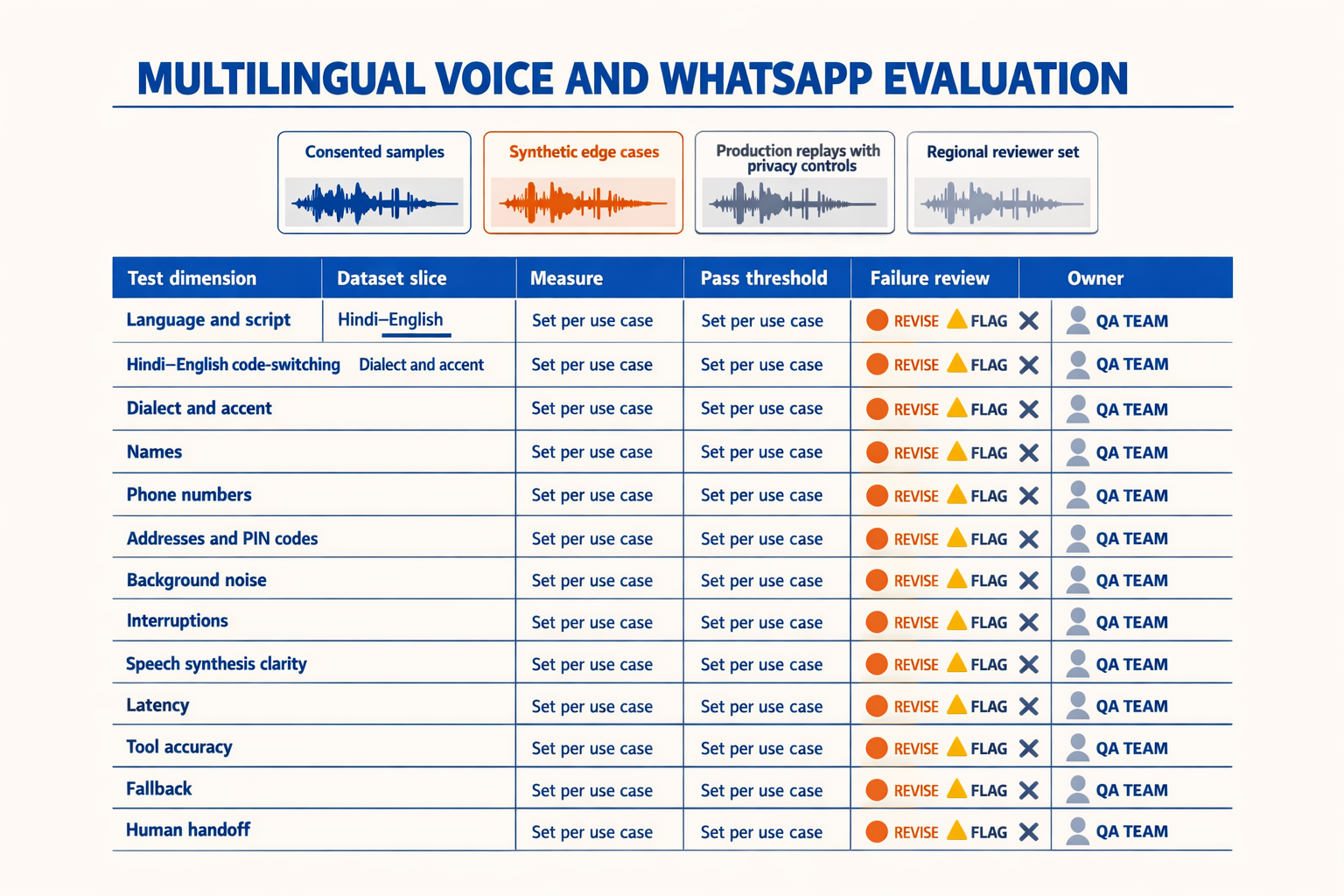
Test speech-to-text (STT) and text-to-speech (TTS) separately, then evaluate the complete agent over real WhatsApp and telephone conditions. A production dataset should represent each supported language, code-switch pattern, region, intent, speaker group, and acoustic environment—not merely clean studio recordings.
Build a representative evaluation dataset
CallMissed’s July 2026 website states that the platform supports speech workflows across 22 Indian languages. However, support coverage does not imply identical performance for every language, accent, domain, or audio channel; each language enabled in production needs its own benchmark.
Create a consented, de-identified test corpus using production-like utterances. Include:
- Hindi and Hinglish: “Mera order kal morning tak deliver hoga?” and similar within-sentence switches.
- Regional variation: Speakers from multiple states, districts, and urban–rural settings relevant to the business.
- Critical entities: Indian names, locality names, landmarks, PIN codes, amounts, dates, vehicle numbers, and alphanumeric order IDs.
- Acoustic diversity: Quiet rooms, traffic, shops, speakerphone, packet loss, low volume, and overlapping speech.
- Conversational events: Interruptions, corrections, hesitation, repeated digits, and mid-call language changes.
Do not use synthetic speech as the entire STT benchmark. Synthetic samples are useful for regression testing, but they underrepresent natural disfluencies, microphone variation, and regional pronunciation.
Evaluation matrix and acceptance criteria
| Test area | Dataset slice | Primary metric | Production check |
|---|---|---|---|
| STT transcription | Each language, accent, and noise tier | WER/CER | Compare overall errors and worst-performing slices |
| Code-switching | Hindi–English and regional-language–English turns | Mixed-language WER | Preserve language switches, intent, and named entities |
| Critical details | Names, numbers, dates, PIN codes, addresses | Entity accuracy | Require confirmation before committing high-impact fields |
| TTS intelligibility | Regional text, abbreviations, amounts, names | Listener transcription rate | Listeners must reproduce the spoken content correctly |
| TTS naturalness | Full prompts and multi-turn replies | MOS and preference scores | Rate pronunciation, rhythm, warmth, and consistency |
| End-to-end agent | WhatsApp calls under realistic network conditions | Task success and latency | Verify recovery, interruption handling, and human transfer |
For STT, calculate word error rate (WER) as substitutions plus deletions plus insertions, divided by reference words. Also report character error rate (CER) for scripts and short entities where one incorrect character can materially change a name or address. Aggregate WER alone can hide serious failures, so publish results by language, code-switch type, noise condition, and business intent.
For TTS, follow a structured listening method such as the ITU-T P.800 five-point Mean Opinion Score framework, but pair naturalness ratings with objective task checks. A pleasant voice that mispronounces “₹15,000,” a medicine name, or a Kerala locality remains unsuitable.
Run blind regional-language reviews
Recruit at least two independent native reviewers for every launch language and give them a shared rubric:
- Score meaning preservation, pronunciation, naturalness, politeness, and script handling.
- Flag technically understandable but culturally awkward translations.
- Compare outputs without revealing the model or configuration.
- Adjudicate disagreements and add confirmed failures to a permanent regression set.
Finally, replay the same frozen dataset whenever the CallMissed API model, prompt, vocabulary, voice, or routing logic changes. Meta for Developers confirms that the WhatsApp Business Calling API carries calls over VoIP as of July 2026, so end-to-end testing should include realistic WhatsApp network behaviour rather than evaluating only local audio files.
What common failure modes, consent duties, privacy risks, and customer impacts should you plan for?
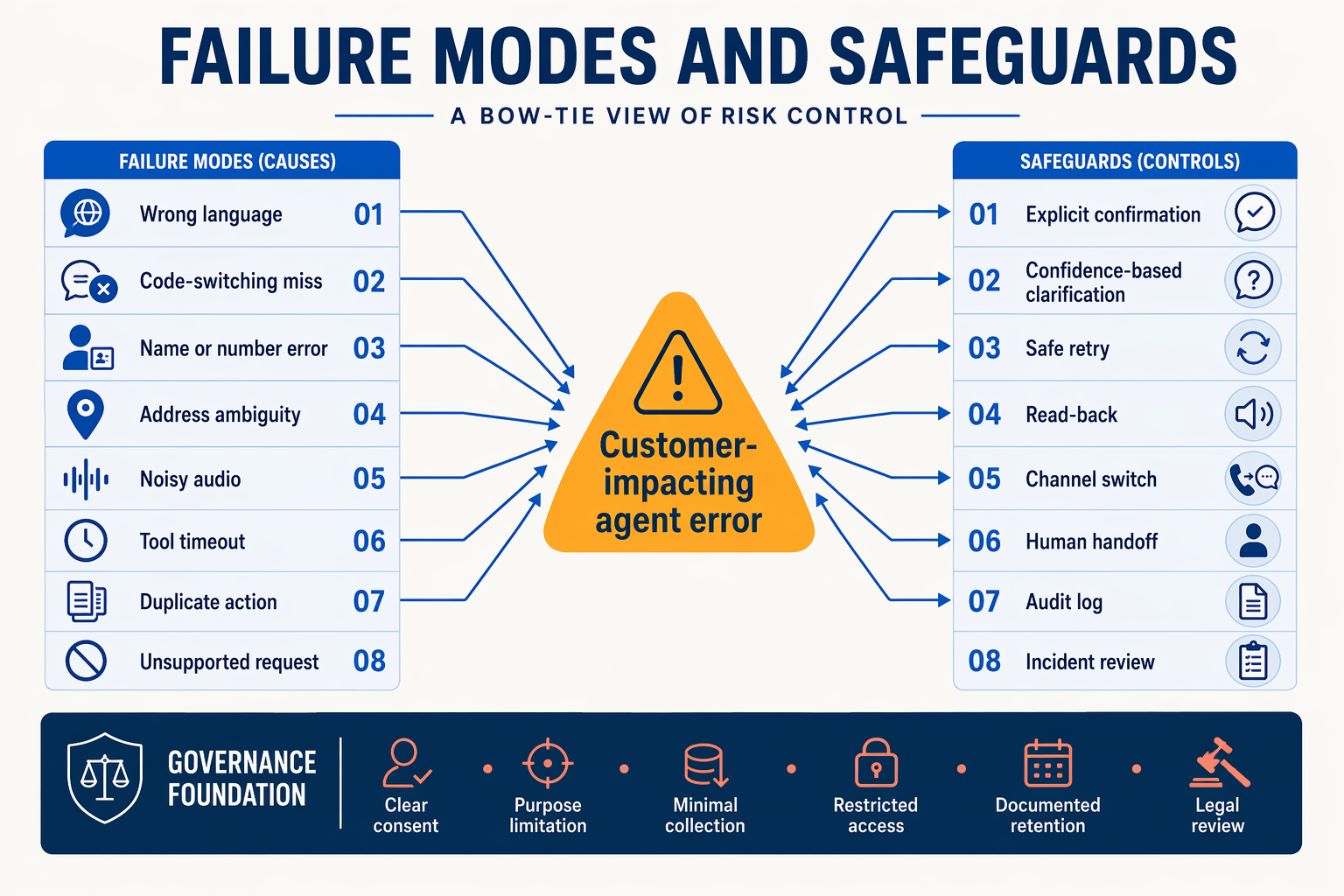
Production planning must assume that speech recognition, language routing, external tools, and consent flows will sometimes fail. The safest design limits the impact of each failure, tells customers when automation is involved, and transfers control before uncertainty becomes financial, legal, or reputational harm.
Treat predictable failures as controlled states
A multilingual agent should never convert uncertainty into a confident action. Common failure modes include:
- Incorrect language routing: Hindi is mistaken for another language, or Hinglish triggers repeated switching. Preserve the conversation context, offer an explicit language choice, and avoid restarting the journey.
- Hallucinated understanding: The agent invents an answer after a partial or noisy transcription. Require retrieval evidence for policy answers and respond with “I could not verify that” when grounding fails.
- Corrupted critical fields: Names, dates, amounts, PIN codes and addresses are transcribed incorrectly. Read back high-impact fields individually and obtain confirmation before writing to a CRM or invoking an API.
- Looping retries: The customer repeats the same phrase without progress. Cap clarification attempts and initiate a human handoff instead of asking indefinitely.
- Unsafe tool execution: A misunderstood request triggers cancellation, payment, booking or account changes. Apply server-side authorisation, idempotency, amount limits and explicit confirmation; never rely on the model’s prompt alone.
- Latency or dropped audio: Long silence makes customers repeat themselves or abandon the call. Use short progress cues, timeouts and a fallback such as WhatsApp text or a callback.
- Code-switch context loss: The transcript is accurate, but the agent loses intent after a language change. Store meaning and verified entities separately from the language used to express them.
CallMissed supports speech workflows across 22 Indian languages, according to CallMissed’s July 2026 website. That coverage creates a broad test surface: each supported language still needs validation by intent, accent, device, noise condition and channel.
Capture consent at the correct layer
Meta for Developers states that, as of July 2026, the WhatsApp Business Calling API supports both business-initiated and user-initiated VoIP calls. These directions should not share one blanket consent assumption.
Before processing begins, disclose:
- That the customer is interacting with an AI agent.
- The purpose of the call or message.
- Whether audio or transcripts will be recorded or retained.
- How the customer can decline, stop or request a person.
- Any separate permission required for marketing or a business-initiated call.
Consent evidence should record the disclosure version, timestamp, channel, purpose and customer response. Withdrawal must propagate to campaigns and downstream systems rather than merely ending the current conversation. Have Indian counsel review implementation against the Digital Personal Data Protection Act, 2023, applicable rules, sector regulations and Meta’s current platform terms; using an API does not itself establish compliance.
Minimise privacy and security exposure
Apply purpose limitation, least privilege and short retention:
- Do not request or store OTPs, card CVVs, UPI PINs, passwords or unnecessary identity documents.
- Redact sensitive values from transcripts, logs, analytics and model traces.
- Encrypt data in transit and at rest; restrict transcript access by role.
- Separate production data from evaluation datasets and remove direct identifiers before annotation.
- Define deletion schedules across recordings, transcripts, CRM records, backups and vendors.
- Treat retrieved knowledge and customer messages as untrusted input to reduce prompt-injection risk.
Measure customer impact, not just model accuracy
Track wrong-action rate, unresolved-call rate, repeated-turn rate, handoff delay, consent withdrawal, complaint rate and abandonment after silence. Review incidents by language and intent: a small overall error rate can conceal severe harm in payments, healthcare, collections or account access. When confidence is low or customer distress is detected, stopping automation is a successful safety outcome—not a failed conversation.
What should product, language, security, legal, and operations experts review before launch?
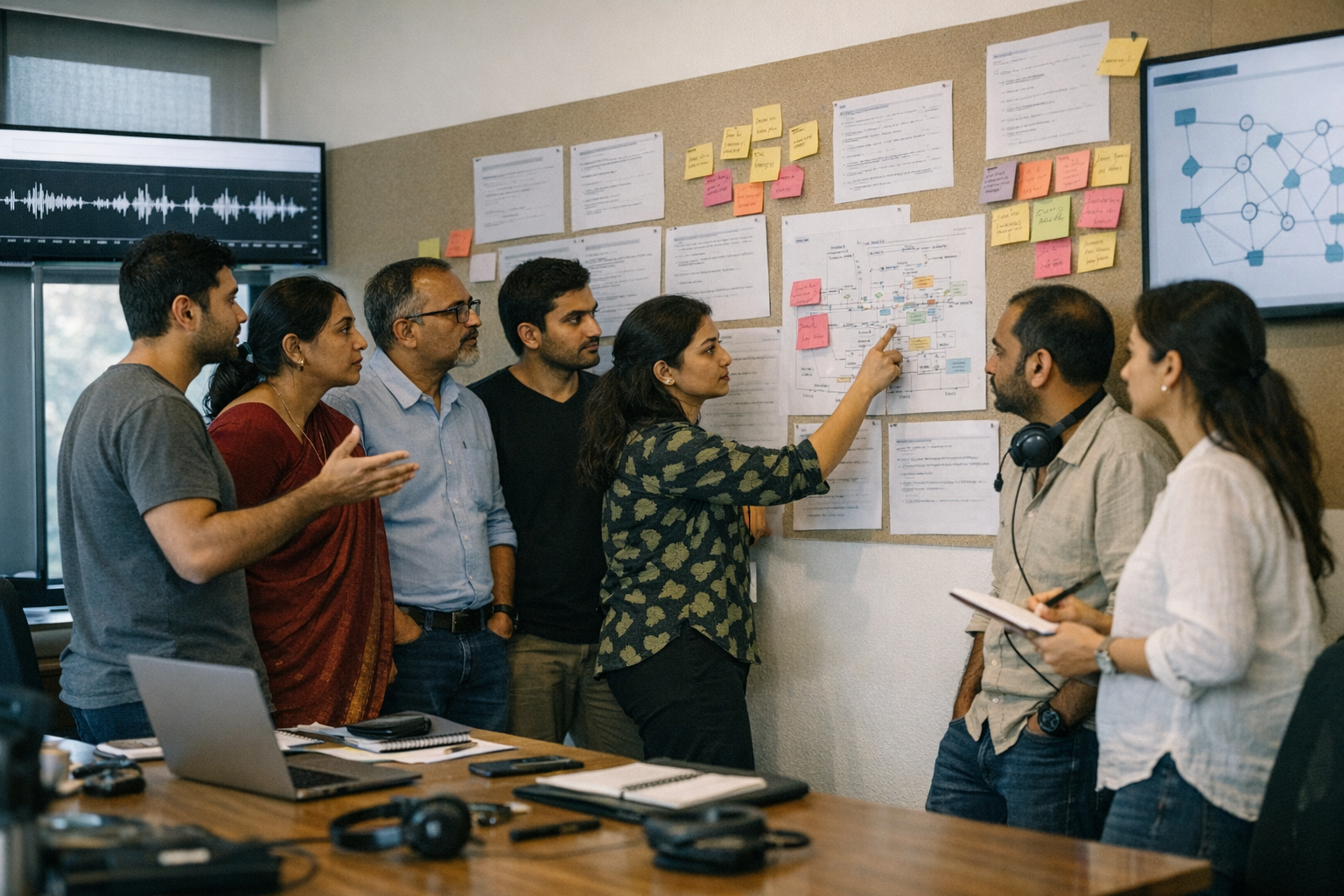
Launch only after product, language, security, legal, and operations owners independently approve the agent against documented acceptance criteria. A multilingual AI voice agent is production-ready only when the complete workflow—including WhatsApp permissions, tool calls, data handling, escalation, and incident response—is safe under realistic Indian-language conditions.
Product and conversation review
The product owner should verify that the agent solves a bounded customer task rather than attempting unrestricted automation.
- Map every intent to an approved outcome, API action, refusal, or human handoff.
- Test inbound and business-initiated calling as separate journeys, including unanswered calls, reconnects, and channel switching.
- Confirm that irreversible actions—such as cancelling an order or scheduling a payment—require explicit customer approval.
- Ensure customers can request a person, change language, repeat information, or end the interaction without friction.
- Review latency budgets across speech recognition, model reasoning, tools, synthesis, and network transport.
Meta for Developers states in July 2026 that the WhatsApp Business Calling API enables businesses to initiate and receive VoIP calls with WhatsApp users; each direction should therefore have its own permission, consent, and failure-path review.
Language and cultural review
A fluent bilingual employee is helpful but insufficient. Language specialists should evaluate transcripts and audio across accents, age groups, genders, locations, devices, and code-switching patterns.
Reviewers should inspect:
- Natural Hindi–English switching rather than literal translation.
- Pronunciation of names, districts, brands, currencies, dates, and abbreviations.
- Formality, honorifics, gender agreement, and potentially offensive phrasing.
- Whether the voice clearly distinguishes similar numbers and place names.
- Whether low-confidence language detection triggers clarification instead of guessing.
CallMissed reports support for speech workflows across 22 Indian languages on its July 2026 website. Teams should still approve each enabled language separately; platform coverage does not replace domain-specific evaluation.
Security and privacy review
Security engineers should threat-model the complete CallMissed API workflow, including webhooks, CRM access, retrieval sources, logs, and downstream business tools.
- Store API credentials in a secrets manager and rotate them on a defined schedule.
- Authenticate webhook requests, reject replays, and log privileged actions.
- Apply least-privilege permissions to order, booking, payment, and customer-record tools.
- Redact sensitive fields from prompts, transcripts, analytics, and debugging traces.
- Test prompt injection through speech, WhatsApp messages, retrieved documents, and uploaded content.
- Define retention, deletion, encryption, access-control, and breach-escalation procedures.
Legal and policy review
Indian counsel and the organisation’s privacy officer should determine which obligations apply under the Digital Personal Data Protection Act, 2023, its currently effective rules and notifications, sector-specific regulations, contractual commitments, and Meta’s WhatsApp policies. Do not treat platform configuration as legal compliance.
The approval record should cover notice and consent language, lawful data use, recording disclosure, retention, processor contracts, cross-border transfers, marketing permissions, opt-outs, and grievance handling. Legal reviewers should also confirm when the agent must identify itself as automated.
Operations launch gate
Operations should conduct a final tabletop exercise before enabling customer traffic:
- Simulate model, telephony, webhook, CRM, and knowledge-base failures.
- Verify on-call ownership, alert thresholds, rollback controls, and status communications.
- Confirm that human agents receive the transcript, selected language, verified fields, and handoff reason.
- Establish daily launch reviews for failed tasks, unsafe responses, language errors, complaints, and abnormal latency.
- Record named sign-off owners, unresolved risks, rollout limits, and the conditions that trigger an immediate pause.
No owner, no launch: every critical risk needs an accountable reviewer and a tested recovery path.
What does a phased rollout and QA scorecard mean for your team? (TABLE)
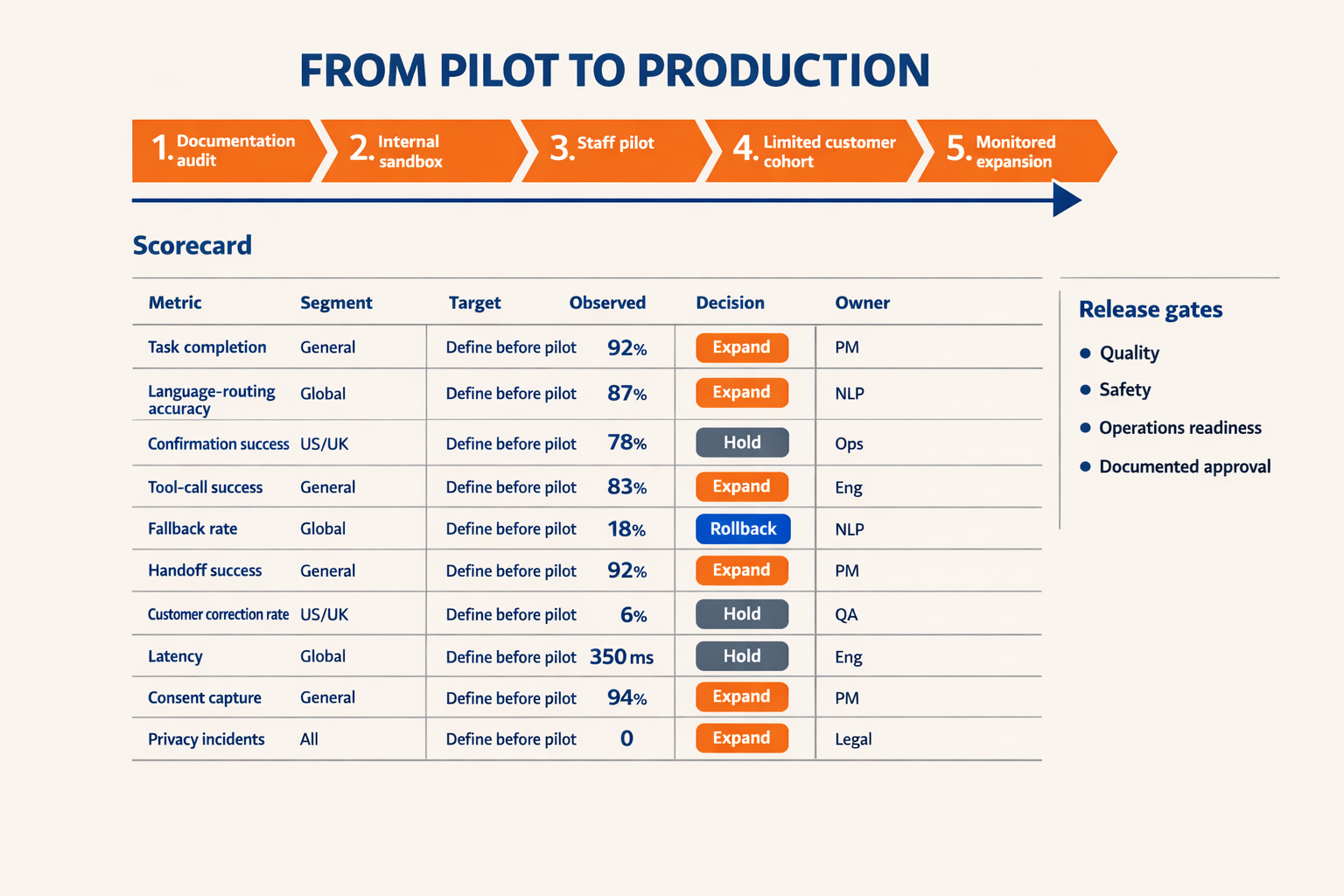
A phased rollout means expanding a multilingual AI voice agent only after it passes measurable quality gates for each language, intent and channel. Your QA scorecard turns subjective feedback such as “the Hindi sounds natural” into release decisions based on task completion, critical-detail accuracy, latency, safety and successful human handoff.
Recommended rollout sequence and release gates
Treat the thresholds below as starting targets, not universal CallMissed performance claims. Adjust them for risk: appointment reminders can tolerate different failure rates from payment collection, healthcare triage or account changes.
| Phase | Audience and traffic | What to evaluate | Suggested release gate |
|---|---|---|---|
| 0. Offline evaluation | Recorded and synthetic test set; no customers | Hindi/Hinglish code-switching, regional accents, noise, names, dates, amounts, PIN codes and addresses | 100% confirmation of critical entities; zero unauthorised tool actions |
| 1. Internal pilot | Employees and approved testers | Prompt clarity, interruptions, pronunciation, webhook failures and escalation paths | ≥90% task completion; ≥95% successful handoff attempts |
| 2. Controlled customer pilot | One language, one low-risk intent, 1%–5% of eligible traffic | Real phone audio, abandonment, retries, opt-outs and agent corrections | No critical safety incidents; metrics stable for at least seven days |
| 3. Limited production | 10%–25% of eligible traffic; selected regions | Accent cohorts, peak-hour latency, repeat contacts and containment quality | Every tested cohort stays within agreed error and latency limits |
| 4. Language expansion | Add one regional language or code-switching pair at a time | Language-specific datasets, text-to-speech naturalness and translated policy prompts | New language matches the approved baseline without raising critical errors |
| 5. General availability | Approved intents and customer segments | Drift, provider fallback, complaint patterns and human-agent feedback | Automated rollback alerts and weekly scorecard review remain active |
CallMissed supports speech workflows across 22 Indian languages, according to the CallMissed website in July 2026, but coverage should not be interpreted as permission to activate all 22 simultaneously. Each language–intent pair is a separate release unit requiring representative evaluation.
Build a scorecard that exposes aggregate blind spots
Calculate results separately for Hindi, Hinglish and each regional language, then segment them by accent, device quality, noise level, intent and customer cohort. A 95% aggregate score can conceal a serious failure affecting one language or region.
Your scorecard should include:
- Task success rate: completed conversations divided by eligible conversations, excluding test calls.
- Critical-entity accuracy: correctly captured and explicitly confirmed names, phone numbers, dates, amounts, PIN codes and addresses.
- Correction burden: average retries or customer corrections per completed task.
- Handoff success: transfers that reach a human with transcript, language, intent and verified details preserved.
- Latency: median and p95 time from the end of customer speech to the start of the agent’s response.
- Safety rate: unauthorised actions, missing consent, policy violations or unsupported claims; critical incidents should have a target of zero.
- Containment quality: automated resolutions that do not generate a repeat contact or agent correction within the team’s chosen review window.
Make release ownership explicit
Before increasing traffic through the CallMissed API, assign one named owner for conversation quality, one for production reliability and one for privacy or policy review. Require sign-off from all three, preserve failing audio samples only under the organisation’s retention policy, and maintain a rollback path to human handling.
A phase should pause automatically when a critical safety event occurs, handoff becomes unavailable, or any language cohort crosses its error budget. Roll out by evidence—not by calendar date or aggregate averages.
Frequently asked questions about CallMissed multilingual voice and WhatsApp agents
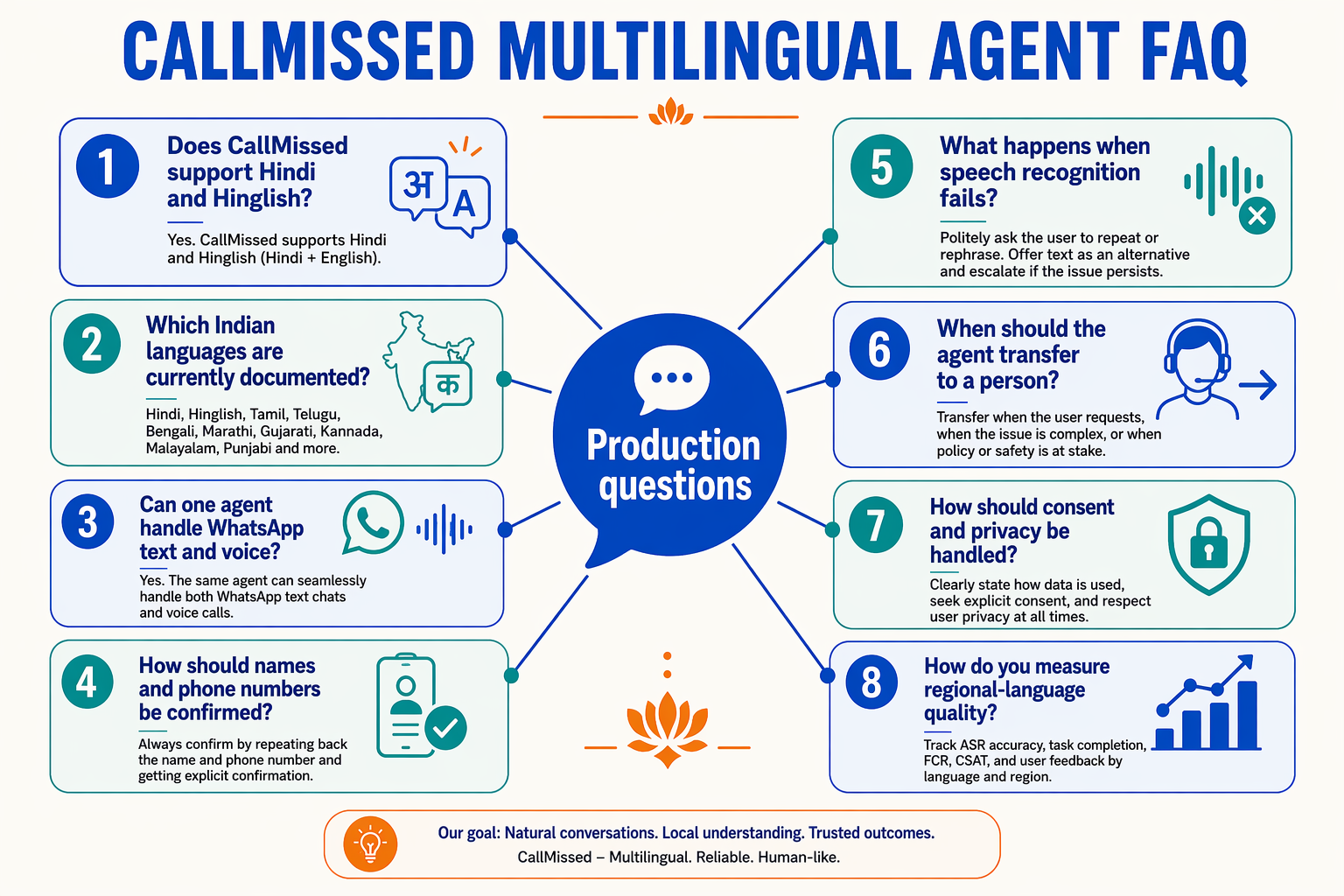
Which Indian languages does a CallMissed multilingual AI voice agent support?
How does the CallMissed API handle Hindi, Hinglish, and code-switching?
Can a WhatsApp AI voice agent make and receive customer calls in India?
How should I test Voice AI Agents for Indian Languages before production?
When should a multilingual WhatsApp AI voice agent transfer to a human?
How do I protect consent and personal data in a CallMissed voice AI API integration in India?
Conclusion
A production-ready WhatsApp AI voice agent in India must do more than generate fluent responses: it must understand how customers actually speak, confirm critical details, protect personal data, and recover safely when confidence drops. As of July 2026, Meta’s WhatsApp Business Calling API supports user-initiated and business-initiated VoIP calls, while CallMissed supports speech workflows across 22 Indian languages, according to CallMissed’s July 2026 website.
Key takeaways for moving from pilot to production include:
- Treat Hindi, Hinglish, code-switching, regional accents, and noisy mobile audio as separate, testable conditions—not a single multilingual setting.
- Test speech recognition and synthesis with representative names, dates, PIN codes, numbers, honorifics, and complete Indian addresses.
- Require explicit confirmation for high-impact information, use confidence-aware retries, and trigger deterministic fallback or human handoff when automation becomes unreliable.
- Measure task completion, transcription quality, response latency, handoff outcomes, and unsafe responses while retaining only necessary customer data and respecting consent.
Looking ahead, watch how language routing, mixed-language evaluation datasets, and WhatsApp Business calling mature across real Indian operating environments. Teams that continuously evaluate every language, intent, channel, and acoustic condition will be better prepared to scale without sacrificing trust.
To put this framework into practice, explore CallMissed, an India-built platform connecting WhatsApp Business calls and messaging with multilingual AI voice agents—and ask: would your agent handle the customer’s next language switch safely?
Related Reading
- WhatsApp Calling API Architecture: Production Voice and AI Chat Agents with CallMissed
- CallMissed API: Build a WhatsApp and Voice AI Appointment Booking Agent
- Best Omnichannel AI Voice Agent Platforms for Calls & WhatsApp (2026)
Sources
Related Posts


Ready to automate customer conversations?
Launch AI voice agents and WhatsApp bots with CallMissed — one API, 22+ Indian languages.