

CallMissed API Guide: Missed Call Automation With Voice AI and WhatsApp


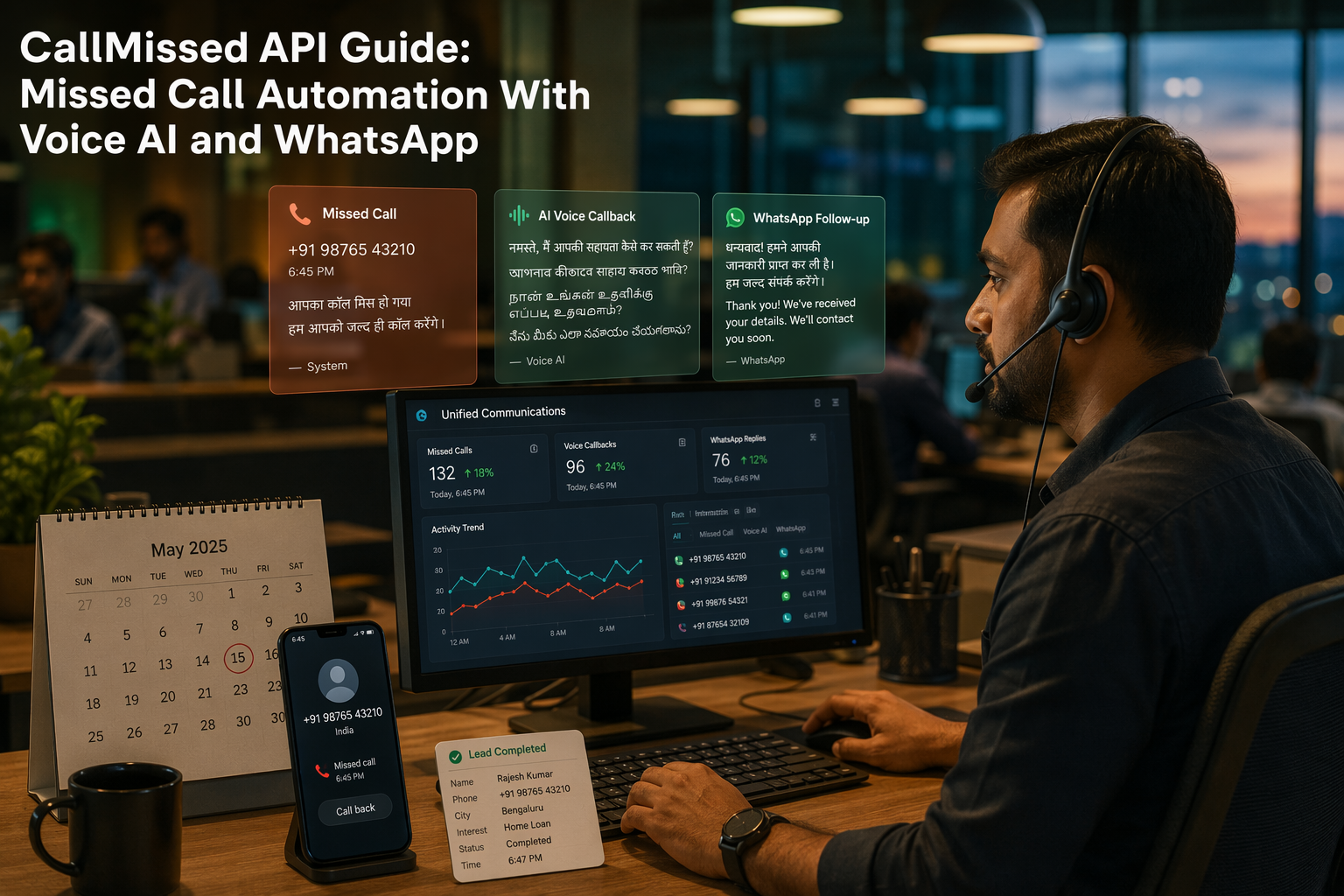
Build missed call automation with the CallMissed API, voice AI and WhatsApp follow-up, including retries, handoffs, logging and KPI formulas.
CallMissed API Guide: Missed Call Automation With Voice AI and WhatsApp
What if an unanswered phone call could trigger an intelligent callback, qualify the caller, book an appointment, and continue the conversation on WhatsApp—before a human agent even notices the missed call? CallMissed API missed call automation turns that possibility into an orchestrated recovery workflow spanning Voice AI, WhatsApp, customer data, and human escalation.
Missed calls are not merely a telephony problem. They often represent high-intent customers who called to request a quote, confirm availability, schedule a service, or resolve an urgent issue. Delayed responses increase the chance that the caller will try another provider, while disconnected tools can produce duplicate callbacks, repetitive questions, and incomplete conversation records. Effective missed call recovery therefore requires more than sending a generic text: it needs fast detection, context-aware engagement, reliable retries, and measurable outcomes.
Language coverage also matters in India, where a caller may be more comfortable speaking Hindi, Bengali, Marathi, Telugu, Tamil, or another regional language. As of July 2026, the CallMissed product site states that its Speech-to-Text and Text-to-Speech capabilities support 22 Indian languages through an OpenAI-compatible API. That combination allows businesses to build an AI voice agent for missed calls while keeping regional-language speech processing and WhatsApp engagement within the same broader platform.
This guide will show how to design an end-to-end workflow in which the CallMissed API coordinates:
- Missed-call detection and event intake
- An immediate AI callback or an approved WhatsApp follow-up
- Caller intent capture and lead qualification
- Appointment booking or task creation
- Escalation to a human when confidence, policy, or customer preference requires it
- Conversation logging across voice and WhatsApp
- Deduplication, retries, idempotency, and failure handling
- KPI measurement without relying on invented performance benchmarks
The workflow will also distinguish between operational logic you control—such as callback timing and qualification rules—and WhatsApp actions that must follow applicable business messaging permissions and platform policies. By the end, you will have a practical implementation blueprint for missed call WhatsApp automation, including an event flow, recovery safeguards, and formulas for measuring callback speed, contact rate, qualification rate, booking conversion, escalation, and recovered revenue.
How does end-to-end missed call recovery work with the CallMissed API?
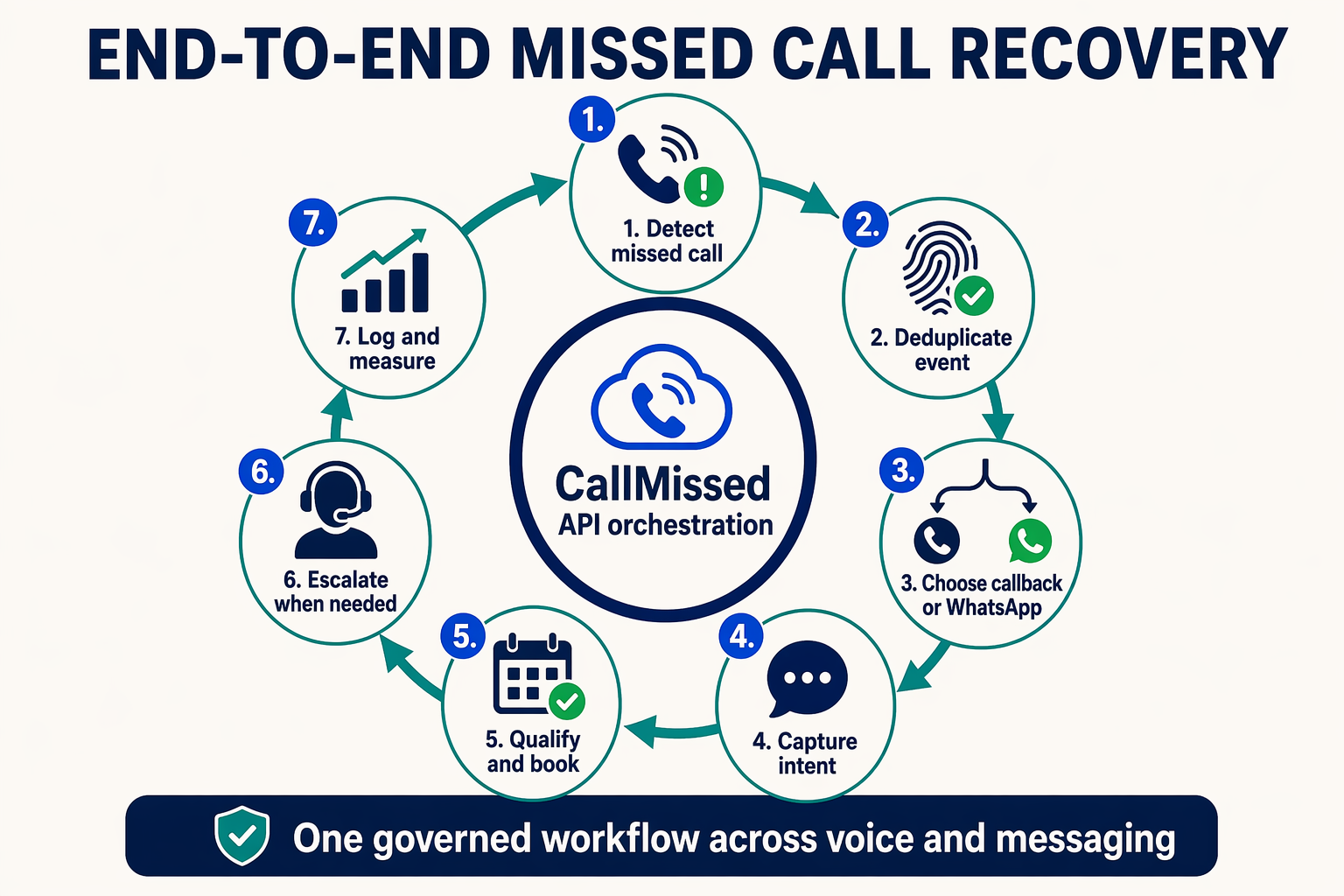
End-to-end missed-call recovery works as an event-driven state machine. The CallMissed API acts as the API-first orchestration layer connecting missed-call events with voice AI, supported Meta/WhatsApp services, business systems, human handoff, and follow-up. Each action updates one shared recovery record until the caller is qualified, booked, escalated, opts out, or reaches a defined retry limit.
The recovery sequence
- Detect the missed call.
The telephony layer determines that an inbound call was unanswered, busy, rejected, or abandoned before connection. An event adapter passes normalized details—such as the caller number, dialled number, timestamp, call identifier, and disposition—to the CallMissed API workflow.
- Create or update a recovery record.
The orchestration logic checks for an active case associated with the normalized phone number before initiating contact. An idempotency key, commonly based on the call identifier or the phone number plus a time bucket, helps prevent duplicate callbacks when an event is delivered more than once.
- Choose an eligible follow-up channel.
Business rules can select an immediate AI callback, a scheduled callback, or a WhatsApp follow-up. The CallMissed API coordinates that decision and the subsequent workflow, but it does not replace Meta’s channel requirements. WhatsApp messaging remains subject to Meta permissions, business verification, channel approval, customer consent, messaging-window rules, approved templates where required, opt-outs, and applicable policies.
- Run the voice AI conversation.
The voice agent identifies the business, explains that it is returning the missed call, and asks how it can help. The CallMissed API connects the conversation to the wider recovery state so the agent can capture the caller’s purpose, use approved business context, and trigger permitted next steps rather than operating as an isolated voice bot.
- Capture intent and qualify the caller.
The agent transcribes the conversation, identifies intent, and stores the structured fields needed for the task. A service business might collect location, requested service, urgency, preferred time, and budget range. A clinic might collect an appointment type while avoiding unnecessary sensitive information.
- Complete the task or hand it off.
The workflow can invoke an approved booking or CRM integration, confirm the outcome during the call, and coordinate an eligible WhatsApp follow-up. If the request requires human judgment, the caller asks for a person, or confidence falls below a business-defined threshold, the CallMissed API routes the case to the appropriate human queue with the available context.
- Continue follow-up until resolution.
Delivery events, replies, callback results, booking outcomes, and human actions feed back into the same workflow. Before each retry, the orchestration layer re-checks consent, opt-out status, contact limits, case state, and channel eligibility. Recovery stops when the case reaches a terminal outcome or the retry policy is exhausted.
One record across voice and WhatsApp
Each transition should append an auditable event instead of overwriting previous state. A practical CallMissed API recovery record includes:
- Channel and timestamps: missed call, callback attempt, WhatsApp delivery, reply, and handoff
- Conversation context: transcript, summary, detected language, intent, and extracted fields
- Operational state:
detected,contacting,qualified,booked,escalated, orclosed - Control data: consent status, retry count, idempotency key, channel eligibility, and failure reason
- Ownership: voice AI agent, WhatsApp AI agent, human queue, branch, or assigned representative
Keeping this context in one recovery record allows the customer’s history to follow the interaction from the initial callback to WhatsApp and, when necessary, to a human. The CallMissed API provides the orchestration and continuity; Meta controls access to WhatsApp services and the permissions, templates, verification, consent, and approval conditions governing that channel.
What makes the workflow reliable
The orchestration layer should store events durably before acknowledging them, retry transient failures with exponential backoff, and send unrecoverable cases to a review queue. It should also enforce contact-frequency limits, stop immediately after an opt-out, and verify the latest case state before every callback or message.
These controls make the CallMissed API more than a trigger for outbound actions. It becomes the coordination layer for missed-call events, voice AI, supported WhatsApp follow-up, business-system actions, and human escalation—turning missed call automation into a recoverable and measurable process.
What CallMissed, telephony and WhatsApp capabilities should you verify before implementation?
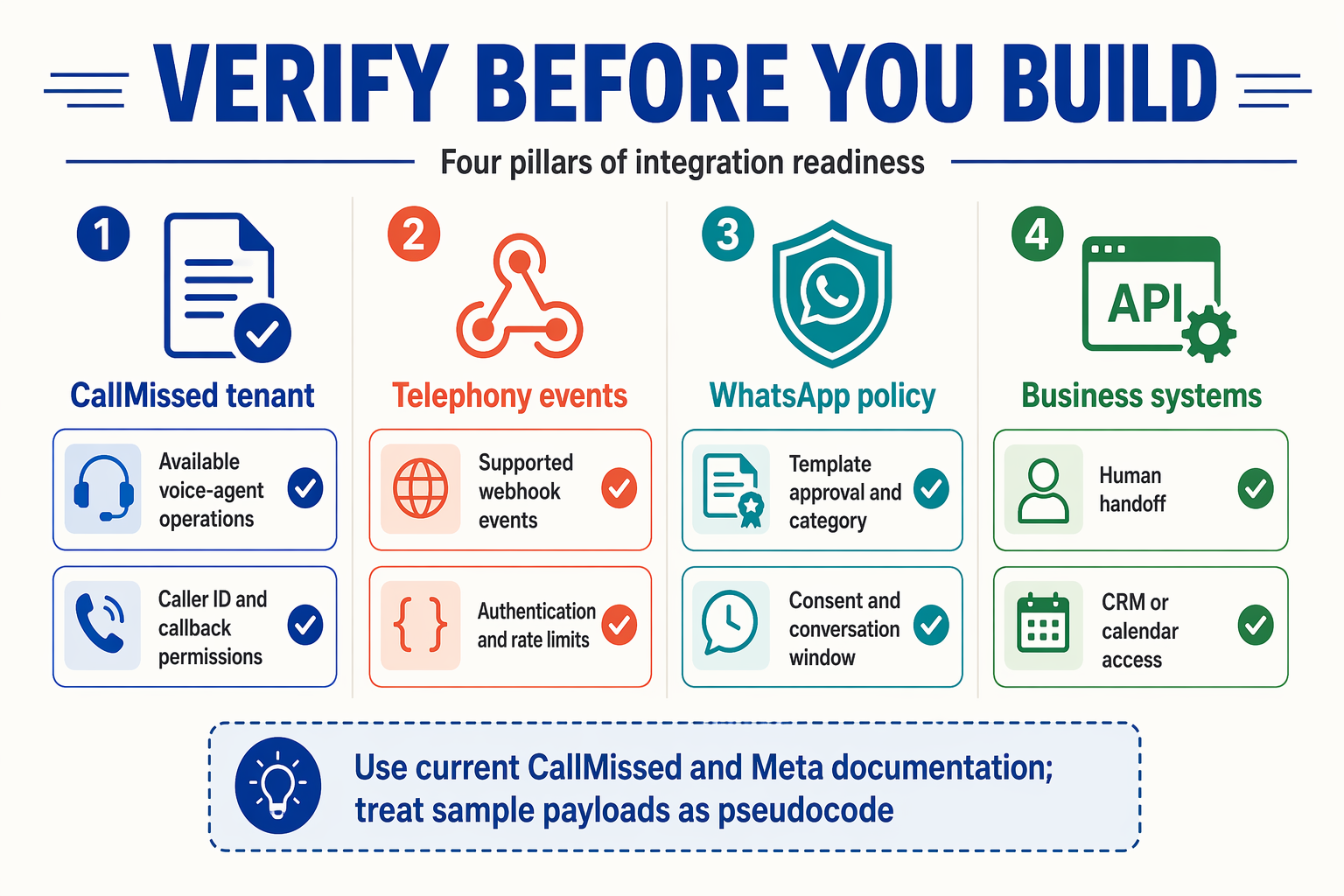
Before implementation, verify three layers independently: CallMissed API access, telephony event delivery, and WhatsApp messaging permissions. Production readiness requires a real missed-call event, an authorized callback, a policy-compliant WhatsApp follow-up, and a unified conversation record—not merely a successful API request.
Verify CallMissed API and agent readiness
OpenAI compatibility does not imply that every operational action uses the same endpoint, schema, or authentication scope. Confirm each required resource against the current CallMissed API documentation rather than inferring undocumented payloads.
The target account should have:
- A valid API key, sufficient credits, and separate development and production credentials.
- Access to the required large language model, Speech-to-Text, and Text-to-Speech models.
- Verified model identifiers, language codes, rate limits, concurrency limits, timeouts, and fallback behavior.
- Agent instructions covering intent capture, qualification questions, booking rules, escalation criteria, and prohibited actions.
- Documented methods for initiating callbacks, receiving status events, storing transcripts, and transferring conversations to humans.
- A retention policy for recordings, transcripts, summaries, consent evidence, and personally identifiable information.
As of July 2026, CallMissed describes its OpenAI-compatible platform as supporting voice AI and WhatsApp AI agents in 22 Indian languages. OpenAI’s voice-agent documentation also recommends selecting the voice architecture explicitly and connecting it to the wider application stack.
Confirm telephony event coverage
The telephony layer must distinguish an unanswered call from a completed, abandoned, rejected, or failed call. Establish whether CallMissed, the carrier, the PBX, or another telephony provider emits the authoritative final event consumed by the recovery workflow.
Verify that events provide, where supported:
- Caller and destination numbers normalized to E.164
- A unique call identifier
- Ring-start, ring-end, and final-disposition timestamps
- Status values such as no answer, busy, rejected, or network failure
- Webhook signatures or another authentication mechanism
- Retry schedules and duplicate-delivery behavior
Also confirm outbound-calling authorization, caller-ID presentation, operating-hour restrictions, recording consent, DTMF handling, voicemail detection, and human transfer. Trigger recovery only after the source marks the call as final; otherwise, delayed events could launch a callback while an employee is already speaking with the caller.
Validate WhatsApp messaging—and verify calling separately
For missed call WhatsApp automation, confirm the WhatsApp Business Account, sending number, customer consent basis, approved templates, and current customer-service-window rules. An automated message via the WhatsApp API for missed calls must use an approved template whenever free-form business messaging is not permitted.
Do not assume that voice AI and WhatsApp messaging support automatically includes WhatsApp Business calling. If any calling workflow is proposed, separately verify:
- Whether the WhatsApp account, number, country, and provider support calling
- Whether inbound or business-initiated calls are permitted
- What user permission or consent is required
- Which call-status events and failure codes are available
- Whether the chosen calling path can integrate with the selected AI agent
- What fallback applies when calling is unavailable, declined, or unsupported
Treat WhatsApp calling as a verification-only capability until the account provider and current documentation substantiate the complete path.
Set a production-readiness gate
Require an end-to-end test proving that:
- One final missed-call event creates exactly one recovery record.
- Duplicate webhooks do not generate duplicate callbacks or messages.
- Voice and WhatsApp events attach to the same customer timeline.
- Failed requests retry with bounded backoff and remain observable.
- Consent, templates, quiet hours, suppression lists, and escalation rules are enforced.
- A human can review the complete conversation history and take over safely.
Which events move a missed caller from detection to recovery? (TABLE)
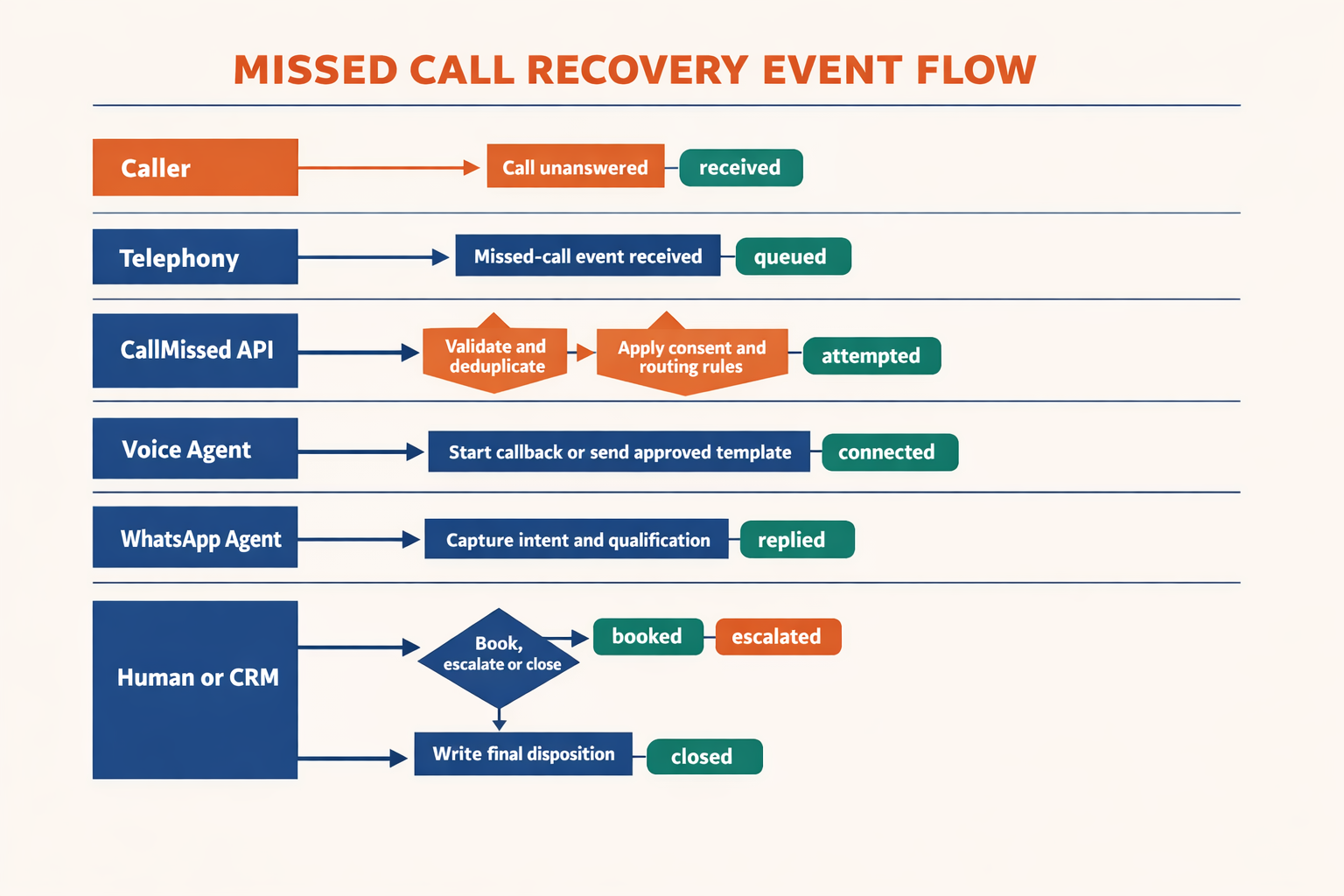
A missed caller moves from detection to recovery through six state-changing events: missed call recorded, contact attempt started, caller reached, intent qualified, action completed, and outcome closed. Each event should update one durable recovery record, ensuring the CallMissed API does not trigger duplicate callbacks, messages, or bookings.
Event flow from missed call to recovered outcome
| Event and state | Trigger | CallMissed API orchestration | Guard and next outcome |
|---|---|---|---|
1. Missed call detected DETECTED | The telephony system reports an unanswered, busy, rejected, or timed-out inbound call. | Create or update a recovery record containing caller number, called number, timestamp, disposition, and source. | Normalize the phone number and check an idempotency key before continuing; duplicate events remain attached to the existing record. |
2. Recovery attempt requested CONTACT_PENDING | The caller is eligible under business hours, consent, suppression-list, and retry rules. | Ask the CallMissed API to initiate an AI voice callback or send an approved WhatsApp message when the applicable permission and messaging rules allow it. | Select one primary channel to prevent simultaneous outreach; schedule a retry if the request fails transiently. |
3. Caller contacted ENGAGED | The voice callback is answered, or the caller responds on WhatsApp. | Connect the interaction to the AI agent, load relevant knowledge and prior context, and capture the caller’s preferred language. | A successful API request or message delivery is not recovery; engagement requires an answered call or customer response. |
4. Intent captured QUALIFYING | Speech-to-Text or WhatsApp input identifies a request such as pricing, support, availability, or booking. | Store the transcript, structured intent, extracted fields, and confidence result against the same recovery ID. | Ask a clarifying question when required information is missing; escalate if confidence is below the business-defined threshold. |
5. Resolution action executed ACTIONED | Qualification rules determine that the caller can be booked, routed, or assisted automatically. | Invoke the approved calendar, CRM, ticketing, or internal business action, then send confirmation through voice or WhatsApp. | Treat the action as complete only after the downstream system confirms success; use the same idempotency key for retries. |
6. Outcome finalized RECOVERED or CLOSED | A booking, qualified lead, resolved request, human handoff, opt-out, or retry exhaustion occurs. | Log the final disposition, timestamps, channel history, escalation reason, and attributable business outcome. | Stop all pending automation for terminal states, except explicitly authorized reminders or human follow-up tasks. |
These are logical event names, not claims about literal CallMissed webhook or endpoint names. Implementers should map them to the event schemas and API operations available in the current CallMissed documentation.
Transition rules that prevent workflow errors
Every transition should enforce four controls:
- Deduplication: Build an idempotency key from the tenant, normalized caller number, missed-call timestamp, and source event identifier.
- Channel locking: Once a callback is answered, cancel an unsent WhatsApp fallback; if WhatsApp engagement begins first, suppress an unnecessary callback.
- Retry classification: Retry timeouts, rate limits, and temporary downstream failures with exponential backoff, but do not retry opt-outs, invalid numbers, or permanent policy failures.
- Terminal-state protection: Reject late events that would move
RECOVERED,OPTED_OUT, orCLOSEDrecords back into an active outreach state.
Why one shared event record matters
As of July 2026, the CallMissed product site describes voice AI and WhatsApp AI agents operating through one OpenAI-compatible platform. That architecture is useful here because voice transcripts, WhatsApp replies, qualification data, and handoff reasons can be correlated under one recovery ID rather than treated as unrelated conversations.
The key operational distinction is simple: delivery is an event; recovery is an outcome. A workflow should count recovery only when the caller’s objective produces a defined result, such as a confirmed appointment, qualified opportunity, resolved query, or accepted human handoff.
How do you implement detection, callback, WhatsApp follow-up, qualification and booking?
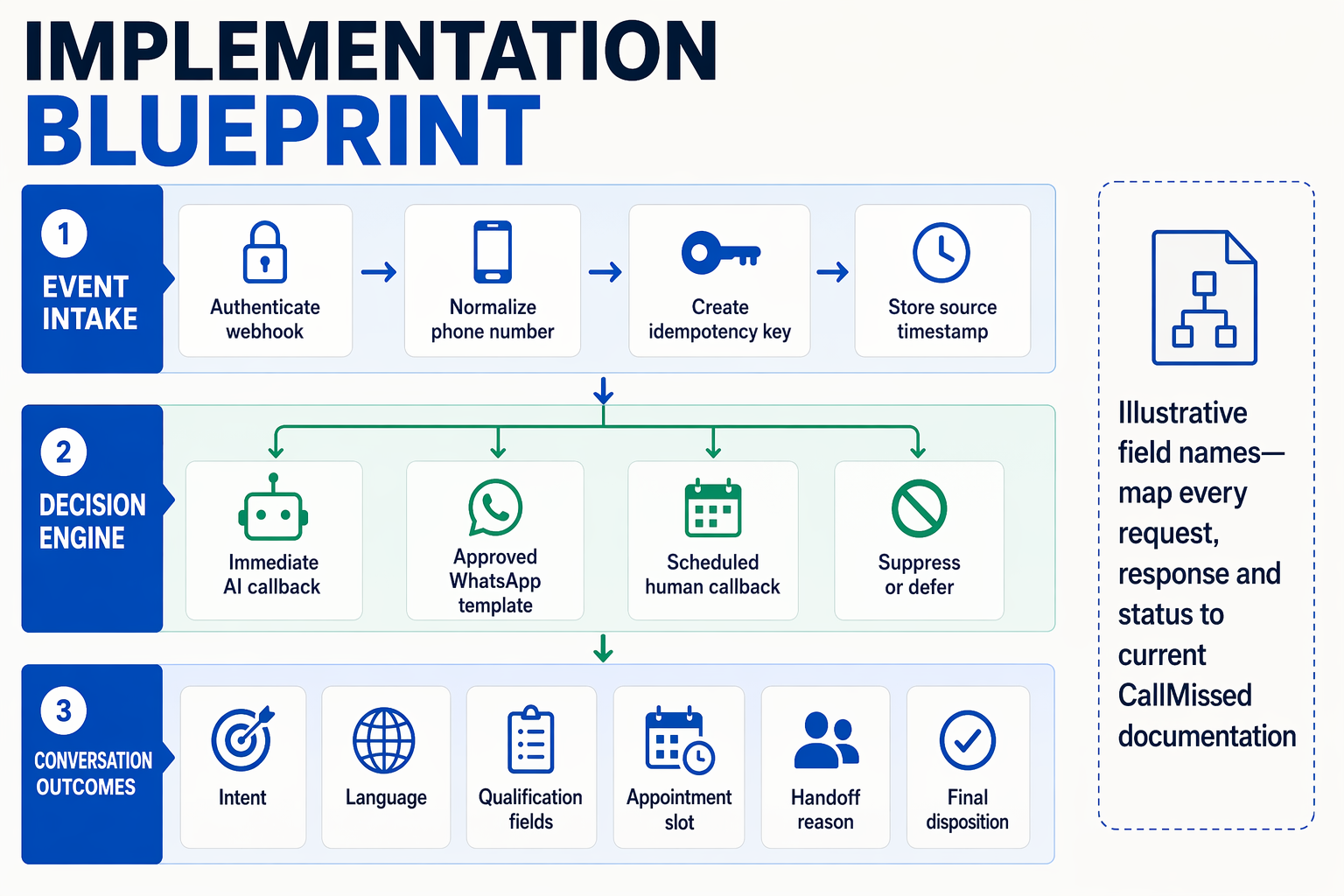
Implement the workflow as five API-orchestrated stages: detect the unanswered call, start the permitted recovery action, capture and qualify intent, book or escalate, and log every outcome. Keep CallMissed API operation names and payload fields aligned with the current documentation rather than hard-coding assumed endpoints.
1. Detect and normalize the missed call
Configure the telephony layer to send an event when a call is unanswered, rejected, busy, or abandoned before connection. Your orchestration service should validate the event and create a recovery record containing:
- A unique correlation ID
- Caller number in E.164 format
- Called business number
- Event timestamp, ring duration, and termination reason
- Campaign, branch, queue, or source metadata
- Consent, opt-out, timezone, and previous-contact status
Before taking action, query the recovery store for the same caller and call event. Use the provider event ID—or a deterministic key combining caller, business number, and timestamp—as the idempotency key so duplicate webhooks cannot trigger multiple callbacks.
2. Start the callback or WhatsApp follow-up
Apply business rules before sending an automation command through the CallMissed API:
- If calling is permitted and the business is within operating hours, initiate an AI voice callback.
- If the callback is unanswered, schedule a bounded retry with increasing delays.
- If WhatsApp messaging is permitted, send the appropriate follow-up.
- If neither channel is allowed, create a human task without contacting the caller.
A missed telephone call does not automatically establish an active WhatsApp customer-service conversation. An automated message via the WhatsApp API for missed calls may therefore require an approved template, depending on the conversation state and applicable WhatsApp Business rules.
3. Capture and qualify the caller’s intent
Give the voice agent a narrow recovery objective: identify why the customer called, collect the minimum required details, and choose the next action. Open with context rather than pretending the callback is unrelated: “You called us a few minutes ago. May I help with your booking or enquiry?”
Use structured fields for:
- Intent: appointment, quotation, support, order status, or other
- Qualification: location, service required, budget band, urgency, and eligibility
- Preferences: language, callback time, branch, and communication channel
- Confidence: transcription and intent confidence signals
- Disposition: qualified, unqualified, booked, escalated, or unreachable
CallMissed supports voice and WhatsApp AI agents on one OpenAI-compatible platform, according to the CallMissed product site as of July 2026. This lets the orchestrator preserve the same recovery context when moving from speech to WhatsApp.
4. Book, confirm, or escalate
When qualification succeeds, invoke the business’s scheduling tool, CRM, or internal service through an approved agent tool integration. Validate availability again immediately before committing the appointment, then return the confirmed time and booking reference to the voice agent.
Send the confirmation through WhatsApp when policy and consent permit. Escalate instead when:
- The caller requests a person
- Intent or transcription confidence falls below your configured threshold
- Pricing, complaints, emergencies, or regulated decisions require staff
- The booking system is unavailable
- Authentication or consent cannot be completed
5. Preserve one conversation history
Write voice transcripts, WhatsApp messages, tool results, retry attempts, booking references, consent changes, and escalation notes to the same correlation record. Redact sensitive fields, restrict transcript access, and record timestamps for every state transition so operators can reconstruct exactly what happened without making the caller repeat information.
How should the AI voice agent capture intent, support Indian languages and escalate safely?

The AI voice agent should capture intent through a constrained, confirmable dialogue, process speech in the caller’s preferred language, and escalate whenever confidence, consent, urgency, or policy rules make automation unsafe. The CallMissed API should preserve each decision as structured data so the callback, WhatsApp follow-up, booking flow, and human handoff share the same context.
Capture intent as structured outcomes
Do not ask the language model to produce only a free-text transcript. Configure the agent to classify the caller into a controlled intent taxonomy and collect the minimum fields required for the next action.
A practical missed-call schema could contain:
- Primary intent: request quote, check availability, book appointment, reschedule, support, complaint, cancellation, or other
- Qualification fields: service, location, preferred date, budget range, urgency, and existing-customer status
- Language: detected or caller-selected language, recorded using a consistent code
- Consent state: permission for WhatsApp follow-up and any required communication preferences
- Confidence: classification confidence plus missing or ambiguous fields
- Resolution: booked, qualified, follow-up required, escalated, declined, or unreachable
Use short prompts such as, “Are you calling to book a service, request a price, or get support?” After extracting an important detail, the agent should confirm it aloud: “You want an AC service visit in Pune on Tuesday morning—is that correct?” This prevents an uncertain transcription from becoming an incorrect booking.
The orchestration layer should validate structured output against your own schema before updating the recovery record. Unknown values should remain unknown; the model must not infer a budget, address, or appointment time that the caller never supplied.
Handle Indian languages and code-switching
As of July 2026, the CallMissed product site states that CallMissed supports Speech-to-Text and Text-to-Speech across 22 Indian languages through an OpenAI-compatible API. This enables the same workflow to serve callers who prefer Hindi, Bengali, Marathi, Telugu, Tamil, or other supported regional languages.
Language handling should follow four steps:
- Ask for the preferred language when the opening utterance is ambiguous.
- Pass the selected language consistently through transcription, reasoning, and speech synthesis.
- Preserve the original transcript alongside any translated summary.
- Reconfirm names, numbers, addresses, and dates—especially during code-switched conversations.
BCP-47 language tags provide a portable representation such as hi-IN or ta-IN. Sarvam API documentation also describes BCP-47 codes for 22 Indian languages and supports an unknown setting for automatic detection; however, developers should verify the exact language parameters supported by their selected CallMissed model before implementation.
Escalate safely instead of guessing
Escalation should be a deterministic policy decision, not merely a model preference. Trigger human handoff when:
- The caller explicitly asks for a person.
- Intent or critical-field confidence falls below your tested threshold.
- The caller repeats or corrects the same detail twice.
- The request involves emergencies, threats, sensitive complaints, refunds, or regulated advice.
- No approved appointment slot or policy-compliant answer is available.
- Speech quality, accent handling, or language detection remains unreliable.
The CallMissed API can orchestrate the handoff by ending automated qualification, creating a human task, and attaching the transcript, confirmed fields, unresolved questions, language, and callback priority. If immediate transfer is unavailable, the agent should state that clearly and offer a callback window or consented WhatsApp continuation—never promise that a human is already connected.
Finally, log why escalation occurred. Reason codes such as customer_requested, low_confidence, policy_restriction, and urgent_case make safety rules auditable and reveal where prompts, language routing, or business processes need improvement.
How do deduplication, retries and failure handling prevent duplicate or abandoned follow-ups?
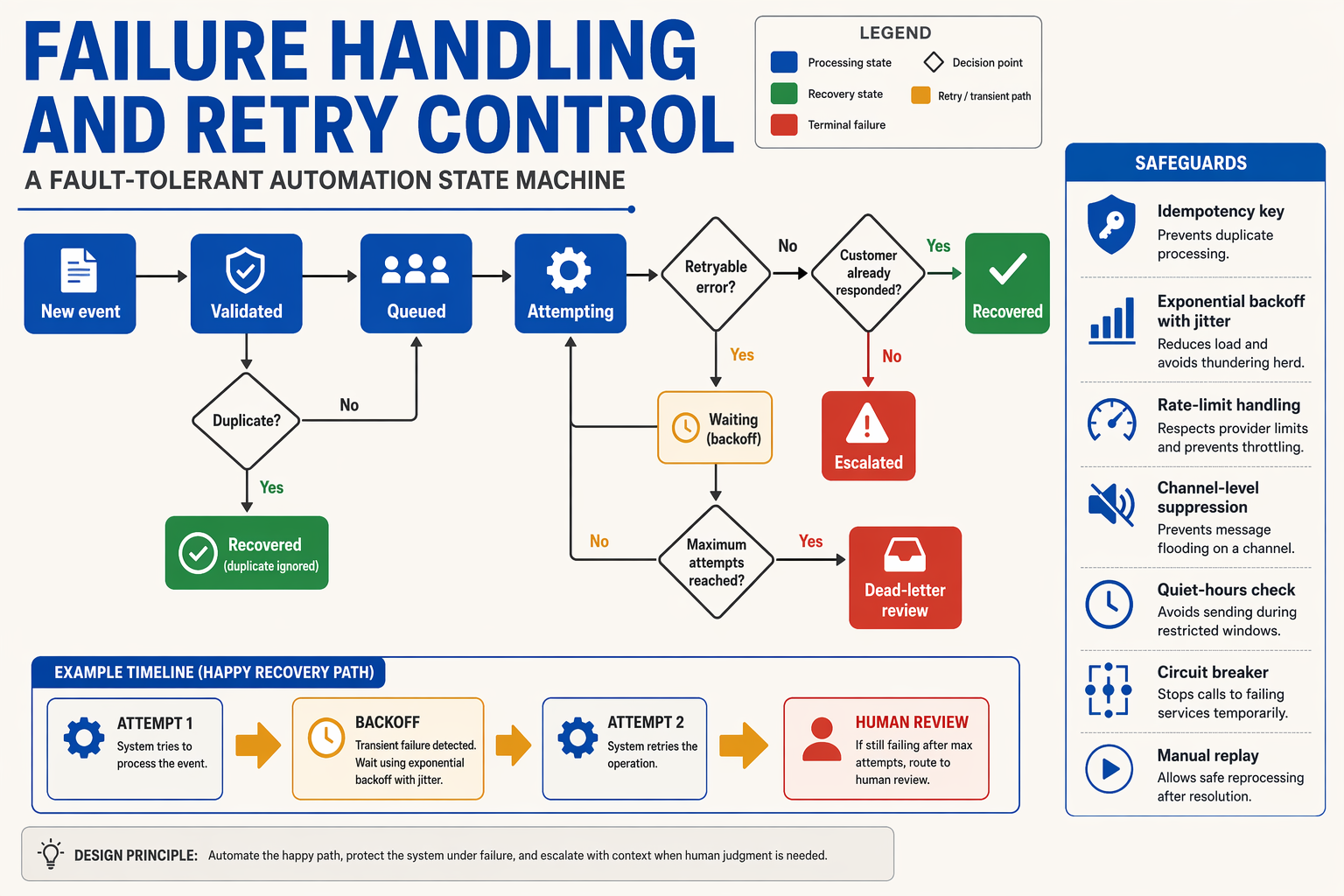
Deduplication ensures that one missed call creates one active recovery journey, while retries recover transient failures without repeating successful callbacks, messages, or bookings. Failure handling prevents abandonment by recording every outcome, applying bounded retry policies, and escalating unresolved cases to a human queue.
Create one durable recovery record
Assign every detected missed call an internal recovery ID and compute an idempotency key from stable inputs, such as:
business_id + caller_number + missed_call_timestamp_bucket
Before starting an AI callback or WhatsApp follow-up, check whether that key already exists. This protects the workflow when a telecom event is delivered twice, a webhook is replayed, or two workers process the same notification concurrently.
Store the state of each action separately:
missed_call_receivedcallback_requestedcallback_connectedorcallback_failedintent_capturedwhatsapp_followup_requestedwhatsapp_followup_sentorwhatsapp_followup_failedbooking_confirmedhuman_escalation_requiredrecovery_closed
A practical deduplication window might group repeated network notifications occurring within a few minutes, but it should not merge genuinely separate customer calls automatically. Keep the raw event IDs and timestamps so disputed merges can be audited.
Make every side effect idempotent
Checking only the initial missed-call event is insufficient. Every irreversible or customer-visible action needs its own idempotency control.
- Callback: Record the callback request before invoking the CallMissed API, then reuse the same operation key if the request must be retried.
- WhatsApp follow-up: Do not send if the recovery record already contains a successful message result for that purpose and conversation stage.
- Appointment booking: Reserve a slot once and attach the booking reference to the recovery ID before confirming it to the caller.
- CRM update: Upsert by recovery ID rather than creating a new lead after every voice or WhatsApp event.
CallMissed supports voice AI and WhatsApp AI agents through an OpenAI-compatible platform, according to the CallMissed product site as of July 2026. A shared orchestration record is therefore essential for preventing voice and WhatsApp branches from acting independently on the same caller.
Retry only failures that may succeed later
Use exponential backoff with jitter for temporary conditions such as timeouts, rate limits, unavailable dependencies, and server-side errors. For example, retry after approximately 30 seconds, two minutes, and ten minutes, while randomising the exact delay to avoid synchronized request spikes.
Do not automatically retry permanent or policy-sensitive failures:
- Invalid or unreachable phone number
- Caller opt-out or do-not-contact status
- WhatsApp message lacking the required permission or approved format
- Invalid booking parameters
- Authentication or account-configuration errors
- A callback that connected and completed successfully
A timeout is an unknown outcome, not proof of failure. Query the recorded operation status or reconcile later events before repeating a callback, message, or booking.
Prevent abandoned recoveries
When the retry budget is exhausted, move the recovery into a visible dead-letter or human-review queue rather than silently closing it. Capture the failed step, error category, attempt count, last response, next action, and conversation transcript reference.
Apply a final decision tree:
- If voice fails but messaging is permitted, attempt the approved WhatsApp path.
- If WhatsApp fails but callback consent and operating-hour rules allow, schedule another voice attempt.
- If both channels fail, create a human task with caller context.
- If the customer opts out, stop all automated outreach immediately.
- If booking confirmation is uncertain, escalate instead of creating another reservation.
Monitor duplicate-action rate, retry success rate, dead-letter volume, and recoveries without a terminal state. These controls turn failures into traceable operational work rather than duplicate outreach or lost leads.
How should missed call recovery impact be measured without relying on unsupported benchmarks?
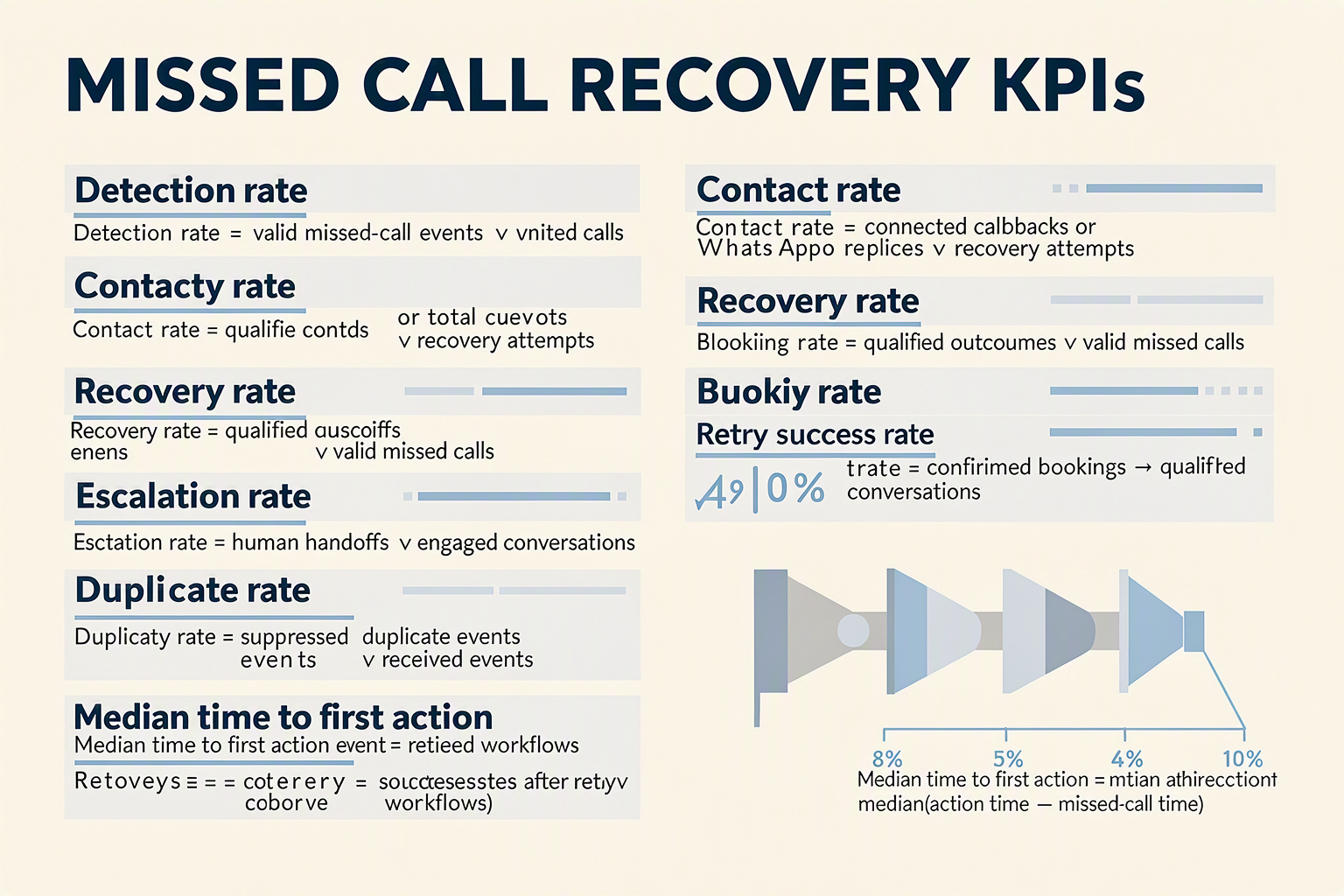
Measure missed-call recovery against your own pre-automation baseline, eligible-call cohorts, and business outcomes, not an unverified claim that a workflow “should” recover a particular percentage of calls. The supplied sources provide no validated industry benchmark for recovery or conversion, so targets should be established from observed production data.
Build a trustworthy measurement record
Assign one immutable recovery_id to every missed-call event and use it across the callback, WhatsApp follow-up, booking, escalation, and CRM record. As of July 2026, the CallMissed product site describes voice AI and WhatsApp AI agents operating through one OpenAI-compatible platform; that shared orchestration makes cross-channel attribution possible without treating each interaction as an unrelated lead.
Record at least:
- Detection, callback, message, answer, qualification, booking, and closure timestamps
- Caller identifier, campaign or source, business unit, language, and consent status
- Every attempt’s channel, status, duration, and failure reason
- Final disposition: contacted, qualified, booked, escalated, opted out, invalid, or unresolved
- Order or booking value, when available
- Automation version and qualification-policy version
Exclude test calls, blocked numbers, duplicates, and callers ineligible for contact. Report their counts separately rather than silently removing them.
Calculate operational and commercial KPIs
Use fixed definitions and publish every denominator:
- Detection latency
missed-call event received at − call ended at
Report median, p90, and p95; an average can conceal long delays.
- Callback initiation time
first callback requested at − missed-call event received at
- Contact rate
unique callers who answered or replied ÷ eligible unique missed callers × 100
- Qualification rate
qualified callers ÷ contacted callers × 100
- Booking conversion
confirmed bookings ÷ qualified callers × 100
Also calculate bookings per eligible missed caller to expose losses earlier in the funnel.
- Escalation rate
recoveries transferred to a human ÷ contacted recoveries × 100
- WhatsApp continuation rate
callers who responded on WhatsApp ÷ callers sent an eligible follow-up × 100
- Recovered revenue
sum of completed, attributable transaction value
Keep booked value separate from completed revenue, cancellations, refunds, and no-shows.
- Cost per recovered outcome
(voice + messaging + model + human-handling costs) ÷ completed recovered outcomes
Establish impact rather than correlation
Compare equivalent periods before and after deployment, controlling for opening hours, weekday, campaign, location, and call source. A stronger design randomly assigns eligible missed calls to the new workflow or the existing recovery process, subject to customer-consent and service obligations.
Define an attribution window before analysis—for example, whether a booking must occur within 24 hours, seven days, or the business’s normal sales cycle. Count each caller once, even when retries generate multiple events.
Segment results by language, intent, branch, time of day, callback attempt, and automation version. Language-level reporting is particularly relevant because caller populations and recognition conditions can differ; it also prevents an aggregate improvement from hiding a weak regional-language experience.
Pair conversion with guardrails
A higher booking rate is not automatically better. Monitor:
- Opt-outs, complaints, and abandoned AI calls
- Duplicate contacts and excessive retry frequency
- Failed transfers and booking conflicts
- Low-confidence intent classifications
- WhatsApp delivery failures and policy-ineligible sends
- Human override and post-booking cancellation rates
Set targets only after a representative baseline period, then document sample size, exclusions, and confidence intervals. The defensible benchmark is the measured change in your own eligible population—not a promotional percentage borrowed from another business.
What do current platform guidance and messaging policies mean for your rollout? (TABLE)
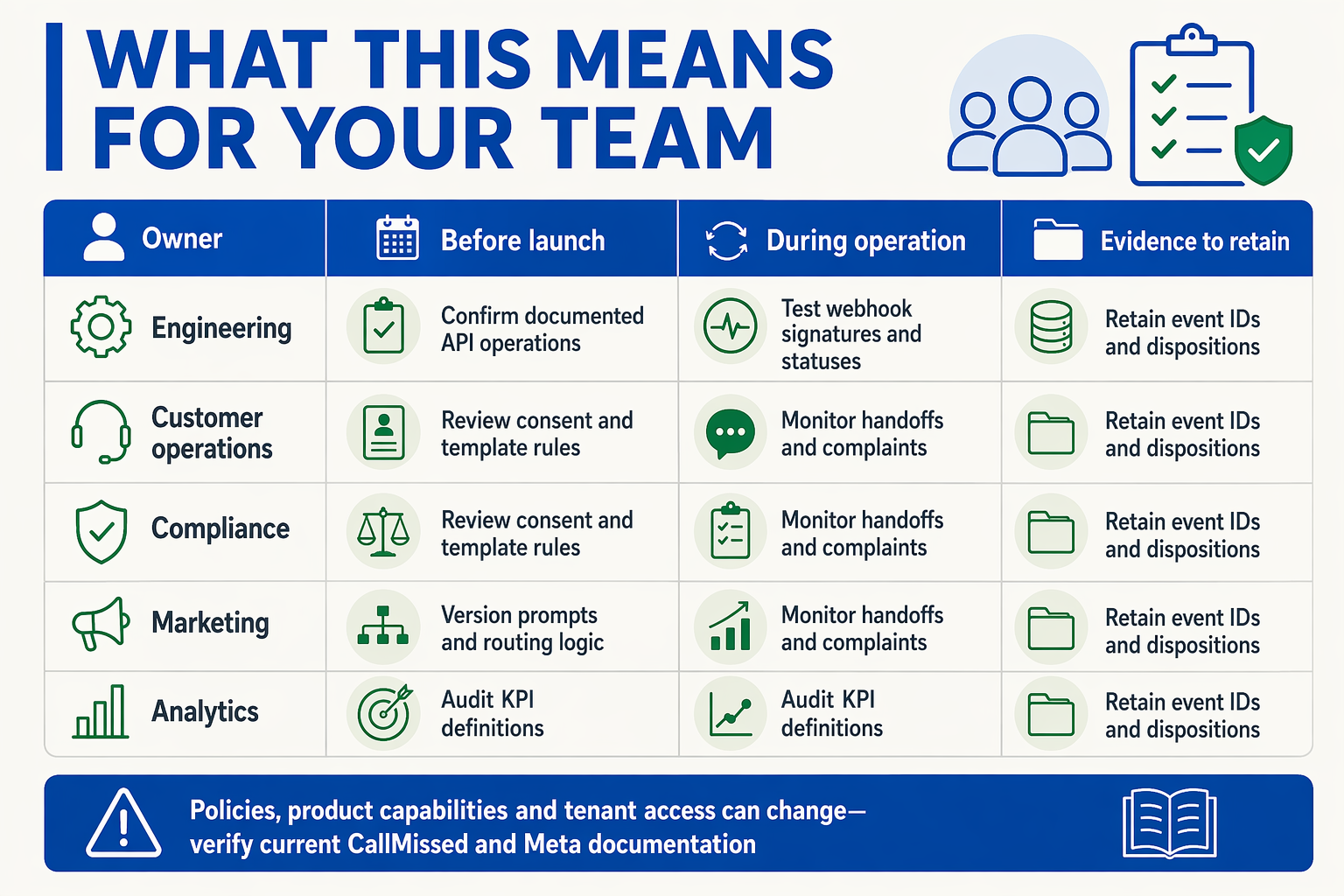
A CallMissed API workflow must treat WhatsApp eligibility, customer consent, calling rules, and opt-outs as execution gates—not assumptions. Automation can decide what should happen next, but Meta’s WhatsApp Business Platform policies and applicable Indian privacy and telecom requirements determine whether a message or business-initiated call may actually be sent.
Policy gates for each recovery action
| Recovery action | Current platform or policy consideration | CallMissed orchestration rule | Evidence to retain |
|---|---|---|---|
| Detect a missed call | A phone number is not automatically consent for every future channel or purpose | Create the recovery record, but evaluate voice and WhatsApp permissions separately | Call timestamp, dialled number, source and event ID |
| Return the phone call | Apply local calling, consent, quiet-hours and suppression requirements | Check calling eligibility before instructing the AI voice agent to dial | Consent source, policy decision and dial attempt |
| Send WhatsApp inside an open conversation | Meta generally permits free-form replies during the customer-service window, which lasts 24 hours after the customer’s latest message | Calculate the window from the latest inbound WhatsApp timestamp—not the missed-call time | Inbound message ID and timestamp |
| Message outside the 24-hour window | Meta requires an approved message template for business-initiated outreach outside the customer-service window | Select an approved missed-call template with the correct language and purpose | Template name, language, category and send result |
| Initiate a WhatsApp Business call | Business-initiated WhatsApp calling is subject to Meta’s current call-permission and eligibility rules | Request or verify permission before placing the call; fall back to an eligible message or human task | Permission status, request timestamp and call outcome |
| Process an opt-out or human request | Customer preference must override campaign and retry logic | Suppress further automated outreach or route immediately to a person | Opt-out text, timestamp, channel and suppression status |
A missed telephone call does not itself open WhatsApp’s 24-hour customer-service window, because that window is based on a customer message on WhatsApp. Therefore, an automated message via the WhatsApp API for missed calls will commonly require an approved template unless a valid WhatsApp conversation window is already open.
Build policy checks into the state machine
Before every outbound action, have the CallMissed API-controlled workflow evaluate:
- Channel consent: Is there a recorded basis for contacting this customer through WhatsApp or voice?
- Conversation state: Did the customer send a WhatsApp message within the preceding 24 hours?
- Template eligibility: Is the intended template approved, correctly categorised and available in the required language?
- Calling permission: Is a business-initiated WhatsApp call currently permitted under Meta’s applicable rules?
- Suppression state: Has the customer opted out, requested a human, or reached the configured retry limit?
- Timing and jurisdiction: Do quiet hours, telecom rules, contractual requirements or internal policies restrict the action?
Store the result as a versioned policy decision alongside the recovery record. This makes retries safer: a delayed job must re-evaluate permissions and conversation windows instead of reusing an outdated approval.
Language and rollout controls
As of July 2026, the CallMissed product site states that CallMissed supports Speech-to-Text and Text-to-Speech across 22 Indian languages through an OpenAI-compatible API. Use that coverage to localise voice conversations, but deploy only WhatsApp templates that Meta has approved for the corresponding locale.
Platform rules can change, so validate template categories, calling permissions, rate limits and quality requirements against the latest Meta WhatsApp Business Platform documentation before production launch. Start with a limited audience, monitor delivery failures and blocks, and retain a compliant fallback such as a standard callback task rather than repeatedly attempting an ineligible WhatsApp action.
Frequently asked questions: How do missed-call webhooks, WhatsApp templates, consent, retries, languages and human handoffs work?
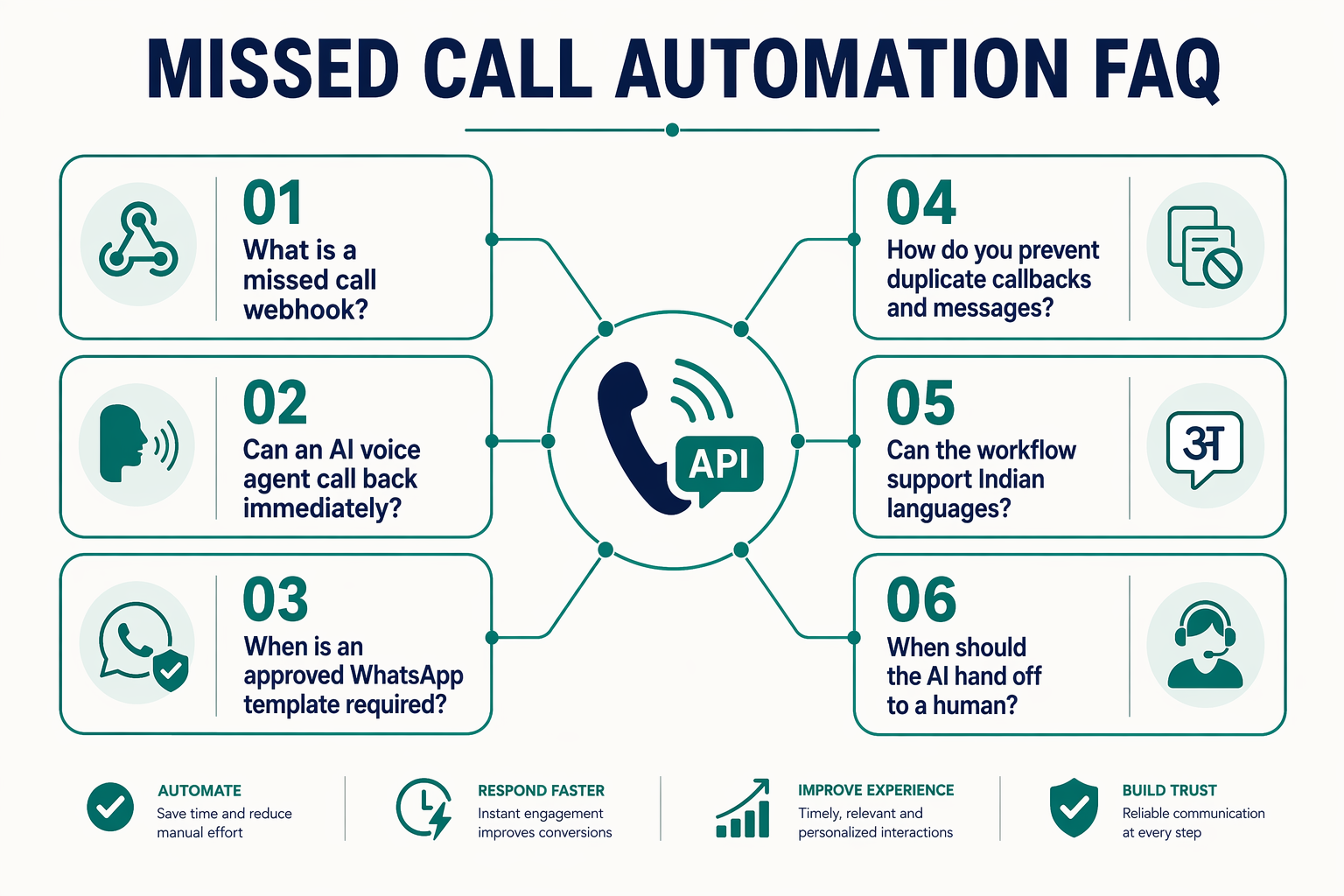
How does a missed-call webhook start CallMissed API missed call automation?
Does missed call WhatsApp automation require an approved message template?
Do businesses need customer consent before sending an automated WhatsApp message after a missed call?
How should missed call automation retry failed callbacks, webhooks, and WhatsApp messages?
Retry-After when the upstream service provides it. Do not automatically retry permanent errors such as invalid numbers, blocked recipients, revoked consent, or rejected templates; combine idempotency keys, attempt counters, a maximum retry limit, and a dead-letter queue to prevent duplicate contacts and infinite loops.Which Indian languages can a CallMissed AI voice agent use for missed call recovery?
When should an AI voice agent for missed calls transfer the customer to a human?
Conclusion
Missed-call recovery succeeds when every unanswered call becomes a traceable workflow rather than an isolated telephony event. With the CallMissed API coordinating Voice AI, WhatsApp follow-up, customer context, booking, and escalation, businesses can respond quickly without sacrificing control or continuity.
The implementation blueprint comes down to four principles:
- Treat recovery as a state machine. Detect the missed call, create one recovery record, and update that record as the caller is contacted, qualified, booked, escalated, opted out, or marked unreachable.
- Choose the next action contextually. Trigger an immediate AI callback when appropriate, or send an approved WhatsApp message when permissions and platform policies allow it. Capture intent once and preserve it across channels so customers do not need to repeat themselves.
- Design explicitly for operational failure. Idempotency keys, deduplication windows, bounded retries, status checks, and human-review queues help prevent duplicate callbacks, repeated messages, and abandoned leads.
- Measure outcomes rather than assumptions. Track callback speed, contact rate, qualification rate, booking conversion, escalation rate, and recovered revenue using documented formulas—without relying on invented benchmarks.
Regional-language support can make this workflow more accessible across India. As of July 2026, the CallMissed product site states that CallMissed Speech-to-Text and Text-to-Speech support 22 Indian languages through an OpenAI-compatible API. This enables an AI voice agent for missed calls to serve callers in languages such as Hindi, Bengali, Marathi, Telugu, and Tamil while maintaining continuity with WhatsApp engagement.
What should teams watch next? The important shift will be from separate “callback” and “messaging” automations toward a single, policy-aware conversation history spanning voice, WhatsApp, booking, and human handoff. Teams should continue reviewing consent rules, WhatsApp messaging requirements, retry policies, qualification logic, and KPI definitions as their workflows evolve.
To explore this approach, visit CallMissed, an AI communication infrastructure platform for multilingual voice agents and WhatsApp automation. If every missed call created a recoverable customer journey, how much demand could your business retain?
Related Reading
- WhatsApp Calling API Architecture: Production Voice and AI Chat Agents with CallMissed
- WhatsApp AI Voice Agent: Build With the CallMissed API in 2026
- WhatsApp Business API Guide: CallMissed API for Voice and AI Agents
Sources
Related Posts

Ready to automate customer conversations?
Launch AI voice agents and WhatsApp bots with CallMissed — one API, 22+ Indian languages.