

Claude Opus 5 vs Mistral Large 3: Verified 2026 Comparison



Compare Claude Opus 5 vs Mistral Large 3 on release status, pricing, context, coding, multilingual support, privacy, and deployment.
Claude Opus 5 vs Mistral Large 3: Verified 2026 Comparison
What happens when a model you can download and deploy today is compared with a flagship that Anthropic has not officially announced? Claude Opus 5 vs Mistral Large 3 is not yet a conventional benchmark contest: as of July 23, 2026, Mistral Large 3 is a released, open-weight flagship, while Claude Opus 5 remains an expected Anthropic model with no verified model card, pricing, context window, benchmark scores, or release date.
The answer-first verdict
Use Mistral Large 3 now if you need open weights, self-hosting, deployment control, or a production model with documented capabilities. Wait for official Anthropic evidence before choosing Claude Opus 5 for performance reasons. Any website presenting precise Opus 5 scores or specifications before Anthropic publishes them is comparing verified Mistral data with speculation.
This distinction matters because architecture and deployment rights increasingly influence AI purchasing as much as raw benchmark rankings. Mistral AI describes Mistral Large 3 as a permissive open-weight model and positions the Mistral 3 generation for multilingual and multimodal workloads. Open weights can enable private-cloud deployment, infrastructure-level optimisation, fine-tuning and stricter data-governance controls—options that differ fundamentally from relying exclusively on a hosted proprietary API.
Anthropic’s Claude family, meanwhile, has established demand around coding, reasoning, tool use and agentic workflows. But reputation from earlier Claude Opus releases cannot be converted into invented Claude Opus 5 metrics. A credible comparison must label every claim as official, independently measured, inferred from predecessors, or unknown.
This guide therefore examines:
- Evidence status, release availability and model documentation
- Weights, licensing, self-hosting and privacy controls
- API access, pricing and deployment complexity
- Context and output limits, without assigning unverified Opus 5 numbers
- Coding, reasoning, agents, multilingual and multimodal use cases
- Whether teams should deploy Mistral Large 3 now or wait for Claude Opus 5
Platforms such as CallMissed, an OpenAI-compatible multi-model gateway, reflect the broader move toward provider flexibility by letting developers access multiple AI model categories through one integration.
The goal is not to predict a winner from rumours. It is to separate what organisations can verify and deploy today from what may become available later—and update the decision framework when Anthropic publishes primary evidence.
Which model should you choose as of July 23, 2026?
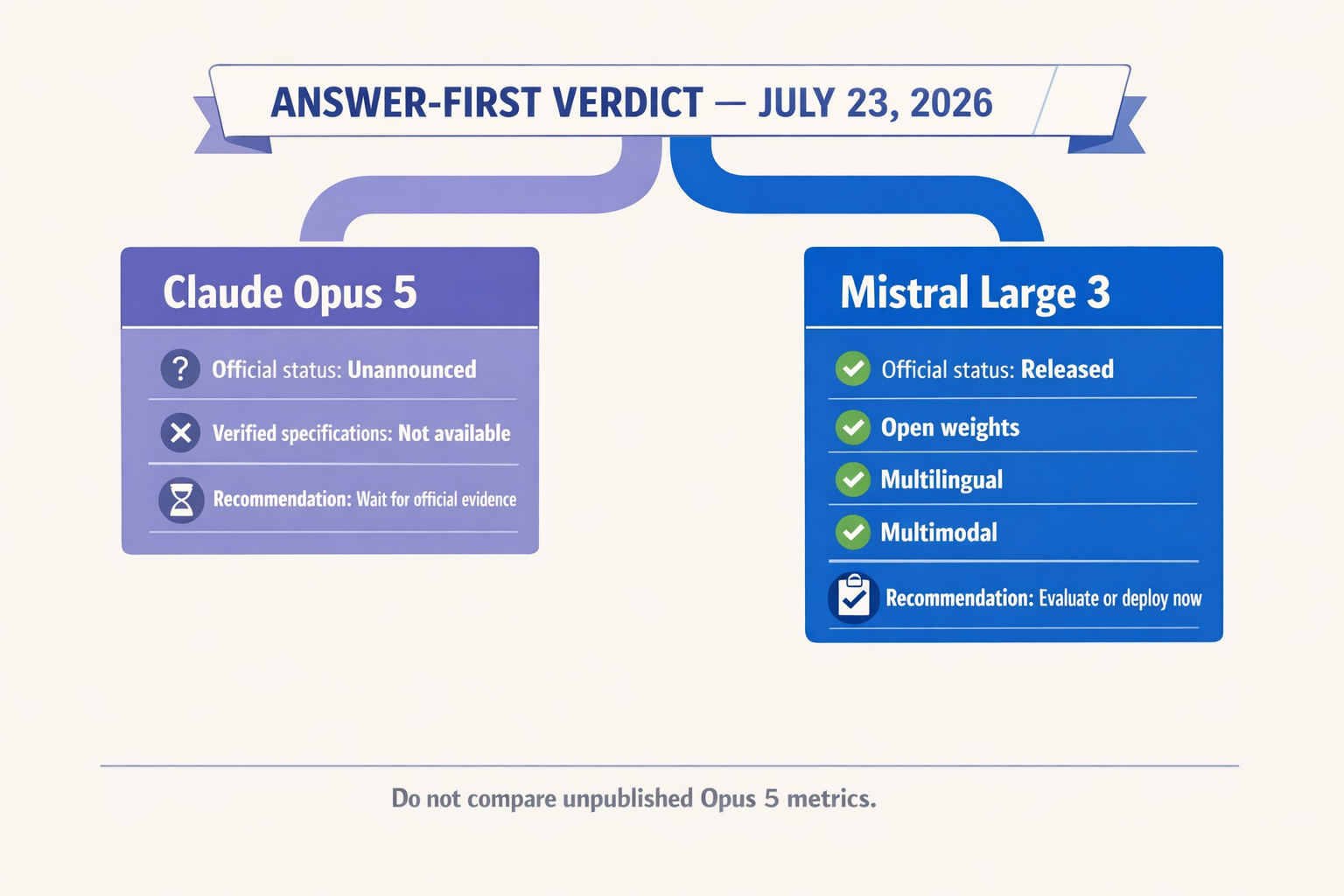
Choose Mistral Large 3 today if your decision depends on verifiable capabilities, downloadable weights, self-hosting, multilingual or multimodal support, and deployment control. Do not choose Claude Opus 5 on presumed performance as of July 23, 2026, because Anthropic has not officially published the model, specifications, pricing, benchmarks, or availability.
Decision snapshot
| Decision factor | Mistral Large 3 | Claude Opus 5 | Practical conclusion |
|---|---|---|---|
| Release status | Officially released | Not officially announced | Only Mistral Large 3 can be evaluated and deployed now |
| Model weights | Permissive open weights | Unknown | Choose Mistral for self-hosting and infrastructure control |
| Modalities | Multilingual and multimodal | Unknown | Mistral has documented support; Opus 5 cannot yet be assessed |
| API and pricing | API access and pricing are published by Mistral AI | Unknown | Mistral permits present-day cost modelling |
| Benchmarks | Official evidence is available | No verified scores | Avoid numerical performance claims about Opus 5 |
Mistral AI’s official “Introducing Mistral 3” announcement describes Mistral Large 3 as a permissive open-weight model within a multilingual and multimodal model generation. That makes the comparison structurally asymmetric: Mistral Large 3 is a usable product, whereas Claude Opus 5 is currently an expected product name without primary documentation.
Choose Mistral Large 3 when control matters
Mistral Large 3 is the defensible choice for organisations that need to act now rather than forecast Anthropic’s roadmap. Its open-weight distribution can support:
- Self-hosted or private-cloud inference where data must remain within controlled infrastructure.
- Model customisation and optimisation for specialised domains, latency targets or hardware.
- Multilingual applications serving customers across regions and languages.
- Multimodal workflows that require documented support rather than an assumed future capability.
- Procurement and compliance reviews based on an actual licence, published documentation and available deployment options.
Open weights do not automatically mean easier or cheaper operations. Teams must account for accelerators, inference software, observability, security, scaling and model updates. Mistral’s hosted API may be more practical when organisations want the released model without operating the serving stack themselves.
Wait for Claude Opus 5 when performance evidence is essential
Waiting is reasonable if your workload is closely tied to Anthropic’s ecosystem or if earlier Claude models already perform well in your internal evaluations. However, the correct process is to wait for three forms of evidence:
- Anthropic’s official model card and API documentation
- Published input, output and context limits plus pricing
- Independent tests using your coding, reasoning and agent workloads
Earlier Claude Opus results cannot serve as Claude Opus 5 benchmarks. Model naming does not establish quality, latency, safety behaviour, context capacity or tool-use reliability.
Bottom line
For a deployment decision on July 23, 2026, Mistral Large 3 wins by availability and verifiability—not by an invented head-to-head benchmark victory. Choose it for open weights, multilingual and multimodal capability, self-hosting, or immediate API access; wait for Anthropic’s primary evidence before treating Claude Opus 5 as a purchasable alternative.
What is officially known about Claude Opus 5 and Mistral Large 3? (TABLE)
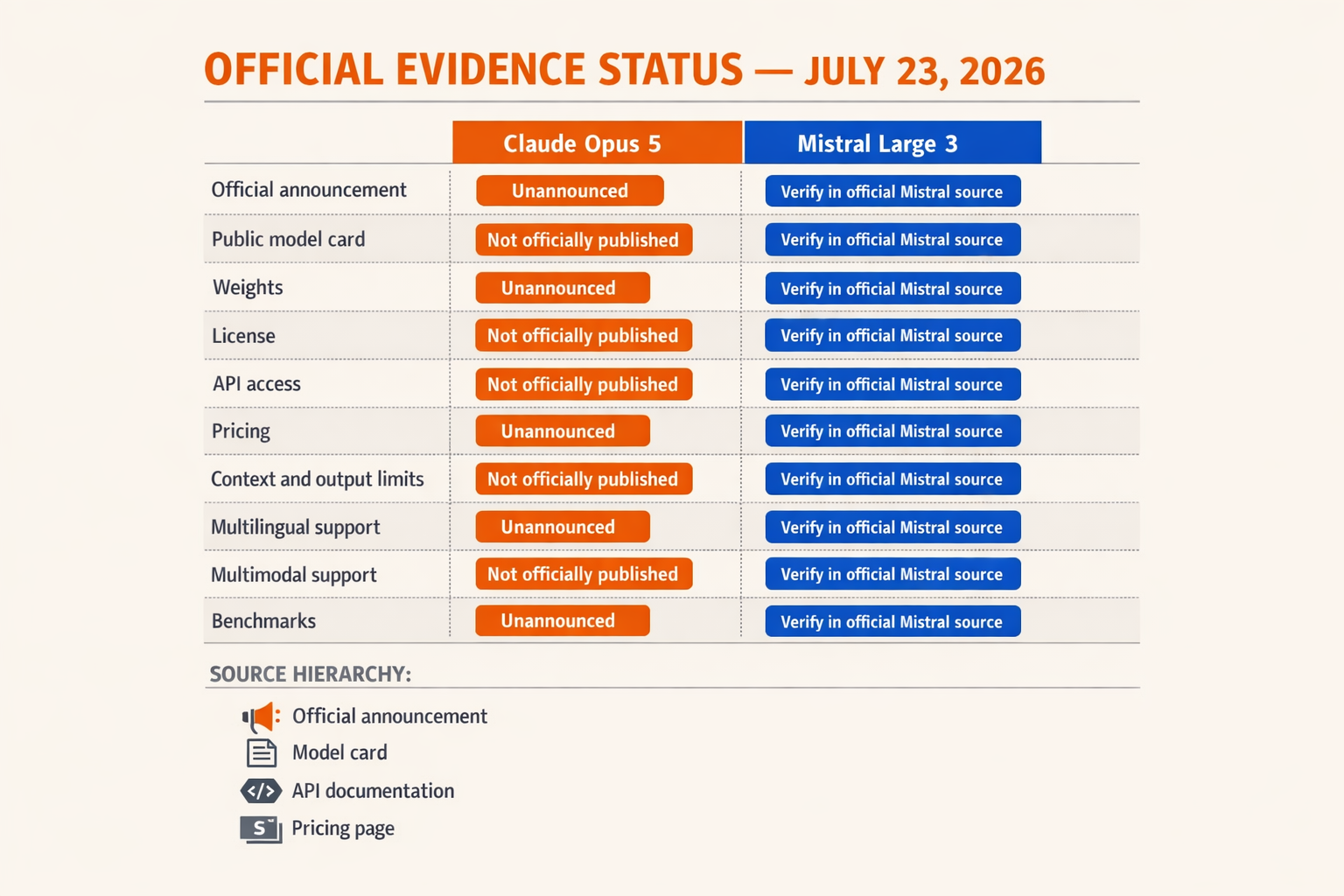
As of July 23, 2026, Mistral Large 3 is a released, permissive open-weight, multilingual and multimodal flagship with official API access, while Anthropic has not announced Claude Opus 5. A numerical Claude Opus 5 vs Mistral Large 3 comparison is therefore premature, and several widely repeated Mistral specifications remain unverified by the official evidence reviewed here.
Official evidence snapshot
| Attribute | Claude Opus 5 | Mistral Large 3 | Evidence status |
|---|---|---|---|
| Release status | Not officially announced | Released by Mistral AI | Opus 5: no Anthropic announcement as of July 23, 2026; Mistral: officially announced |
| Model positioning | Expected Anthropic flagship; details unknown | Flagship model in the Mistral 3 family | Confirmed for Mistral; “expected” must not be treated as an Anthropic specification |
| Architecture and parameters | Unknown | Exact architecture and parameter counts not established by the supplied official evidence | Claims of 675B total/41B active parameters require model-card verification |
| Modalities | Unknown | Multilingual and multimodal | Confirmed by Mistral AI’s Introducing Mistral 3 announcement |
| Weights and licence | Unknown | Described by Mistral AI as permissive open weight | Exact licence and repository terms must be checked; Apache 2.0 is not substantiated here |
| Context and output limits | Unknown | Not established by the supplied official sources | Do not assume a 256,000-token context window or transfer limits from another Mistral model |
| Access and pricing | Unknown | Mistral provides API access and API pricing | Availability confirmed; current rates and model identifiers should be checked directly |
| Self-hosting | Unknown | Potentially supported by the open-weight positioning, subject to artifact availability and licence terms | Downloadable weights are not explicitly verified by the evidence supplied |
What Mistral AI has officially confirmed
Mistral AI’s Introducing Mistral 3 announcement presents Mistral Large 3 as a permissive open-weight model designed for multilingual and multimodal workloads. The official Mistral AI material also points customers toward API access, API pricing and customization.
Those confirmations support several practical conclusions:
- Businesses can evaluate Mistral Large 3 through Mistral AI’s managed API.
- The model targets use cases involving multiple languages, text and visual inputs.
- Its open-weight positioning may enable greater deployment control than API-only models.
However, “open weight” should not automatically be translated into a specific licence, repository, download method or unrestricted commercial-use guarantee. Before planning self-hosting, readers should inspect the current Mistral model card, official repository, licence file, artifact availability and deployment documentation.
The reviewed evidence does not substantiate the frequently cited claims of 675 billion total parameters, 41 billion active parameters, a 256,000-token context window, training on 3,000 NVIDIA H200 GPUs or an Apache 2.0 licence. Those details should remain excluded unless an official Mistral source explicitly confirms them for Mistral Large 3.
What remains unknown about Claude Opus 5
Anthropic has not published a Claude Opus 5 release announcement, model card, system card or documented API entry as of July 23, 2026. Consequently, there is no official basis for assigning Claude Opus 5:
- A context window, output limit or parameter count
- API pricing or availability dates
- Coding, reasoning or agent benchmark scores
- Supported modalities, languages or deployment regions
- Privacy, retention or tool-use specifications
Specifications from earlier Claude models cannot be transferred to Claude Opus 5. Until Anthropic releases documentation, Mistral Large 3 is the only model in this comparison that can be assessed as a current product, while Claude Opus 5 remains an unannounced prospective model.
How did Mistral Large 3 become the released open-weight alternative to an expected Opus 5? (TABLE)
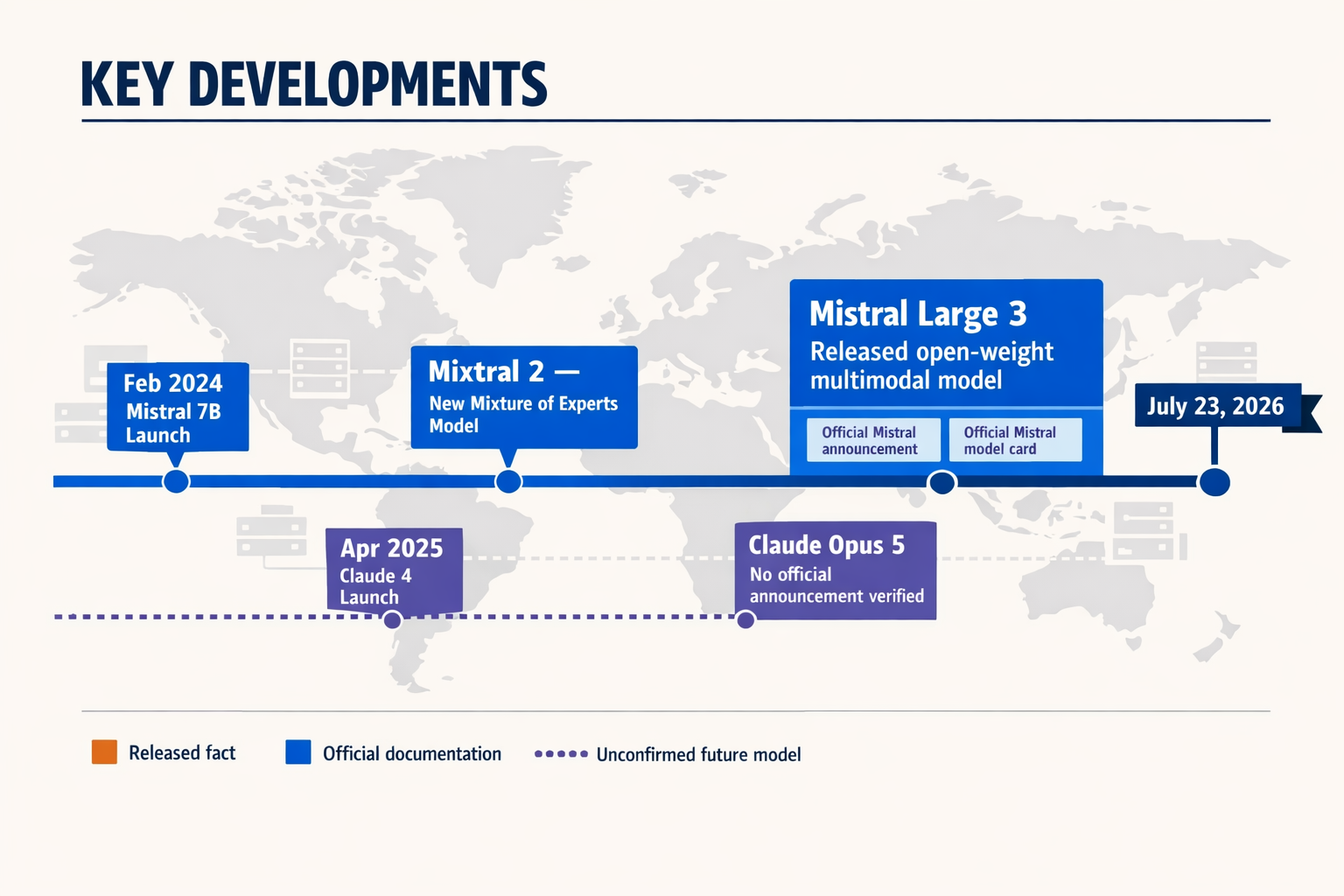
Mistral Large 3 became the practical open-weight alternative by shipping documented multilingual and multimodal capabilities with permissive weights, while Claude Opus 5 remained unannounced. As of July 23, 2026, this is an availability and deployment comparison—not proof that Mistral Large 3 will outperform Anthropic’s expected flagship.
From model lineage to deployable flagship
Mistral AI’s progression shows a consistent expansion from multilingual text models toward multimodal, reasoning and enterprise deployment:
- Mistral Large 2407 introduced a 128,000-token context window and supported dozens of languages, including French, German, Spanish, Italian and Portuguese, according to Mistral AI.
- Mistral NeMo also offered a context window of up to 128,000 tokens and targeted global multilingual applications, according to Mistral AI.
- Pixtral Large extended the portfolio into vision, although Mistral AI now marks that model as deprecated and replaced by newer multimodal models.
- Magistral added domain-specific, transparent and multilingual reasoning to the Mistral family.
- Mistral 3 consolidated these directions around multilingual, multimodal and open-weight deployment, with Mistral AI describing Mistral Large 3 as “one of the best permissive open weight models.”
The key change was not merely a new benchmark position. Mistral Large 3 turned those capabilities into a released flagship that organisations could evaluate under their own infrastructure, privacy and localisation requirements.
Evidence and product-status comparison
| Milestone or criterion | Mistral Large 3 | Claude Opus 5 | Practical significance |
|---|---|---|---|
| Public status | Released and documented by Mistral AI | Not officially announced by Anthropic | Only Mistral Large 3 can be evaluated as a current product |
| Model access | Permissive open weights | Unknown | Mistral supports weight-level inspection and controlled deployment |
| Language direction | Officially positioned for multilingual workloads | No Opus 5 language list published | Regional-language plans can be tested now only on Mistral |
| Multimodal direction | Officially positioned as multimodal | Opus 5 modalities unknown | Do not assume image or other modality support for Opus 5 |
| Deployment model | Downloadable/self-managed options plus API access | No verified Opus 5 API or self-hosting terms | Mistral enables private-cloud and infrastructure-level optimisation |
| Published specifications | Official information is available | Zero verified Opus 5 pricing, context, output or benchmark figures | Any numerical Opus 5 comparison is presently speculative |
Why “alternative” does not mean “equivalent”
Open-weight availability changes what buyers can control. Teams can potentially place Mistral Large 3 inside a chosen cloud or private environment, optimise inference, apply domain-specific customisation and establish data-retention controls around their own stack. The permissive model positioning also matters for developers who do not want their production architecture tied entirely to one hosted endpoint.
However, three distinctions must remain explicit:
- Released does not automatically mean faster or more accurate. Comparable independent tests are required.
- Multilingual support is not uniform multilingual quality. Businesses should test their actual languages, scripts, code-switching patterns and domain vocabulary.
- An expected flagship is not a product specification. Earlier Claude Opus models may inform hypotheses about coding, reasoning and agents, but they cannot establish Opus 5 capabilities.
Therefore, Mistral Large 3 became the open-weight alternative through availability, documented scope and deployment freedom. Whether it becomes the stronger model for a particular workload can only be determined after Anthropic releases Claude Opus 5 and both models undergo controlled, task-specific evaluation.
How do weights, licensing, self-hosting, and API access compare?
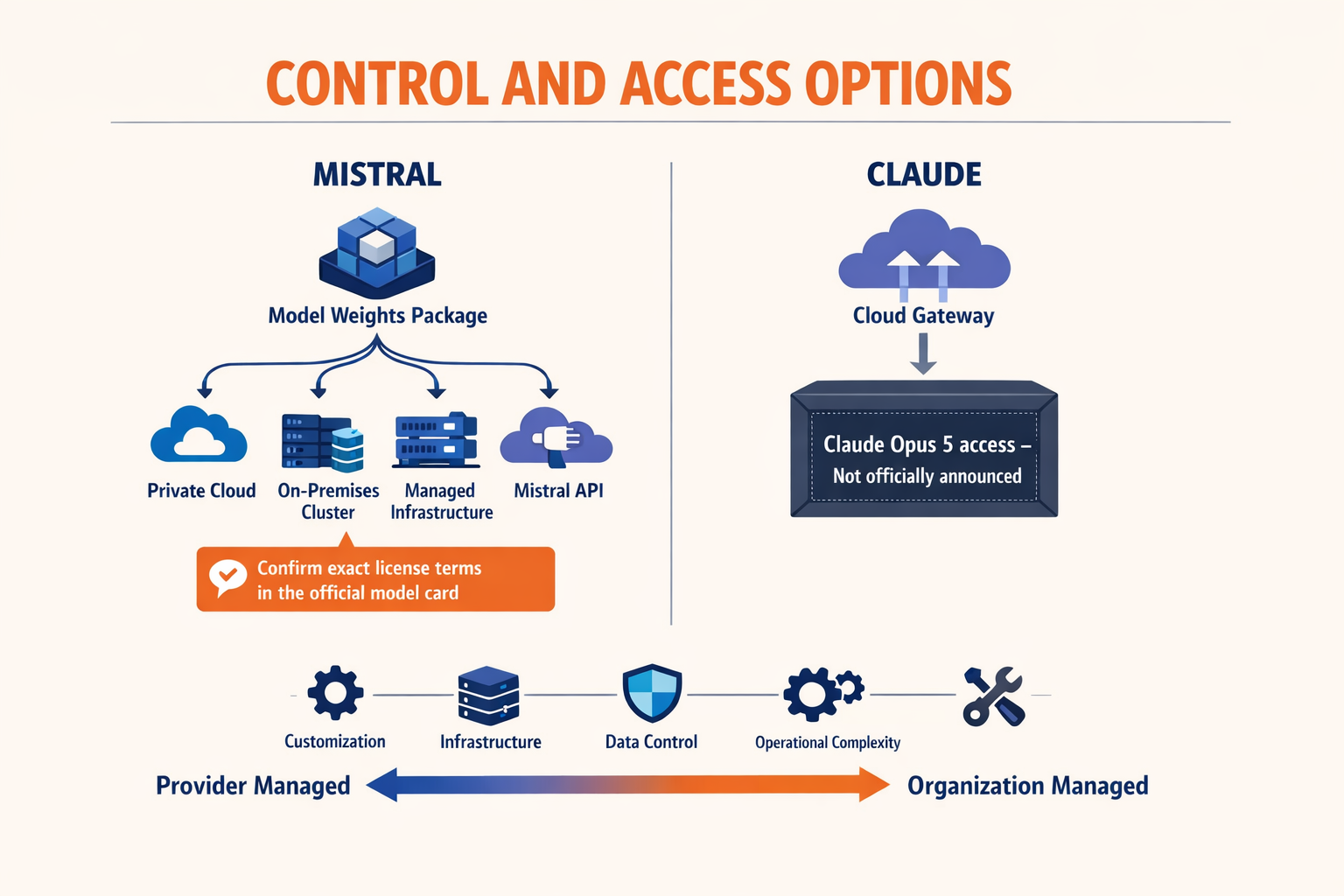
Mistral Large 3 provides downloadable weights, permissive licensing, self-hosting and hosted API access; Claude Opus 5 provides none of those verifiably as of July 23, 2026 because Anthropic has not announced the model. For organisations prioritising infrastructure control, Mistral Large 3 is therefore the actionable option—not necessarily the eventual performance winner.
Access and deployment at a glance
| Capability | Mistral Large 3 | Claude Opus 5 | Practical implication |
|---|---|---|---|
| Released model | Yes | No official announcement | Mistral can be evaluated now |
| Downloadable weights | Yes, open-weight | Unknown | Mistral supports private deployment |
| Licence | Described by Mistral AI as permissive | Unknown | Review Mistral’s exact repository terms before production |
| Self-hosting | Supported | Not verifiably available | Mistral offers infrastructure and data-location control |
| Hosted API | Available through Mistral AI | No Opus 5 endpoint announced | Only Mistral has a documented production path today |
Mistral AI’s official “Introducing Mistral 3” announcement describes Mistral Large 3 as a “permissive open weight” model and explicitly provides routes for API access, API pricing and customisation. Anthropic has published no equivalent Opus 5 model card, licence, API identifier or deployment documentation as of the comparison date.
What open weights change
Open-weight access means an organisation can obtain the trained parameters and run inference outside Mistral AI’s managed service. Depending on the licence terms and deployment stack, this can enable teams to:
- Host inference in a private cloud, sovereign environment or controlled data centre.
- Keep prompts, retrieved documents and outputs inside an approved network boundary.
- Optimise quantisation, batching, caching and serving infrastructure.
- Fine-tune or customise the model for specialised workflows.
- Fix a model version rather than automatically adopting provider-side updates.
Open-weight does not mean zero-cost or zero-risk. Large-model hosting requires suitable accelerators, distributed inference expertise, security patching, observability and capacity planning. Teams must also inspect the official licence, acceptable-use requirements and any third-party components instead of interpreting “open-weight” as unrestricted public-domain software.
API convenience versus self-hosting control
Mistral Large 3 supports two distinct adoption paths: consume the managed Mistral API or operate the released weights on infrastructure selected by the customer. The API reduces operational work, while self-hosting provides more control over residency, network isolation, latency engineering and model modification.
Mistral AI maintains an official API-pricing channel, but buyers should use the live pricing page for current input-token, output-token and related charges; static figures can become outdated. A complete cost comparison should include:
- Managed API spend, including tokens, retries and peak traffic.
- Self-hosted total cost, including accelerators, engineering and idle capacity.
- Governance costs, such as audit logging, access control and compliance reviews.
No corresponding Claude Opus 5 API price can be calculated because there is no verified Opus 5 API offering. Pricing from earlier Claude models should not be presented as Opus 5 pricing.
Decision consequence
Choose Mistral Large 3 when downloadable weights, private deployment or immediate API availability is mandatory. If Anthropic later releases Claude Opus 5 solely as a managed service, the comparison will remain structurally different: Mistral Large 3 would offer both hosted and self-managed routes, while Opus 5 would need evaluation under Anthropic’s published API and data-governance terms.
How do price, context window, and output limits compare using verified data?
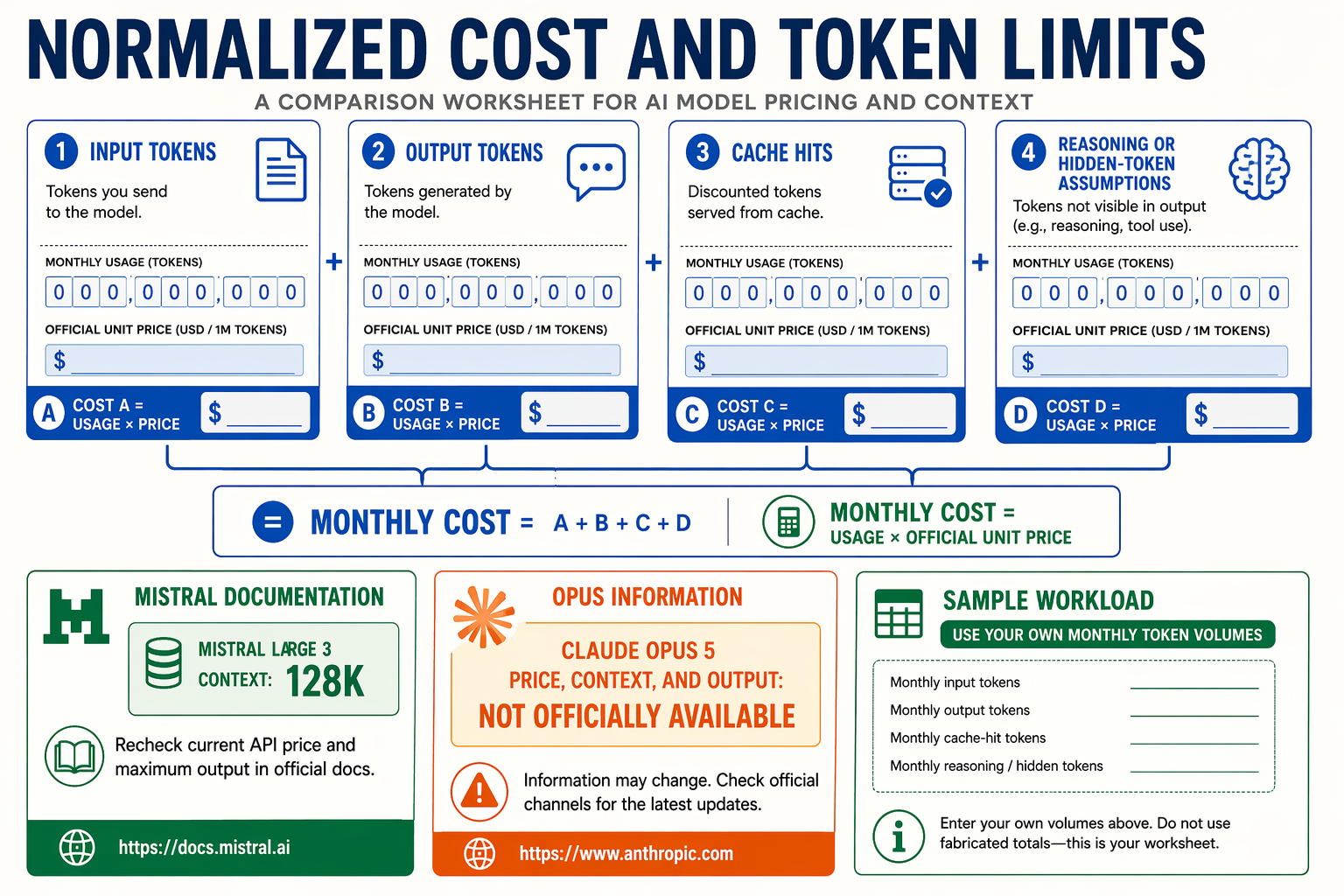
Mistral’s official documentation establishes a 128,000-token context window for Mistral Large 3 and lists hosted Mistral Large API pricing at $2 per million input tokens and $6 per million output tokens. These rates apply to Mistral’s hosted service—not to self-hosted inference. Mistral Large 3 is also available as an open-weight model under the Apache 2.0 license. An official maximum-output limit was not established, so it remains unknown.
Claude Opus 5 is not listed in Anthropic’s official model catalogue and remains unannounced as of July 23, 2026. Its price, context window, output limit, availability, and licensing must therefore remain unknown.
Verified comparison
| Metric | Mistral Large 3 | Claude Opus 5 |
|---|---|---|
| Hosted input-token price | $2 per million tokens for the hosted Mistral Large endpoint | Unknown |
| Hosted output-token price | $6 per million tokens for the hosted Mistral Large endpoint | Unknown |
| Context window | 128,000 tokens | Unknown |
| Maximum output | Unknown; not established by the cited official documentation | Unknown |
| Model availability | Hosted API and open weights | Unannounced |
| Open-weight license | Apache 2.0 | Unknown |
Mistral’s $2/$6 rates are API list prices for the hosted Mistral Large offering. Buyers should confirm that the selected endpoint and model identifier correspond to Mistral Large 3 and recheck the live pricing page before deployment, because endpoint mappings and prices can change.
At those published hosted rates, estimated token charges can be calculated as:
Cost = (input tokens ÷ 1,000,000 × $2) + (output tokens ÷ 1,000,000 × $6)
For example, one million input tokens and one million output tokens would produce an estimated token charge of $8. This excludes any separate platform, storage, networking, caching, or ancillary fees.
Context window and output limit are different
The 128,000-token context window defines the model’s documented total working capacity for a request. Depending on the API’s implementation, that capacity may need to accommodate the prompt, conversation history, retrieved material, tool content, and generated response.
A maximum-output limit separately controls how many tokens the model can generate in one response. The official evidence used here does not establish that value for Mistral Large 3, so it should not be inferred from the 128,000-token context window or from another Mistral model. Teams should check the exact endpoint’s API parameters and deployment documentation before setting generation limits.
Hosted pricing is not self-hosting cost
The $2 input and $6 output rates apply to Mistral’s hosted API. They do not represent the cost of running the Apache 2.0-licensed weights on private infrastructure.
Self-hosting has no vendor per-token API fee, but it still requires budgeting for:
- Accelerators and memory
- Inference and orchestration software
- Engineering and operations
- Power, networking, and storage
- Monitoring, security, and redundancy
- Capacity planning and hardware utilisation
The verified conclusion is therefore straightforward: Mistral Large 3 has a documented 128,000-token context window, open weights under Apache 2.0, and hosted Mistral Large pricing of $2 per million input tokens and $6 per million output tokens. Its maximum output remains unverified. Every Claude Opus 5 field remains unknown until Anthropic officially announces and documents the model.
Which model is better for coding, reasoning, and AI agents?
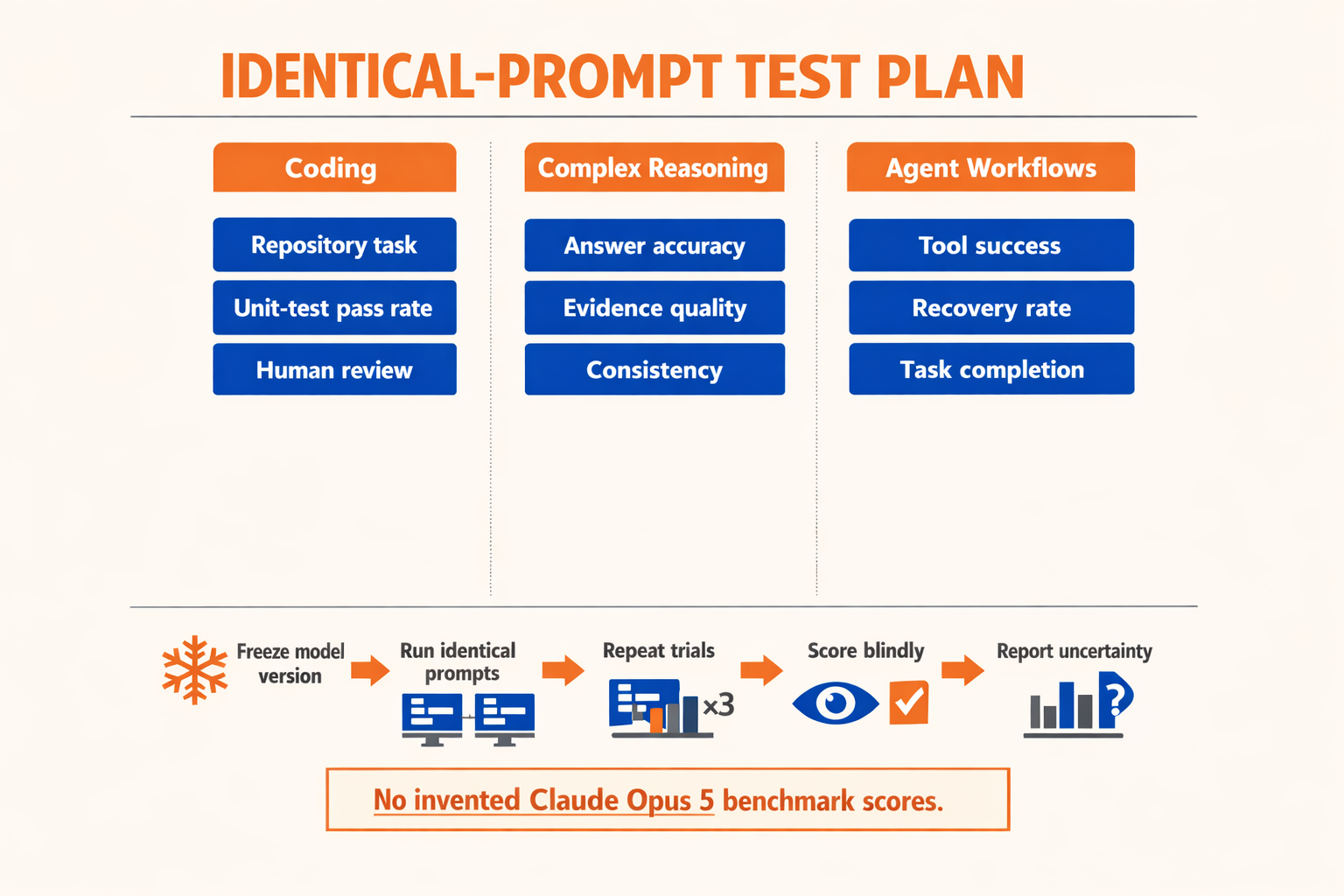
Mistral Large 3 is the better evidence-based choice for coding and AI-agent deployment today, especially when self-hosting, multilingual operation or model customisation matters. Claude Opus 5 cannot be declared better at coding or reasoning as of July 23, 2026, because Anthropic has published no official model card, benchmark results or tool-use specifications for it.
Coding: deployable capability versus expected performance
Mistral Large 3 can be evaluated on private repositories, adapted to specialised codebases and deployed within controlled infrastructure. Mistral AI officially describes Mistral Large 3 as a permissive open-weight model, giving engineering teams substantially more control than a hosted-only model generally provides.
That makes Mistral Large 3 practical for:
- Repository-aware coding assistants operating inside private environments
- Code generation and review across multilingual documentation
- Domain adaptation for proprietary languages, frameworks or internal APIs
- On-premises inference where source code cannot leave company infrastructure
- Infrastructure optimisation through quantisation, batching and custom serving
No verified Claude Opus 5 coding benchmark exists as of July 23, 2026. Anthropic’s earlier Claude models established the family’s reputation for software engineering, but predecessor performance does not prove Opus 5’s accuracy, latency, context handling or cost.
Reasoning: avoid transferring scores between models
Neither brand reputation nor a related model’s benchmark should substitute for direct testing. Mistral AI calls Magistral its first reasoning model and describes it as supporting “domain-specific, transparent, and multilingual reasoning.” However, Magistral and Mistral Large 3 are separate models, so Magistral’s positioning must not be presented as a Mistral Large 3 benchmark.
For reasoning-heavy applications, compare both models—once Claude Opus 5 exists—using task-specific evaluations such as:
- Correctness: Does the model reach the right conclusion?
- Faithfulness: Are conclusions grounded in supplied evidence?
- Consistency: Does performance remain stable across repeated runs?
- Multilingual parity: Does reasoning quality hold outside English?
- Operational efficiency: What accuracy is achieved per unit of latency and cost?
Until Anthropic releases Opus 5, there is no defensible head-to-head reasoning winner.
AI agents: control currently favours Mistral Large 3
Mistral AI’s product ecosystem explicitly includes tools to “build, test, and run AI agents and apps.” Combined with open weights, Mistral Large 3 gives agent developers control over model hosting, observability, fine-tuning and data boundaries.
Mistral Large 3 is therefore the stronger current option when an agent requires:
- Private execution over sensitive documents or code
- Custom model serving and predictable infrastructure policies
- Multilingual or multimodal customer interactions
- Provider-independent deployment
- Internal evaluation before production rollout
Claude Opus 5 may eventually offer strong tool use or computer interaction, but its supported tools, structured-output reliability, rate limits and agent benchmarks remain unknown.
For customer-facing agents, model quality is only one layer. Platforms such as CallMissed, an OpenAI-compatible multi-model gateway, let developers connect models with speech, search and other AI services while retaining the ability to change providers. CallMissed also supports speech across 22 Indian languages, which is relevant when an agent must serve regional Indian audiences rather than operate only in English.
The practical verdict is straightforward: build and test with Mistral Large 3 now; reassess Claude Opus 5 only after Anthropic publishes official specifications and reproducible results.
Which model is stronger for multilingual and multimodal work?
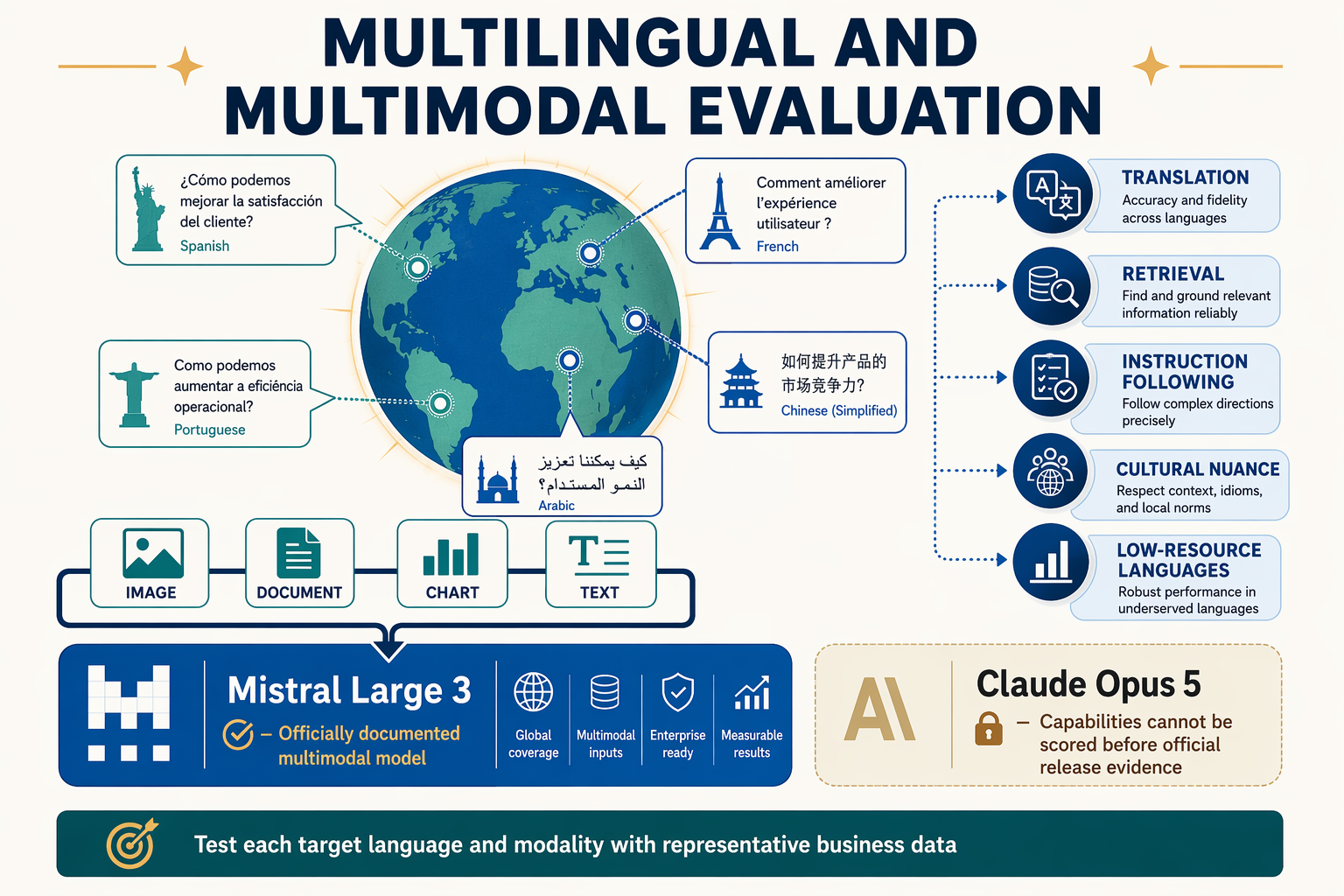
Mistral Large 3 is the stronger choice today for teams that need a released, open-weight model from a multilingual and multimodal model generation. However, the available evidence does not prove that Mistral Large 3 delivers better language or vision quality than Claude Opus 5, because Anthropic had not announced Claude Opus 5 or published its specifications as of July 23, 2026.
What the official evidence establishes
Mistral AI presents Mistral Large 3 as the flagship model in the Mistral 3 generation, which the company positions around multilingual and multimodal AI. Mistral Large 3 is also available under permissive open-weight terms, giving organisations more control over deployment, customisation and data handling than an API-only model generally permits.
The supplied official evidence does not establish specific Mistral Large 3 architecture figures or confirm an exact input-modality interface. In particular, buyers should not infer native text-and-image input, speech processing or video support solely from the broader Mistral 3 generation’s multimodal positioning.
Mistral AI’s multilingual record predates this generation. Mistral AI reported in July 2024 that Mistral Large 2407 supported dozens of languages—including French, German, Spanish, Italian and Portuguese—and offered a 128,000-token context window. That predecessor specification demonstrates an established multilingual product direction, but it is not a language-by-language benchmark for Mistral Large 3.
For production decisions, distinguish among three claims:
- Verified: Mistral Large 3 is released and open-weight.
- Official positioning: Mistral 3 is a multilingual and multimodal model generation.
- Not established here: Mistral Large 3’s exact modality interface, per-language quality, vision benchmark scores or architecture parameter counts.
Why Claude Opus 5 remains unranked
As of July 23, 2026, Anthropic had not announced Claude Opus 5, released a model card or documented its supported modalities and languages. No verified Opus 5 results were available for translation, multilingual reasoning, optical character recognition, chart analysis or visual question answering.
That means Claude Opus 5 cannot responsibly be declared either stronger or weaker. Capabilities from earlier Claude models should not automatically be attributed to an unreleased successor, even if users expect Anthropic to preserve or improve them.
How teams should evaluate multilingual and multimodal performance
Published labels such as “multilingual” and “multimodal” describe scope, not uniform quality. A fair evaluation should use the organisation’s actual workload:
- Test native-language prompts rather than machine-translated English benchmarks.
- Include code-switching, regional terminology, dialects and low-resource languages.
- Evaluate relevant visual materials—such as invoices, charts, forms and screenshots—only after confirming each model’s supported input formats.
- Score factual accuracy, instruction following, cultural appropriateness, latency and cost separately.
- Use fluent human reviewers and repeat tests across deployment configurations.
Speech should be evaluated as a separate system layer unless native audio support is explicitly documented. Speech-to-Text, Text-to-Speech and telephony components can materially affect an otherwise capable multilingual workflow.
Current verdict: Mistral Large 3 leads on availability, open-weight deployment and documented generation-level positioning. The final quality winner must be determined through workload-specific language and vision tests once Anthropic publishes verifiable Claude Opus 5 documentation.
What do privacy, deployment, and use-case differences mean for you? (TABLE)
Mistral Large 3 gives organisations more control over where inference runs and how data is governed, while Claude Opus 5 cannot yet support a procurement or privacy decision because Anthropic has published no official deployment terms. For regulated, multilingual or infrastructure-sensitive workloads, the practical distinction is controllable deployment today versus an unannounced future service.
Deployment and privacy comparison
| Decision area | Claude Opus 5 | Mistral Large 3 | What it means for you |
|---|---|---|---|
| Availability | Not officially announced as of July 23, 2026 | Released and documented by Mistral AI | Mistral can enter testing and procurement now; Opus 5 cannot |
| Model weights | No published weights or access model | Mistral AI describes it as a “permissive open weight” model | Teams can inspect, customise and operate Mistral weights within licence terms |
| Self-hosting | No verified self-hosting option | Open weights enable private-cloud or on-premises deployment | Mistral offers greater control over data location, networking and inference logs |
| Hosted API | API availability, regions and retention policies are unknown | Official Mistral API access is available alongside deployable weights | Mistral supports managed convenience or infrastructure control |
| Multilingual and multimodal work | Capabilities remain unverified | Mistral AI positions the Mistral 3 generation for multilingual and multimodal applications | Mistral is the evidence-backed choice for regional-language and mixed-media pilots |
| Operational responsibility | Cannot yet be assessed | Self-hosters manage security, scaling, monitoring and updates | Open weights increase control, but also transfer engineering responsibility |
Open weights do not automatically guarantee privacy
Self-hosting can reduce third-party data exposure, but it is not a privacy certification. An organisation deploying Mistral Large 3 must still secure prompts, vector databases, application logs, backups, model endpoints and administrator access.
A sound deployment should include:
- Encryption in transit and at rest, with customer-managed keys where required.
- Role-based access controls for inference endpoints, logs and model artefacts.
- Retention limits and redaction for personally identifiable or sensitive information.
- Regional hosting controls aligned with contracts and applicable data-protection law.
- Human review and audit trails for consequential decisions.
A hosted API can also be suitable when its contractual retention, training, residency and security terms satisfy the organisation’s requirements. For Claude Opus 5 specifically, those terms must remain marked unknown until Anthropic publishes official documentation; policies for earlier Claude models should not be silently carried forward.
Which use cases favour each deployment model?
Mistral Large 3 is the more actionable option for:
- Private knowledge assistants operating inside a controlled network.
- Multilingual customer service where teams need model customisation or regional deployment.
- Multimodal document workflows involving text and visual inputs.
- Sovereign or regulated infrastructure requiring control over inference location.
- High-volume applications where organisations want to optimise their own serving stack.
Claude Opus 5 may become relevant to teams prioritising a fully managed flagship API, advanced agents, coding or reasoning—but those use cases require verified capabilities, pricing and privacy terms before evaluation.
Indian businesses should also distinguish model multilinguality from production speech coverage. CallMissed supports Speech-to-Text and Text-to-Speech across 22 Indian languages and can connect model intelligence to voice and WhatsApp workflows through an OpenAI-compatible infrastructure layer.
The operational conclusion is straightforward: deploy Mistral Large 3 when control and current evidence matter; keep Claude Opus 5 on a watchlist, not an approved architecture diagram.
What can experts responsibly conclude, and which official sources should readers trust?

Experts can responsibly conclude that Mistral Large 3 is the only model in this comparison supported by released artifacts and official product documentation as of July 23, 2026. Claude Opus 5 may eventually change the competitive picture, but no defensible verdict on its performance, price or technical limits is possible until Anthropic announces it.
The evidence-supported conclusion
The available evidence supports four conclusions:
- Mistral Large 3 can be evaluated and deployed now. Mistral AI officially presents Mistral Large 3 as a permissive open-weight model within the multilingual and multimodal Mistral 3 generation.
- Claude Opus 5 remains unverified. As of July 23, 2026, Anthropic has not published an announcement, model card, API identifier, pricing page or benchmark report for that model.
- No benchmark winner can be declared responsibly. Scores attributed to Claude Opus 5 before an official release cannot support a valid Mistral Large 3 comparison.
- Mistral’s current advantage is certainty and deployment choice—not proven universal performance superiority. Its released weights make self-hosting, private deployment and infrastructure optimisation assessable today.
Mistral AI calls Mistral Large 3 “one of the best permissive open weight models,” but readers should recognise that wording as the vendor’s positioning, not an independent ranking. Experts should examine the accompanying model card, licence, evaluation methodology and downloadable artifacts before converting that statement into a procurement claim.
Which official sources deserve priority?
For Mistral Large 3, consult these sources in order:
- Mistral AI’s “Introducing Mistral 3” announcement for release status, intended capabilities and the company’s open-weight positioning.
- The official Mistral model card and weight repository for architecture, licence terms, supported formats, evaluation details and deployment requirements.
- Mistral API documentation and pricing pages for current model identifiers, token charges, rate limits and availability.
- Mistral’s lifecycle notices before adopting older models. Mistral AI, for example, explicitly labels Pixtral Large as deprecated and says it has been replaced by newer vision and multimodal models.
For Claude Opus 5, trust only:
- Anthropic’s official newsroom or product announcements;
- Anthropic API documentation and model catalogue;
- Anthropic’s pricing, usage-limit and model-card pages;
- Reproducible third-party evaluations conducted after public access becomes available.
Avoid cross-model specification contamination
A specification published for one Mistral model must not be silently assigned to another. Mistral AI documented a 128,000-token context window for Mistral Large 2407, while its official Mistral NeMo announcement separately states support for up to 128,000 tokens. Neither fact independently proves Mistral Large 3’s context limit.
The same rule applies to language coverage, output limits and benchmarks:
- Do not transfer predecessor specifications to Mistral Large 3.
- Do not project earlier Claude Opus results onto Claude Opus 5.
- Distinguish vendor-reported benchmarks from independent tests.
- Record the exact model version, quantisation, prompt, hardware and evaluation date.
Final expert position
Deploy Mistral Large 3 when open weights and verifiable availability satisfy the requirement; wait for Anthropic’s primary documentation before evaluating Claude Opus 5. Once Anthropic releases the model, the comparison should be updated using matched prompts, identical datasets, disclosed settings, total cost and task-level quality—not rumours or inherited benchmark scores.
Frequently asked questions about Claude Opus 5 vs Mistral Large 3
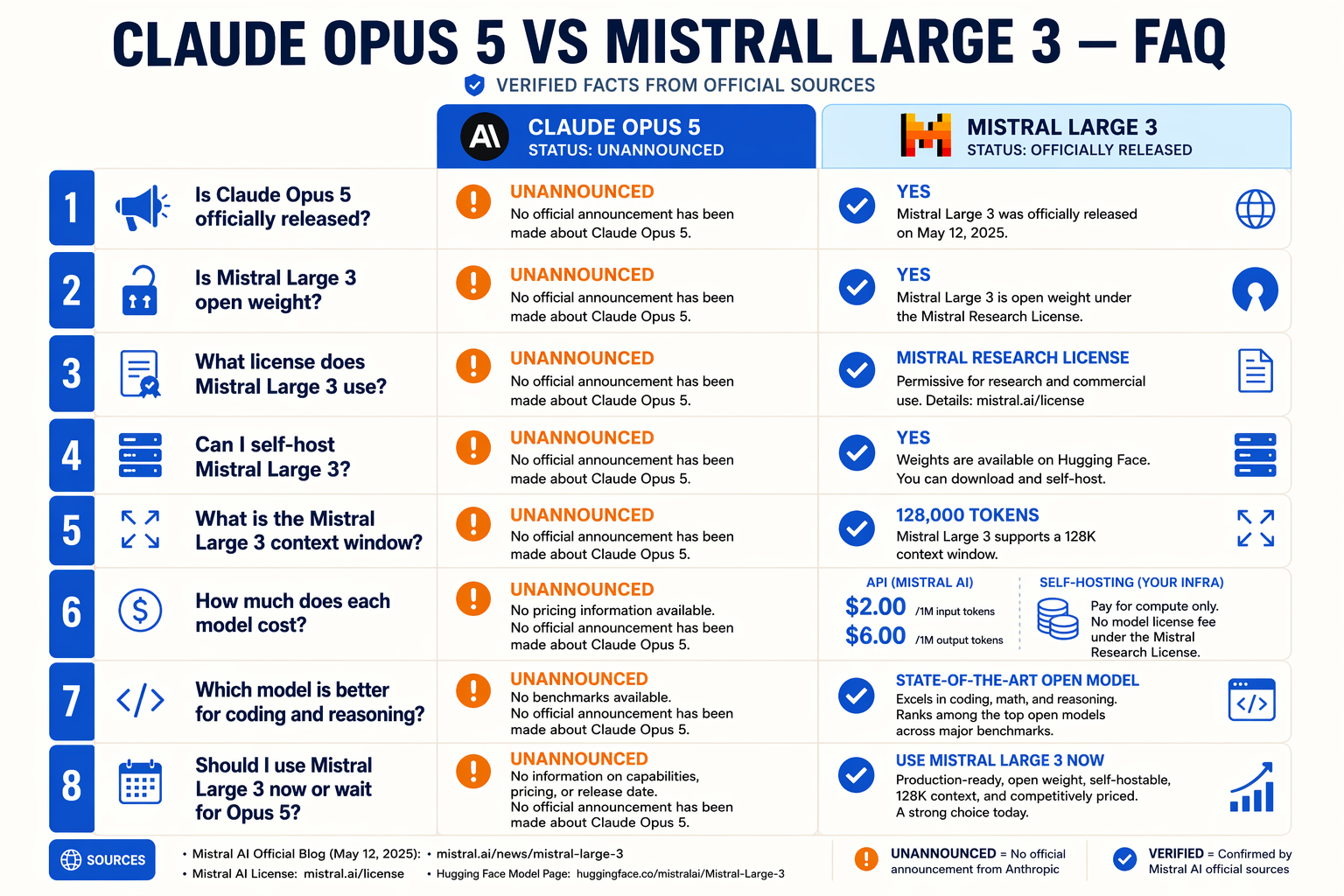
Which model wins the Claude Opus 5 vs Mistral Large 3 comparison as of July 23, 2026?
How does Claude Opus 5 vs Mistral Large 3 pricing compare?
What are the context-window and output limits of Mistral Large 3 and Claude Opus 5?
Is Mistral Large 3 better than Claude Opus 5 for private or on-premises deployment?
Which languages and modalities does Claude Opus 5 vs Mistral Large 3 support?
Should developers integrate Mistral Large 3 now or wait for Claude Opus 5?
Conclusion
As of July 23, 2026, Mistral Large 3 is the practical choice for teams that need a verifiable, deployable model today; Claude Opus 5 should remain on the watchlist until Anthropic publishes primary evidence. This comparison cannot credibly declare a performance winner while one contender remains unannounced.
- Evidence favours Mistral Large 3: Mistral AI officially presents the model as a released, permissive open-weight flagship for multilingual and multimodal workloads. Claude Opus 5 has no verified model card, benchmark results, pricing, context window or release date.
- Deployment control is the clearest differentiator: Downloadable weights give organisations options for self-hosting, private-cloud deployment, fine-tuning and infrastructure-level optimisation.
- Performance claims require equal evidence: Earlier Claude models may provide useful context, but predecessor capabilities cannot be treated as Claude Opus 5 specifications or scores.
- The right decision is workload-dependent: Mistral Large 3 merits immediate evaluation where openness, privacy, localisation and deployment flexibility matter; waiting is rational when a team specifically wants to assess Anthropic’s next flagship.
Watch for Anthropic’s official announcement, model card, API pricing, context and output limits, safety documentation, and independently reproduced coding, reasoning, agentic and multilingual benchmarks. Those disclosures could materially change the verdict.
To explore how AI communication is evolving, check out CallMissed, an AI infrastructure platform supporting voice agents and multilingual chatbots. Will your next model decision prioritise benchmark leadership—or control over how and where AI runs?
Related Reading
- Claude Opus 5 vs Qwen3.8-Max: Verified July 2026 Comparison
- Claude Opus 5 vs Claude Fable 5: Verified Comparison for 2026
- Claude Opus 5 vs Kimi K3: Leaks vs Verified Facts (July 2026)
Sources
Related Posts


Ready to automate customer conversations?
Launch AI voice agents and WhatsApp bots with CallMissed — one API, 22+ Indian languages.