

CallMissed Outbound Calling Compliance Guide: Permission-Based AI Calls and WhatsApp Follow-Up


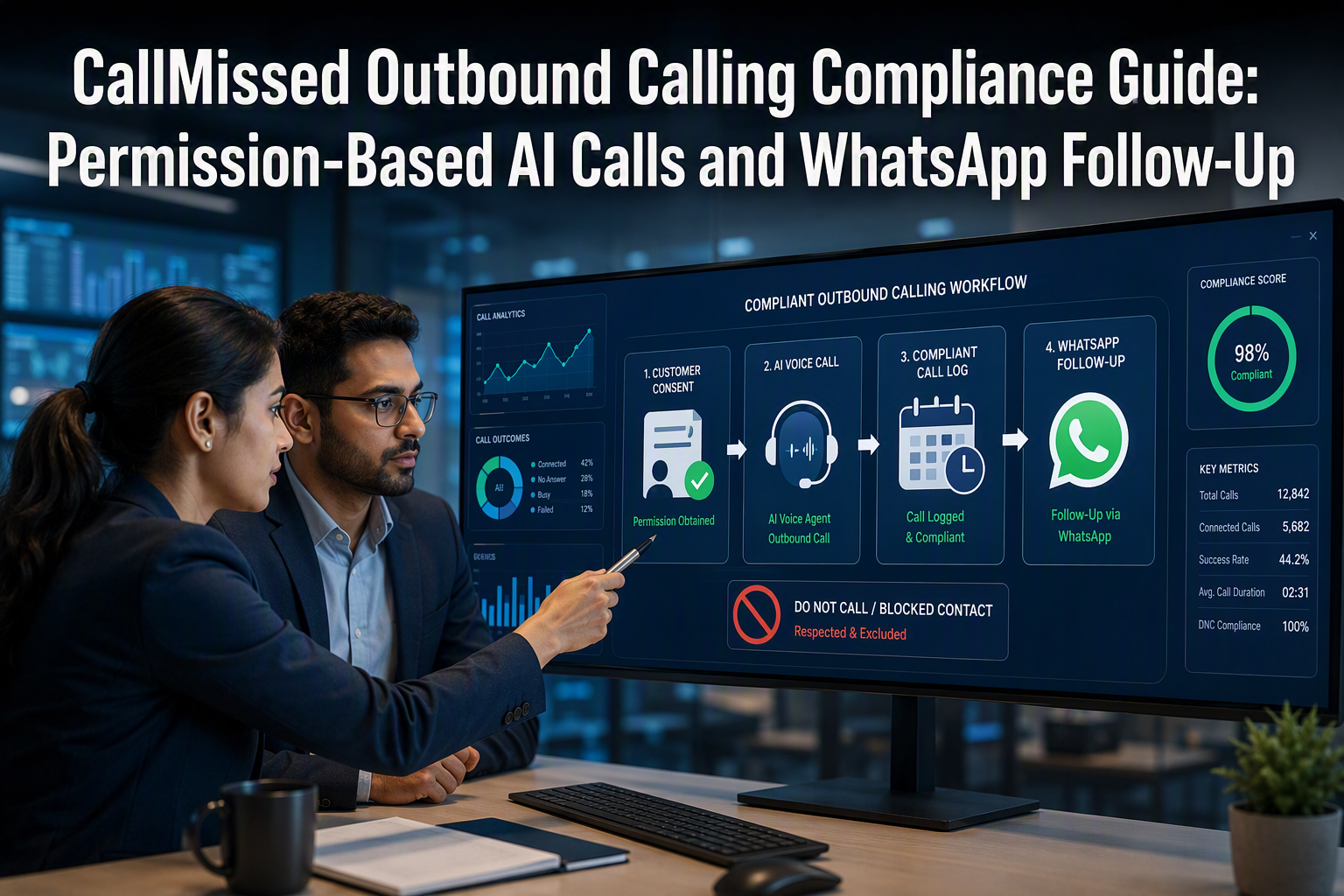
Learn how to run CallMissed outbound calling with consent, identity disclosure, suppression, retry limits, opt-outs, and follow-up controls.
CallMissed Outbound Calling Compliance Guide: Permission-Based AI Calls and WhatsApp Follow-Up
What if the biggest risk in an AI calling campaign is not what the agent says, but whether the business can prove it had permission to call? CallMissed outbound calling should begin with verifiable consent, clear identity disclosure and an immediate path to opt out—not simply a list of phone numbers and a persuasive script.
That discipline matters because an outbound AI calling agent can contact and qualify leads at a scale that manual teams cannot match, while WhatsApp follow-up automation can continue the conversation after a call. The same scale magnifies mistakes: one missing consent record, ignored suppression request or badly timed retry can affect thousands of recipients. India’s Telecom Regulatory Authority of India established the Telecom Commercial Communications Customer Preference Regulations, 2018 to regulate unsolicited commercial communications and customer preferences. India’s Digital Personal Data Protection Act, 2023, which received presidential assent on August 11, 2023, also makes lawful, transparent handling of personal data a board-level operational concern.
WhatsApp introduces another policy layer. Meta’s WhatsApp Business Platform documentation defines a 24-hour customer-service window, with approved message templates generally required when a business initiates messaging outside that window. Message categories, template approval, quality signals, calling availability and initiation rules can vary by market, Meta policy, business account, phone number status and product plan. A phone-call permission must not automatically be treated as permission for every future WhatsApp message—or vice versa.
This guide turns outbound calling compliance into a practical workflow rather than a box-ticking exercise. It explains how to:
- Restrict outreach to legitimate use cases such as requested callbacks, lead qualification, appointment reminders and service updates.
- Capture the consent source, timestamp, channel, purpose and applicable campaign before dialling.
- Apply internal suppression lists, regulatory preferences, calling windows, retry limits and channel-specific opt-outs.
- Disclose the business identity and AI involvement without confusing or misleading the recipient.
- Escalate sensitive, disputed or high-value conversations to a human.
- Monitor recordings, transcripts, outcomes, complaints and opt-out execution before expanding campaign volume.
- Use staged launch controls, test cohorts and automatic pause thresholds to contain errors.
CallMissed supports this operating model by combining AI voice agents, WhatsApp chat and WhatsApp Business calling—including AI-agent bridging—with an omnichannel inbox, while supporting voice interactions across 22 Indian languages. Capability, however, does not create permission: every deployment must still reflect the applicable telecom rules, Meta requirements, regional laws, business account eligibility and CallMissed plan configuration.
The result is a permission-first framework for outbound AI calling agent compliance—designed to help teams qualify genuine interest, follow up usefully and stop immediately when a customer says no. This guide provides operational guidance, not a legal guarantee; businesses should validate their final workflow with qualified counsel and current regulator, carrier and Meta documentation before launch.
How should you run CallMissed outbound calling? Use documented permission, suppression checks, permitted calling windows, clear identity disclosure, limited retries, immediate opt-outs, monitored WhatsApp follow-up, and human escalation before scaling
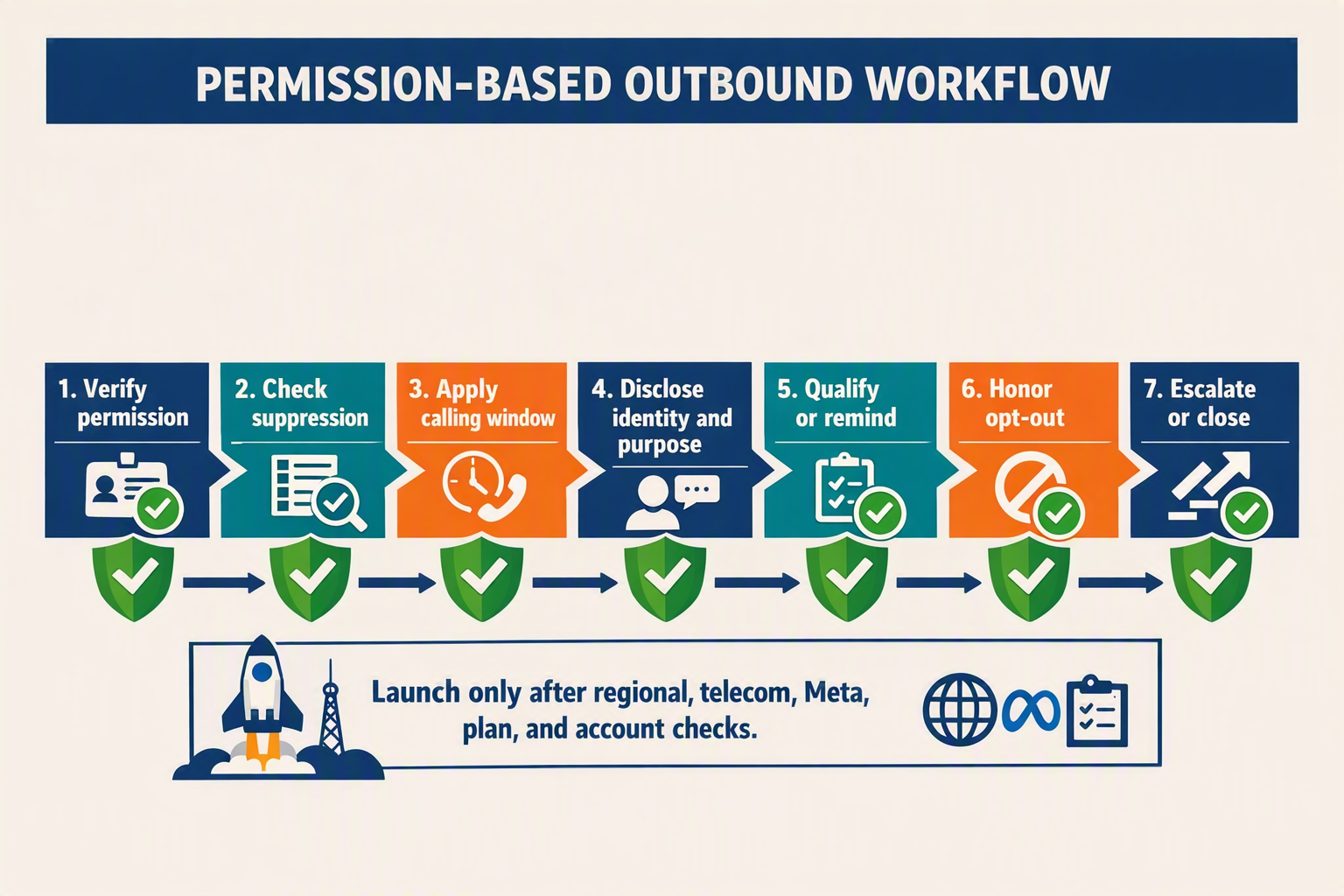
Run CallMissed outbound calling through this operational sequence:
- Verify the outreach purpose and documented permission.
- Check internal suppression lists, prior opt-outs, campaign exclusions and applicable telecom preference systems.
- Apply the permitted calling window for the recipient’s location and campaign type.
- Disclose the business name, reason for calling and AI involvement.
- Limit retries and stop after rejection, an opt-out, a complaint or a wrong-number result.
- Record opt-outs immediately in a central suppression system.
- Use WhatsApp only when that separate channel is permitted and expected.
- Escalate disputes, vulnerable-customer situations and consequential decisions to a trained human.
- Start with a small cohort, review outcomes and expand only after compliance and operations approval.
Put a compliance gate before the dialler
A contact should enter a CallMissed outbound calling campaign only after automated checks confirm that the outreach is appropriate. Legitimate purposes may include:
- A callback explicitly requested by the customer.
- Qualification of a lead who agreed to be contacted.
- An appointment, delivery or payment reminder covered by the original permission.
- A service update relevant to an existing customer relationship.
- A follow-up to a customer-initiated enquiry.
For every contact, retain the consent source, timestamp, channel, stated purpose, capture language, campaign and policy version. Before dialling, compare the number against:
- Internal do-not-contact records.
- Previous opt-outs.
- Campaign exclusions.
- Applicable telecom preference or suppression systems.
The Telecom Regulatory Authority of India’s Telecom Commercial Communications Customer Preference Regulations, 2018 govern commercial communications and customer preferences in India. Registration, number use, consent, preference and calling-window obligations may vary by communication category, telecom provider and current regulatory implementation. Verify the requirements for each campaign instead of applying one global rule.
Control every call, retry and opt-out
At the start of the call, promptly state the business name, reason for calling and AI involvement in plain language. The outbound AI calling agent must not imply that it is human, conceal the caller’s identity or continue after a clear refusal.
Configure each CallMissed outbound calling flow to:
- Confirm that the intended recipient has answered before sharing account-specific information.
- Ask only the questions needed for lead qualification or the stated service purpose.
- Offer an immediate verbal opt-out, such as “Please do not call me again.”
- Write that preference to a central suppression record before another campaign can use the contact.
- Escalate consent disputes, complaints, vulnerable-customer situations and consequential decisions to a trained human.
Use conservative retry limits. Set a maximum number of attempts, a minimum interval between attempts and clear stop conditions. Stop further calls after rejection, a wrong number, an opt-out or a complaint. Define whether voicemail or repeated unanswered calls should also end the sequence.
Configure calling hours by recipient location and use case. Permitted windows can vary by telecom rules, region and campaign classification.
Treat WhatsApp as a separate permissioned channel
Answering a voice call does not automatically grant permission for WhatsApp follow-up automation. Confirm that WhatsApp contact is expected, record the relevant permission and keep each message within the stated purpose.
Meta’s WhatsApp Business Platform documentation defines a 24-hour customer-service window; approved templates are generally required for business-initiated messages outside that window. Template category, calling availability, initiation rights and message eligibility may also depend on Meta policy, market, business account status, phone-number status and product plan.
Use CallMissed’s omnichannel inbox to monitor voice and WhatsApp outcomes together, while maintaining channel-specific permissions and suppression controls.
Review results before increasing volume
Launch CallMissed outbound calling with a small cohort. Establish automatic pause thresholds and review:
- Consent-match and suppression-check failures.
- Opt-out processing time and repeat-contact incidents.
- Call recordings, transcripts and disclosure accuracy.
- Retry patterns, wrong-number outcomes and complaints.
- WhatsApp template rejections, blocks and complaints.
- Human-handoff completion and unresolved cases.
Increase volume only after compliance and operations teams approve the results. These controls reduce risk, but they do not provide a legal guarantee. Telecom rules, Meta policies, regional requirements, account status and plan capabilities must be checked continuously.
Which legitimate use cases fit an outbound AI calling agent, and where should lead qualification, requested callbacks, reminders, and service updates stop?

An outbound AI calling agent fits interactions that a recipient requested, reasonably expects or specifically authorised for a defined purpose. It should stop when permission, identity, purpose or recipient interest becomes uncertain—and it should never convert a narrow service interaction into unrestricted marketing.
Four appropriate, bounded use cases
- Requested callbacks: Call a person who submitted a callback request, missed-call enquiry or support form. The agent should reference the request, identify the business and explain that it is an AI agent. Permission should expire according to the stated purpose and the business’s retention policy; an old enquiry is not permanent calling consent.
- Permission-based lead qualification: Ask a short set of relevant questions—for example, preferred location, budget range or appointment availability—after the person has agreed to discuss the product or service. Qualification should support routing, not pressure the recipient or collect unnecessary sensitive data.
- Reminders: Confirm appointments, deliveries, renewals, payment due dates or scheduled demonstrations when the recipient has an existing relationship or explicitly requested the reminder. Keep the call transactional unless separate promotional consent exists.
- Service updates: Communicate an outage, order-status change, rescheduling notice, fraud alert or another material update connected to an active service. “Service update” must not become a pretext for an unrelated sales pitch.
These categories describe operationally legitimate purposes, not automatic legal approval. Outbound calling compliance still depends on the applicable telecom rules, regional law, consent wording, customer preferences, number type and campaign configuration. India’s Telecom Regulatory Authority of India introduced the Telecom Commercial Communications Customer Preference Regulations in 2018, creating a formal framework for commercial communications and customer preferences.
Where lead qualification must stop
A qualification script needs a defined endpoint. The agent should stop questioning and offer human assistance when:
- The recipient says “stop,” “not interested,” “do not call” or uses equivalent language in any supported language.
- The recipient disputes consent, says the number belongs to someone else or cannot identify the original enquiry.
- The conversation enters sensitive territory, such as health, financial hardship, legal disputes or identity verification beyond the approved workflow.
- The person asks for a binding quotation, contractual interpretation, complaint resolution or exception the agent is not authorised to provide.
- Repeated misunderstanding, distress, hostility or low speech-recognition confidence makes continued automation inappropriate.
Silence, an unanswered call or an ambiguous response is not affirmative interest. The workflow should record the outcome, avoid endless retries and route explicit opt-outs to suppression before another campaign can select the number.
Do not let one interaction silently expand into another
A requested callback authorises the callback’s stated purpose—not every later channel or campaign. Before using WhatsApp follow-up automation, verify that the business has the appropriate WhatsApp permission and that the message complies with Meta’s current initiation, template and account requirements. Meta’s WhatsApp Business Platform documentation defines a 24-hour customer-service window, while business-initiated messages outside that window generally require an approved template.
A safe transition sounds like: “Would you like us to send the appointment details on WhatsApp?” Record the answer separately from voice-call permission.
CallMissed outbound calling can connect AI voice interactions with WhatsApp and an omnichannel inbox, helping teams preserve the conversation history and hand off to staff. That technical continuity should reinforce purpose limitation: when the authorised task is completed, consent is withdrawn or a human decision is required, the automation stops.
Which policy developments and dependencies affect AI calls and WhatsApp messages? (TABLE: telecom rules, regional law, Meta policy, recording, plan features, and account eligibility)
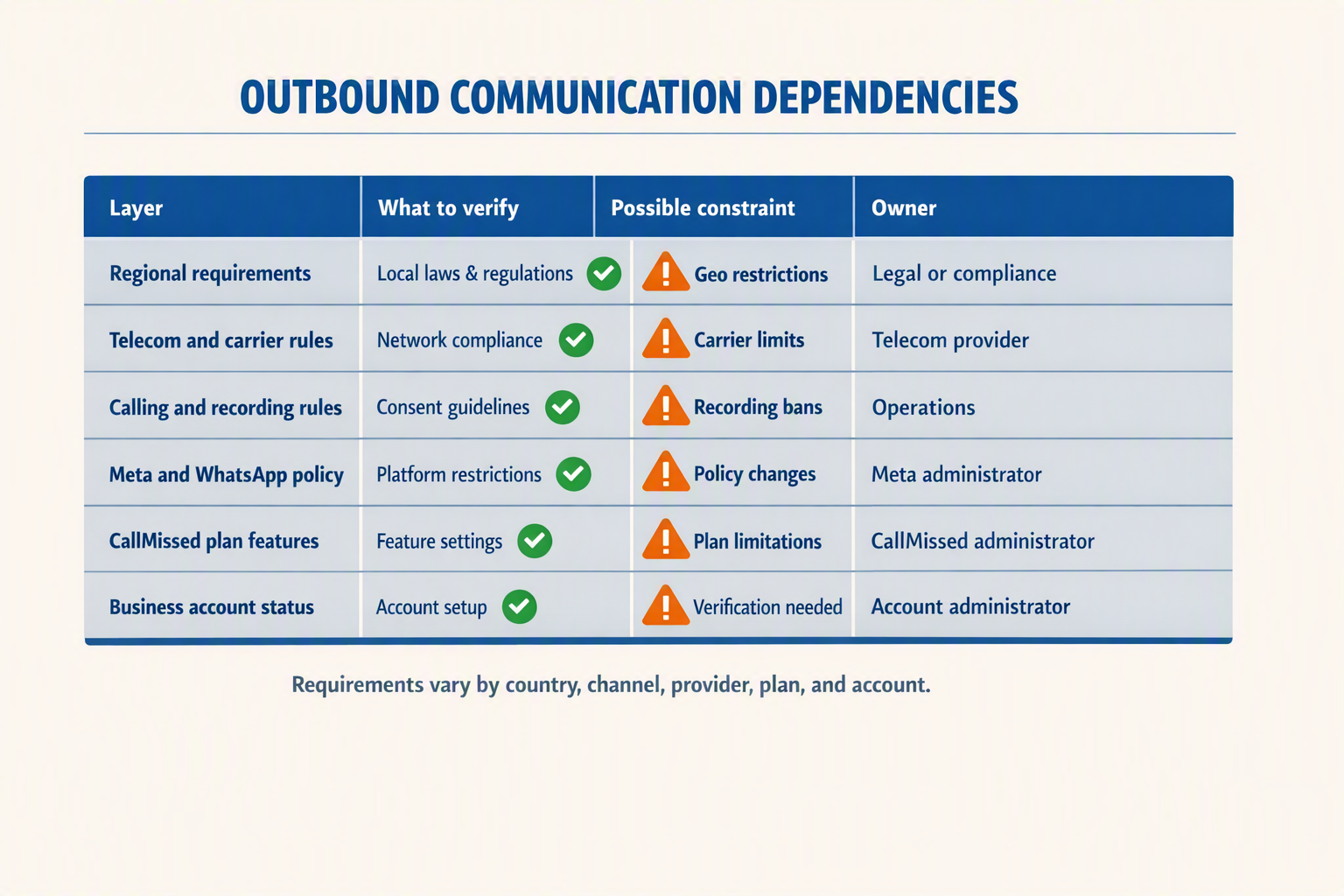
AI calls and WhatsApp messages depend on multiple independent rule sets: telecom regulations, regional privacy law, recording requirements, Meta policies, product-plan capabilities and account eligibility. Passing one check does not authorise another channel; every campaign needs a documented, market-specific review before launch.
Policy and product dependency matrix
| Dependency | What governs it | Operational requirement | What can vary |
|---|---|---|---|
| Telecom rules | India’s Telecom Regulatory Authority of India established the Telecom Commercial Communications Customer Preference Regulations, 2018 to regulate commercial communications and customer preferences. | Validate consent and applicable preference or suppression records before dialling; enforce approved calling windows, sender requirements and opt-outs. | Rules may differ by country, communication type, recipient preference, number class and campaign purpose. |
| Regional privacy law | India’s Digital Personal Data Protection Act, 2023 received presidential assent on August 11, 2023. Other jurisdictions apply their own privacy and direct-marketing laws. | Record the purpose, consent source, timestamp, data used and retention basis; provide a process for withdrawal and data-rights requests. | Consent standards, lawful grounds, notice wording, retention and cross-border obligations depend on jurisdiction. |
| Meta messaging policy | Meta’s WhatsApp Business Platform documentation defines a 24-hour customer-service window; approved templates are generally required for business-initiated messages outside that window. | Classify each follow-up, use an approved template where required and honour WhatsApp-specific opt-outs immediately. | Template approval, message category, pricing, quality status and initiation rights can change by market and account. |
| Call recording | Recording and monitoring requirements arise from applicable national, state or regional laws, as well as contractual and sector rules. | Decide whether recording is necessary, announce it where required, restrict access and define retention and deletion controls. | One-party or all-party consent standards, disclosure language and admissibility can differ by location. |
| Plan features | CallMissed outbound calling, WhatsApp automation, AI-agent bridging and campaign controls depend on the enabled product configuration. | Confirm that the plan supports the intended channel, volume, number, routing, recording and human-handoff workflow before publishing. | Features, limits, credits, numbers and rollout status may differ by plan or deployment. |
| Account eligibility | Meta and telecom providers evaluate business verification, phone-number status, quality signals, market availability and policy compliance. | Verify the WhatsApp Business Account, number and calling capability before treating a workflow as production-ready. | Messaging access does not automatically establish WhatsApp Business calling eligibility, especially for business-initiated calls. |
Treat every channel as a separate permission decision
An outbound AI calling agent should receive a callable record only after the system resolves all applicable dependencies. Likewise, WhatsApp follow-up automation should not infer messaging permission merely because a recipient answered a call or requested information through another channel.
Before activation, create separate fields for:
- Voice-call permission, including purpose and permitted number.
- WhatsApp messaging permission and the approved follow-up category.
- WhatsApp calling permission, where required by Meta’s current rules.
- Recording status, disclosure requirement and retention period.
- Global and channel-level suppression, including withdrawal timestamps.
- Recipient geography and local time, used to calculate the allowed calling window.
Use a launch gate, not a legal assumption
Outbound calling compliance is a continuing control rather than a one-time approval. Meta policies, telecom requirements, regional implementation rules and account status can change after a campaign is configured.
A practical outbound AI calling agent compliance gate should therefore confirm:
- The recipient has valid, purpose-specific permission.
- No regulatory or internal suppression applies.
- The contact falls within the permitted local calling window.
- Identity, AI involvement and recording disclosures are configured.
- The WhatsApp template, number and account remain eligible.
- CallMissed plan features and campaign limits match the intended workflow.
These checks reduce avoidable policy failures, but they are not a legal guarantee. Businesses should validate current requirements with qualified counsel, telecom providers, Meta documentation and their CallMissed account configuration before launch.
How should consent, suppression, calling windows, identity disclosure, and WhatsApp follow-up automation work across the contact lifecycle?
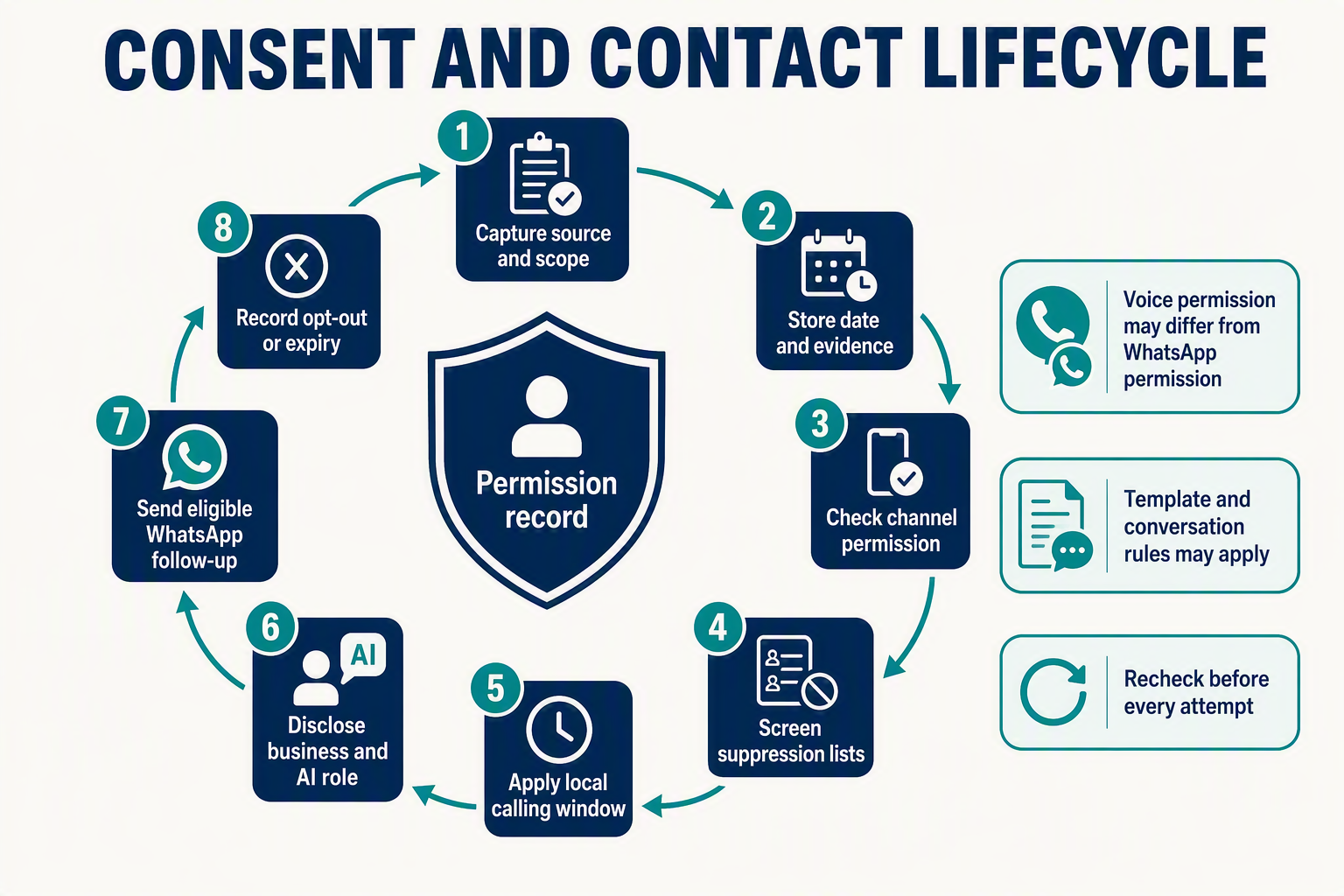
Consent should operate as a lifecycle control, not a one-time checkbox: verify permission before each contact, re-check suppression and calling-window rules at execution time, disclose identity immediately, and pass only channel-authorised contacts into WhatsApp automation. Every decision should leave an auditable record.
1. Capture consent as structured evidence
A consent ledger should store more than “yes” or “no.” For each person, record:
- Phone number or contact identifier
- Consent source, such as a web form, requested callback or recorded conversation
- Timestamp, purpose and campaign
- Permitted channels: voice, WhatsApp, email or a specific combination
- Notice or script version shown when permission was obtained
- Expiry or review date, where applicable
- Withdrawal timestamp and evidence
India’s Digital Personal Data Protection Act, 2023 received presidential assent on August 11, 2023, making purpose-specific and transparent personal-data handling an important operational consideration. Legal applicability and implementation obligations should be reviewed with qualified counsel.
Before every attempt, a CallMissed outbound calling workflow should query the current consent record—not rely on the status imported when the campaign was created.
2. Make suppression override campaign logic
Suppression must take priority over lead scores, sales stages and scheduled retries. A pre-dial decision should check, in order:
- Regulatory or operator-level preference requirements
- The business’s global do-not-contact list
- Channel-specific opt-outs
- Campaign-level suppression
- Temporary restrictions, disputes or complaint investigations
- Permitted local calling windows and retry limits
The Telecom Regulatory Authority of India established the Telecom Commercial Communications Customer Preference Regulations, 2018 to govern commercial communications and customer preferences. Exact registration, sender, number, consent and timing requirements can depend on the communication type, telecom ecosystem and subsequent regulatory directions.
An opt-out during a call should update suppression promptly enough to stop queued calls and associated messages. Keep the request, timestamp, channel and execution result as evidence of outbound calling compliance.
3. Evaluate calling windows at dial time
Calling-window controls should use the recipient’s applicable time zone and jurisdiction, not merely the campaign owner’s clock. Configure permitted days and hours according to current telecom rules, regional law, use case and operator requirements.
The outbound AI calling agent should also enforce:
- A maximum number of attempts per contact and period
- Minimum spacing between retries
- No automatic retry after an explicit refusal
- Lower retry intensity for unanswered promotional calls
- Immediate human review after complaints or disputed consent
These controls are central to outbound AI calling agent compliance because a technically authorised campaign can still become intrusive through excessive or badly timed retries.
4. Disclose identity before qualification
At the beginning of the call, identify the business, explain the purpose, and clearly state that the recipient is interacting with an AI agent where required or appropriate. Provide a simple option to decline, opt out or request a human.
A practical opening is: “Hello, this is an AI assistant calling on behalf of [Business] about the callback you requested. Is now a suitable time?” Do not conceal automation, impersonate an employee or pressure the recipient to continue.
5. Pass only eligible contacts to WhatsApp
WhatsApp follow-up automation should receive a separate eligibility decision containing consent scope, conversation status, template eligibility and suppression state. Meta’s WhatsApp Business Platform documentation defines a 24-hour customer-service window; approved templates are generally required for business-initiated messages outside that window.
CallMissed can coordinate voice and WhatsApp activity through an omnichannel workflow, but automation should send a message only when current Meta policy, regional rules, business-account status, phone-number eligibility and plan configuration permit it. A voice opt-out should suppress related WhatsApp promotion unless the person has clearly retained separate WhatsApp permission.
What impact do retry limits, opt-outs, human escalation, monitoring, and incident controls have on customer experience and compliance risk?
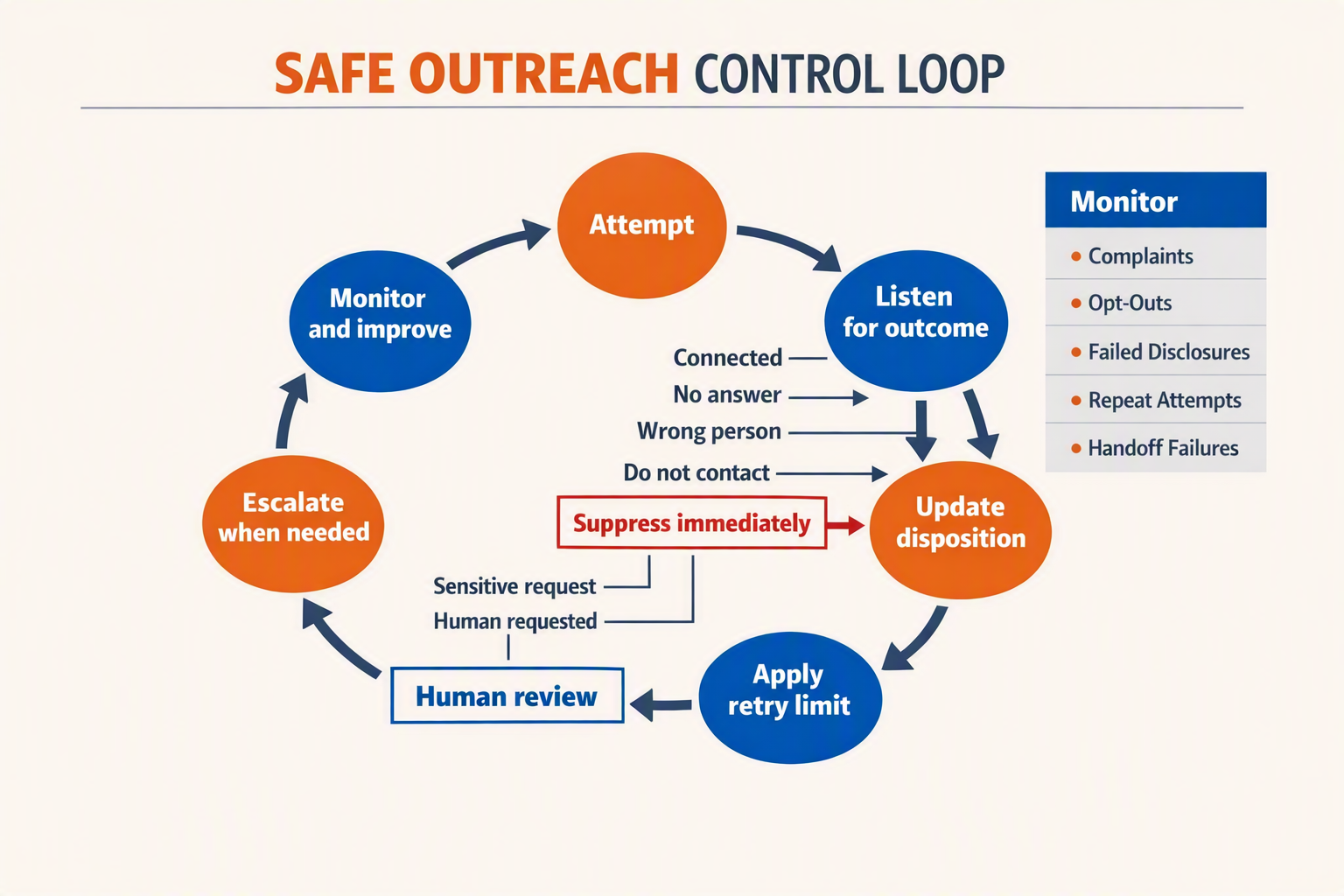
Retry limits, immediate opt-outs, reliable human escalation, continuous monitoring and automatic incident controls reduce both customer frustration and the probability that a small workflow error becomes a campaign-wide compliance event. For an outbound AI calling agent, these controls should be enforced by the system—not left to script wording or agent judgement alone.
Use retries to recover conversations, not pressure recipients
A retry policy should define the maximum attempts, minimum spacing, permitted calling windows and terminal outcomes for each campaign. There is no universal safe retry count: requirements depend on telecom rules, recipient preferences, campaign purpose, region, account eligibility and business risk.
A practical policy can:
- Make fewer attempts for promotional lead qualification than for a requested callback.
- Stop retries after an opt-out, explicit refusal, wrong-number report or successful contact.
- Avoid repeated calls at the same time each day.
- Count attempts across AI agents, human agents and connected systems—not separately.
- Prevent a failed call from automatically triggering an unapproved WhatsApp message.
For CallMissed outbound calling, businesses should store every attempt with its timestamp, outcome, campaign identifier and next-action status. This creates an auditable record and prevents parallel workflows from repeatedly contacting the same person.
Treat opt-outs as real-time suppression events
An opt-out must change system behaviour immediately. The AI agent should recognise clear phrases such as “stop calling,” “remove my number” and equivalent expressions in supported languages, confirm the request briefly, and avoid trying to persuade the recipient to remain enrolled.
Suppression should then propagate across relevant systems:
- Mark the phone number and channel as suppressed.
- Cancel queued retries and scheduled campaign tasks.
- Block list re-imports from silently restoring eligibility.
- Record the request’s timestamp, wording, source and execution result.
- Apply channel-specific choices where a customer stops calls but still permits service messages.
Phone consent does not automatically authorise WhatsApp follow-up automation. Meta’s WhatsApp Business Platform documentation defines a 24-hour customer-service window, and approved templates are generally required for business-initiated messaging outside that window. Template rules, calling permissions and initiation requirements remain dependent on Meta policy, market, account status and product configuration.
Escalate when automation is no longer appropriate
Human handoff protects customers when a conversation involves disputed consent, complaints, vulnerability, payment concerns, legal threats, sensitive personal data or repeated misunderstanding. It also improves lead qualification when a prospect asks for non-standard terms or a high-value consultation.
A reliable escalation should transfer the conversation context, including the transcript, consent record, detected intent and promised next step. If no employee is available, the agent should offer a scheduled callback rather than trapping the customer in an automation loop.
Monitor outcomes and contain incidents early
Monitoring should examine more than answer rates. Review:
- Opt-out and complaint rates by campaign, script, language and data source.
- Retry frequency, calling-window violations and suppression failures.
- Identity-disclosure completion and human-handoff success.
- Transcript samples for misleading claims or missed refusal signals.
- WhatsApp delivery, block and quality signals where available.
The Telecom Regulatory Authority of India’s Telecom Commercial Communications Customer Preference Regulations, 2018 makes customer preferences central to commercial communications in India. Monitoring should therefore verify execution, not merely confirm that a policy exists.
Set automatic pause thresholds for unusual complaint spikes, suppression-sync failures, incorrect caller identity or calls outside configured windows. Preserve logs, isolate the affected cohort, investigate the cause and require approval before restarting. These controls support outbound calling compliance, but they do not guarantee it; telecom obligations, recording rules, Meta requirements and regional privacy laws must be reviewed for each deployment.
Which expert opinions should you obtain before launch from legal, privacy, telecom, security, customer operations, and WhatsApp account specialists?
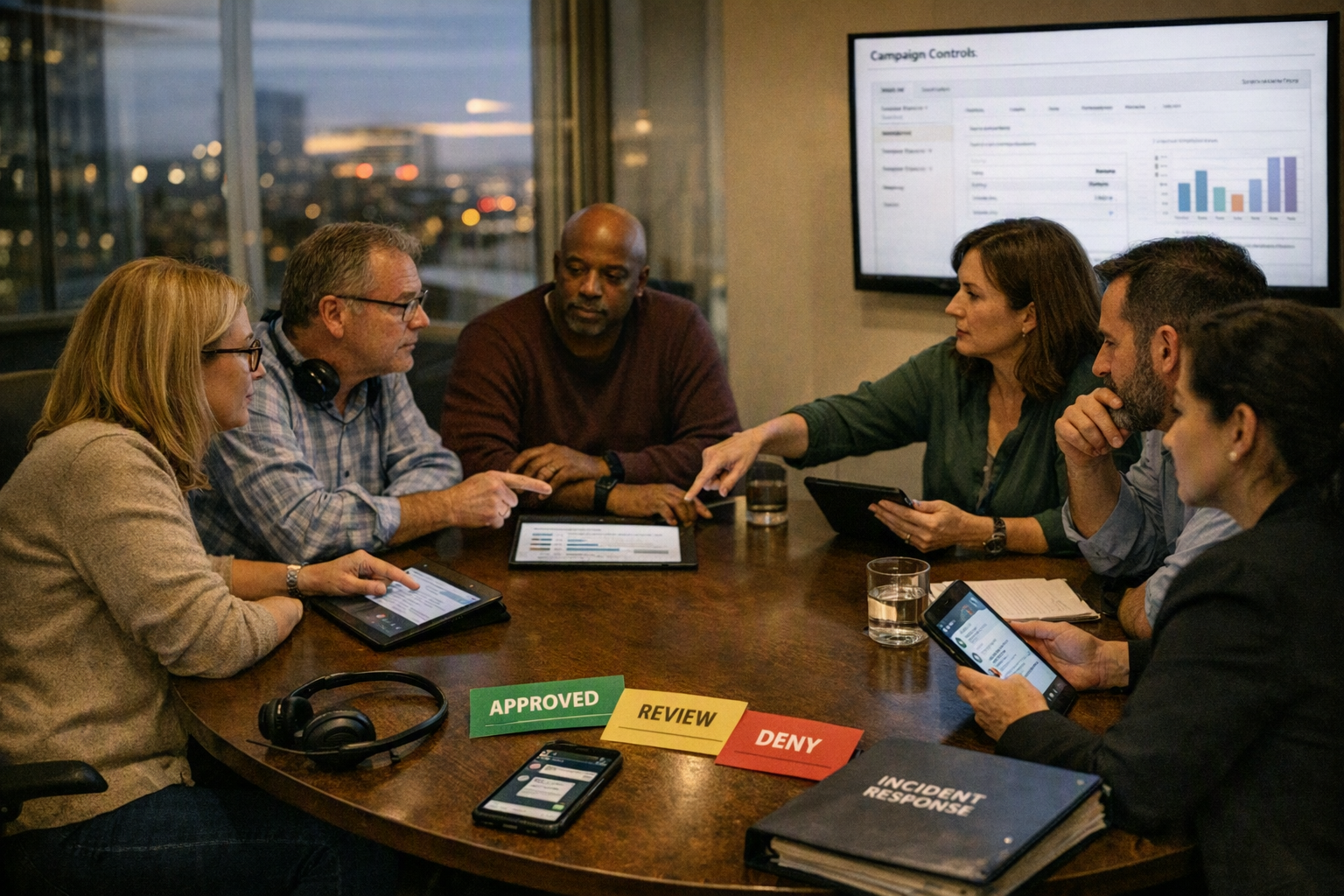
Obtain written sign-off from legal, privacy, telecom, security, customer-operations and WhatsApp Business Platform specialists before activating production traffic. Each reviewer should approve a defined control area and record assumptions, unresolved risks and launch conditions; no single opinion establishes universal compliance.
1. Legal counsel: permission, disclosure and evidence
Ask counsel familiar with every recipient’s jurisdiction to review:
- The lawful basis and wording used to obtain channel- and purpose-specific consent.
- Whether the agent must disclose that it is automated, identify the sponsoring business or provide other notices.
- Call-recording, transcription and monitoring requirements, including whether one-party or all-party consent applies.
- Scripts for lead qualification, reminders, service updates and regulated sectors.
- Contract terms, complaint handling and evidence-retention periods.
India’s Digital Personal Data Protection Act, 2023 received presidential assent on August 11, 2023; counsel should advise how the law, its operative provisions and applicable rules affect the particular deployment. Legal approval should identify regional differences rather than issue an unsupported “globally compliant” conclusion.
2. Privacy specialist: data purpose and lifecycle
The privacy reviewer should create a data-flow map covering the lead source, dialler, AI model, recordings, transcripts, CRM, analytics and WhatsApp follow-up. Require a decision on:
- Data minimisation, retention and deletion schedules.
- Access, correction, withdrawal and grievance workflows.
- Processor and cross-border transfer arrangements.
- Whether model prompts or transcripts may be retained or used for training.
- How consent provenance and suppression events remain linked to the customer record.
The opinion should explicitly test whether permission for an AI call also covers WhatsApp follow-up automation. These should be treated as separate permissions unless the recorded notice and applicable rules support both channels.
3. Telecom specialist: routing and calling restrictions
A telecom regulatory specialist or qualified carrier partner should verify number use, registration, commercial-communication classifications, preference checks, caller identification and permitted calling windows. The Telecom Regulatory Authority of India’s Telecom Commercial Communications Customer Preference Regulations, 2018 govern unsolicited commercial communications and customer preferences in India, but implementation can depend on message or call type, carrier processes and subsequent directions.
Have the specialist document:
- Permitted use cases and recipient categories.
- Applicable time windows and holidays.
- Retry and abandoned-call limits.
- Required suppression or preference checks.
- Number, route and registration dependencies.
4. Security specialist: technical abuse controls
Request a threat model and production-readiness assessment for CallMissed outbound calling or any outbound AI calling agent. The assessment should cover role-based access, API-key storage, webhook authentication, encryption, audit logs, export controls and incident response.
Security testing should also simulate prompt injection, unauthorised campaign uploads, suppression-list bypasses and excessive retries. Automatic pause controls should activate when authentication fails, opt-outs cannot be written or complaint thresholds are breached.
5. Customer-operations leader: real-world conversation safety
Customer operations should approve scripts, escalation triggers and agent availability. Test ambiguous consent, vulnerable customers, language switching, disputes, abusive interactions and requests to stop contact. For regional deployments, reviewers should validate pronunciation and comprehension rather than assuming translation alone is sufficient; CallMissed supports voice interactions across 22 Indian languages.
6. WhatsApp account specialist: policy and eligibility
A WhatsApp specialist should confirm business-account status, phone-number eligibility, template category, quality signals and calling permissions. Meta’s WhatsApp Business Platform documentation defines a 24-hour customer-service window, with approved templates generally required for business-initiated messages outside that window.
Record Meta, market, account, number and plan dependencies in the launch decision. Recheck them before scaling because policy approval, template approval and technical availability can change independently of legal consent.
What does this mean for your launch? (TABLE: control, evidence, owner, pass criteria, dependency, and rollback action)
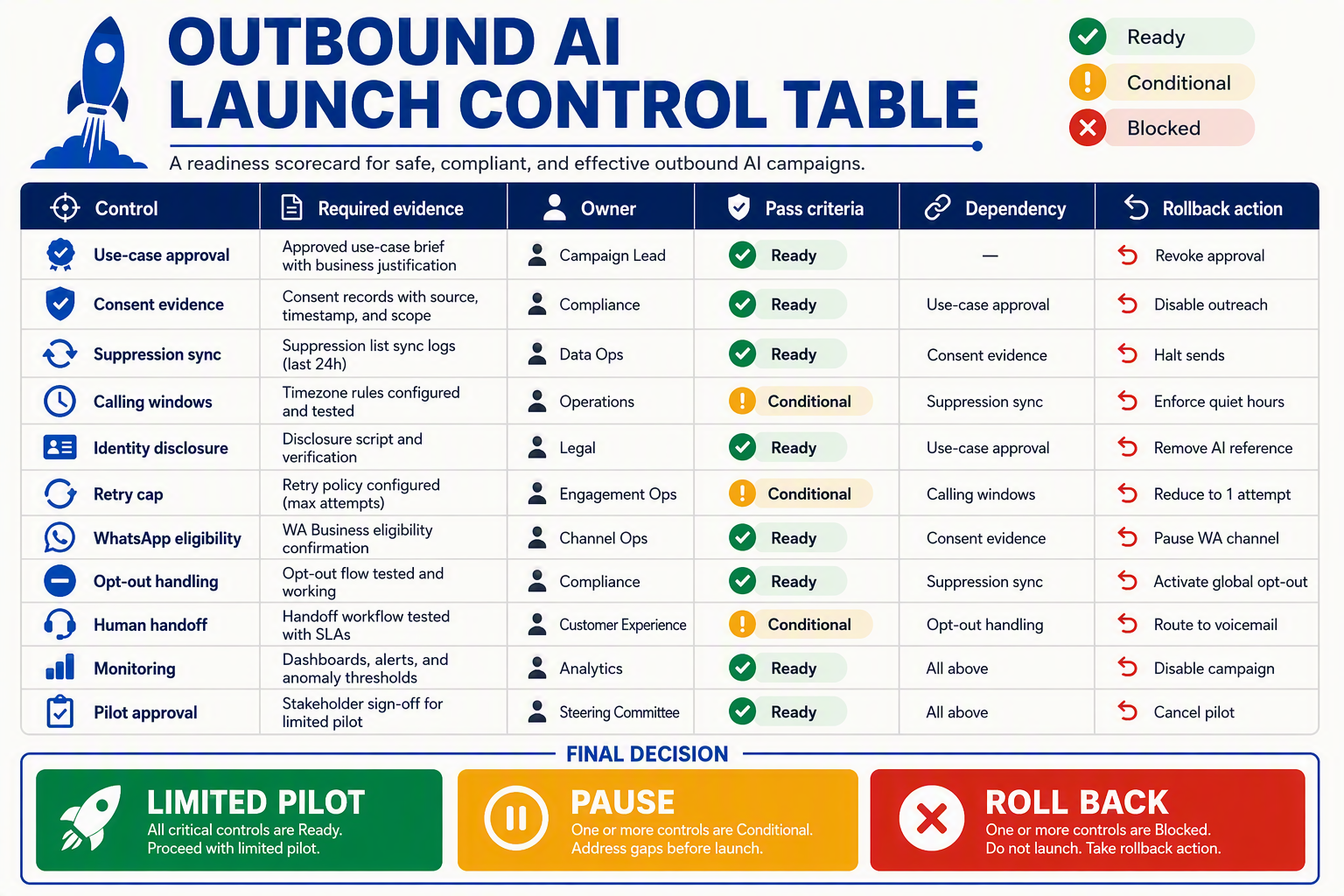
A launch should proceed only when every control has an accountable owner, reproducible evidence, measurable pass criteria and a tested rollback action. Treat CallMissed outbound calling, the outbound AI calling agent and WhatsApp follow-up automation as one governed workflow, but validate permission, suppression and policy eligibility separately for each channel.
Launch control matrix
| Control | Evidence | Owner | Pass criteria | Dependency and rollback action |
|---|---|---|---|---|
| Consent and purpose | Source record, timestamp, captured wording, channel, purpose and campaign ID linked to each recipient | CRM or data-governance owner | 100% of the launch cohort has traceable permission appropriate to the intended call; ambiguous or mismatched records are excluded | Depends on consent design, applicable law and source-system integrity. If evidence is missing, stop dialling and quarantine affected records. |
| Suppression and opt-outs | Internal do-not-contact list, applicable preference checks, channel-level opt-out logs and test results | Compliance operations owner | Seeded suppressed numbers are never dialled or messaged; test opt-outs block further contact before any retry | Depends on telecom rules, regional requirements and synchronisation across CRM, voice and WhatsApp systems. On failure, pause the campaign and reconcile every active queue. |
| Calling windows and retries | Configured time-zone rules, permitted schedules, attempt counter and retry-spacing logs | Campaign operations owner | No test contact occurs outside the approved local window; retry ceilings and spacing operate exactly as documented | Depends on recipient location, campaign purpose and applicable telecom requirements. Roll back to a disabled schedule and clear pending retries if timing cannot be determined reliably. |
| Identity and AI disclosure | Approved opening script, recordings, transcripts and multilingual quality checks | Legal/compliance reviewer plus conversation-design owner | Every sampled call identifies the business, explains the automated or AI nature of the interaction where required, and offers a clear opt-out or human route | Depends on regional disclosure and recording rules. Replace the script, disable recording where necessary, or suspend the affected language flow. |
| WhatsApp follow-up | Opt-in basis, template name and approval status, delivery logs, customer-service-window timestamp and account eligibility | WhatsApp channel owner | The correct approved template is used when required; no follow-up assumes that voice consent automatically covers WhatsApp | Meta’s WhatsApp Business Platform documentation defines a 24-hour customer-service window. If eligibility, template status or initiation rights fail, suppress the message and move the case to an approved channel. |
| Escalation and monitoring | Human-handoff test, staffed queue, complaint dashboard, sampled transcripts and pause-threshold alerts | Contact-centre owner and incident lead | Handoff completes with context intact; every alert has an owner; automatic pause and manual kill switch are demonstrated before launch | Depends on staffing, CallMissed plan configuration, account status and integration health. Pause new contacts, preserve audit evidence and route open cases to trained staff. |
Run a staged release, not a full-volume debut
Use the matrix as a go/no-go record, not merely a setup checklist:
- Test with synthetic and staff-owned numbers. Confirm suppression, opening disclosures, retry counters, WhatsApp templates and human escalation without exposing real prospects.
- Release a small permission-verified cohort. Monitor connection outcomes, opt-outs, complaints, failed handoffs and transcript anomalies before increasing volume.
- Require written approval for expansion. Compliance, campaign operations and the incident owner should sign off against the same evidence set.
- Revalidate after every material change. A new language, script, lead source, jurisdiction, template, phone number or use case creates a new control dependency.
India’s Telecom Commercial Communications Customer Preference Regulations, 2018, issued by the Telecom Regulatory Authority of India, govern commercial communications and customer preferences. India’s Digital Personal Data Protection Act, 2023 received presidential assent on August 11, 2023, making evidence-based personal-data governance especially relevant to campaign design.
For regional deployments, CallMissed supports voice interactions across 22 Indian languages, but every language flow still needs equivalent disclosure, opt-out recognition and escalation testing. This approach turns outbound AI calling agent compliance into an auditable release process without implying a legal guarantee; telecom rules, Meta policies, regional laws, account eligibility and product-plan capabilities remain deployment-specific dependencies.
Frequently asked questions: Is outbound AI calling legal, what consent is needed, must the agent disclose it is AI, when may it call, can WhatsApp follow automatically, and how are opt-outs handled?
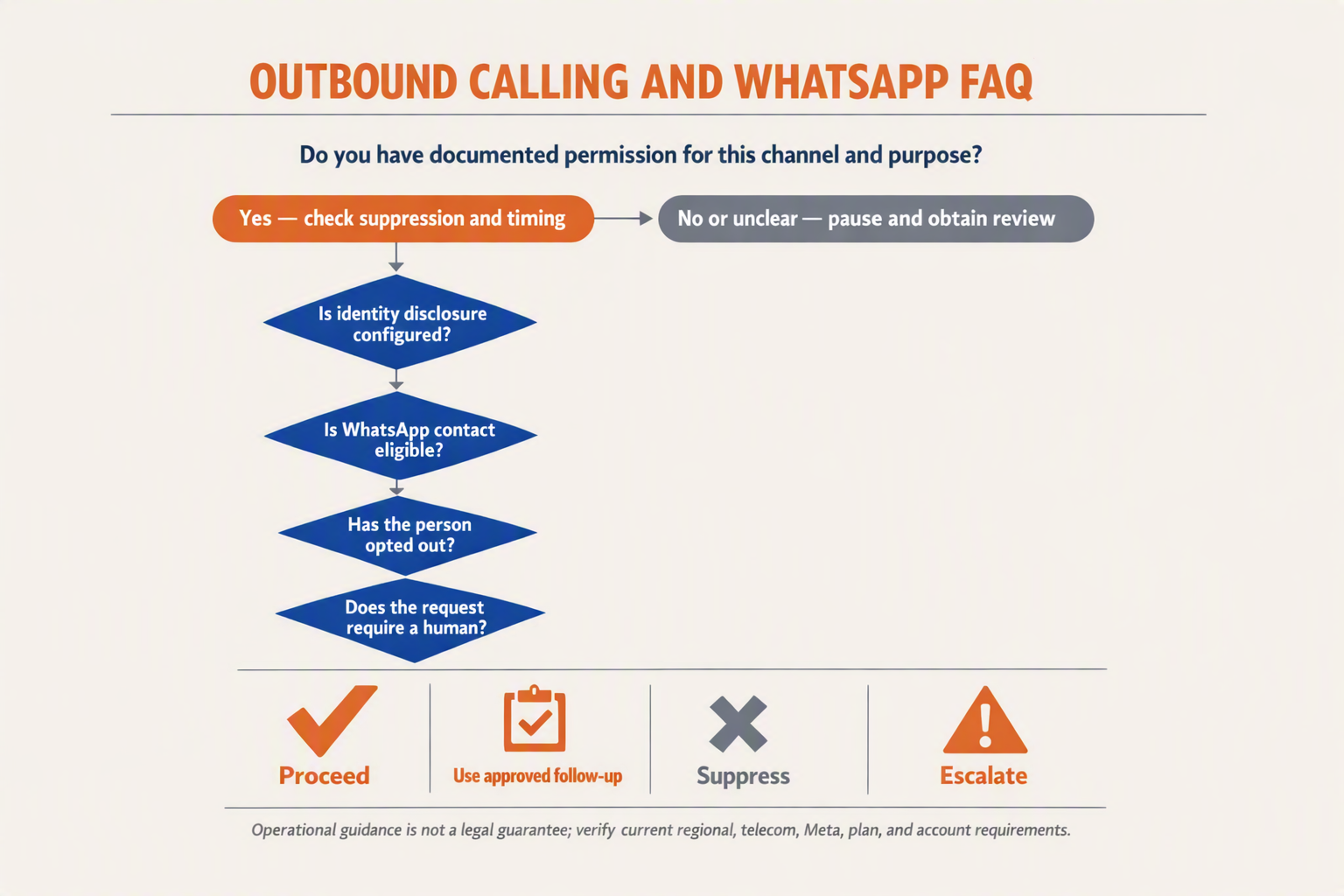
Is outbound AI calling legal in India?
What consent is needed for CallMissed outbound calling?
Must an outbound AI calling agent disclose that it is AI?
What calling hours and retry limits apply to outbound AI calls?
Can WhatsApp follow-up automation start automatically after an AI call?
How should opt-outs and suppression lists work across AI calls and WhatsApp?
Conclusion
Permission—not automation—is the foundation of compliant outbound engagement. A defensible CallMissed outbound calling workflow connects every AI call and WhatsApp message to recorded consent, channel-specific rules, suppression controls and transparent identity disclosure.
Key takeaways
- Start with a legitimate, documented purpose. Requested callbacks, lead qualification, appointment reminders and service updates are appropriate starting points when the business can demonstrate permission. Before an outbound AI calling agent dials, retain the consent source, timestamp, channel, purpose and campaign association.
- Treat consent and opt-outs as operational data. Calling permission should not automatically authorize WhatsApp outreach, and WhatsApp consent should not be assumed to cover every type of call. Central suppression lists must be checked before each attempt, while opt-out requests should stop relevant communication promptly across connected workflows.
- Build policy controls into automation. Apply permitted calling windows, retry limits and automatic pause thresholds rather than relying on agents or campaign managers to remember them. Meta’s WhatsApp Business Platform documentation defines a 24-hour customer-service window, with approved templates generally required for business-initiated messages outside that period.
- Disclose, escalate and monitor. An AI agent should clearly identify the business, explain its AI role without misleading the recipient and provide an easy route to a human. Recordings, transcripts, outcomes, complaints and suppression execution should be reviewed in test cohorts before campaign volume expands.
These controls align with the direction established by the Telecom Regulatory Authority of India’s Telecom Commercial Communications Customer Preference Regulations, 2018 and the Digital Personal Data Protection Act, 2023, which received presidential assent on August 11, 2023. They are operating principles, not a legal guarantee: telecom requirements, regional laws, Meta policies, business-account eligibility and product-plan capabilities can change.
The next phase of outbound calling compliance will depend on proving permission and policy execution at machine speed. Teams should watch for updates to calling availability, initiation rules, message templates, account-quality signals and regional requirements—and continuously retest outbound AI calling agent compliance rather than treating launch approval as permanent.
To explore permission-led voice engagement and WhatsApp follow-up automation, visit CallMissed, a platform supporting AI voice agents, WhatsApp Business calling and voice interactions across 22 Indian languages. As communication becomes more automated, can your business prove why every call was made, when permission was granted and how quickly an opt-out was honoured?
Related Reading
Related Posts
Ready to automate customer conversations?
Launch AI voice agents and WhatsApp bots with CallMissed — one API, 22+ Indian languages.