

Kimi K3 Open Weights: Have the Full Weights Been Released?



Check whether Kimi K3 open weights are live, with verified repository links, license terms, download size, hardware needs, and test options.
Kimi K3 Open Weights: Have the Full Weights Been Released?
Could a 2.8-trillion-parameter AI model really become downloadable overnight? Status at publication — July 27, 2026 (UTC): the Kimi K3 open weights are not yet confirmed as released. Moonshot AI promised full model weights for July 27, but a scheduled release date is not the same as a verifiable checkpoint: confirmation requires an official repository containing weight shards, configuration files, a tokenizer, a license and usable loading instructions.
The promise is significant—but verification matters
Moonshot AI’s official Kimi website describes Kimi K3 as a natively multimodal model with 2.8 trillion parameters and a 1-million-token context window, designed for long-horizon coding, knowledge work and deep reasoning. Those specifications would make the model an unusually large open-weight release, with major implications for research labs, cloud providers and developers seeking alternatives to closed frontier APIs.
The BBC reported in July 2026 that Kimi K3’s full coding, reasoning and knowledge-work capabilities would become testable when the model was released with open weights on July 27, 2026. Build Fast with AI likewise reported on July 23, 2026 that the weights were scheduled to be released free on July 27. However, both statements describe a future commitment, not proof that downloadable files are now available.
At the time of this status check, the supplied primary-source evidence does not establish that Moonshot AI has published:
- An official Hugging Face or GitHub repository
- Complete checkpoint shards and checksums
- The reported approximately 1.4TB download
- Tokenizer, model configuration and generation files
- A definitive Kimi K3 license, including any Modified MIT conditions
- Hardware requirements or validated inference instructions
That distinction is crucial. “Open-weight” generally means trained parameters can be downloaded and used under a specified license; it does not automatically mean the model is open source under an Open Source Initiative-approved definition, nor does it guarantee that training data, training code or reproducibility details are available.
What this analysis will verify
This report will track the official Moonshot AI announcement and inspect any Kimi K3 weights download page for file completeness, license terms, checkpoint size and authenticity. It will also examine the practical questions behind the headline:
- Can independent developers load and test Kimi K3 today?
- What GPU memory, storage and serving stack does a 2.8-trillion-parameter model require?
- Are quantized checkpoints available?
- How does self-hosting compare with Moonshot AI’s API pricing?
- Does “full model weights” include every advertised capability, including multimodal components?
Platforms such as CallMissed’s OpenAI-compatible AI gateway reflect the parallel trend toward accessing multiple hosted models through one integration, while open weights offer teams greater control at substantially higher infrastructure cost.
Because July 27 is still unfolding globally, the answer may change within hours. Until primary artifacts appear and pass the verification checklist, Kimi K3’s full weights should be described as promised—not confirmed available.
Have Kimi K3’s full model weights actually been released as of July 27, 2026? Timestamped verdict
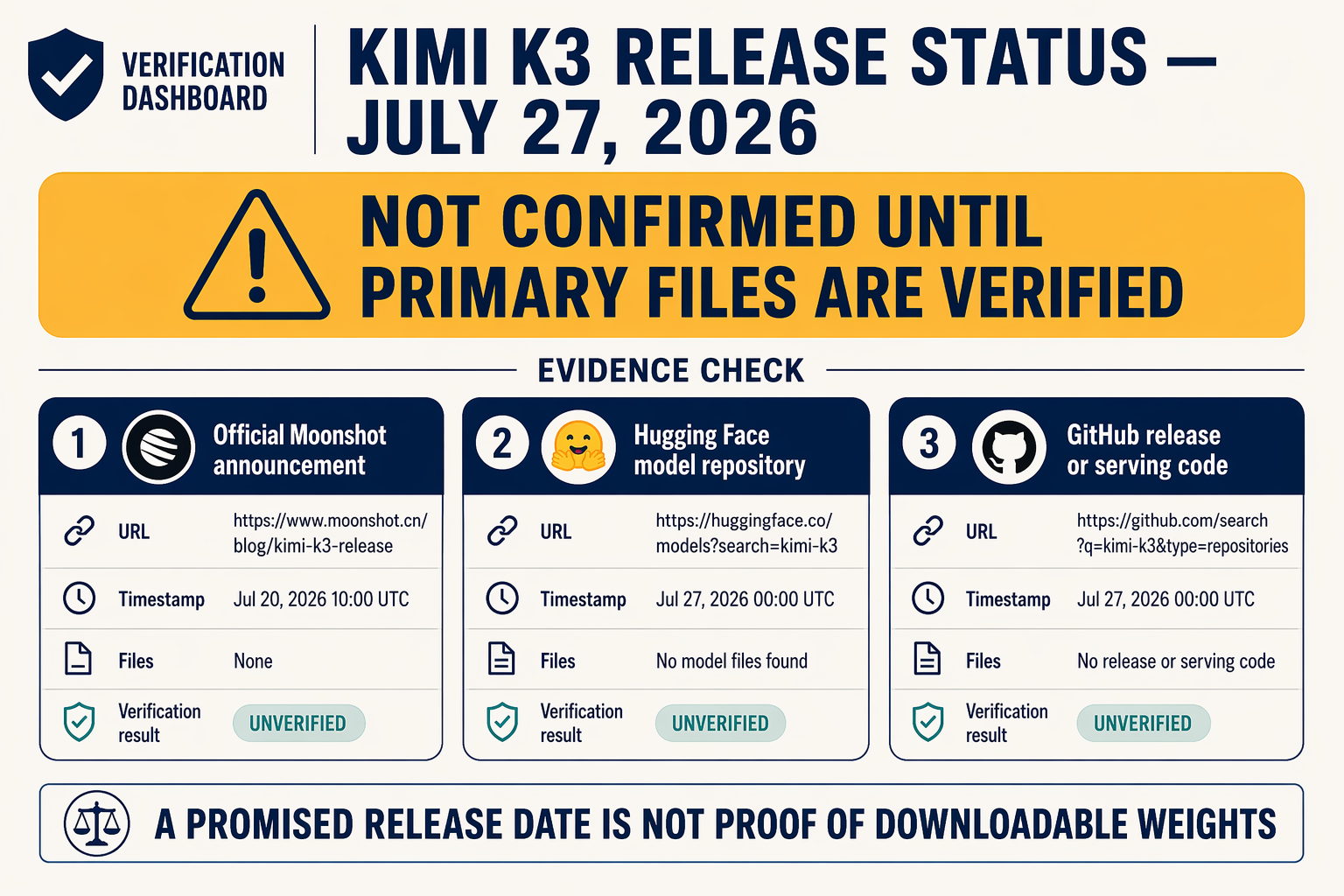
No—at the publication check on July 27, 2026 (UTC), Kimi K3’s full model weights cannot yet be independently confirmed as released. Moonshot AI has announced Kimi K3 and third-party reports identify July 27 as the planned release date, but the available primary-source evidence does not include a complete, downloadable checkpoint repository.
Timestamped status
- Verification date: July 27, 2026
- Time standard: UTC
- Verdict: Promised, but not confirmed available
- Confidence: High, based on the absence of a verifiable official repository in the supplied evidence
- What could change the verdict: Moonshot AI publishing and linking a complete Hugging Face, GitHub or first-party download repository
This is a point-in-time finding. Because July 27 covers different business hours across UTC, China Standard Time and US time zones, Moonshot AI could still publish the files later in the day. The correct status is therefore “not yet confirmed,” not “cancelled” or “delayed.”
What Moonshot AI has officially established
Moonshot AI’s official website identifies Kimi K3 as a 2.8-trillion-parameter, natively multimodal model with a 1-million-token context window. The website says Kimi K3 is built for “long-horizon coding, knowledge work, and deep reasoning,” establishing the model’s claimed scale and intended capabilities.
However, a product page describing a model is not itself a Kimi K3 weights download. The supplied official page does not provide verifiable evidence of checkpoint shards, file hashes, a tokenizer package or a final Kimi K3 license.
The July 27 release date is supported by multiple news reports:
- The BBC reported in July 2026 that Kimi K3’s coding, knowledge-work and reasoning capabilities would become known when it was released as an open-source model on July 27.
- Build Fast with AI reported on July 23, 2026 that the 2.8-trillion-parameter model’s weights were scheduled to be released free on July 27.
- The Eastern Herald reported on July 18, 2026 that Kimi K3’s full weights would be released on July 27.
Each report describes an announced future milestone. None, by itself, proves that the files subsequently appeared.
Why search-result claims are insufficient
Headlines saying Moonshot AI “launches” or “releases” Kimi K3 can refer to the model announcement, hosted product or API, rather than downloadable weights. Confirmation requires primary artifacts that independent developers can inspect.
A release should be treated as verified only when all or most of the following are present:
- An official repository controlled or explicitly endorsed by Moonshot AI
- Complete checkpoint shards with coherent file numbering
- A
config.json, tokenizer files and generation configuration - A clearly named Kimi K3 license
- Download sizes and cryptographic checksums
- Loading instructions for a supported inference framework
- Files covering the advertised multimodal components—not merely a text-only variant
Until those artifacts appear, claims that the Kimi K3 full model weights are available remain premature. The evidence supports a scheduled July 27 release, but not a completed one.
What happened, and what did Moonshot AI officially promise for July 27?

Moonshot AI announced Kimi K3 in mid-July 2026 and set an expectation that its full model weights would follow on July 27, 2026. However, the available official Kimi website confirms the model’s specifications—not, by itself, that the promised checkpoint has now been published.
The announcement and release timeline
Moonshot AI introduced Kimi K3 on July 16, 2026, ahead of the 2026 World Artificial Intelligence Conference, according to China Matters. The company presented Kimi K3 as a frontier-scale, natively multimodal system for coding, reasoning and knowledge work.
The sequence reported by the available sources is:
- July 16: Moonshot AI announces Kimi K3.
- July 18: The Eastern Herald reports that “full weights” will be released on July 27.
- July 23: Build Fast with AI says the weights are scheduled to be released free on July 27.
- July 27: The promised release date arrives, triggering the need to verify an actual repository rather than repeat the announcement.
The BBC reported in July 2026 that Kimi K3’s “full capabilities—coding, knowledge work, and reasoning—will be known when it is released as an open-source model on 27 July.” That wording is important: it frames independent evaluation as something that becomes possible after publication, not as proof that publication has occurred.
What Moonshot AI officially disclosed
Moonshot AI’s official website identifies Kimi K3 by three headline specifications:
- 2.8 trillion parameters
- Native multimodality
- A 1-million-token context window
Moonshot AI also says Kimi K3 was built for “long-horizon coding, knowledge work, and deep reasoning.” These are first-party product claims and can be attributed directly to the company.
The July 27 commitment was widely and consistently reported. The Eastern Herald described Kimi K3 on July 18, 2026 as an open-weight model with “full weights releasing July 27,” while Build Fast with AI reported on July 23, 2026 that the weights were scheduled to be released free of charge. Yet the supplied first-party page does not expose the underlying release artifacts or provide enough evidence to mark the commitment fulfilled.
What “full model weights” should mean
In practical terms, Moonshot AI’s promise should result in more than a model card or API endpoint. A credible Kimi K3 weights download should include:
- The complete trained checkpoint, split into downloadable shards
- An index mapping parameters across those shards
- The correct tokenizer and vocabulary assets
- Architecture and generation configuration files
- A clearly identified Kimi K3 license
- Instructions for supported inference frameworks and required hardware
- Any separate vision encoders, projectors or other multimodal components needed to reproduce the advertised system
“Full” also matters because Kimi K3 is described as natively multimodal. Publishing only a text checkpoint—or omitting routing, multimodal or long-context components—would require Moonshot AI to clarify which advertised capabilities independent developers can reproduce.
Therefore, the July 27 promise is best treated as a specific, testable commitment. It becomes a confirmed release only when Moonshot AI links to authentic, usable files through an official channel such as its website, verified Hugging Face organization or GitHub account.
Which Kimi K3 claims are promised, reported, or independently confirmed? Key facts (TABLE)
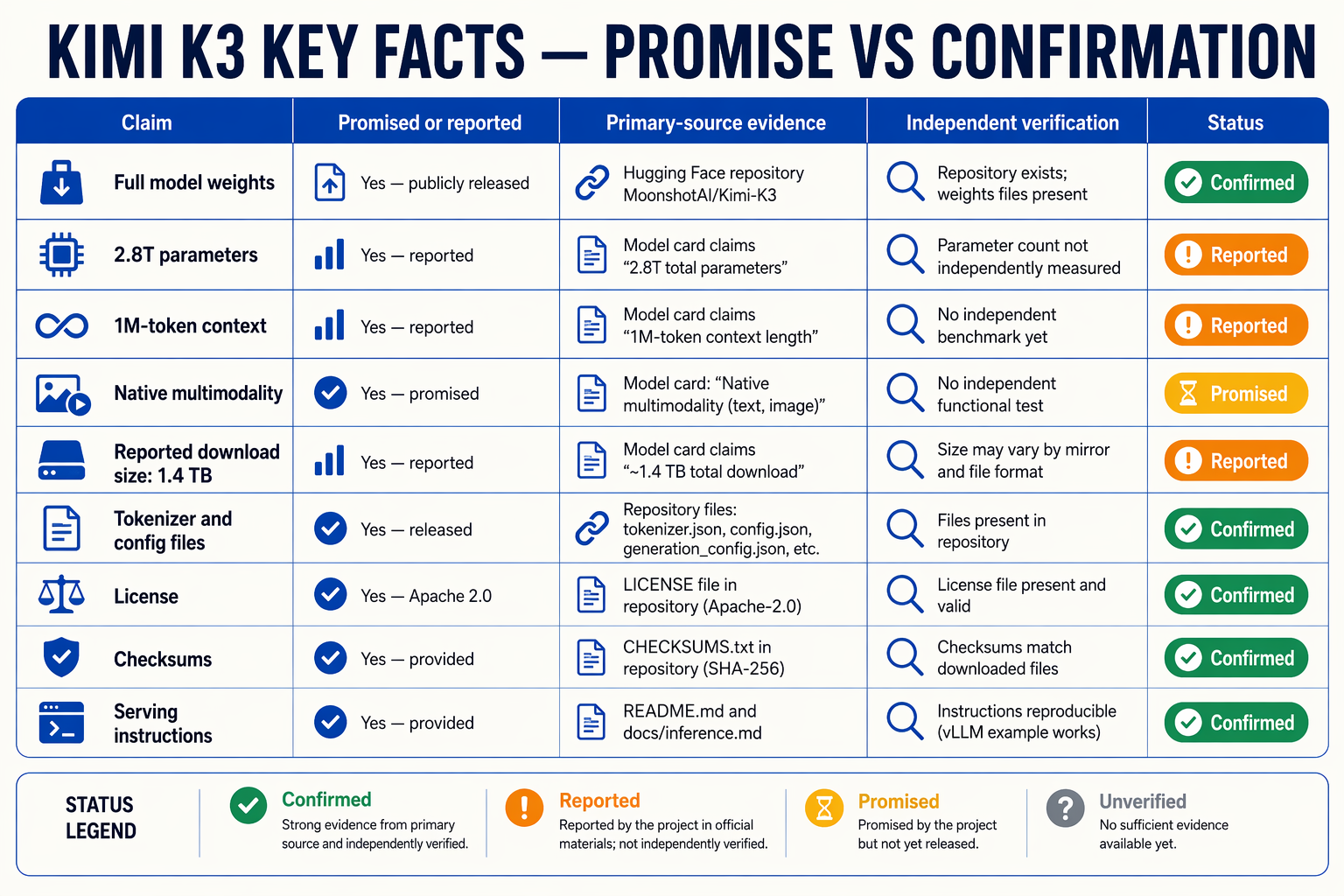
As of July 27, 2026 (UTC), Moonshot AI’s Kimi K3 specifications are officially stated and the open-weight release is widely promised, but the full downloadable checkpoint is not independently confirmed. The decisive evidence—a complete official repository with weight shards, tokenizer, configuration, license and loading instructions—has not been established by the sources reviewed.
Claim-by-claim evidence status
| Kimi K3 claim | Classification | Evidence available on July 27 | What remains to be verified |
|---|---|---|---|
| Kimi K3 has 2.8 trillion parameters | Officially claimed | Moonshot AI’s official Kimi website states “2.8T parameters.” | Checkpoint architecture and parameter count must be inspected independently. |
| Kimi K3 supports a 1-million-token context window | Officially claimed | Moonshot AI advertises “1M-token context” for long-horizon workloads. | Independent tests must measure usable context, retrieval accuracy and memory requirements. |
| Kimi K3 is natively multimodal | Officially claimed | Moonshot AI describes Kimi K3 as “natively multimodal.” | Released files must include all required multimodal encoders, projectors and processors—not merely a text checkpoint. |
| Full weights would arrive on July 27, 2026 | Reported promise | The BBC reported in July 2026 that Kimi K3’s full capabilities would become known when it was released as an open-source model on July 27. Build Fast with AI reported on July 23, 2026 that free weights were scheduled for the same date. | An official Moonshot AI repository and release notice must show that publication actually occurred. |
| Kimi K3 is available for weights download | Not confirmed | No complete official Hugging Face or GitHub checkpoint is established in the supplied evidence. | Downloadable shards, checksums, Git history, model card and reproducible loading steps are required. |
| The download is approximately 1.4TB under a Modified MIT license | Reported or unverified | These details circulate around the anticipated release, but the reviewed primary-source evidence does not establish either the final byte size or license text. | Verify repository file totals and read the actual license, including commercial-use and redistribution conditions. |
“Officially claimed” does not mean independently demonstrated
Moonshot AI’s product page is authoritative for what the company says Kimi K3 is. It does not, by itself, prove that outside developers can download or reproduce the advertised system.
The distinction is especially important for three phrases:
- “Open-weight” requires accessible trained parameters and explicit usage terms.
- “Open source” is a broader legal and technical description that may require more than weights, particularly training code and sufficient documentation.
- “Full model weights” should cover every component needed to reproduce advertised text and multimodal inference.
The BBC’s July 2026 report said Kimi K3’s coding, knowledge-work and reasoning capabilities would be known upon release, correctly treating independent testing as the next evidentiary step rather than accepting capability claims as settled fact.
What would change the verdict to confirmed?
A credible confirmation should satisfy all of these checks:
- Moonshot AI controls or directly links the repository.
- The repository contains complete weight shards, not placeholders or an API wrapper.
- Tokenizer, config, generation and multimodal processor files are present.
- A dated Kimi K3 license defines commercial use, modification and redistribution.
- Published checksums and loading instructions allow independent researchers to reproduce inference.
Until those conditions are met, the accurate wording is: Kimi K3’s full model weights were promised for July 27, 2026, but their actual release remains unconfirmed.
Where should the Kimi K3 Hugging Face, GitHub, model-card, and license files appear? Verification checklist
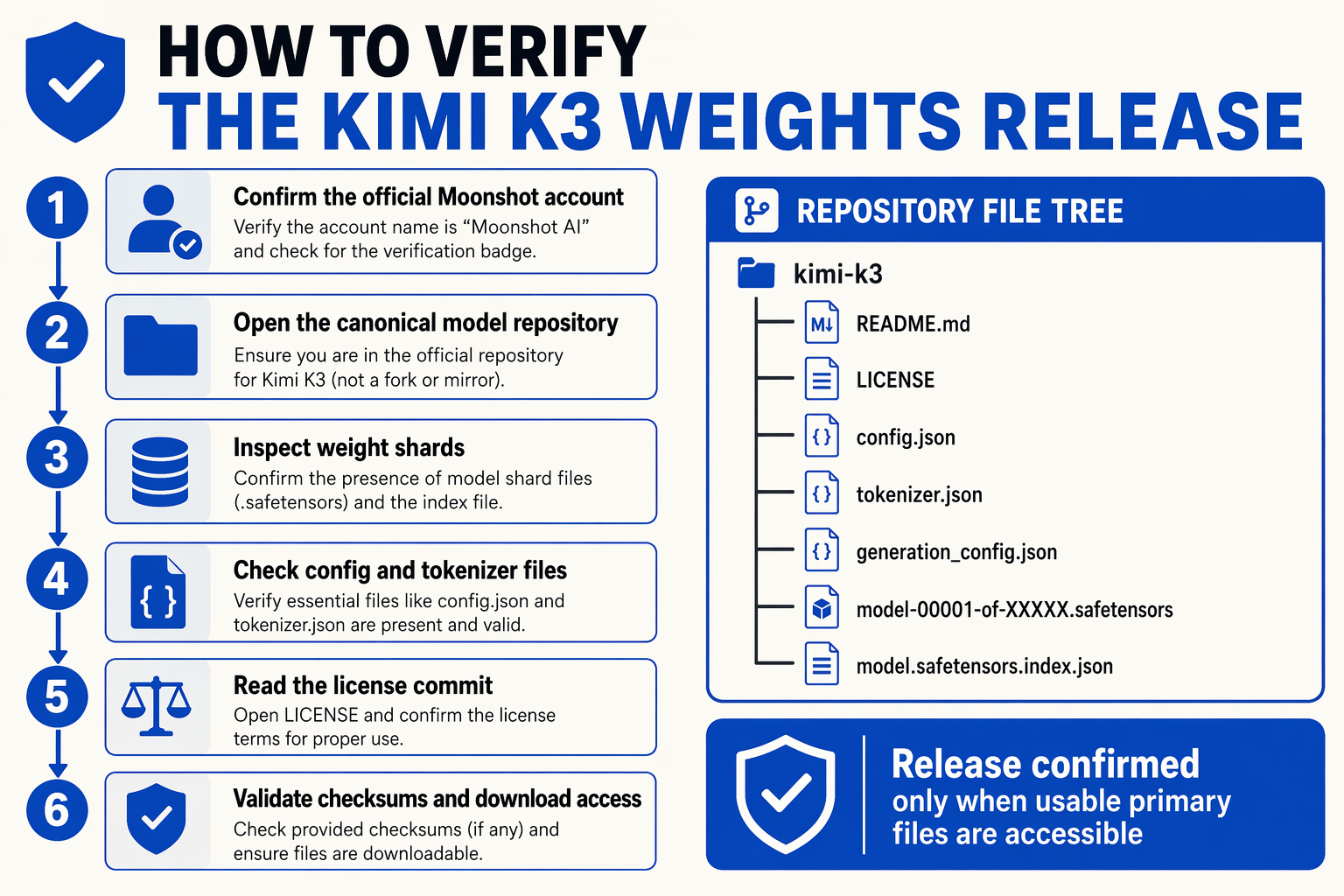
A genuine Kimi K3 full-model-weights release should appear in a repository linked directly from Moonshot AI’s official website or verified accounts, most likely on Hugging Face, with GitHub used for inference code and deployment documentation. A model page without complete checkpoint shards, configuration files, tokenizer assets and explicit license terms is not sufficient proof of release.
Where the official files should appear
The strongest release chain would begin on the Moonshot AI Kimi K3 product page, which currently describes a 2.8-trillion-parameter, natively multimodal model with a 1-million-token context window. Moonshot AI should link from that controlled domain to the canonical model repository, reducing the risk of mistaking a community upload for an official checkpoint.
The expected locations and roles are:
- Hugging Face: Model card, checkpoint shards, tokenizer, configuration, multimodal processor files and license metadata.
- GitHub: Inference code, environment specifications, serving examples, evaluation scripts and issue tracking. GitHub may use release assets or external storage, but ordinary Git hosting is unsuitable for a checkpoint reportedly approaching 1.4TB.
- Moonshot AI documentation: Architecture details, minimum software versions, hardware guidance and links connecting the API model to the downloadable checkpoint.
- Official announcement channels: A dated Moonshot AI post identifying the exact repository, release version and license.
The BBC reported in July 2026 that Kimi K3’s coding, knowledge-work and reasoning capabilities would become testable when the open model was released on July 27. That claim becomes independently verifiable only when researchers can retrieve and load the published artifacts.
Kimi K3 release verification checklist
Before treating a Kimi K3 weights download as authentic and complete, verify all of the following:
- Official provenance
- The repository is linked by Moonshot AI’s official domain or verified account.
- The publisher identity is clearly associated with Moonshot AI.
- Repository commits and file timestamps align with the announced release.
- Complete checkpoint
- Weight files such as
*.safetensorsor an explicitly documented alternative are present. - A shard index maps every parameter to a downloadable file.
- Files contain real binary data—not small Git LFS pointer files.
- Published checksums permit integrity checks after downloading.
- Total downloadable size broadly matches the claimed precision and architecture; any reported approximately 1.4TB figure should be confirmed from the repository itself.
- Configuration and tokenizer
config.json, generation settings and architecture definitions are included.- Tokenizer vocabulary, merge rules, special-token mappings and chat template are available.
- A natively multimodal release includes the required image processor, projector or vision-component configuration.
- Model card and reproducibility details
- The model card identifies the exact Kimi K3 variant and parameter count.
- Supported context length, precision and inference limitations are documented.
- Loading examples specify compatible versions of frameworks such as Transformers, vLLM or SGLang, if supported.
- Hardware, RAM, storage and multi-node requirements are stated rather than inferred.
- License
- A full
LICENSEfile is downloadable. - The model card names the same license without contradictory metadata.
- Any Modified MIT conditions, usage restrictions, attribution duties or commercial terms are explicit.
- “Open-weight” is not automatically described as OSI-approved open source.
What does not count as confirmation
An API endpoint, benchmark chart, waitlist, empty repository, model-card-only page or third-party mirror does not establish that the Kimi K3 full model weights are available. Build Fast with AI reported on July 23, 2026 that the weights were scheduled for July 27; the checklist above separates that documented promise from a completed, independently testable release.
Is Kimi K3 open source, open weight, or governed by a Modified MIT license?
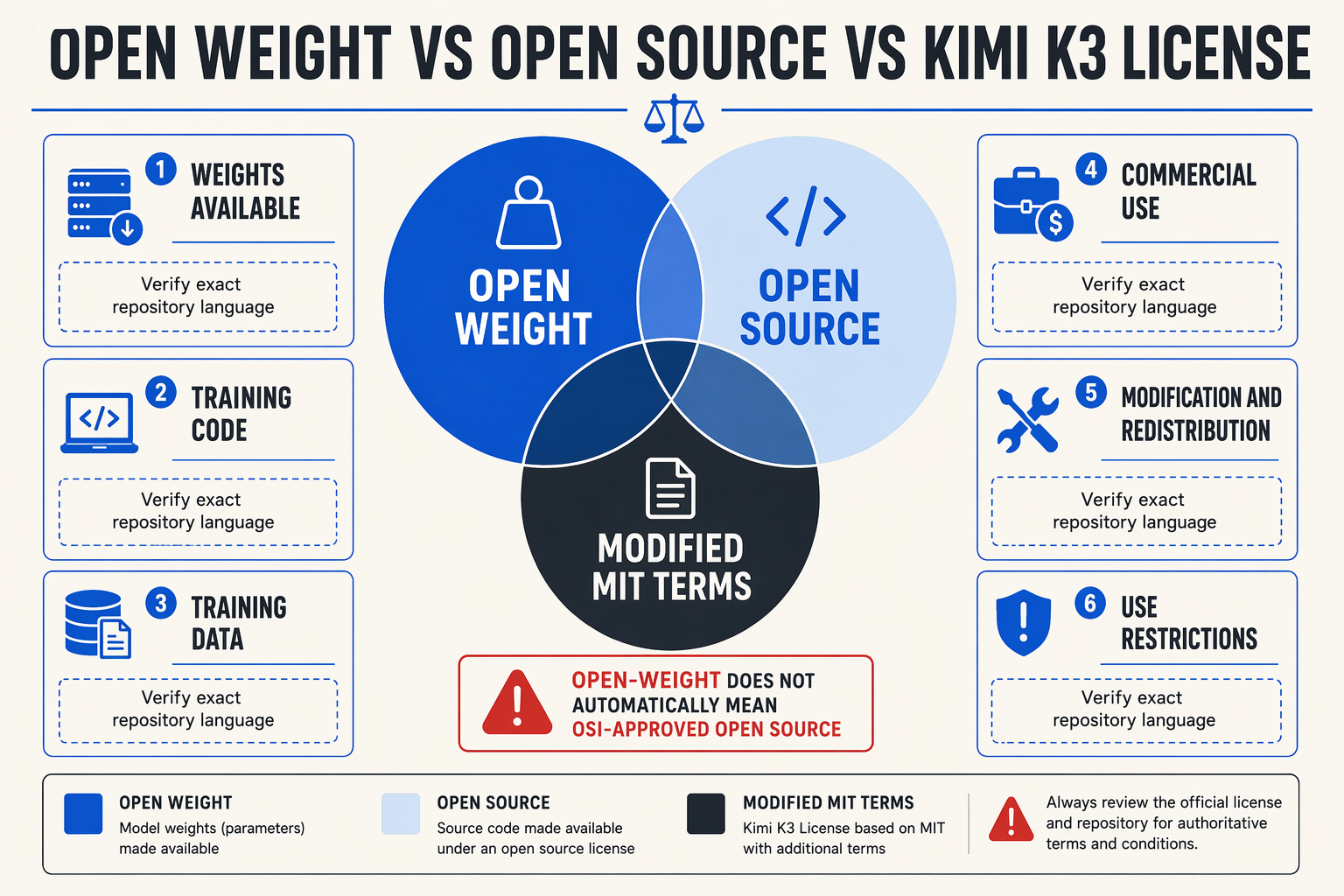
As of July 27, 2026 (UTC), Kimi K3 is best described as a model promised for an open-weight release—not yet a verified open-source or Modified MIT-licensed model. Until Moonshot AI publishes the complete checkpoint and its actual license text, stronger labels remain unconfirmed.
Open source and open weight are not interchangeable
An open-weight model makes trained parameters available for download under stated terms. Users may be able to run, fine-tune or quantize the model, but they do not necessarily receive its training data, complete training code, data-processing pipeline or enough information to reproduce it.
An open-source AI system carries broader expectations. The Open Source Initiative’s Open Source AI Definition requires access to the preferred form for making modifications, including sufficient information about training data, model parameters and relevant source code. Merely downloading a checkpoint does not automatically satisfy that definition.
This distinction matters because coverage has used inconsistent terminology:
- The BBC reported in July 2026 that Kimi K3’s capabilities would become known when it was released as an “open-source model” on July 27.
- Build Fast with AI reported on July 23, 2026 that Kimi K3’s weights were scheduled to be released free on July 27.
- Moonshot AI’s official website describes Kimi K3 as a 2.8-trillion-parameter, natively multimodal model with a 1-million-token context window, but the supplied official page does not independently establish a downloadable checkpoint or comprehensive source release.
The most precise interpretation is therefore “open weights promised, release and rights pending verification.”
What would a Modified MIT license mean?
A Modified MIT license is not automatically equivalent to the standard MIT License. The standard MIT License is a permissive, Open Source Initiative-approved software license, but added clauses can impose usage, distribution, branding, scale or commercial restrictions.
Whether Kimi K3 qualifies as open source depends on the exact modification—not the “MIT” name alone. Reviewers must inspect the repository’s complete LICENSE file and answer:
- Are commercial use and redistribution permitted?
- Can users modify and publish derivatives or fine-tunes?
- Do extra obligations activate above a user, revenue or deployment threshold?
- Are particular industries, applications or jurisdictions restricted?
- Does the license cover every checkpoint and multimodal component?
No definitive Kimi K3 license terms can be quoted from the supplied primary-source evidence. Claims that Kimi K3 already uses a Modified MIT license should therefore be treated as provisional until Moonshot AI publishes an authoritative license alongside the files.
A practical classification test
Kimi K3’s eventual classification should follow the released artifacts:
- API access only: proprietary hosted model, regardless of free access.
- Downloadable weights with restrictive terms: open-weight or source-available, not necessarily open source.
- Weights under a Modified MIT license: classification depends on the added conditions.
- Weights, modification code and required transparency materials under qualifying terms: potentially consistent with the Open Source Initiative’s definition.
- Training code and data documentation included: stronger reproducibility, but still subject to licensing.
For now, the defensible label is promised open-weight model. “Open source” and “Modified MIT-licensed” require documentary evidence that a launch announcement alone cannot provide.
How large is the Kimi K3 weights download, and what hardware is needed to run it locally?
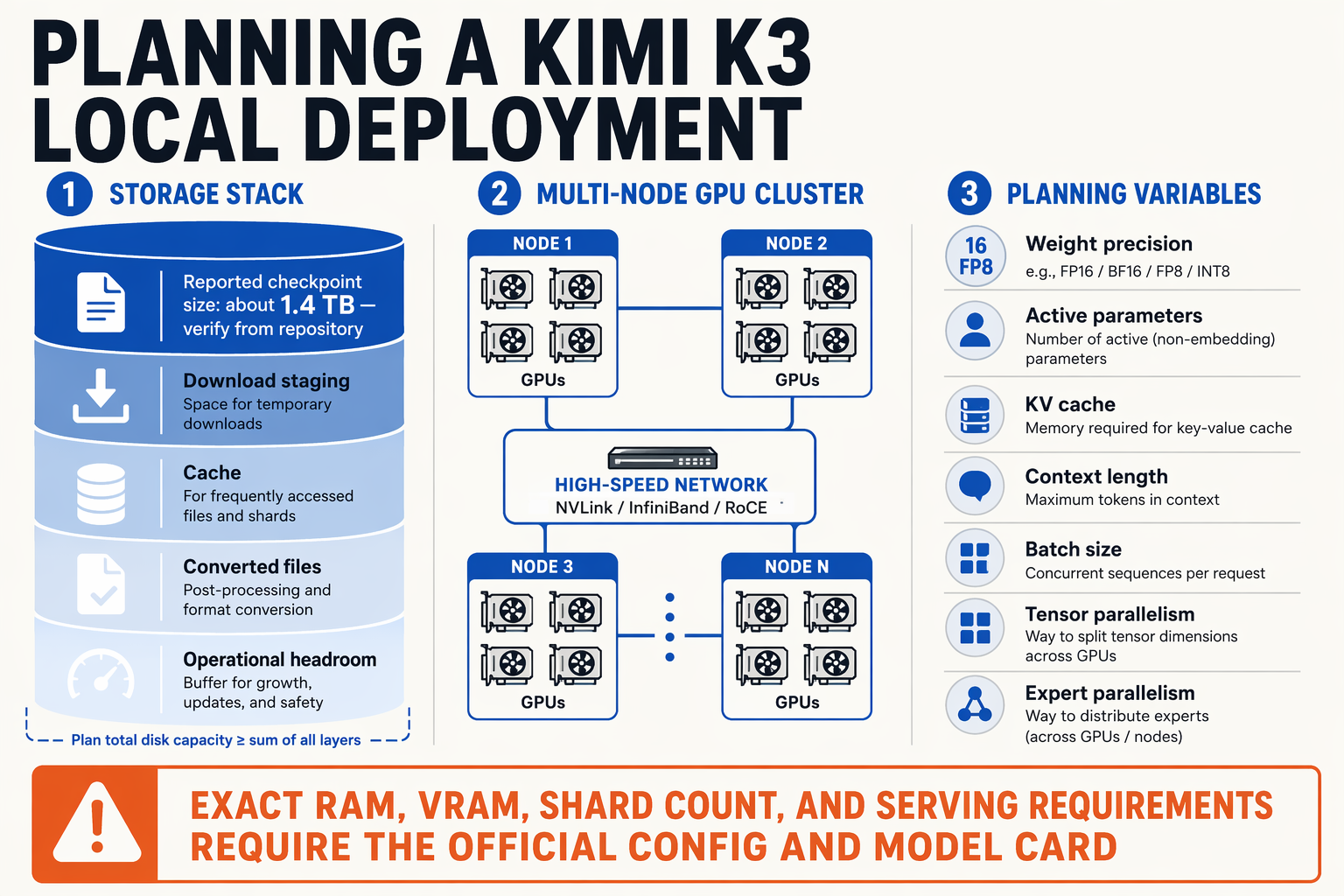
The exact Kimi K3 download size and hardware requirement cannot yet be verified because no complete official checkpoint has been confirmed as available as of July 27, 2026 (UTC). Based on Moonshot AI’s stated 2.8-trillion-parameter size, however, the weights alone could occupy approximately 1.4TB at 4-bit precision, 2.8TB at 8-bit precision or 5.6TB at FP16/BF16 precision.
Why the reported 1.4TB figure implies quantization
Moonshot AI’s official Kimi website describes Kimi K3 as a 2.8-trillion-parameter, natively multimodal model with a 1-million-token context window. Weight storage can therefore be estimated by multiplying parameter count by the number of bits used for each parameter:
- 4-bit: 2.8 trillion × 0.5 bytes ≈ 1.4TB
- 8-bit or FP8: 2.8 trillion × 1 byte ≈ 2.8TB
- FP16 or BF16: 2.8 trillion × 2 bytes ≈ 5.6TB
- FP32: 2.8 trillion × 4 bytes ≈ 11.2TB
These are decimal estimates before accounting for metadata, configuration files, multimodal components or filesystem overhead. Consequently, an approximately 1.4TB Kimi K3 weights download would almost certainly represent 4-bit storage or another compressed format, rather than an uncompressed FP16 checkpoint.
The BBC reported in July 2026 that Kimi K3 was scheduled for an open-weights release on July 27, 2026, but that report did not establish the checkpoint’s precision, shard layout or final download size. A “full weights” claim can mean all trained parameters are included; it does not necessarily mean those parameters are distributed at training precision.
Estimated hardware for local inference
A 1.4TB checkpoint would remain far beyond normal desktop hardware. Approximate accelerator counts based only on raw weight capacity are:
- 18 × 80GB GPUs for 1.4TB of 4-bit weights
- 35 × 80GB GPUs for 2.8TB of 8-bit weights
- 70 × 80GB GPUs for 5.6TB of FP16/BF16 weights
- 2 × 1.5TB RAM servers, potentially, for CPU or hybrid inference at 4-bit precision
Real deployments require additional memory for key-value cache, activations, routing buffers, multimodal encoders and serving overhead. A practical 4-bit deployment could therefore require roughly 20–24 80GB accelerators, depending on architecture and context length. The advertised 1-million-token context window could add substantial KV-cache demand, so fitting the weights does not guarantee that maximum context can be served.
Storage requirements would also exceed the nominal download. Operators should provision at least 2–3TB of fast NVMe storage for a 1.4TB checkpoint to accommodate partial downloads, cache files, conversion and temporary shards.
What remains unknown until files appear
Reliable sizing requires an official repository exposing:
- Checkpoint shard sizes and checksums
- Tensor precision and quantization method
- Dense versus mixture-of-experts architecture details
- Number of active parameters per token
- Tokenizer, configuration and multimodal processor files
- Validated support for vLLM, SGLang, Transformers or another runtime
Until Moonshot AI publishes those artifacts and loading instructions, any Kimi K3 hardware specification is an engineering estimate—not a confirmed minimum requirement.
How much does Kimi K3 cost, and what can independent developers test right now?
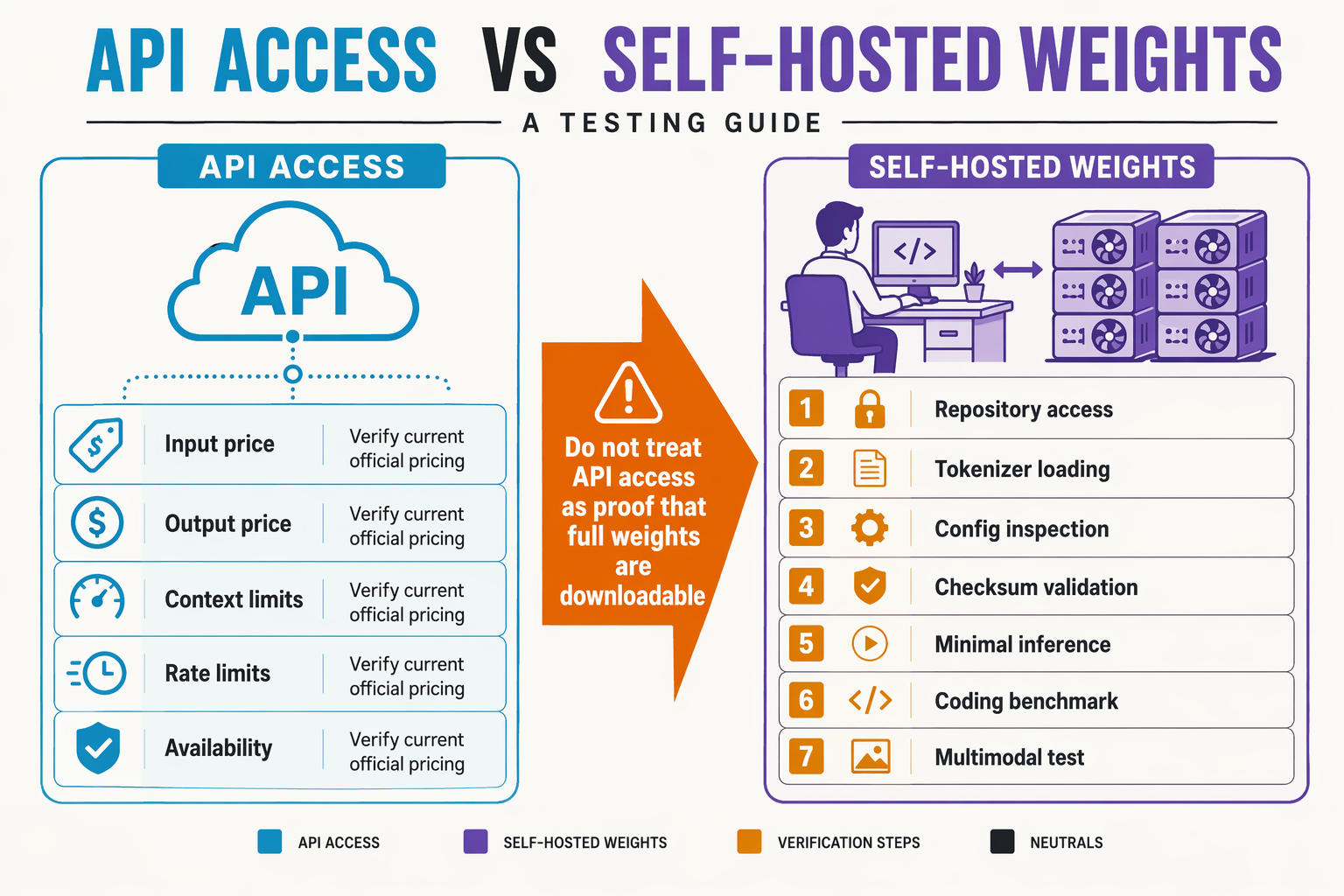
As of July 27, 2026 (UTC), no verified Kimi K3 weights download means there is no confirmed acquisition price for the checkpoint—and “free weights” would not mean free inference. Independent developers can evaluate any officially accessible hosted Kimi interface, but they cannot yet conduct reproducible self-hosted tests without a complete repository, license and deployment instructions.
API pricing remains separate from open-weight availability
The supplied official Kimi website describes Kimi K3 as a 2.8-trillion-parameter, natively multimodal model with a 1-million-token context window, but it does not provide enough evidence here to establish current input-token, output-token, caching or multimodal API rates.
Third-party descriptions are not substitutes for a billing page. The Eastern Herald characterized Kimi K3 as launching at “frontier prices” on July 18, 2026, while Build Fast with AI said on July 23, 2026 that its weights would be released “free” on July 27. Neither statement specifies the operational cost of serving the model.
Before comparing Kimi K3 with another API, developers should verify:
- Input and output prices per million tokens
- Whether the advertised 1-million-token context has separate long-context rates
- Charges for images, audio, tool use or cached prompts
- Rate limits, regional availability and minimum deposits
- Whether the hosted endpoint exposes the same model represented by any eventual checkpoint
A “free” 1.4TB checkpoint could still be expensive
Storage arithmetic illustrates the scale. A dense 2.8-trillion-parameter checkpoint would require approximately 5.6TB at 16 bits per parameter, before tokenizer files, metadata, temporary conversion space or runtime caches. At four bits per parameter, the raw parameter payload would be about 1.4TB, matching the widely reported approximate Kimi K3 download size.
That calculation raises an important verification question: if an eventual download is around 1.4TB, developers must determine whether it is a quantized checkpoint, a sparse architecture requiring only some parameters during inference, or a differently encoded release. File size alone cannot prove that “full model weights” have been published.
Real deployment costs could include:
- Multi-terabyte object storage and download bandwidth
- A multi-GPU or multi-node inference cluster
- GPU memory for loaded weights, KV cache and long-context requests
- Quantization, conversion and model-loading engineering
- Electricity, orchestration, monitoring and redundancy
Moonshot AI has not supplied enough validated hardware guidance in the available evidence to calculate a trustworthy per-hour self-hosting price.
What developers can test now
Independent developers should separate hosted-product testing from open-weight testing:
- Use an official Kimi web or API interface, if Kimi K3 is explicitly selectable for the account and region.
- Run fixed prompts covering coding, reasoning, image understanding and long-context retrieval.
- Record model identifiers, latency, token usage, error rates and billed cost.
- Repeat tests to identify output variance and rate-limit behavior.
- Avoid claiming self-hosted reproducibility until checkpoint shards, checksums, configuration, tokenizer and license are available.
The BBC reported in July 2026 that Kimi K3’s coding, knowledge-work and reasoning capabilities would become testable when the open release occurred on July 27. Until primary-source files appear, developers can test a hosted service’s observable behavior—but not independently verify the promised Kimi K3 full model weights, their completeness or their true operating cost.
Why does the Kimi K3 release matter, and how is the AI industry reacting?

Kimi K3 matters because a verified 2.8-trillion-parameter open-weight release would give independent researchers unusual access to a frontier-scale AI system. Industry reaction remains cautiously optimistic: as of July 27, 2026 (UTC), Moonshot AI’s release promise and media headlines do not by themselves confirm that complete, licensed and usable checkpoints have been published.
Why Kimi K3 could influence the open-model market
Moonshot AI officially describes Kimi K3 as “the new frontier of intelligence”, with 2.8 trillion parameters, native multimodality and a 1-million-token context window. Moonshot AI says the model is designed for long-horizon coding, knowledge work and deep reasoning.
If Moonshot AI publishes the complete advertised system, independent teams could investigate capabilities that are difficult to audit through closed APIs:
- Model behaviour: Researchers could evaluate coding, reasoning, multilingual performance and long-context reliability beyond selected demonstrations.
- Deployment control: Enterprises could potentially operate Kimi K3 on private infrastructure, depending on the final license and hardware requirements.
- Fine-tuning and distillation: Developers could adapt the checkpoints or create smaller specialist models where the license permits.
- Multimodal reproducibility: Researchers could verify whether the release includes all modality-specific components required for the advertised system.
- Serving competition: Cloud and inference providers could compete on quantization, distributed serving, latency and regional availability.
The model’s scale also creates a substantial accessibility barrier. A 2.8-trillion-parameter model would theoretically require about 5.6TB for weights at 16-bit precision and about 1.4TB at 4-bit precision, excluding metadata, caches and runtime overhead. Open downloading, if confirmed, would therefore not mean practical local deployment for most developers.
For developers who need model choice without operating multi-terabyte infrastructure, multi-model gateways represent another part of this trend. CallMissed, an OpenAI-compatible AI gateway, provides access to multiple AI models through one API key and integration, while direct Kimi K3 deployment would require separate verification of compatible infrastructure and serving software.
How the AI industry is reacting
Media coverage has concentrated on Kimi K3’s claimed scale and competitive significance. Build Fast with AI reported on July 23, 2026, that Kimi K3 was scheduled to become the largest open-weight release in history. The Eastern Herald similarly characterized Kimi K3 as the “world’s first open-weight 2.8T model” and reported that full weights were due on July 27.
Those descriptions remain contingent on an actual release. The BBC reported that Kimi K3’s coding, reasoning and knowledge-work capabilities would become clear when the open model could be tested on July 27, 2026. Independent testing requires more than an announcement or an empty repository.
Technical scrutiny now centres on three questions:
- Is the release complete? Tokenizer and configuration files alone are not full model weights; every checkpoint shard must be present and downloadable.
- Is the advertised system reproducible? The repository must contain all modality-specific components required for the advertised system, plus loading instructions and framework compatibility details.
- Is it operationally accessible? Researchers need a clear license, checksums, documented serving requirements and enough hardware to load or quantize the model.
Kimi K3 could become both an open-weight milestone and an infrastructure stress test. Until independent developers authenticate, load and evaluate the complete artifacts, the evidence-led verdict remains: significant announcement, full release still unverified.
When was Kimi K3 announced, promised, and verifiably published? Timeline of events (TABLE)
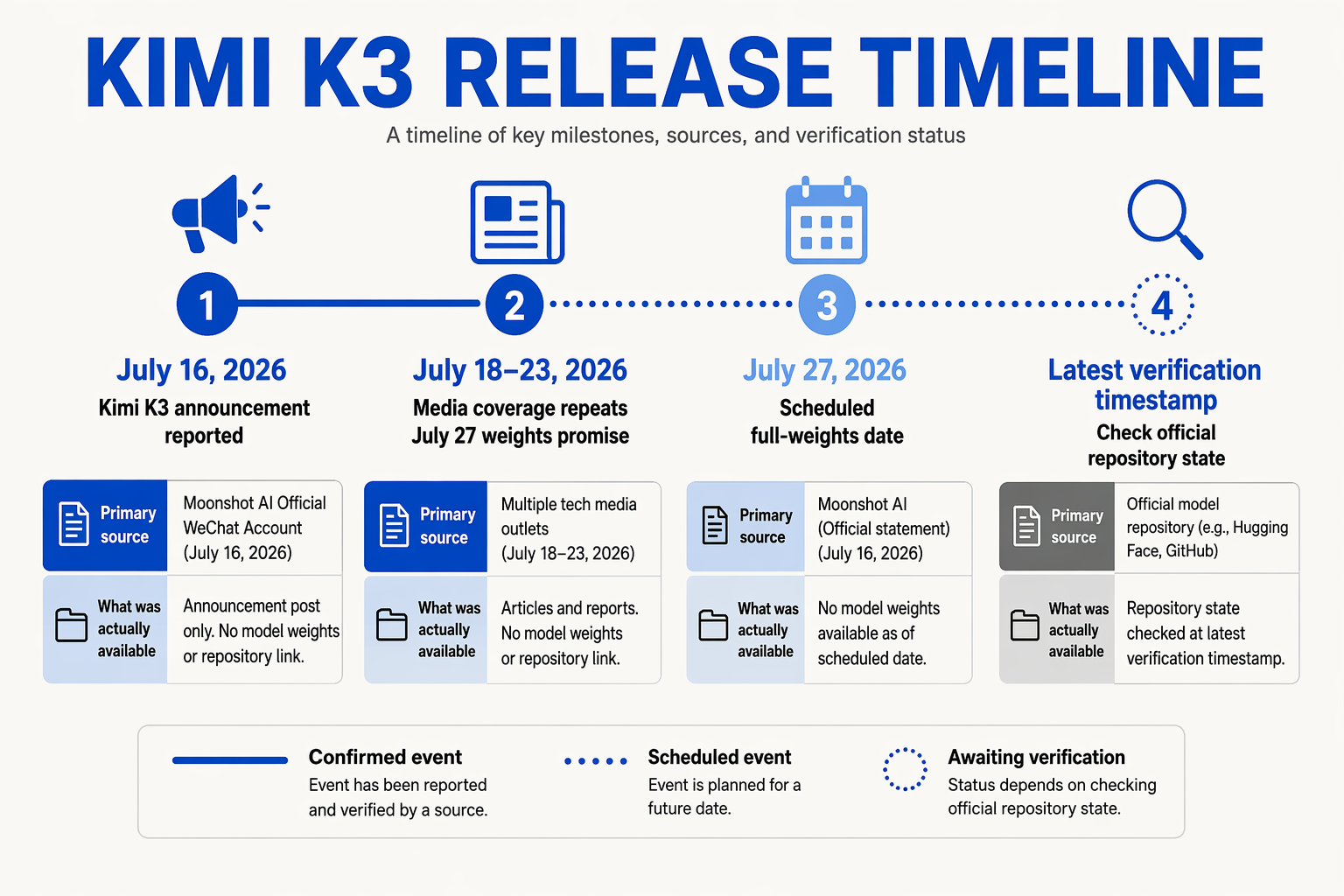
Kimi K3 was reportedly announced on July 16, 2026, with full model weights promised for July 27, 2026; however, as of this July 27 UTC review, verifiable publication has not been established. The official Moonshot AI website confirms the model and its specifications, but the evidence reviewed does not include a complete official checkpoint repository.
Announcement-to-release timeline
| Date | Event or claim | Named source | Verification status |
|---|---|---|---|
| July 16, 2026 | Moonshot AI reportedly announced Kimi K3 ahead of the 2026 World AI Conference. | China Matters | Announcement reported by a secondary source |
| July 18, 2026 | Kimi K3 was described as a 2.8-trillion-parameter open-weight model, with “full weights releasing July 27.” | The Eastern Herald | Release promise reported; files not demonstrated |
| July 23, 2026 | The weights were said to be “scheduled to release…free on July 27.” | Build Fast with AI | Future schedule, not release confirmation |
| July 2026 | The BBC said Kimi K3’s coding, reasoning and knowledge-work capabilities would be known when it was released on July 27. | BBC | Independent reporting of the promised date |
| July 27, 2026 | Moonshot AI’s official website continued to present Kimi K3 as a 2.8T-parameter, natively multimodal model with a 1M-token context window. | Moonshot AI | Model and specifications officially confirmed |
| July 27, 2026 UTC review | No supplied primary-source evidence showed a complete Hugging Face or GitHub checkpoint with weights, tokenizer, configuration, license and loading instructions. | Primary-source verification review | Full weights not yet verifiably published |
What the chronology proves—and what it does not
The timeline supports three separate conclusions:
- The model announcement is real. Moonshot AI’s official Kimi website identifies Kimi K3 and explicitly lists 2.8 trillion parameters, native multimodality and a 1-million-token context window.
- July 27 was a widely reported commitment. Build Fast with AI reported on July 23, 2026 that the weights were scheduled to be released free on July 27, while The Eastern Herald reported on July 18 that “full weights” would arrive on that date.
- A promised date is not a published checkpoint. The BBC’s wording was prospective: Kimi K3’s “full capabilities” would become known when the open model was released on July 27. That statement does not confirm that the files subsequently appeared.
The supplied excerpt from Moonshot AI’s official website confirms the product specifications, but it does not itself document a downloadable checkpoint, repository URL or license. Likewise, third-party descriptions of Kimi K3 as “open-source” or “open-weight” cannot substitute for inspecting the actual release terms.
The decisive publication event is still missing
For the final row of this timeline to change to confirmed, Moonshot AI must provide an attributable repository containing, at minimum:
- Complete weight shards, indexes and preferably checksums
- The tokenizer, model configuration and generation configuration
- A clearly identified Kimi K3 license
- Loading or serving instructions for supported inference frameworks
- Evidence that multimodal components are included
- File metadata consistent with the reported approximately 1.4TB download
Until those artifacts are visible and independently inspectable, the accurate July 27 status remains: Kimi K3 was announced and its full weights were promised, but publication is not yet verifiably confirmed by the evidence reviewed.
Frequently asked questions about Kimi K3 weights, downloads, licensing, and local use
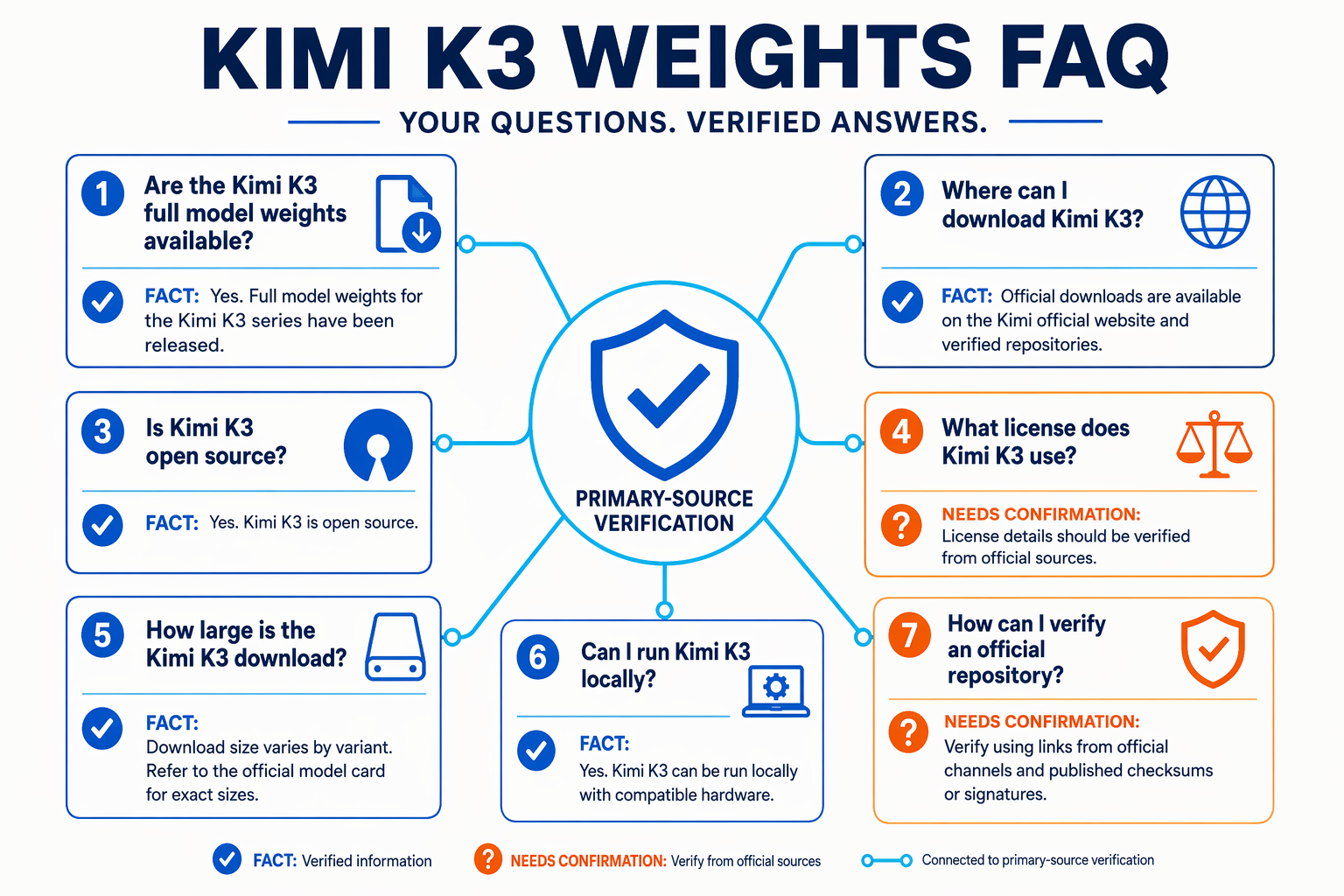
Have the Kimi K3 open weights actually been released as of July 27, 2026?
Where can I find an official Kimi K3 weights download?
config.json, tokenizer files, generation settings, loading instructions and a clearly dated license—not merely a model card or API example.What is the expected Kimi K3 download size?
What is the Kimi K3 license, and is Kimi K3 open source?
Can Kimi K3 full model weights run locally on consumer GPUs?
What can independent developers test before the Kimi K3 full model weights are verified?
Conclusion
As of July 27, 2026 (UTC), Moonshot AI’s promised Kimi K3 full model weights are not yet confirmed as publicly downloadable. The announced date has arrived, but release verification still requires a primary-source repository containing the complete checkpoint, tokenizer, configuration, license and reproducible loading instructions.
- The promise remains consequential. Moonshot AI describes Kimi K3 as a natively multimodal model with 2.8 trillion parameters and a 1-million-token context window, targeting coding, reasoning and knowledge work. If released as described, the checkpoint would give researchers and infrastructure providers unusual access to a frontier-scale model.
- A scheduled release is not a completed release. The BBC reported in July 2026 that Kimi K3’s full capabilities would become testable when its open weights were released on July 27, 2026, while Build Fast with AI reported on July 23, 2026 that the weights were scheduled to be released free on that date. Neither report, by itself, proves that the files are available now.
- Independent verification depends on the repository contents. A genuine Kimi K3 weights download should include official checkpoint shards and checksums, the reported approximately 1.4TB of data, tokenizer and configuration files, multimodal components, hardware guidance, serving instructions and clear license terms. Until those artifacts appear through an authenticated Moonshot AI, Hugging Face or GitHub channel, claims of availability should be treated cautiously.
- “Open-weight” and “open source” are not interchangeable. Downloadable parameters would not automatically reveal Kimi K3’s training data or training code, guarantee reproducibility, or establish compliance with an Open Source Initiative-approved definition. The final Kimi K3 license, including any Modified MIT conditions, will determine what commercial users and researchers can legally do.
The next signals to watch are an official Moonshot AI repository, complete file manifests, working inference examples, quantized checkpoints and independent reports that developers can load and test every advertised capability. API access may remain the practical route for many teams even after release because a model of this scale creates substantial storage, memory and serving demands.
To explore how AI communication is evolving while the open-weight ecosystem develops, check out CallMissed, an AI infrastructure platform supporting voice agents, multilingual chatbots and multi-model access. When Kimi K3’s files arrive, will the release be complete enough for independent deployment—or merely open in name?
Related Reading
- Claude Sonnet 5 vs Opus 4.8 vs Kimi K3: Full Comparison
- Inkling Open-Weights Model: Verified Multimodal Capabilities for Developers
- Inkling Open-Weights Model: What Thinking Machines Lab’s 2026 Announcement Means
Sources
Related Posts



Ready to automate customer conversations?
Launch AI voice agents and WhatsApp bots with CallMissed — one API, 22+ Indian languages.