

GPT-4o Transcribe vs GPT-4o Mini Transcribe Accuracy Difference: What the Evidence Shows


Compare GPT-4o Transcribe and Mini Transcribe accuracy evidence, pricing verification, trade-offs, and a fair WER testing plan for your audio.
GPT-4o Transcribe vs GPT-4o Mini Transcribe Accuracy Difference: What the Evidence Shows
What if the biggest claim about the GPT-4o Transcribe vs GPT-4o Mini Transcribe accuracy difference has no verified number behind it? The available research found no public, controlled head-to-head benchmark—and no reliable percentage advantage—so neither model should be declared universally more accurate without testing representative audio.
That uncertainty matters because transcription quality can change sharply across accents, background noise, overlapping speakers, domain vocabulary, and languages. CallMissed, for example, supports speech-to-text across 22 Indian languages, illustrating why broad model claims may not predict performance for every audience.
This comparison separates documented capabilities from inference, explains how to calculate word error rate (WER), and provides a reproducible test plan using substitutions, deletions, insertions, timestamps, and punctuation. It also compares pricing and practical trade-offs, helping teams decide when a lower-cost model may be worth validating—and when transcription errors are too costly to risk.
Is GPT-4o Transcribe more accurate than GPT-4o Mini Transcribe?
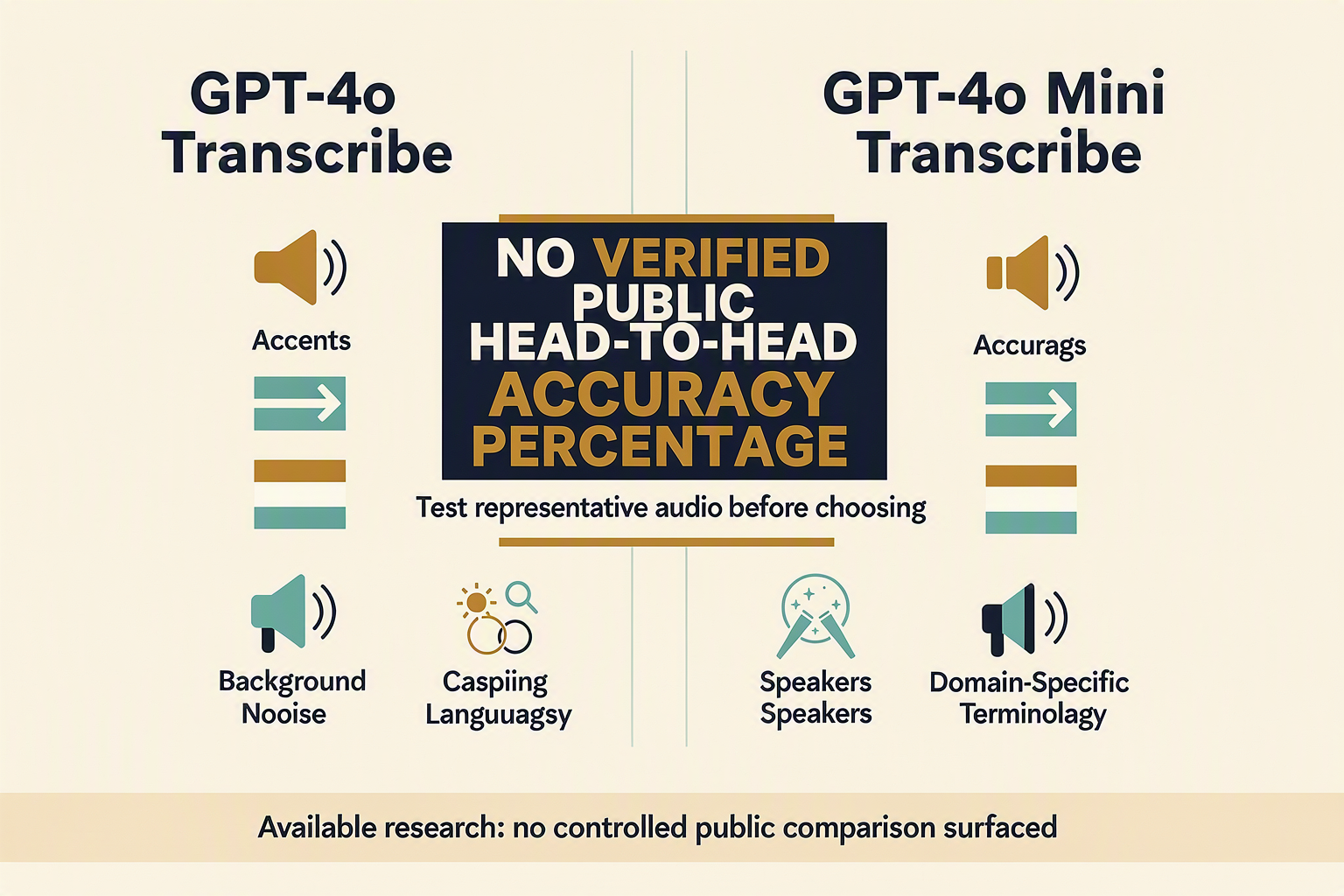
No verified public, controlled benchmark establishes a percentage accuracy advantage for GPT-4o Transcribe over GPT-4o Mini Transcribe. The practical difference must be measured on your languages, accents, noise conditions, speaker patterns, and domain vocabulary.
Evidence-based verdict
- GPT-4o Transcribe: May be the safer hypothesis for accuracy-sensitive workloads, but the research brief found no public WER result proving it is universally more accurate.
- GPT-4o Mini Transcribe: May be attractive for high-volume or cost-sensitive transcription, but lower cost must not be treated as evidence of lower accuracy without testing.
- Public evidence: The research surfaced no official or independent head-to-head benchmark, no public accuracy percentage, no SERP result, no People Also Ask result, and no related-search result quantifying the gap.
- What must be measured: Compare word error rate (WER), calculated as
(substitutions + deletions + insertions) / reference words × 100, on identical audio and reference transcripts. - Test coverage: Include clean speech, regional accents, background noise, music, far-field recordings, overlapping speakers, and specialist terminology; performance in one condition cannot establish a universal ranking.
- Decision hypothesis: Use GPT-4o Transcribe where a single missed term or deletion is costly, and evaluate GPT-4o Mini Transcribe for large workloads—but label either choice provisional until representative testing is complete.
- Practical implication: Teams serving multilingual audiences should test every important language separately; a model’s result in English does not establish its accuracy in other languages.
What accuracy benchmark proves the difference?
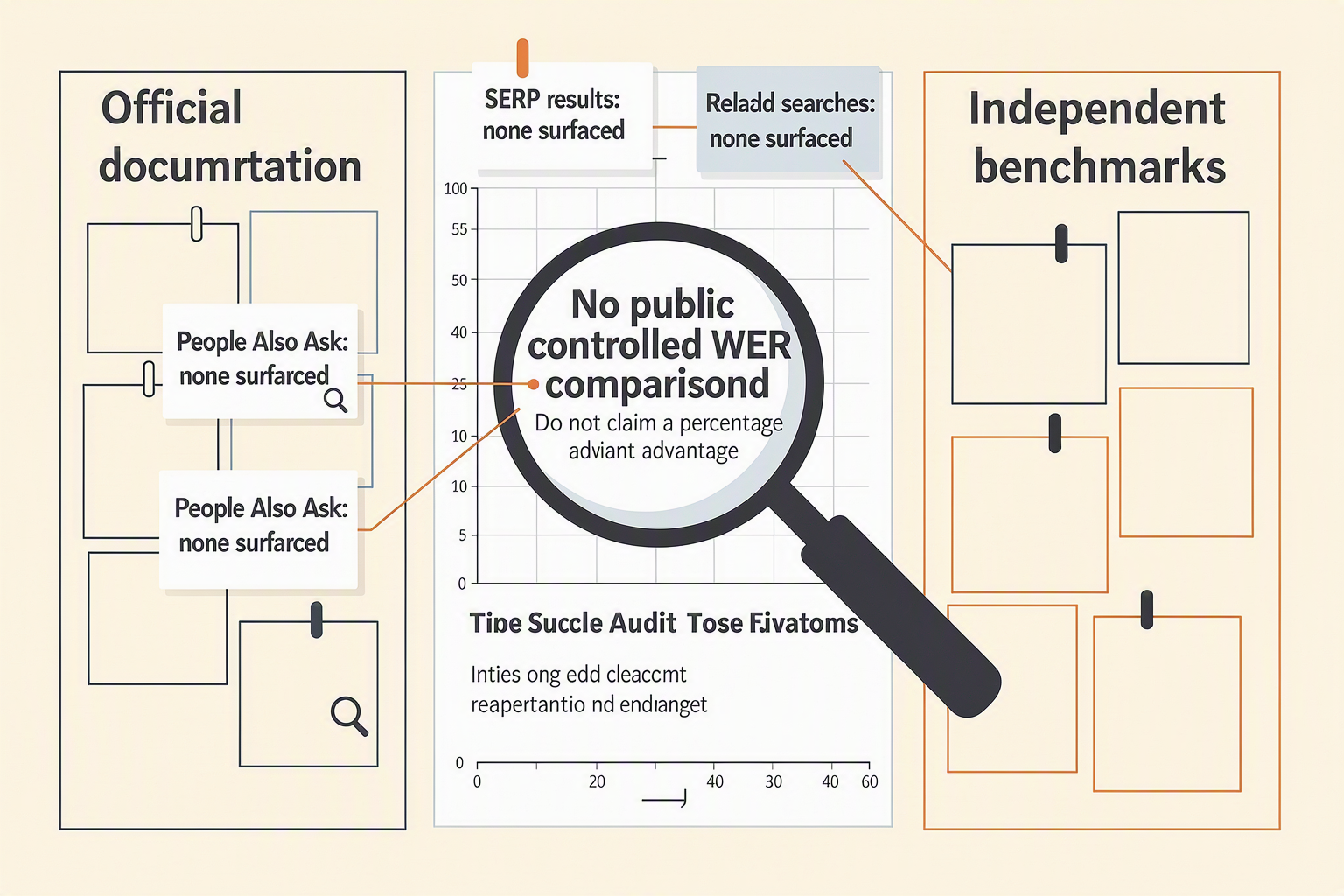
No public, controlled benchmark currently proves a specific accuracy difference between GPT-4o Transcribe and GPT-4o Mini Transcribe. The research brief found no verified WER percentage, official comparison, or independent head-to-head result that supports declaring one model universally more accurate.
- Public benchmark evidence: The research brief surfaced no official or independent benchmark quantifying the gap, and no relevant SERP, People Also Ask, or related-search result supplied a defensible accuracy percentage.
- What would prove the difference: Both models must transcribe the same audio set, against identical human-verified reference transcripts, covering the same languages, accents, noise levels, speaker overlap, and terminology.
- Primary metric: Word error rate (WER) is calculated as
(substitutions + deletions + insertions) / reference words × 100; lower WER indicates fewer word-level transcription errors. - Illustrative calculation: A 100-word reference containing 5 substitutions, 3 deletions, and 2 insertions produces a WER of 10%; this is a scoring example, not a GPT-4o model result.
- Required test slices: Report separate scores for clean speech, background noise, music, far-field microphones, overlapping speakers, regional accents, and specialist vocabulary rather than one blended average.
- Beyond WER: Track punctuation, capitalization, speaker labels, timestamps, and latency separately, because a lower WER does not automatically mean better meeting notes, call analytics, or searchable transcripts.
- Conditional interpretation: If GPT-4o Transcribe records lower WER on error-sensitive audio, its higher cost may be justified; if GPT-4o Mini Transcribe performs comparably, its lower-cost profile may suit high-volume workloads—but both conclusions require representative testing.
How do GPT-4o Transcribe and GPT-4o Mini Transcribe compare feature by feature?
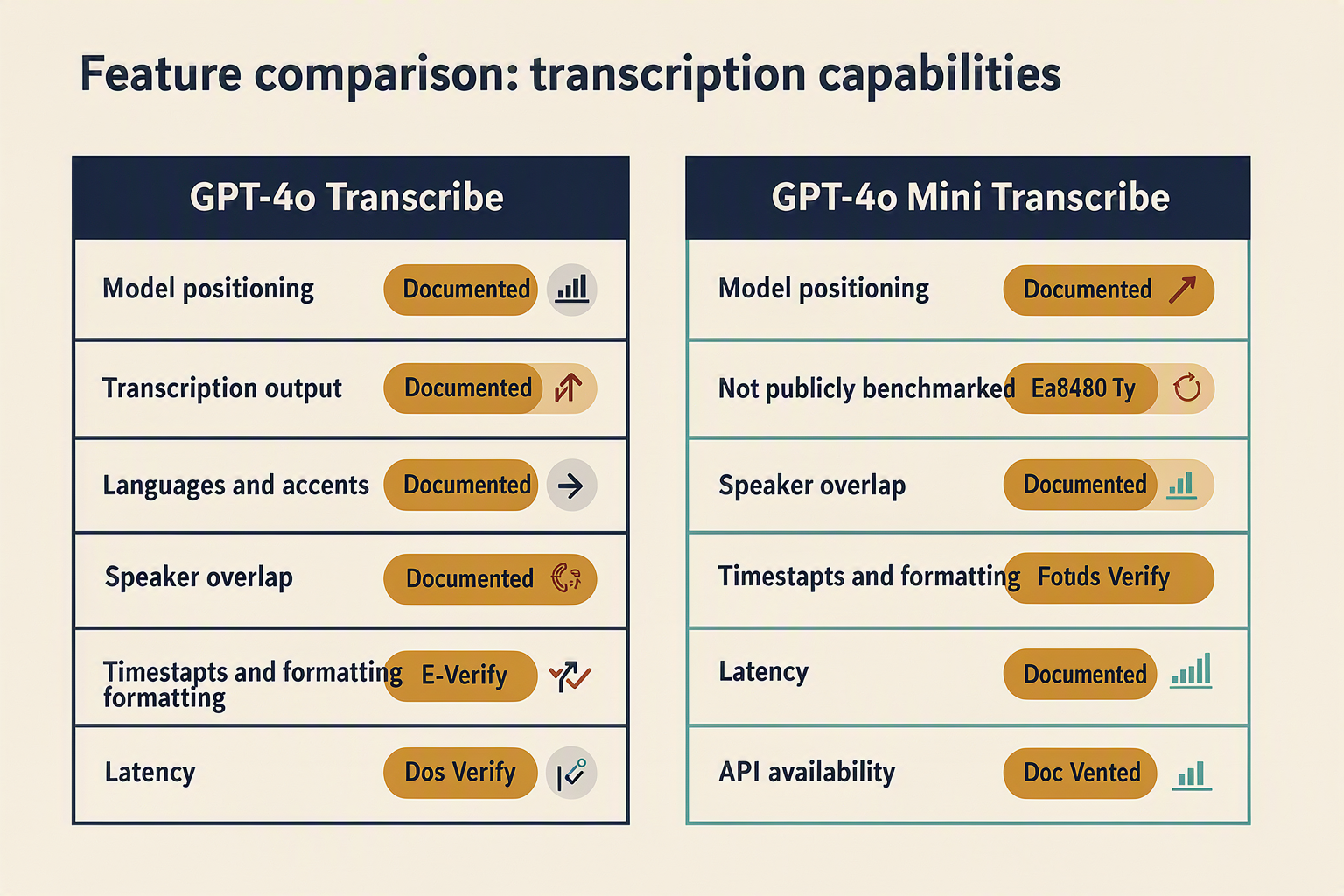
The documented product distinction is not the same as a proven accuracy ranking: available research found no public, controlled GPT-4o Transcribe versus GPT-4o Mini Transcribe benchmark. Treat language coverage, latency, overlap handling, and output behavior as test variables—not evidence of a universal winner.
Feature-by-feature comparison
| Feature | GPT-4o Transcribe | GPT-4o Mini Transcribe | Evidence status |
|---|---|---|---|
| Model positioning | Full-size transcription model | Smaller, cost-oriented transcription model | Positioning is documented; accuracy gap is not |
| Transcription output | Speech-to-text output for evaluation | Speech-to-text output for evaluation | Capability documented; no public head-to-head WER |
| Languages and accents | Test separately across target languages and accents | Test separately across target languages and accents | No reliable public percentage comparison found |
| Noise and speaker overlap | Evaluate background noise, music, far-field audio, and interruptions | Evaluate the same audio under identical conditions | No surfaced benchmark quantifies the difference |
| Timestamps and formatting | Verify timestamps, punctuation, casing, and speaker behavior in responses | Verify the same output requirements | Behavior requires endpoint-level testing |
| Latency and API use | Measure response time and confirm current API configuration | Measure response time and confirm current API configuration | Availability and latency should be verified at implementation time |
- Accuracy: The research surfaced no official or independent benchmark proving that GPT-4o Transcribe has a specific percentage advantage over GPT-4o Mini Transcribe.
- WER: Score both models with
(substitutions + deletions + insertions) / reference words × 100; report results by language and audio condition, not only as one average. - Accent coverage: Include representative regional accents, because an English result cannot establish performance across multilingual audiences.
- Overlap handling: Use recordings with interruptions and multiple speakers; measure missed words, incorrect speaker attribution, and unusable segments separately.
- Decision hypothesis: GPT-4o Mini Transcribe may suit validated, high-volume workloads, while GPT-4o Transcribe may be preferred when individual errors are costly—but this remains conditional until tested.
- Operational comparison: Record model version, API settings, audio format, duration, latency, and output options so the test can be repeated after model updates.
How much do the two models cost, and what value can be verified?
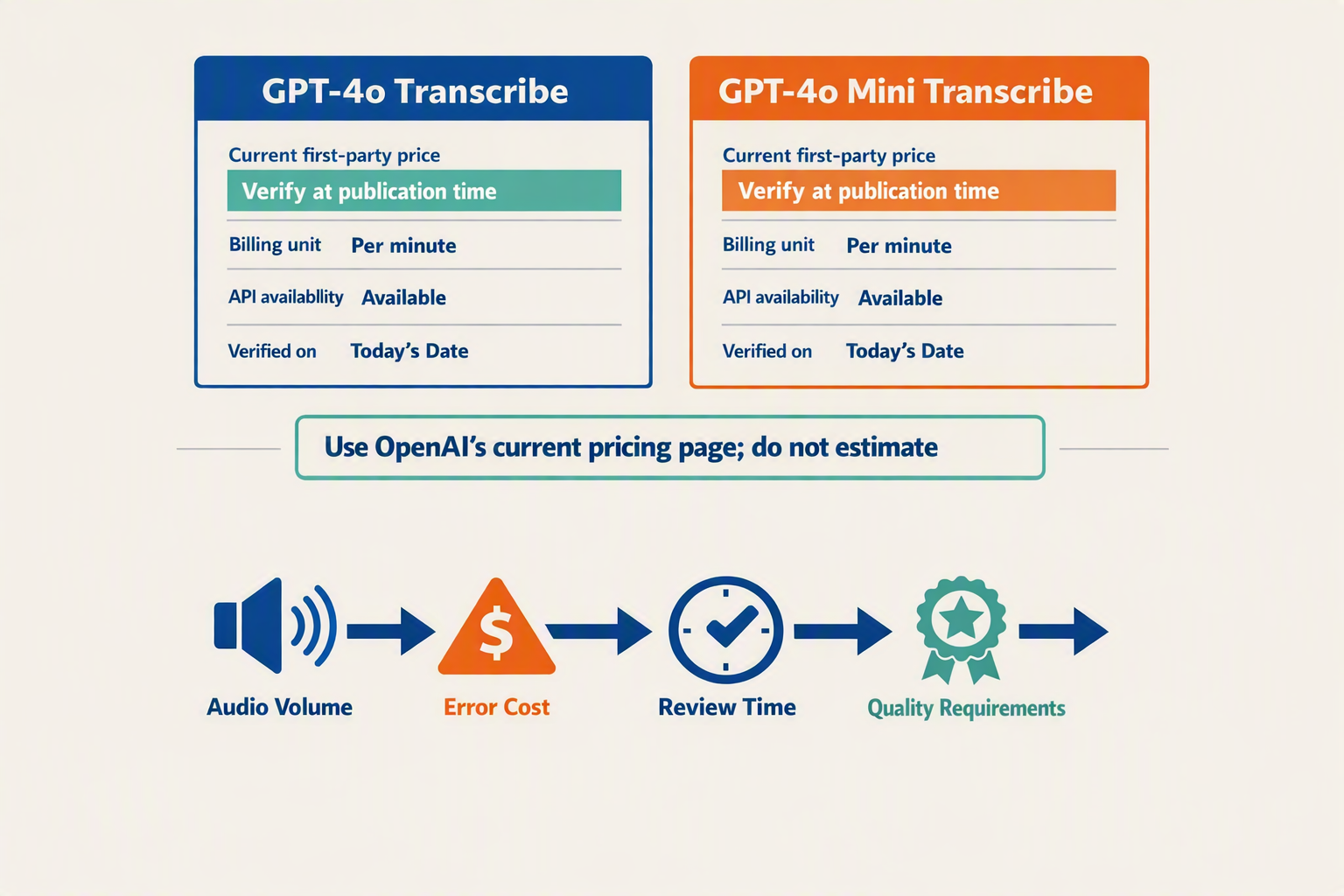
The available research does not establish a verified accuracy-per-rupee advantage for either model: no public, controlled GPT-4o Transcribe versus GPT-4o Mini Transcribe benchmark or percentage gap was surfaced. Cost value therefore depends on measured WER, error consequences, and workload volume—not price alone.
What pricing and value can be verified?
- GPT-4o Transcribe: OpenAI’s published API pricing lists a higher per-minute rate than the mini model; confirm the live rate on OpenAI’s pricing page before deployment.
- GPT-4o Mini Transcribe: OpenAI positions the mini variant for lower-cost, higher-volume usage, but lower price is not evidence of lower or higher accuracy.
- Accuracy evidence: The research found no official or independent benchmark quantifying the models’ WER difference.
- Value test: Calculate total cost alongside substitutions, deletions, insertions, punctuation errors, and correction time.
- Workload strategy: A practical hypothesis is to reserve the larger model for costly errors and test the mini model on routine or high-volume audio.
| Comparison field | GPT-4o Transcribe | GPT-4o Mini Transcribe | Evidence status |
|---|---|---|---|
| Positioning | Full-size transcription model | Lower-cost transcription model | Documented by OpenAI |
| Published price | Check current OpenAI API pricing | Check current OpenAI API pricing | Must verify at publication |
| Accuracy percentage | No verified public figure | No verified public figure | Not established |
| WER comparison | No controlled head-to-head result found | No controlled head-to-head result found | Requires testing |
| Best-value hypothesis | Potentially suitable when errors are expensive | Potentially suitable for high-volume workloads | Conditional inference |
How should teams measure value?
- Transcribe identical audio with both models.
- Record reference words, substitutions, deletions, and insertions.
- Calculate WER = (substitutions + deletions + insertions) / reference words × 100.
- Repeat across accents, noise, overlapping speakers, specialist vocabulary, and each important language.
For multilingual deployments, platforms such as CallMissed add a relevant comparison point by supporting speech-to-text across 22 Indian languages; however, teams should still validate language-specific accuracy rather than infer it from English results.
What are the honest pros and cons of each transcription model?
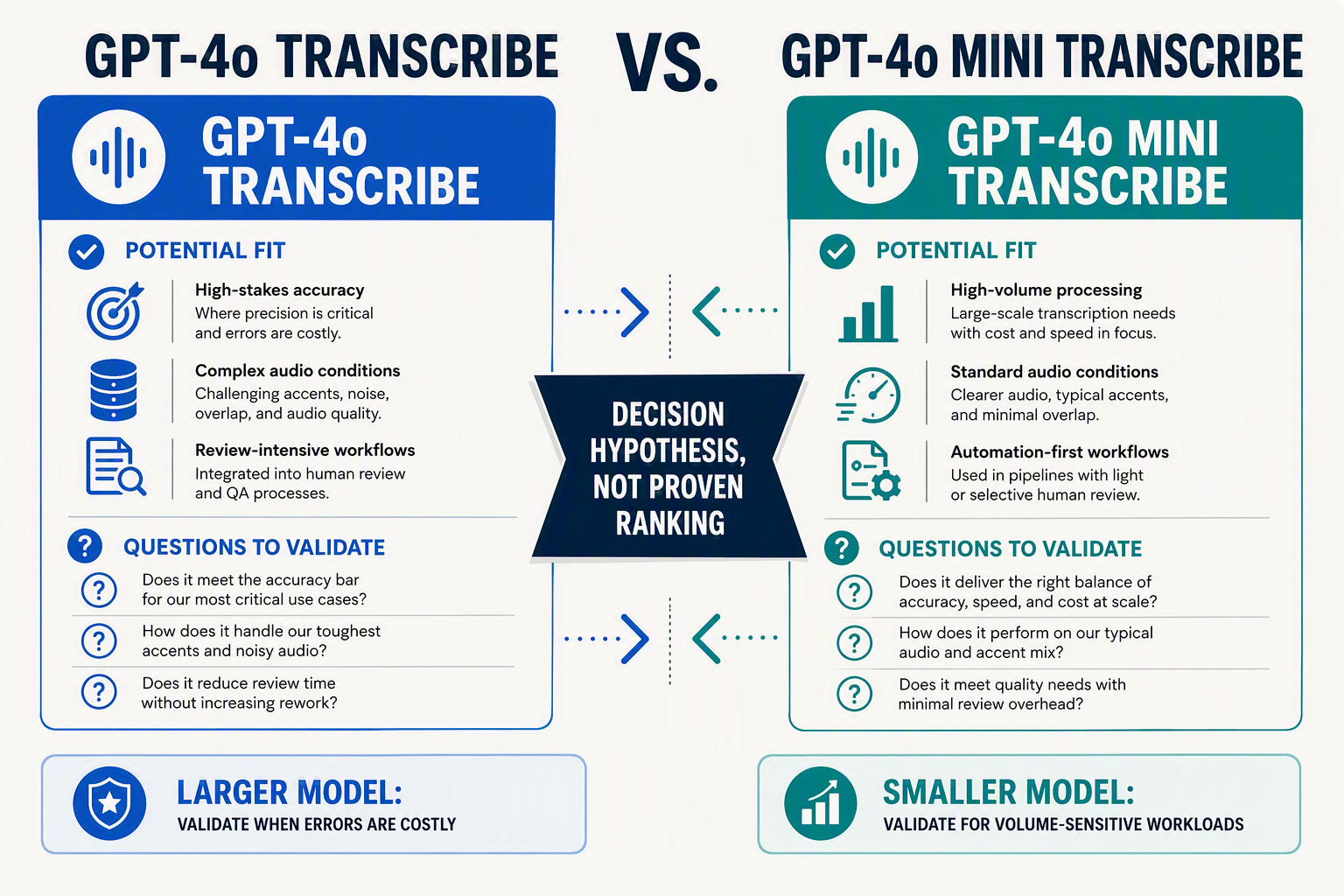
The honest distinction is not a proven accuracy gap: the research brief found no public, controlled benchmark quantifying GPT-4o Transcribe versus GPT-4o Mini Transcribe. GPT-4o Transcribe is a reasonable accuracy-first hypothesis; GPT-4o Mini Transcribe is a reasonable cost-and-scale hypothesis—both require testing on representative audio.
| Decision factor | GPT-4o Transcribe | GPT-4o Mini Transcribe | Evidence status |
|---|---|---|---|
| Accuracy positioning | Potentially preferable when transcription errors are costly | Potentially preferable when volume and cost dominate | No verified public WER comparison |
| Cost efficiency | May be less suitable for extremely high-volume workloads | May offer a more economical operating hypothesis | Pricing and accuracy trade-off require current verification |
| Accents and languages | Test separately across target accents and languages | Test separately across target accents and languages | No universal language or accent ranking found |
| Noise and far-field audio | Candidate for accuracy-sensitive recordings | Candidate for scalable, lower-risk workloads after validation | No controlled public noise benchmark found |
| Overlapping speakers | Measure deletions, substitutions, and speaker-attribution errors | Measure the same errors; do not infer performance from model size | Requires identical-audio testing |
| Best-fit workload | Legal, medical, compliance, or high-value transcripts where missed words matter | Call archives, drafts, search indexing, and other high-volume use cases | Conditional guidance, not a proven ranking |
Practical pros and cons
- GPT-4o Transcribe — pro: A sensible first candidate when one missing term, number, or name could create material risk.
- GPT-4o Transcribe — con: Without a public benchmark, paying more—if applicable—does not prove lower word error rate (WER).
- GPT-4o Mini Transcribe — pro: A plausible option for large-scale transcription, provided sample-based WER testing confirms acceptable quality.
- GPT-4o Mini Transcribe — con: Do not assume acceptable performance across accents, music, overlap, or specialist vocabulary without evidence.
- Both models: Score identical audio using
(substitutions + deletions + insertions) / reference words × 100; report results by condition, not only as one average. - Multilingual teams: Test each important language independently; platforms such as CallMissed support speech-to-text across 22 Indian languages, reinforcing why English-only conclusions are insufficient.
How should I test GPT-4o Transcribe and Mini Transcribe fairly?
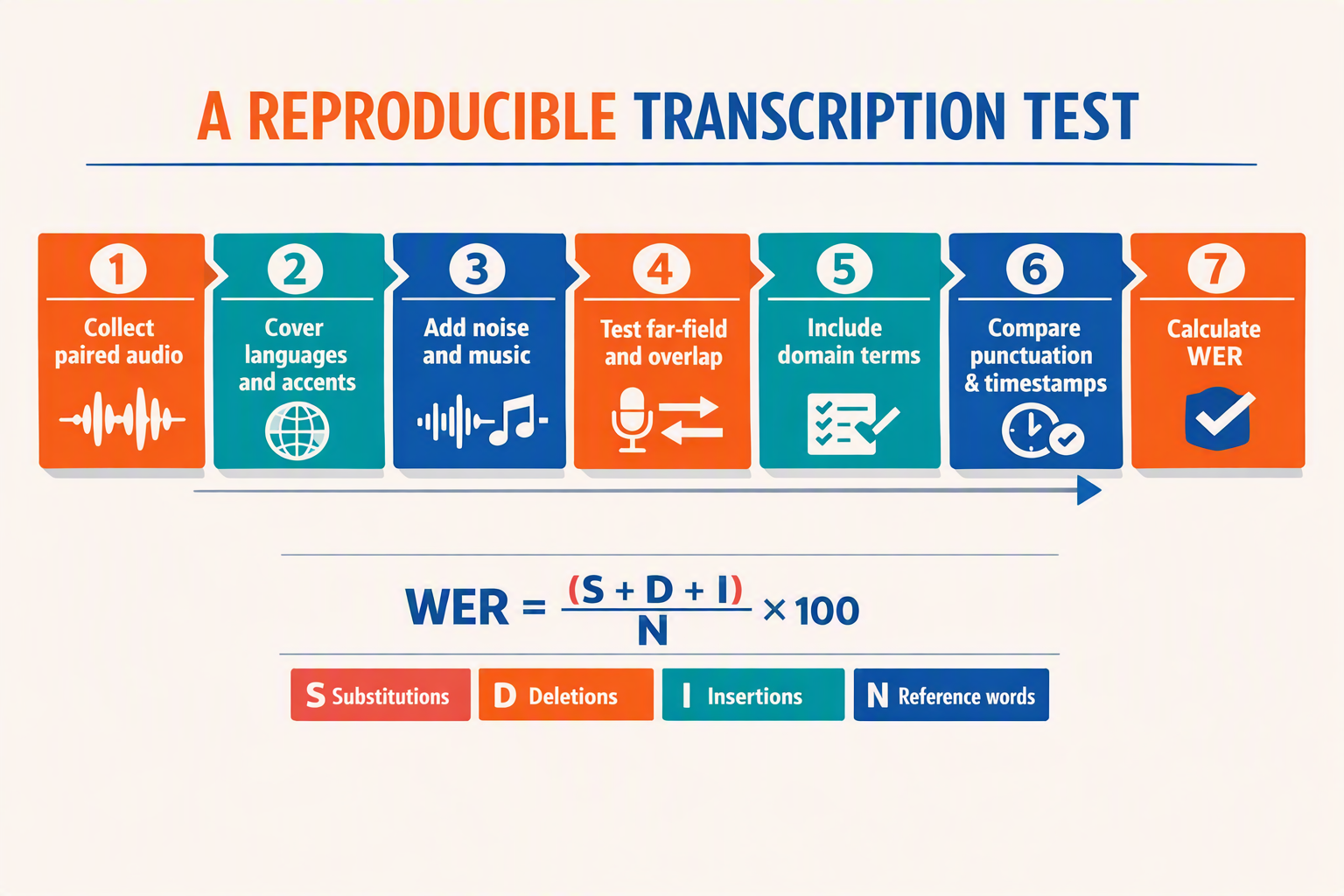
The fairest test uses identical audio, identical reference transcripts, and the same evaluation rules for both models. The research brief found no public, controlled benchmark proving a GPT-4o Transcribe accuracy advantage, so your test should measure the gap on your own languages and recording conditions.
Use a controlled, stratified test set
- Audio: Include clean speech, regional accents, background noise, music, far-field recordings, overlapping speakers, and domain terminology; test each important language separately, including the 22 Indian languages supported by platforms such as CallMissed.
- Sampling: Build balanced clips for every condition rather than relying on one long recording; a practical internal design is at least 30 clips per condition, clearly labelled as a recommendation—not a published benchmark.
- Controls: Send byte-identical audio to GPT-4o Transcribe and GPT-4o Mini Transcribe, keeping file format, prompts, temperature or equivalent settings, retries, and API preprocessing consistent.
- Reference transcript: Create a human-verified transcript before testing, with explicit rules for numbers, abbreviations, punctuation, code-switching, names, and unintelligible speech.
- Primary metric: Calculate WER = (substitutions + deletions + insertions) / reference words × 100; report total WER and separate results for each language, accent, noise level, and speaker condition.
- Secondary metrics: Score punctuation, capitalization, timestamps, speaker separation, proper nouns, and critical-term recall separately; a low WER can still hide a dangerous medical, financial, or product-name error.
- Fair comparison: Blind human reviewers to model identity, compare paired outputs, repeat unstable API calls where appropriate, and report confidence intervals rather than one rounded average.
- Decision rule: Choose Mini Transcribe for a workload only if its measured error rate, latency, and cost satisfy your tolerance; choose Transcribe when the test shows that missed words or critical terms carry higher operational cost.
Which model should you choose without a public accuracy benchmark?
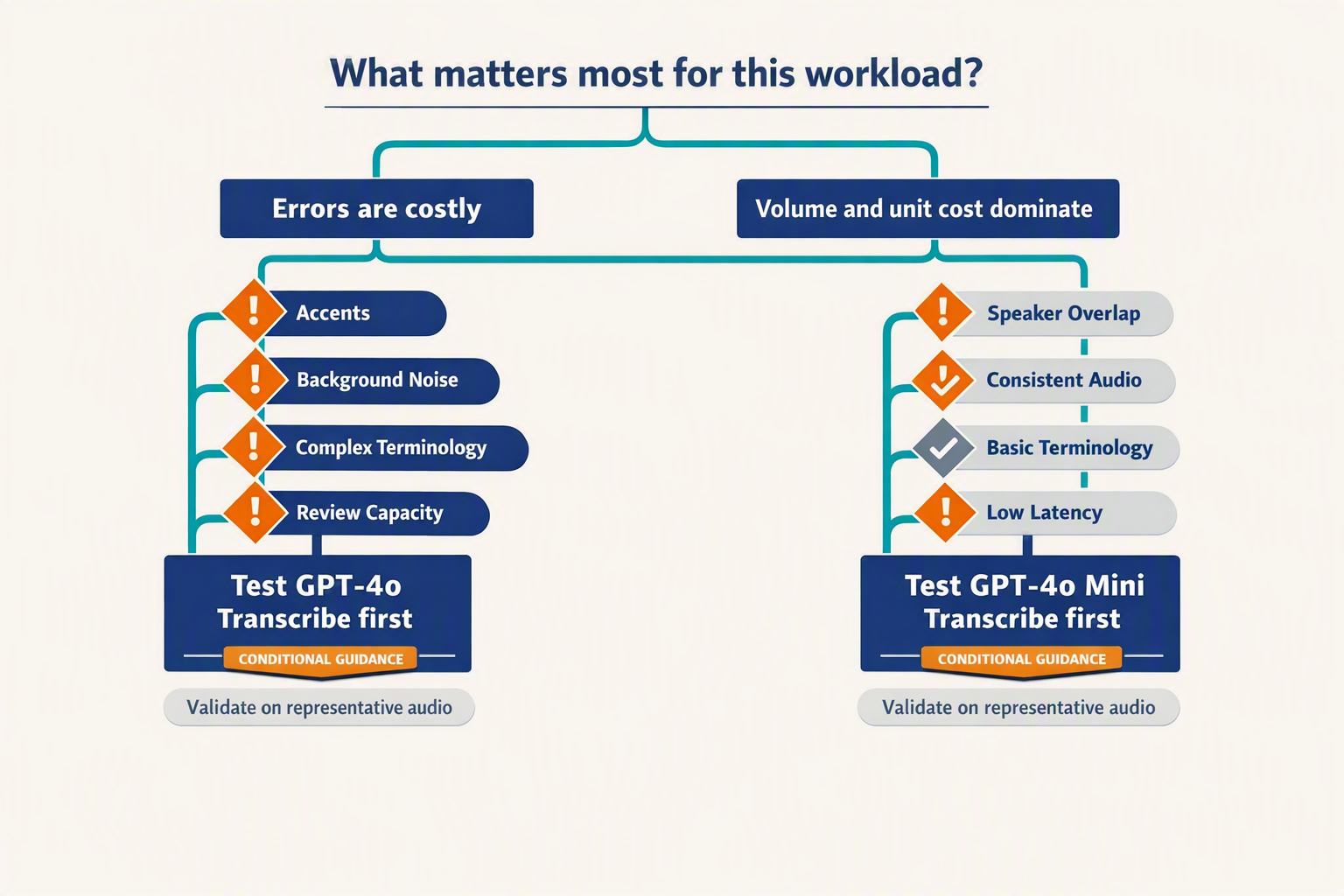
Choose GPT-4o Transcribe when transcription errors carry material business, legal, or operational risk; choose GPT-4o Mini Transcribe when throughput and cost are priorities—but treat both choices as hypotheses until tested on representative audio.
- GPT-4o Transcribe: Start here for high-consequence calls, specialist terminology, compliance records, or workflows where a single deletion or substitution can change meaning; this is a risk-based preference, not a proven accuracy ranking.
- GPT-4o Mini Transcribe: Pilot it for high-volume, cost-sensitive workloads such as searchable archives, call summaries, or first-pass classification; lower price alone does not prove lower accuracy.
- No benchmark advantage: The research brief found no public, controlled head-to-head result, official WER comparison, or percentage accuracy gap between the models.
- Choose by measured WER: Calculate
(substitutions + deletions + insertions) / reference words × 100on identical audio, then compare results by language, accent, noise level, and domain. - Use a routing policy: Send routine, clean recordings to the model that meets your error threshold; reserve the other model for difficult audio or high-value transcripts after validation.
- Test regional coverage separately: English results cannot establish performance for other languages, particularly when serving multilingual audiences; platforms such as CallMissed support speech-to-text across 22 Indian languages, making language-specific evaluation practical.
- Run a limited pilot first: Build a labelled sample covering clean speech, background noise, far-field audio, music, overlapping speakers, accents, and specialist vocabulary before committing to a default model.
- Reassess by business cost: Compare transcription spend with the cost of manual correction, missed entities, incorrect timestamps, and downstream AI errors—not model price alone.
What do people ask about the GPT-4o Transcribe accuracy difference?
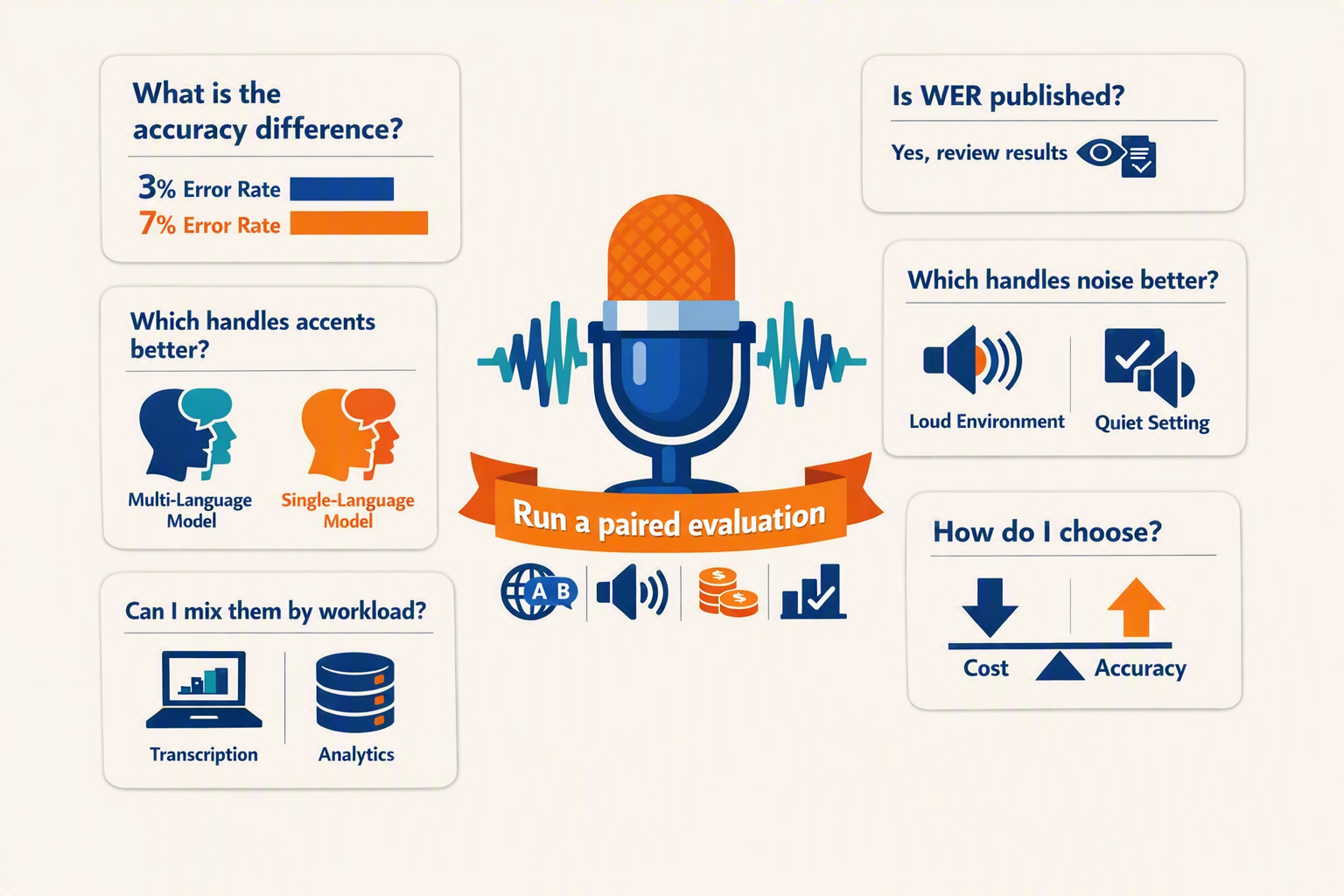
Frequently Asked Questions
- Q: What is the GPT-4o transcribe vs GPT-4o mini transcribe accuracy difference?
A: No verified public, controlled benchmark provides a percentage difference. Test both models on the same representative recordings to measure the gap.
- Q: Is GPT-4o Transcribe more accurate than GPT-4o Mini Transcribe?
A: There is no proven universal ranking. Accuracy can vary with language, accent, audio quality, vocabulary, and speaker overlap. Compare both models under your actual operating conditions.
- Q: What WER score is available for this comparison?
A: No reliable public WER score establishes the GPT-4o transcribe vs GPT-4o mini transcribe accuracy difference. Calculate word error rate as (substitutions + deletions + insertions) ÷ reference words × 100. Use identical audio and human-verified reference transcripts.
- Q: Which model performs better with noisy audio or overlapping speakers?
A: Public evidence does not prove that either model consistently performs better. Test background noise, far-field speech, music, interruptions, and overlapping speakers as separate scenarios.
- Q: How should teams test multilingual transcription accuracy?
A: Build a test set for every required language and regional accent. Include code-switching, names, numbers, and specialist terms. Report WER by language instead of relying only on one combined score.
- Q: Is GPT-4o Mini Transcribe cheaper?
A: Check current first-party pricing before making a cost comparison. Also measure correction time and cost per usable transcript. A lower processing price may not reduce total cost if outputs require more editing.
- Q: Which model has lower transcription latency?
A: Do not assume that model size alone determines real-world latency. Measure time to first result and total processing time with the same files, settings, request volume, and deployment region.
- Q: How should teams choose between the two models?
A: Evaluate accuracy, WER, language coverage, noise handling, latency, cost, and correction effort. The best way to determine the GPT-4o transcribe vs GPT-4o mini transcribe accuracy difference is a controlled test using representative production audio. Teams can also route low-risk recordings differently from accuracy-sensitive ones.
Conclusion
The evidence supports a cautious conclusion: no public, controlled benchmark has established a reliable accuracy percentage separating GPT-4o Transcribe from GPT-4o Mini Transcribe. Key takeaways:
- Test WER across your languages, accents, noise, speakers, and terminology.
- Treat larger-model accuracy and smaller-model cost advantages as hypotheses, not proven rankings.
- Reassess as official benchmarks and real-world evaluations emerge.
For multilingual voice products, CallMissed offers speech-to-text across 22 Indian languages. Explore CallMissed as you build, then ask: which model performs best on your own representative audio?
Related Reading
Related Posts
Ready to automate customer conversations?
Launch AI voice agents and WhatsApp bots with CallMissed — one API, 22+ Indian languages.