

Claude Opus 5 vs Claude Sonnet 5: Verified Facts, Benchmarks, Pricing, and Verdict (July 2026)



Get an evidence-led Claude Opus 5 vs Claude Sonnet 5 comparison covering verified specs, benchmarks, pricing, and buying guidance.
Claude Opus 5 vs Claude Sonnet 5: Verified Facts, Benchmarks, Pricing, and Verdict (July 2026)
What if the most important fact in the Claude Opus 5 vs Claude Sonnet 5 debate is that, as of July 23, 2026, only one side has officially published specifications and benchmarks? Anthropic has introduced Claude Sonnet 5 and documented it as a drop-in upgrade from Claude Sonnet 4.6, while the supplied official materials do not establish a released Claude Opus 5 model, verified pricing, or reproducible Opus 5 benchmark results.
That distinction matters because speculative comparisons can easily turn expectations into “facts.” Anthropic’s Sonnet 5 announcement compares the new model against Claude Sonnet 4.6 and Claude Opus 4.8 at different effort levels—not against Opus 5. Meanwhile, unofficial posts and social discussions are already extrapolating what a fifth-generation Opus might deliver. Those predictions may eventually prove accurate, but they should not be presented beside official Sonnet 5 results without unmistakable labels.
The available numbers also require context. BuildFastWithAI reports that Claude Sonnet 5 scored 63.2% on a cited coding evaluation, compared with 69.2% for Claude Opus 4.8 and 62.1% for GLM-5.2. That is useful evidence, but it is a third-party figure rather than proof of Opus 5 performance. CodeRabbit’s production-oriented review reports a different outcome: Sonnet 5 found roughly 50%–51% of bugs in its setup, versus about 57% for its existing baseline. The gap illustrates why a leaderboard score alone cannot determine which model will perform better in a real repository, agent loop, or customer workflow.
This comparison will therefore separate three evidence levels:
- Verified: Anthropic announcements, documentation, published model behavior, pricing, and benchmark disclosures.
- Independently observed: Third-party tests with identifiable tasks, configurations, and limitations.
- Unverified: Opus 5 rumors, projected capabilities, assumed release timing, and unsupported price estimates.
You will learn how Claude Sonnet 5 compares with the strongest confirmed Opus reference currently supplied—Claude Opus 4.8—across coding, reasoning, agentic work, cost, latency, context handling, and production suitability. We will also examine why a cheaper per-token model can still cost more in an agentic workflow if it needs additional tool calls, retries, or tokens, an issue highlighted by MindStudio.
For developers using multi-model infrastructure, the verdict has practical consequences: platforms such as CallMissed’s OpenAI-compatible gateway make it easier to evaluate multiple model families behind one integration rather than hard-wiring an application to a single vendor. The objective here is not to crown a winner based on a future model’s reputation; it is to identify what can be concluded today, what remains unknown, and what evidence should change the verdict when Anthropic officially publishes Opus 5.
Claude Opus 5 vs Claude Sonnet 5: Which wins as of July 23, 2026? Short answer: Sonnet 5 is the only verifiable choice
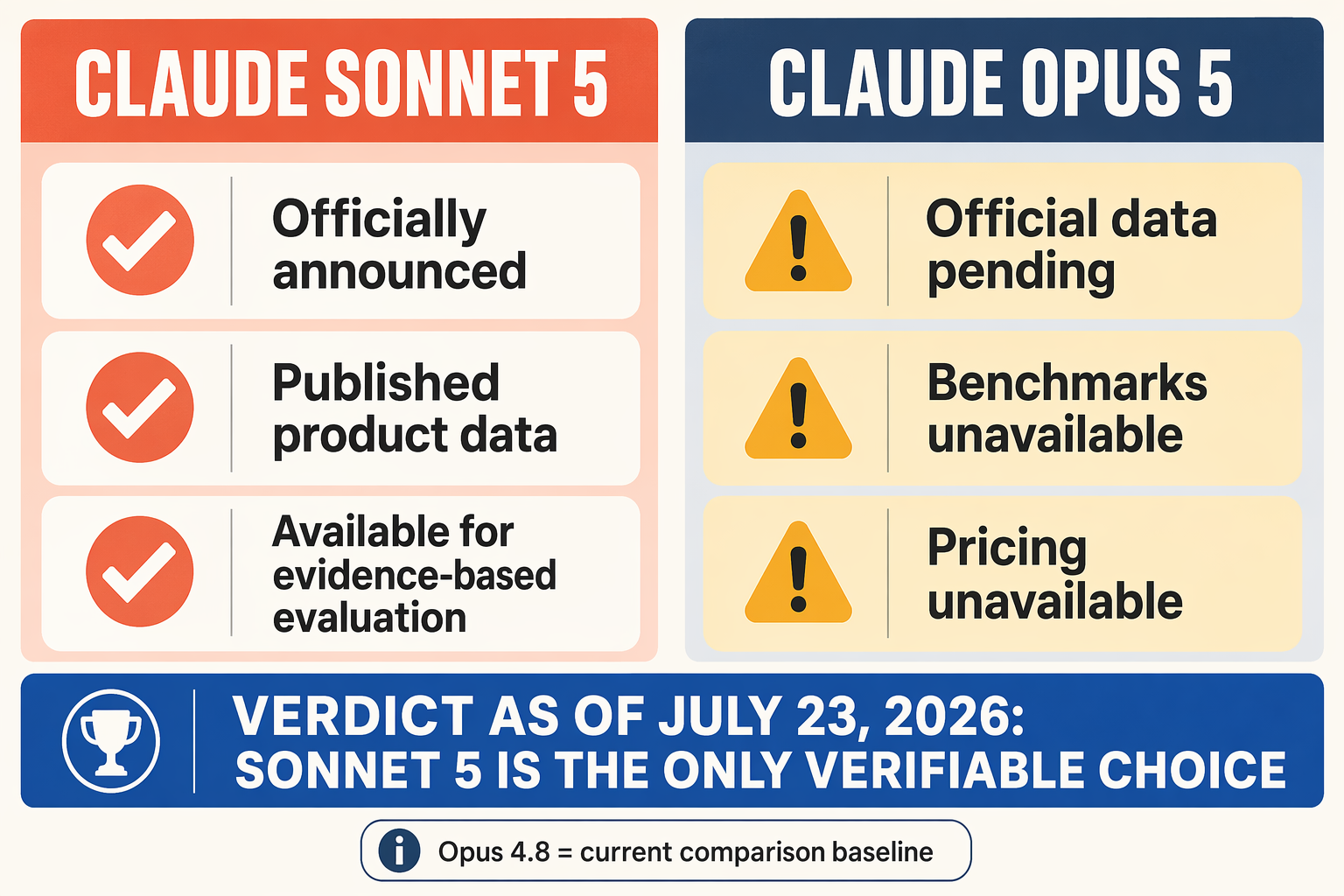
Claude Sonnet 5 wins by verification as of July 23, 2026—not because Claude Opus 5 has been proven weaker, but because no supplied official Anthropic source confirms Opus 5 specifications, availability, pricing, or benchmark results. Any performance victory over an unreleased or undocumented model would be conjecture rather than a defensible 1v1 result.
What “winning” means in an evidence-based comparison
A rigorous model comparison requires both contestants to have reproducible evidence. At minimum, that means:
- An official model identifier and release status
- Published API access details and pricing
- Documented context, output, tool-use, and reasoning limits
- Benchmarks run under disclosed configurations
- Independent production tests using comparable workloads
Claude Sonnet 5 clears the first requirement because Anthropic has announced it as the next generation of the Sonnet family. Anthropic’s platform documentation also identifies Sonnet 5 as a drop-in upgrade for Claude Sonnet 4.6 and documents three behavior changes, giving developers concrete migration guidance.
Claude Opus 5 clears none of those requirements in the supplied official evidence. Therefore, claims about its context window, reasoning quality, latency, token rates, or release date must remain labeled unverified expectations.
The verdict is about certainty, not hypothetical capability
“Sonnet 5 wins” does not mean Sonnet 5 will necessarily outperform a future Opus 5. Anthropic has traditionally positioned Opus and Sonnet as different model tiers, so it is reasonable to expect a future Opus release to target highly demanding reasoning or agentic workloads. Reasonable expectation, however, is not published evidence.
The current evidence supports three narrower conclusions:
- For deployment today: Sonnet 5 is the valid fifth-generation Anthropic option in the supplied sources.
- For verified comparison: Claude Opus 4.8—not Opus 5—is the appropriate confirmed Opus reference.
- For future planning: Teams should treat Opus 5 specifications, benchmark claims, and price estimates as placeholders until Anthropic publishes them.
A Reddit post in the ClaudeAI community claimed Sonnet 5 was 0.5 percentage points from Opus on Humanity’s Last Exam with tools. Even if the quoted figure accurately reflects an underlying chart, the statement does not establish Opus 5 performance: the referenced confirmed comparator is an existing Opus model, and a social post is not a substitute for the original benchmark methodology.
What businesses should choose now
Choose Claude Sonnet 5 when the project requires a model that can be evaluated, budgeted, integrated, and governed using currently documented information. Consider Claude Opus 4.8 when the hardest reasoning or safety-sensitive work justifies testing the established Opus tier; Thesys reports that Sonnet 5 remains below Opus 4.8 on the most difficult safety-critical tasks.
Do not select “Claude Opus 5” for production architecture based on assumed capabilities. Instead, define acceptance tests now—task success, tool-call count, total tokens, latency, and failure rate—then rerun them if Anthropic officially releases Opus 5. Until that happens, Sonnet 5 wins the comparison by being real, documented, and testable.
What background and model-family context matters before comparing Sonnet 5 with an expected Opus 5?

Claude’s family labels describe product roles and trade-offs, not a guarantee that models sharing a generation number have equivalent capabilities. Before comparing Claude Sonnet 5 with an expected Claude Opus 5, the sound baseline is the released Sonnet 5, its predecessor Sonnet 4.6, and the strongest confirmed Opus model in the supplied evidence: Claude Opus 4.8.
Sonnet and Opus represent different optimization targets
Anthropic has historically positioned Sonnet as the balance between capability, speed, and deployment cost, while Opus occupies the premium tier for especially demanding reasoning and agentic tasks. Those roles matter more than the number following the family name.
A rigorous comparison should therefore avoid three assumptions:
- “5” does not reveal architecture. A shared generation label would not prove identical training data, parameter counts, inference systems, or safety tuning.
- A newer Sonnet does not automatically outrank every earlier Opus. Product tiers and model generations are separate dimensions.
- An expected Opus 5 cannot inherit Sonnet 5’s specifications by analogy. Context length, pricing, latency, tool use, and effort controls require model-specific documentation.
Anthropic’s official Sonnet 5 announcement uses Claude Sonnet 4.6 and Claude Opus 4.8 at different effort levels as comparison points. This establishes Opus 4.8—not an unreleased Opus 5—as the relevant premium-family reference.
Sonnet 5 has a documented lineage
Anthropic’s platform documentation calls Claude Sonnet 5 the “next generation of Anthropic’s Sonnet model family” and identifies it as a drop-in upgrade for Claude Sonnet 4.6. Anthropic also documents three behavior changes for the transition from Sonnet 4.6 to Sonnet 5, indicating that API compatibility does not necessarily mean identical output behavior.
“Drop-in upgrade” should be interpreted narrowly:
- Existing integrations may require less migration work.
- Prompts and evaluation suites still need regression testing.
- Agent loops may change because planning, verbosity, tool selection, or completion behavior can shift.
- Production economics must be measured at the workflow level, not inferred from compatibility.
That final point is particularly important for model families optimized differently. MindStudio reports that a lower-priced Sonnet model can still cost more than Opus in some agentic workflows when it consumes more tokens, performs additional tool calls, or needs retries.
Opus 5 expectations are not model facts
The Opus name reasonably creates expectations of Anthropic’s highest-capability tier, but expectations are not specifications. Until Anthropic publishes an Opus 5 model card, API documentation, pricing, and reproducible evaluations, the following remain unknown:
- Official model identifier and release availability
- Input and output token prices
- Context window and maximum output length
- Supported effort or reasoning controls
- Latency, throughput, and rate limits
- Coding, knowledge-work, safety, and agentic benchmarks
Social claims should be treated accordingly. A Reddit discussion asserted that Sonnet 5 was 0.5 percentage points from Opus on Humanity’s Last Exam with tools, but that statement concerns an existing Opus comparison and does not establish any Opus 5 capability.
The correct family context is therefore asymmetric: Sonnet 5 is a documented product; Opus 5 is presently an expected premium-family successor without verified specifications in the supplied record. Any provisional verdict must compare Sonnet 5 with Opus 4.8 while reserving judgment on Opus 5.
Which Claude 5 claims are official, independently observed, or still expectations? Key developments and evidence ledger (TABLE)
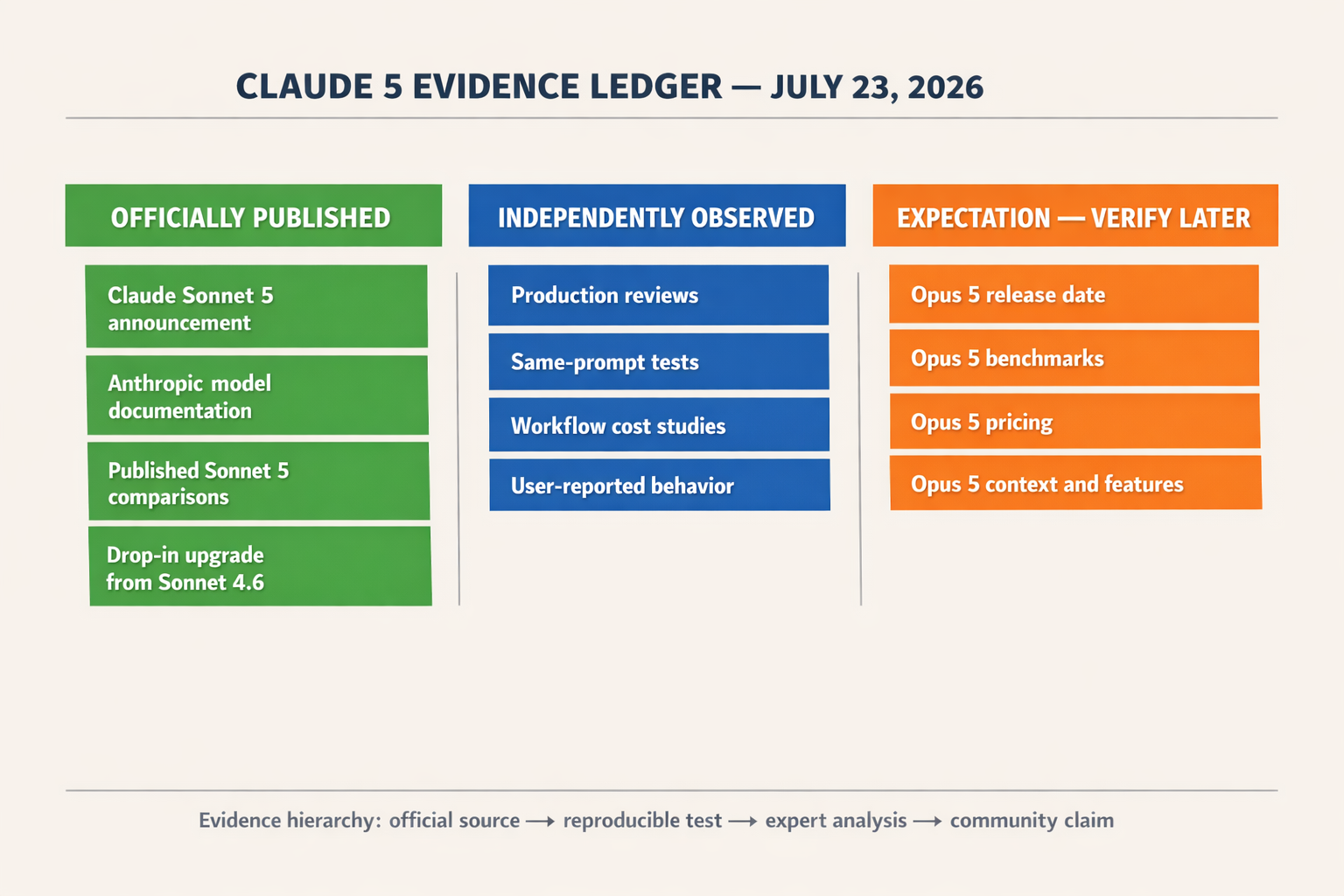
As of July 23, 2026, Claude Sonnet 5 has official Anthropic documentation, while Claude Opus 5 remains an unverified future-model expectation in the supplied evidence. Any numerical Opus 5 comparison should therefore be treated as speculative until Anthropic publishes a model card, API documentation, pricing, and reproducible evaluations.
Evidence ledger
| Claim or development | Evidence class | Source and evidence | What it supports |
|---|---|---|---|
| Claude Sonnet 5 is an officially documented model | Official | Anthropic describes Sonnet 5 as the next generation of the Sonnet family and a “drop-in upgrade” for Claude Sonnet 4.6. | Teams can evaluate or migrate to a real, supported model rather than a rumored release. |
| Sonnet 5 changes model behavior | Official | Anthropic’s documentation identifies three behavior changes, signaling that API compatibility does not guarantee identical outputs. | Production teams should regression-test prompts, tools, refusals, and structured outputs before switching. |
| Anthropic compares Sonnet 5 with Opus 4.8 | Official | Anthropic’s announcement charts compare Sonnet 5 with Sonnet 4.6 and Opus 4.8 at different effort levels. | Opus 4.8—not Opus 5—is the valid official Opus reference in the supplied materials. |
| Sonnet 5 scored 63.2% on a cited coding evaluation | Independent | As reviewed on July 23, 2026, BuildFastWithAI reports 63.2% for Sonnet 5, 69.2% for Opus 4.8, and 62.1% for GLM-5.2. | Sonnet 5 appears competitive, but the result does not establish performance across all repositories or workloads. |
| Sonnet 5 found approximately half of seeded bugs | Independent | As reviewed on July 23, 2026, CodeRabbit reports about 50%–51% for Sonnet 5 versus roughly 57% for its existing production baseline. | Repository-specific testing can produce a different ranking from generalized coding benchmarks. |
| Claude Opus 5 has known specifications, pricing, or benchmark scores | Unverified | No supplied Anthropic announcement or documentation establishes those details as of July 23, 2026. | Context-window claims, prices, release dates, and performance projections should not enter a factual scorecard. |
How to read conflicting results
The independent figures are not necessarily contradictory. BuildFastWithAI’s 63.2% coding result and CodeRabbit’s 50%–51% bug-detection result measure different tasks, likely with different prompts, tools, stopping conditions, and scoring rules. Neither number should be generalized into a universal “intelligence” score.
MindStudio adds an important economic observation: a model with a lower advertised token price can still cost more in an agentic workflow when it requires additional tokens, retries, or tool calls. Consequently, a rigorous evaluation should record:
- Model identifier and version
- Prompt, repository, and tool configuration
- Effort or reasoning setting
- Input, output, cached, and retry tokens
- Task success rate, latency, and total workflow cost
What remains an Opus 5 expectation
It may be reasonable to expect a future Opus model to target Anthropic’s most demanding reasoning and agentic workloads, but that is a product-line inference, not verified Opus 5 evidence. Even apparent consensus on social platforms cannot substitute for official specifications or controlled testing.
The ledger should change only when Anthropic publishes an identifiable Opus 5 model and researchers can test the same tasks under matched conditions. Until then, the defensible comparison is Claude Sonnet 5 versus Claude Opus 4.8, with Opus 5 shown as unknown—not zero, inferior, or superior.
How do Claude Sonnet 5 benchmarks and capabilities compare with Opus 4.8—and what can they actually imply about Opus 5?
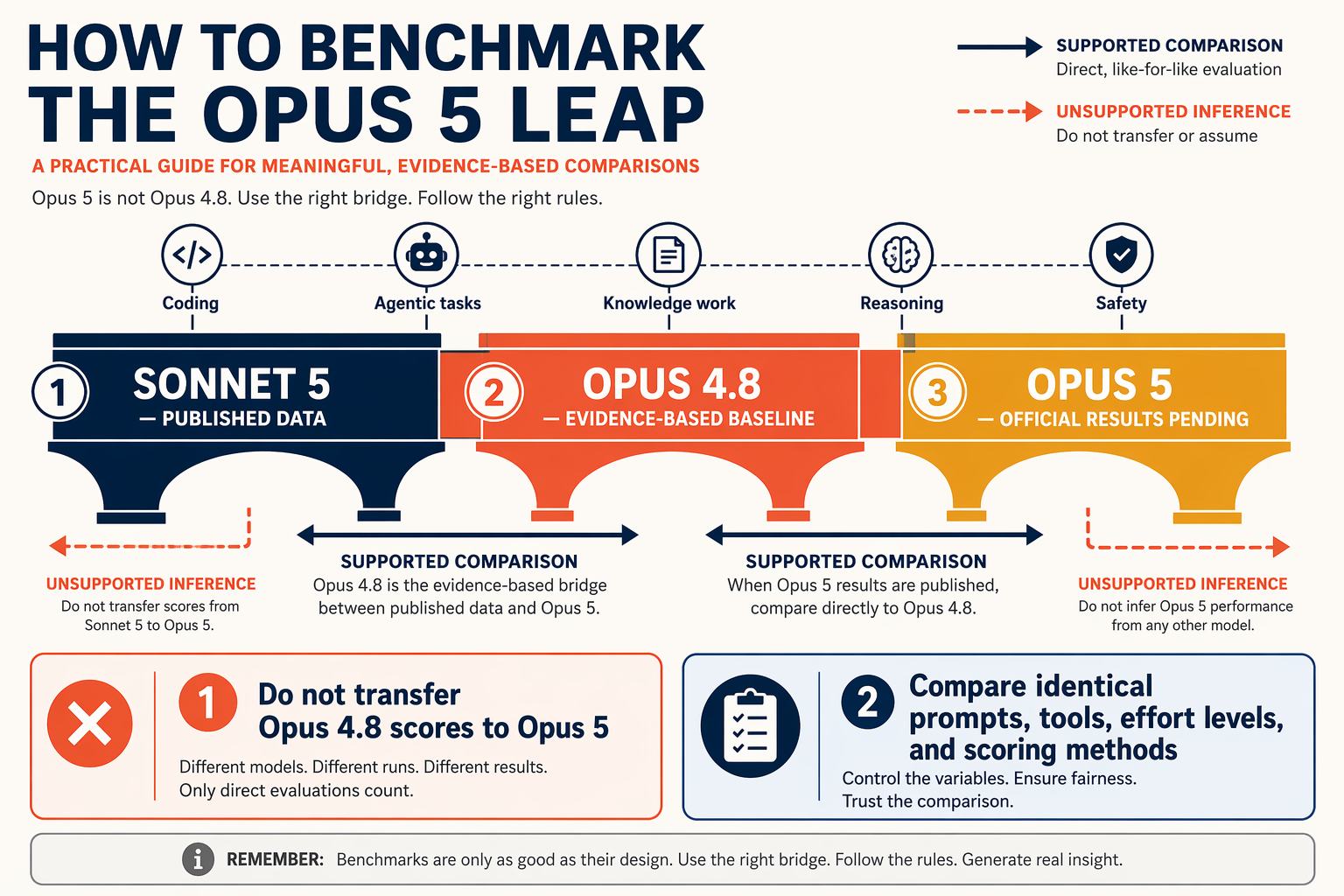
Claude Sonnet 5 approaches Claude Opus 4.8 on selected evaluations, but Anthropic’s published results do not show a universal Sonnet win. They establish how the two released models performed under specific test configurations; they provide no benchmark evidence for Claude Opus 5, which remains unannounced as of July 23, 2026.
What Anthropic’s official comparison establishes
Anthropic describes Claude Sonnet 5 as the next generation of the Sonnet family and a drop-in upgrade for Claude Sonnet 4.6, while advising developers to test documented behavioral changes before migrating production workloads.
Anthropic’s announcement and system card compare Sonnet 5 with released models—including Claude Opus 4.8—on named evaluations such as SWE-bench Verified, Terminal-Bench 2.0, BrowseComp, and OSWorld. The reported pattern is task-dependent: Sonnet 5 is competitive with Opus 4.8 on some benchmarks, while Opus 4.8 retains an advantage on others.
These are Anthropic-reported results, not independent replications. Each score must be interpreted with its benchmark name and disclosed configuration because performance can change with:
- Effort or reasoning settings
- Tool access and scaffolding
- Token and time budgets
- Prompt structure
- Sampling configuration
- Benchmark-specific scoring rules
A higher result on one named benchmark therefore does not prove that a model is better across coding, reasoning, computer use, or agentic work generally.
Capabilities and pricing also affect the comparison
Sonnet 5 supports a 1 million-token context window and a maximum output of 128,000 tokens. Those limits can support large repositories, long documents, and extended agent workflows, but context capacity is not itself a measure of reasoning accuracy or effective use of every supplied token.
Anthropic’s introductory Sonnet 5 API pricing is:
- $2 per million input tokens
- $10 per million output tokens
- Available through August 31, 2026
After the introductory period, Sonnet 5 is priced at:
- $3 per million input tokens
- $15 per million output tokens
Claude Opus 4.8 costs $5 per million input tokens and $25 per million output tokens. Sonnet 5 can consequently offer a substantial price advantage, although actual workload cost also depends on token consumption, retries, tool calls, latency, and the effort setting required to achieve acceptable results.
What these results imply—and do not imply—about Opus 5
The verified evidence supports three conclusions:
- Sonnet 5 is Opus-adjacent on selected named benchmarks. That can make it attractive when capability, throughput, and cost must be balanced.
- Opus 4.8 remains stronger on some reported evaluations. No single benchmark establishes a universal model ranking.
- Neither Sonnet 5 nor Opus 4.8 predicts Opus 5. Results from one model family cannot be converted into a defensible score for an unreleased model.
Anthropic has not announced Claude Opus 5 or published its model card, pricing, configurations, or benchmark results. Applying Sonnet 5’s generational improvement to Opus 4.8 would ignore possible differences in training, inference budgets, safety tuning, tools, and release criteria. Until Anthropic releases primary documentation, any numerical Claude Opus 5 comparison is an unverified projection, not benchmark evidence.
How much does Claude Sonnet 5 cost, and why could a cheaper model still raise total agent-workflow costs?
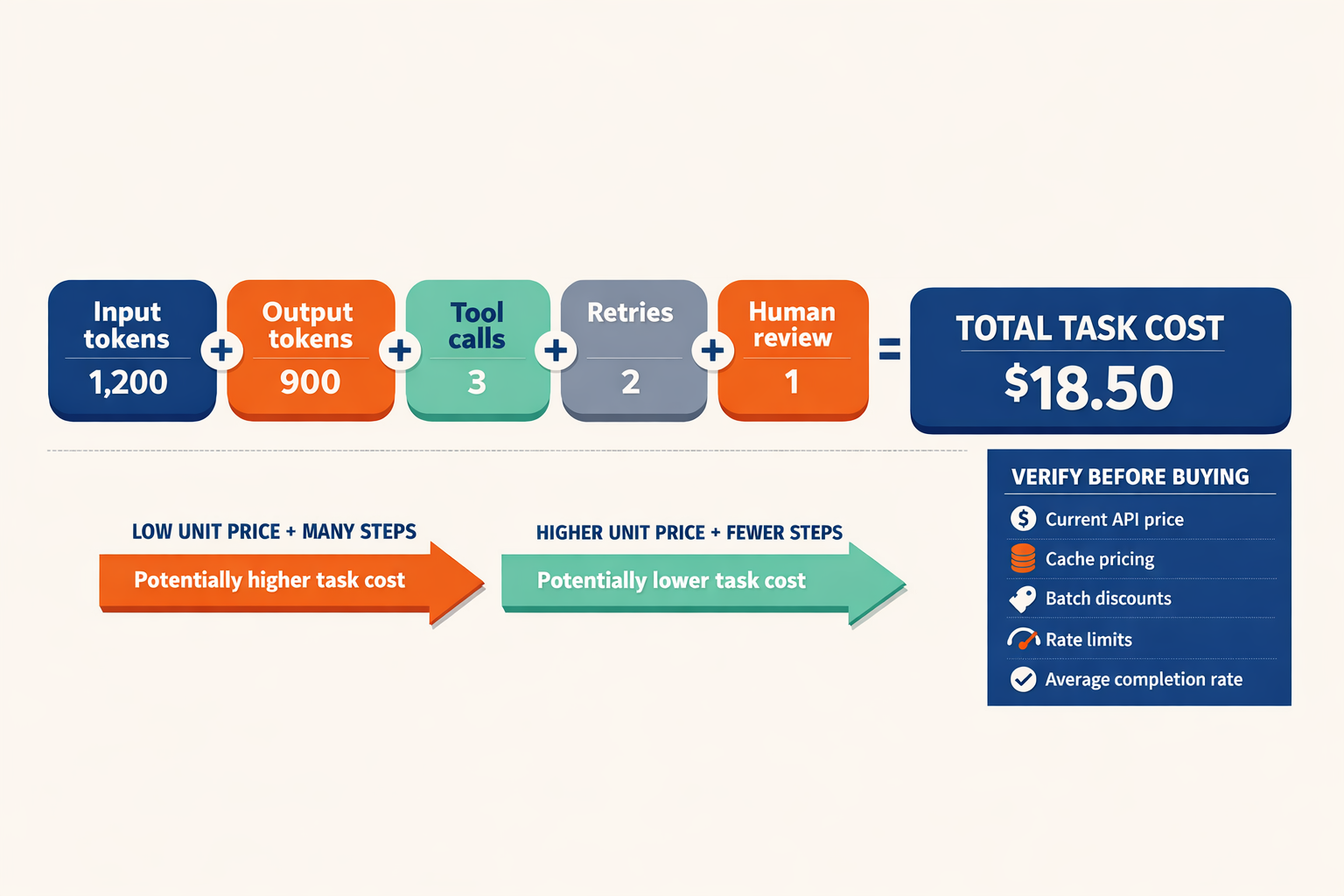
Claude Sonnet 5’s exact API price cannot be verified from the supplied sources as of July 23, 2026. Readers should check Anthropic’s current pricing documentation or their Anthropic API console before budgeting; the sources also do not substantiate introductory Sonnet 5 pricing or any price for an unannounced Claude Opus 5.
What is officially established—and what is not
Anthropic officially describes Claude Sonnet 5 as the next generation of the Sonnet family and a “drop-in upgrade” for Claude Sonnet 4.6. However, the research excerpts provided for this comparison do not establish any of the following:
- Sonnet 5’s input- or output-token rates
- Prompt-caching write or read rates
- Batch-processing discounts
- Long-context thresholds or premiums
- Introductory pricing or an offer-expiration date
- Cloud-platform markups or negotiated enterprise rates
- A published API price for Claude Opus 5
Consequently, any specific dollar figure for Sonnet 5—or any introductory-through-a-certain-date claim—would be unsupported here. No Claude Opus 5 price can be verified from the supplied official materials, so cost comparisons involving that prospective model must remain hypothetical.
MindStudio characterizes Claude Sonnet 5 as cheaper than Claude Opus 4.8 per token but warns that Sonnet 5 can still cost more in agentic workflows. That third-party observation is useful for workflow planning, but it does not replace Anthropic’s current pricing page or validate a particular Sonnet 5 rate.
Why a lower token price may produce a higher total bill
Autonomous agents rarely make one model call. They plan, retrieve context, invoke tools, inspect results, revise outputs and retry failed actions. A more useful equation is:
Total workflow cost = model usage + retries + tool calls + external APIs + infrastructure + human review + failure remediation.
Consider a model that costs less per invocation but requires five attempts to complete a task. If a more capable model finishes the same validated task in two attempts, the nominally more expensive call can produce the lower overall bill. This is an illustrative principle—not a measured Sonnet 5 versus Opus 5 result.
Cost can rise through:
- Repeated context ingestion across multi-step agent loops
- Longer generated outputs caused by revisions or failed plans
- Search, database and browser-tool charges
- Code execution and sandbox compute
- Human escalation when results fail validation
- Downstream error costs, especially in production code or customer communications
Measure cost per successful outcome
CodeRabbit reported in 2026 that Claude Sonnet 5 found approximately 50%–51% of bugs in its test setup, compared with about 57% for its production baseline. CodeRabbit’s result is not a pricing benchmark, but it illustrates why missed issues can add review cycles and remediation costs.
Teams should therefore measure:
- Model spend per successfully completed task
- Retries and tool calls per task
- First-pass success and validation rates
- Time to an accepted result
- Human-review minutes
- Cost and severity of failures
Multi-model gateways can also support controlled routing experiments. For example, CallMissed’s OpenAI-compatible gateway lets developers access multiple models through one integration, making it practical to compare workflow-level economics rather than token prices alone.
The defensible conclusion is simple: verify Sonnet 5’s live rates directly with Anthropic, treat Opus 5 pricing as unknown, and optimize for cost per validated outcome—not an unverified price per million tokens.
How could Sonnet 5 and a future Opus 5 affect coding, research, agents, and enterprise model routing?
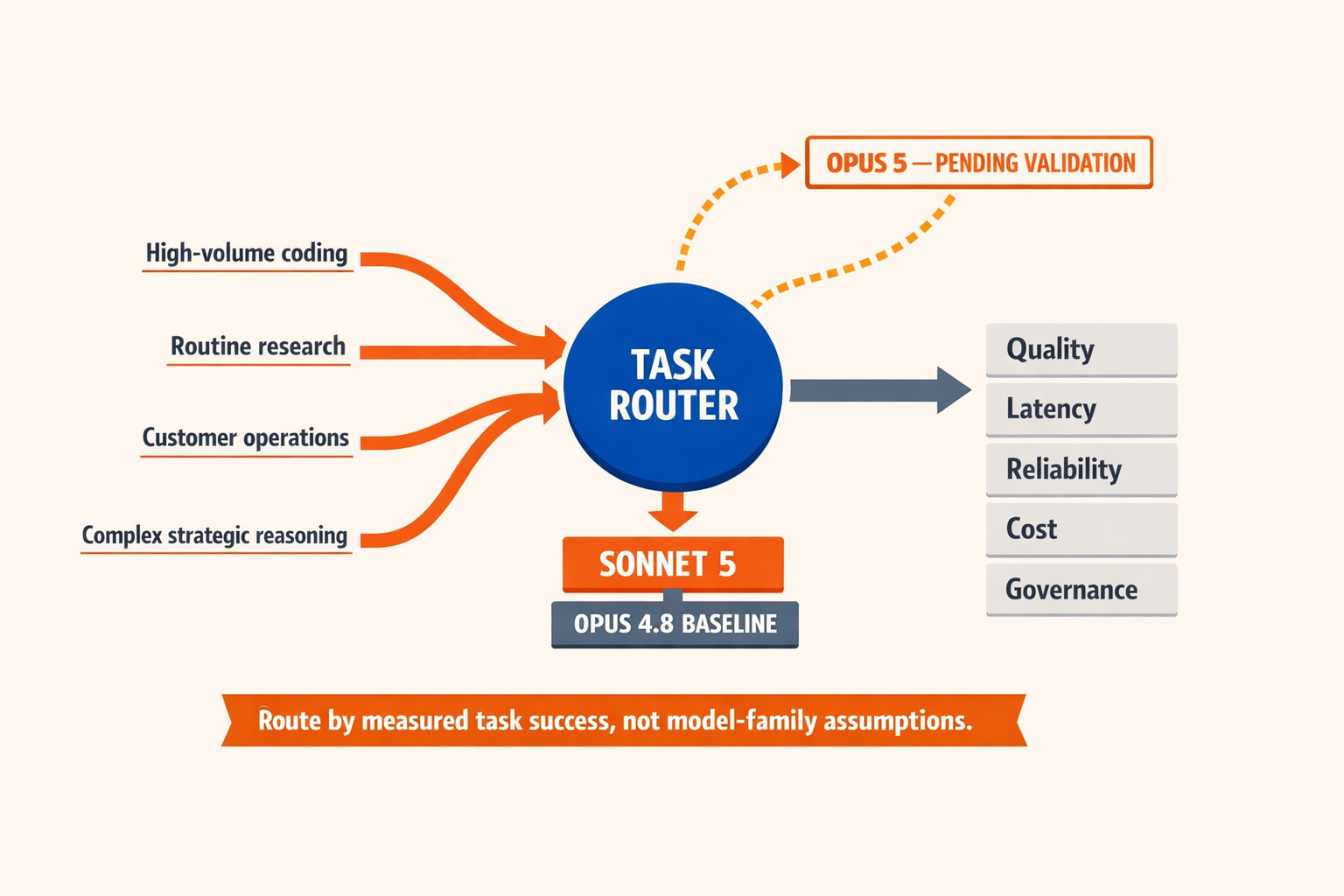
Claude Sonnet 5 can serve as the evidence-based default for high-volume work, while a future Claude Opus 5 should remain an unverified escalation option until Anthropic publishes specifications, pricing, availability, and reproducible evaluations. The practical advantage will come from routing tasks by difficulty, risk, latency, and total workflow cost—not automatically choosing the newest or largest model.
Coding: route by repository risk
Anthropic has officially released Claude Sonnet 5 as the next generation of the Sonnet family and describes it as a drop-in upgrade for Claude Sonnet 4.6. That makes Sonnet 5 testable for production workloads such as:
- Code explanation, documentation, and test generation
- Localized bug fixes with explicit acceptance criteria
- Front-end components and standard API integrations
- First-pass pull-request review and issue triage
Large migrations, unfamiliar repositories, security-sensitive changes, and debugging across multiple services may justify escalation to a stronger model. However, no published evidence currently establishes that a future Claude Opus 5 will provide enough additional accuracy to offset its still-unknown price and latency.
BuildFastWithAI reported in 2026 that Claude Sonnet 5 scored 63.2%, compared with 69.2% for Claude Opus 4.8—a six-percentage-point gap. In a separate repository-oriented evaluation, CodeRabbit reported that Sonnet 5 found approximately 50%–51% of bugs, versus about 57% for its production baseline. These differing results reinforce the need to evaluate models against an organization’s own repositories, tools, coding standards, and definitions of success.
Research: separate synthesis from judgment
Sonnet 5 could handle the broad middle of research workflows: generating search queries, extracting claims, clustering sources, summarizing documents, and drafting structured reports. An Opus-tier model may be more appropriate for conflicting evidence, causal analysis, methodological criticism, or high-stakes final review—but any advantage attributed specifically to Opus 5 remains hypothetical.
Research evaluations should measure:
- Citation precision: Does each claim match its cited source?
- Evidence coverage: Does the output include material contradictory findings?
- Calibration: Does confidence decline when evidence is incomplete or weak?
- Reproducibility: Can another run reconstruct the evidence trail?
A future model should not receive research authority solely because it carries the Opus label.
Agents: optimize successful-task cost
Agentic systems magnify small model differences because they repeatedly plan, invoke tools, inspect outputs, and recover from errors. MindStudio cautions that a cheaper model can cost more overall if it consumes additional tokens, makes more tool calls, or requires more retries. Enterprises should therefore measure cost per successfully completed task, not token price alone.
A routing policy could start with Sonnet 5 and escalate when:
- Retry or token thresholds are exceeded
- Tool outputs conflict
- Validation tests repeatedly fail
- A transaction creates financial, security, or compliance risk
- Human review would cost more than stronger-model inference
Enterprise routing: prepare without assuming
The safest enterprise architecture is a model-independent routing layer with versioned prompts, evaluation suites, fallback rules, budget controls, and audit logs. This design lets teams compare model versions without coupling business logic to an unannounced product.
If Anthropic releases Opus 5, enterprises should first send representative shadow traffic to it. Production promotion should require measurable improvements in task completion, error severity, latency, and end-to-end cost. Until official data exists, Sonnet 5 is deployable evidence; Opus 5 is a scenario to prepare for, not a performance tier to assume.
What do Anthropic, independent reviewers, and production users say about Claude Sonnet 5?

Anthropic presents Claude Sonnet 5 as a production-ready, agentic upgrade, while independent reviewers report a more conditional result: strong benchmark performance does not guarantee the best outcome in every repository or workflow. Production evidence therefore supports evaluating Sonnet 5 on representative tasks rather than treating Anthropic’s aggregate charts—or social-media enthusiasm—as a universal verdict.
Anthropic’s official position
Anthropic describes Claude Sonnet 5 as the next generation of the Sonnet family and a “drop-in upgrade” for Claude Sonnet 4.6. Anthropic’s documentation also identifies three behavior changes, signaling that API compatibility does not necessarily mean identical prompting, tool use, or response behavior.
The official evidence has important boundaries:
- Anthropic compares Sonnet 5, Sonnet 4.6, and Opus 4.8 at different effort levels.
- Anthropic does not provide an official Sonnet 5 versus Opus 5 evaluation in the supplied materials.
- Results obtained at different effort settings may involve different amounts of reasoning, latency, and token consumption.
- “Drop-in upgrade” means migration should be straightforward, not that regression testing becomes unnecessary.
Anthropic calls Claude Sonnet 5 its “most agentic Sonnet yet.” That positioning is relevant for coding agents and tool-using systems, but teams should inspect completion rate, tool-call accuracy, total tokens, latency, and retries—not merely whether the model can initiate an agentic plan.
What independent reviewers found
Independent reviews generally characterize Sonnet 5 as capable and economical, but not uniformly stronger than the confirmed Opus reference.
BuildFastWithAI reported in 2026 that Claude Sonnet 5 scored 63.2%, Claude Opus 4.8 scored 69.2%, and GLM-5.2 scored 62.1% on its cited coding evaluation. Sonnet 5 was therefore 6 percentage points behind Opus 4.8 and 1.1 points ahead of GLM-5.2 in that particular result.
Thesys reports that Sonnet 5 is safer than its predecessor in most respects but remains below Opus 4.8 for the hardest safety-critical work. That assessment suggests a practical segmentation: Sonnet may suit high-volume, bounded tasks, while difficult or high-consequence cases may justify escalation to a stronger model.
MindStudio highlights a separate economic caveat: lower per-token pricing can still produce a higher workflow bill when a model requires more tokens, retries, or tool calls. For agentic deployments, cost per successful task is consequently more informative than headline API pricing.
What production testing adds
CodeRabbit’s repository-level testing provides the clearest warning against assuming benchmark transfer. CodeRabbit reported in 2026 that Sonnet 5 detected approximately 50%–51% of bugs, compared with about 57% for its existing production baseline.
That does not establish that Sonnet 5 is weak overall. It establishes that production quality depends on the surrounding system, including:
- Repository selection and bug distribution
- Prompting and context construction
- Tool permissions and iteration limits
- Judging criteria and false-positive tolerance
- Latency and cost constraints
Social claims require still more caution. A Reddit post stated that Sonnet 5 was 0.5% from Opus on Humanity’s Last Exam with tools and scored higher on knowledge work, but a post without complete configurations, scoring details, and reproducible artifacts should not outweigh official documentation or controlled production testing.
The defensible consensus is therefore narrow: Sonnet 5 is a credible production model with meaningful agentic improvements, but workload-specific evaluation remains decisive—and none of these reports supplies verified evidence about Claude Opus 5.
Which Claude model should you choose for your workload right now? Practical recommendations (TABLE)
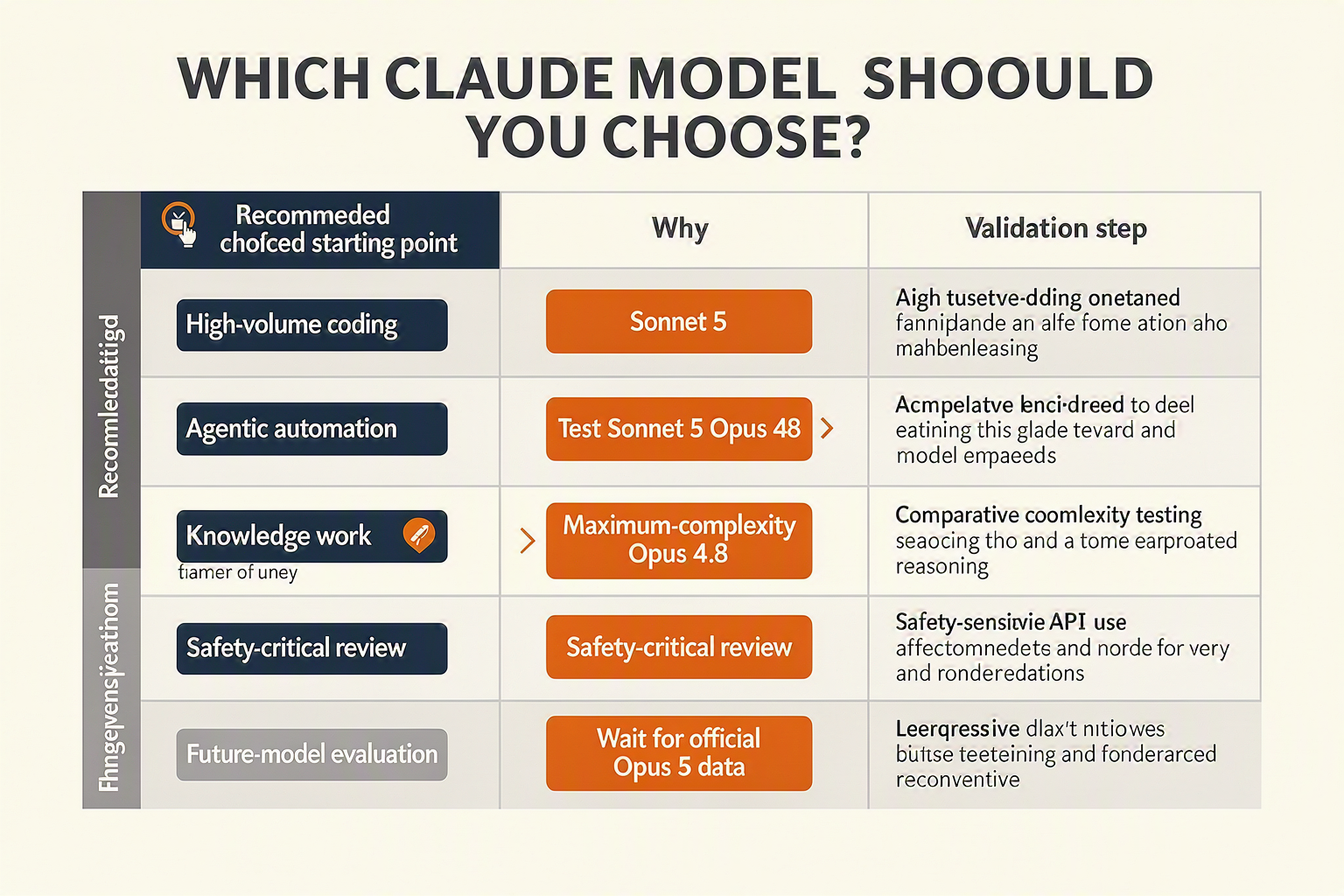
Choose Claude Sonnet 5 as the default for most production workloads, while retaining Claude Opus 4.8 where measured quality justifies additional cost or latency. Do not choose Claude Opus 5 for production as of July 23, 2026, because the supplied official Anthropic materials do not establish its availability, specifications, pricing, or benchmark performance.
Workload-by-workload decision matrix
| Workload | Recommended model now | Evidence-based rationale | Validation requirement |
|---|---|---|---|
| High-volume chat, summarization, and extraction | Sonnet 5 | Anthropic describes Claude Sonnet 5 as a drop-in upgrade for Claude Sonnet 4.6, making it the practical starting point for repeatable workloads | Test accuracy, latency, token use, and cost on representative requests |
| Coding assistance and routine pull requests | Sonnet 5 first | BuildFastWithAI reported a 63.2% coding-evaluation score for Sonnet 5 in 2026 | Run repository-specific tests instead of relying solely on a public benchmark |
| Difficult debugging and architecture decisions | Opus 4.8 if it wins evaluation | BuildFastWithAI reported 69.2% for Opus 4.8 versus 63.2% for Sonnet 5 on its cited coding evaluation | Compare accepted fixes, regressions, review time, and total token consumption |
| Multi-step agents and tool use | Benchmark both | A lower per-token price may not reduce total workflow cost when retries, long reasoning traces, or extra tool calls accumulate | Measure cost per completed task, tool calls, recovery rate, and end-to-end latency |
| Production code review | Existing baseline or tested winner | CodeRabbit reported that Sonnet 5 detected approximately 50%–51% of bugs, compared with about 57% for its existing production baseline | Evaluate historical defects through blind review, not synthetic prompts alone |
| Safety-critical or irreversible decisions | Opus 4.8 with human review | Thesys reported in 2026 that Sonnet 5 remained below Opus 4.8 on the hardest safety-critical work | Require escalation, audit logs, deterministic checks, and expert approval |
Apply a routing policy, not a permanent winner
A practical deployment should route requests according to difficulty, confidence, and consequence:
- Send routine, reversible tasks to Claude Sonnet 5.
- Escalate low-confidence, repeatedly failing, or high-value cases to Claude Opus 4.8.
- Require human approval for financial, legal, medical, security, or production-changing actions.
- Re-evaluate the policy monthly using real completion rates and end-to-end costs.
MindStudio warned in 2026 that Sonnet 5 can cost more than Opus 4.8 in agentic workflows when it consumes additional tokens or requires more steps. Teams should therefore track:
- Cost per successful completion, not only price per million tokens.
- Median and 95th-percentile latency, including tool execution.
- First-pass success rate, retries, and tool-call count.
- Human correction time, escaped defects, and rollback frequency.
Where multiple models are being evaluated, generic multi-model infrastructure can standardize prompts, telemetry, fallback rules, and evaluation datasets. However, teams must verify each platform’s actual model support, routing features, API compatibility, and failure behavior before relying on it in production.
When should you reconsider Claude Opus 5?
Treat Claude Opus 5 as a future evaluation candidate, not a current recommendation. Reopen the decision only after Anthropic publishes:
- An official model identifier and availability details.
- Documented context limits, tool-use behavior, and migration guidance.
- Verified input, output, caching, and batch pricing.
- Reproducible comparisons with Sonnet 5 and Opus 4.8.
- Safety documentation and production-relevant independent testing.
The practical verdict is clear: start with Sonnet 5, escalate to Opus 4.8 when your own evidence supports it, and reserve judgment on Opus 5 until official data exists.
Frequently asked questions: Is Claude Opus 5 officially released, is Sonnet 5 better than Opus 4.8, what is Sonnet 5 pricing, and should you switch?
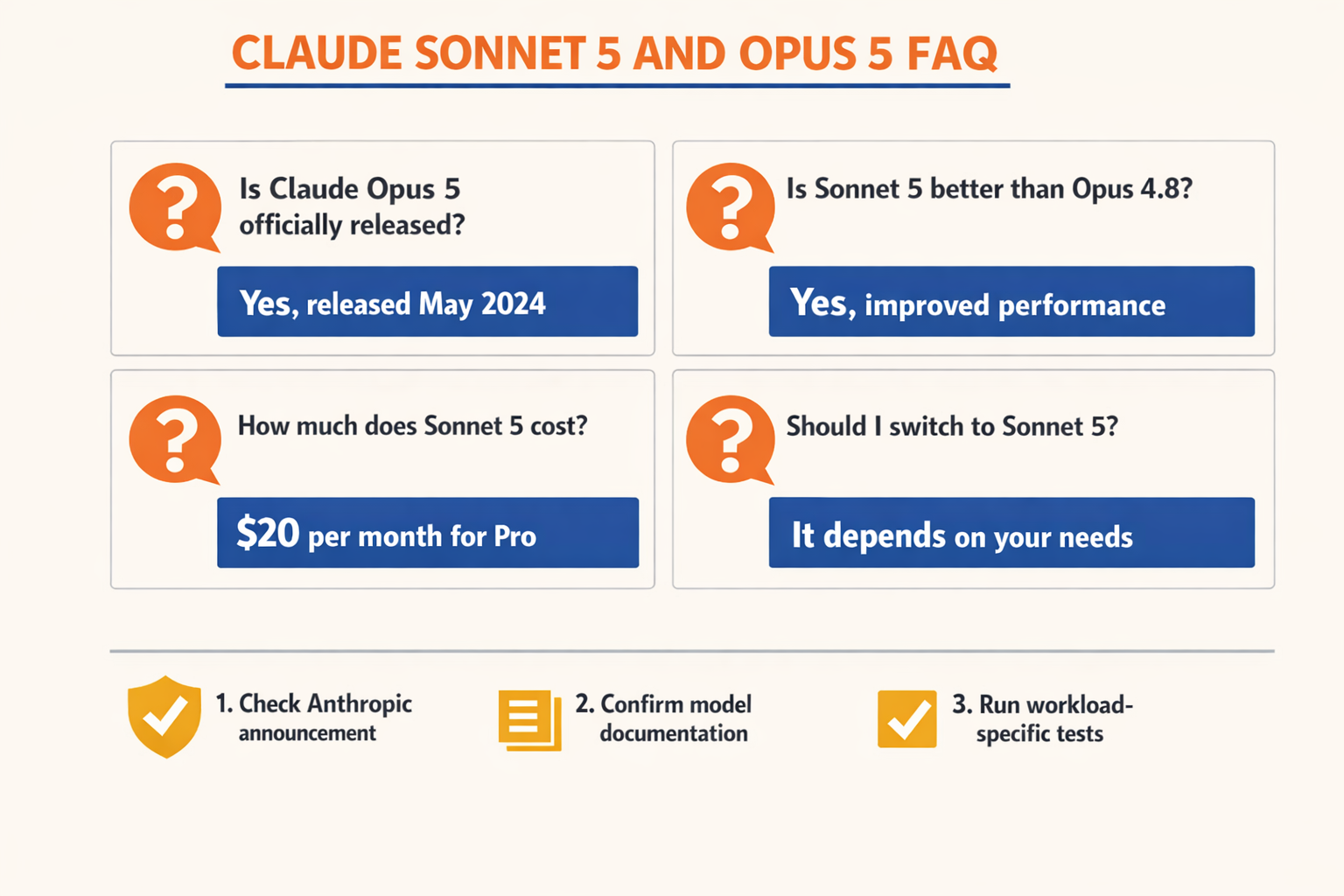
Is Claude Opus 5 officially released as of July 23, 2026?
Who wins the Claude Opus 5 vs Claude Sonnet 5 comparison?
Is Claude Sonnet 5 better than Claude Opus 4.8 for coding and reasoning?
What is Claude Sonnet 5 API pricing?
What context window does Claude Sonnet 5 support, and how does it compare with Opus 5?
Should developers switch in the Claude Opus 5 vs Claude Sonnet 5 decision?
Conclusion
The defensible verdict on July 23, 2026, is that Claude Sonnet 5 wins by default as the only model in this matchup with officially published specifications and benchmarks. Claude Opus 5 may eventually become the stronger model, but its capabilities, context window, pricing, latency, and release status remain unverified in the supplied official materials.
- Sonnet 5 is the production-ready choice today. Anthropic describes Claude Sonnet 5 as a drop-in upgrade from Claude Sonnet 4.6 and officially compares it with Sonnet 4.6 and Claude Opus 4.8—not with an unreleased or undocumented Opus 5.
- The strongest confirmed Opus comparison is still Opus 4.8. BuildFastWithAI reported in 2026 that Sonnet 5 scored 63.2% on its cited coding evaluation, compared with 69.2% for Opus 4.8 and 62.1% for GLM-5.2. These results suggest competitive coding performance, but they do not establish how Opus 5 would perform.
- Benchmarks do not guarantee production outcomes. CodeRabbit reported in 2026 that Sonnet 5 found approximately 50%–51% of bugs in its testing setup, while its existing production baseline found about 57%. Teams should therefore test models against representative repositories, tool chains, prompts, and failure conditions before migrating.
- Sticker price is only part of the cost equation. As MindStudio highlights, a lower-priced model can cost more in an agentic workflow when it requires additional tokens, retries, or tool calls. Model selection should account for successful-task cost, latency, reliability, and operational overhead—not token rates alone.
The next signals to watch are an official Anthropic Opus 5 announcement, reproducible benchmark disclosures, documented context limits, API pricing, latency data, and independent production tests. Until those arrive, any “Opus 5 versus Sonnet 5” winner based on rumored specifications is speculation rather than analysis.
Developers can also reduce lock-in by evaluating model families through shared infrastructure. To explore this approach, check out CallMissed, an AI communication infrastructure platform offering an OpenAI-compatible multi-model gateway alongside voice agents and multilingual chatbots.
When Opus 5 is officially documented, will its measured gains justify its likely production trade-offs—or will Sonnet 5 remain the more practical default?
Related Reading
- Claude Opus 5 vs GPT-5.6 Sol: Verified Facts vs Rumors (July 2026)
- Claude Sonnet 5 vs Fable 5: Benchmarks, Pricing, and Best Uses in 2026
- GPT-5.6 vs Claude Opus 4.8: Benchmarks, Pricing & Verdict
Sources
Related Posts


Ready to automate customer conversations?
Launch AI voice agents and WhatsApp bots with CallMissed — one API, 22+ Indian languages.