

Claude Opus 5 vs Claude Mythos 5: Verified Facts, Claims and Verdict



Compare Claude Opus 5 vs Claude Mythos 5 using verified facts, claim labels, access details and practical guidance on whether to wait.
Claude Opus 5 vs Claude Mythos 5: Verified Facts, Claims and Verdict
Here is the surprising verdict: Claude Opus 5 vs Claude Mythos 5 is not yet a valid apples-to-apples model comparison. As of July 23, 2026, Anthropic has officially documented and released Claude Mythos 5, while Claude Opus 5 still has no confirmed model card, API identifier, pricing, benchmark suite, context window, or release date.
That distinction matters because online speculation can make an anticipated model look like a shipping product. Anthropic’s Model System Cards page lists the Claude Fable 5 and Claude Mythos 5 system card in June 2026, alongside Claude Opus 4.7 from April 2026, but it does not list an Opus 5 system card as of July 23, 2026. Any precise claim about Claude Opus 5 performance or cost must therefore be labeled expected, leaked, or unverified, not presented as official Anthropic data.
Why this comparison matters now
Claude Mythos 5 has followed an unusually eventful release path. Anthropic announced Claude Mythos 5 on June 9, 2026; the company’s product page recorded the model as unavailable on June 12, 2026; and Anthropic announced its redeployment on July 1, 2026, after export controls affecting Claude Fable 5 and Mythos 5 were lifted. This timeline makes access and availability central to the comparison—not a minor footnote.
Anthropic also states that Claude Mythos 5 can identify and exploit software vulnerabilities more effectively than any previous model, except the most skilled human specialists. That capability raises practical questions about cybersecurity access, safeguards, agent autonomy, and whether Mythos 5 is appropriate for ordinary coding workloads or specialized, controlled deployments.
What this guide will verify
This comparison separates evidence into clear categories:
- Official: Anthropic announcements, product pages, transparency disclosures, and system cards
- Unverified: leaks, forecasts, naming assumptions, and unsupported Claude Opus 5 specifications
- Unknown: details Anthropic has not publicly confirmed
You will learn how the models compare—or cannot yet be compared—across pricing, API access, context and output limits, coding, reasoning, long-horizon agents, multimodality, safety, availability, and workload fit. The analysis will also explain whether developers should use Mythos 5 now, choose a documented Opus release, or wait for verified Opus 5 information.
For teams insulating applications from rapidly changing model availability, platforms such as CallMissed’s OpenAI-compatible multi-model gateway reflect the broader shift toward one integration with automatic same-tier fallbacks. The guiding rule throughout this verdict is simple: documented facts outrank plausible rumors.
Which model wins? Use Claude Mythos 5 if you qualify; wait for official evidence before choosing Claude Opus 5
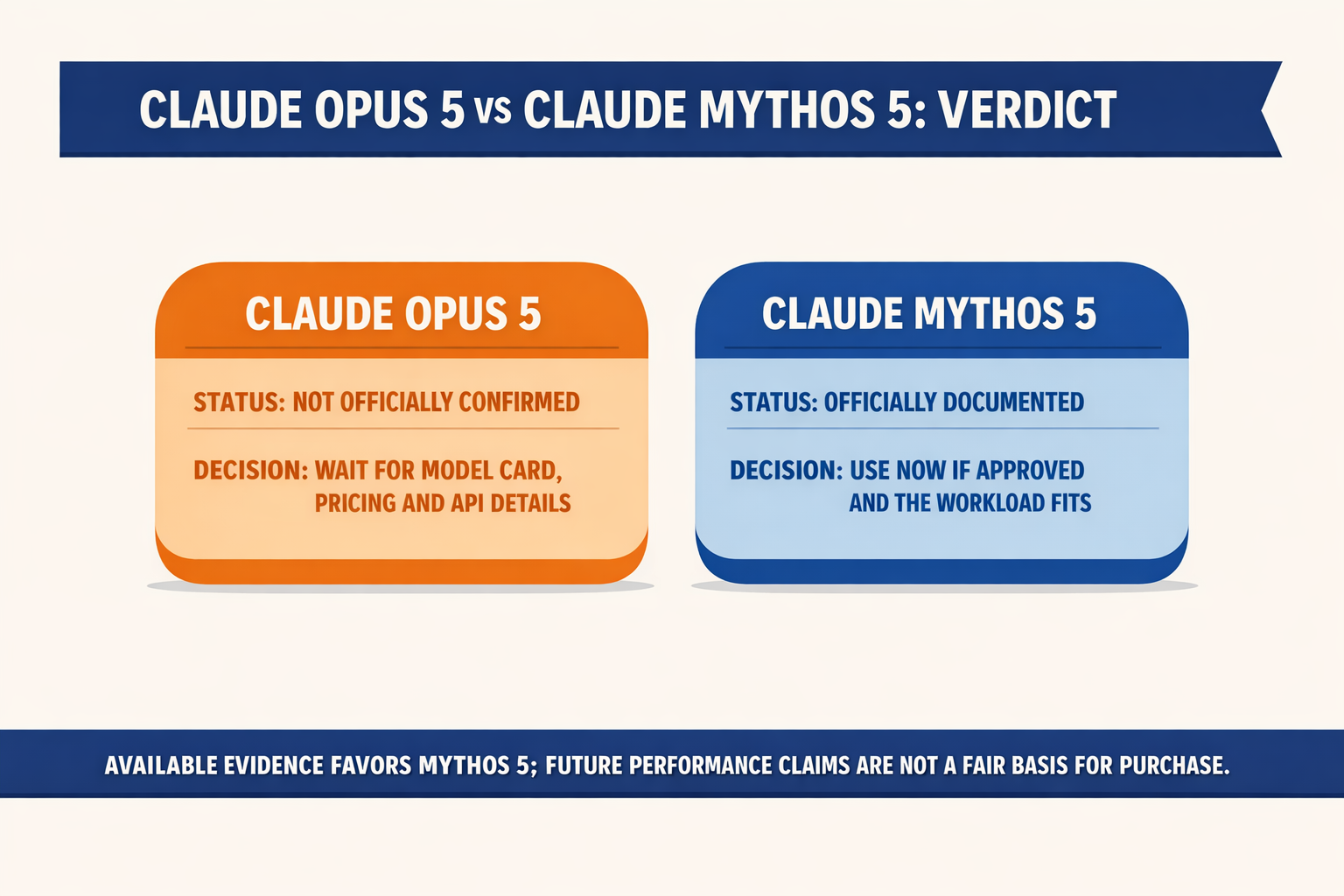
Claude Mythos 5 wins only for qualified teams that need its verified, specialized capabilities and can obtain access. For everyone else, there is no evidence-based winner: Claude Opus 5 remains unconfirmed as of July 23, 2026, so organizations should wait for official documentation or use a currently documented Claude model.
The verdict depends on evidence and eligibility
This is an asymmetric comparison between a released but access-controlled model and an anticipated model with no official specifications.
- Choose Claude Mythos 5 when advanced cybersecurity or biological-research capabilities directly match your workload, your organization meets Anthropic’s access requirements, and appropriate human oversight is in place.
- Wait for Claude Opus 5 when your decision depends on price, latency, context length, output limits, API compatibility, multimodal support, or benchmark performance. Anthropic has not confirmed those details.
- Use a documented general-purpose model now when you need predictable production access rather than specialized capabilities or an unknown launch timetable. Anthropic’s Model System Cards page lists Claude Opus 4.7 from April 2026 as an officially documented release.
- Do not treat “Honeycomb” as Claude Opus 5 unless Anthropic explicitly confirms that relationship. A codename, leak, or inference is not a product specification.
Why Mythos 5 wins its narrow category
Anthropic describes Claude Mythos 5 as capable of finding and exploiting software vulnerabilities “more effectively than any other model—and all but the most skilled human specialists.” That official claim makes Mythos 5 relevant to authorized vulnerability research, defensive security, and carefully governed long-horizon investigations.
Its release history also explains why availability is part of model performance in practice:
- Anthropic announced Claude Mythos 5 on June 9, 2026.
- Anthropic’s Claude Mythos product page marked the model unavailable on June 12, 2026.
- Anthropic announced that export controls had been lifted and redeployed Claude Mythos 5 on July 1, 2026.
- Anthropic’s product materials still direct prospective cybersecurity and biology users toward an access process, so “redeployed” should not automatically be interpreted as unrestricted self-service API availability for every user.
A highly capable model that a team cannot access, authorize, or safely govern is not the practical winner for that team.
Why Opus 5 cannot win yet
Any Claude Opus 5 advantage currently rests on expectations rather than reproducible evidence. There is no official basis for precise claims about:
- Claude Opus 5 pricing or API costs
- Context-window or maximum-output limits
- Coding and reasoning benchmarks
- Long-horizon agent reliability
- Multimodal inputs and outputs
- API model identifiers, regions, or release timing
This does not establish that Claude Opus 5 will underperform Mythos 5. It establishes that the comparison cannot yet be measured.
Practical wait-or-use-now decision
Use Claude Mythos 5 now only if its specialized risk profile and controlled access align with a concrete need. Otherwise, select an officially documented production model and reevaluate Opus 5 after Anthropic publishes a model card, API documentation, pricing, availability terms, and reproducible benchmarks.
The defensible conclusion on July 23, 2026 is therefore: Mythos 5 is the conditional winner for qualified specialist workloads; Opus 5 is a wait, not a recommendation.
What is the background to Claude Mythos 5, and is Claude Opus 5 officially real as of July 23, 2026?

Claude Mythos 5 is an officially released, documented Anthropic model with a system card and a complex deployment history. Claude Opus 5, by contrast, is not an officially confirmed product as of July 23, 2026; its name and purported specifications remain expectations or unverified claims.
Mythos 5 evolved from a documented preview
Anthropic’s public records establish a clear lineage for Mythos. The company’s Model System Cards page lists Mythos Preview in April 2026, followed by the combined Claude Fable 5 and Claude Mythos 5 system card in June 2026. This progression indicates that Mythos moved from a preview-stage system into a formally documented release rather than appearing only through leaks or model-name sightings.
Anthropic announced Claude Mythos 5 on June 9, 2026. The company positions Mythos 5 as a highly capable model intended for sensitive, advanced work, particularly in cybersecurity and biology.
One capability claim is especially important: Anthropic stated in June 2026 that Claude Mythos 5 could find and exploit software vulnerabilities more effectively than any other model and all but the most skilled human specialists. That is Anthropic’s characterization—not an independently reproduced universal benchmark—but it explains why Mythos 5 carries stricter access and safety considerations than a general-purpose chatbot.
Officially established facts include:
- Model status: Released and documented by Anthropic
- Release period: June 2026, according to Anthropic’s Transparency Hub
- System card: Published jointly with Claude Fable 5 in June 2026
- Predecessor stage: Mythos Preview received a system card in April 2026
- Intended relevance: Advanced cybersecurity and biology capabilities, subject to safeguards and access controls
Why Mythos 5 availability has been unusual
Mythos 5 should not be described simply as “globally available” without explaining its interruption and qualification requirements. Anthropic’s product page recorded three distinct events:
- June 9, 2026: Claude Mythos 5 was announced.
- June 12, 2026: Anthropic marked Claude Mythos 5 as unavailable after complying with a US government directive affecting access to Mythos 5 and Fable 5.
- July 1, 2026: Anthropic announced that export controls had been lifted and the models were redeployed.
Redeployment does not necessarily mean unrestricted self-service access for every customer or every capability. Anthropic’s Claude Fable information specifically directs users to ask when they can obtain Mythos 5 access for cybersecurity and biology, supporting the conclusion that some high-risk uses remain gated or eligibility-dependent.
Opus 5 is a plausible name, not a verified model
Anthropic’s documented Opus line reached Claude Opus 4.7 in April 2026, according to the company’s Model System Cards page. However, the same official index contains no Claude Opus 5 system card as of July 23, 2026.
Consequently, the following Claude Opus 5 details are unknown, not zero or “to be announced” specifications:
- API model identifier and provider availability
- Input context and maximum output
- Token or subscription pricing
- Coding, reasoning, agentic, or multimodal benchmarks
- Safety classification, deployment scope, and release date
References to leaked codenames—including attempts to equate Honeycomb with Claude Opus 5—must remain labeled unverified. A model becomes comparison-ready only when Anthropic supplies primary documentation, not when a predicted name becomes widely repeated.
Which developments are verified, expected or leaked? (TABLE)
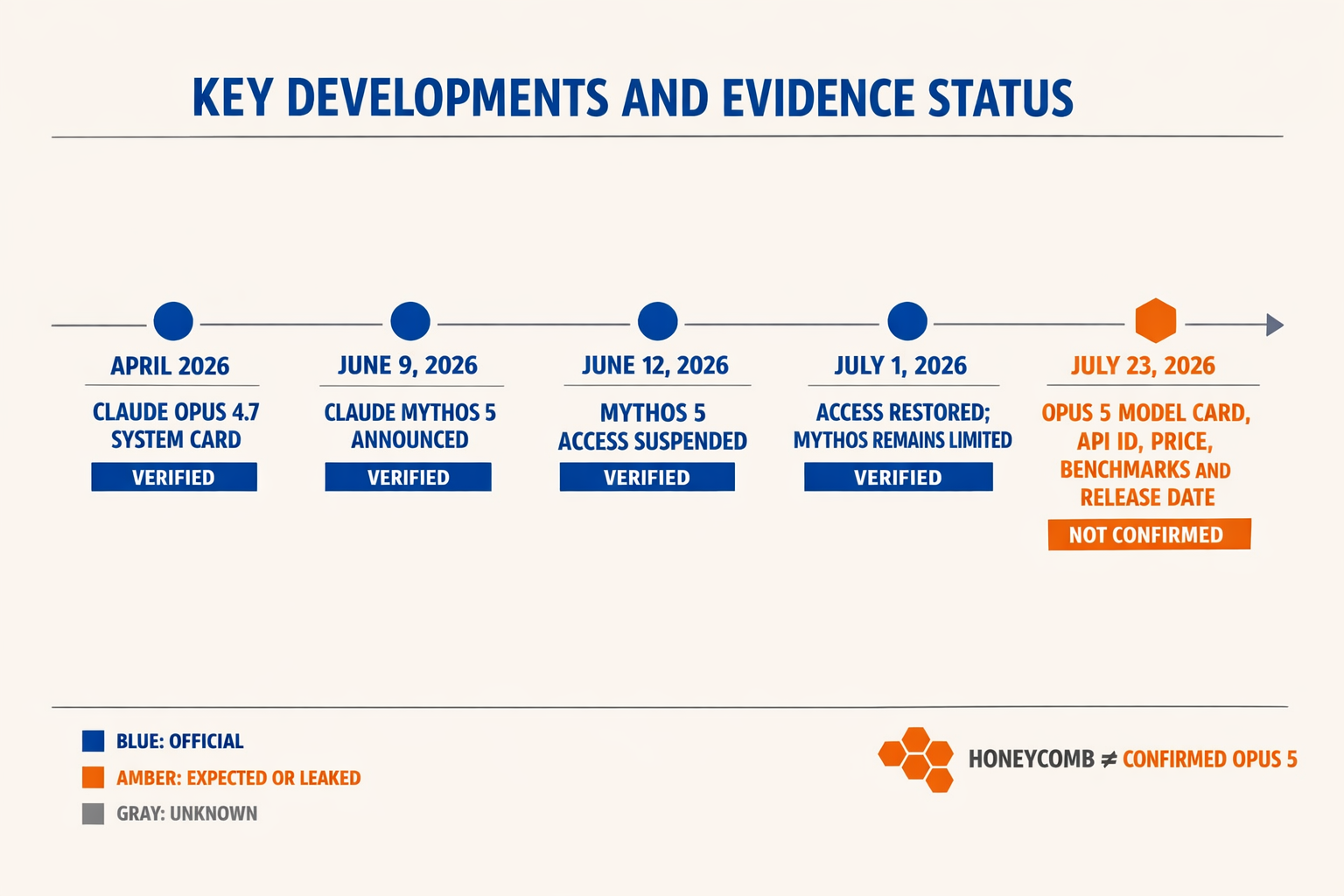
Claude Mythos 5 is verified; Claude Opus 5 remains speculative as of July 23, 2026. Anthropic has published a Mythos 5 system card, release history, capability disclosures, and access updates, while alleged Opus 5 specifications lack an official model card or product announcement.
Evidence status at a glance
| Development or claim | Claude Mythos 5 evidence | Claude Opus 5 evidence | Status |
|---|---|---|---|
| Model officially exists | Anthropic announced Mythos 5 on June 9, 2026 | No Anthropic announcement identified | Mythos: verified; Opus: unverified |
| System card published | Anthropic lists the Claude Fable 5 and Mythos 5 system card dated June 2026 | Anthropic’s system-card index stops at Claude Opus 4.7, dated April 2026 | Official record |
| Current availability | Anthropic announced redeployment on July 1, 2026, after export controls were lifted | No confirmed release date or availability | Mythos: verified but access-dependent |
| Cybersecurity capability | Anthropic says Mythos 5 can find and exploit vulnerabilities better than any previous model and “all but the most skilled” human specialists | No official coding or cybersecurity benchmarks | Mythos: official claim |
| Price, context and output limits | Not established by the supplied public evidence as universal commercial specifications | No confirmed price, API ID, context window, or output limit | Unknown |
| “Honeycomb” or leaked Opus 5 specifications | Not applicable | No official evidence establishes that a codename, leak, or benchmark belongs to Opus 5 | Leaked or unverified |
What Anthropic has officially verified
Anthropic’s Model System Cards page lists “Claude Fable 5 and Mythos 5” for June 2026, following the Mythos Preview from April 2026. The same index lists Claude Opus 4.7 in April 2026, but no Claude Opus 5 entry as of July 23, 2026.
The Mythos 5 availability record is also documented, although it is not a simple uninterrupted launch:
- Anthropic announced Claude Mythos 5 on June 9, 2026.
- Anthropic’s Claude Mythos product page marked it unavailable on June 12, 2026.
- Anthropic reported that Mythos 5 and Fable 5 were available again on July 1, 2026, after the relevant export controls were lifted.
“Redeployed” should not be interpreted as proof of unrestricted self-service access in every region, account tier, API, or high-risk domain. Anthropic’s materials separately discuss access for cybersecurity and biology, so buyers should verify eligibility and permitted use directly rather than assuming general availability.
What is expected—and what remains leaked
It is reasonable to expect a future Opus-generation model to target advanced reasoning, coding, and agentic workloads because those capabilities align with Anthropic’s established Opus positioning. However, an expectation is a forecast, not a specification.
Claims should remain labeled leaked or unverified when they assign Claude Opus 5:
- A particular codename, including Honeycomb
- Exact benchmark scores or performance gains
- A context window, output ceiling, or multimodal feature set
- API pricing, an API model identifier, or a launch date
Until Anthropic publishes primary documentation, these figures cannot support a defensible Claude Opus 5 vs Claude Mythos 5 buying decision. The practical rule is: treat Mythos 5 disclosures as model-specific evidence, and treat every precise Opus 5 claim as unknown unless Anthropic confirms it.
How do price, context window, output limits and access compare? (TABLE)
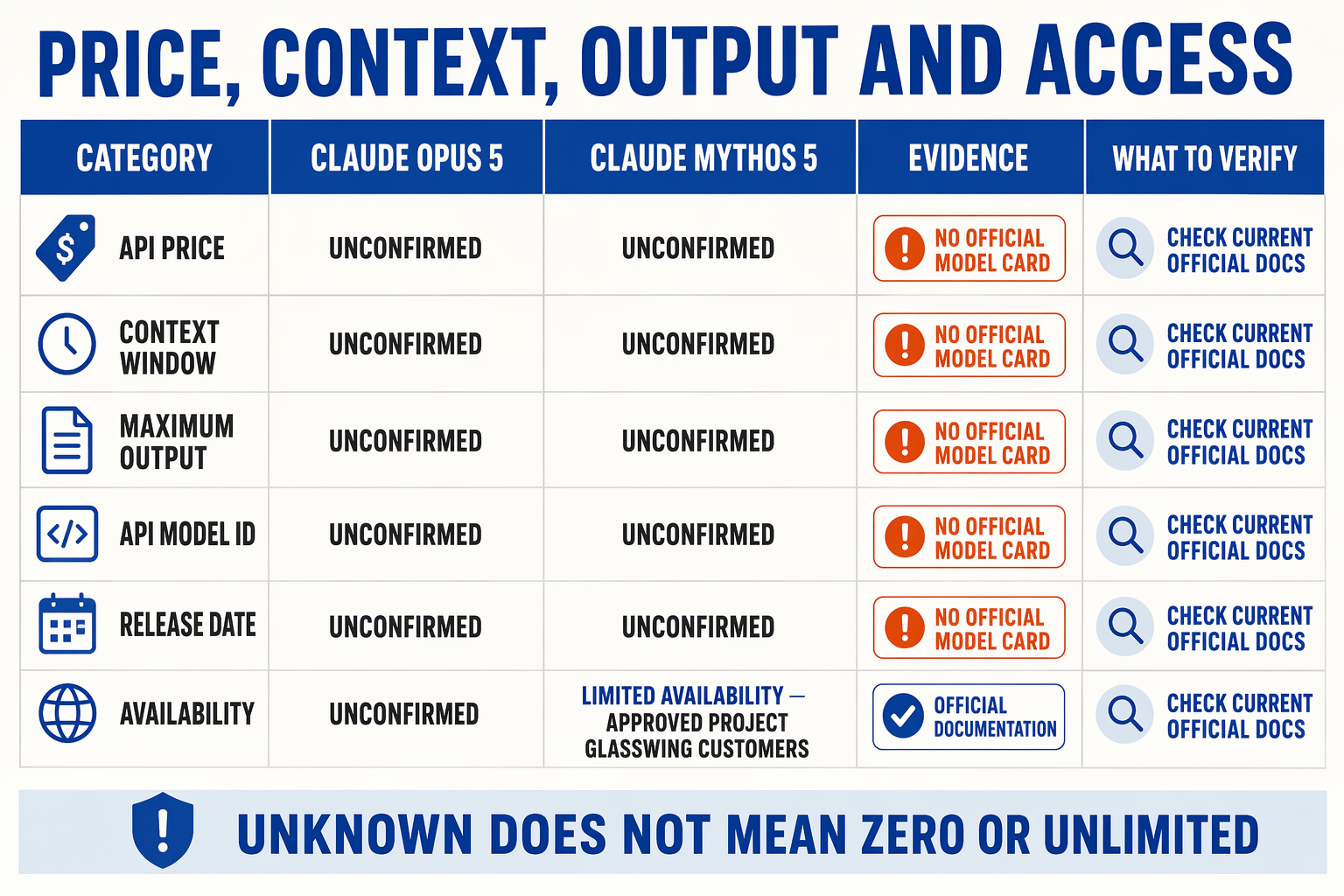
Only a partial commercial comparison is currently possible. As of July 23, 2026, Anthropic documents Claude Mythos 5 pricing at $10 per million input tokens and $50 per million output tokens, but access is limited. Claude Opus 5 remains unannounced, so its price, limits, API details, availability, and performance are unknown.
Evidence-labeled specification comparison
| Specification | Claude Mythos 5 | Claude Opus 5 | Evidence status |
|---|---|---|---|
| Release status | Officially announced; limited deployment | Unannounced | Mythos: official; Opus: unknown |
| API pricing | $10/MTok input; $50/MTok output | Unknown | Mythos: official; Opus: unknown |
| Context window | No public numerical limit stated in Anthropic’s Mythos 5 documentation | Unknown | Not available for comparison |
| Maximum output | No public numerical limit stated in Anthropic’s Mythos 5 documentation | Unknown | Not available for comparison |
| API identifier | No standard, generally available self-serve API ID publicly documented | Unknown | Not publicly established |
| Access | Limited, safeguard-controlled access rather than unrestricted self-serve availability | Unavailable | Mythos: limited; Opus: unavailable |
| Benchmarks | Use only results published in Anthropic’s Mythos 5 materials, subject to their stated test conditions | Unknown | No Opus 5 comparison is possible |
“MTok” means one million tokens. At the documented list rates, one million input tokens plus one million generated output tokens would cost $60 before any separately documented discounts, caching charges, or other account-specific terms.
What Mythos 5’s safeguard configuration means
Anthropic presents Mythos 5 as a limited-access model operating with safeguards around higher-risk capabilities, including sensitive cybersecurity and biological use. These safeguards concern access, capability exposure, monitoring, and permitted use; they should not be reinterpreted as token limits or as evidence that every customer receives the model’s full sensitive-domain capabilities.
Accordingly, “available” does not mean that Mythos 5 is an unrestricted, instantly enabled API model for every account. Organizations may need Anthropic approval, and access can depend on the use case, customer eligibility, jurisdiction, and applicable safety controls. Anthropic’s public materials do not justify assigning Mythos 5 a context-window or maximum-output figure that the company has not explicitly published.
What buyers can—and cannot—calculate
The official $10/$50 per-MTok pricing permits basic usage-cost estimates. For example:
- 100,000 input tokens cost $1
- 10,000 output tokens cost $0.50
- A request using both would cost $1.50 at list price
However, without public context and output limits, buyers still cannot reliably determine:
- The largest document or repository accepted in one request
- The longest possible uninterrupted response
- Whether a particular long-horizon agent workflow fits within one context
- Public rate limits or concurrency allowances
- Whether their account qualifies for Mythos 5 access
- The cost or performance of any Claude Opus 5 workload
The practical procurement sequence is therefore:
- Confirm Mythos 5 eligibility directly with Anthropic.
- Obtain the exact model identifier, context limit, output cap, regional availability, rate limits, and safeguard obligations in writing.
- Use the documented $10/MTok input and $50/MTok output rates only for Mythos 5.
- Treat every Claude Opus 5 price, token limit, API ID, benchmark, or release date as unverified unless Anthropic publishes it.
Bottom line: Claude Mythos 5 has official per-token pricing but limited, safeguard-controlled access, and its public context and output limits are not established here. Claude Opus 5 is unannounced, so no defensible price, capacity, access, or benchmark comparison can yet be made.
Which is stronger for coding, reasoning, long-horizon agents and multimodal work?
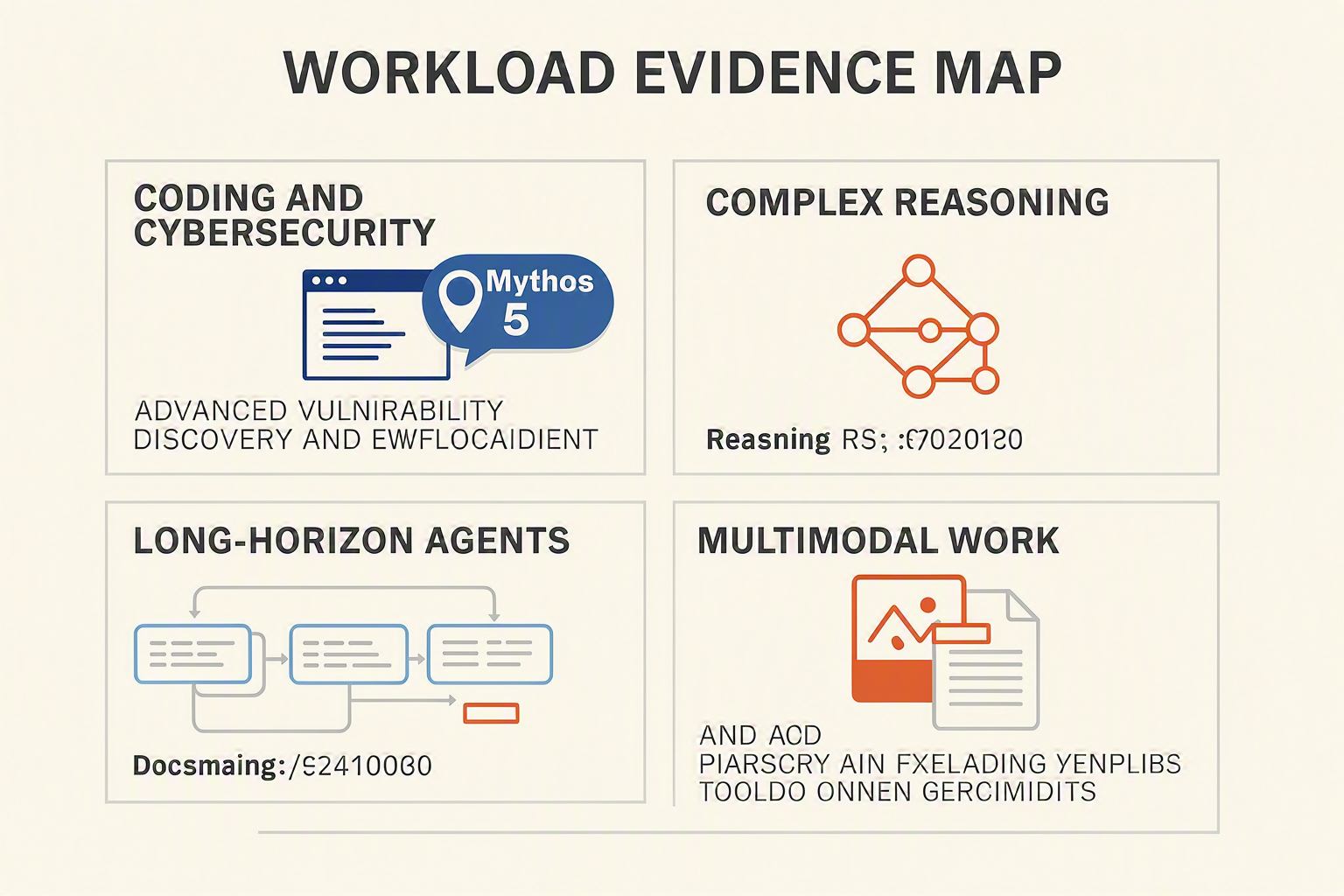
Claude Mythos 5 is stronger only in the area where Anthropic has published specific evidence: advanced cybersecurity, particularly vulnerability discovery and exploitation. For routine coding, general reasoning, long-horizon agents, and multimodal work, no defensible winner exists because Claude Opus 5 had no official specifications, model card, or benchmarks as of July 23, 2026.
Coding and cybersecurity
In its July 2026 redeployment announcement, Anthropic said Claude Mythos 5 can find and exploit software vulnerabilities more effectively than “any other model—and all but the most skilled human specialists.” This is Anthropic’s exact claim, but it does not establish that Mythos 5 is universally superior across software engineering.
Coding performance must be divided into distinct workloads:
- Cybersecurity: Mythos 5 has the clearest documented advantage for authorized vulnerability discovery and exploitation.
- Application development: Anthropic has not published comparative evidence covering feature implementation, debugging, refactoring, test generation, or repository maintenance.
- Coding benchmarks: No official Claude Opus 5 benchmark set exists against which Mythos 5 can be evaluated.
- Production reliability: Comparable figures for tool-call accuracy, regression rates, latency, cost, and completed tasks remain unavailable.
Claims that Claude Opus 5 will become Anthropic’s premium general-purpose coding model are expectations or leaks, not verified facts. Anthropic’s Model System Cards page listed Claude Opus 4.7 in April 2026 and Claude Fable 5 and Claude Mythos 5 in June 2026, but it did not list an Opus 5 system card by July 23.
Reasoning and long-horizon agents
Neither model can currently be declared the overall reasoning winner. Mythos 5’s cybersecurity capabilities imply sophisticated planning within a specialized domain, but they do not prove leadership in mathematics, scientific research, legal analysis, or business reasoning.
For long-horizon agents, teams should evaluate operational behavior rather than infer performance from a cybersecurity claim:
- Goal retention across extended, multi-step workflows
- Recovery from failed tools and incomplete information
- Permission, escalation, and refusal behavior
- Frequency of human intervention
- Successful completion per unit of time and cost
Anthropic’s Transparency Hub records June 2026 as the Claude Mythos 5 release period and points to Section 8 of the Claude Fable 5 and Mythos 5 system card for capability details. No equivalent Opus 5 disclosure was available, preventing a controlled agent-performance comparison.
Multimodal work
There is no verified multimodal winner. Claude Opus 5’s supported input types, image understanding, audio or video handling, context window, and maximum output remain unconfirmed. Mythos 5 should likewise be judged only by capabilities explicitly documented for that model—not by features available elsewhere in the Claude family.
Practical verdict by workload
- Authorized vulnerability research: Prefer Claude Mythos 5, subject to Anthropic’s access controls and usage policies.
- Everyday software development: Test documented, accessible models on representative repositories and tasks.
- General reasoning: No evidence-based Opus 5 versus Mythos 5 winner exists.
- Long-running agents: Use controlled pilots with logging, restricted permissions, and human approval gates.
- Multimodal applications: Wait for model-specific documentation before committing architecture or budget.
Anthropic redeployed Claude Mythos 5 on July 1, 2026, following its June interruption. Redeployment does not mean unrestricted suitability: for a model with unusually powerful cybersecurity capabilities, authorization, safeguards, and access conditions are part of the workload decision.
Can Claude Mythos/Fable 5 benchmarks be compared fairly with expected Opus 5 claims?
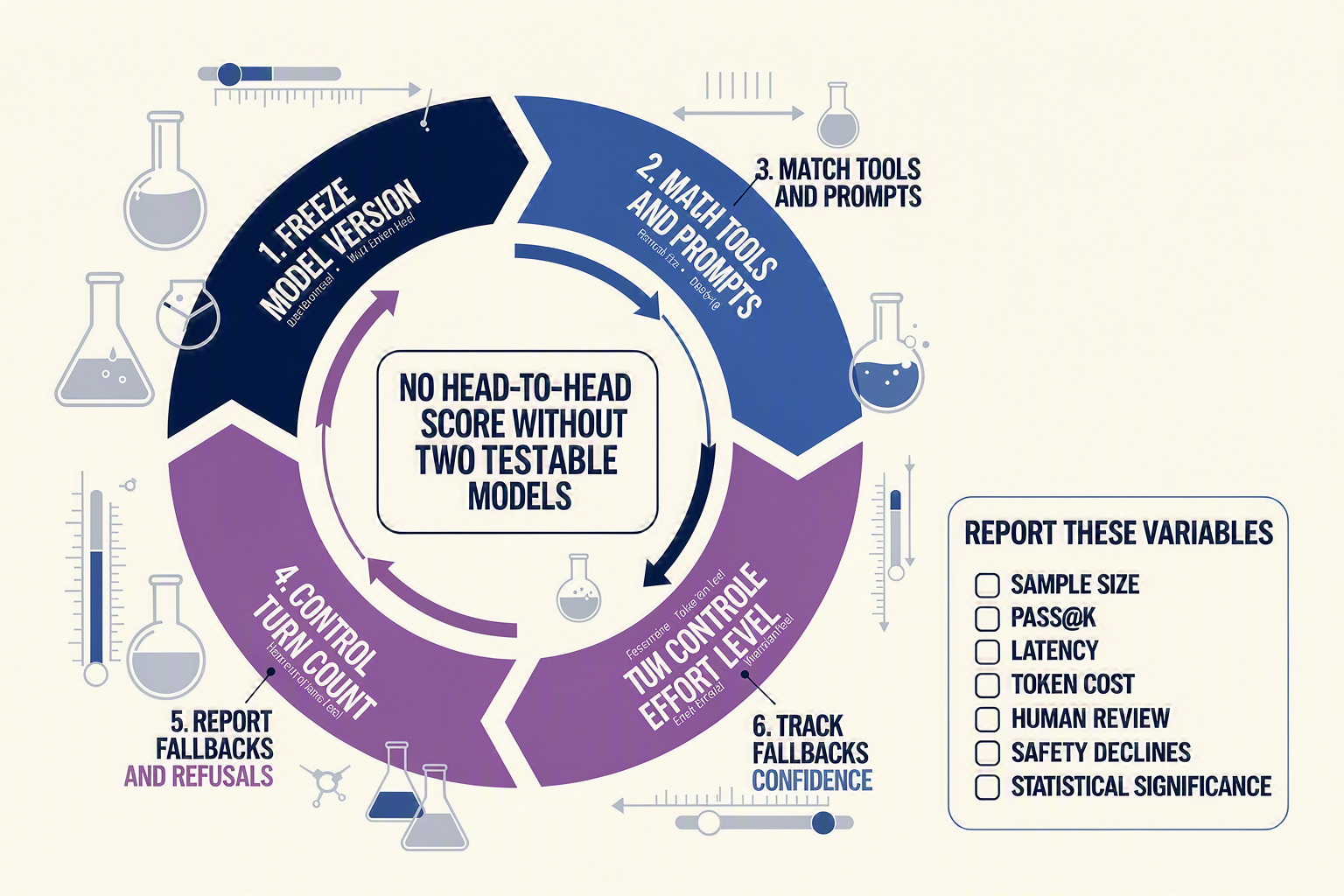
No—not yet. Claude Mythos/Fable 5 benchmark results cannot be compared fairly with Claude Opus 5 claims because Mythos 5 has official Anthropic documentation, while Opus 5 has no confirmed benchmark suite, model card, API identifier, pricing, or release date as of July 23, 2026.
What counts as verified benchmark evidence?
A defensible comparison requires both models to be evaluated under the same conditions. At minimum, a benchmark should disclose:
- The exact model version or API identifier
- Identical prompts, tools, token budgets, and sampling settings
- Whether extended reasoning, web access, or computer use was enabled
- The evaluation date and number of trials
- Scoring methodology, pass criteria, and human-review procedures
- Access conditions, including safeguards or restricted deployment modes
Claude Mythos 5 clears part of this evidence threshold because Anthropic lists the Claude Fable 5 and Claude Mythos 5 system card on its Model System Cards page with a June 2026 publication date. Anthropic’s Transparency Hub directs readers specifically to Section 8 of that system card for capabilities.
Claude Opus 5 does not clear the threshold. A leaked score attributed to “Opus 5,” an unnamed “next Opus,” or a rumored internal model cannot be treated as comparable until Anthropic confirms which model produced it and how the test was run.
Capability statements are not benchmark scores
Anthropic states that Claude Mythos 5 can find and exploit software vulnerabilities more effectively than any other model and all but the most skilled human specialists. This is a significant official capability claim, but it is not interchangeable with a public leaderboard percentage.
Readers should distinguish among three evidence types:
- Official quantitative result: A score published with a named test and documented methodology.
- Official qualitative claim: Anthropic’s vulnerability-research statement about Mythos 5.
- Unverified claim: Any precise Opus 5 score, context limit, coding percentage, or agent-performance figure without an Anthropic model card.
The same caution applies to the phrase “Claude Mythos/Fable 5 benchmarks.” Anthropic published a joint system card, but Claude Fable 5 and Claude Mythos 5 should not automatically be treated as the same model. A result labeled only “Fable 5” cannot be reassigned to Mythos 5 unless the source explicitly says the evaluated capability or score applies to both.
Why access conditions can distort results
Availability changed materially during the launch period. Anthropic announced Mythos 5 on June 9, 2026, recorded it as unavailable on June 12, 2026, and announced that Fable 5 and Mythos 5 were available again on July 1, 2026, after export controls were lifted.
That interruption creates several comparison risks:
- Independent evaluators may have had unequal or short-lived access.
- Cybersecurity safeguards may constrain tools, targets, or prompts.
- Anthropic’s internal evaluations may test capabilities unavailable to ordinary users.
- Small test samples can exaggerate apparent differences between models.
The fair-comparison verdict
For now, use Mythos 5 results to assess documented Mythos 5 capabilities, not to predict an Opus 5 victory or defeat. A valid Claude Opus 5 vs Claude Mythos 5 benchmark comparison must wait for an official Opus 5 release and matched, reproducible testing; until then, precise head-to-head performance claims remain speculation rather than evidence.
Why is Claude Mythos 5 availability limited, and what are the safety implications?

Claude Mythos 5 availability has been limited by a documented US government directive and by safeguards around high-risk cybersecurity and biology use cases. Anthropic restored the model on July 1, 2026, but its release history shows that legal controls and domain-specific access requirements can affect availability independently of technical readiness.
Verified availability timeline
Claude Mythos 5’s status changed three times over 22 days:
- June 9, 2026: Anthropic announced Claude Mythos 5.
- June 12, 2026: Anthropic suspended Claude Mythos 5 and Claude Fable 5 under a US government legal directive.
- July 1, 2026: Anthropic redeployed both models after the relevant export controls were lifted.
On June 12, Anthropic said it was “removing access to Fable 5 and Mythos 5 for all users” while complying with the government directive, although Anthropic stated that it disagreed with the decision. Anthropic subsequently reported that the export controls had been lifted and that Claude Mythos 5 was available again on July 1.
These are reported availability facts, not evidence of a technical outage or model-quality problem. They demonstrate that access to frontier AI can depend on export policy and government action, not merely API capacity, pricing, or subscription level.
As of July 23, 2026, Anthropic lists Claude Mythos 5 as redeployed. However, Anthropic’s Claude Fable documentation separately addresses obtaining Mythos 5 access for cybersecurity and biology, indicating that sensitive uses may follow specialized access guidance rather than ordinary self-service onboarding.
Why Mythos 5 raises dual-use concerns
Anthropic claims that Claude Mythos 5 can “find and exploit software vulnerabilities more effectively than any other model—and all but the most skilled human specialists.” The comparison is explicitly with any other model, not merely previous Claude models, and it remains Anthropic’s own capability assessment.
That claim creates clear dual-use implications:
- Defensive security: Mythos 5 could help authorized teams identify vulnerabilities, reproduce exploits, and prioritize remediation.
- Offensive misuse: The same capabilities could support reconnaissance, exploit development, or multi-stage attack automation.
- Biological risk: Anthropic’s specialized access framing identifies biology as another domain requiring heightened safeguards.
- Agentic risk: A model connected to terminals, code execution, credentials, or networks can translate generated instructions into consequential actions.
Limited or reviewed access can therefore function as a safety control. It should not automatically be interpreted as evidence that Mythos 5 is unreliable or generally unavailable.
Prudent deployment recommendations
The following are risk-management recommendations, not controls that Anthropic has necessarily documented as mandatory for every Mythos 5 deployment:
- Run generated code in isolated sandboxes with restricted network access.
- Use least-privilege, short-lived credentials for tools and infrastructure.
- Require human approval before exploitation, external communication, or production changes.
- Log prompts, tool calls, generated code, and operator decisions.
- Permit security testing only on systems covered by written authorization.
- Establish disclosure and escalation procedures for newly discovered vulnerabilities.
Opus 5 safety remains unverified
No equivalent assessment is possible for Claude Opus 5. As of July 23, 2026, Anthropic has not published a confirmed Opus 5 system card, API identifier, release date, pricing schedule, or safeguard framework.
The evidence supports a narrow conclusion: Mythos 5 experienced a documented legal suspension and has specialized access considerations for sensitive domains; claims about Opus 5 availability or safety remain speculative.
What do Anthropic’s primary sources and independent experts actually establish?
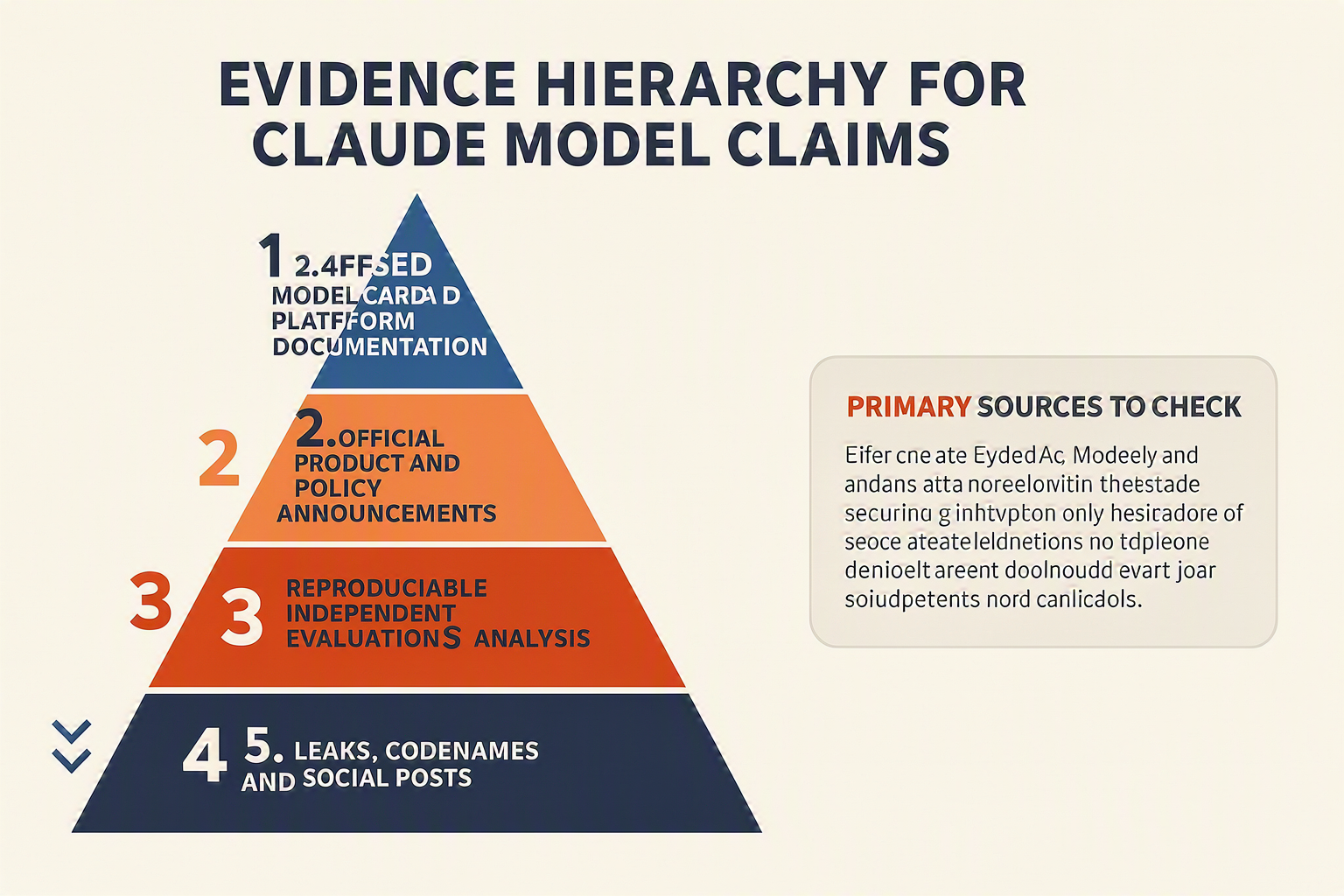
Anthropic’s primary sources establish that Claude Mythos 5 is a released, documented model with unusually advanced cybersecurity capabilities, while they establish virtually nothing about Claude Opus 5. As of July 23, 2026, no supplied independent evidence closes that gap or validates alleged Opus 5 specifications.
What Anthropic officially confirms
Anthropic’s first-party evidence consists of its launch announcements, product pages, Transparency Hub, access statements, and model system cards. Together, those sources establish several facts:
- Claude Mythos 5 was announced on June 9, 2026.
- Anthropic’s product page marked Claude Mythos 5 unavailable on June 12, 2026.
- Anthropic announced that Claude Fable 5 and Claude Mythos 5 were available again on July 1, 2026, after the applicable export controls were lifted.
- Anthropic’s Transparency Hub records the release date as June 2026 and directs readers to Section 8 of the joint Claude Fable 5 and Claude Mythos 5 system card for capability evaluations.
- Anthropic’s Model System Cards index lists “Claude Fable 5 and Mythos 5” for June 2026, giving Mythos 5 a traceable safety and evaluation document.
Anthropic also makes a striking cybersecurity claim: “Claude Mythos 5 can be used to find and exploit software vulnerabilities more effectively than any other model—and all but the most skilled human specialists.” That is meaningful first-party evidence about Anthropic’s intended positioning, but it remains an Anthropic claim, not an independently replicated scientific finding.
The access history also requires nuance. “Redeployed” or “available” does not automatically mean unrestricted access through every consumer plan, API region, cloud marketplace, or use case. Buyers should verify current account eligibility, geography, acceptable-use requirements, and cybersecurity or biology access controls directly with Anthropic.
What the sources do not establish about Claude Opus 5
No cited Anthropic primary source confirms:
- A Claude Opus 5 release date
- An official API model identifier
- Input or output pricing
- A context window or maximum output
- Coding, reasoning, agentic, or multimodal benchmark scores
- A system card, availability policy, or safety classification
Accordingly, claims that Opus 5 has a particular architecture, price, benchmark lead, or launch window remain expected, leaked, or unverified. References to a project or model called Honeycomb also cannot be treated as confirmation that Honeycomb is Claude Opus 5 unless Anthropic explicitly makes that connection.
What independent analysis can—and cannot—prove
Independent experts can scrutinize Anthropic’s methodology, compare published benchmark design, test accessible endpoints, and document real-world failure modes. However, credible comparison requires a reproducible model version, stable access, disclosed settings, and enough methodological detail to repeat the test.
The supplied evidence includes no named independent laboratory, peer-reviewed paper, or reproducible third-party benchmark that evaluates Claude Opus 5 against Claude Mythos 5. Search rankings, screenshots, anonymous leaks, and unsourced benchmark charts do not substitute for that evidence.
A defensible evidence hierarchy is therefore:
- Strongest: Anthropic system cards, transparency disclosures, and dated release notices
- Useful but qualified: Independent, reproducible testing of an accessible model
- Preliminary: Credible reporting based on identified sources
- Unverified: Anonymous leaks, inferred names, screenshots, and forecast specifications
The evidence supports evaluating Mythos 5 on documented terms. It does not yet support declaring Opus 5 faster, cheaper, safer, or more capable.
What does this mean for your workload: use Mythos 5 now or wait for Opus 5? (TABLE)
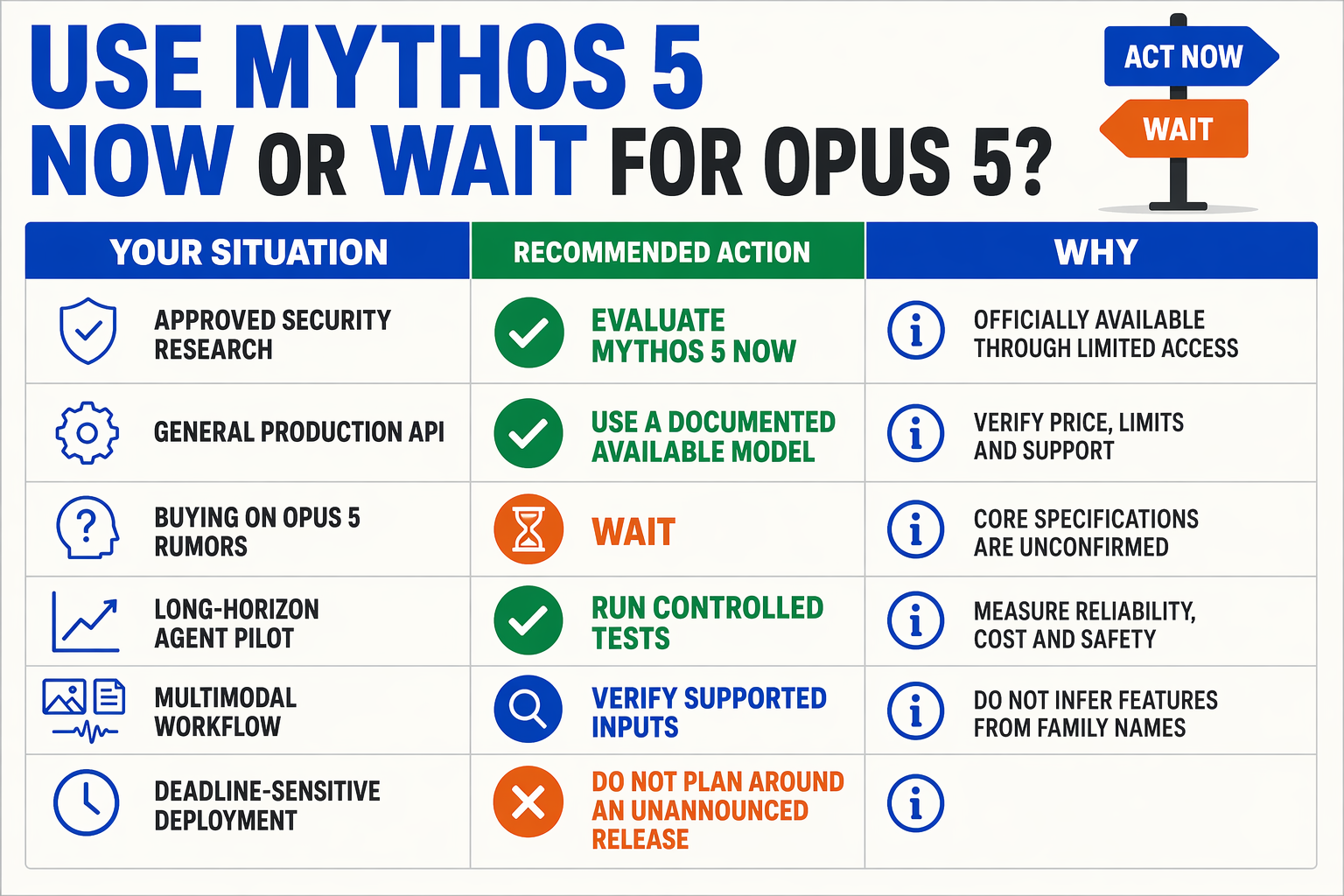
Use Claude Mythos 5 now only if its officially documented capabilities match a controlled, high-value workload and your organization is eligible for access. Otherwise, deploy a documented production model rather than waiting on Claude Opus 5, which had no confirmed release date, model card, API identifier, pricing, or benchmarks as of July 23, 2026.
Workload decision matrix
| Workload | Mythos 5 now? | Wait for Opus 5? | Evidence and recommended action |
|---|---|---|---|
| Authorized vulnerability research | Consider it if approved and accessible | Usually unnecessary | Anthropic stated in July 2026 that Claude Mythos 5 can “find and exploit software vulnerabilities more effectively than any other model—and all but the most skilled human specialists.” Subject to Anthropic’s access conditions and safeguards, evaluate it only in isolated, explicitly authorized environments. |
| Security-sensitive coding agents | Run a restricted pilot | Possibly | Mythos 5’s officially described cyber capability warrants sandboxing, least-privilege credentials, audit logs, network controls, and human approval. Wait if your risk process requires evidence that only an official Opus 5 system card could provide. |
| General application development | Usually not necessary | Do not block delivery | Evaluate a documented model available to your organization, potentially Claude Opus 4.7, instead of assuming Opus 5 will improve coding quality or cost. Mythos 5 should be considered only if internal tests show a meaningful workload benefit. |
| Long-horizon autonomous agents | Only after workload testing | Reasonable, but optional | Neither leaked claims nor model names establish dependable autonomy. Measure task completion, intervention frequency, tool errors, recovery behavior, latency, and failure severity before deployment. |
| Regulated or safety-critical operations | Limited evaluation only | Prefer official evidence | Require applicable system documentation, data-governance review, reproducible evaluations, human approval gates, incident procedures, and rollback paths. Unverified Opus 5 specifications cannot support compliance or procurement decisions. |
| Cost-sensitive production systems | Only after confirming commercial terms | Wait for pricing, or use a documented alternative | A defensible comparison requires confirmed input, output, caching, batch, and tool-use charges. No official Opus 5 pricing was available as of July 23, 2026. |
Availability must be verified before adoption
Anthropic announced Claude Mythos 5 on June 9, 2026, removed access on June 12, 2026 in response to a US government directive, and announced redeployment on July 1, 2026 after the relevant export controls were lifted. Anthropic’s announcements therefore support treating availability as conditional on region, account eligibility, approved use, safeguards, and current product terms, rather than assuming universal API access.
Anthropic’s Transparency Hub records June 2026 as the release month for Claude Fable 5 and Claude Mythos 5 and points to Section 8 of their shared system card for capability details. Anthropic’s Model System Cards page listed Claude Opus 4.7 in April 2026 and Claude Fable 5 and Mythos 5 in June 2026, but it did not list an Opus 5 system card as of July 23, 2026.
Apply a reversible decision rule
Before selecting either path:
- Confirm access and terms: Check Anthropic’s current regional, account, and use-case restrictions.
- Test representative tasks: Use production-like inputs rather than generic leaderboard prompts.
- Constrain autonomy: Sandbox tools, restrict credentials, log actions, and require approval for consequential steps.
- Measure total economics: Track cost per completed task, latency, retries, failures, and human-review time.
- Avoid rumor-driven commitments: Do not budget for or promise Opus 5 capabilities until Anthropic publishes official documentation.
- Preserve portability: Maintain versioned prompts, model abstractions, fallback routing, and regression evaluations.
The practical choice is conditional: evaluate Mythos 5 now where access, safeguards, and specialist workload fit are established; wait for Opus 5 only when official evidence is essential to the decision.
Frequently asked questions about Claude Opus 5 vs Claude Mythos 5
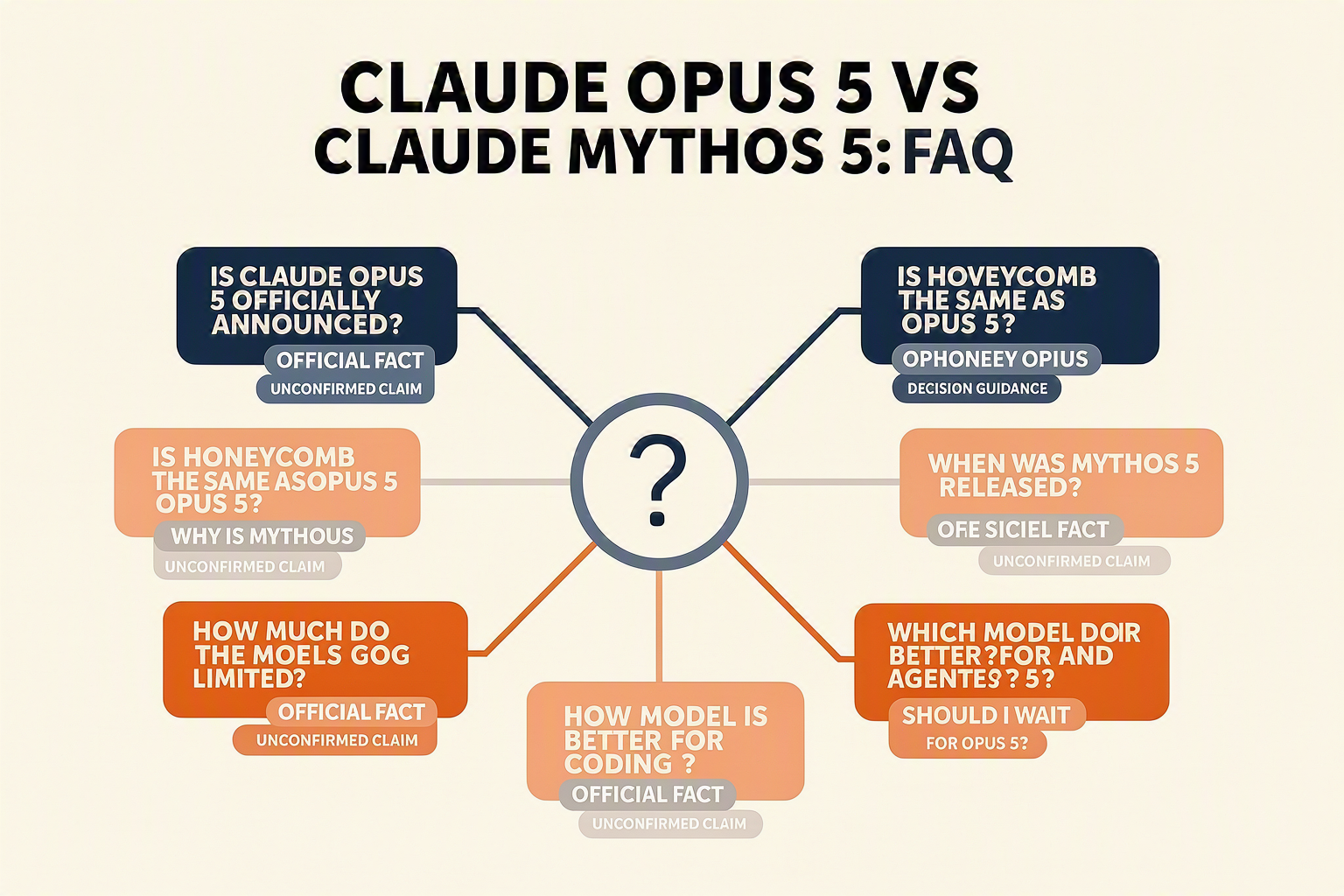
Release, access, and specifications
Is Claude Opus 5 or Claude Mythos 5 officially released?
Is Claude Mythos 5 available to everyone through the Anthropic API?
What are the Claude Opus 5 vs Claude Mythos 5 pricing and context-window limits?
Performance, safety, and buying decisions
Are there verified Claude Opus 5 vs Claude Mythos 5 benchmarks?
Why does Claude Mythos 5 require special attention for cybersecurity use?
Should developers use Claude Mythos 5 now or wait for Claude Opus 5?
Conclusion
As of July 23, 2026, Claude Mythos 5 is the only evidence-backed choice in this matchup—but only for qualified teams whose specialized requirements justify its access conditions and safeguards. Claude Opus 5 cannot credibly win or lose until Anthropic publishes official specifications, availability, pricing, and evaluations.
- Claude Mythos 5 is documented; Claude Opus 5 remains unverified. Anthropic’s Model System Cards page lists the Claude Fable 5 and Claude Mythos 5 system card from June 2026 and Claude Opus 4.7 from April 2026, but no Claude Opus 5 system card was listed by July 23, 2026.
- Availability is part of the product comparison. Anthropic announced Mythos 5 on June 9, recorded it as unavailable on June 12, and announced its redeployment on July 1 after relevant export controls were lifted. Teams should confirm current eligibility and regional access before designing production workloads around it.
- Mythos 5 has an exceptional but sensitive specialization. Anthropic says Claude Mythos 5 can identify and exploit software vulnerabilities more effectively than any previous model and all but the most skilled human specialists. That makes safety controls, authorization, and deployment governance as important as raw capability.
- Precise Opus 5 comparisons are premature. Any claimed Claude Opus 5 API identifier, price, context window, output limit, benchmark score, multimodal feature, or release date should be treated as expected, leaked, or unknown—not official Anthropic information.
The next meaningful comparison begins when Anthropic publishes a Claude Opus 5 model card, API documentation, pricing, benchmark methodology, safety disclosures, and release date. Until then, use Mythos 5 only where its verified capabilities and access model fit; otherwise, select a documented Opus release or wait.
To reduce dependence on any single model’s shifting availability, developers can explore CallMissed, an OpenAI-compatible, multi-model AI infrastructure platform supporting automatic same-tier fallbacks alongside voice, speech, and multilingual communication tooling. The decisive question is not whether Claude Opus 5 sounds promising—but what evidence will Anthropic publish before you trust it in production?
Related Reading
- Claude Opus 5 vs GPT-5.6 Terra: Verified Facts, Expected Features and Verdict
- Claude Opus 5 vs Claude Sonnet 5: Verified Facts, Benchmarks, Pricing, and Verdict (July 2026)
- Claude Opus 5 vs Kimi K3: Leaks vs Verified Facts (July 2026)
Sources
Related Posts



Ready to automate customer conversations?
Launch AI voice agents and WhatsApp bots with CallMissed — one API, 22+ Indian languages.