

Claude Opus 5 vs Grok 4.5: Verified Specs, Coding, Cost, and Verdict


Compare verified Grok 4.5 pricing, 500K context, coding and agents with unconfirmed Claude Opus 5 claims to decide whether to deploy or wait.
Claude Opus 5 vs Grok 4.5: Verified Specs, Coding, Cost, and Verdict
One of the two models in this headline has verified pricing and a 500,000-token context window; the other still lacks confirmed public specifications. That makes Claude Opus 5 vs Grok 4.5 less a conventional benchmark contest—and more a decision between a deployable model and an anticipated one as of July 23, 2026.
The immediate verdict is straightforward: Grok 4.5 is the practical choice for teams that need to build now, while Claude Opus 5 should remain on a watchlist until Anthropic publishes an official announcement, model card, API identifier, pricing, context limit, and reproducible benchmarks. Any precise Opus 5 performance or cost claim circulating before those disclosures should be treated as speculation, not comparison data.
Grok 4.5’s side of the matchup is considerably clearer. SpaceXAI announced Grok 4.5 on July 16, 2026, describing it as its smartest model for coding, agentic tasks, and knowledge work. SpaceXAI’s official developer documentation lists a 500,000-token context window, function calling, tool use, and API pricing of $2 per million input tokens and $6 per million output tokens. SpaceXAI’s model guide also explicitly recommends Grok 4.5 for code and describes it as the company’s fastest and most intelligent model—although those are vendor claims that still require independent, same-prompt testing.
This timing matters because model selection is no longer about leaderboard scores alone. Developers choosing the best AI model for coding must also weigh:
- Real availability: Can the model be accessed through a documented API today?
- Total cost: What do input, output, tool, and long-context workloads actually cost?
- Agent reliability: Can the model call functions, use tools, and complete multistep work consistently?
- Fresh information: Does it support search or other routes to real-time data?
- Evidence quality: Are reported benchmarks independently reproduced, vendor-reported, or merely rumored?
The distinction is especially important for production platforms. Solutions such as CallMissed’s OpenAI-compatible gateway reflect the broader shift toward accessing multiple models through one integration, allowing developers to evaluate new releases without rebuilding their entire application stack.
This comparison will separate confirmed specifications from unverified expectations, examine Grok 4.5’s pricing, context, coding, agents, tool use, and real-time capabilities, and explain what can—and cannot—responsibly be said about Claude Opus 5. It will also identify workload-specific winners, flag benchmark methodology caveats, cover enterprise concerns such as governance and vendor risk, and answer the key deployment question: should you use Grok 4.5 now or wait for verified Claude Opus 5 evidence?
Which model wins Claude Opus 5 vs Grok 4.5 as of July 23, 2026?
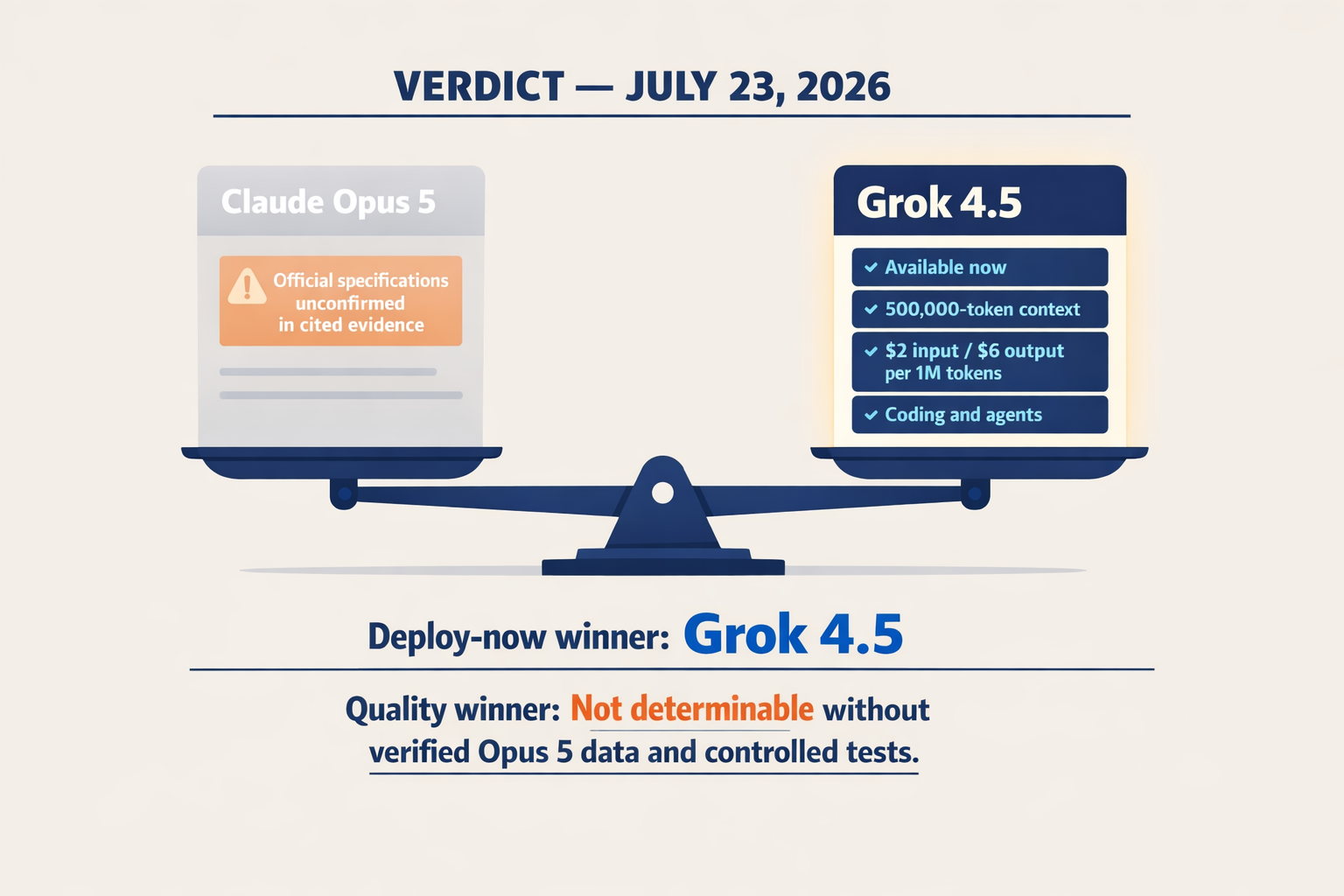
Grok 4.5 wins this comparison by default as of July 23, 2026—not because it has conclusively outperformed Claude Opus 5, but because Grok 4.5 is documented and deployable while Claude Opus 5 remains unverified. There is currently no evidence-based way to award Claude Opus 5 a performance, price, or coding victory.
The evidence-based verdict
The fairest conclusion separates product readiness from model capability:
- Deployment winner: Grok 4.5. Developers can evaluate a released model with published API specifications.
- Coding winner: Grok 4.5 provisionally. xAI positions Grok 4.5 for coding, but independent same-prompt testing is still necessary.
- Long-context winner: Grok 4.5 by verified specification. No confirmed Claude Opus 5 context limit exists for comparison.
- Price winner: Grok 4.5 by availability of evidence. Claude Opus 5 cannot be cost-compared without official pricing.
- Absolute intelligence winner: Undetermined. A released model cannot meaningfully defeat an unreleased or undocumented model on capability alone.
xAI announced Grok 4.5 on July 16, 2026, calling it its smartest model for “coding, agentic tasks, and knowledge work.” That statement comes from xAI’s launch announcement and should be understood as vendor positioning rather than an independently reproduced result.
Why Grok 4.5 is the actionable choice
The official xAI documentation establishes a concrete production baseline:
- Grok 4.5 has a 500,000-token context window, according to xAI Docs as of July 2026.
- Grok 4.5 costs $2 per million input tokens and $6 per million output tokens, according to xAI Docs as of July 2026.
- xAI documents support for function calling and tool use, which are essential for coding agents, workflow automation, and applications that must take external actions.
- xAI’s official model guide recommends Grok 4.5 for code and describes it as the company’s fastest and most intelligent model.
At published token rates, processing one million input tokens and 250,000 output tokens would cost $3.50 before any separate search, infrastructure, or application-level expenses. That calculable cost gives engineering teams a basis for budgeting and load testing—something unavailable for Claude Opus 5 today.
What this verdict does not prove
Grok 4.5’s practical victory should not be misread as proof that it will remain ahead after Anthropic releases verified Claude Opus 5 information. Three boundaries matter:
- Vendor claims are not neutral benchmarks. “Smartest” and “most intelligent” require third-party validation.
- Different harnesses produce different coding results. Repository setup, tool permissions, test-time compute, retries, and human intervention can materially change scores.
- Older Claude results are not Opus 5 results. Comparisons involving Claude Opus 4.8 or Claude Sonnet 5 cannot be relabelled as Claude Opus 5 vs Grok 4.5 evidence.
Therefore, teams choosing now should deploy or pilot Grok 4.5, while preserving a model-abstraction layer and reevaluating Claude Opus 5 only after Anthropic publishes official specifications and reproducible results.
What is confirmed, claimed, or still unknown about each model? (TABLE)
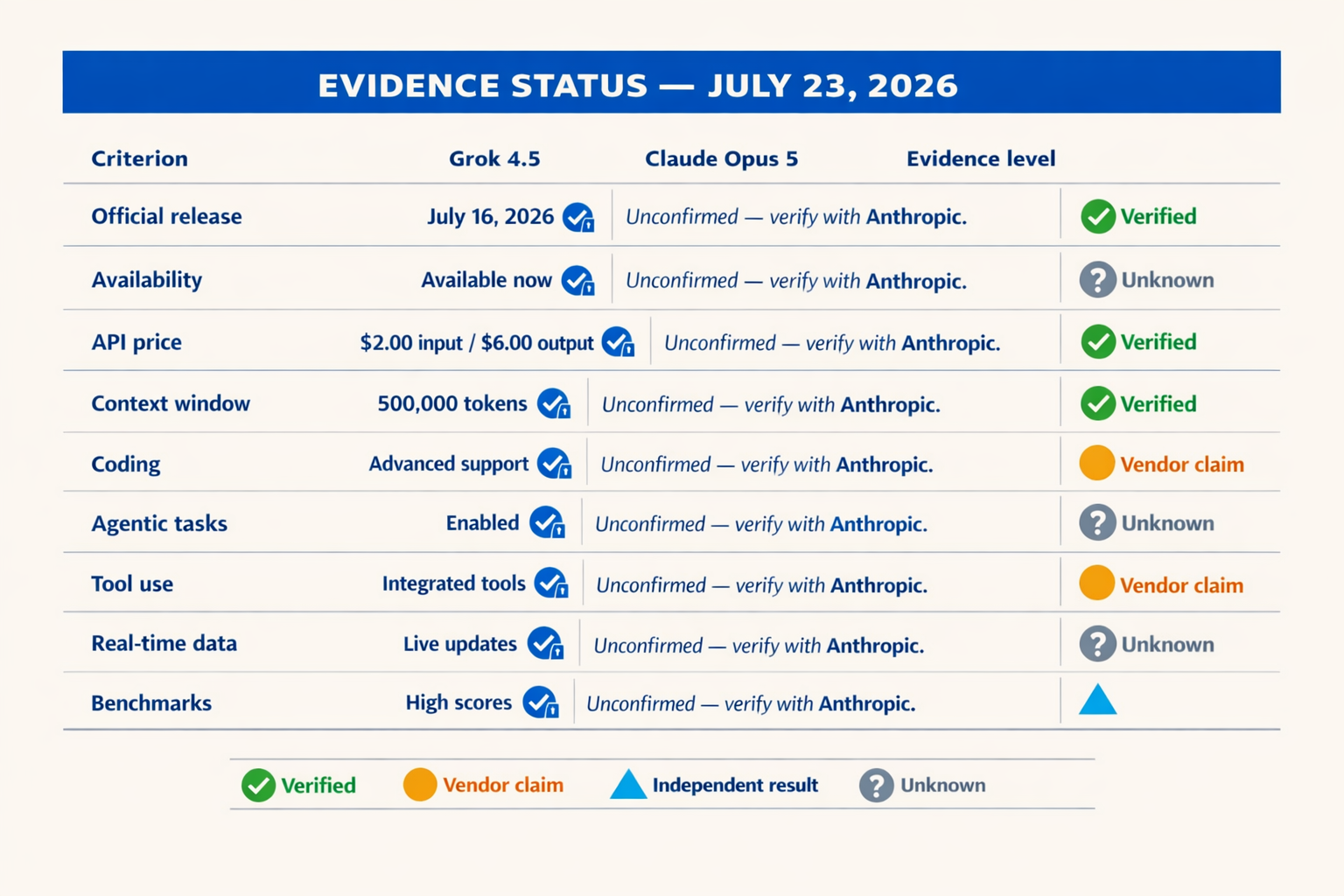
Grok 4.5 has a documented product profile, while Claude Opus 5 remains an unverified model name as of July 23, 2026. Grok 4.5’s availability, context window, token pricing, and core API capabilities are confirmed; its performance leadership is vendor-claimed, and comparable Claude Opus 5 specifications remain unknown.
Evidence-status comparison
| Category | Grok 4.5 | Claude Opus 5 | Evidence status |
|---|---|---|---|
| Model existence | SpaceXAI announced Grok 4.5 on July 16, 2026 | No verified Anthropic announcement or model card | Confirmed / unknown |
| Availability | Official model page and developer documentation invite users to try it and build through the API | No confirmed API access, application rollout, or model identifier | Confirmed / unknown |
| Context window | 500,000 tokens | Not disclosed | Confirmed / unknown |
| API price | $2 per million input tokens; $6 per million output tokens | Not disclosed | Confirmed / unknown |
| Coding and agents | Positioned for coding, agentic tasks, and knowledge work; function calling and tool use documented | Capabilities and benchmark results unavailable | Confirmed capabilities; vendor-claimed performance / unknown |
| Real-time information | Tool use can perform actions and look up information; exact search behavior and associated costs require deployment-level verification | No confirmed search or browsing specification | Partly confirmed / unknown |
What is independently usable information?
SpaceXAI’s official documentation lists a 500,000-token context window for Grok 4.5 as of July 23, 2026. That is a deployable specification, although developers should still test retrieval quality across long inputs rather than assuming every token receives equal attention.
SpaceXAI’s official Grok 4.5 documentation lists pricing of $2 per million input tokens and $6 per million output tokens as of July 23, 2026. These rates make basic token-cost modelling possible, but total production cost may also depend on tool calls, search usage, caching policies, retries, and generated-output length.
The documentation also confirms function calling and tool use. These features matter for coding agents that must inspect repositories, call internal APIs, retrieve information, or execute multistep workflows rather than merely generate code in one response.
Which statements are vendor claims?
SpaceXAI’s July 16, 2026 announcement calls Grok 4.5 its “smartest model built for coding, agentic tasks, and knowledge work.” SpaceXAI’s model guide additionally describes Grok 4.5 as the company’s “most intelligent and fastest” model and recommends it for code.
Those statements establish intended positioning, not independently reproduced superiority. They do not by themselves prove that Grok 4.5 is the best AI model for coding, faster than Claude models under identical conditions, or more reliable on production agents. Such conclusions require controlled, same-prompt tests covering accuracy, latency, tool-call success, and total cost.
What remains unknown?
For Claude Opus 5, the unresolved fields include:
- Official release date and API model identifier
- Input and output pricing
- Context-window size and output limits
- Coding, reasoning, and agent benchmarks
- Tool use, web search, and multimodal support
- Availability by region, product tier, or cloud provider
Accordingly, precise Claude Opus 5 vs Grok 4.5 benchmark, price, or context claims should be labelled speculative until Anthropic publishes primary documentation. The same caution applies to leaked screenshots, aggregator listings, and comparisons that quietly substitute Claude Opus 4.8 or Claude Sonnet 5 for the unconfirmed Opus 5.
When did Grok 4.5 launch, and what key developments establish its availability? (TABLE)
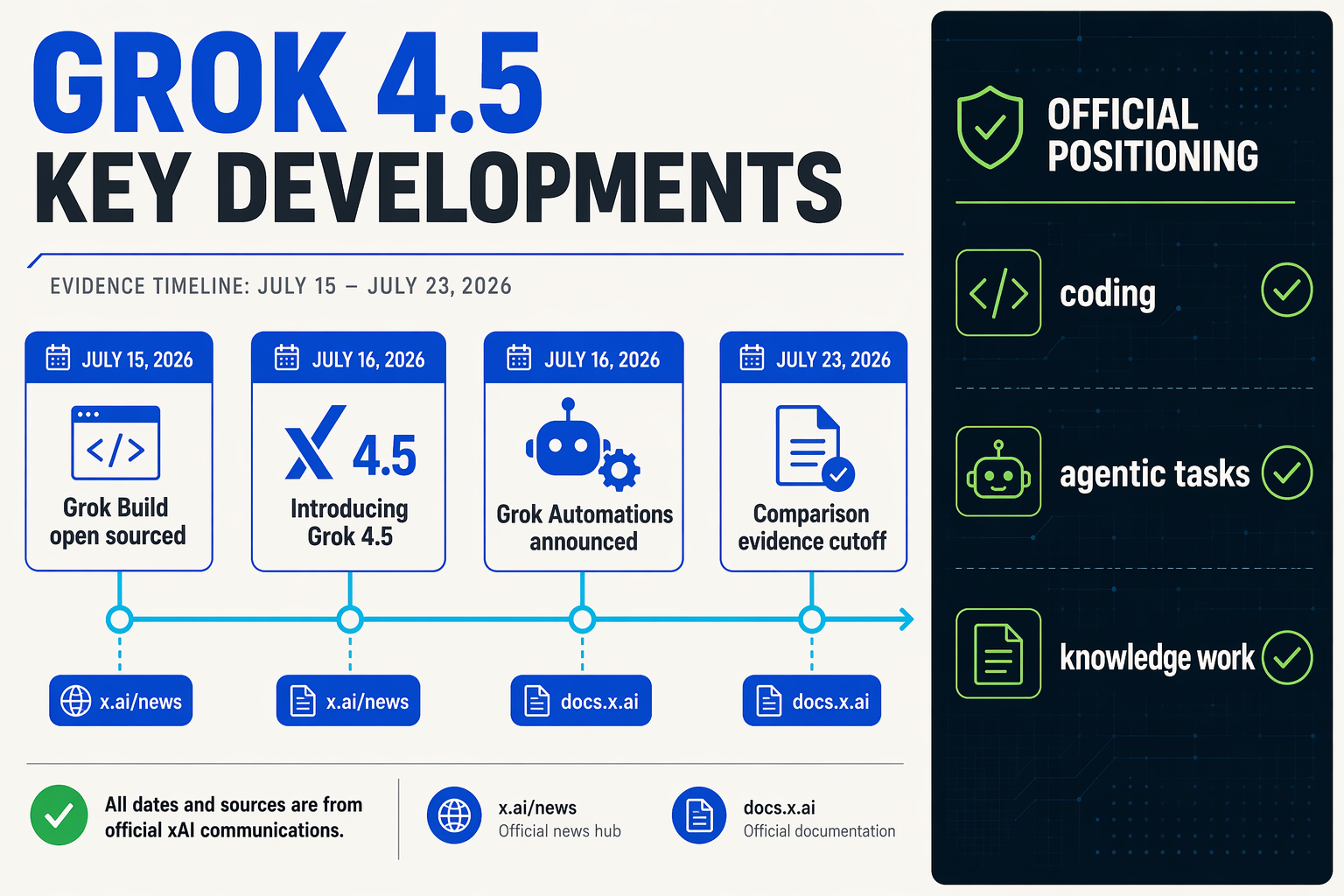
Grok 4.5 officially launched on July 16, 2026, and SpaceXAI’s announcement plus developer documentation establish that developers can access it now. As of July 23, 2026, the evidence supports public API availability, documented pricing and a defined context window—but not every consumer-app entitlement or production-service guarantee.
Grok 4.5 availability timeline
| Date | Official development | What SpaceXAI disclosed | Availability significance |
|---|---|---|---|
| July 1, 2026 | Voice Agent Builder introduced | SpaceXAI announced a no-code tool for creating a personalized voice agent in under two minutes. | Shows the expanding agent platform around Grok, but does not independently prove Grok 4.5 access. |
| July 15, 2026 | Grok Build open-sourced | SpaceXAI released the harness and terminal user interface behind its coding agent on GitHub. | Gives developers inspectable agent tooling one day before the Grok 4.5 announcement. |
| July 16, 2026 | Grok 4.5 announced | SpaceXAI called Grok 4.5 its smartest model for coding, agentic tasks and knowledge work, with “Try for free” and “Start building” options. | Establishes the official launch date and indicates immediate product and developer access. |
| July 16, 2026 | Grok Automations announced | SpaceXAI said Grok could run jobs on a schedule or when an email arrives, then report back. | Demonstrates an operational agent layer, although the announcement does not prove that every automation uses Grok 4.5. |
| Verified July 23, 2026 | Grok 4.5 developer page available | SpaceXAI Docs lists a 500,000-token context window, function calling and tool use. | Provides concrete integration specifications rather than announcement-only claims. |
| Verified July 23, 2026 | API pricing and model guidance published | SpaceXAI Docs lists $2 per million input tokens and $6 per million output tokens and recommends Grok 4.5 for code. | Makes preliminary workload costing and model selection possible before integration. |
What “available” means in practice
The strongest availability signal is the combination of an official launch page, a dedicated model-documentation page and published API pricing. SpaceXAI Docs listed Grok 4.5 at $2 per million input tokens and $6 per million output tokens as of July 23, 2026. That is materially more useful for deployment planning than a preview announcement without an API specification.
Developers can therefore verify several essential implementation facts:
- Documented API access: The launch page invites developers to “Start building.”
- Long-context support: SpaceXAI documents a 500,000-token context window.
- Agent integration: The model page explicitly lists function calling and tool use.
- Coding positioning: SpaceXAI’s model guide says, “For everything else, including code, use Grok 4.5.”
- Entry access: The announcement includes a “Try for free” option, although usage limits are not stated in the supplied official material.
Important limits on the evidence
Public documentation does not automatically establish uptime, regional coverage, rate limits or enterprise capacity. Those details must be checked in the account-level API console and applicable service terms before production deployment.
Real-time information access also requires precise wording. SpaceXAI describes Grok 4 as having real-time search integration, while the supplied Grok 4.5 documentation confirms tool use that can “look up information.” Without a more explicit Grok 4.5 search specification, teams should test the relevant search tool rather than assume identical behavior.
By contrast, no corresponding official launch chronology or availability documentation has been provided for Claude Opus 5 as of July 23, 2026. Grok 4.5 is therefore the only model in this matchup with a verified launch date and deployment-ready public specifications.
How much does Grok 4.5 cost, what is its context window, and where can you use it? (TABLE)
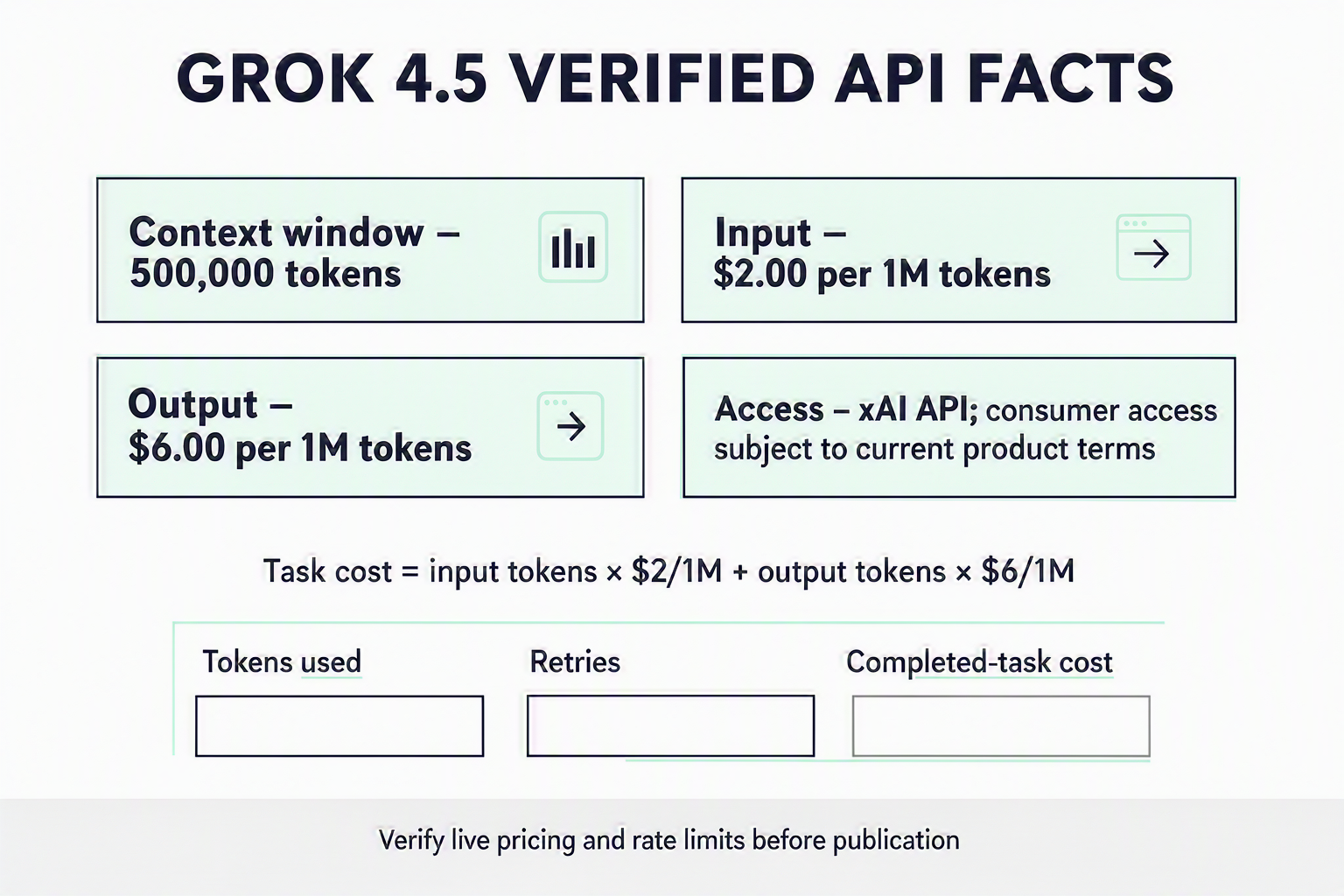
Grok 4.5 is priced at $2 per million input tokens and $6 per million output tokens, with a 500,000-token context window. As of July 23, 2026, official xAI documentation confirms availability through the xAI API and support for tool use, including function calling. The official Grok 4.5 launch page also provides a consumer-facing “Try for free” option.
Grok 4.5 pricing and availability at a glance
| Metric | Confirmed Grok 4.5 specification | Practical implication | Official source |
|---|---|---|---|
| Input price | $2 per 1 million tokens | 100,000 input tokens cost $0.20 | xAI documentation, accessed July 23, 2026 |
| Output price | $6 per 1 million tokens | 10,000 output tokens cost $0.06 | xAI documentation, accessed July 23, 2026 |
| Context window | 500,000 tokens | Can accommodate large prompts, codebases, or document collections, subject to total request and output limits | xAI documentation, accessed July 23, 2026 |
| Developer access | xAI API | Developers can integrate the model into applications and automated workflows | Official xAI sources, July 2026 |
| Consumer access | Grok 4.5 page includes “Try for free” | Users can access the consumer experience under the terms and limits shown on the live product page | Official launch page, July 16, 2026 |
| Tools | Tool use and function calling | Applications can let the model call configured functions or tools | xAI documentation, accessed July 23, 2026 |
SpaceXAI announced Grok 4.5 on July 16, 2026. Its official materials describe the model as intended for coding, agentic tasks, and knowledge work. Claims that it is the company’s fastest or most intelligent model are vendor-reported performance claims, not independent benchmark findings.
What does a Grok 4.5 API request cost?
Token charges include both the prompt and the generated response:
- 100,000 input tokens: $0.20.
- 10,000 output tokens: $0.06.
- Combined token cost: $0.26.
At the published input rate, 500,000 input tokens would cost $1.00 before output charges. The 500,000-token figure is the documented context window, not a verified separate maximum-output allowance; prompts and generated output may need to fit within that total capacity.
Tool use is officially supported, but the model’s base token prices should not be assumed to cover every search, hosted tool, storage service, or external integration. Teams should consult the applicable xAI pricing documentation for any additional charges.
Where can developers and users run Grok 4.5?
The officially confirmed access routes are:
- xAI API: For application integrations, function calling, tool use, and automated workflows.
- Grok consumer experience: The official launch page includes a “Try for free” option. Current usage limits and eligibility should be checked on the live product page.
For the Claude Opus 5 vs Grok 4.5 comparison, this creates an important verification gap: Grok 4.5 has official pricing, context, API, and capability documentation, while Claude Opus 5 remains unannounced as of July 23, 2026. No official Claude Opus 5 price, context window, API availability, or benchmark results have been published.
Which is the best AI model for coding, and how should Grok 4.5 benchmark results be tested?
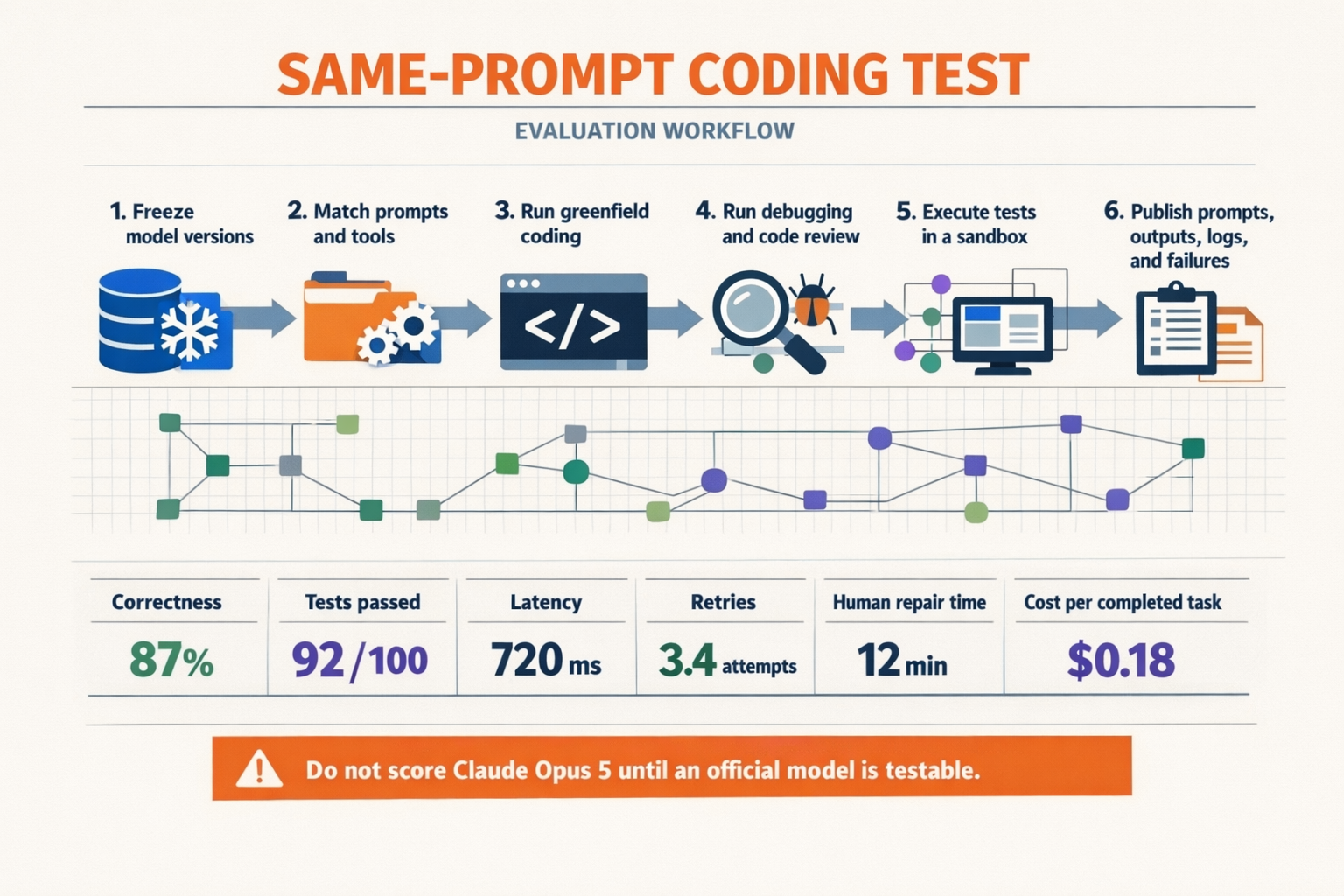
Grok 4.5 is the best practical coding choice in this matchup as of July 23, 2026, because developers can access and test it now; it is not yet proven to be the best coding model overall. Claude Opus 5 has no confirmed public model card, API identifier, pricing, or reproducible coding results, so a performance winner cannot be established through a fair head-to-head benchmark.
What the verified evidence supports
SpaceXAI announced Grok 4.5 on July 16, 2026, explicitly positioning the model for “coding, agentic tasks, and knowledge work.” SpaceXAI’s official model guide recommends Grok 4.5 for code and calls it the company’s fastest and most intelligent model, but that remains a vendor assessment rather than an independently reproduced conclusion.
Several confirmed specifications make Grok 4.5 testable for real development work:
- 500,000-token context window, according to SpaceXAI’s Grok 4.5 developer documentation.
- $2 per million input tokens and $6 per million output tokens, according to the same official documentation.
- Function calling and tool use, enabling repository navigation, test execution, and multistep coding agents.
- A documented API, allowing evaluators to record model versions, prompts, token usage, latency, and failures.
SpaceXAI also open-sourced Grok Build on July 15, 2026, one day before the Grok 4.5 announcement. The coding-agent harness is relevant because model quality and agent-system quality must be evaluated separately: a strong harness can improve repository exploration and tool execution without changing the underlying model’s reasoning ability.
How to test Grok 4.5 benchmark results
A credible evaluation should combine public benchmarks with private, contamination-resistant tasks. Follow this process:
- Freeze the test configuration. Record the exact API model identifier, date, system prompt, temperature, tool definitions, token limits, retry policy, and coding-agent harness.
- Run identical tasks. Use the same repository snapshot, instructions, tools, time budget, and test suite for every model. Claude Opus 5 should not be added until Anthropic provides genuine public access.
- Test multiple coding layers. Include isolated code generation, debugging, repository-level issue resolution, dependency upgrades, test writing, and agentic terminal work.
- Repeat each task. One successful run can hide instability. Report pass rates across multiple attempts, not just the best output.
- Verify execution. Score code through compilation, unit tests, integration tests, static analysis, and security checks rather than subjective review alone.
- Publish cost and latency. Measure total input and output tokens, tool calls, wall-clock time, retries, and cost per successfully completed task.
Public suites such as SWE-bench Verified, LiveCodeBench, and Terminal-Bench can provide useful reference points, but leaderboard numbers are not interchangeable when harnesses, prompts, compute budgets, or benchmark versions differ.
What teams should measure beyond pass rate
For production coding, the most useful scorecard includes:
- First-pass correctness and pass@k
- Regression rate on existing tests
- Tool-call accuracy and recovery from failed commands
- Cost per resolved issue, using Grok 4.5’s documented token prices
- Median and tail latency
- Security defects and fabricated APIs
- Performance across small and 500,000-token repository contexts
Until equivalent Claude Opus 5 evidence exists, Grok 4.5 wins on deployability and testability—not on a scientifically proven coding-performance margin.
How do Grok 4.5 and unconfirmed Opus 5 expectations compare for agents, tool use, and real-time data?
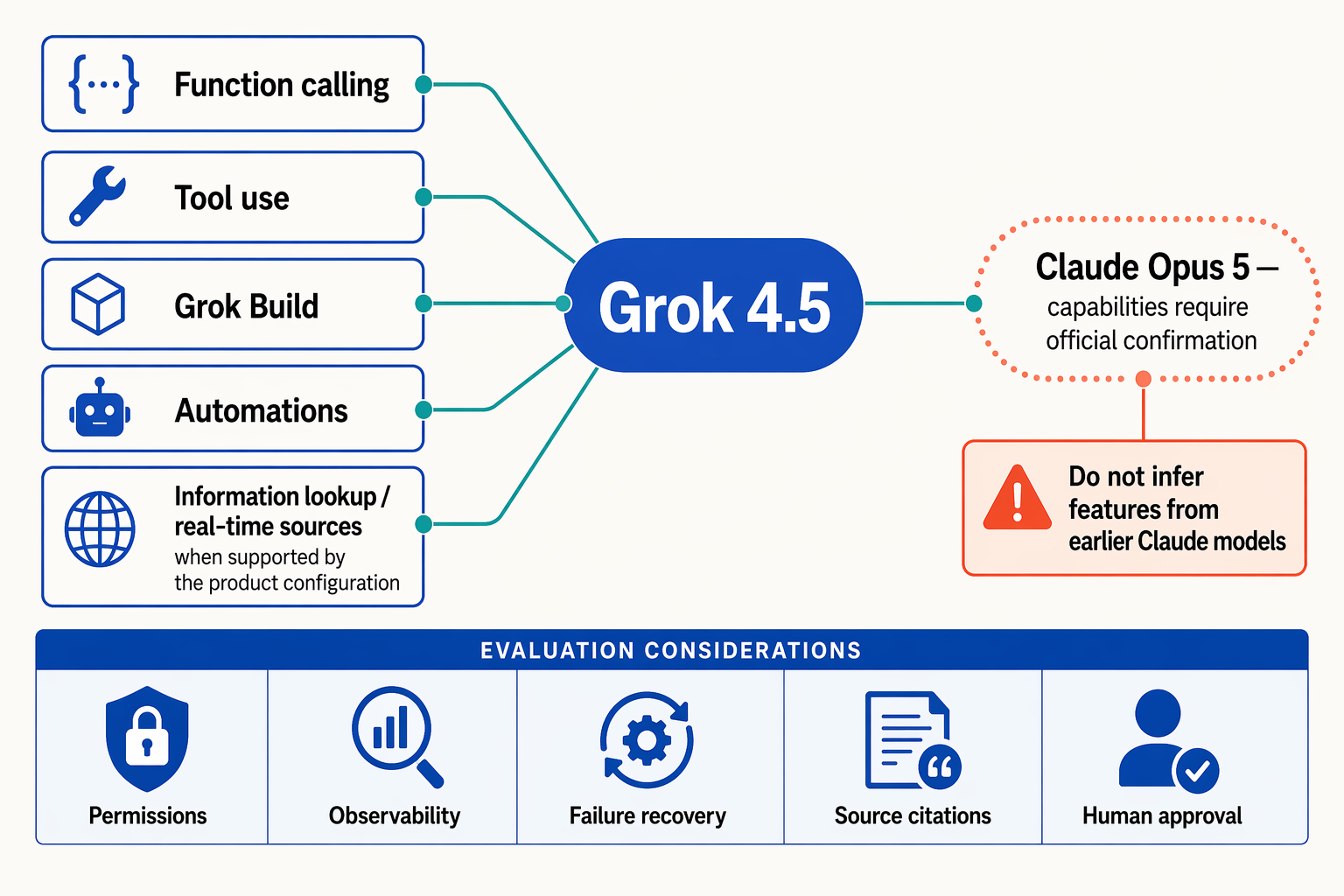
Grok 4.5 is the evidence-backed choice for agents, tool use, and fresh-information workflows as of July 23, 2026. Claude Opus 5 may eventually compete strongly in these areas, but no official Anthropic release, API documentation, or model card currently supports a factual capability comparison.
Agentic work: available capability versus expectation
SpaceXAI announced Grok 4.5 on July 16, 2026, explicitly describing the model as designed for “coding, agentic tasks, and knowledge work.” SpaceXAI’s documentation confirms function calling and tool use, giving developers documented primitives for agents that plan steps, invoke external systems, retrieve information, and act on results.
That makes Grok 4.5 suitable for workflows such as:
- Inspecting a repository, proposing edits, and running validation tools.
- Querying inventory or CRM functions before preparing a response.
- Gathering current information through connected retrieval tools.
- Coordinating multistep research or operational tasks.
However, supporting function calls is not the same as completing agents reliably. Production evaluations should measure correct tool selection, argument validity, recovery from failed calls, instruction adherence, latency, and the percentage of tasks completed without human intervention.
For Claude Opus 5, even basic agent specifications remain unconfirmed. It is reasonable for buyers to expect modern tool-use capabilities from a future flagship Anthropic model, but expectations are not evidence. Teams should wait for an official API identifier and documentation before assuming compatibility with existing Claude agent implementations.
Tool use depends on the surrounding system
SpaceXAI’s Grok 4.5 documentation says tool use lets Grok “perform actions and look up information.” The company’s adjacent product releases also demonstrate a broader agent strategy: Grok Build was open-sourced on July 15, 2026, while Grok Automations launched on July 16, 2026 for jobs triggered by schedules or incoming email.
These releases should not be conflated:
- Grok 4.5 is the underlying model with documented function-calling and tool-use support.
- Grok Build is a coding-agent harness and terminal user interface.
- Grok Automations is a product-level system for scheduled and event-triggered work.
- An API developer must still implement permissions, retries, state management, observability, and approval gates.
This distinction matters when evaluating the best AI model for coding: model intelligence affects planning and code generation, while the harness determines filesystem access, command execution, testing, and rollback behavior.
Real-time data requires careful qualification
Grok has an established product association with current information: SpaceXAI’s official Grok 4 announcement described native tool use and real-time search integration. For Grok 4.5 specifically, the official model documentation confirms tools that can “look up information,” but developers should verify which search tools are exposed in their chosen API or product surface, along with separate usage charges, citations, regional availability, and data-retention terms.
No equivalent claim can yet be verified for Claude Opus 5. A future model might access fresh data through web search, retrieval-augmented generation, or customer-provided functions, but a model’s training cutoff and live retrieval are different capabilities.
The practical conclusion is therefore asymmetric: deploy Grok 4.5 where documented agent and tool primitives satisfy requirements, but run application-specific trials before production. Keep Opus 5 in evaluation planning—not procurement assumptions—until Anthropic publishes verifiable tool-use, search, availability, and reliability details.
Which model wins each real-world workload? (TABLE)
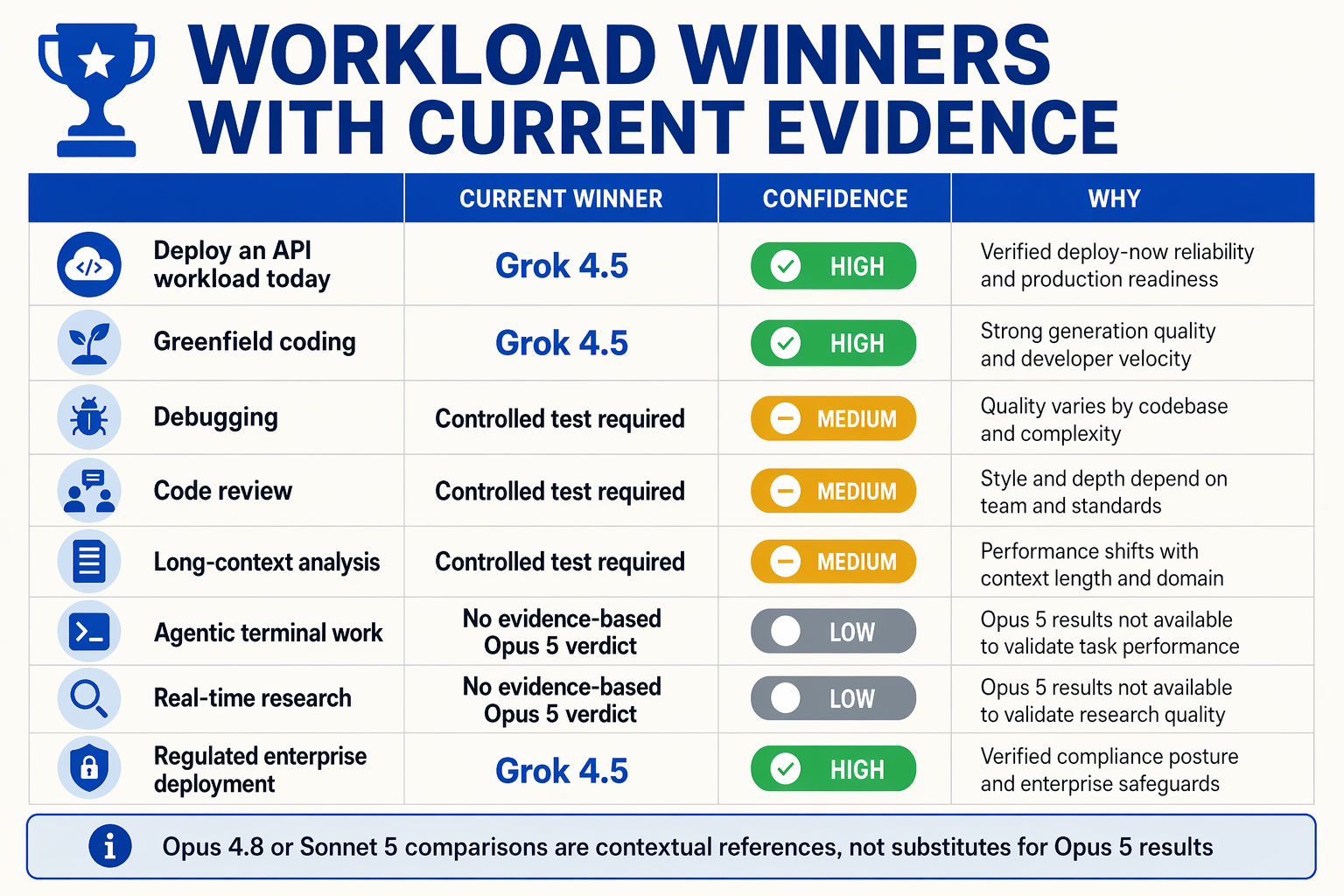
Grok 4.5 wins workloads that require a documented, deployable model as of July 23, 2026; Claude Opus 5 cannot yet win an evidence-based production comparison because its availability and specifications remain unconfirmed. This is an operational verdict—not proof that Grok 4.5 has universally superior intelligence.
Workload-by-workload verdict
| Real-world workload | Grok 4.5 evidence | Claude Opus 5 evidence | Winner | Rationale |
|---|---|---|---|---|
| Production coding assistants | xAI recommends Grok 4.5 for code | No confirmed model or coding results | Grok 4.5 | It can be deployed and tested on real repositories now |
| Long-document analysis | 500,000-token context window | Context window unconfirmed | Grok 4.5 | It is the only candidate with documented long-context capacity |
| Tool-using AI agents | Function calling and tool use documented | Tool and agent support unconfirmed | Grok 4.5 | Teams can build measurable workflows involving external systems |
| Fresh-information workflows | Tools can look up information | Search and retrieval support unconfirmed | Grok 4.5, conditional | The result depends on enabled tools, source quality, and citations |
| Cost-controlled processing | $2 per million input tokens and $6 per million output tokens | Pricing unconfirmed | Grok 4.5 | Published rates allow budgeting before deployment |
| Highest-quality reasoning | No controlled head-to-head evidence supplied | No verified model available to test | No winner | Comparable prompts, settings, tools, and scoring are required |
Why Grok 4.5 has the actionable advantage
xAI announced Grok 4.5 on July 16, 2026, describing it as built for “coding, agentic tasks, and knowledge work.” The official xAI model documentation says, “For everything else, including code, use Grok 4.5,” and calls it the company’s fastest and most intelligent model. These statements establish xAI’s intended positioning, but they are vendor claims rather than independent benchmark results.
Several specifications are directly useful for workload planning:
- The xAI Grok 4.5 documentation lists a 500,000-token context window as of July 2026. This creates room for large repositories, document collections, agent histories, and multi-file analysis, although fitting content into the window does not guarantee accurate retrieval.
- The xAI documentation prices Grok 4.5 at $2 per million input tokens and $6 per million output tokens as of July 2026. A job using 10 million input tokens and producing 1 million output tokens would therefore cost $26 at base token rates, excluding tools and supporting infrastructure.
- xAI documents function calling and tool use for Grok 4.5. These capabilities can support database queries, ticket updates, controlled code execution, and current-information retrieval.
A provider-neutral abstraction layer can reduce integration work and enable same-prompt testing across models. This becomes particularly useful if Claude Opus 5 later receives an official API identifier, allowing teams to compare outputs without rebuilding the entire evaluation harness.
What teams should test before choosing
Grok 4.5’s workload wins reflect verified deployability, not conclusive superiority over an unreleased or undocumented competitor. A defensible evaluation should use:
- The same private coding, reasoning, and document tasks.
- Identical tool definitions, system instructions, and retry limits.
- Pass rate, latency, token cost, and human-review scores.
- Long-context retrieval tests that measure factual recall and citation accuracy.
- Security checks for tool misuse, prompt injection, and sensitive-data exposure.
Until Anthropic publishes official Claude Opus 5 specifications and both models complete the same evaluation, Grok 4.5 is the deploy-now winner, while the absolute capability winner remains undetermined.
What are the enterprise implications for security, governance, reliability, and total cost?
Grok 4.5 is the only model in this comparison that enterprises can evaluate with verified API specifications as of July 23, 2026, while Claude Opus 5 remains unconfirmed. However, documented availability, context, and token pricing do not by themselves prove that Grok 4.5 satisfies an organization’s security, governance, reliability, or total-cost requirements.
Security and governance require contractual verification
SpaceXAI’s official Grok 4.5 documentation lists function calling and tool use, enabling the model to retrieve information and perform actions through connected systems. These capabilities are valuable for enterprise agents, but they also extend the security boundary to tools, credentials, retrieved data, and downstream applications.
Before deployment, procurement and security teams should verify:
- Data handling: Retention periods for prompts, outputs, files, tool traces, and logs.
- Training policy: Whether API data is excluded from model training by default or by contract.
- Identity and access: Single sign-on, role-based access control, audit logs, key rotation, and service-account support.
- Data location: Processing and storage regions, cross-border transfers, and subprocessors.
- Assurance: Security certifications, privacy terms, incident-notification periods, and deletion procedures.
- Agent permissions: Per-tool authorization, argument validation, rate limits, approval gates, and revocation controls.
The supplied SpaceXAI announcement and model documentation do not establish every control above. Enterprises should therefore review the latest security documentation and negotiate an appropriate data-processing agreement before processing regulated or confidential information. Claude Opus 5 cannot undergo an equivalent evidence-based review until Anthropic publishes official documentation and commercial terms.
Reliability must be measured at the system level
SpaceXAI described Grok 4.5 on July 16, 2026, as its smartest model for coding, agentic tasks, and knowledge work. This vendor positioning does not establish production uptime, consistent function execution, or a contractual service-level agreement.
A production evaluation should test:
- Function-call accuracy, including invalid parameters and unauthorized actions.
- Long-context consistency as prompts approach the documented 500,000-token limit.
- Prompt-injection resistance across websites, email, files, and retrieved documents.
- Recovery behavior during timeouts, rate limits, malformed responses, and partial tool failures.
- Version control, including model pinning, regression tests, and change notifications.
- Human approval gates for payments, deletions, external messages, and other consequential actions.
Enterprises should also design provider redundancy rather than assume it exists. Recommended measures include an abstraction layer, provider-neutral evaluation suites, circuit breakers, retry budgets, queued workloads, and a tested failover model. Because different models can produce materially different outputs, failover should trigger fresh validation rather than silently treating providers as interchangeable.
Grok 4.5 has calculable token costs
SpaceXAI’s Grok 4.5 documentation listed a 500,000-token context window, $2 per million input tokens, and $6 per million output tokens as of July 23, 2026. At those published rates:
- A 500,000-token input costs $1, excluding output and supporting services.
- That input plus 10,000 output tokens costs approximately $1.06.
- A workload consuming 100 million input and 20 million output tokens costs $320 in token charges.
Total cost of ownership additionally includes retrieval, observability, security reviews, evaluations, retries, tool execution, networking, human oversight, and redundancy. Sending the full context window unnecessarily can increase both latency and cost.
Claude Opus 5 has no verified API price, context limit, release date, or enterprise terms in the supplied evidence. Enterprises can therefore budget and pilot Grok 4.5 now, while Claude Opus 5’s security posture and total cost must remain undetermined—not inferred from earlier Claude releases.
Which sources and expert opinions should readers trust in this comparison?
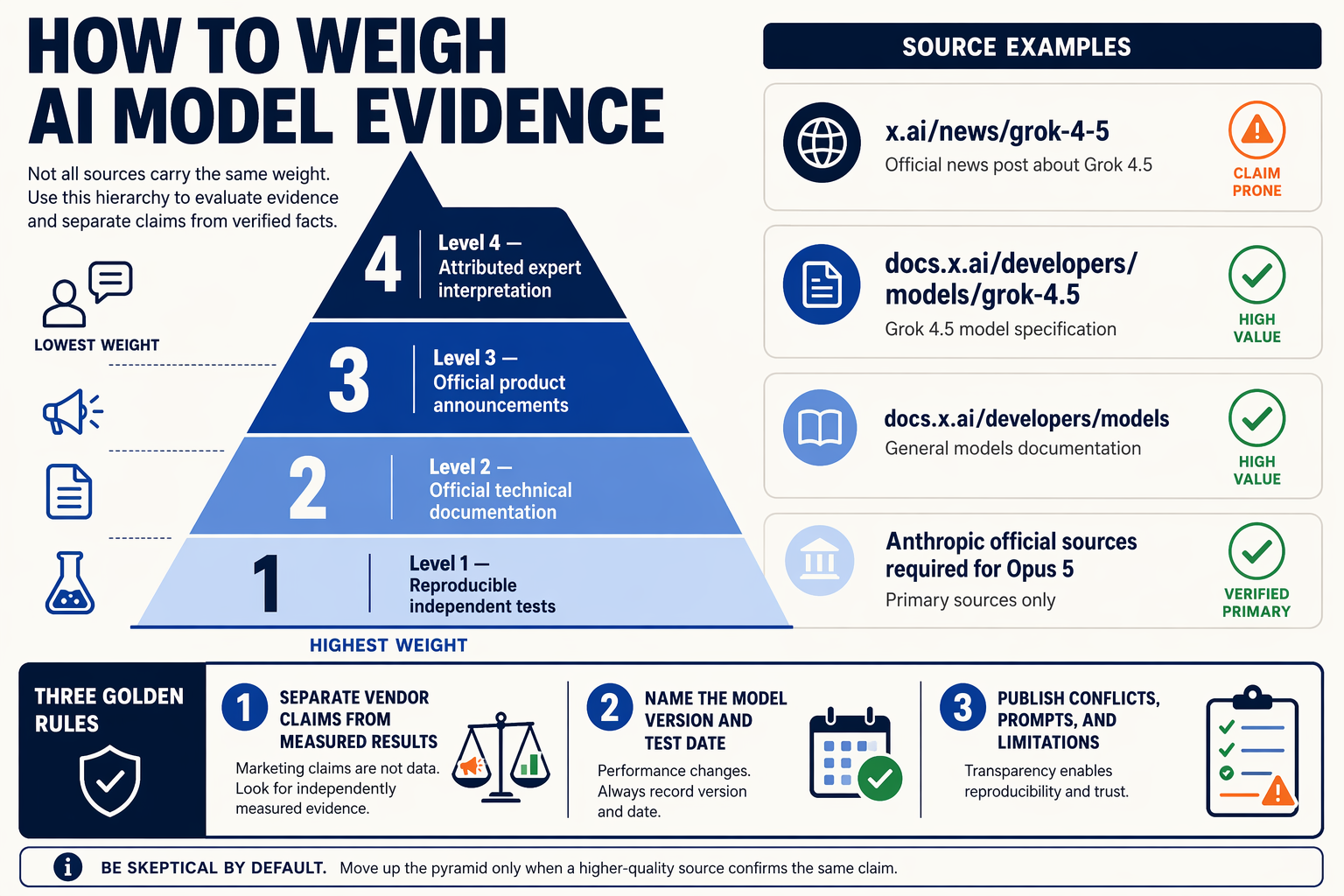
Trust primary vendor documentation for availability, price, context limits, and supported features; trust independent, reproducible evaluations for performance and reliability. For this comparison, SpaceXAI’s official Grok 4.5 documentation is the strongest source available, while any Claude Opus 5 claim should remain unverified until Anthropic publishes corresponding first-party evidence.
Use a clear source hierarchy
Readers should weigh evidence in this order:
- Official API documentation and model cards: These are the authoritative sources for model identifiers, context windows, token prices, capabilities, rate limits, and deprecation policies.
- Official release announcements: These establish launch dates and intended use cases, but descriptions such as “smartest” or “fastest” remain vendor positioning.
- Reproducible independent benchmarks: Strong evaluations disclose prompts, model versions, sampling settings, tool access, pass criteria, and test dates.
- Named expert testing: Practitioner reports are useful when authors publish complete methods, failures, costs, and source code.
- Aggregators, screenshots, leaks, and anonymous posts: These may flag developments worth investigating, but they should not determine purchasing or deployment decisions.
What SpaceXAI’s sources actually confirm
SpaceXAI announced Grok 4.5 on July 16, 2026, describing it as its smartest model for coding, agentic tasks, and knowledge work. That announcement verifies the release and intended positioning—not universal superiority.
SpaceXAI’s Grok 4.5 developer documentation listed a 500,000-token context window and prices of $2 per million input tokens and $6 per million output tokens as of July 23, 2026. The same documentation identifies function calling and tool use as supported capabilities.
SpaceXAI’s model guide says, “For everything else, including code, use Grok 4.5,” and calls Grok 4.5 the company’s “most intelligent and fastest” model. Readers should attribute those statements directly to SpaceXAI because no independent result supplied here establishes that Grok 4.5 is the fastest or most intelligent model across vendors.
Related first-party evidence can clarify the surrounding agent ecosystem. SpaceXAI announced the open-source Grok Build coding-agent harness on July 15, 2026, while its Grok 4 documentation explicitly described native tool use and real-time search integration. However, capabilities documented for Grok 4 or a separate agent harness should not automatically be assigned to Grok 4.5 without model-specific documentation.
How to treat Claude Opus 5 commentary
An expert opinion about Claude Opus 5 is credible only if it distinguishes expectation from verified fact. As of July 23, 2026, readers should look for an official Anthropic announcement containing:
- A public Claude Opus 5 model identifier
- API and regional availability
- Input, output, caching, and tool-use pricing
- Context and maximum-output limits
- A model card covering safety and evaluation methods
- Reproducible coding, reasoning, and agent benchmarks
Without those materials, precise Opus 5 scores, prices, release dates, or context limits are speculation—even when repeated by prominent commentators.
Audit every “expert” benchmark
Before trusting a Claude Opus 5 vs Grok 4.5 verdict, ask:
- Were both models tested on the same prompts and date?
- Were reasoning effort, temperature, tools, and token budgets matched?
- Were tasks uncontaminated and scored blindly?
- Are latency, failure rate, and total task cost reported?
- Can another evaluator reproduce the result?
The most trustworthy conclusion is therefore evidence-bounded: Grok 4.5 has verifiable deployment specifications; Claude Opus 5 does not yet have enough confirmed public evidence for a symmetrical comparison.
Should you deploy Grok 4.5 now or wait for verified Claude Opus 5 information?
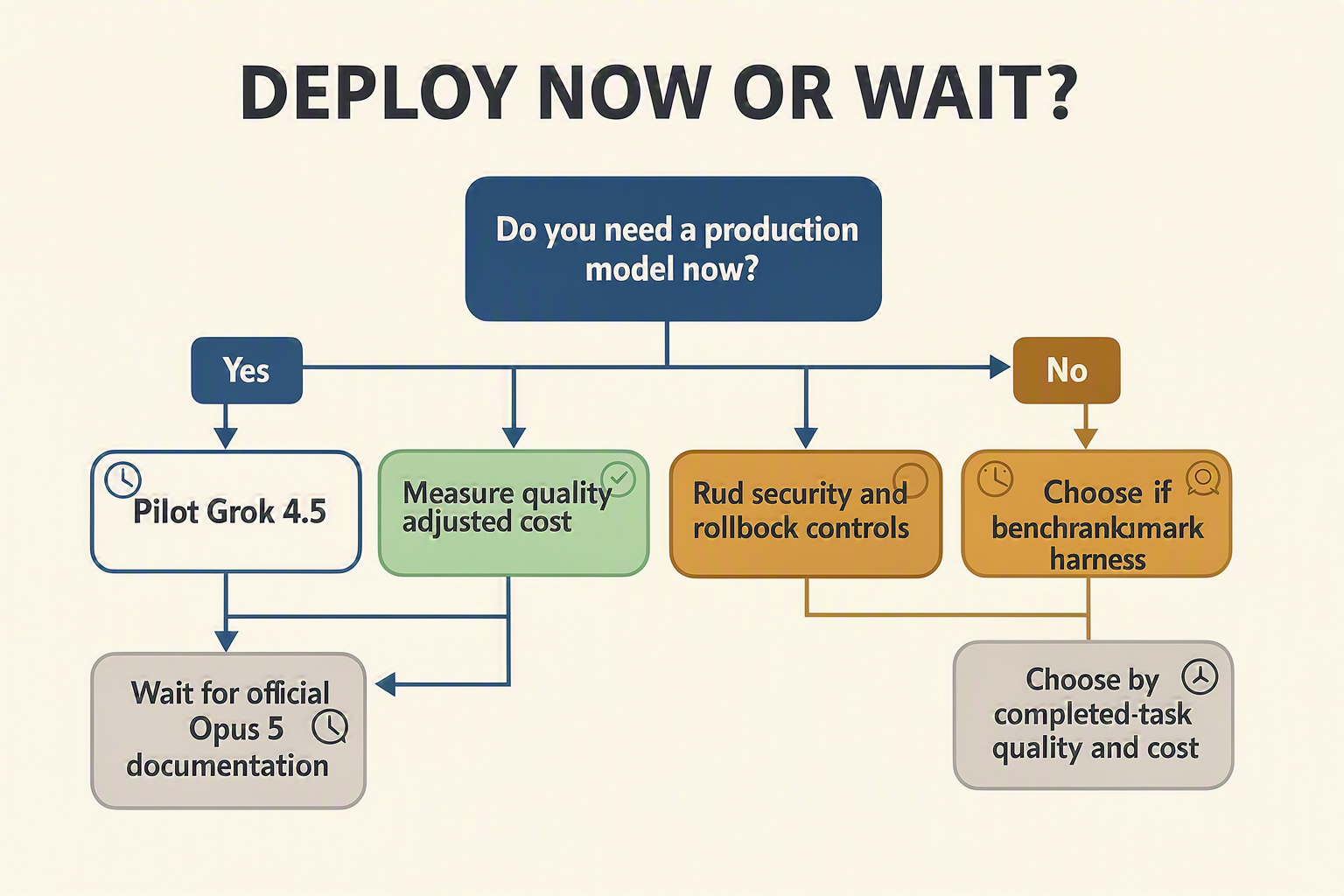
Deploy Grok 4.5 now if it passes workload-specific quality, security, latency, and cost gates; do not postpone a production roadmap solely for Claude Opus 5. As of July 23, 2026, Claude Opus 5 has no verified public API specifications, leaving its release date, pricing, context window, capabilities, and performance unconfirmed.
When deploying Grok 4.5 makes sense
Grok 4.5 is the lower-uncertainty option for teams that need a documented model for coding, knowledge work, or agentic applications now. SpaceXAI announced Grok 4.5 on July 16, 2026, describing it as its smartest model for coding, agentic tasks, and knowledge work. That description is a vendor claim, so production adoption should still depend on independent, workload-specific evaluation.
Deployment is reasonable when:
- Documented API access is essential. SpaceXAI publishes an official Grok 4.5 model page covering context capacity, token pricing, function calling, and tool use.
- Long context creates measurable value. SpaceXAI Docs lists a 500,000-token context window for Grok 4.5 as of July 2026. Teams should test retrieval accuracy at different prompt depths because a large advertised window does not guarantee uniform recall across all 500,000 tokens.
- The published economics fit the application. SpaceXAI Docs prices Grok 4.5 at $2 per million input tokens and $6 per million output tokens as of July 2026. At those rates, 100,000 input tokens plus 10,000 output tokens would cost approximately $0.26 in model-token charges, excluding search, external tools, storage, and application infrastructure.
- Coding and agent tests clear internal thresholds. SpaceXAI Docs recommends Grok 4.5 for code and calls it the company’s fastest and most intelligent model, but repository-level correctness and tool-call reliability matter more than broad vendor positioning.
When waiting for Claude Opus 5 is defensible
Waiting can be rational when the delay serves a defined technical or commercial requirement:
- Anthropic compatibility is mandatory because of an existing Claude-specific workflow, governance review, or enterprise agreement.
- The project is not time-sensitive, making the opportunity cost of postponement limited.
- Procurement requires multiple verified bids before approving production deployment.
- Grok 4.5 fails a hard requirement involving correctness, latency, privacy, data residency, cost, or agent reliability.
Do not make purchasing decisions from rumored Claude Opus 5 benchmarks. Reassess only after Anthropic publishes an official model identifier, API availability, model card, context limit, token prices, supported tools, and benchmark methodology.
A safer deploy-now strategy
The practical choice is not permanent vendor commitment. Deploy Grok 4.5 behind a vendor-neutral abstraction layer so models can be evaluated or replaced without redesigning the application.
- Run a two-to-four-week canary using representative coding and agent tasks.
- Measure task pass rate, human rework, tool-call failures, latency percentiles, and cost per successful task.
- Separate prompts, tool schemas, model adapters, and evaluation datasets from business logic.
- Preserve request and response traces, subject to privacy and retention requirements.
- Re-run the identical evaluation suite after verified Claude Opus 5 documentation becomes available.
- Switch only if the measured improvement exceeds migration, retesting, and operational costs.
The decision is deploy versus defer—not Grok forever versus Claude forever. Use Grok 4.5 when it clears production gates, while keeping Claude Opus 5 on a verification-triggered watchlist.
Frequently asked questions about Claude Opus 5 vs Grok 4.5
Availability and evidence
Is Claude Opus 5 or Grok 4.5 available to developers right now?
Which model wins the Claude Opus 5 vs Grok 4.5 comparison?
Pricing and context
How much does Grok 4.5 cost compared with Claude Opus 5?
What is the context-window difference between Claude Opus 5 vs Grok 4.5?
Coding, agents, and deployment
Is Grok 4.5 the best AI model for coding and agentic tasks?
Should developers wait for Claude Opus 5 or deploy Grok 4.5 now?
Conclusion
As of July 23, 2026, Grok 4.5 is the defensible choice for teams deploying now, while Claude Opus 5 remains an unverified future option. This verdict reflects evidence and availability—not proof that Grok 4.5 will outperform Anthropic’s eventual model across every workload.
- Grok 4.5 is deployable and documented. SpaceXAI announced Grok 4.5 on July 16, 2026, positioning the model for coding, agentic tasks, and knowledge work. SpaceXAI’s official documentation confirms API access, function calling, tool use, and a 500,000-token context window.
- Grok 4.5 has transparent API pricing. SpaceXAI lists Grok 4.5 at $2 per million input tokens and $6 per million output tokens, giving developers a concrete basis for forecasting production costs. Actual spend will still depend on prompt size, generated output, tool calls, retries, and agent-loop length.
- Claude Opus 5 cannot yet be compared responsibly. Without an official Anthropic announcement, model card, API identifier, context limit, pricing, or reproducible benchmark results, precise claims about Claude Opus 5 remain speculative. Teams should not make procurement or architecture decisions using rumored specifications.
- Coding leadership requires workload-level testing. SpaceXAI calls Grok 4.5 its fastest and most intelligent model and recommends it for code, but those remain vendor claims until independent evaluators reproduce results with identical prompts, tools, repositories, time limits, and scoring rules.
What happens next
The comparison could change quickly if Anthropic releases Claude Opus 5 with competitive pricing, stronger coding results, dependable tool use, or enterprise controls suited to regulated deployments. Watch for an official model card, generally available API access, complete token pricing, context-window details, safety documentation, regional availability, and independently reproduced coding and agent benchmarks.
Production teams should also avoid designing around a permanent winner. Multi-model architectures make it easier to route workloads by cost, latency, language, or task performance as new evidence arrives. CallMissed, an OpenAI-compatible AI infrastructure platform, reflects this approach by giving developers access to multiple models through one integration while also supporting voice agents and multilingual customer engagement across 22 Indian languages. To explore how AI communication infrastructure is evolving, visit CallMissed.
For now, the actionable answer is deploy and test Grok 4.5 rather than waiting on undocumented Claude Opus 5 expectations—but what evidence would make you reconsider that decision?
Related Reading
- GPT-5.6 Luna vs Claude Opus 5: Verified Facts, Leaks, and Verdict
- Claude Opus 5 vs Claude Mythos 5: Verified Facts, Claims and Verdict
- Claude Opus 5 vs GPT-5.6 Terra: Verified Facts, Expected Features and Verdict
Sources
Related Posts


Ready to automate customer conversations?
Launch AI voice agents and WhatsApp bots with CallMissed — one API, 22+ Indian languages.