

Claude Opus 5 vs GPT-5.6 Sol: Verified Facts vs Rumors (July 2026)


Claude Opus 5 vs GPT-5.6 Sol separates verified OpenAI facts from expected, rumored, and unconfirmed claims as of July 23, 2026.
Claude Opus 5 vs GPT-5.6 Sol: Verified Facts vs Rumors (July 2026)
What if the most anticipated AI showdown of July 2026 is only half real? Claude Opus 5 vs GPT-5.6 Sol is attracting benchmark claims, pricing comparisons, and “winner” declarations—but as of July 23, 2026, OpenAI has published information about GPT-5.6 Sol, while the available Claude Opus 5 specifications remain expected, rumored, or unconfirmed.
That distinction matters because businesses increasingly use frontier models for software engineering, autonomous agents, research, and customer communication. Choosing a model based on an unsupported leak can distort cost projections, architecture decisions, and deployment timelines. It can also create false equivalence between a documented product and a model whose name, availability, capabilities, and commercial terms have not been established in the supplied official evidence.
OpenAI describes GPT-5.6 Sol as setting “a new standard” for intelligence in its official GPT-5.6 announcement. OpenAI also reports that GPT-5.6 Sol outperforms Claude Fable 5 with adaptive reasoning by 13.1 points on the benchmark highlighted in that announcement. That is an OpenAI-published result—not an independent head-to-head test against Claude Opus 5—and the difference is critical when interpreting the claim.
By contrast, reported details about Claude Opus 5 are unconfirmed. One third-party report says early leaks claim the expected model could outperform GPT-5.6 Sol on SWE-Bench Pro, but the same report acknowledges that the evidence is thin and originates from a single community post. Claims of a 1-million-token context window are also rumored, not verified Anthropic specifications in the provided sources.
What this comparison will establish
This analysis separates evidence into three clear categories:
- Verified: Specifications, benchmark statements, and positioning published directly by OpenAI for GPT-5.6 Sol.
- Rumored: Claude Opus 5 claims circulating through community posts, leaks, or third-party reporting.
- Unknown: Pricing, API access, context limits, release timing, safety documentation, and benchmark results that Anthropic has not officially confirmed for Claude Opus 5.
The comparison will examine reasoning, coding, context capacity, availability, pricing, and deployment implications without presenting speculation as product documentation. It will also explain why scores against Claude Fable 5 or the officially referenced Claude Opus 4.8 cannot automatically be treated as scores against the rumored Claude Opus 5.
For developers navigating rapidly changing model catalogs, platforms such as CallMissed’s OpenAI-compatible gateway reflect a broader move toward accessing multiple AI models through one integration, with same-tier fallbacks reducing dependence on any single provider.
The goal is not to crown a premature winner. It is to show exactly what can be verified on July 23, 2026, what remains rumor, and what evidence teams should demand before making a production decision.
What is the verdict? GPT-5.6 Sol has OpenAI-published evidence, while Claude Opus 5 remains expected, rumored, and unconfirmed
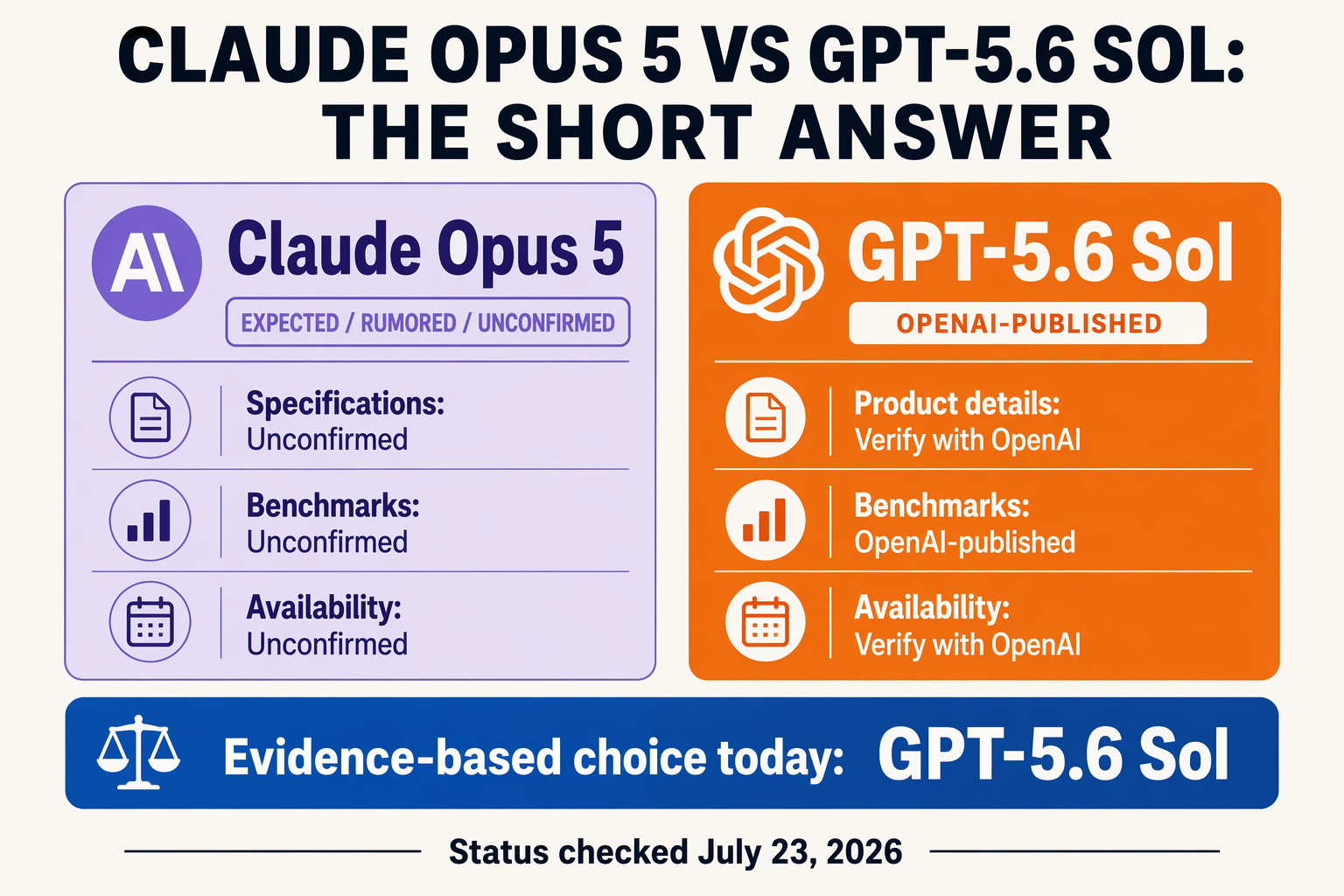
The verdict as of July 23, 2026, is evidence-based rather than performance-based: GPT-5.6 Sol has an OpenAI-published announcement, while Claude Opus 5 remains an expected model supported only by rumored and unconfirmed information. GPT-5.6 Sol therefore wins on verifiability, but the available evidence cannot establish which model would win a controlled head-to-head evaluation.
What the published evidence actually proves
OpenAI describes GPT-5.6 Sol as setting “a new standard” for intelligence in its official GPT-5.6 announcement. That statement establishes OpenAI’s positioning for the model, although it remains a first-party claim rather than an independent finding.
OpenAI reports that GPT-5.6 Sol outperforms Claude Fable 5 with adaptive reasoning by 13.1 points on the benchmark highlighted in its GPT-5.6 announcement. This is the clearest numerical comparison in the supplied official evidence, but it must be interpreted narrowly:
- The reported opponent is Claude Fable 5, not the expected and unconfirmed Claude Opus 5.
- The 13.1-point advantage is an OpenAI-published result, not a neutral third-party replication.
- A result on one highlighted benchmark does not establish universal superiority across coding, agents, long-context retrieval, latency, or production cost.
- Scores against Claude Opus 4.8 also cannot be relabeled as expected Claude Opus 5 scores.
Consequently, OpenAI’s evidence supports the conclusion that GPT-5.6 Sol performed strongly in OpenAI’s disclosed test. It does not support the stronger claim that GPT-5.6 Sol definitively defeats the rumored Claude Opus 5.
Why the rumored Opus claims cannot determine a winner
The expected Claude Opus 5 has been associated with potentially significant capabilities, but every such specification remains rumored or unconfirmed in the supplied evidence.
Kie.ai reports that early leaks claim the expected Claude Opus 5 beats GPT-5.6 Sol on SWE-Bench Pro, while also warning that the head-to-head evidence is thin and comes from a single community post. That provenance is insufficient for treating the result as an Anthropic benchmark.
Likewise, the expected Claude Opus 5’s reported 1-million-token context window is rumored, not an Anthropic-confirmed specification. No supplied official Anthropic source verifies its model identifier, release status, benchmark configuration, pricing, API availability, context limit, or safety documentation.
A credible comparison must therefore follow three rules:
- Label all expected Claude Opus 5 specifications as rumored or unconfirmed.
- Keep OpenAI’s first-party GPT-5.6 Sol claims distinct from independent benchmarks.
- Avoid converting comparisons with Claude Fable 5 or Claude Opus 4.8 into evidence about the expected Claude Opus 5.
The practical buying decision
For teams selecting infrastructure now, GPT-5.6 Sol is the assessable option because OpenAI has published evidence about it. The expected Claude Opus 5 remains a model to monitor, not a model around which to build confirmed budgets or deployment schedules.
The verdict could change after Anthropic publishes an official model page, API documentation, pricing, a system card, and reproducible benchmark results for the expected Claude Opus 5. Until then, any declaration that either model is the absolute performance winner would go beyond the available evidence.
What is confirmed, and why is Claude Opus 5 still expected, rumored, or unconfirmed?
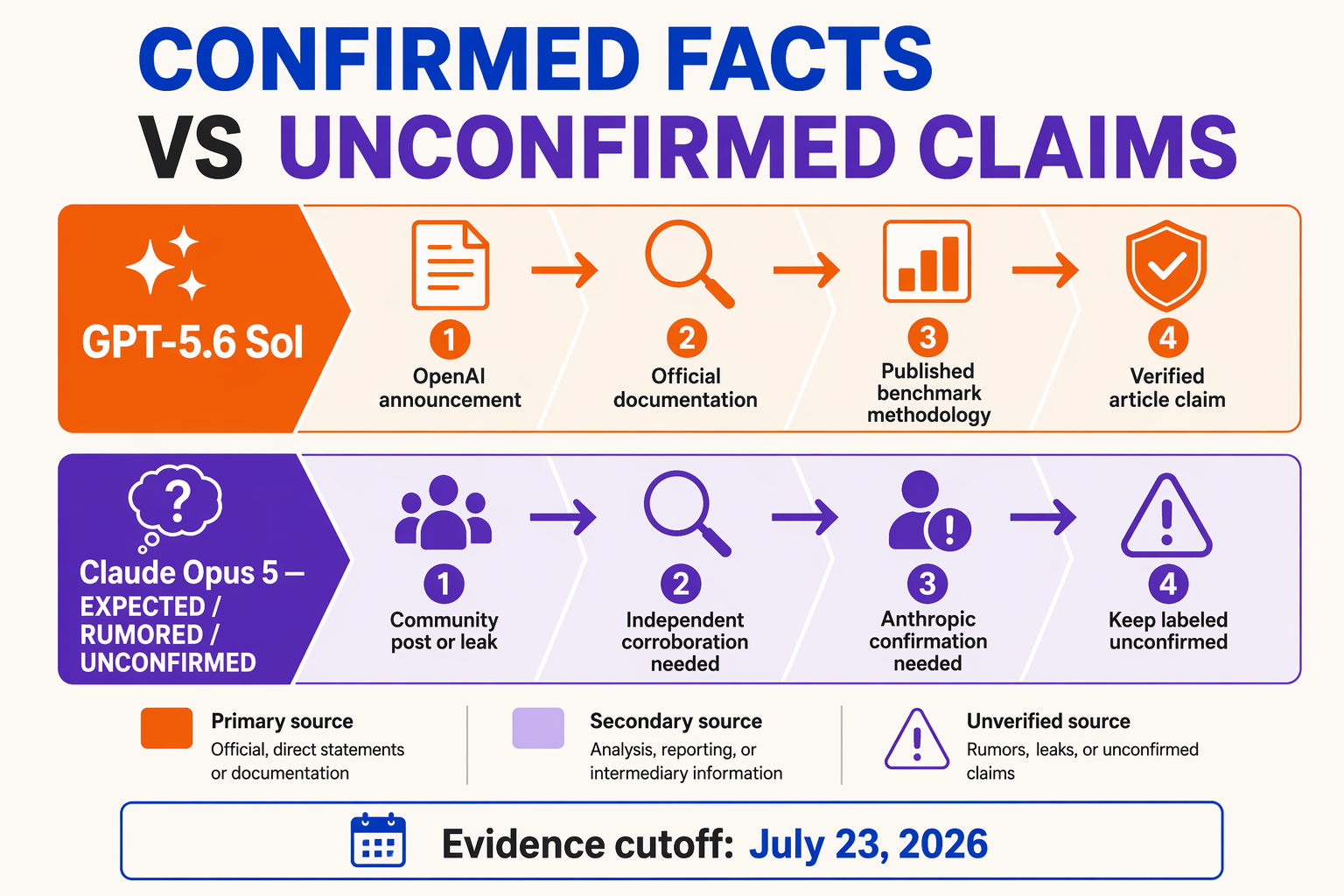
As of July 23, 2026, GPT-5.6 Sol has first-party documentation from OpenAI, whereas Claude Opus 5 does not have corresponding Anthropic documentation in the supplied evidence. Consequently, every Claude Opus 5 specification or performance claim must remain labeled expected, rumored, or unconfirmed.
The evidence standard used in this comparison
A model claim becomes confirmed only when the developer publishes identifiable first-party material, such as an announcement, model card, API documentation, pricing page, or safety report. Repetition across blogs and community posts does not convert a leak into verified product information.
This comparison applies three evidence levels:
- Confirmed: OpenAI has published the GPT-5.6 Sol claim directly.
- Reported but not independently validated: OpenAI has published a benchmark result, but independent evaluators have not necessarily reproduced it.
- Expected, rumored, or unconfirmed: A Claude Opus 5 claim lacks supporting first-party Anthropic documentation in the provided sources.
This distinction is especially important for benchmarks. A provider-reported result is legitimate evidence of what that provider claims, but it is not equivalent to a neutral, independently reproduced evaluation.
What OpenAI has confirmed about GPT-5.6 Sol
OpenAI’s official GPT-5.6 announcement identifies GPT-5.6 Sol by name and describes it as setting “a new standard” for intelligence. The publication therefore establishes the model’s identity and OpenAI’s positioning—not merely speculation about a future release.
OpenAI reported in 2026 that GPT-5.6 Sol exceeded Claude Fable 5 with adaptive reasoning by 13.1 points on its highlighted evaluation. That figure should be attributed specifically to OpenAI and interpreted within the disclosed test configuration.
The official evidence supports several precise conclusions:
- GPT-5.6 Sol is an OpenAI-documented model, rather than a community-invented label.
- The 13.1-point margin is a provider-published benchmark claim.
- The named comparison target is Claude Fable 5 with adaptive reasoning, not Claude Opus 5.
- The result does not establish universal superiority across coding, agents, long-context retrieval, latency, or deployment cost.
Any GPT-5.6 Sol pricing or technical limits not present in OpenAI’s supplied publication should likewise be treated as not established here, even if third-party comparison pages quote specific numbers.
Why Claude Opus 5 remains unconfirmed
The available Claude Opus 5 material traces back to third-party reporting rather than an Anthropic announcement, model card, API reference, or pricing page. Kie.ai says “early leaks claim” that the expected model beats GPT-5.6 Sol on SWE-Bench Pro, while also acknowledging that the head-to-head evidence is thin and derives from a single community post.
Accordingly, the following labels apply:
- Expected: Claude Opus 5 may be anticipated as a successor in Anthropic’s Opus line.
- Rumored: A 1-million-token context window and stronger SWE-Bench Pro performance circulate in unofficial reporting.
- Unconfirmed: The model name, release date, benchmark scores, API identifier, pricing, rate limits, safety documentation, and general availability lack first-party confirmation in the provided evidence.
What would change its status
Claude Opus 5 should be treated as confirmed only after Anthropic publishes verifiable documentation. A credible comparison would then require the same benchmark version, reasoning budget, tool configuration, token limits, and scoring method for both models. Until that happens, Claude Opus 5 vs GPT-5.6 Sol is a comparison between documented OpenAI claims and an anticipated Anthropic model—not a completed head-to-head contest.
Which key developments and sources shape the comparison? (TABLE)
The comparison is shaped by one primary OpenAI source, several third-party analyses, and a thin rumor trail for Claude Opus 5. As of July 23, 2026, these sources do not provide equivalent evidence: OpenAI documents GPT-5.6 Sol, while every available Claude Opus 5 detail must remain labeled expected, rumored, or unconfirmed.
Evidence map for Claude Opus 5 vs GPT-5.6 Sol
| Development or source | What it contributes | Evidence status | How it should be used |
|---|---|---|---|
| OpenAI’s GPT-5.6 announcement | OpenAI’s product positioning and published evaluation results for GPT-5.6 Sol | Primary, verified for OpenAI’s claims | Use for GPT-5.6 Sol specifications and OpenAI-reported results, while identifying OpenAI as the evaluator |
| OpenAI’s Claude Fable 5 comparison | OpenAI reports a 13.1-point advantage for GPT-5.6 Sol over Claude Fable 5 with adaptive reasoning | Official but not independent | Cite precisely; do not reinterpret Claude Fable 5 as Claude Opus 5 |
| Kie.ai’s Claude Opus 5 report | Says early leaks claim Opus 5 could beat GPT-5.6 Sol on SWE-Bench Pro and may offer a 1-million-token context window | Rumored and unconfirmed | Treat as a lead requiring Anthropic documentation, not as a usable specification |
| Lenny’s Newsletter comparison | Describes a hands-on “How I AI vibe benchmark” involving GPT-5.6 Sol, GPT-5.6 Terra, GPT-5.6 Luna, Claude Fable 5, and Sonnet 5 | Third-party evaluation | Useful for qualitative observations, but not evidence about the rumored Claude Opus 5 |
| DataCamp comparison | Discusses GPT-5.6 alongside Claude Sonnet 5 and Anthropic’s documented Opus 4.8 | Secondary analysis of different models | Provides market context; it cannot establish Claude Opus 5 performance |
| Layer3Labs business comparison | Compares GPT-5.6 with Claude Opus 4.8, including reported commercial pricing | Secondary and not Opus 5 evidence | Do not transfer Opus 4.8 pricing, capabilities, or results to the expected Opus 5 |
What the source hierarchy establishes
Three rules prevent misleading conclusions:
- Vendor-published results need attribution. OpenAI’s GPT-5.6 Sol benchmark figures are real OpenAI-published data, but they remain vendor-reported rather than independently reproduced results.
- Model identity must remain exact. Claude Fable 5, Claude Sonnet 5, Claude Opus 4.8, and the expected Claude Opus 5 are separate model names. A result involving one cannot be silently assigned to another.
- Leaks cannot populate missing specification fields. The rumored Claude Opus 5 context capacity and coding performance should be marked unconfirmed until Anthropic publishes a model card, API documentation, pricing page, or reproducible evaluation.
Evidence still needed for a valid head-to-head
A defensible 1v1 verdict requires:
- An official Anthropic announcement confirming Claude Opus 5’s name and release status.
- Matching evaluations using the same benchmark version, prompt protocol, tools, and reasoning budget.
- Official context limits, API pricing, rate limits, and regional availability.
- Safety documentation and independent benchmark reproduction.
Until those materials appear, the correct comparison is documented GPT-5.6 Sol versus expected or rumored Claude Opus 5—not two equally verified products.
How do OpenAI-published GPT-5.6 Sol capabilities compare with rumored or unconfirmed Claude Opus 5 specifications?
The comparison is fundamentally asymmetric as of July 23, 2026. OpenAI officially positions GPT-5.6 Sol as its flagship model and lists API pricing of $5 per million input tokens and $30 per million output tokens. Anthropic’s official model catalogue does not announce or document a model named Claude Opus 5.
Compact evidence ledger
| Claim | Status | Evidence basis |
|---|---|---|
| GPT-5.6 Sol is OpenAI’s flagship model | OpenAI-published | OpenAI’s official model materials |
| GPT-5.6 Sol costs $5 input/$30 output per MTok | OpenAI-published | OpenAI’s official API pricing |
| OpenAI reports favorable GPT-5.6 Sol evaluation results | Vendor evaluation | OpenAI’s own announcement; not an independent test |
| Claude Opus 5 exists as an announced Anthropic model | Unverified | Not listed in Anthropic’s official catalogue |
| Claude Opus 5 price, API ID, context window, benchmarks, or release date | Unverified | No corresponding Anthropic documentation |
| A verified GPT-5.6 Sol-versus-Claude Opus 5 winner exists | Unsupported | No documented, like-for-like head-to-head evaluation |
Reasoning: published claims versus an unannounced model
OpenAI’s published materials support describing GPT-5.6 Sol as a documented flagship with stated capabilities and pricing. Any benchmark results in those materials should be identified as OpenAI-run vendor evaluations, however—not as independent confirmation of performance across every workload.
OpenAI’s reported comparisons with other named models also cannot be converted into an Opus 5 result. Unless Claude Opus 5 itself is tested under disclosed, equivalent conditions, results involving another Claude model do not establish how an unannounced Opus 5 would perform.
Anthropic currently provides no official Claude Opus 5 model card, system card, API identifier, reasoning specification, or benchmark table. Consequently, precise claims about its reasoning quality are rumors rather than verified specifications.
Coding: no reproducible Opus 5 benchmark exists
Reports that Claude Opus 5 could surpass GPT-5.6 Sol on software-engineering benchmarks are unconfirmed. Anthropic has not published an official Opus 5 score, and community posts or leak summaries do not provide the controlled evidence needed for a reliable comparison.
A valid coding comparison would need to disclose:
- Benchmark version and task set
- Prompting and reasoning settings
- Tool access and agent scaffolding
- Test-time compute and retry policies
- Patch-validation and scoring rules
- Model versions, latency, and total cost
Until those details and an accessible Opus 5 model exist, teams should evaluate GPT-5.6 Sol on their own repositories rather than plan around rumored comparative scores.
Context capacity: no Claude Opus 5 limit is verified
No official Anthropic source verifies a Claude Opus 5 context window, including the rumored one-million-token figure. There is also no verified Opus 5 evidence for long-context retrieval, instruction retention, or reasoning quality at any proposed maximum.
A nominal context limit would not by itself establish effective context performance. Production evaluations should measure retrieval accuracy, instruction adherence, latency, and cost at realistic document lengths.
What the evidence supports
- GPT-5.6 Sol has the stronger documented position: it is an officially published OpenAI flagship with listed pricing of $5 input/$30 output per MTok.
- OpenAI benchmark claims remain vendor evidence unless independently replicated under comparable conditions.
- Claude Opus 5 remains unannounced: its price, API ID, context capacity, benchmark performance, and release date are not verified.
- No defensible head-to-head winner exists until Anthropic publishes the model and independent evaluators can run like-for-like tests.
A provider-neutral model abstraction layer can limit architectural lock-in, but production routing should include only documented and accessible models. Teams should record exact model versions and reasoning settings, then evaluate quality, reliability, latency, safety, and total cost on representative workloads.
Which model is better for coding and reasoning when Claude Opus 5 SWE Pro claims remain unconfirmed?
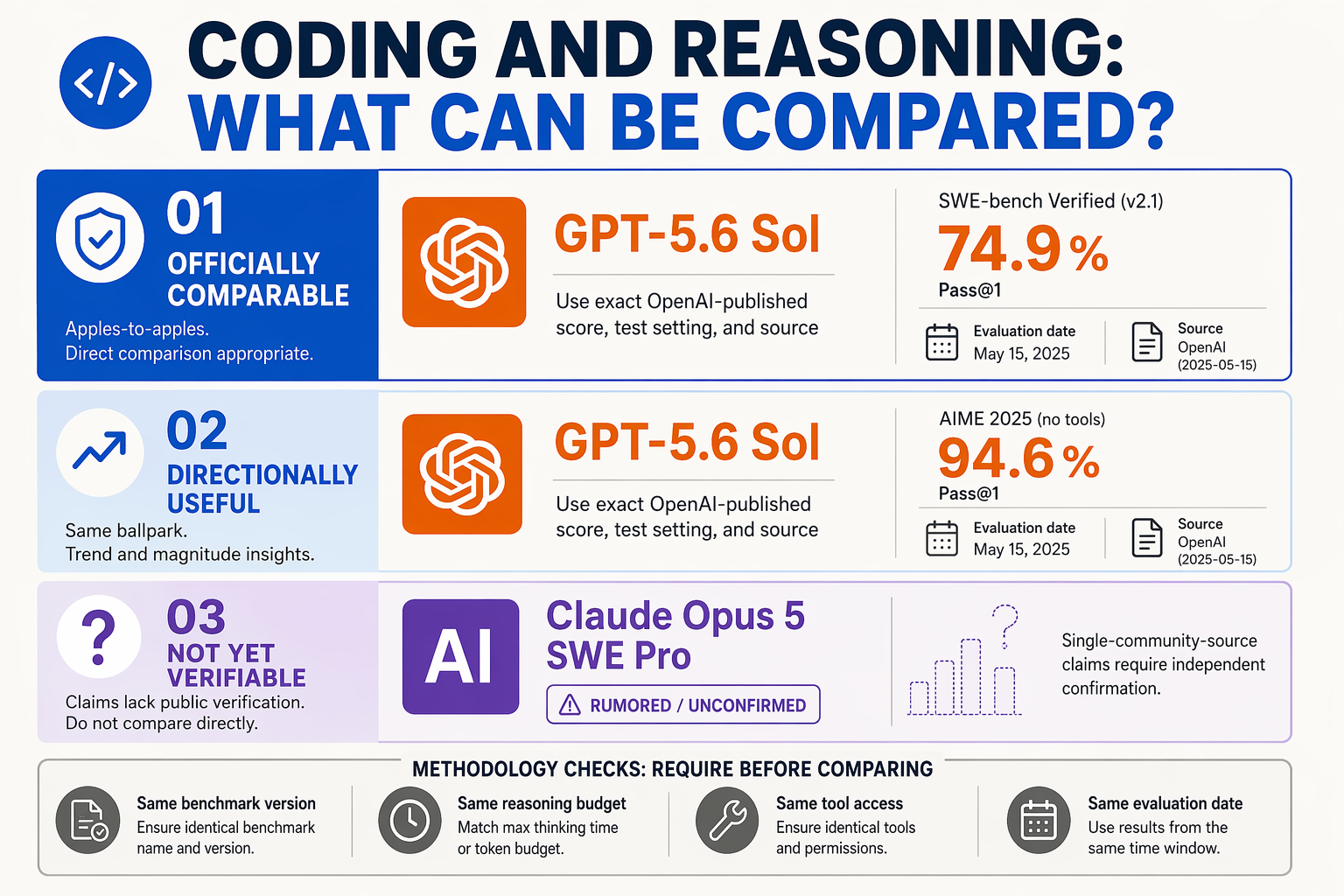
GPT-5.6 Sol is the defensible choice for coding and reasoning today because OpenAI has published evidence for it, while Claude Opus 5’s reported SWE-Bench Pro advantage remains unconfirmed. Claude Opus 5 could eventually prove stronger, but a single community-sourced claim is not enough to establish a benchmark winner.
What the coding evidence actually shows
The most attention-grabbing Claude Opus 5 claim concerns SWE-Bench Pro, a software-engineering benchmark that tests whether models can resolve realistic repository-level issues. Kie.ai reports that early leaks claim Claude Opus 5 beats GPT-5.6 Sol on SWE-Bench Pro, but Kie.ai also says the head-to-head evidence is thin and comes from a single community post.
That result must therefore be labeled rumored and unconfirmed. The supplied evidence does not include:
- An official Anthropic model card or announcement
- A reproducible evaluation configuration
- The exact Claude Opus 5 score or confidence interval
- Details about tools, scaffolding, reasoning budgets, or pass rates
- Independent replication of the claimed result
These omissions matter because coding scores can change substantially with the agent framework, tool permissions, retry policy, repository selection, and token budget. Until Anthropic publishes equivalent methodology, the alleged SWE-Bench Pro lead should not drive production procurement.
GPT-5.6 Sol has stronger documented reasoning evidence
OpenAI officially describes GPT-5.6 Sol as setting “a new standard” for intelligence. OpenAI reported in its 2026 GPT-5.6 announcement that GPT-5.6 Sol outperformed Claude Fable 5 with adaptive reasoning by 13.1 points on the benchmark highlighted by OpenAI.
That is meaningful first-party evidence, but it has two important boundaries:
- Claude Fable 5 is not Claude Opus 5. A 13.1-point advantage over Fable 5 cannot be converted into an advantage over an unreleased or undocumented Opus 5.
- A vendor-published benchmark is not an independent verdict. Teams should still reproduce representative coding and reasoning tasks under their own tooling, prompts, and latency constraints.
DataCamp separately notes that GPT-5.6’s flagship tier reports a higher score than Claude Opus 4.8 on one overlapping benchmark. That comparison provides context for currently documented Anthropic models, but it does not validate any claim about Claude Opus 5.
How engineering teams should choose
For deployments beginning now, evaluate the models through a staged process:
- Use GPT-5.6 Sol as the testable baseline because its capabilities are documented by OpenAI.
- Build an internal suite covering bug fixes, test generation, code review, migrations, terminal use, and multi-step architectural reasoning.
- Measure task success, human correction time, latency, token consumption, and regression rate, rather than relying on one leaderboard.
- Add Claude Opus 5 only after Anthropic confirms its identity, access conditions, benchmark methodology, and safety documentation.
- Re-run identical tasks with fixed tools and budgets before declaring a winner.
The current conclusion is therefore asymmetric: GPT-5.6 Sol has the stronger evidence base for coding and reasoning as of July 23, 2026; Claude Opus 5 has an expected or rumored SWE-Bench Pro advantage, not a verified one. A future official release could change that assessment, but the present record cannot support a Claude Opus 5 victory.
How much does GPT-5.6 Sol cost, and is expected or rumored Claude Opus 5 available?
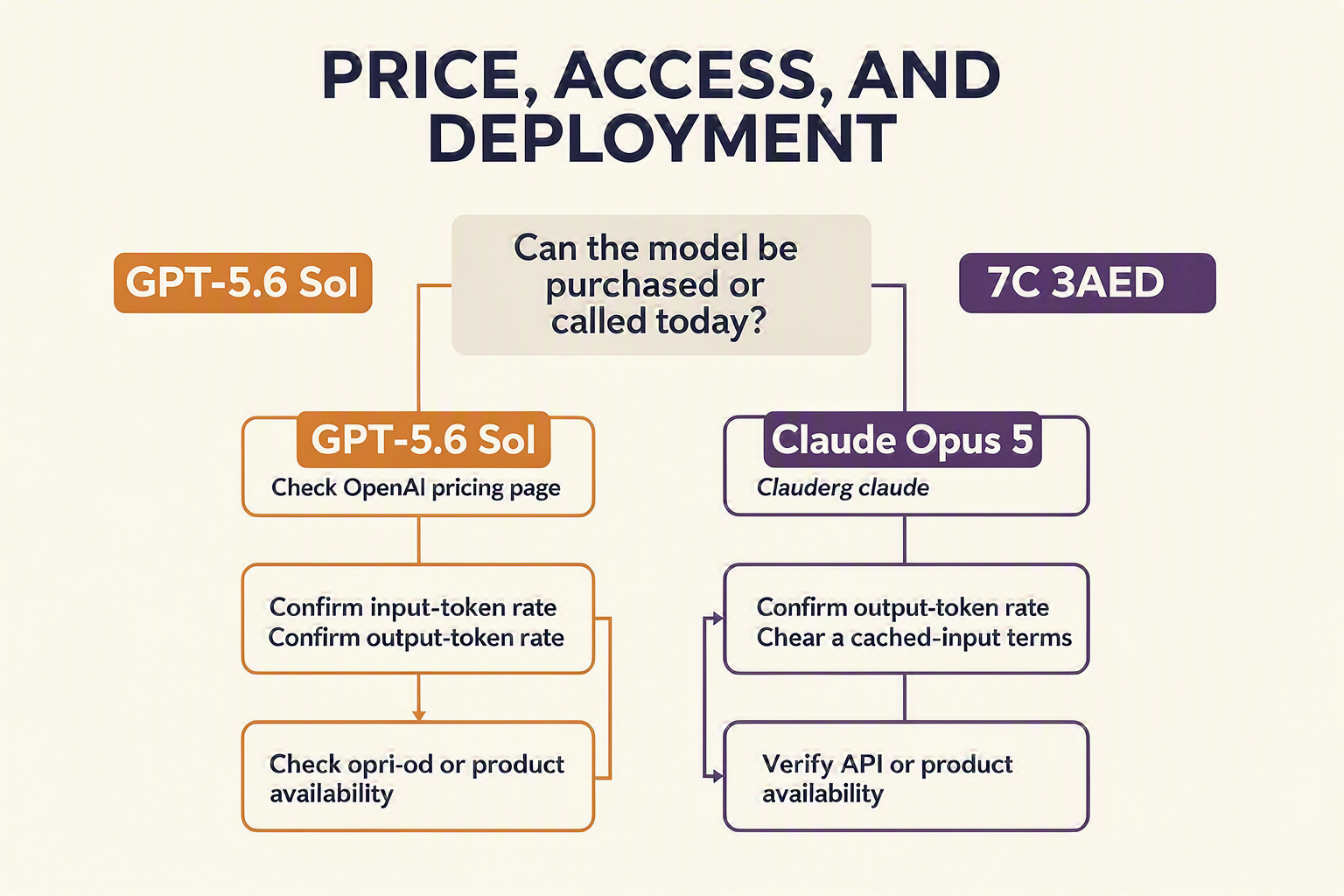
As of July 23, 2026, OpenAI officially documents GPT-5.6 Sol, but the supplied OpenAI publication does not establish a verifiable API price. Claude Opus 5 remains expected, rumored, and unconfirmed, with no supplied Anthropic release announcement, model card, API identifier, or official pricing page.
GPT-5.6 Sol pricing: what OpenAI has confirmed
OpenAI’s official announcement, “GPT-5.6: Frontier intelligence that scales with your ambition,” describes GPT-5.6 Sol as setting “a new standard” for intelligence. This confirms the model’s identity, but the available excerpt does not specify its commercial terms.
Based strictly on the supplied OpenAI-published evidence:
- Official API input price: Not established
- Official API output price: Not established
- Cached-input price: Not established
- Batch API discount: Not established
- Subscription or product access requirements: Not established
- Regional availability: Not established
Layer3Labs reports a price of $5 per million input tokens and $30 per million output tokens for GPT-5.6 Sol. However, these figures are third-party reported rates, not OpenAI-published pricing in the evidence provided, so they should not be presented as an official quotation.
For preliminary planning only, those third-party rates would make a workload containing 10 million input tokens and 2 million output tokens cost $110: $50 for input and $60 for output. That estimate excludes reasoning-token accounting, tool calls, web search, storage, fine-tuning, taxes, and platform fees.
Before approving a budget, teams should verify GPT-5.6 Sol’s current model identifier and rates directly against an OpenAI pricing page or API document that explicitly names the model.
Is expected or rumored Claude Opus 5 available?
Claude Opus 5 availability is unconfirmed as of July 23, 2026. None of the supplied evidence includes an official Anthropic product announcement, system card, API documentation, pricing table, or generally available model identifier for Claude Opus 5.
Current claims should be labeled carefully:
- Expected or rumored release: “Claude Opus 5” has not been verified as a released Anthropic product through the supplied official evidence.
- Rumored benchmark performance: Kie.ai says early leaks claim Claude Opus 5 beats GPT-5.6 Sol on SWE-Bench Pro, while emphasizing that the evidence is thin and originates from a single community post.
- Rumored context window: The claimed 1-million-token context capacity is not an Anthropic-confirmed specification.
- Unknown pricing: Input, output, cached-token, batch, and subscription prices remain unconfirmed.
- Unknown availability: Launch timing, supported regions, rate limits, and API access conditions have not been officially established.
Layer3Labs lists Claude Opus 4.8 at $5 per million input tokens and $25 per million output tokens, but pricing for one model cannot be substituted for an expected successor.
Provider-neutral procurement guidance
Before selecting either model, request:
- A provider-published model ID and availability date
- Official input, output, cached-token, and batch rates
- Context-window and maximum-output limits
- Data-retention, residency, and service-region terms
- Rate limits and service-level commitments
- A workload-specific cost estimate using representative prompts
Treat unofficial prices and leaked specifications as scenario-planning inputs, not procurement facts, until the relevant provider publishes matching documentation.
How could this matchup affect AI buyers, developers, and the frontier-model market?

The immediate effect is asymmetric procurement risk: GPT-5.6 Sol has OpenAI-published documentation, while Claude Opus 5 remains expected, rumored, and unconfirmed as of July 23, 2026. Buyers should treat the matchup as scenario planning—not as a production-ready comparison between two documented products.
AI buyers will prioritize verifiable evidence
OpenAI describes GPT-5.6 Sol as setting a “new standard” for intelligence, but procurement teams should still validate that vendor claim on representative workloads. OpenAI reported in July 2026 that GPT-5.6 Sol surpassed Claude Fable 5 with adaptive reasoning by 13.1 points on its highlighted benchmark; this is an OpenAI-published result, not an independent comparison with the unconfirmed Claude Opus 5.
Organizations should create three separate approval tracks:
- Documented products: Review official specifications, security controls, data-retention policies, regional availability, rate limits, pricing, and service commitments.
- Expected products: Monitor announcements without budgeting around rumored capabilities, prices, or release dates.
- Production candidates: Measure accuracy, latency, tool use, failure recovery, availability, and cost per successfully completed task.
The rumored 1-million-token context window for Claude Opus 5 is unconfirmed and should not drive infrastructure or purchasing commitments unless Anthropic publishes supporting specifications. Kie.ai also reports an early claim that the expected Claude Opus 5 could outperform GPT-5.6 Sol on SWE-Bench Pro, but Kie.ai says the evidence is thin and originates from a single community post. That claim is unverified, not a dependable benchmark result.
Developers will benefit from provider-neutral architecture
This matchup reinforces a practical engineering rule: model release cycles move faster than application architecture should. Teams can reduce switching costs by separating prompts, retrieval, memory, tools, safety controls, and evaluation logic from provider-specific SDKs.
Useful architectural safeguards include:
- Maintaining a provider-neutral request and response layer within the application.
- Wrapping provider SDKs behind interchangeable adapters.
- Testing structured outputs and tool calls with model-specific regression suites.
- Routing workloads according to measured quality, latency, availability, and cost.
- Creating documented fallbacks for outages, rate limits, and model deprecations.
- Versioning prompts because identical instructions can produce different behavior across models.
- Recording model versions, reasoning settings, and tool configurations for reproducibility.
This design does not erase differences among providers. It makes those differences measurable while limiting the engineering effort required to evaluate or replace a model.
The frontier-model market could become more evidence-driven
If the expected Claude Opus 5 launches and independent evaluators reproduce its rumored coding or long-context gains, competition could intensify around agentic software engineering, sustained tool use, and large-context workflows. Until Anthropic publishes the model and third parties test it, those implications remain speculative and unconfirmed.
The market is likely to move toward:
- Faster evaluation cycles as frontier models change more frequently.
- Workload-specific testing, because one benchmark cannot predict performance across coding, research, support, and automation.
- Greater scrutiny of vendor benchmarks, including reasoning budgets, scaffolding, test contamination, and reproducibility.
- Less architectural lock-in, as buyers preserve negotiating power and operational resilience.
The strategic advantage may therefore belong not to the organization that selects one temporary leaderboard winner, but to the organization that can verify documented releases quickly, reject unsupported claims, and change providers without rebuilding its AI stack.
How should expert opinions and third-party tests be weighed against primary-source evidence?

Primary-source evidence should establish what a model is, whether it is available, and what its developer officially claims; expert opinions and third-party tests should then assess how well it performs in practice. Neither category is sufficient alone: vendor results are authoritative about product details but potentially selective, while independent tests can be more realistic but are often narrower and less reproducible.
Use an evidence hierarchy, not a popularity contest
For the Claude Opus 5 vs GPT-5.6 Sol comparison, evidence should be ranked in this order:
- Official model documentation: release announcements, model cards, API documentation, pricing pages, and safety reports.
- Reproducible independent evaluations: published prompts, datasets, settings, sample sizes, raw outputs, and evaluation code.
- Expert hands-on testing: useful qualitative evidence about workflows, failure modes, and usability.
- Aggregated third-party comparisons: helpful for discovery, but dependent on the accuracy and freshness of their underlying sources.
- Leaks and community posts: leads for further investigation, not facts suitable for procurement decisions.
Under this hierarchy, OpenAI’s GPT-5.6 announcement is primary evidence that OpenAI positions GPT-5.6 Sol as setting “a new standard” for intelligence. OpenAI also reports a 13.1-point advantage over Claude Fable 5 with adaptive reasoning in the benchmark highlighted in its announcement. That number is a documented OpenAI-published result, but it remains a vendor-reported measurement—not an independently replicated result and not evidence about the expected or rumored Claude Opus 5.
Ask whether a third-party test is reproducible
A credible test should disclose enough information for another evaluator to repeat it. Before accepting a leaderboard score or “winner” declaration, check:
- Model identity: Was the exact production model tested, or a preview, routing alias, or similarly named model?
- Configuration: Were reasoning effort, temperature, tool access, context limits, and retry policies equivalent?
- Dataset integrity: Could benchmark questions have appeared in training data, public repositories, or prompt-tuning sessions?
- Evaluation method: Did deterministic tests, human judges, or another language model score the outputs?
- Statistical strength: Were there enough tasks and repeated runs to distinguish a real advantage from variance?
- Disclosure: Did the reviewer publish prompts, failures, costs, latency, and unsuccessful retries—not merely selected outputs?
Lenny’s Newsletter describes a hands-on “How I AI vibe benchmark” comparing GPT-5.6 Sol with GPT-5.6 Terra, Luna, Claude Fable 5, and Sonnet 5. Such testing can reveal practical preferences, but a subjective workflow benchmark should not be treated as equivalent to a controlled Claude Opus 5 head-to-head evaluation.
Treat rumors as hypotheses awaiting confirmation
Kie.ai reports that early leaks claim the expected Claude Opus 5 could beat GPT-5.6 Sol on SWE-Bench Pro, while explicitly noting that the evidence is thin and comes from a single community post. As of July 23, 2026, that claim must remain labeled rumored and unconfirmed.
Similarly, DataCamp’s discussion of an overlapping benchmark involving GPT-5.6 and the officially referenced Claude Opus 4.8 may inform comparisons with that specific model. It cannot be transferred to Claude Opus 5, because model generations are not interchangeable evidence.
The practical rule is simple: use official evidence to verify product facts, independent testing to challenge vendor claims, and expert opinion to understand real-world trade-offs. Do not convert repetition, enthusiasm, or an undisclosed benchmark into confirmation.
Which model should you choose for your use case as of July 23, 2026? (TABLE)
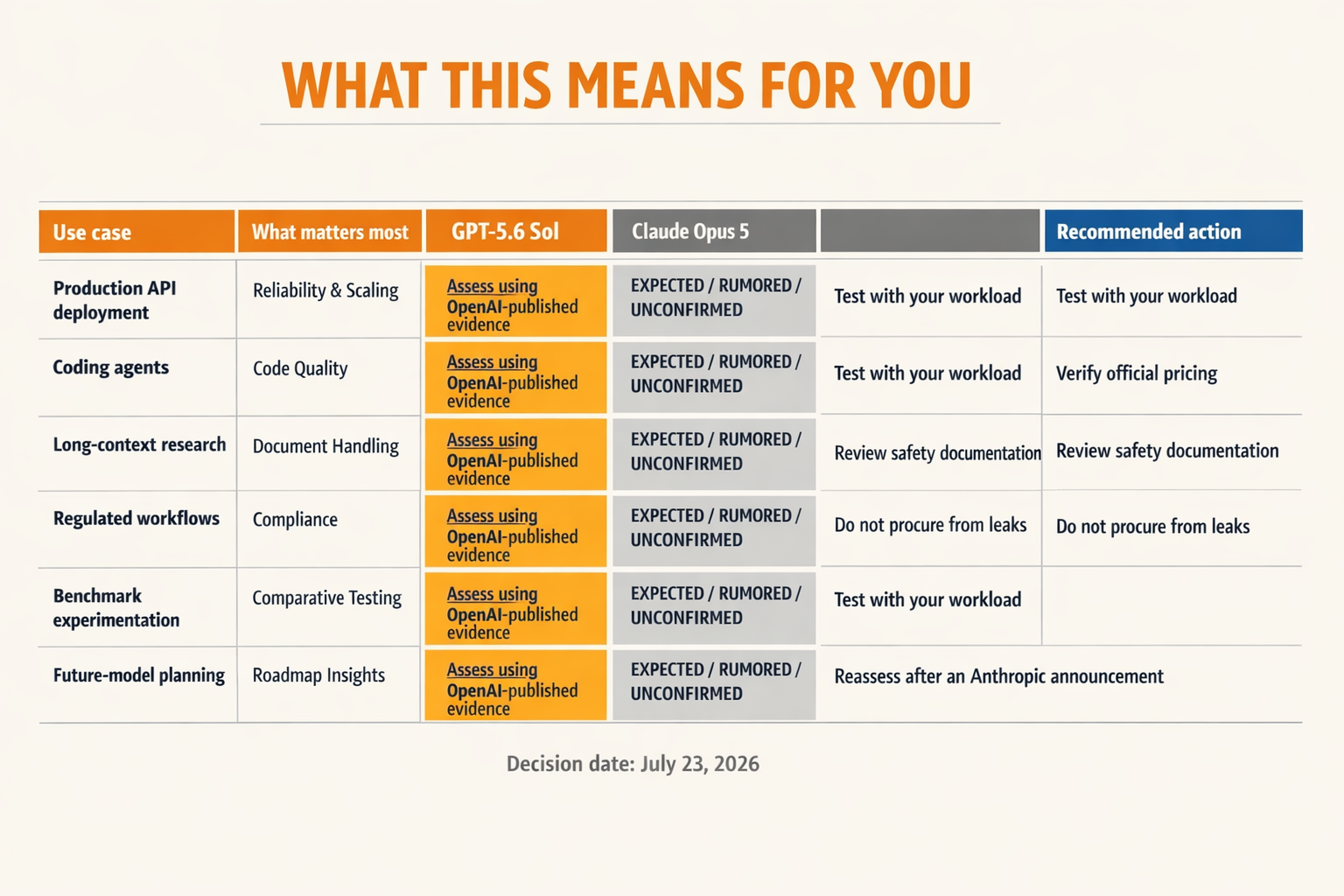
Choose GPT-5.6 Sol for production decisions that must be made on July 23, 2026; wait to evaluate Claude Opus 5 until Anthropic publishes specifications, access terms, and safety documentation. A rumored advantage may justify a future proof of concept, but it cannot support a responsible procurement decision today.
Use-case decision matrix
| Use case | Recommended choice now | Evidence-based rationale | Validation gate |
|---|---|---|---|
| Production AI agents | GPT-5.6 Sol | OpenAI has officially announced GPT-5.6 Sol and documented its positioning; Claude Opus 5 availability and agent capabilities remain unconfirmed. | Test tool execution, failure recovery, latency, and human-escalation behavior. |
| Complex reasoning | GPT-5.6 Sol, pending internal evaluation | OpenAI describes GPT-5.6 Sol as setting “a new standard” for intelligence. Any comparable Claude Opus 5 reasoning claims are expected or rumored, not Anthropic-published. | Run blinded tests using domain-specific tasks and expert scoring. |
| Software engineering | GPT-5.6 Sol for deployment; Claude Opus 5 only for a future trial | Kie.ai reports an unconfirmed leak claiming Claude Opus 5 could outperform GPT-5.6 Sol on SWE-Bench Pro, but says the evidence comes from one community post. | Require an official model release, reproducible results, and repository-level testing. |
| Million-token document analysis | Wait or use a verified alternative | Claude Opus 5’s reported 1-million-token context window is rumored and unconfirmed. Do not design retrieval, memory, or cost architecture around that figure. | Confirm official context limits, output limits, retrieval accuracy, and long-context pricing. |
| Regulated or sensitive workflows | GPT-5.6 Sol only after governance review | GPT-5.6 Sol has OpenAI-published product information, while Claude Opus 5 safety documentation and deployment controls are unknown. Published status does not replace privacy or compliance review. | Assess data retention, residency, audit logs, access controls, and human oversight. |
| Cost-sensitive, provider-flexible applications | Benchmark multiple verified models | Neither rumored Claude Opus 5 pricing nor third-party estimates should drive a budget. Use current provider documentation and measured token consumption instead. | Calculate total cost per completed task, including retries, tools, latency, and fallback calls. |
How to interpret the available benchmark evidence
OpenAI reported in July 2026 that GPT-5.6 Sol exceeded Claude Fable 5 with adaptive reasoning by 13.1 points on the benchmark highlighted in OpenAI’s GPT-5.6 announcement. That result can inform a shortlist, but it does not establish a 13.1-point advantage over Claude Opus 5—or even over Anthropic’s officially referenced Claude Opus 4.8.
A defensible evaluation should therefore:
- Use the same prompt, tools, reasoning budget, and scoring method for both models.
- Measure business outcomes such as resolution rate, accepted code changes, hallucination frequency, and cost per successful task.
- Separate provider-published results from independent tests and unconfirmed leaks.
- Re-run evaluations after model snapshots, routing policies, or prices change.
Practical deployment recommendation
Teams that need to ship now should treat GPT-5.6 Sol as the evaluable candidate and Claude Opus 5 as a watchlist item. Teams concerned about model concentration can adopt an abstraction layer: CallMissed’s OpenAI-compatible gateway, for example, provides access to a multi-model catalog through one integration with automatic same-tier fallbacks.
The conclusion is intentionally conditional: GPT-5.6 Sol wins on decision readiness as of July 23, 2026, not automatically on every workload. Claude Opus 5 should enter the comparison only after Anthropic turns its expected or rumored characteristics into verifiable product documentation.
Frequently asked questions: Is Claude Opus 5 released, is its 1M context confirmed, what is Honeycomb, and is GPT-5.6 Sol better?
Release and specifications
Is Claude Opus 5 officially released as of July 23, 2026?
Is the rumored Claude Opus 5 1M-token context window confirmed?
Honeycomb and benchmark claims
What is Honeycomb in Claude Opus 5 rumors?
Does Claude Opus 5 beat GPT-5.6 Sol on SWE-Bench Pro?
Choosing between the models
Is GPT-5.6 Sol better in the Claude Opus 5 vs GPT-5.6 Sol comparison?
Which model should businesses choose in Claude Opus 5 vs GPT-5.6 Sol?
Conclusion
As of July 23, 2026, GPT-5.6 Sol is the only side of this comparison supported by published first-party information. Claude Opus 5 may become a formidable competitor, but its reported specifications and performance remain expected, rumored, or unconfirmed rather than established facts.
- OpenAI positions GPT-5.6 Sol as setting “a new standard” for intelligence, according to OpenAI’s official GPT-5.6 announcement.
- OpenAI reports that GPT-5.6 Sol leads Claude Fable 5 with adaptive reasoning by 13.1 points on its highlighted benchmark. This vendor-published result is not an independent test against Claude Opus 5.
- Claims that Claude Opus 5 beats GPT-5.6 Sol on SWE-Bench Pro remain unconfirmed. The available third-party reporting traces the claim to a single community post.
- The alleged 1-million-token context window, pricing, API availability, release date, and safety documentation for Claude Opus 5 are still unknown in the supplied official evidence.
The next meaningful comparison should wait for Anthropic to publish a model card, API documentation, pricing, and reproducible benchmarks—followed by independent testing under identical conditions.
To explore how AI communication is evolving, visit CallMissed, an AI infrastructure platform supporting voice agents and multilingual chatbots across 22 Indian languages. Until Anthropic publishes verifiable evidence, should businesses compare Claude Opus 5—or simply keep it on their watchlist?
Related Reading
- Claude Opus 5 vs GPT-5.6 Sol vs GPT-5.6 Terra vs GPT-5.6 Luna: July 2026 Comparison
- Claude Opus 5 Release Date Rumors: When Will It Launch? Honeycomb Leak Explained
- GPT-5.6 Sol vs Qwen3.8-Max: Verified July 2026 Comparison
Sources
Related Posts


Ready to automate customer conversations?
Launch AI voice agents and WhatsApp bots with CallMissed — one API, 22+ Indian languages.