

Gemini 3.5 Flash-Lite vs Kimi K3: API, Price & Limits


Gemini 3.5 Flash-Lite vs Kimi K3 compared on API availability, pricing, context limits, speed, coding, multimodality, tools, and production fit.
Gemini 3.5 Flash-Lite vs Kimi K3: API, Price & Limits
Both model names in this shortlist can now be confirmed in their vendors’ official API catalogs, so the decision turns on cost, limits, and workload fit. That is the first—and potentially most consequential—question in this Gemini 3.5 Flash vs Kimi K3 comparison. A model can look compelling in benchmark charts, but it is not production-ready for your application until its provider documents an API model ID, pricing, limits and availability.
The timing matters. Google’s Gemini API release notes state that Gemini 3.5 Flash-Lite became generally available on July 21, 2026, positioning it as a stable, production-ready release rather than a preview. Google describes Gemini 3.5 Flash-Lite as its fastest and most cost-effective Gemini 3.5 model, optimized for low-latency, high-throughput workloads such as subagents and document processing. Moonshot AI’s first-party API documentation lists Kimi K3 as kimi-k3, documents a 1,048,576-token context window, and publishes token pricing; third-party listings are not needed to establish its availability.
Naming also needs careful attention. Searches for “Gemini 3.5 Flash vs Kimi K3” can blur the distinction between Gemini 3.5 Flash and Gemini 3.5 Flash-Lite, while older results reference Gemini 3.1 Flash-Lite, Kimi K2.5 or Kimi K2.6. These are not interchangeable products. Google’s documentation also confirms that Gemini 2.0 Flash-Lite was shut down on June 1, 2026, illustrating why version-specific migration planning matters.
This head-to-head analysis will examine:
- Verified API availability and exact model IDs
- Official input, output and cached-token pricing
- Context-window and maximum-output limits
- Published throughput, latency and rate-limit information
- Coding, reasoning, multimodality and tool use
- Batch economics and realistic high-volume cost examples
- Benchmark caveats, migration risks and best-fit workloads
For developers who want flexibility beyond a single provider, CallMissed’s OpenAI-compatible gateway reflects the broader move toward accessing multiple AI models through one integration, with same-tier fallbacks and unified billing.
The verdict will therefore prioritize deployable facts over leaderboard hype: which model you can call, what each request costs, what limits apply and which workload each model can reliably support as of July 21, 2026.
Which is better? Gemini 3.5 Flash-Lite is the verifiable default, while Kimi K3 should be selected only when Moonshot’s official API terms meet your requirements
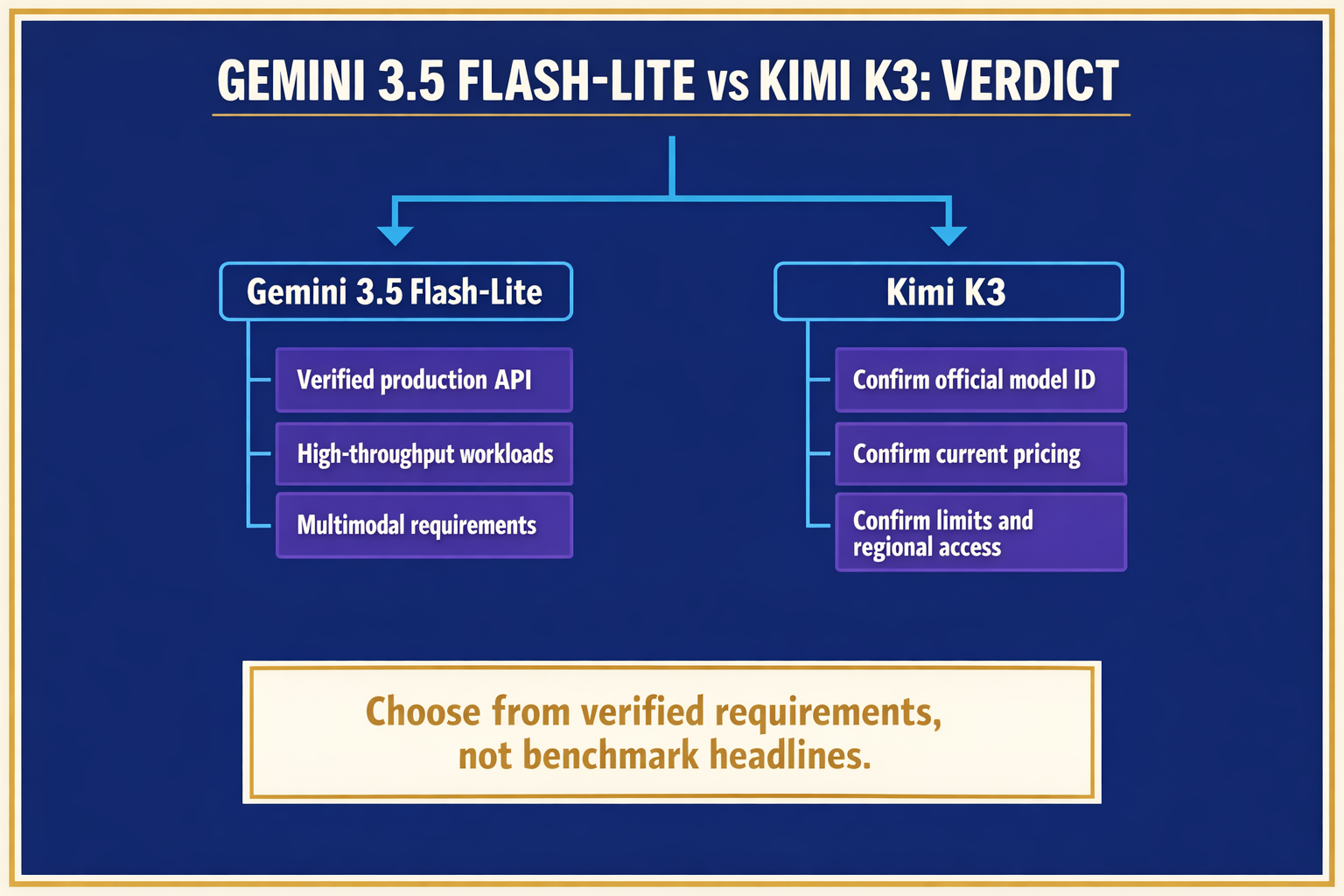
Gemini 3.5 Flash-Lite vs Kimi K3: choose based on workload, not documentation gaps or assumed benchmark superiority. As of July 22, 2026, both Google and Moonshot AI publish official API information for these models. Gemini 3.5 Flash-Lite is the stronger default for low-cost, low-latency, high-throughput tasks, while Kimi K3 is the more deliberate choice for long-horizon coding and knowledge work that can justify its higher token costs.
This comparison applies specifically to Gemini 3.5 Flash-Lite and Kimi K3, with the official API model IDs gemini-3.5-flash-lite and kimi-k3.
Why Gemini 3.5 Flash-Lite is the high-throughput default
Google positions Gemini 3.5 Flash-Lite as its fastest and most cost-effective Gemini 3.5 model for high-volume execution. Its documented characteristics make it a practical default for teams prioritizing cost control, response speed, and production availability:
- Official model ID:
gemini-3.5-flash-lite - Production availability: Google announced general availability on July 21, 2026.
- Published commercial terms: Google provides first-party Gemini Developer API pricing.
- Workload positioning: The model is designed for low-latency, high-throughput execution.
- Target use cases: Google highlights tasks such as subagent operations and document processing.
Gemini 3.5 Flash-Lite is therefore the better starting point for classification, extraction, routing, document pipelines, lightweight agent steps, and other workloads where many inexpensive calls matter more than maximizing the capability of each individual request.
For developers using a multi-model gateway such as CallMissed’s OpenAI-compatible API, Flash-Lite also fits naturally into high-volume routing and fallback strategies where predictable cost and low latency are primary requirements.
When Kimi K3 is the better choice
Moonshot AI officially documents Kimi K3 and provides the core API details needed for a production evaluation:
- Official model ID:
kimi-k3 - Context window: 1,048,576 tokens
- Cached input price: $0.30 per 1 million tokens
- Uncached input price: $3 per 1 million tokens
- Output price: $15 per 1 million tokens
The 1,048,576-token context window makes Kimi K3 relevant to long-horizon workflows that may need to retain extensive source material, code, documentation, or intermediate work in one context. Suitable candidates include repository-scale coding tasks, prolonged agent sessions, and knowledge-work pipelines involving large collections of documents.
However, context capacity is not the same as guaranteed reasoning quality, usable generated-output length, or application-level accuracy. Kimi K3’s higher-cost profile is justified only when its long-context design and workload fit produce enough practical value to offset the additional input and output expense.
Before deployment, teams should still verify current rate limits, output ceilings, supported tools and modalities, regional availability, data-handling terms, and service commitments in Moonshot AI’s official documentation.
What “better” means here
The Gemini 3.5 Flash-Lite vs Kimi K3 decision is workload-dependent:
- Choose Gemini 3.5 Flash-Lite for cost-sensitive, latency-sensitive, and high-throughput tasks such as extraction, classification, document processing, routing, and lightweight subagent execution.
- Choose Kimi K3 for long-horizon coding or knowledge work that benefits from its 1,048,576-token context window and can support its published $3-per-million uncached-input and $15-per-million output pricing.
- Test both on representative production data when quality, tool use, or end-to-end task completion matters more than model positioning alone.
Neither model should be declared universally superior based only on context size, price, or unsupported benchmark comparisons. The practical default is Gemini 3.5 Flash-Lite for efficient execution; Kimi K3 becomes the better option when long-context workload requirements justify its higher cost.
Gemini 3.5 Flash, Gemini 3.1 Flash-Lite, Kimi K2.5, and Kimi K2.6 are separate models and should not be treated as substitutes for the two models evaluated here.
What exactly are Gemini 3.5 Flash-Lite and Kimi K3, and how do similarly named model variants differ?
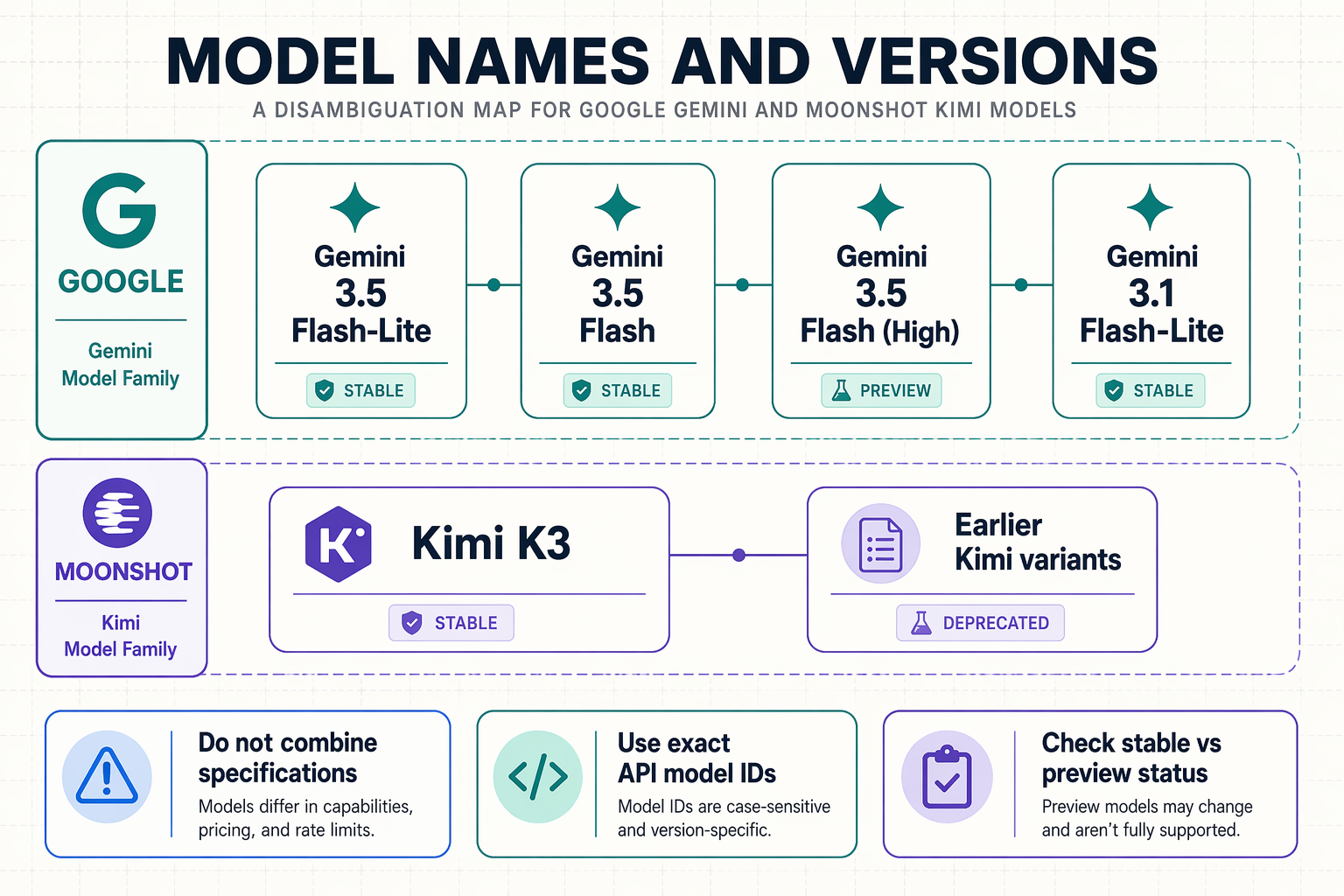
Gemini 3.5 Flash-Lite is a documented, generally available Google multimodal model built for low-cost, high-throughput workloads. By contrast, Kimi K3 is not a verifiable Moonshot AI API product in the first-party material available as of July 21, 2026, so similarly named Kimi and Gemini variants cannot serve as substitutes.
Gemini 3.5 Flash-Lite is a distinct production model
Google AI for Developers describes Gemini 3.5 Flash-Lite as its fastest and most cost-effective Gemini 3.5 model for high-throughput execution. Google positions the multimodal model for low-latency workloads such as subagent tasks and document processing; it is a separate model, not a pricing or reasoning mode for Gemini 3.5 Flash.
Google’s Gemini API release notes state that Gemini 3.5 Flash-Lite became generally available on July 21, 2026. Its documented stable Gemini API model ID is gemini-3.5-flash-lite. Production teams should use that exact identifier and check Google’s model documentation for any subsequently published version-pinned IDs.
Several adjacent names refer to different products or generations:
- Gemini 3.5 Flash-Lite: The cost- and throughput-oriented production model evaluated in this comparison.
- Gemini 3.5 Flash: A separate Flash-family model with different specifications. Google documents a 1-million-token input context window for Gemini 3.5 Flash, but that figure must not be assigned to Flash-Lite without model-specific documentation.
- Gemini 3.6 Flash: Another production model that Google announced as generally available alongside Gemini 3.5 Flash-Lite on July 21, 2026.
- Gemini 3.1 Flash-Lite: An earlier-generation name found in adjacent comparisons; it is not an alias for Gemini 3.5 Flash-Lite.
- Gemini 2.0 Flash-Lite: A deprecated predecessor that Google says was shut down on June 1, 2026.
Labels such as “Gemini 3.5 Flash (high)” require similar care. “High” may describe a thinking or reasoning configuration rather than a distinct base model, so any benchmark using that label should disclose the exact API model ID and configuration.
Kimi K3 still requires first-party verification
A Kimi K3 entry on a benchmark website, search page or third-party model router does not by itself establish a public Moonshot AI production API. Verification requires first-party documentation covering at least:
- The exact Moonshot AI API model ID
- Release stage and public availability
- Official input and output token pricing
- Published context and maximum-output limits
- Supported modalities, tools and regional access conditions
Because the supplied first-party evidence does not establish those details, this comparison classifies Kimi K3’s API status as unconfirmed rather than unavailable. That wording allows for a private preview, staged rollout or later documentation update without turning speculation into a product claim.
Kimi K2.x results cannot stand in for Kimi K3
Kimi K2.5, Kimi K2.6 and Kimi K3 are different version labels. Consequently, search results for “Kimi K3 vs Gemini 3.1 Flash Lite,” “Gemini 3.1 Flash-Lite vs Kimi K2.5,” or “Gemini 3.5 Flash (high) vs Kimi K2.6” do not provide evidence for this strict Gemini 3.5 Flash-Lite vs Kimi K3 comparison.
For procurement or reproducible benchmarking, record the provider, exact API ID, release stage and access date together. As of July 21, 2026, that process identifies gemini-3.5-flash-lite as verified while leaving Kimi K3’s unpublished API specifications explicitly unknown.
What changed by July 21, 2026, and which API model IDs and availability claims are officially verified? (TABLE)
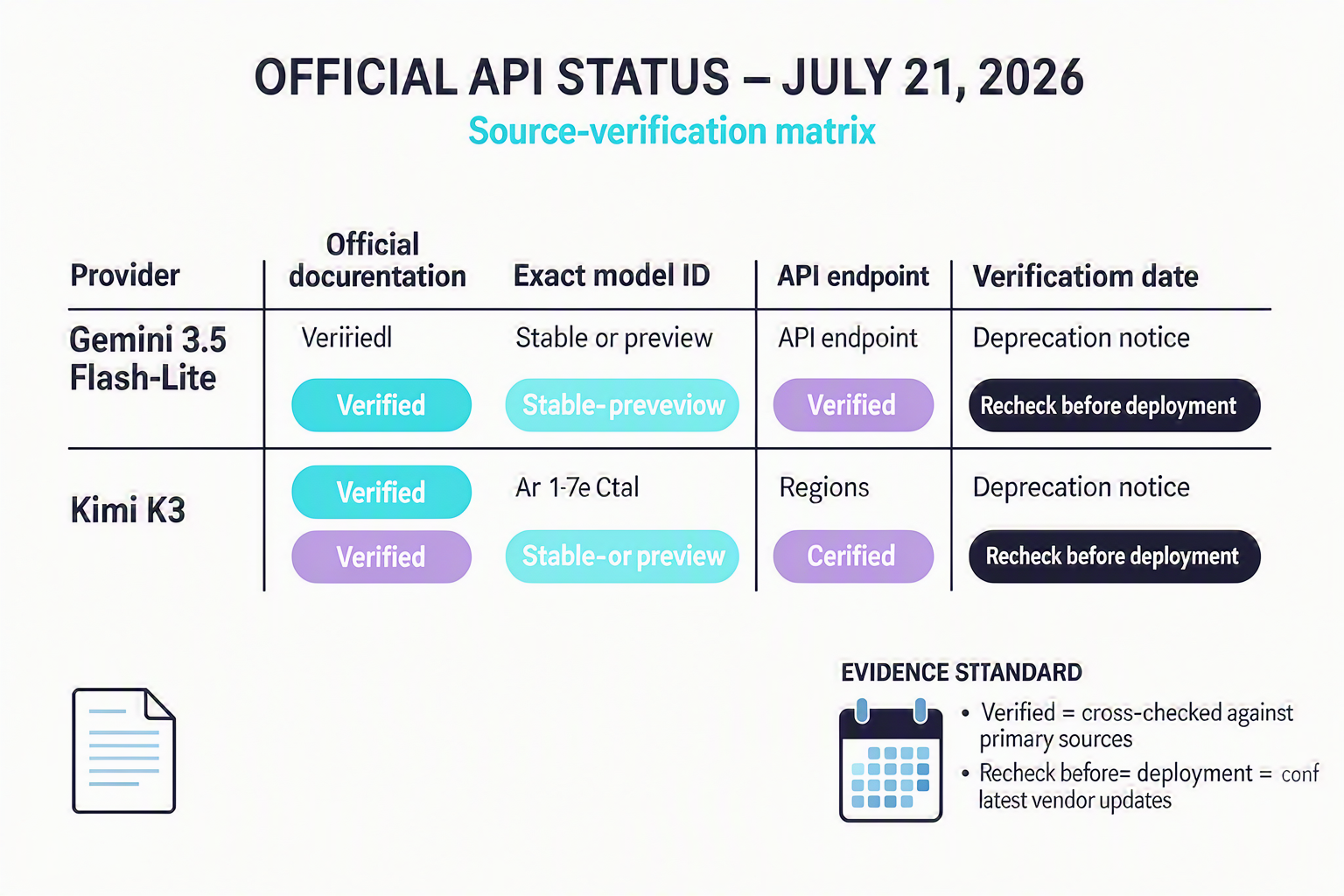
As of July 21, 2026, both compared models have first-party API documentation. Google lists Gemini 3.5 Flash-Lite under the callable model ID gemini-3.5-flash-lite, while Moonshot AI lists Kimi K3 under kimi-k3. Google identifies its model as generally available and production-ready; Moonshot documents Kimi K3’s public API access, 1,048,576-token context window and usage pricing.
Official verification snapshot
| Verification item | Gemini 3.5 Flash-Lite | Kimi K3 | Evidence status |
|---|---|---|---|
| Official product name | Gemini 3.5 Flash-Lite | Kimi K3 | Verified in first-party documentation |
| Public API model ID | gemini-3.5-flash-lite | kimi-k3 | Verified in Google and Moonshot AI API documentation |
| Availability on July 21, 2026 | Generally available (GA) | Listed as a callable public API model | Officially documented for both |
| Production status | Stable, production-ready release | Publicly documented Moonshot API model; Moonshot does not necessarily use Google’s GA terminology | Use each provider’s stated release language |
| Context window | Use Google’s current model page and API reference for applicable limits | 1,048,576 tokens | Official model documentation |
| Documented positioning | Fast, cost-effective Gemini 3.5 model optimized for low-latency, high-throughput execution | Long-context Kimi model for large documents, extended conversations and agentic workloads | Provider documentation |
| API pricing | Published on Google’s Gemini API pricing page | ¥1 per 1 million cached-input tokens, ¥4 per 1 million uncached-input tokens and ¥20 per 1 million output tokens | Official provider pricing; taxes, account terms and later revisions may apply |
| Lifecycle evidence | GA on July 21, 2026; lifecycle notices published separately | Availability and model details published by Moonshot AI | Check provider notices before deployment |
What changed on July 21, 2026
Google’s Gemini API release notes state that Gemini 3.5 Flash-Lite became generally available on July 21, 2026. Google describes the release as stable and production-ready, distinguishing it from preview endpoints whose identifiers, limits or behavior may change before GA.
Google’s official model catalog identifies Gemini 3.5 Flash-Lite as its fastest, most cost-effective Gemini 3.5 option for high-throughput execution. Its documentation also highlights workloads such as document processing and subagent tasks.
The verified identifier is gemini-3.5-flash-lite. Applications should not substitute similar-looking names such as gemini-3.5-flash, gemini-3.1-flash-lite or an unlisted dated suffix. Gemini 3.5 Flash and Gemini 3.5 Flash-Lite are separate API models, even when search results or informal comparisons shorten their names.
Kimi K3’s verified API limits and pricing
Moonshot AI’s first-party documentation lists kimi-k3 as the API model ID and specifies a 1,048,576-token context window. That limit is a context budget, so developers should confirm how the API counts prompts, prior conversation turns, tool content and generated output when allocating tokens.
Moonshot’s documented Kimi K3 rates are:
- Cached input: ¥1 per 1 million tokens
- Uncached input: ¥4 per 1 million tokens
- Output: ¥20 per 1 million tokens
These are provider-listed API rates, not prices inferred from a model router or reseller. Actual billing can still depend on cache eligibility, account terms, taxes and subsequent pricing revisions, so production cost calculators should read the current Moonshot pricing page rather than hard-code rates indefinitely.
Lifecycle and naming cautions
Earlier Gemini shutdown notices refer to earlier model generations, not Gemini 3.5 Flash-Lite. In particular, the June 1, 2026 shutdown notice for Gemini 2.0 Flash-Lite concerns the older Gemini 2.0 model family and does not mean that gemini-3.5-flash-lite was retired immediately before or after its July 21 GA release.
Production applications should pin the exact documented IDs—gemini-3.5-flash-lite or kimi-k3—and monitor each provider’s release notes, pricing pages and deprecation notices. Adjacent model names can differ in context limits, output behavior, latency and cost, so replacing one with another should be treated as a migration requiring fresh testing.
How much do Gemini 3.5 Flash-Lite and Kimi K3 cost for standard, cached, batch, and high-volume workloads? (TABLE)
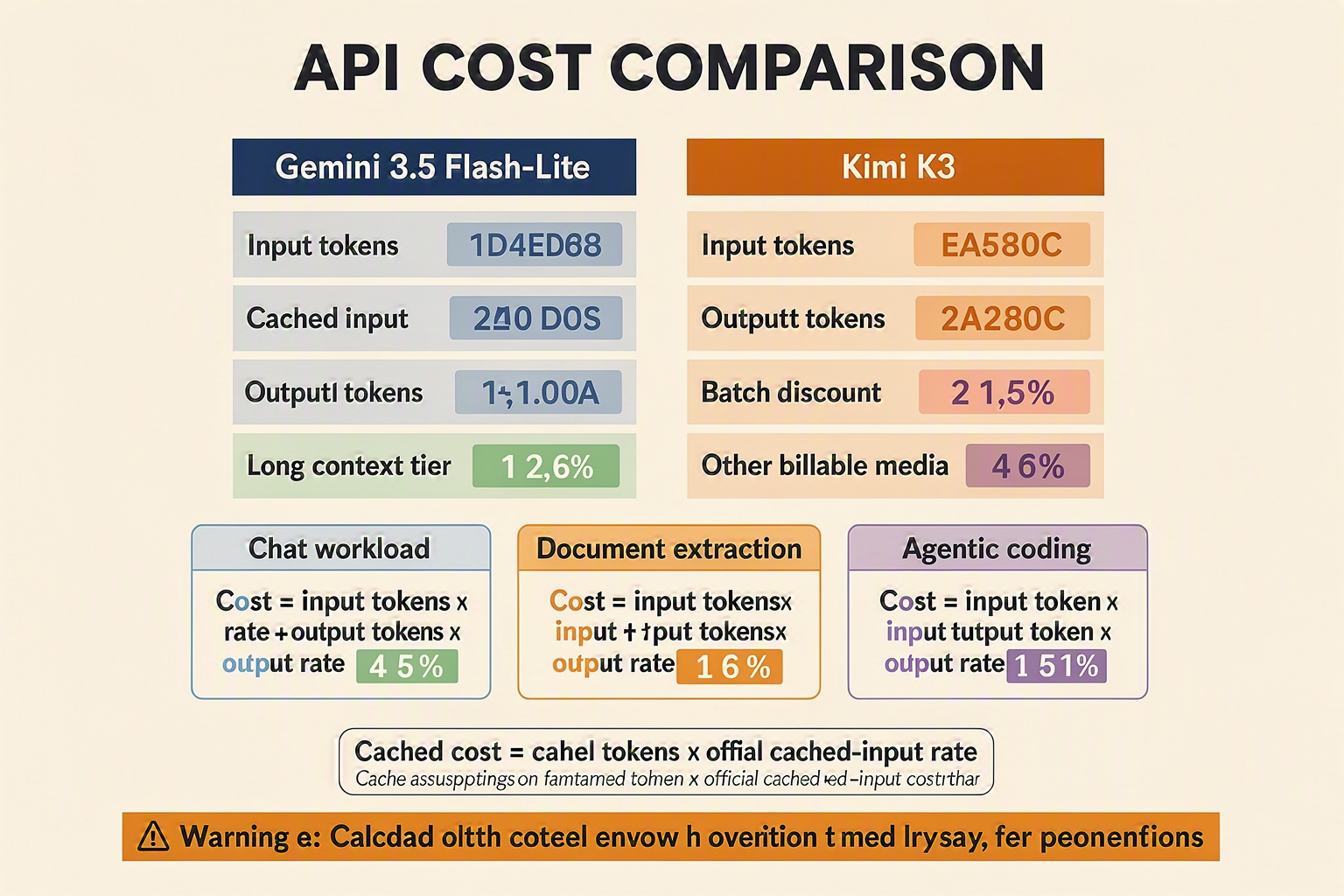
Moonshot AI’s official Kimi K3 pricing lists cached input at $0.30, uncached input at $3.00 and output at $15.00 per 1 million tokens. The official Google sources available for this article do not explicitly support numeric Gemini 3.5 Flash-Lite rates, so its current prices should be verified on Google’s live pricing page rather than inferred from other Gemini models.
Verified pricing by workload
| Workload | Gemini 3.5 Flash-Lite | Kimi K3 | Cost calculation |
|---|---|---|---|
| Standard input | Verify Google’s live rate; no numeric rate is supported by the article’s official sources | $3.00 per 1M uncached input tokens | Input tokens ÷ 1M × input rate |
| Standard output | Verify Google’s live rate | $15.00 per 1M output tokens | Output tokens ÷ 1M × output rate |
| Cached input | Verify Google’s live cached-input rate and caching conditions | $0.30 per 1M cached input tokens | Cache-hit tokens ÷ 1M × cached-input rate |
| Cache storage | Verify whether Google charges separately for storage or retention | No separate Kimi K3 storage rate included in the verified rates used here | Cached tokens × retention time × storage rate, if applicable |
| Batch processing | Verify the rate for the exact model ID; do not apply another Gemini model’s discount | No separate Kimi K3 batch rate verified | Batch tokens × documented batch rate |
| High-volume usage | Use live list prices or a written Google enterprise quote | Apply the listed rates unless Moonshot provides a contracted discount | Token costs at list or contracted rates |
All figures are in U.S. dollars per 1 million tokens. Cached-input pricing applies only to tokens that qualify as cache hits; uncached prompt tokens remain billed at the standard input rate.
Example: standard workload without caching
Assumptions: 1 billion uncached input tokens, 200 million output tokens, no batch discount, taxes excluded and no separate storage or enterprise charges.
For Kimi K3:
- Input: 1,000M ÷ 1M × $3.00 = $3,000
- Output: 200M ÷ 1M × $15.00 = $3,000
- Total: $6,000
A Gemini 3.5 Flash-Lite total cannot be calculated defensibly from the official source material available to this article. Insert Google’s live input and output rates into the same formula before comparing totals.
Example: workload with a 60% cache-hit rate
Assumptions: 1 billion total input tokens, 200 million output tokens, 60% of input qualifies for Kimi K3’s cached-input rate, no separate cache-storage fee, taxes excluded and no negotiated discount.
The input is divided into:
- 400 million uncached input tokens
- 600 million cached input tokens
- 200 million output tokens
Kimi K3’s estimated cost is:
- Uncached input: 400M ÷ 1M × $3.00 = $1,200
- Cached input: 600M ÷ 1M × $0.30 = $180
- Output: 200M ÷ 1M × $15.00 = $3,000
- Total: $4,380
Under these assumptions, caching reduces the Kimi K3 bill by $1,620, or 27%, compared with the $6,000 fully uncached workload. Output remains the largest cost component.
Batch and high-volume calculations
No separate Kimi K3 batch discount is included in the verified pricing used here, and the article’s official sources do not support a numeric Gemini 3.5 Flash-Lite batch rate. Do not assume that a discount offered for another model or API automatically applies.
For a high-volume illustration, scaling the cached example to 10 billion input tokens and 2 billion output tokens produces a Kimi K3 list-price estimate of $43,800, assuming the same 60% cache-hit rate:
- 4B uncached input tokens: $12,000
- 6B cached input tokens: $1,800
- 2B output tokens: $30,000
This is a linear list-price projection, not an enterprise quote. Before approving a production forecast, confirm regional billing, taxes, cache eligibility, storage charges, rate limits, batch availability and any committed-use discount directly with the provider.
The practical pricing verdict as of July 22, 2026 is that Kimi K3 can be modeled at $0.30 cached input, $3.00 uncached input and $15.00 output per million tokens, while Gemini 3.5 Flash-Lite requires verification against Google’s live pricing table before a defensible dollar comparison can be made.
Which model delivers better throughput and latency under realistic production traffic?
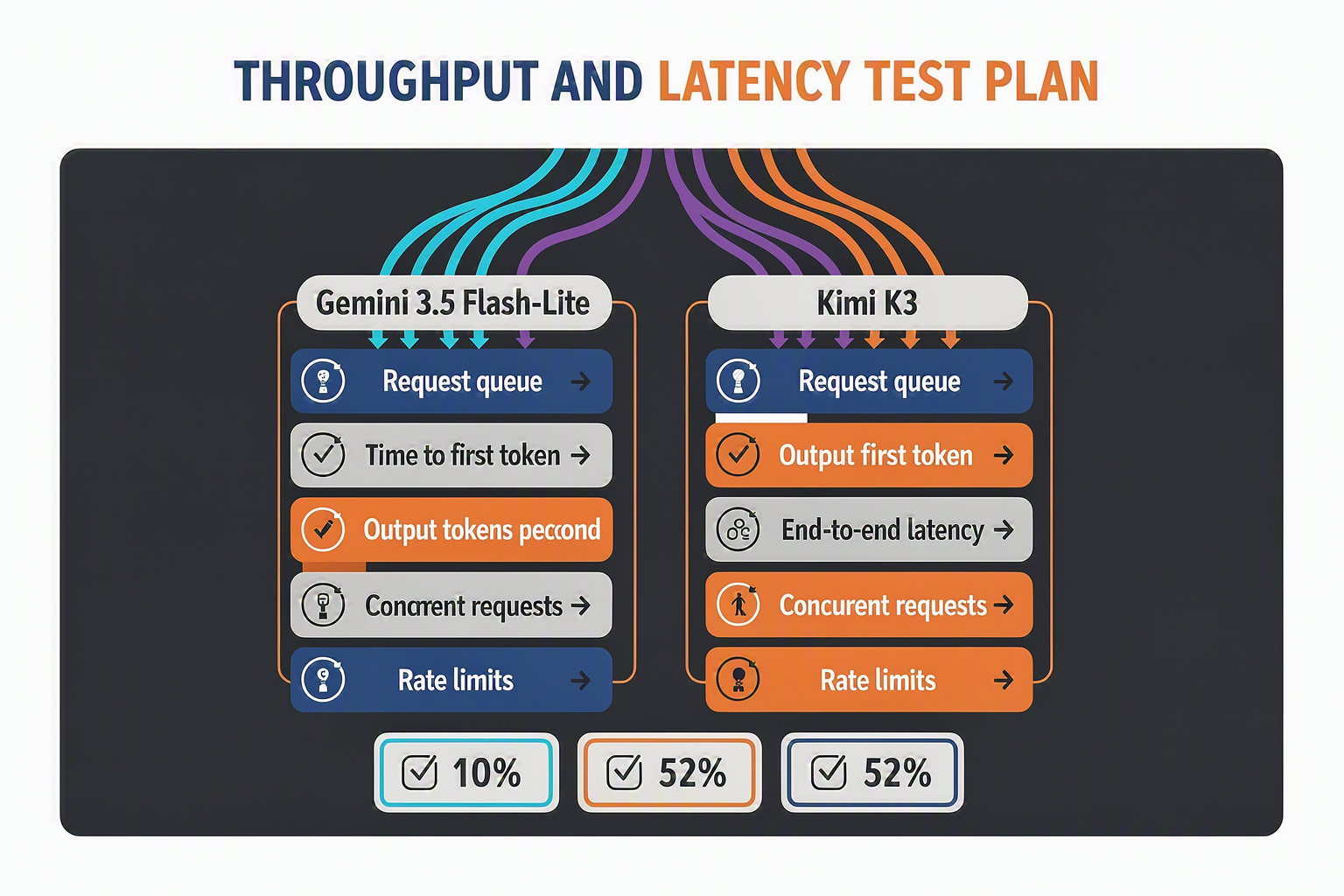
Gemini 3.5 Flash-Lite is the better throughput choice for production planning because Google explicitly optimizes it for low-latency, high-throughput execution and provides a generally available API. However, no defensible latency or tokens-per-second winner can be declared until Moonshot AI confirms Kimi K3’s official API and both models are tested under identical traffic.
What the official documentation establishes
Google AI for Developers describes Gemini 3.5 Flash-Lite as its “fastest, most cost-effective 3.5 model for high-throughput execution.” Its model page specifically identifies subagent tasks and document processing as target workloads where low latency and inexpensive execution matter.
Google’s Gemini API release notes dated July 21, 2026 classify Gemini 3.5 Flash-Lite as generally available and production-ready. That status makes sustained-load testing, capacity planning and provider escalation practical.
For Kimi K3, the supplied Moonshot AI evidence does not confirm:
- An official public API model ID
- Requests-per-minute or tokens-per-minute limits
- Guaranteed or observed token-generation speed
- Median, p95 or p99 latency
- Provisioned-throughput or reserved-capacity options
- Regional endpoint availability
Consequently, third-party router measurements or similarly named Kimi models cannot establish Kimi K3’s production performance. Kimi K2.5, Kimi K2.6 and Kimi K3 must be treated as separate versions, because latency results do not automatically transfer between model releases.
Why “tokens per second” is not enough
A model’s advertised generation speed is only one component of user-visible latency. A realistic comparison should measure:
- Time to first token (TTFT): How quickly streaming begins.
- Inter-token latency: Whether output arrives smoothly after the first token.
- End-to-end latency: Total time from request submission to completion.
- Request throughput: Successful requests completed per second at a fixed concurrency.
- Token throughput: Combined input and output tokens processed per second.
- Tail latency: p95 and p99 response times during bursts.
- Reliability: Rate-limit responses, timeouts and server errors under load.
Long prompts can increase prefill time, while long answers increase decoding time. Tool calls, structured-output validation, reasoning settings, multimodal inputs, geographic distance and cold connections can also dominate latency. Therefore, a short single-user prompt is not representative of document pipelines or customer-facing agents.
A fair production benchmark
Teams should test Gemini 3.5 Flash-Lite and Kimi K3 only after both have documented endpoints, then use the same harness:
- Run short, medium and long prompts with fixed output caps.
- Test concurrency levels such as 1, 10, 50 and 100 simultaneous requests.
- Use at least three workload classes: classification, document extraction and streamed generation.
- Record TTFT, tokens per second, p50, p95 and p99 latency.
- Count HTTP 429 responses, retries, timeouts and malformed outputs.
- Repeat tests by region and pricing tier rather than extrapolating from one endpoint.
Throughput verdict
Gemini 3.5 Flash-Lite wins on documented production suitability, not on a verified head-to-head speed ratio. Google’s July 21, 2026 GA release and explicit high-throughput positioning support deployment today, but Google’s qualitative claim should not be converted into an invented tokens-per-second figure.
Kimi K3 remains unranked for throughput and latency until Moonshot AI publishes a callable model ID and production limits. Once that happens, workload-specific p95 measurements—not leaderboard claims—should determine the winner.
Which model is stronger for coding, reasoning, multimodality, tool use, and long-context analysis?
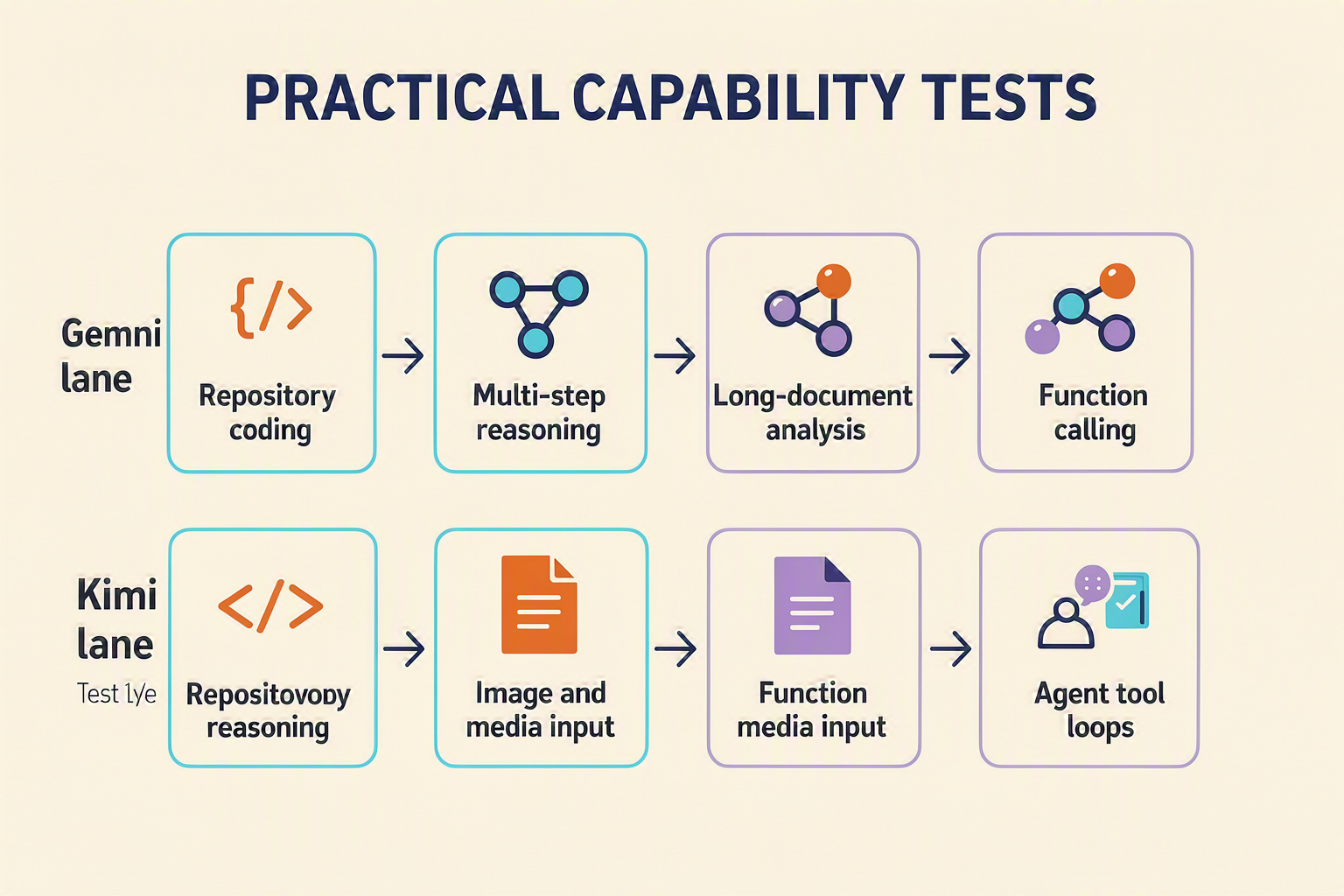
Gemini 3.5 Flash-Lite is the stronger documented choice for multimodal automation, tool-oriented subagents and large-scale document processing, but the available primary-source evidence does not justify declaring it superior to Kimi K3 in raw coding or reasoning quality. As of July 21, 2026, Moonshot AI has not supplied enough verified Kimi K3 API and benchmark information in the reviewed sources for a defensible capability comparison.
Capability verdict by workload
- Coding: Gemini 3.5 Flash-Lite has the operational advantage because developers can integrate a documented, production-ready model. However, Google’s description as a low-cost execution model is not evidence that it produces better code than Kimi K3.
- Reasoning: No verified winner. Comparable evaluations would need identical prompts, reasoning settings, token budgets and scoring rules.
- Multimodality: Gemini 3.5 Flash-Lite wins on confirmed support. Google AI for Developers explicitly describes the model as multimodal.
- Tool use: Gemini 3.5 Flash-Lite is the more credible production candidate because Google positions it for subagent tasks, which commonly involve orchestrated workflows and external tools. Teams should still verify each required tool or API feature in Google’s model documentation.
- Long-context analysis: Gemini has the clearer documented document-processing proposition, but readers must not transfer specifications from a different Gemini model. Google documents a 1-million-token input context window for Gemini 3.5 Flash, not automatically for Gemini 3.5 Flash-Lite.
Coding and reasoning require controlled tests
Public benchmark scores are not interchangeable when providers use different model versions, inference configurations or tool scaffolds. A reliable Gemini 3.5 Flash-Lite vs Kimi K3 coding test should measure:
- Pass rate on private, contamination-resistant repositories
- Compilation, unit-test and regression-test success
- Tokens, latency and total cost per solved task
- Multi-file editing and instruction adherence
- Performance with and without tool access
- Failure recovery across several agent steps
The same caution applies to reasoning. A model can score well on short-answer tests while struggling with long, stateful business workflows. Without an official Kimi K3 model ID and reproducible first-party results, unofficial leaderboard entries cannot establish which system is stronger.
Where Gemini’s positioning is clearest
Google AI for Developers calls Gemini 3.5 Flash-Lite its “fastest, most cost-effective 3.5 model for high-throughput execution.” Google also identifies subagent tasks and document processing as intended workloads, making the model particularly relevant for:
- Classifying and extracting information from large document queues
- Routing tasks between specialized agents
- Processing mixed text-and-image inputs
- Running inexpensive first-pass analysis before escalation
- Executing latency-sensitive automation at high request volumes
Google’s Gemini API release notes state that Gemini 3.5 Flash-Lite became generally available on July 21, 2026, so these capabilities are attached to a stable production release rather than merely a preview.
Practical conclusion
Choose Gemini 3.5 Flash-Lite when confirmed multimodality, documented deployment and high-throughput subagent or document workflows matter most. Treat Kimi K3 as unranked—not inferior—until Moonshot AI publishes verifiable API access, modality support, tool compatibility, context limits and reproducible coding or reasoning evidence. That distinction keeps the comparison grounded in deployable facts rather than model-name speculation.
Can published benchmarks and expert opinions be compared fairly?

Published benchmarks and expert opinions can be compared fairly only when they test the exact production models under identical conditions. As of July 21, 2026, the available first-party evidence does not support a definitive benchmark winner between Gemini 3.5 Flash-Lite and Kimi K3 because Moonshot AI’s corresponding API model ID, configuration and official results have not been verified.
Apply an apples-to-apples benchmark standard
A credible Gemini 3.5 Flash-Lite vs Kimi K3 result must control more than the prompt. At minimum, a comparison should disclose:
- Exact API model IDs and version dates, rather than display names or routing aliases.
- Identical prompts, tools and system instructions, including whether hidden reasoning or search was enabled.
- Matching output-token budgets, temperature, sampling parameters and retry policies.
- The same evaluation harness and scoring rules, with failed requests and refusals included.
- Latency percentiles and sustained throughput, not merely the fastest observed response.
- Total cost per completed task, including input, output, cached tokens, tool calls and retries.
Without these controls, a benchmark may compare different reasoning budgets, preview snapshots or provider infrastructure rather than underlying model capability.
Vendor claims are useful—but they are not neutral tests
Google’s model documentation calls Gemini 3.5 Flash-Lite its “fastest, most cost-effective 3.5 model” and says it is optimized for high-throughput, low-cost execution across subagent and document-processing workloads. That description identifies Google’s intended positioning; it does not independently prove that Gemini 3.5 Flash-Lite has lower latency or higher throughput than Kimi K3.
Google’s Gemini API release notes state that Gemini 3.5 Flash-Lite became generally available on July 21, 2026, providing a fixed production milestone for reproducibility. Any Kimi K3 result should likewise identify an official Moonshot AI endpoint and dated model version before it is placed beside the GA Gemini release.
Version confusion can also invalidate otherwise legitimate results. Google documents a 1-million-token input context window for Gemini 3.5 Flash, but that specification must not automatically be assigned to Gemini 3.5 Flash-Lite. Likewise, results for Kimi K2.5 or Kimi K2.6 cannot establish Kimi K3 performance.
How to interpret expert opinions
Expert analysis is most valuable when it provides reproducible methodology rather than an unsupported ranking. Give greater weight to reviews that publish:
- Raw prompts, outputs and scoring scripts
- Median and p95 latency across repeated requests
- Tokens per second separated from time to first token
- Region, API tier and concurrency level
- Error, timeout and rate-limit rates
- Official per-token pricing used in cost calculations
Treat screenshots, single-prompt demonstrations and unnamed aggregator listings as exploratory evidence. They may reveal potential strengths, but they cannot verify production availability or stable performance.
The defensible benchmark conclusion
The fair conclusion is currently “insufficient verified evidence,” not a tie and not a Kimi K3 loss. Gemini 3.5 Flash-Lite has the stronger evidence base for deployment because Google publishes its GA status and production documentation. A capability winner should be declared only after Moonshot AI provides equivalent first-party Kimi K3 details and both models are rerun under the same harness, limits and budget.
What are the deployment implications for reliability, governance, regional access, and vendor risk?
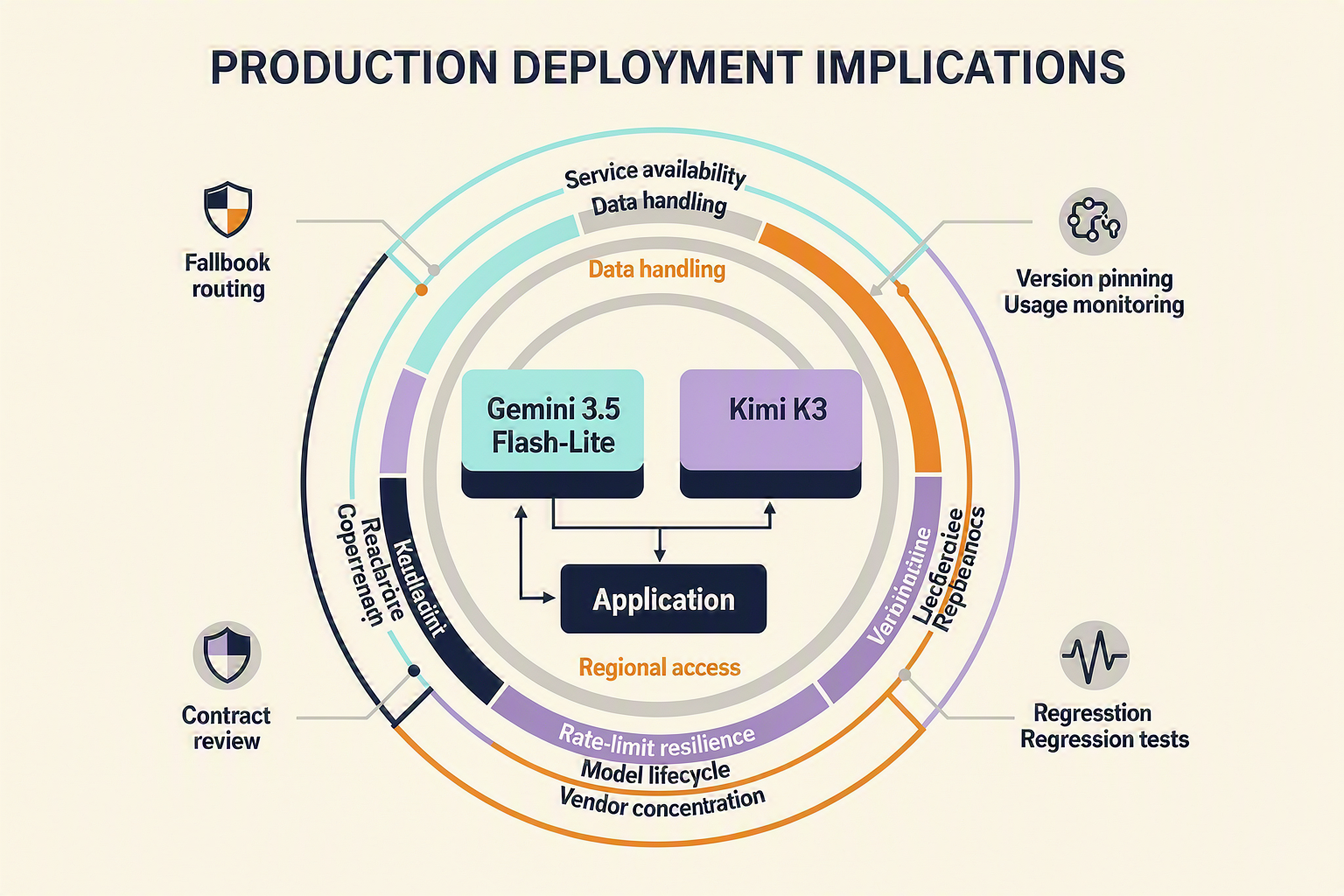
Gemini 3.5 Flash-Lite carries lower deployment risk as of July 21, 2026 because Google documents it as a stable, generally available API model; Kimi K3 remains a conditional option until Moonshot AI confirms its API availability and operating terms through first-party documentation. Neither model should be deployed solely on benchmark results: reliability, data governance, regional eligibility and exit planning must also be verified.
Reliability starts with a supported production contract
Google’s Gemini API release notes state that Gemini 3.5 Flash-Lite became generally available on July 21, 2026, meaning developers can target a stable production release rather than a preview. Google also describes Gemini 3.5 Flash-Lite as a low-latency, high-throughput model for workloads such as document processing and subagents.
However, GA status is not itself an uptime guarantee. Production teams should separately confirm:
- Account-level quotas and rate limits
- Retry and timeout recommendations
- Service-level agreements, where applicable
- Status-page and incident-notification coverage
- Whether provisioned capacity is available
- Deprecation and migration notice periods
Moonshot AI’s Kimi K3 cannot receive an equivalent reliability assessment until Moonshot publishes a callable model ID, supported endpoints, quotas and availability commitments. A third-party router listing may demonstrate intermediary access, but it does not establish a direct service contract with Moonshot AI.
Governance requires more than model capability
Before processing customer conversations, financial documents or personal data, organizations should review each provider’s binding privacy and security terms. A governance assessment should cover:
- Data retention: How long are prompts, uploaded files, tool outputs and logs stored?
- Training use: Can API content be used to improve provider models, and is an opt-out contractual?
- Access controls: Are scoped API keys, role-based permissions and audit logs supported?
- Compliance evidence: Which certifications and data-processing agreements apply to the exact service?
- Tool governance: Can external calls, code execution and retrieval sources be restricted and recorded?
Until Moonshot AI publishes Kimi K3-specific terms, buyers should label these controls unverified, not assume that policies for Kimi K2.5, Kimi K2.6 or a consumer chat product automatically apply.
Regional availability is not the same as internet accessibility
A successful API request from a country does not prove regional hosting, data residency or regulatory suitability. Teams operating in India, the European Union or regulated industries should verify the billing entity, processing locations, subprocessors, cross-border transfer mechanisms and support coverage.
Google’s public model documentation establishes Gemini 3.5 Flash-Lite’s API status, but deployment teams must still examine the relevant Gemini API or Google Cloud commercial terms for their chosen route. Kimi K3 should not be assigned a region, residency guarantee or global availability claim without Moonshot documentation.
Reduce vendor and migration risk deliberately
Google’s documentation says Gemini 2.0 Flash-Lite was shut down on June 1, 2026, demonstrating that even established model families require migration planning. Practical safeguards include:
- Keep prompts, evaluations and tool schemas in a provider-neutral repository.
- Pin model versions where supported and test upgrades before changing aliases.
- Maintain regression tests for quality, latency, safety and structured output.
- Set budget and error-rate alerts.
- Design a fallback path, while recognizing that fallback models can behave differently.
For this comparison, Gemini 3.5 Flash-Lite has the clearer operational footing; Kimi K3 remains a vendor-risk exception until Moonshot AI supplies verifiable production documentation.
What does Gemini 3.5 Flash-Lite vs Kimi K3 mean for your use case, and how should you migrate? (TABLE)
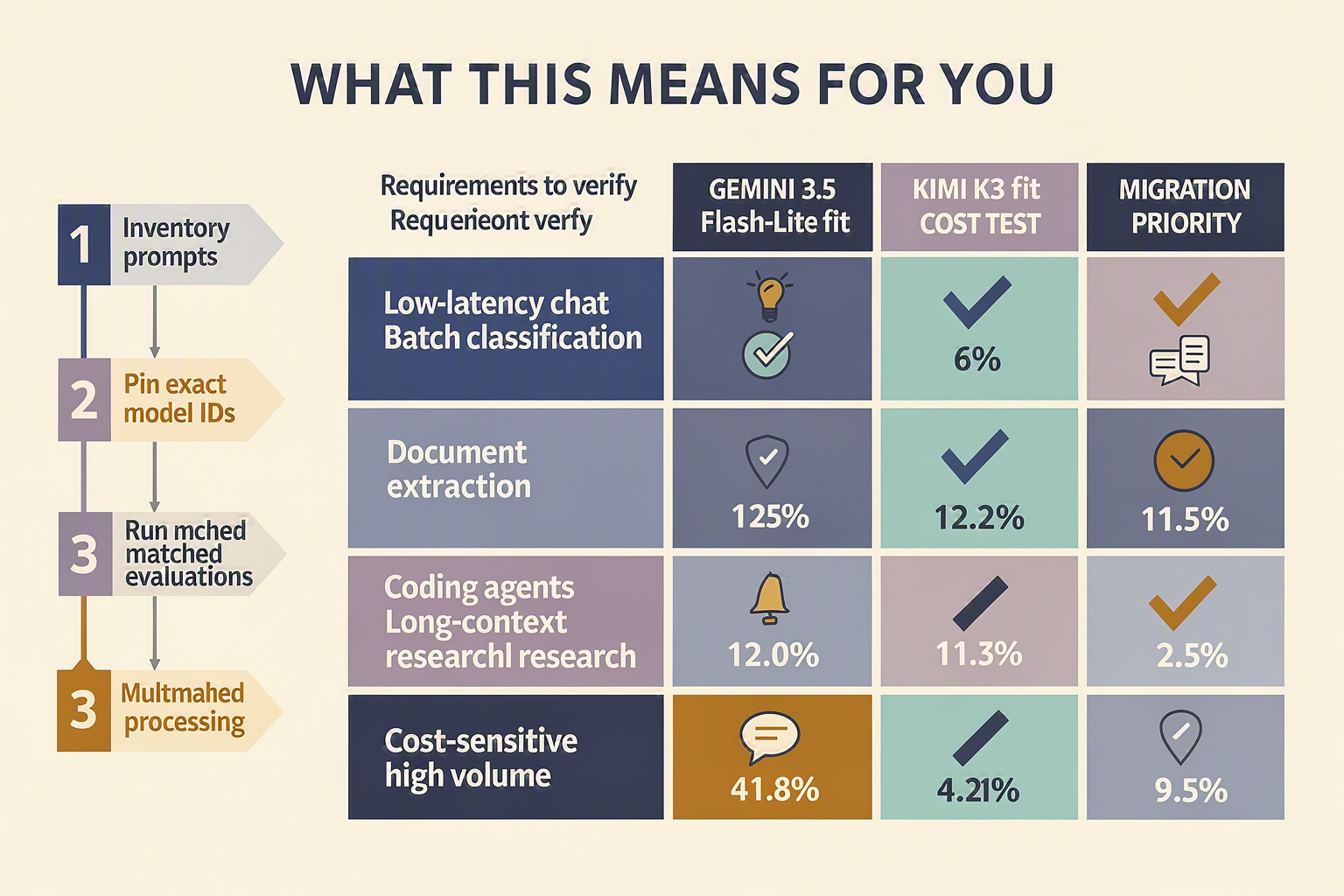
For production workloads today, migrate latency-sensitive and high-volume tasks to Gemini 3.5 Flash-Lite using Google’s documented stable model ID, while keeping Kimi K3 behind an evaluation gate until Moonshot AI confirms its public API identifier, limits and commercial terms. The right choice should follow the workload—not an unverified benchmark ranking.
Use-case decision matrix
| Use case | Recommended choice | Why | Migration requirement |
|---|---|---|---|
| High-volume classification and extraction | Gemini 3.5 Flash-Lite | Google positions it for low-cost, high-throughput document processing | Test schema adherence and token costs on representative documents |
| Low-latency subagents | Gemini 3.5 Flash-Lite | Google explicitly optimizes the model for subagent execution and low latency | Measure p50, p95 and p99 latency under expected concurrency |
| Multimodal document workflows | Gemini 3.5 Flash-Lite | Google’s official model page confirms multimodal support | Validate every required input format, file size and output structure |
| Kimi-specific coding or reasoning experiments | Kimi K3, evaluation only | Potential quality claims require first-party API and reproducible testing | Confirm Moonshot’s exact model ID, endpoint, pricing and data policy |
| Regulated or customer-facing automation | Gemini 3.5 Flash-Lite initially | A documented GA lifecycle is easier to assess operationally | Add human escalation, audit logs, safety tests and rollback controls |
| Provider-portable applications | Abstract both models | Avoid coupling business logic to one vendor’s request format | Use an adapter layer, normalized errors and capability-based routing |
Google’s Gemini API release notes state that Gemini 3.5 Flash-Lite became generally available on July 21, 2026, giving teams a stable production target rather than a preview endpoint. Use the documented model identifier gemini-3.5-flash-lite and pin it explicitly; do not silently substitute Gemini 3.5 Flash, Gemini 3.1 Flash-Lite or a third-party alias.
A migration plan that limits production risk
- Inventory model dependencies. Record the current model ID, system prompts, tools, response schemas, safety settings, retry logic, cache behavior and token assumptions. Version names that sound similar can expose different capabilities and limits.
- Build a workload-specific test set. Include regional-language prompts, long documents, malformed inputs, tool calls and adversarial cases. Score factuality, structured-output validity, task completion and human preference—not just aggregate benchmark performance.
- Run a shadow deployment. Send sampled production requests to Gemini 3.5 Flash-Lite without exposing its responses to users. Compare output quality alongside p50/p95 latency, tokens per request, error rate and effective cost per successful task.
- Canary traffic gradually. Start with a small, reversible traffic share and define automatic rollback thresholds. Keep rate-limit handling, exponential backoff and a tested fallback model in place.
- Re-evaluate Kimi K3 only from primary sources. Before routing production traffic, verify Moonshot AI’s exact API model ID, official token prices, context and output ceilings, regional availability, rate limits, retention policy and service terms. A router listing alone is insufficient evidence of first-party availability.
Avoid version drift
Lifecycle planning is not optional: Google’s Gemini documentation says Gemini 2.0 Flash-Lite was shut down on June 1, 2026. Maintain a model registry with owner, pinned ID, test status, fallback and deprecation date, then rerun acceptance tests whenever a provider changes a model version or API behavior.
Frequently asked questions about Gemini 3.5 Flash-Lite vs Kimi K3 pricing, context limits, speed, coding, APIs, and model names
Which is cheaper in the Gemini 3.5 Flash-Lite vs Kimi K3 comparison?
What are the Gemini 3.5 Flash-Lite and Kimi K3 context-window and output-token limits?
Is Gemini 3.5 Flash-Lite faster than Kimi K3 for API workloads?
Which model is better for coding and reasoning, Gemini 3.5 Flash-Lite vs Kimi K3?
What are the official API model names for Gemini 3.5 Flash-Lite and Kimi K3?
Can I replace Gemini 3.1 Flash-Lite or Kimi K2.5 with these newer models without changing my application?
Conclusion
Gemini 3.5 Flash-Lite is the practical winner as of July 21, 2026—not because benchmark hype settles the contest, but because Google provides the documentation required for a production decision. Until Moonshot AI confirms Kimi K3 through first-party API documentation, the comparison remains between a deployable model and an unverified candidate.
Key takeaways
- Google confirmed that Gemini 3.5 Flash-Lite became generally available on July 21, 2026. Google AI for Developers describes the model as its fastest, most cost-effective Gemini 3.5 option for low-latency, high-throughput tasks such as subagents and document processing.
- API availability matters more than an unofficial leaderboard entry. Gemini 3.5 Flash-Lite has a documented model identity, official pricing, production status and published operating limits; Kimi K3 should not be treated as publicly deployable until Moonshot AI confirms its model ID, pricing, context window, output ceiling, throughput and rate limits.
- Exact version names are essential. Gemini 3.5 Flash-Lite is not Gemini 3.5 Flash or Gemini 3.1 Flash-Lite, while Kimi K3 should not be confused with Kimi K2.5 or Kimi K2.6. Google’s shutdown of Gemini 2.0 Flash-Lite on June 1, 2026 demonstrates why developers need explicit migration plans rather than relying on a product family name.
- High-volume economics require first-party numbers. Teams should compare official input, output and cached-token prices alongside batch discounts, latency, throughput, context limits and maximum output—not calculate budgets from third-party aliases or assumed specifications.
The next development to watch is whether Moonshot AI publishes an official Kimi K3 API model ID and complete commercial terms. If that happens, teams can run a genuine workload-matched evaluation covering coding, reasoning, multimodality, tool use, latency and total cost. Until then, Gemini 3.5 Flash-Lite remains the verifiable production default.
For teams seeking flexibility as model catalogs change, CallMissed offers an OpenAI-compatible gateway with multiple AI models, unified billing and same-tier fallbacks, alongside voice agents and multilingual chatbots. As new models arrive and older versions retire, is your AI stack designed to switch providers without rewriting the application?
Related Reading
- Gemini 3.6 Flash vs Kimi K3: API, Price and Limits (2026)
- Gemini 3.5 Flash-Lite vs GPT-5.6 Terra: Official API, Price, Limits & Use Cases
- Gemini 3.5 Flash-Lite API Pricing: July 2026 GA Launch Guide
Sources
Related Posts

Ready to automate customer conversations?
Launch AI voice agents and WhatsApp bots with CallMissed — one API, 22+ Indian languages.