
Why OpenAI-Compatible Communication APIs Help Teams Ship Faster


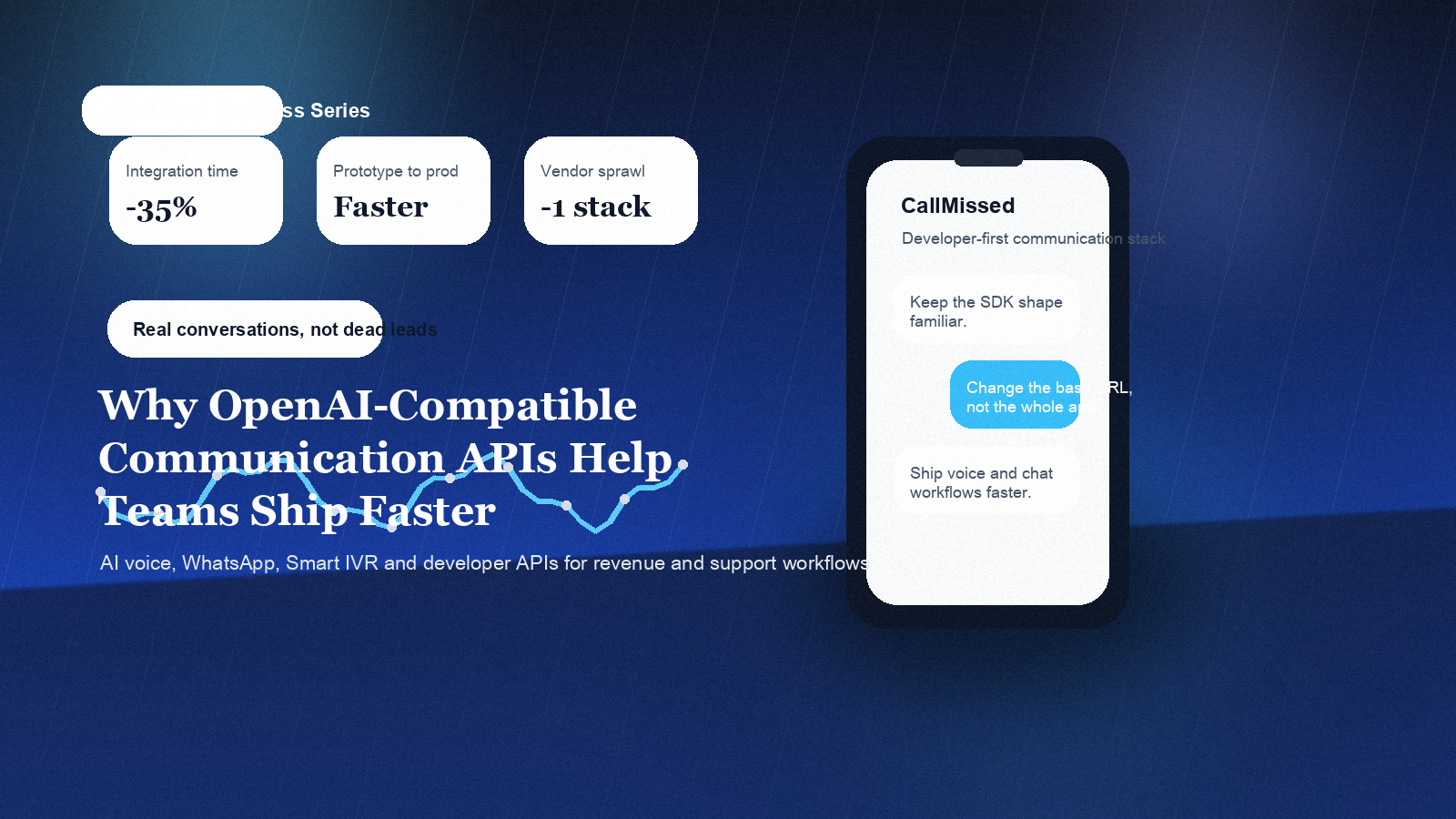
Why OpenAI-Compatible Communication APIs Help Teams Ship Faster explains how CallMissed combines AI voice agents, WhatsApp automation, Smart IVR, and developer APIs for production workflows.
Why OpenAI-Compatible Communication APIs Help Teams Ship Faster
Developer tooling shapes product velocity more than most teams admit. When a company wants to add AI voice calls, speech transcription, or conversational routing into an existing app, the biggest slowdown is rarely the core idea. It is the integration tax: new auth flows, unfamiliar payload shapes, multiple SDKs, different streaming semantics, and glue code that no one wants to maintain six months later. OpenAI-compatible communication APIs matter because they reduce that tax. A familiar interface lets teams move faster from concept to production workflow.
CallMissed is relevant here because the product is positioned as AI communication infrastructure for businesses that want WhatsApp chatbots, AI voice call agents, Smart IVR, multilingual speech, and OpenAI-compatible APIs in one operational stack. The article below is therefore not framed as generic AI commentary. It is framed around the exact workflows where that infrastructure becomes commercially useful.
The business problem behind the keyword
Compatibility is valuable because it preserves muscle memory. If a team already knows how to call chat completions, stream tokens, or authenticate an SDK client, it can start experimenting immediately instead of learning another bespoke stack.
That matters even more when the product goal is not just text generation. Communication products need speech-to-text, text-to-speech, real-time voice, and business routing to work together. The integration surface gets complicated quickly.
The best developer platforms win by compressing that complexity into a shape teams already understand while still exposing the specialized primitives required for production voice and messaging systems.
Where legacy workflows usually break
- Teams lose time when they must integrate separate vendors for speech, voice orchestration, chat reasoning, telephony, and messaging, each with different auth and monitoring patterns.
- They also lose time when internal tools need custom wrappers for every provider. A proof of concept grows into a pile of adapters that make model changes and environment rollout risky.
- Finally, product teams struggle when experimentation and production share nothing. A chatbot demo may be easy to build, but a support workflow with real logging, routing, and multi-tenant controls is much harder if the platform surface changes halfway through.
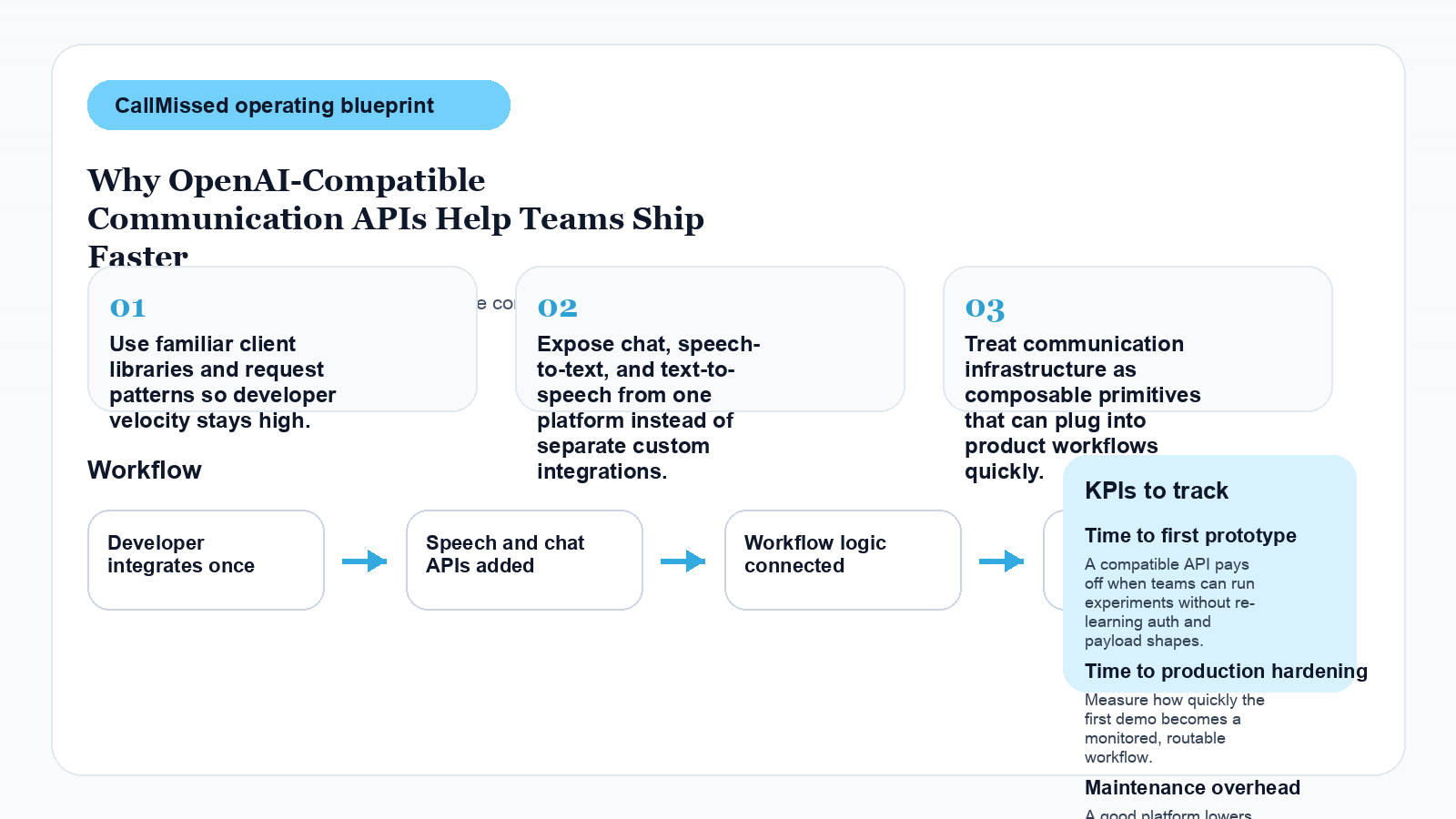
What CallMissed changes in this workflow
CallMissed is strong on this dimension because the platform explicitly exposes OpenAI-compatible endpoints while also covering chat completions, speech-to-text, text-to-speech, AI voice call agents, and Smart IVR use cases.
That means a team can keep its SDK habits familiar and still gain access to communication-specific building blocks such as telephony-ready audio formats, multilingual speech, webhooks, and model routing.
For agencies and SaaS platforms, the multi-tenant architecture matters as much as the API format. A compatible developer surface is useful, but it becomes far more valuable when it sits on top of tenant isolation, request logging, and deployment patterns that work for multiple customers.
CallMissed documentation also reinforces the product building blocks behind this angle: AI-powered communication APIs, WhatsApp chatbots, AI voice call agents, Smart IVR, OpenAI-compatible endpoints, multilingual STT across 22 Indic languages plus English, and TTS options designed for telephony and app workflows. Those are not abstract features. They shape how fast a team can ship and refine a production conversation system.
A practical workflow blueprint
- Start with a single integration entry point so auth, retries, logging, and tracing share one client layer.
- Use the same API contract across prototypes and production services wherever possible. The less rework between experiment and rollout, the faster the team ships.
- Connect communication endpoints to product events through webhooks and internal job runners rather than hard-coding orchestration into the UI layer.
- Route models intentionally. A fast, lower-cost path may be enough for basic tasks, while high-risk or multilingual tasks may deserve a different reasoning stack.
- Instrument latency, cost, and error rates early because communication workflows become customer-facing faster than most internal AI tools.
High-value use cases
- Support products can add AI answer drafting, voice triage, and speech capture without forcing separate provider integrations for each capability.
- Field-service apps can add booking calls, voice reminders, and WhatsApp follow-up on top of a familiar API client.
- SaaS builders can expose customer-specific communication workflows inside their own platform without creating a bespoke AI infrastructure layer from scratch.
- Internal ops teams can reuse one client approach across experimentation, staging, and production while still switching models or voices as requirements change.
Rollout checklist for operations teams
- Optimizing for compatibility alone while ignoring latency, monitoring, and business workflow design.
- Assuming that a familiar payload shape automatically solves production concerns like retries, observability, and escalation boundaries.
- Treating speech and messaging as separate projects when the real product needs them to share context.
- Forgetting that multi-tenant data isolation and request logging are part of the developer experience once customer workloads are involved.
Why this matters commercially
The reason OpenAI-compatible communication API deserves executive attention is simple: conversation quality affects revenue, service cost, and brand trust at the same time. When a business improves how quickly it answers, how consistently it qualifies or resolves, and how cleanly it moves between voice and WhatsApp, the gains show up in real operating lines such as booked appointments, recovered leads, lower support backlog, and fewer repeat contacts. This is why communication infrastructure is a growth lever rather than a cosmetic feature.
A workflow like this also compounds operationally. Once the business has clear prompts, escalation logic, and measurement in place, the same structure can be reused across new campaigns, locations, or customer segments. In practical terms, that means the first successful automation does not remain a one-off win. It becomes a template the team can improve and repeat.
Leaders should therefore evaluate this category the same way they evaluate any other operational investment: how much manual effort does it remove, how much customer demand does it preserve, and how quickly can the team adapt the workflow when products, seasons, or policy requirements change. CallMissed is useful in that frame because it gives teams one place to coordinate AI voice, WhatsApp, Smart IVR, multilingual speech, and developer integrations instead of rebuilding the communication layer for every experiment.
A 30-day pilot plan
- Pick one workflow where customer intent is already clear and measurable, such as missed-call recovery, booking confirmations, or order-status support.
- Define the non-negotiables before launch: latency threshold, escalation triggers, language support, and the exact outcome metric the business cares about.
- Review transcripts or call summaries daily in week one so the team can tighten prompts, remove repetitive questions, and correct weak handoff phrasing quickly.
- Compare the pilot against the manual baseline using conversation-level outcomes, not vanity metrics like message count or raw automation rate.
- Expand only after the workflow proves it can protect customer experience while improving speed, throughput, or conversion.
What strong human handoff looks like
A good handoff does not merely transfer the customer. It transfers the conversation state. The human should receive the reason for contact, the important entities already captured, the customer’s tone or urgency, and the recommended next action. When that summary is missing, the customer experiences escalation as a reset. When it is present, escalation feels like continuity. In other words, the difference between poor automation and useful automation is often the quality of the handoff rather than the quality of the first answer alone.
This is one of the more practical reasons to think about CallMissed as infrastructure. The value is not simply that the platform can answer on voice or WhatsApp. The value is that both channels can participate in one operating workflow where summaries, routing, and next steps are structured enough to support human teams instead of interrupting them.
Metrics that matter
| Metric | Why it matters |
|---|---|
| Time to first prototype | A compatible API pays off when teams can run experiments without re-learning auth and payload shapes. |
| Time to production hardening | Measure how quickly the first demo becomes a monitored, routable workflow. |
| Maintenance overhead | A good platform lowers the number of one-off wrappers and brittle vendor adapters over time. |
The important operating principle is that conversation automation should be judged at the workflow level, not at the prompt level. Businesses do not buy “good AI replies” in isolation. They buy fewer dropped leads, faster service loops, lower manual coordination, better routing, and more reliable communication across voice and WhatsApp. If a workflow does not move those outcomes, the automation is decorative rather than useful.
Common mistakes to avoid
- ('Why do OpenAI-compatible APIs matter?', 'They let developers use familiar clients and request patterns, reducing the time needed to prototype and ship communication features.')
- ('What does compatibility not solve by itself?', 'It does not replace good routing, monitoring, or workflow design. Those still need to be built deliberately.')
- ('How does CallMissed use this idea?', 'CallMissed offers OpenAI-compatible endpoints for chat, speech-to-text, and text-to-speech while also supporting voice agent and WhatsApp workflows.')
- ('Who benefits most from this model?', 'Teams that already have apps, dashboards, or customer workflows and want to add AI communication features quickly without learning a new integration model for each capability.')
- ('What should developers track first?', 'Time to first working prototype, streaming reliability, per-request latency, and the operational cost of maintaining vendor adapters.')
FAQ
Product references
- CallMissed Introduction: https://docs.callmissed.com/docs/introduction
- CallMissed Quickstart: https://docs.callmissed.com/docs/quickstart
- CallMissed Speech to Text: https://docs.callmissed.com/docs/speech-to-text
- CallMissed Text to Speech: https://docs.callmissed.com/docs/text-to-speech
- CallMissed Chat Completions: https://docs.callmissed.com/docs/chat-completion
Conclusion
OpenAI-compatible communication API is valuable because it sits at the intersection of customer intent, operational speed, and workflow design. The businesses that win here are not the ones that bolt AI onto a contact form or a phone tree. They are the ones that redesign the communication loop so voice, WhatsApp, escalation, and measurement all reinforce each other. CallMissed fits that conversation because its product surface already matches the real implementation needs: AI voice, WhatsApp, Smart IVR, multilingual speech, and familiar developer APIs.
Discussion
Related Posts
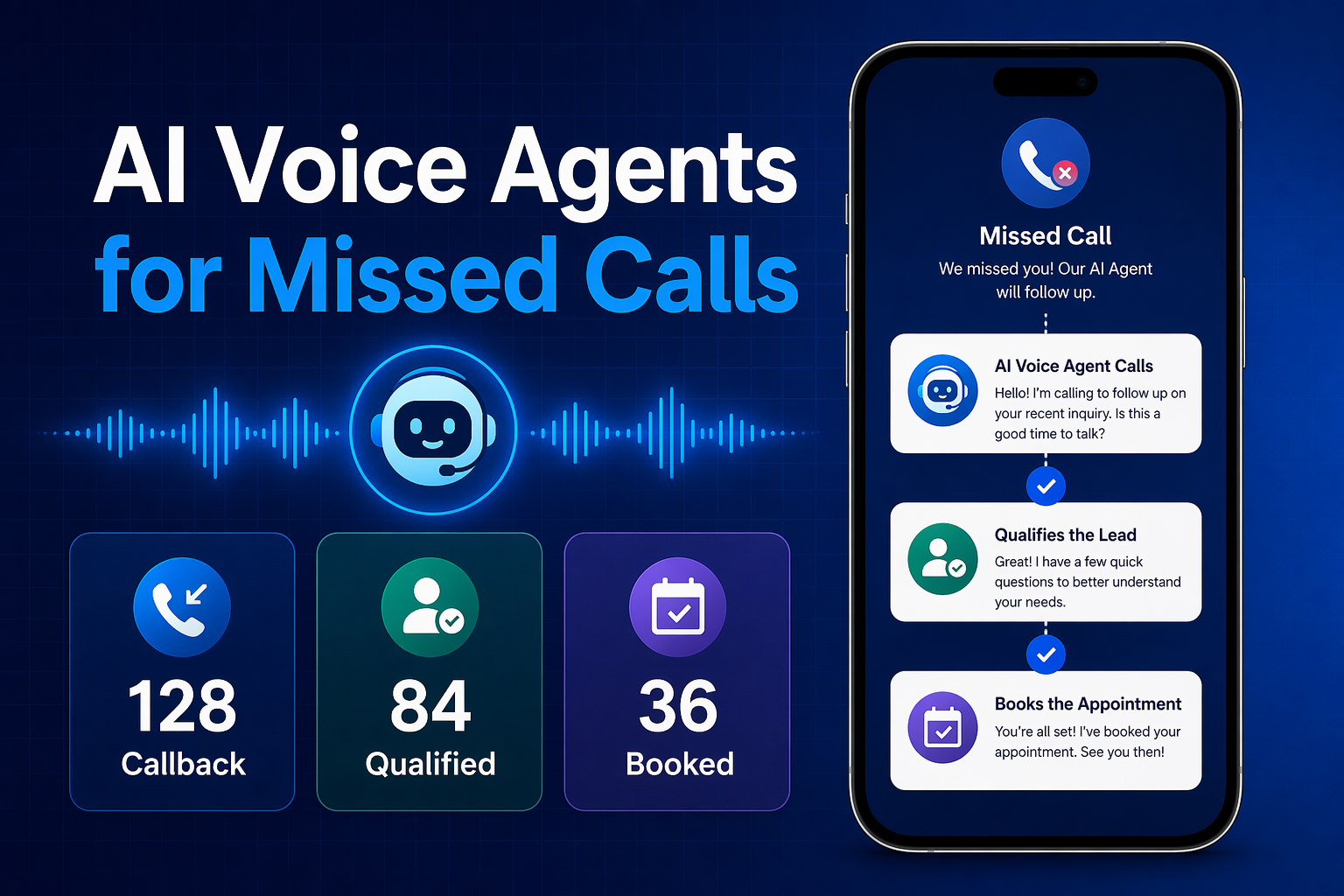


Ready to automate customer conversations?
Launch AI voice agents and WhatsApp bots with CallMissed — one API, 22+ Indian languages.