
AI Inference Cost Optimization: 7 Ways to Cut LLM Spend



Cut LLM spend with prompt caching, model routing, batching, smaller models, observability, and cost-per-successful-task measurement in 2026.
AI Inference Cost Optimization: 7 Ways to Cut LLM Spend
The first AI bill is small. The second is a surprise. The third is a meeting. By 2026 most production AI workloads have left the toy budget behind, and the gap between teams that "do something about cost" and teams that do not is now measured in factors of 5–10x. The good news: most of the wins come from a small handful of well-understood techniques.
1. Prompt caching: the highest-leverage move
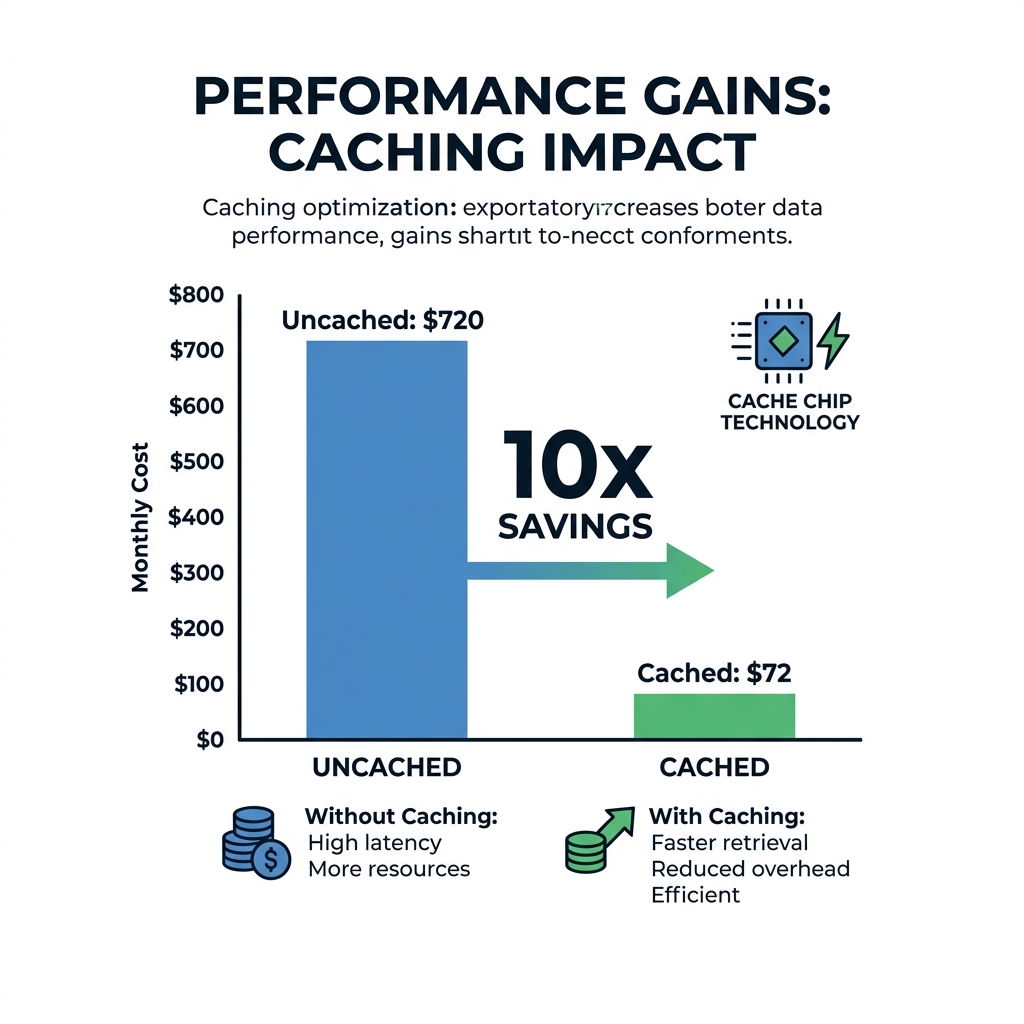
AI inference cost optimization often starts with prompt caching because repeated prompt prefixes can otherwise incur the same prefill cost on every request. If a 4,000-token system prompt, tool schema, and example set is sent 10,000 times, most of those 40 million input tokens may be eligible for cheaper cache reads.
Provider-native caching stores or recognizes the model’s precomputed state for a matching prefix. It reduces input-side cost and prefill latency; it does not reduce output-token charges or eliminate inference for the user-specific suffix.
| Provider | Cache behavior | Billing shape | Key consideration |
|---|---|---|---|
| Anthropic | Explicit cache breakpoints and TTL options | Cache writes cost more than normal input; reads cost substantially less | Prefixes must meet eligibility and remain identical through the breakpoint |
| OpenAI | Automatic prompt caching on supported models, with cached-token usage reported | Cached input price is model-specific and lower than uncached input | Put static content first; caching thresholds and retention vary |
| Google Gemini | Implicit caching on supported models plus explicit context caching | Model-specific cached-token pricing; explicit caches can add storage charges | Include storage cost and cache lifetime in the calculation |
Sources: Anthropic prompt caching, OpenAI prompt caching, and Gemini context caching. Pricing, minimum token counts, TTLs, and eligible models change, so verify the provider’s current pricing page before forecasting savings.
Design for a stable prefix. Order the request from least variable to most variable:
- System instructions and policies
- Tool definitions and schemas
- Few-shot examples and reference context
- Session-specific context
- The current user message and other volatile data
With explicit caching, place the breakpoint immediately after the reusable content. With automatic caching, the same ordering maximizes the common prefix the provider can detect. Avoid timestamps, request IDs, randomized tool ordering, changing whitespace, or dynamically generated JSON in the prefix: even semantically equivalent content can produce a different token sequence and miss the cache.
Model the write/read economics before rollout. Let W be the cache-write price as a multiple of normal input, R the cache-read multiple, and h the expected number of hits after one write. Caching wins when:
W + hR < 1 + h
Therefore, the minimum hit count is greater than (W - 1) / (1 - R). Using Anthropic’s documented multipliers, a five-minute write at 1.25× with reads at 0.10× recovers its write premium after one hit; a one-hour write at 2× requires two hits. That calculation assumes the whole eligible prefix is reused and excludes any storage fee, variable suffix, and output tokens.
Measure realized savings, not theoretical reuse. Log total input tokens, cached-read tokens, cache-creation tokens, output tokens, latency, model, and cache identifier or breakpoint where available. Then track:
- Eligible-prefix ratio: reusable prefix tokens ÷ total input tokens
- Cache-hit rate: requests with cached tokens ÷ eligible requests
- Effective input cost: total input-related spend ÷ total input tokens
- Savings: uncached baseline cost minus actual write, read, and storage costs
- Latency impact: p50 and p95 time to first token for hits versus misses
Run the comparison by model and workload. A high hit rate can still produce modest savings if the cached prefix is small, while a lower hit rate can be valuable when the prefix contains large tool schemas or retrieved reference material.
Common pitfalls include caching content that changes every request, choosing a TTL longer than the reuse window, ignoring explicit-cache storage charges, warming a cache that receives no subsequent traffic, assuming caches survive model or provider changes, and treating a cache as durable application storage. Also verify tenant isolation and data-retention terms rather than assuming “cached” means data is stored or shared in a particular way.
A reported agent workload fell from $720/month to $72/month after prompt caching, but that result is anecdotal and workload-specific. (Medium case study) The reliable takeaway is the method: stabilize the longest reusable prefix, select a TTL that matches actual request locality, and validate savings from provider usage fields and invoices.
2. Model cascading
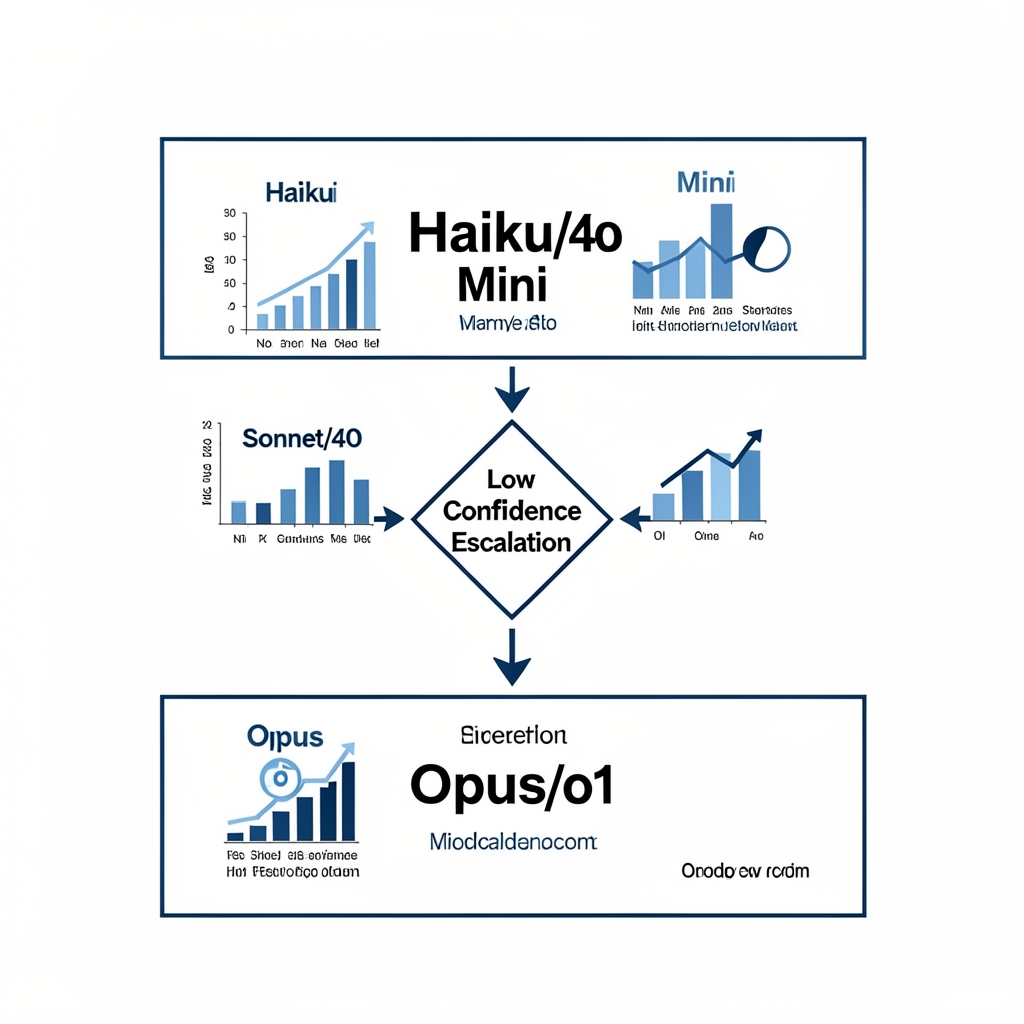
Not every request needs the most capable model. Model cascading sends each request to the least expensive route that can meet its quality, latency, and safety requirements, then escalates when a measurable signal indicates that it cannot.
A practical cascade starts by assigning tasks to tiers:
- Tier 0: deterministic path — cached responses, rules, templates, retrieval, or conventional code for exact and repeatable tasks.
- Tier 1: small model — classification, extraction, routing, short summaries, and constrained drafting.
- Tier 2: general-purpose model — multi-step reasoning, nuanced writing, tool selection, and ambiguous requests.
- Tier 3: specialist or frontier model — difficult reasoning, high-value decisions, complex code, or domain-specific work.
- Human review — regulated, safety-critical, or irreversible actions that cannot be approved automatically.
| Route | Typical task | Escalation trigger | Metric to track |
|---|---|---|---|
| Deterministic → small model | FAQ lookup, formatting, known intents | No rule/cache match or incomplete retrieval | Cache hit rate, task success |
| Small → general model | Classification, extraction, simple summaries | Confidence below a calibrated threshold, invalid schema, or verifier failure | Escalation rate, precision/recall |
| General → specialist model | Complex reasoning, coding, long-context synthesis | Failed quality gate, conflicting evidence, or unsupported answer | Pass rate, groundedness, cost per accepted result |
| Any model → fallback model | Production traffic | Timeout, rate limit, provider error, or repeated malformed output | Availability, retry rate, p95 latency |
| Any model → human review | Sensitive or high-impact decisions | Policy rule, unresolved ambiguity, or low confidence after escalation | Review rate, override rate, incident rate |
Confidence-based escalation should use signals that correlate with correctness on your own evaluation set. Useful signals include:
- Model probabilities or log-probabilities, when the API exposes them.
- A separate classifier or verifier that scores the answer against a rubric.
- Agreement between multiple low-cost attempts.
- Retrieval coverage and citation support.
- Schema validation, tool execution results, and domain-specific checks.
Do not treat a model saying “I’m confident” as a reliable confidence score. Set thresholds using labeled examples, then monitor false accepts—incorrect answers that were not escalated—not just the overall escalation rate.
Fallback rules should be explicit:
- Retry transient errors with bounded exponential backoff.
- Route to an equivalent backup model or provider after timeouts or rate limits.
- Escalate malformed or incomplete outputs after one constrained repair attempt.
- Preserve safety requirements during fallback; do not downgrade to a route that lacks required controls.
- Stop after a fixed number of attempts and return a safe failure or request human review.
Each route also needs quality gates. Depending on the task, these can include valid JSON, required fields, grounded citations, successful code or tool execution, policy checks, and rubric-based scoring. Audit a sample of accepted responses at every tier to catch quality drift after model, prompt, or data changes.
Research such as FrugalGPT demonstrated large cost reductions on specific benchmark configurations by combining and cascading models. Those results are examples, not guaranteed savings. Your outcome depends on model pricing, task mix, routing accuracy, escalation frequency, retries, and the quality threshold you must maintain.
Measure the cascade by cost per accepted result, not token price alone. Track task success, false-accept rate, escalation rate, latency, fallback frequency, and human-review rate by route. If a cheaper tier escalates frequently or creates costly rework, moving that task directly to a stronger model may be both less expensive and more reliable.
3. Continuous batching (if you self-host)
If you serve your own model, continuous batching is the single largest GPU-utilization win. Static batching forces every request in a batch to wait for the slowest one; continuous batching schedules new requests into the GPU as soon as a slot opens.
vLLM's continuous batching is reported to lift GPU utilization from ~15–30% (naïve serving) to ~60–80%, with 3–4× higher effective throughput at the same GPU cost. (Hakia) [Unverified — synthesis from multiple practitioner sources]
If you are on managed APIs, this happens for you. If you self-host, run vLLM, SGLang, or TensorRT-LLM with continuous batching turned on; do not roll your own scheduler.
4. Smaller, fine-tuned models for hot paths
For repetitive workloads — classification, extraction, summarization with a fixed schema — a small fine-tuned model often matches a frontier API at 5–20× lower cost.
Pattern:
- Run the frontier model on the workload for a week to generate ground-truth examples.
- Fine-tune (LoRA on a 7B–14B open model, or hosted fine-tune on a small closed model) on those examples.
- Route the workload to the fine-tuned model; keep the frontier model as fallback.
The economics flip when daily call volume crosses ~50K–500K depending on prompt size. [Inference]
5. Output structure and length
The cheapest token is the one you do not generate. Concrete tactics:
- Structured output (JSON schema, function calling) replaces "explain in prose" outputs that bloat token counts 3–5x.
max_tokensdiscipline — set it to the actual ceiling, not the model max.- Stop sequences — terminate generation as soon as the answer is complete.
- Compression in chains — for multi-step pipelines, summarize intermediate steps before passing them forward.
6. Observability is the prerequisite
You cannot optimize what you cannot see. Log per-request:
- Model used, prompt tokens, completion tokens, cached tokens, total cost
- Latency (TTFT, total)
- Tenant / user / feature attribution
- Cache hit/miss
Roll those up by feature and by model. The 80/20 will surface within a week — usually one feature is 60% of cost, and one prompt template is 40% of that feature's tokens. Optimize the head of the distribution; ignore the tail.
7. Batch APIs for non-realtime work
Both OpenAI and Anthropic offer batch APIs at roughly 50% off for asynchronous workloads with a longer SLA (typically up to 24 hours). For overnight enrichment, embeddings backfill, eval runs, and offline analytics, batch is a nearly free 2× discount you should be using by default for everything that does not need a synchronous response. [Unverified — pricing accurate as of early 2026]
A worked example
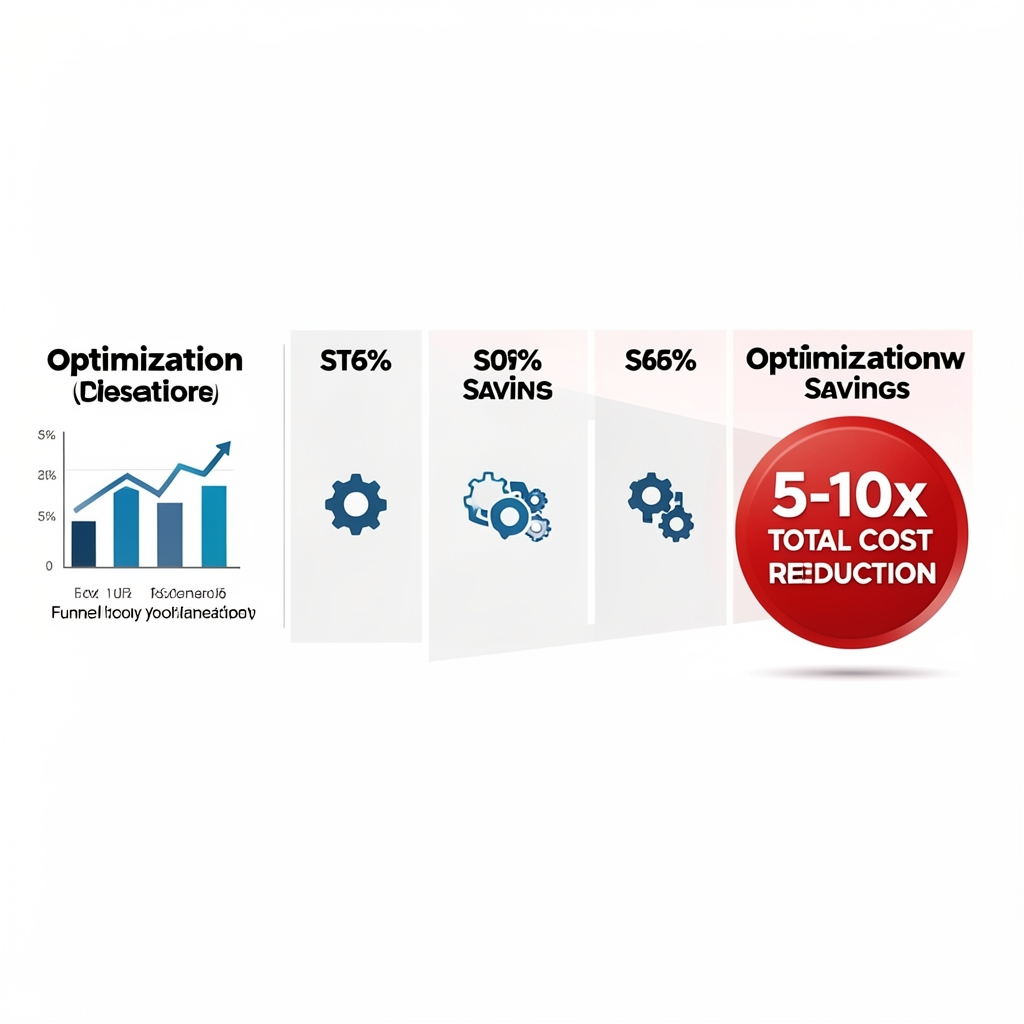
Assume the copilot processes 4.0 billion input tokens and 133.3 million output tokens per month, including retry traffic. The following rates are illustrative rather than current list prices:
- Premium model: $3/M input tokens and $15/M output tokens
- Smaller model: 30% of the premium model’s input and output cost
- Retry overhead: initially 10 retries per 100 successful requests
- Costs are rounded to the nearest $10
The baseline is therefore:
- Input: \(4{,}000M \times \$3/M = \$12{,}000\)
- Output: \(133.3M \times \$15/M \approx \$2{,}000\)
- Total: $14,000/month
| Step | Physical input tokens | Physical output tokens | Monthly cost |
|---|---|---|---|
| Baseline | 4.000B | 133.3M | $14,000 |
| Route 50% to a smaller model | 4.000B | 133.3M | $9,100 |
| Cache repeated prompt prefixes | 4.000B | 133.3M | $5,460 |
| Tighten outputs and reduce retries | 3.745B | 76.2M | $4,640 |
| Batch analytics enrichment | 3.745B | 76.2M | $3,710 |
1. Route straightforward work to a smaller model. Assume classification, retrieval, and routine answers account for 50% of token volume. Keeping the other 50% on the premium model costs \(50\% \times \$14{,}000 = \$7{,}000\). Running the routed half at 30% of the premium price costs another \(50\% \times \$14{,}000 \times 30\% = \$2{,}100\). The new total is $9,100, a 35% reduction.
2. Cache the stable system-prompt prefix. After routing, input costs are $7,800 and output costs are $1,300. Assume 75% of input tokens belong to a reusable prefix and the cache hits on 80% of those tokens. That means \(75\% \times 80\% = 60\%\) of all input tokens are cache reads. If the effective cache-read price—including cache-write overhead—is 22.2% of the normal input price:
\[
\$7{,}800 \times (40\% + 60\% \times 22.2\%) \approx \$4{,}160
\]
Adding $1,300 of output spend gives $5,460/month.
3. Constrain outputs and eliminate avoidable retries. Suppose a stricter response schema reduces actual output tokens by 39%, while validation and fallback handling reduce retry overhead from 10% to 3%. Holding successful request volume constant, the retry multiplier becomes \(1.03 / 1.10\):
- Input: \(\$4{,}160 \times 1.03 / 1.10 \approx \$3{,}895\)
- Output: \(\$1{,}300 \times 61\% \times 1.03 / 1.10 \approx \$743\)
- Total: approximately $4,640
Lowering max_tokens does not automatically reduce a bill when providers charge for tokens actually generated; the saving comes from preventing unnecessarily long responses and reducing malformed-output retries.
4. Move asynchronous enrichment to batch processing. Assume analytics enrichment represents 40% of the remaining model spend and the selected batch endpoint bills that work at 50% below the synchronous rate:
\[
\$4{,}640 \times (60\% + 40\% \times 50\%) \approx \$3{,}710
\]
The illustrative result is a reduction from $14,000 to about $3,710 per month, or roughly 73.5%.
[Speculation] Actual results vary materially by workload, model prices, prompt composition, cache eligibility, hit rate, response length, quality thresholds, and batch discounts. A workload with short prompts or low prefix reuse will benefit less from caching, while one with many simple requests may benefit more from model routing.
The real risk in 2026: agentic compounding
Agents call the model in loops. A single user request can trigger 20–50 model calls. If you do not track tokens per task (not just per call), an agentic feature can quietly become your largest cost line item between billing cycles. Set per-task token budgets. Alert when they breach.
Bottom line
AI inference cost optimization works best as a disciplined process, not a one-time model swap. The goal is to reduce spend without sacrificing task success, latency, reliability, or output quality.
Start with measurement
Track cost per successful task—not just cost per token or request—using a clear quality threshold. This baseline shows whether a change creates real savings or simply shifts costs through retries, failures, or manual review.
Optimize in this order
- Cache reusable prompt content and repeated results.
- Route straightforward requests to smaller models and reserve frontier models for harder tasks.
- Control output length with tight schemas, token limits, and concise instructions.
- Batch asynchronous workloads that do not require immediate responses.
- Consider self-hosting only after demand is stable enough to justify the infrastructure and operational overhead.
The bottom line: effective AI inference cost optimization combines measurement, caching, routing, output controls, and batching before taking on the complexity of self-hosting.
Frequently Asked Questions
What is AI inference cost optimization?
How much can prompt caching save?
What is model routing?
Does batching reduce AI inference costs?
What does “cost per successful task” mean?
Can inference cost optimization reduce output quality?
When is self-hosting cheaper than using an API?
What is the biggest AI inference cost optimization mistake?
Discussion
Related Posts



Ready to automate customer conversations?
Launch AI voice agents and WhatsApp bots with CallMissed — one API, 22+ Indian languages.