
WhatsApp Chatbots for Lead Qualification Without Losing Human Context


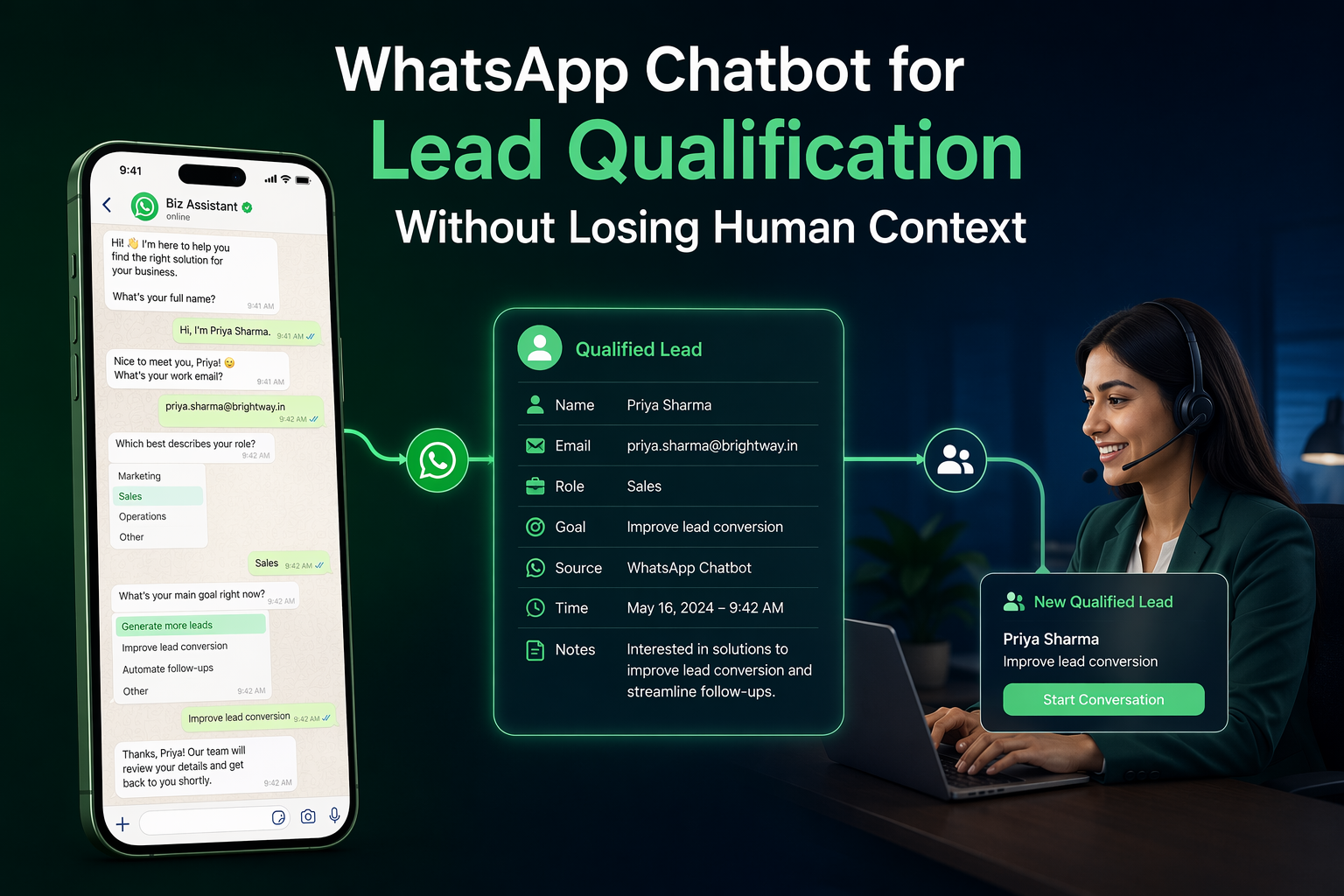
Build a WhatsApp chatbot for lead qualification that asks useful questions, scores intent, preserves context, and hands sales teams a structured lead.
WhatsApp Chatbots for Lead Qualification Without Losing Human Context
WhatsApp has become the default business channel for many buyers because it feels lighter than a form, faster than email, and more natural than waiting on hold. That convenience is exactly why lead qualification on WhatsApp matters. When a prospect opens a chat, the business gets a short window to prove it can respond with relevance. A fast but generic answer wastes the channel. A slow manual response wastes the lead. The real opportunity is to use AI qualification so that every conversation moves forward while the buyer still has momentum.
CallMissed is relevant here because the product is positioned as AI communication infrastructure for businesses that want WhatsApp chatbots, AI voice call agents, Smart IVR, multilingual speech, and OpenAI-compatible APIs in one operational stack. The article below is therefore not framed as generic AI commentary. It is framed around the exact workflows where that infrastructure becomes commercially useful.
The business problem behind the keyword
A WhatsApp chatbot for lead qualification turns a shared messaging inbox into a structured path from first contact to the right next step. It asks consistent discovery questions, retains each answer, and prevents buyers from repeating themselves when sales takes over.
Qualification requires structured questions because budget, use case, urgency, region, deployment needs, and preferred channel can determine fit and ownership. A WhatsApp chatbot for lead qualification can sequence these questions naturally, score the lead based on defined criteria, and route the conversation to the appropriate person or workflow.
Because WhatsApp conversations persist, the chatbot can preserve context across pauses, shared brochures, and demo booking. When human judgment is needed, the handoff should include the conversation history, qualification details, and recommended next action so the sales representative can continue without restarting discovery.
Where legacy workflows usually break
- Most rule-based chatbots overuse menus and underuse context. They feel transactional, which causes drop-off when the prospect has a nuanced request.
- Manual teams often respond out of order. One rep asks for the problem, another asks for company size, and a third asks the same question again because there is no shared summary.
- Qualification also breaks when channel transitions are sloppy. If a lead starts on WhatsApp and later receives a call, the rep needs the transcript, intent summary, and next recommended action before picking up.
What CallMissed changes in this workflow
CallMissed can position WhatsApp as the start of an operationally serious sales workflow instead of an informal inbox. The product already supports WhatsApp chatbots with custom knowledge bases and can pair that channel with voice follow-up where needed.
Because the backend exposes webhooks, model routing, and request logging, teams can decide which conversations stay lightweight and which deserve deeper AI reasoning or a direct human handoff.
The OpenAI-compatible API surface also matters for internal tooling. If a business already has a CRM, scoring layer, or sales dashboard, it can plug CallMissed into that workflow without rewriting SDK logic from scratch.
CallMissed documentation also reinforces the product building blocks behind this angle: AI-powered communication APIs, WhatsApp chatbots, AI voice call agents, Smart IVR, OpenAI-compatible endpoints, multilingual STT across 22 Indic languages plus English, and TTS options designed for telephony and app workflows. Those are not abstract features. They shape how fast a team can ship and refine a production conversation system.
A practical workflow blueprint
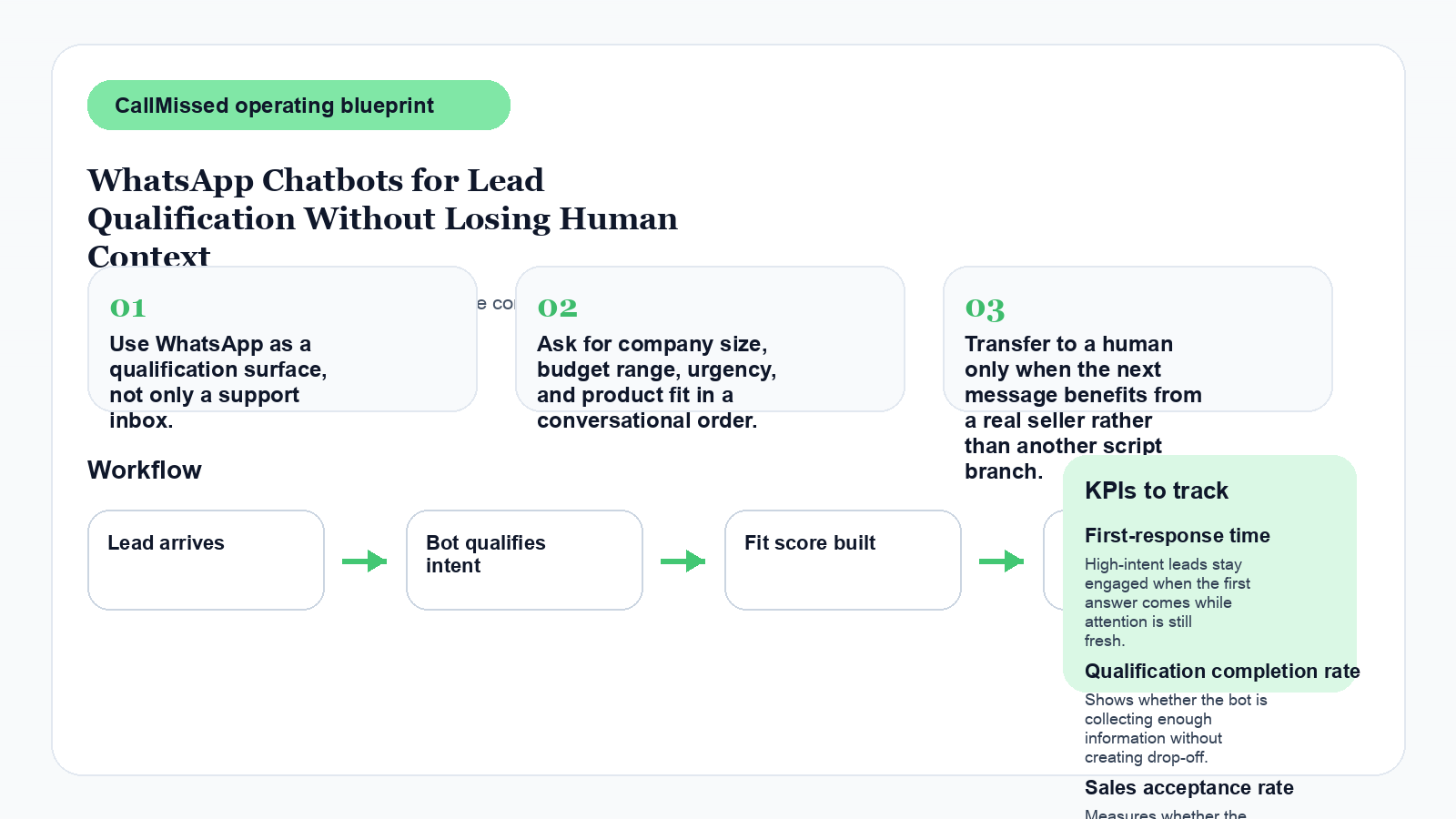
Respond immediately with a brief greeting that identifies the business, explains that the assistant can answer questions and arrange the next step, and makes clear that the buyer is interacting with automation. Confirm what they want help with before collecting details, provide an easy way to request a person, and honor opt-out requests. Only ask for information needed to handle the enquiry.
Qualification
Start with two or three high-signal questions rather than a long form. A B2B flow might ask about use case, company size, and timeline. A local service flow might ask about service type, location, and preferred appointment window. Use buttons or short reply options where helpful, but allow free-text answers so buyers can add context.
Ask follow-up questions only when an answer affects the next step. Preserve the buyer’s original wording alongside structured fields instead of forcing every response into a predefined category.
Scoring and routing
Apply simple, documented routing rules based on factors such as fit, urgency, location, service availability, and buyer intent. The result should determine whether the bot provides self-serve information, books a callback, sends a relevant document, routes the enquiry to a specialist, or offers a live transfer.
Avoid treating the score as a final judgment. Missing or ambiguous information should trigger clarification or human review rather than automatic rejection.
Human handoff
Before transferring the conversation, generate a concise summary that includes the buyer’s request, answers to qualification questions, relevant constraints, and agreed next step. Send the full chat history and captured fields to the rep so the buyer does not have to repeat information.
Tell the buyer who will respond and, where possible, provide a realistic timeframe. If no rep is available, offer to schedule a callback or collect a preferred contact time rather than leaving the conversation at a dead end.
Follow-up
Keep follow-up in the same WhatsApp thread when the buyer has agreed to receive it. Send appointment confirmations, reminders, requested documents, and clear next-step prompts. Record outcomes such as booked, not ready, ineligible, or no response so future messages reflect the actual conversation.
Use sensible frequency limits, stop automated sequences when a person takes over, and make it easy for the buyer to pause or end follow-up.
| Stage | Bot action | Captured fields | Handoff trigger | KPI |
|---|---|---|---|---|
| Entry and consent | Greet the buyer, explain the assistant’s role, identify their goal, and offer a human option | Enquiry source, initial request, consent or opt-out status | Buyer requests a person, raises a sensitive issue, or cannot describe the need through the flow | Response time, consent status, conversation start rate |
| Qualification | Ask two or three high-signal questions and clarify only when necessary | Use case or service type, company size or location, timeline or preferred slot, free-text context | Complex requirements, repeated misunderstanding, or an answer outside supported options | Qualification completion rate, question drop-off rate, missing-field rate |
| Scoring and routing | Apply documented rules and select the appropriate next step | Fit indicators, urgency, availability, intent, routing outcome | High-priority lead, unclear fit, exception case, or action requiring staff approval | Routing accuracy, qualified lead volume, self-serve resolution rate |
| Human handoff | Create a summary, attach conversation context, and connect or schedule the correct rep | Lead summary, assigned owner, callback time, promised next step | Live assistance is requested or the lead meets the relevant routing criteria | Handoff acceptance time, repeat-question rate, scheduled callback rate |
| Follow-up | Send agreed confirmations, reminders, documents, and next-step prompts | Follow-up status, appointment details, documents sent, outcome, opt-out status | Buyer replies with a new question, changes requirements, or needs staff assistance | Appointment confirmation rate, reply rate, follow-up completion rate |
High-value use cases
The best questions confirm fit, intent, and timing without turning WhatsApp into a long application form.
| Use case | Questions to ask | Disqualifiers or urgency signals | Next action |
|---|---|---|---|
| B2B demos | Company size, use case, required integrations, expected user volume, timeline, and decision-making role | Poor product fit or unsupported requirements may disqualify; an active evaluation or near-term deadline signals urgency | Assign the appropriate AE and offer a demo or discovery call |
| Clinics and appointments | Service required, preferred location, availability, and whether the person is a new or existing patient | Requests outside the clinic’s scope may be redirected; severe or emergency symptoms require appropriate emergency guidance rather than continued qualification | Offer suitable appointment options or arrange a staff callback |
| Real estate | Property type, preferred area, budget range, financing status, and move or purchase timeline | An out-of-area request or major budget mismatch may disqualify; a confirmed move date or request for an immediate viewing signals urgency | Route to the relevant agent and schedule a call or viewing |
| Local services | Postcode, service needed, urgency, property or equipment details, and preferred time | An unsupported location or job type may disqualify; loss of essential services, active damage, or a same-day request signals urgency | Send the request to the appropriate local operator for confirmation and scheduling |
| Education admissions | Program of interest, intended intake, prior qualifications, location, and application status | Missing essential eligibility criteria may require alternative guidance; approaching deadlines or a completed application signals urgency | Route to an admissions counselor, share the appropriate next step, or schedule a counseling call |
When a voice call is better
Continued WhatsApp chat works well for short, structured questions. A voice call is usually better when the lead has a complex situation, gives ambiguous answers, needs reassurance, wants to compare several options, or is ready to discuss pricing, availability, or a decision in detail.
Urgent safety or medical situations should not remain in a qualification flow. The chatbot should provide the organization’s approved emergency guidance instead of treating a sales callback as emergency assistance.
Connecting the handoff with CallMissed
Configure the CallMissed handoff so the person receiving or making the call has the WhatsApp qualification summary: the lead’s contact details, answers, urgency, preferred callback time, and the unresolved question. Ask for consent before arranging the call, then confirm what will happen next.
This preserves human context while avoiding repeated questions. The chatbot handles initial sorting, while the human continues from the point where judgment, empathy, or a detailed conversation becomes more valuable.
Rollout checklist for operations teams
- Map the minimum data that a human rep actually needs. Anything beyond that belongs later in the sales process.
- Keep the language conversational. Buyers tolerate qualification when it feels like progress, not when it feels like a form disguised as chat.
- Build handoff summaries in a fixed structure so every rep reads the same pattern: intent, urgency, fit, objections, next step.
- Use voice follow-up selectively for leads that stall on chat or require explanation that is easier by phone.
- Review abandonment points in the WhatsApp flow every week. The highest-friction question is usually obvious in the transcript data.
Why this matters commercially
The reason WhatsApp chatbot for lead qualification deserves executive attention is simple: conversation quality affects revenue, service cost, and brand trust at the same time. When a business improves how quickly it answers, how consistently it qualifies or resolves, and how cleanly it moves between voice and WhatsApp, the gains show up in real operating lines such as booked appointments, recovered leads, lower support backlog, and fewer repeat contacts. This is why communication infrastructure is a growth lever rather than a cosmetic feature.
A workflow like this also compounds operationally. Once the business has clear prompts, escalation logic, and measurement in place, the same structure can be reused across new campaigns, locations, or customer segments. In practical terms, that means the first successful automation does not remain a one-off win. It becomes a template the team can improve and repeat.
Leaders should therefore evaluate this category the same way they evaluate any other operational investment: how much manual effort does it remove, how much customer demand does it preserve, and how quickly can the team adapt the workflow when products, seasons, or policy requirements change. CallMissed is useful in that frame because it gives teams one place to coordinate AI voice, WhatsApp, Smart IVR, multilingual speech, and developer integrations instead of rebuilding the communication layer for every experiment.
A 30-day pilot plan
- Pick one workflow where customer intent is already clear and measurable, such as missed-call recovery, booking confirmations, or order-status support.
- Define the non-negotiables before launch: latency threshold, escalation triggers, language support, and the exact outcome metric the business cares about.
- Review transcripts or call summaries daily in week one so the team can tighten prompts, remove repetitive questions, and correct weak handoff phrasing quickly.
- Compare the pilot against the manual baseline using conversation-level outcomes, not vanity metrics like message count or raw automation rate.
- Expand only after the workflow proves it can protect customer experience while improving speed, throughput, or conversion.
What strong human handoff looks like
A good handoff does not merely transfer the customer. It transfers the conversation state. The human should receive the reason for contact, the important entities already captured, the customer’s tone or urgency, and the recommended next action. When that summary is missing, the customer experiences escalation as a reset. When it is present, escalation feels like continuity. In other words, the difference between poor automation and useful automation is often the quality of the handoff rather than the quality of the first answer alone.
This is one of the more practical reasons to think about CallMissed as infrastructure. The value is not simply that the platform can answer on voice or WhatsApp. The value is that both channels can participate in one operating workflow where summaries, routing, and next steps are structured enough to support human teams instead of interrupting them.
Metrics that matter
| Metric | What it shows |
|---|---|
| First-response time | How quickly a new lead receives a useful initial reply. |
| Qualification completion rate | How often leads provide the information required for routing or follow-up. |
| Sales-accepted lead rate | Whether sales considers qualified handoffs relevant and usable. |
| Handoff time | How long it takes to move a lead from automation to the appropriate person. |
| Booked-next-step rate | How often conversations result in a scheduled call, demo, visit, or other agreed action. |
| Opt-out rate | Whether the workflow, message frequency, or targeting is causing contacts to disengage. |
| Unresolved rate | How often conversations end without an answer, handoff, or clear next step. |
| Downstream revenue | Revenue associated with leads that passed through the WhatsApp qualification workflow. |
Measure the workflow, not individual replies
Evaluate these metrics together. A fast first response has limited value if qualification remains incomplete, handoffs stall, or sales rejects the leads. The goal is to improve the full path from initial WhatsApp contact to resolution, a booked next step, or revenue.
Establish attribution and a baseline
Reliable attribution requires WhatsApp conversation data to be connected with CRM outcomes, including lead status, sales acceptance, appointments, opportunities, and closed revenue. Establish a baseline before changing the workflow, then compare results across consistent time periods, lead sources, and qualification criteria. This makes it possible to distinguish genuine workflow improvement from changes in traffic volume or lead quality.
Common mistakes to avoid
- Turning the chatbot into a brochure that dumps every product detail before asking what the lead actually wants.
- Collecting too much data too early. Early-stage qualification should reduce friction, not replicate a long CRM form.
- Routing every lead to the same rep or queue. Qualification only pays off when it changes downstream handling.
- Failing to summarize the conversation for the human seller. Without that summary, the customer experiences the handoff as a reset.
FAQ
Why qualify leads on WhatsApp instead of a web form?
What makes a good qualification flow?
Can CallMissed connect WhatsApp with voice workflows?
How many questions should the bot ask?
Which metrics matter most?
Product references
- CallMissed Introduction: https://docs.callmissed.com/docs/introduction
- CallMissed Quickstart: https://docs.callmissed.com/docs/quickstart
- CallMissed Speech to Text: https://docs.callmissed.com/docs/speech-to-text
- CallMissed Text to Speech: https://docs.callmissed.com/docs/text-to-speech
- CallMissed Chat Completions: https://docs.callmissed.com/docs/chat-completion
Conclusion
A WhatsApp chatbot for lead qualification works best when it earns consent, asks only essential questions, preserves conversation context, logs data in the CRM, and hands qualified leads to a human or voice workflow at the right moment. The success of a WhatsApp chatbot for lead qualification should then be measured by outcomes such as response, qualification, handoff, and conversion rates—not automation alone.
For businesses connecting a WhatsApp chatbot for lead qualification with voice interactions, CallMissed provides a natural foundation through its WhatsApp, AI voice, Smart IVR, multilingual speech, and developer API capabilities.
Discussion
Related Posts
Ready to automate customer conversations?
Launch AI voice agents and WhatsApp bots with CallMissed — one API, 22+ Indian languages.