
TCS Sharpens AI Focus: Inside the Plan to Become the World’s Largest AI-Led Tech Services Company



What happens when India's largest IT company decides it no longer wants to be just an IT company—but the world's largest AI-led technology services...
TCS Sharpens AI Focus: Inside the Plan to Become the World’s Largest AI-Led Tech Services Company
What happens when India's largest IT company decides it no longer wants to be just an IT company—but the world's largest AI-led technology services company? TCS sharpens its AI focus at precisely the moment the global industry is shifting from experimental projects to core enterprise spending, and the numbers reveal a company already deep into transition: an annualised revenue run rate of $2.3 billion from AI services and 130 of its top 139 clients actively using its AI solutions.
Revealed during its Q2 FY26 results, TCS's $2.3 billion AI revenue figure signals that artificial intelligence has moved decisively from experimental budgets to structural enterprise spending. With nearly every major client already onboarded onto AI platforms, TCS is proving that hyperscale adoption isn't a distant future for India's IT sector—it is the present reality reshaping global technology contracts. This isn't merely a service-line pivot; it is a fundamental rewiring of how one of the world's largest technology workforces delivers value.
So why does this acceleration matter beyond TCS's balance sheet? Under Chairman N. Chandrasekaran, the company is executing what it calls a "bold transformation across talent," embedding AI across cloud, data, and industry-specific workflows rather than treating it as a standalone offering. That strategy is redefining competitive dynamics for the entire global tech services industry and forcing rivals to match an AI penetration rate that already covers over 93% of the firm's top client base.
In this article, we'll dissect the mechanics behind TCS's ambition: how it is reskilling its massive workforce for AI delivery, why its client onboarding velocity serves as a barometer for enterprise AI maturity worldwide, and what its FY26 roadmap reveals about the future of the $250 billion Indian IT industry. Whether you're an enterprise leader evaluating AI partners, an investor tracking the evolution of outsourcing, or a technologist watching India's rise in the global AI stack, TCS's next chapter offers critical market signals.
And this transformation isn't confined to IT services giants alone—across India's technology landscape, companies are racing to build AI-native infrastructure, with platforms like CallMissed enabling businesses to deploy multilingual AI voice agents and chat interfaces that bring enterprise-grade automation within reach of organizations of every size.
Introduction

Tata Consultancy Services (TCS) is no longer content being India’s largest IT exporter. The Mumbai-based giant has set its sights on becoming the world’s largest AI-led technology services company, a declaration that signals a structural rewiring of how global enterprises consume technology. With annualised AI revenue already hitting $2.3 billion in FY26 and a staggering 130 of its top 139 clients now onboarded onto AI-powered engagements, TCS is moving swiftly from experimentation to industrial-scale deployment.
The Scale of TCS’s AI Ambition
The numbers reveal a company in transition. TCS’s AI services revenue run-rate places it among the most aggressive adopters in the global IT services landscape, yet Chairman N. Chandrasekaran has made clear this is only the beginning. The firm’s new-age services portfolio — spanning cloud, data analytics, and generative AI — is now the central growth engine rather than a peripheral innovation lab. In quarterly disclosures tied to its Q2 FY26 results, TCS explicitly anchored its forward strategy in AI-powered transformation, noting that the shift touches everything from talent models to client delivery frameworks.
TCS is systematically rewiring its core offerings to reflect this priority:
- AI and generative AI integration across enterprise workflows and legacy system modernization
- Cloud and data engineering services designed to feed clean, structured data into machine learning pipelines
- Industry-specific LLM deployments tailored to verticals like banking, retail, and healthcare
- Agentic automation platforms that move beyond copilots toward autonomous enterprise operations
What distinguishes this pivot is its velocity and depth. While legacy IT services companies often treat AI as an upsell to existing contracts, TCS appears to be rearchitecting its service lines around intelligent automation and outcome-based delivery. The stat that 130 of its top 139 clients have already adopted AI solutions suggests the company is successfully converting its trusted relationships into next-generation partnerships — a critical advantage in a market where AI procurement decisions increasingly hinge on proven execution scale.
Why This Matters for Global Tech
TCS’s announcement arrives at an inflection point. Global enterprise spending on AI services is projected to outpace traditional IT outsourcing, and Indian IT majors are racing to capture that premium revenue pool. TCS’s workforce readiness underscores the operational seriousness behind the vision: the firm has reportedly trained over 1.6 lakh (160,000) employees in AI capabilities, effectively converting its human capital into a deployable AI talent reservoir.
This transformation extends beyond Tata Consultancy Services itself. As hyperscalers and system integrators race to embed AI into core business processes, the ripple effects are reshaping the broader communication infrastructure layer. Enterprises migrating to AI-first service models require multilingual voice interfaces, real-time speech analytics, and scalable LLM inference stacks to serve diverse markets — particularly in regions like India with fragmented language landscapes. Platforms like CallMissed are emerging within this ecosystem, offering production-ready voice agents, WhatsApp chatbots, and Speech-to-Text APIs covering 22 Indian languages, enabling businesses to operationalize the kind of AI strategies TCS is architecting for the Fortune 500.
The message is unambiguous: TCS is betting that the future of technology services will be won by providers who can deliver AI-driven outcomes, not just labor arbitrage. And with nearly every major client already along for the ride, the race to become the world’s definitive AI-led services firm is no longer aspirational — it is already underway.
Background & Context
TCS at an Inflection Point
Tata Consultancy Services (TCS), India’s largest IT firm, stands at a strategic inflection point. For decades, the company defined the global outsourcing narrative through scale, reliability, and cost-efficient delivery. Now, Chairman N. Chandrasekaran is steering the organization toward a more ambitious identity: the world’s largest AI-led technology services company. This declaration, reinforced during the company’s Q2 FY26 communications, is not a peripheral innovation initiative. It represents a structural repositioning of a $30-billion-plus enterprise for the generative AI era, one that treats artificial intelligence as the central organizing principle of service delivery rather than an add-on capability.
From Legacy IT to AI-Native Delivery
Historically, TCS built its dominance on application maintenance, infrastructure management, and business process outsourcing. That playbook is now giving way to an integrated, intelligence-first model. The company has disclosed that 130 of its top 139 clients have already been onboarded onto AI-led engagements—a figure that underscores how rapidly enterprise buyers are shifting from experimental pilots to production-grade deployments.
The financial evidence of this pivot is equally striking:
- $2.3 billion in annualised revenue from AI services during FY26
- A new-age services portfolio spanning cloud, data engineering, and analytics, now fused with AI layers
- Contract structures increasingly moving from time-and-material staff augmentation to outcome-based transformation models
This portfolio evolution places TCS in direct competition with global peers, yet with a delivery engine rooted in one of the world’s largest technical workforces and a client list that spans nearly every major industry vertical.
Workforce and Competitive Context
Scale in the services business is fundamentally a talent equation, and TCS is mobilizing accordingly. Reports indicate that roughly 1.6 lakh (160,000) employees have been made AI-ready through intensive reskilling programs. In an industry where delivery bandwidth often becomes the primary constraint, this internal mobilization is a strategic weapon: it allows TCS to compress implementation timelines while defending margin profiles that are typically pressured during technology transitions.
The urgency is driven by a crowded global field. Accenture, IBM, and domestic rival Infosys are all racing to embed generative AI across enterprise workflows. CEO K. Krithivasan has emphasized that TCS’s objective is not merely participation but leadership—measured by both the volume of AI-led revenue and the depth of integration within client operations.
The Broader Indian AI Ecosystem
TCS’s ambition mirrors a wider acceleration across India’s technology sector, where both legacy conglomerates and emerging platforms are capturing enterprise AI demand. While TCS architects end-to-end transformation roadmaps for Fortune 500 clients, the underlying stack demands specialized infrastructure—from multilingual Speech-to-Text to high-throughput LLM inference. Here, platforms like CallMissed illustrate the complementary edge of the ecosystem, providing production-ready voice agents, WhatsApp automation, and access to 300+ LLM APIs that enterprises frequently embed within larger system integrator-led deployments. The result is a multi-layered market: global integrators design the strategy, while nimble AI infrastructure providers supply the regional, language-specific, and real-time execution layers essential for India’s diverse digital economy.
Key Developments
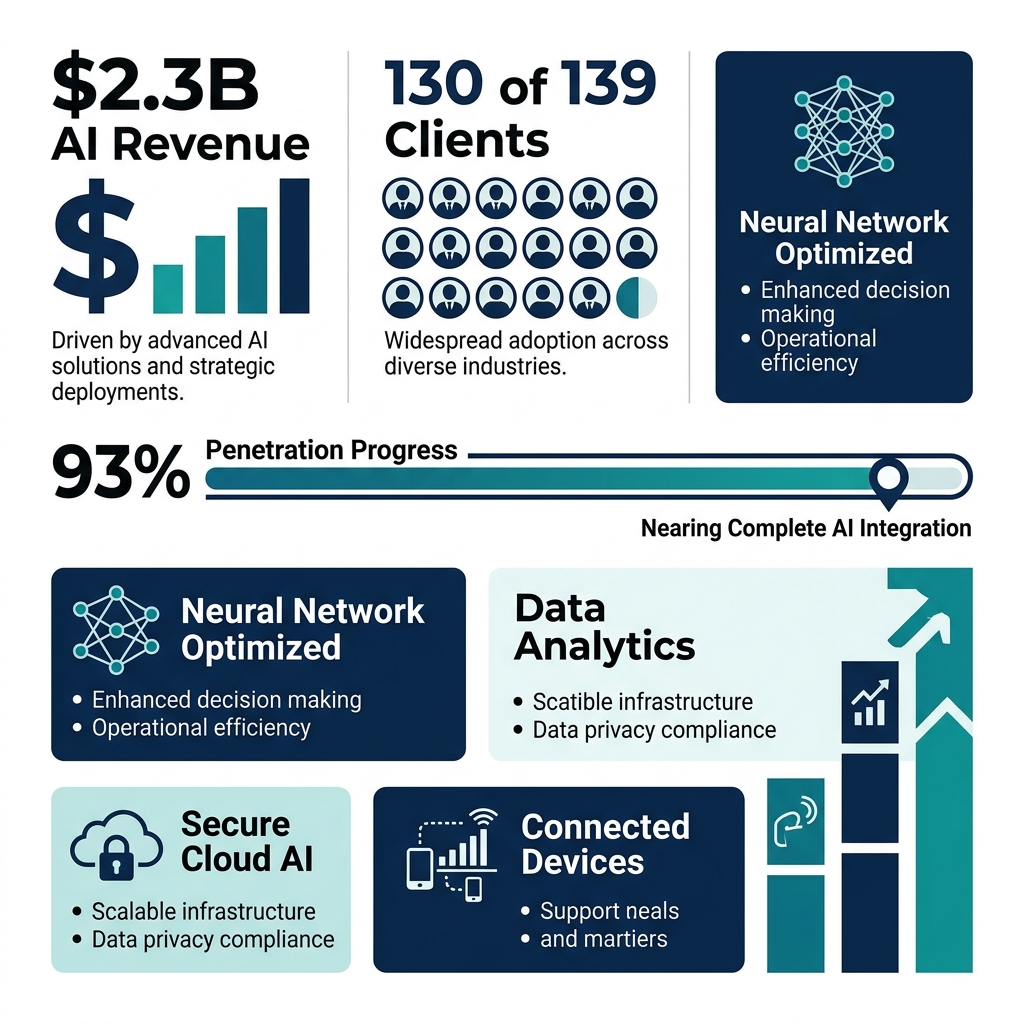
TCS is not merely experimenting with artificial intelligence—it is engineering a company-wide metamorphosis. The Mumbai-headquartered IT giant has woven AI into the strategic fabric of its operations, backed by concrete financial targets, aggressive client onboarding, and one of the largest workforce reskilling programs in the industry. These developments are not isolated pilots; they represent a coordinated effort to redefine how global enterprises consume technology services.
| AI Initiative | FY26 Metric | Scale / Coverage | Strategic Outcome |
|---|---|---|---|
| AI Services Revenue | $2.3 billion annualised | Active FY26 run-rate | Financial foundation for becoming the world’s largest AI-led tech services company |
| Top-Tier Client Onboarding | 130 of 139 top clients | ~94% penetration of key accounts | Enterprise-wide AI transformation at scale with deepening client relationships |
| Workforce AI Reskilling | 1.6 lakh (160,000) employees | Global AI-trained talent pool | Human-AI collaborative delivery model replacing siloed skill sets |
| New-Age Portfolio Integration | Cloud, data, and AI convergence | Unified digital transformation stack | Higher-margin, sticky engagements beyond legacy maintenance |
| Executive-Led Vision | Chairman N. Chandrasekaran & CEO K. Krithivasan | Q2 FY26 strategic pivot & public commitment | Global market positioning against Accenture, IBM, and Capgemini |
| AI-Native Delivery Overhaul | Operational transformation underway | Embedded across all major practices | Shift from headcount-based to outcome-based client value |
The numbers reveal a company that has moved well beyond proof-of-concept. The $2.3 billion annualised revenue from AI services during FY26, as reported by Telangana Today, signals that TCS has already crossed the threshold where AI contributes materially to the top line. For context, many mid-tier IT firms operate on total revenues smaller than this single AI stream. This figure places TCS in rarified air among global systems integrators and establishes a financial baseline from which to scale.
Equally telling is the client concentration strategy. With 130 of its top 139 clients now onboarded for AI initiatives, TCS has achieved approximately 94% penetration among its most strategically important accounts, according to NDTV Profit and Business Standard. Enterprise AI deployments are rarely one-time projects; they expand as clients move from diagnostic AI to predictive and generative use cases. By embedding itself deeply into the AI roadmaps of its largest customers, TCS is effectively locking in long-term, high-visibility revenue streams.
Talent and Portfolio Synchronization
What distinguishes TCS's approach from generic AI consulting is the synchronization between talent readiness and service portfolio evolution. By training over 160,000 employees while simultaneously integrating cloud, data, and AI into a unified delivery stack, TCS ensures that its workforce can actually deliver the AI-enabled solutions being sold to clients. This alignment reduces the "capability gap" that often plagues large-scale IT transformations, where sales outpaces delivery maturity.
Competitive Positioning
Comparatively, while global peers such as Accenture and IBM have also announced billion-dollar AI bets, TCS's combination of deep client penetration, localized talent scale, and integrated portfolio revenue gives it a distinct emerging-market cost advantage with Fortune 500 client access. The company’s stated aspiration—“on a journey to become the world’s largest AI-led technology services company”—is no longer a press-release tagline but a measurable transformation program with quarterly milestones, as reaffirmed in its Q2 FY26 disclosures. The open question is not whether TCS can compete in AI services, but how quickly it can close the gap to become the undisputed category leader.
In-Depth Analysis


Tata Consultancy Services is not simply rebranding itself as an AI company—it is executing a structural overhaul anchored in quantifiable performance. While many global IT firms treat artificial intelligence as an incremental add-on, TCS has tethered its corporate ambition to hard revenue figures, elite client penetration, and workforce reskilling at a scale rarely
Impact & Implications

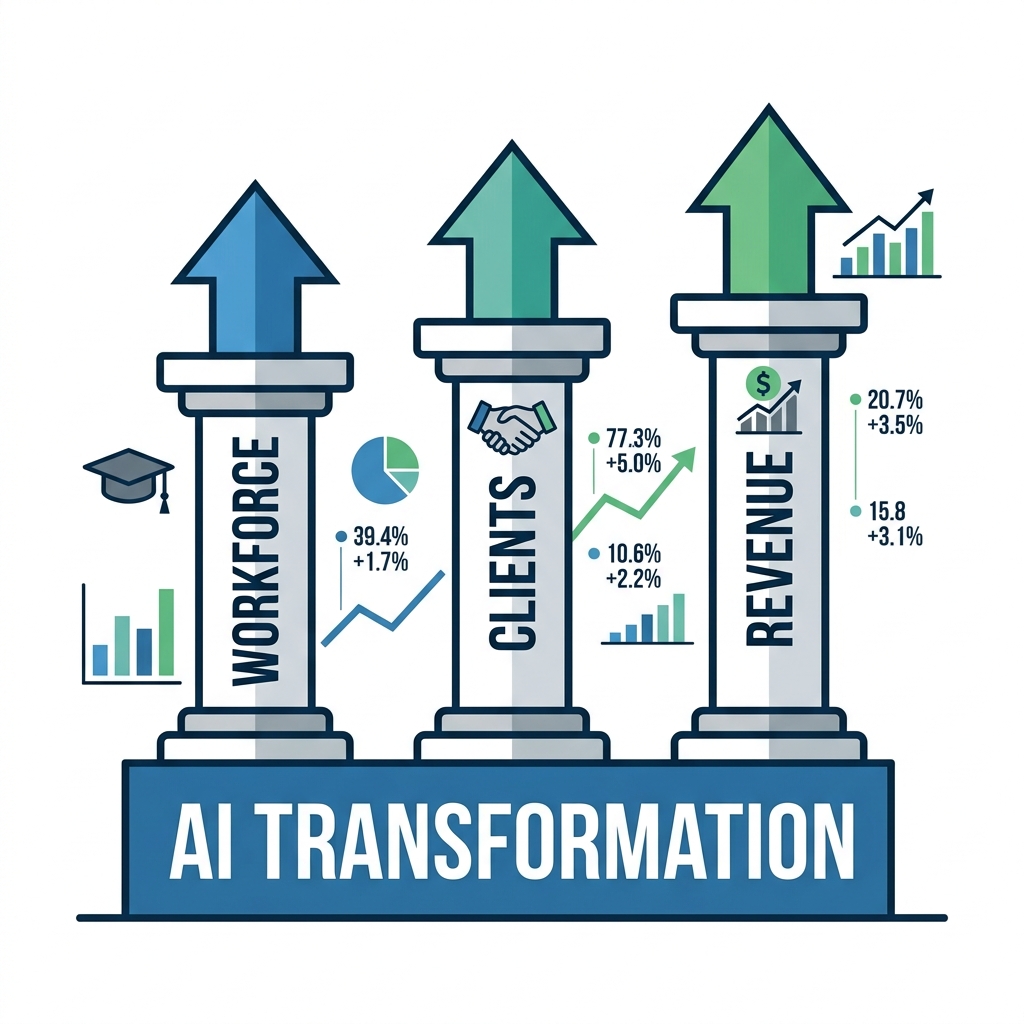
Redefining the Global IT Services Landscape
TCS's ambition to become the world's largest AI-led technology services company represents a structural inflection point for the IT sector. With annualised AI revenue of $2.3 billion during FY26, the company has proven that artificial intelligence is transitioning from experimental budgets to core enterprise spending. This figure signals across the industry that AI-led engagements can now achieve scale comparable to traditional service lines such as application development and maintenance.
The company's track record of onboarding 130 of its top 139 clients for AI initiatives reveals that enterprise adoption has moved decisively past pilot phases into production-grade deployment. For competitors, TCS's sharpening focus establishes a new competitive baseline: AI capabilities are rapidly shifting from premium differentiators to minimum table stakes within the global technology services market.
Workforce Transformation at Scale
Perhaps the most profound implication lies in human capital. TCS has reportedly reskilled over 1.6 lakh (160,000) employees in AI competencies, making it one of the largest corporate upskilling exercises worldwide. This pivot suggests a deliberate strategy to transition its massive workforce away from routine coding and support toward AI-augmented roles in solution architecture, intelligent automation, and data engineering.
This workforce shift carries significant ramifications:
- Elevated hiring standards: As repetitive tasks become automated, entry-level roles will increasingly demand AI fluency and prompt engineering skills alongside traditional programming.
- Industry-wide talent pressure: Rival firms must accelerate their own reskilling investments or risk obsolescence as TCS deploys AI-trained talent at scale across client engagements.
The Ripple Effect on India's AI Ecosystem
As India's largest IT exporter embeds AI into its delivery model, demand for complementary infrastructure—cloud, data pipelines, and AI communication layers—is surging. This creates a halo effect across the domestic technology ecosystem, providing both a template and a talent pool for mid-size enterprises seeking to implement AI.
In this expanding landscape, specialized AI infrastructure providers are playing a critical enabling role. While TCS orchestrates systemic transformation for Fortune 500 clients, platforms such as CallMissed are democratizing access by offering production-ready voice agents, multilingual Speech-to-Text supporting 22 Indian languages, and LLM inference gateways across 300+ models. This convergence ensures that large-scale IT modernization coexists with agile, plug-and-play AI tools for businesses of every size.
Strategic Risks and Competitive Realignment
Despite impressive momentum, TCS's AI pivot carries execution risks. The $2.3 billion annualised AI revenue remains a fraction of the company's total income, meaning the path to becoming the world's largest AI-led tech firm requires sustained R&D investment and deeper hyperscaler partnerships. Additionally, as AI commoditizes routine service layers, TCS must continuously move up the value chain toward proprietary IP and industry-specific solutions rather than implementation-only projects.
Ultimately, the race will be decided by whether TCS can convert its current pipeline into recurring, high-margin revenue streams before global competitors replicate its model at similar scale.
Expert Opinions
TCS Leadership Frames AI as a "Civilizational Shift"
TCS’s ambition to become the world’s largest AI-led technology services company is not merely a rebranding exercise—it is backed by bold rhetoric from its top brass that frames the opportunity in historical terms. Chief Executive Officer K. Krithivasan has described AI’s impact as a "civilizational shift," signaling that the company views artificial intelligence not as an incremental productivity tool, but as a fundamental restructuring of how technology services are conceived, built, and delivered over the next decade. Chairman N. Chandrasekaran has reinforced this strategic posture, publicly stating that TCS is actively positioning itself to capture this paradigm change rather than react to it defensively. Their messaging aligns with concrete execution on the ground: TCS has already onboarded 130 of its top 139 clients onto AI platforms, suggesting that the leadership’s confidence is matched by deep enterprise traction across its most critical global accounts.
Analysts Weigh In on Revenue and Client Adoption Metrics
Industry observers are treating TCS’s latest financial disclosures as a critical barometer for mainstream enterprise AI maturity. Rather than viewing AI as a speculative R&D line item buried inside legacy contracts, analysts point to several tangible indicators that suggest TCS is operationalizing the technology at scale:
- $2.3 billion annualised revenue from AI services in FY26, positioning the practice as a standalone growth engine
- 130 of 139 top clients onboarded for AI, representing nearly 94% adoption within TCS’s elite customer base
- 1.6 lakh (160,000) employees trained in AI capabilities, creating one of the largest internal talent reserves among global IT services firms
With these metrics, market experts argue that the industry conversation has decisively shifted from proof-of-concept pilots to production-grade deployment and recurring revenue models. For analysts, this combination of top-line growth, client density, and human capital investment suggests TCS is building a durable moat around proprietary operational expertise rather than relying solely on third-party software partnerships.
The Broader IT Services Paradigm
Beyond TCS, sector experts see this strategy as a bellwether for the Indian IT industry’s global repositioning and a direct challenge to incumbents in North America and Europe. As traditional labor-arbitrage outsourcing models face relentless margin pressure and client demands for automation accelerate, the pivot toward AI-led, outcome-based services is becoming existential for Tier-1 firms seeking long-term relevance in a post-generative-AI landscape. However, scaling AI for global enterprise clients requires far more than strategy consulting and cloud migration—it demands robust, production-ready communication infrastructure capable of handling multilingual, real-time customer interactions at enterprise scale. Indian platforms like CallMissed are already enabling businesses to deploy AI voice agents and WhatsApp chatbots that operate natively across 22 Indian languages, while offering developers seamless access to 300+ LLMs through a unified API gateway. As TCS and its peers embed AI deeper into client workflows, the symbiosis between large IT services consolidators and specialized AI communication infrastructure providers will likely define the competitive architecture of global technology delivery worldwide.
What This Means For You
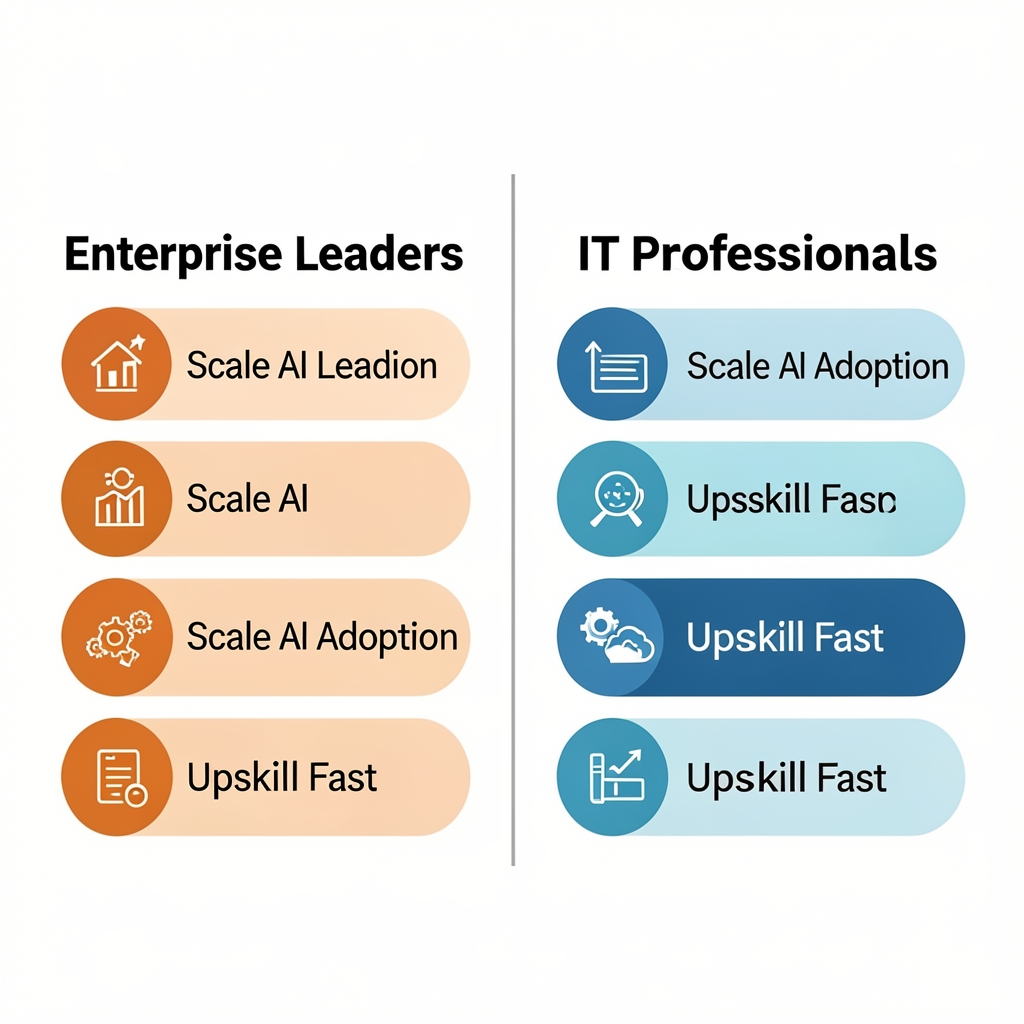
TCS’s declaration that it will become the world’s largest AI-led technology services company is more than an internal ambition—it is a market signal with immediate procurement and talent implications. With $2.3 billion in annualised revenue already flowing from AI services in FY26 and 130 of its top 139 clients already onboarded onto AI platforms, the company is proving that enterprise AI has shifted from experimental budget lines to production-grade, boardroom-mandated contracts. Whether you lead a Fortune 500 division, work inside an IT delivery team, or operate a startup, the ripple effects are immediate and structural.
| Stakeholder | Strategic Shift | Immediate Action | Supporting Data |
|---|---|---|---|
| Enterprise CXOs | AI is transitioning from innovation labs to core business operations | Mandate AI integration into customer experience and back-office workflows | TCS reports $2.3 billion annualised AI-services revenue in FY26 |
| IT Services Professionals | Traditional delivery roles are being redefined by agentic and generative AI | Upskill in LLM orchestration, RAG architectures, and cloud-native AI deployment | Over 1.6 lakh TCS employees have already been retrained on AI capabilities |
| SMBs & Growth Startups | Enterprise-grade AI is now consumable via API rather than custom consulting | Deploy voice agents, chatbots, and LLM workflows through managed platforms | 130 of 139 top TCS clients have already adopted AI, signaling mainstream readiness |
| AI Developers & MLEs | Single-model dependency is giving way to multi-model, multi-modal stacks | Build portable applications using API gateways that support hundreds of models | Indian AI infrastructure now supports 22-language STT and multilingual voice agents |
| Investors & Analysts | New-age services—cloud, data, and AI—are becoming the primary growth engine | Track AI revenue contribution and margin accretion separately from legacy services | TCS’s new-age services portfolio is outpacing traditional IT growth |
| Ecosystem Partners | Verticalized AI solutions and co-development deals are replacing vendor resale | Co-build industry-specific agents using proprietary enterprise datasets | TCS is onboarding client ecosystems at scale across BFSI, retail, and healthcare |
Why This Blueprint Matters Now
For enterprise leaders, the most important takeaway is speed. TCS isn’t forecasting a distant future; it is already capturing billion-dollar AI revenue today. That means competitors, vendors, and customers must accelerate their own adoption curves or risk displacement.
The implications vary by role, but several patterns are universal:
- Workforce reskilling is now non-negotiable. With 1.6 lakh employees at TCS alone already retrained on AI, competency in LLM orchestration, retrieval pipelines, and voice-agent deployment is becoming baseline, not a premium skill.
- AI is accessible outside the Fortune 500. You do not need Tata-scale R&D budgets to participate. Platforms such as CallMissed are already enabling businesses to deploy AI voice agents and WhatsApp chatbots—powered by 300-plus LLMs and 22 Indian-language Speech-to-Text APIs—without rebuilding infrastructure from scratch.
- New-age portfolios command premium valuations. When India’s largest IT firm reorients its identity around AI, it confirms that cloud, data, and AI services will earn higher multiples than legacy system integration. Investors should track AI revenue contribution separately.
- The next wave is vertical and multimodal. With 130 of its top 139 clients already onboarded, TCS has proven enterprise readiness. The coming opportunity lies in specialized agents for BFSI, healthcare, and retail, delivered through partners that provide compliant data pipelines and multilingual communication layers.
For ecosystem partners and technology builders, the message is equally direct: resale models are losing ground to co-development. The companies that plug into large-scale AI transformations—as vertical-AI builders, compliance-first data enablers, or communication-layer providers—will capture the follow-on revenue as TCS and its peers expand the market. The window for observation is closing; the phase of execution is already here.
Frequently Asked Questions
What does it mean for TCS to become the world's largest AI-led tech services company?
How much revenue did TCS generate from AI services in FY26?
How many of TCS's top clients have adopted its AI-led tech services?
What is the size of TCS's AI-trained workforce?
What new-age services does TCS offer alongside its AI practice?
Why is TCS sharpening its focus on becoming an AI-led tech services company now?
Conclusion
TCS’s pivot to become the world’s largest AI-led technology services company is not merely a marketing repositioning—it is a structural reinvention of how enterprise IT delivers value. With $2.3 billion in annualised AI revenue during FY26 and 130 of its top 139 clients already embedded in AI programs, the company has clearly moved past proof-of-concept phases into scaled, revenue-generating execution. As the boundaries between traditional consulting, software engineering, and machine learning operations dissolve, TCS is wagering that its global talent depth and entrenched client relationships will create a competitive moat that narrower AI specialists cannot easily replicate.
Key takeaways from TCS’s AI strategy include:
- Revenue at scale: AI services are already generating multi-billion-dollar annualised revenue, confirming that enterprises are shifting budgets from experimental pilots to production-grade intelligent systems.
- Client penetration: Embedding AI across 130 of its top 139 accounts proves that adoption is now pervasive among legacy Fortune 500 incumbents, not limited to digital-native startups.
- Talent transformation: TCS is executing a bold workforce re-skilling agenda, ensuring human expertise evolves in lockstep with algorithmic capability rather than being displaced by it.
- Integrated portfolio: AI is being woven into a holistic new-age services stack—spanning cloud, data, and cognitive automation—rather than siloed as a standalone novelty.
Looking ahead, the pivotal metric to watch is whether TCS can sustain its traditional margin profile while accelerating AI delivery and defending turf against nimble hyperscaler partners and boutique GenAI challengers. Keep an eye on FY27 guidance for AI revenue mix, the maturity of agentic AI deployments, and the expansion of proprietary intellectual property beyond pure implementation services.
For enterprises and developers navigating this same inflection point, the infrastructure layer matters as much as the boardroom strategy. To explore how AI communication is evolving, check out CallMissed — an AI infrastructure platform powering voice agents and multilingual chatbots for businesses. As AI-led service models become the global standard, the ultimate differentiator may be who can deploy intelligent, always-on customer experiences fastest. Is your organization building for that future today, or still waiting for the blueprint?
Discussion
Related Posts



Ready to automate customer conversations?
Launch AI voice agents and WhatsApp bots with CallMissed — one API, 22+ Indian languages.