
How AI Is Defining India’s Economic Future: GDP Impact, Readiness Gaps, and 2030 Outlook



What if the next half-trillion dollars of India’s economic growth didn’t come from factories, farms, or infrastructure projects—but from lines of code?...
How AI Is Defining India’s Economic Future: GDP Impact, Readiness Gaps, and 2030 Outlook
What if the next half-trillion dollars of India’s economic growth didn’t come from factories, farms, or infrastructure projects—but from lines of code? According to NITI Aayog, artificial intelligence could inject an estimated $500–600 billion into India’s GDP by 2030, a figure echoed by IBM research suggesting AI could add more than $500 billion to the economy. That projection alone makes How AI is defining India's economic future not just a speculative headline, but the most urgent economic question of the decade.
This transformation is already visible at the grassroots level. A PIB report highlights how AI can empower India’s 490 million informal workers by expanding access to healthcare, education, skilling, and financial services—sectors that directly touch the livelihoods of nearly one-third of humanity. Meanwhile, the Economic Survey’s chapter on the evolution of India’s AI ecosystem frames this as a pragmatic strategy to reshape the global economic order, not merely a technological upgrade. Yet the pathway from potential to prosperity is neither automatic nor evenly distributed. ICRIER researchers warn that realizing AI’s transformational potential requires tracing specific impact pathways across employment, productivity, and digital infrastructure.
What This Article Covers
In the sections ahead, we’ll break down the numbers driving this optimism and expose the readiness gaps that could slow India’s momentum:
- GDP Impact: How AI could contribute half a trillion dollars within five years and which sectors stand to gain first.
- Readiness Gaps: The digital divide, skilling deficits, and infrastructure bottlenecks emerging from the Economic Survey and policy analyses.
- 2030 Outlook: What business leaders and policymakers must prioritize to convert India’s demographic dividend into an AI-powered productivity surge.
While national strategy charts the course, the real execution is happening in real-time deployments—from multilingual voice agents streamlining customer engagement to LLM inference powering local enterprises. Platforms like CallMissed, which enable businesses to deploy AI voice and chat solutions across 22 Indian languages, represent the operational edge of this economic shift, turning policy ambition into daily productivity gains.
The countdown to 2030 has already begun. Whether India captures this value or cedes it to better-prepared competitors depends on decisions made today.
Introduction

The $500 Billion Inflection Point
India stands at an economic inflection point. Artificial Intelligence is no longer a distant technological promise—it is the primary engine reshaping the country’s growth trajectory. According to estimates by NITI Aayog, the transformative power of AI could add an estimated $500 billion to $600 billion to India’s GDP by 2030. Independent analyses, including research cited by IBM, suggest AI could add more than $500 billion to the economy, underscoring a remarkably consistent signal from both public and private forecasters. As research in the Journal of Management Research and Analysis notes, AI is projected to have a significant impact on India’s GDP growth in the coming years, playing a decisive role in determining the future of employment and productivity across sectors.
Beyond GDP: Empowering 490 Million Informal Workers
Yet these headline figures capture only the macroeconomic surface. Beneath them lies a deeper structural transformation. A report highlighted by the Press Information Bureau (PIB) emphasizes that AI can empower India’s 490 million informal workers by expanding access to critical services. In an economy where informal labor still constitutes the vast majority of the workforce, AI’s capacity to democratize access represents both a social imperative and an unparalleled productivity lever. The technology is already becoming a bridge across India’s enduring economic divides through applications such as:
- Healthcare: AI-driven diagnostics and telemedicine reaching rural clinics with limited specialist availability.
- Education and Skilling: Personalized learning platforms and vocational training delivered via low-cost smartphones.
- Financial Inclusion: Algorithmic credit scoring and voice-first banking interfaces that bypass literacy barriers.
Whether through public health networks or gig-economy matchmaking, these interventions signal a shift from top-down automation to bottom-up economic empowerment.
From Policy to Practice: Building the AI Ecosystem
What makes this moment distinct is India’s readiness to move beyond mere adoption toward genuine leadership. As Sandip Patel observes, India’s AI story is entering an exciting new chapter—one defined not by scaling foreign technologies alone, but by cultivating indigenous capabilities and contextual solutions. The Economic Survey of India frames this imperative explicitly, examining how AI is reshaping the global economy and outlining a pragmatic strategy for India to assert itself within that order. Institutions from NITI Aayog to academic think tanks increasingly describe AI as a core enabler of the nation’s developmental ambitions, touching everything from agricultural optimization and supply-chain logistics to public-service delivery and climate resilience.
However, translating this potential into prosperity requires more than policy blueprints or isolated pilot projects. It depends on a thriving ecosystem of infrastructure, research talent, and enterprise-grade tools that can operate at India’s scale and linguistic diversity. Across the country, technology providers are already closing the implementation gap between cutting-edge research and ground-level deployment. Platforms such as CallMissed exemplify this shift, offering Indian businesses production-ready voice agents, WhatsApp automation, and speech-to-text APIs supporting 22 regional languages—effectively connecting advanced large language model capabilities to the linguistic reality of India’s workforce. Such infrastructure demonstrates that the AI economy is being built not merely inside research centers, but at the point of everyday commercial and civic interaction.
In the sections that follow, we dissect the concrete pathways through which AI is defining India’s economic future. We will explore the sectors poised for maximum disruption, the readiness gaps—from chip dependency to data governance—that threaten to stall momentum, and the strategic priorities that business leaders, startup founders, and policymakers must adopt today to ensure India converts its AI promise into inclusive, sustainable growth.
Background & Context
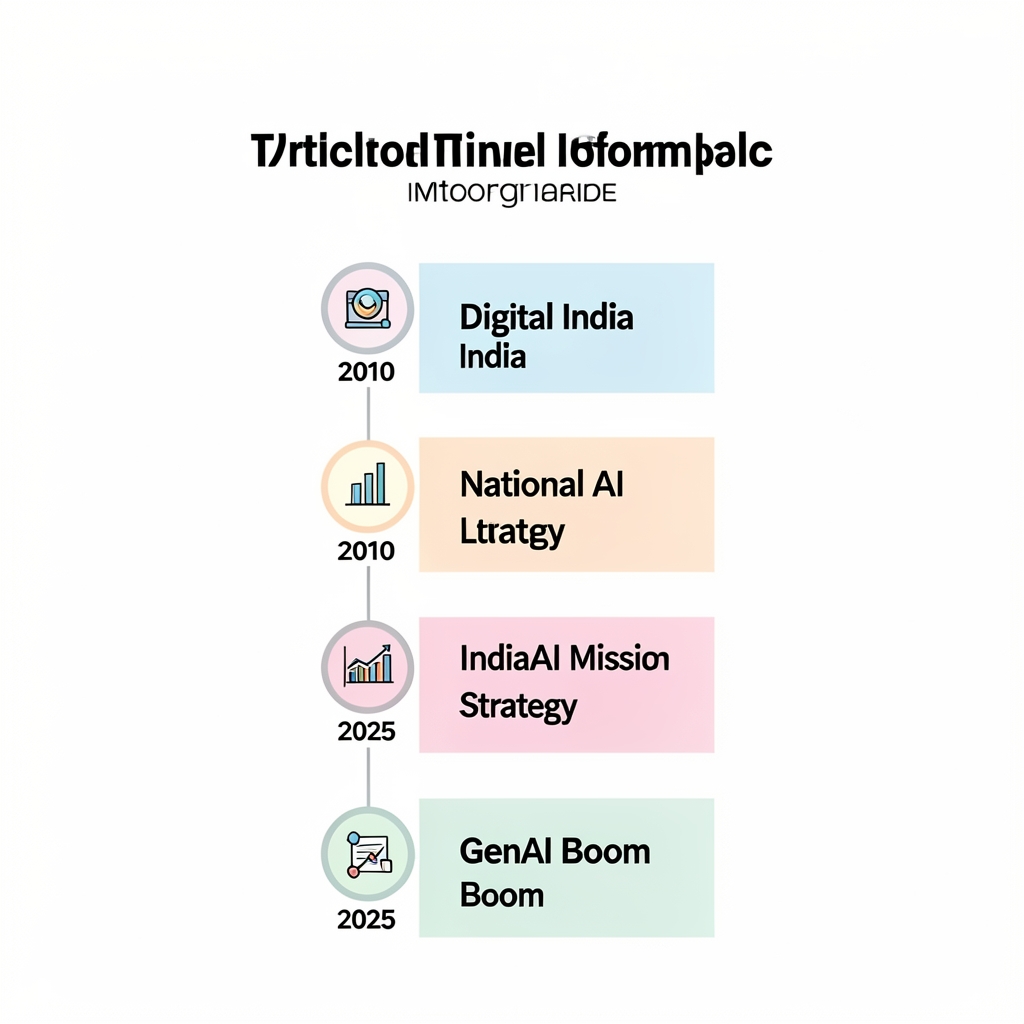
The Scale of India's AI Opportunity
India stands at an inflection point. As the world's fifth-largest economy with a young, digitally native population, the country is uniquely positioned to harness artificial intelligence not merely as a productivity tool, but as a foundational layer for inclusive growth. According to estimates by NITI Aayog, the transformative power of AI could add an estimated $500–600 billion to India's GDP by 2030—a figure that represents roughly 10% of the country's current economic output. Separate analysis cited by IBM indicates AI could add more than $500 billion to India's economy, underscoring the broad consensus among policymakers and industry leaders that this is not speculative fiction, but an imminent economic restructuring that will determine the future of employment and productivity nationwide.
Beyond the Macro: AI and the Informal Workforce
What makes India's AI trajectory distinct from mature Western economies is the sheer scale of its informal sector. The Press Information Bureau (PIB) highlights a critical statistic: India has approximately 490 million informal workers who operate largely outside formal social protections and legacy digital infrastructure. Unlike automation narratives that focus narrowly on factory floors, India's AI strategy must address how these workers access healthcare, education, skilling, and financial services. The government's vision positions AI as a mechanism to empower this 490-million-strong workforce rather than simply displace it—expanding access through vernacular interfaces, voice-first applications, and low-bandwidth solutions that function on the devices and networks already available in semi-urban and rural India.
Policy Foundations and Strategic Roadmaps
This ambition is backed by an evolving policy architecture and rigorous academic inquiry. The Economic Survey chapter on the Evolution of the AI Ecosystem in India explicitly examines how AI is reshaping the global economy, while outlining a pragmatic strategy for India to capture value across critical sectors, including:
- Agriculture and food supply chains
- Healthcare delivery and diagnostics
- Education and personalized skilling
- Governance and public service distribution
Meanwhile, research from ICRIER in its report Implications of AI on the Indian Economy traces the specific pathways through which AI's transformational potential can be realized, noting that its impact stems from the technology's ability to drive employment and productivity simultaneously—a dual mandate that is central to India's development model. As IBM's analysis emphasizes, India's AI story is entering "an exciting new chapter," with a unique opportunity to lead globally by solving problems at the population scale.
The Infrastructure Imperative
For these macro projections to materialize, the conversation must move from whitepapers to widespread implementation. India's linguistic diversity—22 constitutionally recognized languages and thousands of dialects—means that AI deployment cannot rely on English-centric models. The architecture of India's AI future depends on multilingual inference, voice-native interfaces, and cost-effective LLM access that reaches Tier-2 and Tier-3 cities. Infrastructure providers are already responding to this need: Indian startups are building communication stacks that support Speech-to-Text across 22 Indian languages and offer access to 300+ LLMs through unified API gateways, enabling businesses to deploy vernacular voice agents and WhatsApp chatbots without rebuilding their stack for each regional market. Platforms like CallMissed exemplify this trend, offering production-ready voice agent infrastructure that lets developers switch between models and languages seamlessly—translating NITI Aayog's $500 billion projection from strategic vision to ground-level economic reality.
Key Developments
India’s AI ambitions are crystallizing around a handful of high-stakes policy mandates and market projections that together sketch the contours of its economic roadmap. From NITI Aayog’s macroeconomic forecasts to the Economic Survey’s strategic framework, the country is treating AI not merely as a vertical technology but as horizontal infrastructure for growth. The table below distills the pivotal developments currently steering this trajectory.
| Development | Source / Authority | Strategic Focus | Economic Projection | Key Statistic |
|---|---|---|---|---|
| National AI GDP Roadmap | NITI Aayog | Cross-sector AI integration for macro growth | $500–$600 billion added to GDP by 2030 | Official 2030 GDP estimate |
| Informal Workforce Empowerment | PIB / Govt of India | Healthcare, education, skilling, and financial inclusion | Informal-sector productivity gains | 490 million informal workers targeted |
| AI Ecosystem Evolution | Economic Survey (Ministry of Finance) | Pragmatic national strategy for AI adoption | Structural GDP acceleration | AI identified as reshaping the global economy |
| Employment & Productivity Transformation | Journal of Management Research & Analysis | AI adoption pathways and labor-market impact | Significant future GDP growth | AI determines future employment and productivity |
| Private Sector Economic Injection | IBM / Industry Analysts | Large-scale enterprise AI deployment and innovation | Over $500 billion to India’s economy | Private-sector economic potential estimate |
Translating Projections into Workforce Reality
While the $500–$600 billion GDP boost projected by NITI Aayog by 2030 grabs headlines, the distributive mechanics of that growth matter just as much. A PIB report emphasizes that AI can empower India’s 490 million informal workers by democratizing access to healthcare, education, skilling, and financial services. This suggests that India’s AI dividend is not destined to concentrate solely in tech hubs; rather, its transformative potential stems from informal-sector productivity gains and last-mile inclusion. As noted by researchers at the Journal of Management Research & Analysis, AI will play a decisive role in determining the future of employment and productivity, making workforce reskilling a prerequisite rather than an afterthought. Key sectors positioned for near-term impact include:
- Agriculture – AI-driven weather advisory and market-linkage tools for rural producers
- Financial inclusion – Vernacular chatbots and voice agents for credit and insurance access
- Healthcare screening – Diagnostic AI delivered through low-bandwidth mobile interfaces
- Skill development – Personalized, AI-curated training modules for informal labor
Building the Communication Backbone
Realizing these targets, however, demands more than policy papers—it requires deployable infrastructure that can operate across India’s linguistic and digital diversity. For a nation where a vast share of economic activity still unfolds through voice calls and messaging apps, AI communication layers become critical economic infrastructure. Platforms like CallMissed are already enabling businesses to deploy multilingual AI voice agents and WhatsApp chatbots that support 22 Indian languages, effectively shrinking the gap between informal workers and digital services. When an agricultural vendor or a gig worker can access skilling resources or credit updates in their native language via an AI agent, the PIB’s vision of empowering 490 million informal workers becomes technically feasible. The availability of production-ready Speech-to-Text and Text-to-Speech APIs for regional dialects turns smartphones into economic gateways rather than passive devices.
Aligning Strategy with Execution
The Economic Survey’s chapter on AI ecosystem evolution adds a sobering lens: while AI is reshaping the global economy, India needs a pragmatic strategy to capture value rather than simply import it. ICRIER’s research reinforces this by tracing the specific pathways through which AI impacts the Indian economy, warning that transformational potential is contingent on execution. The domestic AI market is already emerging as a core enabler, but the distance between pilot programs and national-scale deployment remains significant. Closing that gap will require:
- Coordinated public-private investment in data governance and compute clusters
- Standardized interoperability frameworks to avoid vendor lock-in
- Scalable LLM inference infrastructure capable of supporting 300+ model variants for diverse use cases
- Regulatory clarity that accelerates adoption without compromising accountability
Only by knitting together these policy, technical, and communication layers can India convert its AI projections into durable economic reality.
In-Depth Analysis
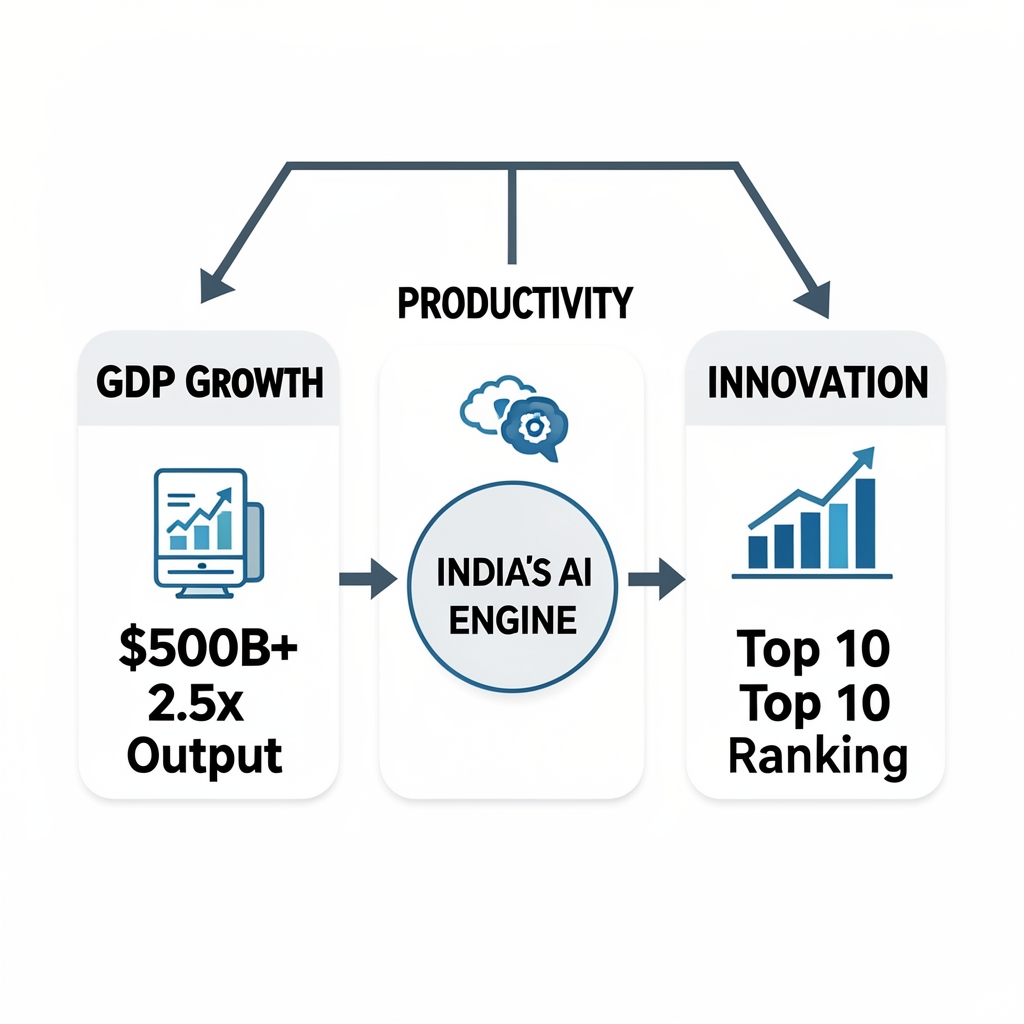
The GDP Multiplier: Quantifying AI's Economic Injection
India's AI pivot is not speculative—it is measurable. According to estimates by NITI Aayog, the transformative power of AI could add an estimated $500–600 billion to India's GDP by 2030. Complementary projections from IBM suggest AI could add more than $500 billion to the economy overall. To put this in perspective, a mid-range estimate of $550 billion would represent a substantial double-digit percentage boost relative to India's current GDP, effectively creating a new digital economy within the economy itself.
The Journal of Management Research and Analysis reinforces this outlook, noting that AI is projected to have a significant impact on India's GDP growth in coming years and will play a decisive role in determining the future of employment and productivity. As highlighted in the Economic Survey's dedicated chapter on the evolution of India's AI ecosystem, the country requires a pragmatic strategy that converts this potential into distributed, sustainable growth rather than isolated tech bubbles.
Inclusion at Scale: AI for the Informal Workforce
While GDP projections capture headline value, AI's deeper promise lies in inclusive economic participation. A PIB report on Transforming India with AI emphasizes that artificial intelligence can empower India's 490 million informal workers by expanding access to:
- Healthcare and telemedicine
- Education and digital skilling
- Financial services and credit scoring
This demographic—constituting the vast majority of India's workforce—has historically operated outside formal digital rails. For these workers, language barriers and low digital literacy have traditionally blocked access to formal markets. AI-driven intermediation can bridge this gap. Indian startups like CallMissed are building multilingual AI agents that support 22 regional languages natively, enabling voice-first access to services for non-English speaking populations and ensuring the informal sector is not left behind in the AI transition.
Structural Readiness and the Path Forward
Realizing these gains demands honest accounting of India's readiness gaps. Research from ICRIER traces the pathways through which AI impacts the Indian economy, concluding that AI's transformational potential stems from its ability to enhance efficiency—but only where supporting infrastructure exists. Critical enablers include:
- Widespread cloud compute availability and affordable edge connectivity
- Quality, non-biased training datasets capturing India's linguistic and cultural diversity
- Regulatory clarity on data governance and algorithmic accountability
The Economic Survey chapter further warns that without targeted policy, AI could concentrate gains in established tech hubs while bypassing rural and semi-urban centers. Drishti IAS analysis similarly frames AI as a core enabler of India's developmental ambitions, noting that the domestic AI market must mature through sustained public-private coordination. Sandip Patel, Managing Director of IBM India, echoed this sentiment, stating that India's AI story is entering an exciting new chapter with a unique opportunity to lead globally.
The pathway forward is bifurcated: scale frontier AI in formal sectors to drive GDP, while deploying accessible, low-bandwidth AI tools for the informal economy. Success in both arenas will determine whether India merely participates in the global AI economy—or defines it.
Impact & Implications
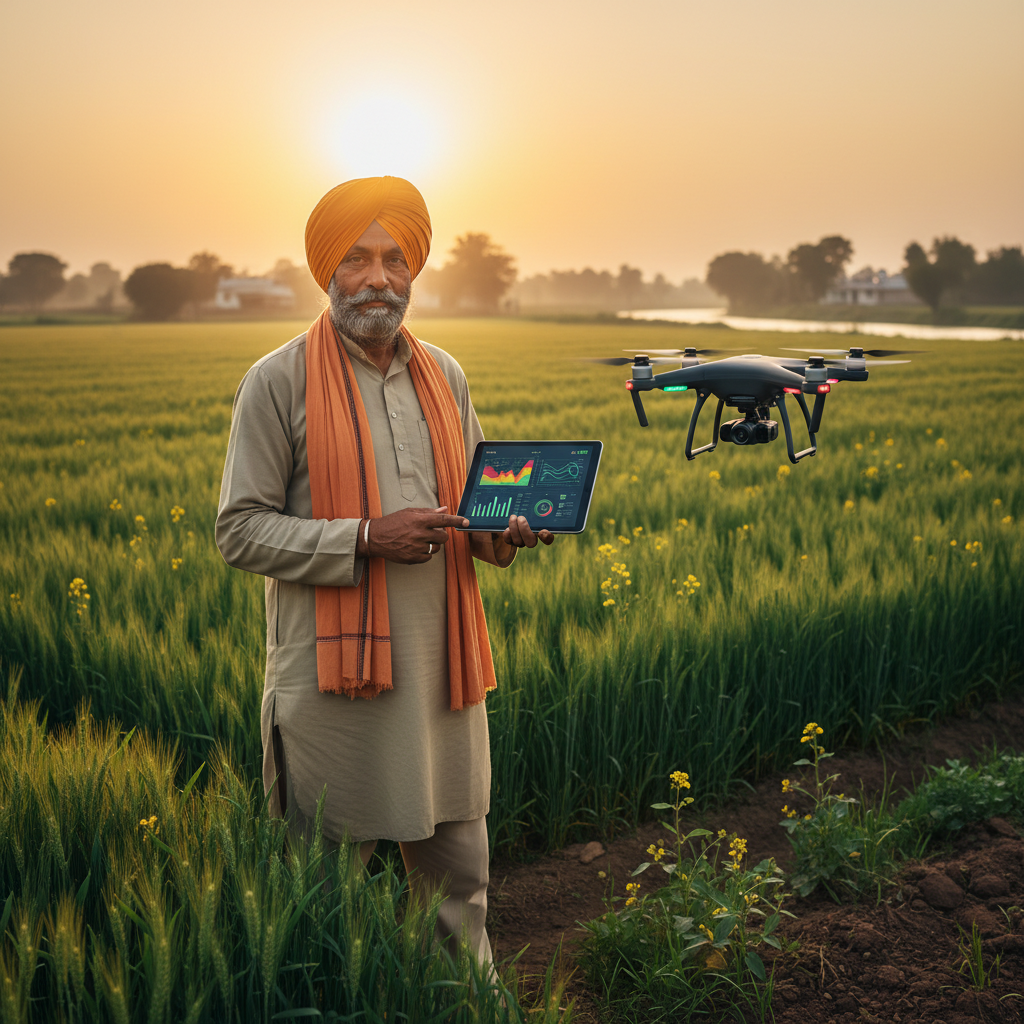
Macroeconomic Transformation at Scale
The arithmetic of India’s AI opportunity is staggering. According to estimates by NITI Aayog cited in The Economic Times, the transformative power of AI could add an estimated $500–600 billion to India’s GDP by 2030—a figure echoed by IBM-linked analyses suggesting AI could contribute more than $500 billion to the economy. This is not marginal efficiency gains; it represents a potential productivity leap comparable to the early waves of digital outsourcing. Research published in the Journal of Management Research and Analysis reinforces that AI is projected to have a significant impact on India’s GDP growth in coming years, fundamentally altering the trajectory of national output and investment attractiveness.
Reconfiguring the Informal Workforce
Beyond top-line growth, the deeper implication is social-capital formation. A PIB report highlights that India is home to approximately 490 million informal workers, and AI is poised to empower this segment by expanding access to healthcare, education, skilling, and financial services. For an economy where the informal sector absorbs the majority of labor, AI’s capacity to deliver vernacular, low-cost, and adaptive services implies a direct bridge to formalization. Rather than displacing workers immediately, the first-order effect may be augmentation—delivering real-time market information, credit scoring, and health diagnostics to populations historically excluded from institutional infrastructure.
Platforms such as CallMissed, which provide Speech-to-Text support for 22 Indian languages and multilingual voice agents, demonstrate how communication infrastructure can operationalize this inclusion at scale, turning language diversity from a barrier into an interface advantage.
Employment, Productivity, and Sectoral Realignment
The Economic Survey chapter on the evolution of India’s AI ecosystem frames a pragmatic strategy: treat AI as a general-purpose technology that reshapes service delivery models across agriculture, manufacturing, and knowledge services. ICRIER’s analysis on the implications of AI for the Indian economy traces these pathways and notes that the transformational potential stems from AI’s ability to reorganize workflows rather than merely accelerate them. Concurrently, research in the Journal of Management Research and Analysis emphasizes that AI will play a defining role in shaping the future of employment and productivity, signalling that labor-market institutions must evolve in parallel with algorithmic capabilities.
The corollary is workforce bifurcation:
- Displacement risk in routine cognitive and repetitive manual tasks, particularly in back-office and clerical functions
- Productivity premiums in sectors that integrate AI into core operations, such as IT services, agri-tech, and financial inclusion
- Skill premiums for roles managing AI-human collaboration and local-language model interfaces
Strategic Imperatives
For business leaders and policymakers, the message is unambiguous: AI readiness is macroeconomic competitiveness. As India’s AI story enters what IBM’s Sandip Patel describes as “an exciting new chapter,” the gap between AI adopters and laggards will widen into a structural economic divide. Organizations must invest now in data infrastructure, talent pipelines, and vernacular AI deployment, because the implication of a $500 billion-plus GDP infusion is that no sector remains insulated from algorithmic transformation. The winners will be those who treat artificial intelligence not as an IT project, but as the underlying fabric of India’s next growth epoch.
Expert Opinions
From GDP Projections to Ground-Level Impact
While estimates provide the quantitative backbone of India's AI promise, expert voices add the strategic depth necessary to understand what those numbers actually mean for the country’s trajectory. According to NITI Aayog, the transformative power of AI could add an estimated $500–600 billion to India's GDP by 2030—a figure reinforced by IBM analysis from Salima Lin, who notes that AI could add more than $500 billion to the economy in the coming years. These are not speculative targets; they represent a growing consensus among policy think tanks and global technology leaders that AI will function as the single largest productivity lever for India this decade.
The Inclusion Imperative: AI for 490 Million Workers
Perhaps the most compelling expert perspective comes from the government's own assessment of AI’s distributive potential. A PIB report highlights that AI can empower India's 490 million informal workers by expanding access to healthcare, education, skilling, and financial services. This reframes AI not merely as an enterprise efficiency tool, but as core economic infrastructure. When the vast majority of India's workforce operates outside formal employment, technologies that bridge language and literacy barriers become macro-economic necessities rather than optional innovations.
For developers and businesses building for this demographic, multilingual AI infrastructure is critical. Startups like CallMissed are already addressing this gap by deploying voice agents and WhatsApp chatbots that support 22 Indian languages natively, extending AI services to populations that traditional digital interfaces often exclude.
Strategic Leadership and the Global Context
Industry veterans emphasize that India's opportunity extends well beyond domestic adoption. Sandip Patel argues that "India's AI story is entering an exciting new chapter," and that the country has a unique opportunity to lead on the global stage—stressing that "this isn't just about scaling." This leadership thesis is reinforced by the Economic Survey's analysis of AI's role in reshaping the global economy, which outlines a pragmatic strategy for India to position itself not as a passive consumer of foreign platforms, but as an architect of sovereign AI capability.
Research from ICRIER further validates this trajectory, tracing the pathways through which AI's transformational potential translates into tangible economic outcomes. As noted in the Journal of Management Research and Analysis, AI will play a decisive role in determining the future of employment and productivity in India, making coordinated action between policymakers and the private sector increasingly urgent.
What Leaders Are Prioritizing Now
Experts agree that the window for establishing AI leadership is narrowing. The focal points emerging across analyst and policy discourse include:
- Workforce reskilling at scale: Preparing India's informal labor pool for human-AI collaboration before automation gaps widen.
- Sovereign model development: Building domestic training infrastructure to reduce long-term reliance on foreign LLMs.
- Regulatory sandboxes: Allowing sectors like agriculture, health, and fintech to experiment with AI governance frameworks before hard-coding legislation.
The convergence of these viewpoints reveals a clear narrative: India's AI future is neither guaranteed nor automatic. It requires intentional investment in accessible, multilingual, and inclusive systems—platforms capable of reaching the last mile while driving half a trillion dollars in economic value.
What This Means For You
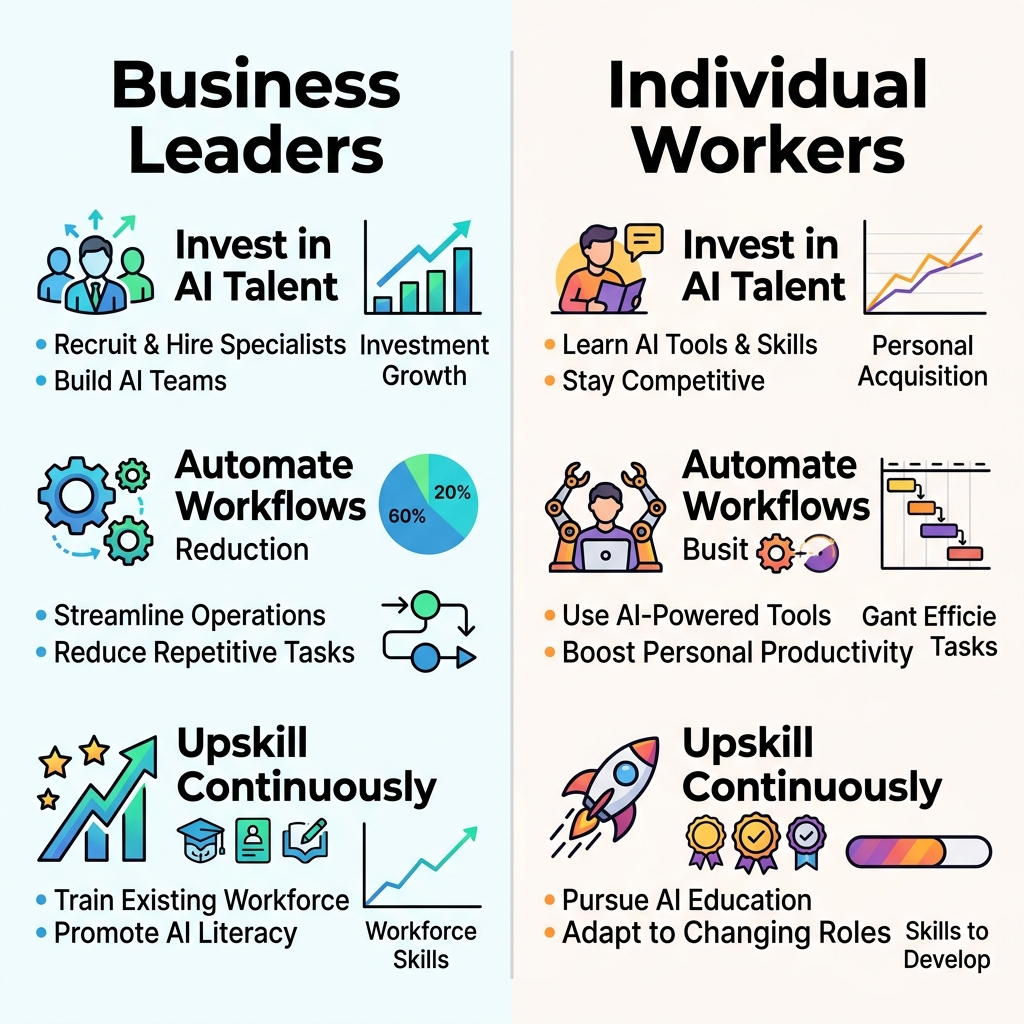
With AI projected to inject $500–600 billion into India’s GDP by 2030 — according to NITI Aayog estimates cited in The Economic Times — the transformation is no longer abstract. Whether you are a startup founder, an enterprise leader, or one of India’s 490 million informal workers, the shift will alter your competitive edge, income trajectory, and digital access. The question is no longer if AI will reshape your sector, but whether you adapt before the infrastructure and standards of this new economy harden around you.
Decode the Opportunity by Your Role
The table below maps what India’s AI economy means across key stakeholder groups, tying NITI Aayog’s macro projections to concrete, time-bound actions:
| Stakeholder | Core AI Opportunity | Immediate Action | Economic Impact | Timeframe |
|---|---|---|---|---|
| Startup / SME Owner | Launch AI-native products and automate operations | Deploy voice agents and regional-language chatbots for Bharat users | Capture share of $500B+ GDP boost; cut ops costs 30–40% | 0–12 months |
| Enterprise Leader | Scale productivity across supply chains and analytics | Integrate domain-specific LLMs and workflow automation | Drive margin expansion and workforce augmentation | 6–18 months |
| Developer / AI Builder | Build locally relevant solutions for Indian contexts | Adopt multi-model APIs and Indic-language STT/TTS stacks | Capture demand in fastest-growing domestic AI market | 0–6 months |
| Policy Maker / Regulator | Enable inclusive growth and skilling at scale | Frame data-governance standards and public AI infrastructure | Empower 490M informal workers via health, edtech, finance | 12–36 months |
| Skilled Professional | Reskill for human-AI collaboration roles | Acquire prompt engineering, AI orchestration, and domain expertise | Secure wage premiums as labor markets polarize | 3–12 months |
| Rural / Informal Worker | Access AI-powered financial and health services | Adopt UPI-integrated voice interfaces and vernacular tools | Bridge inclusion gaps in credit, education, and primary care | 12–24 months |
The First-Mover Advantage
A unifying pattern emerges: the AI dividend is not reserved for tech giants. The half-trillion-dollar GDP infusion will flow through agritech voice bots advising farmers, LLM-powered credit underwriting for micro-businesses, and vernacular edtech tutoring millions. For business owners, the imperative is operational — replace repetitive workflows with intelligent automation before competitors entrench. For developers, tooling agility matters more than ever. Building on rigid stacks will slow iteration as user expectations shift toward real-time, multilingual experiences.
This is where Indian infrastructure providers are already removing friction. Platforms like CallMissed enable businesses to deploy AI voice agents and WhatsApp chatbots that operate across 22 Indian languages natively, collapsing the cost of reaching non-English-speaking customers. Such solutions demonstrate how macro GDP projections translate into practical go-to-market velocity for founders and enterprises alike.
The Inclusion Imperative
Beyond profit, the PIB report on Transforming India with AI underscores that AI can empower India’s 490 million informal workers by democratizing healthcare diagnostics, personalized skilling, and frictionless finance. If you shape policy or run social enterprises, success must be measured in access per capita, not only revenue per user. Deploying voice-first welfare interfaces and vernacular edtech is becoming essential public infrastructure.
Act Within the Window
ICRIER’s study on AI’s implications for India cautions that transformation pathways crystallize fast. Early movers shape data standards, talent networks, and customer trust; late adopters face integration debt. No matter your role, the 12- to 18-month runway between pilot and production is narrowing. To stay ahead:
- Audit one workflow that consumes disproportionate manual hours — customer support, lead qualification, or documentation — and pilot an agentic automation layer.
- Stress-test for Bharat users by introducing a regional-language interface, whether through speech-to-text in Hindi, Tamil, or Bengali, or a vernacular WhatsApp chatbot.
- Upskill one team function in AI orchestration or prompt engineering before labor-market premiums spike.
Treat AI as the operating system of India’s next economy. The $500 billion future is not a distant forecast — it is being compiled now, and your next move determines whether you participate in building it or adapt to it later.
Frequently Asked Questions
Economic Projections and GDP Impact
How is AI defining India's economic future in terms of GDP growth and productivity?
What is the projected economic impact of AI on India's economy by 2030?
How can AI empower India's informal workforce to drive inclusive economic growth?
Global Strategy and Implementation Challenges
How is AI defining India's economic future in the global technology landscape?
Which sectors will see the biggest productivity and employment shifts from AI adoption in India?
What policy and infrastructure challenges must India overcome to realize its full AI economic potential?
Conclusion
India’s economic architecture is being rewritten by artificial intelligence, and the coming decade will separate pioneers from spectators. NITI Aayog projects that AI could add $500–600 billion to India’s GDP by 2030, while PIB reports underscore its potential to empower 490 million informal workers through better healthcare, education, and financial access. Research in the Journal of Management Research and Analysis further confirms that AI’s influence on employment and productivity is now structural, not theoretical.
Looking toward 2030, four priorities define the path forward:
- Realize the GDP dividend. Capturing the half-trillion-dollar opportunity requires urgent investment in compute infrastructure, data governance, and AI talent pipelines.
- Embed inclusion by design. AI’s promise for India’s informal workforce hinges on vernacular interfaces and accessible digital public infrastructure.
- Augment, don’t just automate. The future of work will be shaped by how effectively AI elevates human capability rather than simply displacing labor.
- Convert potential into leadership. As industry leaders note, India’s digital stack and talent density give it a genuine opportunity to lead globally—if execution matches ambition.
Between 2025 and 2030, the decisive inflection point will be enterprise AI fluency: moving beyond pilots to embed models into core, revenue-generating operations. Watch for accelerated adoption of regional-language voice AI, sector-specific LLMs, and edge deployment across Tier-2 and Tier-3 markets.
Organizations looking to operationalize this transition can explore platforms like CallMissed, which provides production-ready voice agents, WhatsApp chatbots, and speech-to-text support for 22 Indian languages—a practical bridge between AI promise and everyday business communication. Learn more at CallMissed.
If AI is indeed the backbone of India’s next growth epoch, the only question that matters is this: will your organization help architect that future, or adapt to it after the fact?
Discussion
Related Posts



Ready to automate customer conversations?
Launch AI voice agents and WhatsApp bots with CallMissed — one API, 22+ Indian languages.