
5NF and Database Design: A Complete Guide to Fifth Normal Form and Project-Join Dependencies



What if the database normalization you learned in college was intentionally oversimplified—and that oversimplification is silently costing your...
5NF and Database Design: A Complete Guide to Fifth Normal Form and Project-Join Dependencies
What if the database normalization you learned in college was intentionally oversimplified—and that oversimplification is silently costing your engineering team thousands of dollars in data anomalies every year? While most computer science curricula rush from First Normal Form (1NF) to Third Normal Form (3NF) and quietly declare victory, production database systems demand far more rigor. That widening gap between academic abstraction and industrial reality is exactly why 5NF and Database Design is currently surging on HackerNews, racking up 131 points and 50 comments in just 8.7 hours, with senior practitioners debating how obscure project-join dependencies quietly undermine schema integrity at scale.
The Normalization Gap Nobody Talks About
Traditional relational database pedagogy follows a rigid, incomplete ladder: eliminate repeating groups to reach 1NF, remove partial dependencies for 2NF, zap transitive dependencies for 3NF, and perhaps mention Boyce-Codd Normal Form (BCNF) as an afterthought. But as the team behind Database Design Book argues, we urgently need to "deconstruct the traditional ways of teaching basic topics in relational" theory precisely because this syllabus stops exactly where the most insidious redundancy problems begin. Fifth Normal Form (5NF)—also known as Project-Join Normal Form (PJ/NF)—represents the true frontier where classroom comfort ends and professional engineering starts. According to GeeksforGeeks, a database achieves 5NF only when there is no join dependency present in the table or database. That definition sounds innocuous until you realize that undetected join dependencies can generate spurious tuples during table decomposition, manufacturing phantom relationships that no application-layer constraint or ORM validation can ever catch.
Why 5NF Is Dominating Engineering Discussions Right Now
Modern data architectures have become deeply interconnected, and the cost of schema-level blindness has never been higher. Engineers on Reddit’s r/dataengineering community regularly grapple with practical strategies to reach true 5NF, collectively noting that "it is essential to ensure that a database schema has no join dependency" that could reintroduce lethal redundancy through seemingly harmless projections. In an era where microservices share normalized datasets across service boundaries and AI-driven platforms process millions of relational transactions per hour, a minor join-level flaw can cascade into catastrophic inconsistency. Consider supply-chain databases encoding tripartite vendor-agreement relationships, or healthcare systems managing complex many-to-many mappings across patients, providers, and treatments—these multi-dimensional tables are exactly where Fourth Normal Form (4NF) fails and 5NF becomes the only defense against incomplete query results, duplicated business logic, and regulatory compliance nightmares.
In this comprehensive guide, you will learn exactly what separates 5NF from its predecessors—moving decisively beyond the standard 1NF-to-4NF journey that database educators map out in foundational normalization walkthroughs. We will arm you with the ability to:
- Decompose real-world schemas to reveal hidden project-join dependencies that BCNF and 4NF simply cannot detect
- Identify the exact moment when a seemingly clean table decomposition reintroduces anomalous tuples through lossless joins
- Apply actionable validation criteria to determine whether your tables mathematically satisfy 5NF and Database Design principles
- Balance theoretical purity with engineering pragmatism, knowing precisely when to denormalize for performance without surrendering to accidental corruption
You will discover why raw decomposition alone is never sufficient, how the project-join dependency acts as the final gatekeeper of relational integrity, and why mastering this normal form transforms you from a developer who hopes their schema is correct into an engineer who knows it cannot produce spurious data.
Even as the broader technology industry races toward AI-native architectures, the immutable laws of relational integrity remain non-negotiable. Platforms like CallMissed, which orchestrate complex conversation data across voice agents, WhatsApp chatbots, and 300+ LLM inference models, depend on rigorously normalized backends to prevent anomalous joins from corrupting multilingual customer interaction histories at massive scale. Whether you are a data engineer architecting your next warehouse, a backend developer tuning PostgreSQL schemas for a high-growth startup, or a student finally ready to look past the 3NF ceiling, mastering 5NF is not academic trivia—it is the architectural difference between a database that appears to work and one that mathematically cannot lie.
Introduction

Database normalization is having a moment. In an era when vector databases and schema-less document stores dominate engineering discourse, a HackerNews post titled 5NF and Database Design rocketed to the top of the front page—garnering 131 points and 50 comments in just 8.7 hours (posted by user petalmind). The message from the community is clear: engineers are hungry for a deeper, more practical understanding of relational theory, particularly the Fifth Normal Form (5NF), a topic that most computer science curricula either gloss over or bury under layers of unnecessary abstraction. At a time when data pipelines are growing more complex and AI systems consume structured relational outputs at unprecedented scale, the foundational discipline of schema design is experiencing a well-deserved renaissance.
Deconstructing the Traditional Approach
One of the core motivations behind the renewed interest in 5NF is dissatisfaction with how the subject has historically been taught. As the Database Design Book publication argues, traditional pedagogical approaches to relational basics are "unnecessarily confusing"—often presenting normal forms as a rigid, mechanical ladder to be climbed rather than as a set of surgical tools for eliminating specific classes of redundancy. Most university courses and intensive bootcamps halt at the Third Normal Form (3NF) or Boyce-Codd Normal Form (BCNF), leaving 5NF as an academic afterthought reserved for doctoral qualifiers.
The result is a generation of working data professionals who can confidently spot partial dependencies and transitive dependencies, yet remain vulnerable to a subtler, more insidious pathology: join dependency. Understanding 5NF requires unlearning the habit of treating normalization as a checkbox exercise. It demands that designers think in terms of Project-Join Normal Form (PJ/NF)—the formal name for 5NF—and rigorously confront whether a table can be decomposed into smaller projections without losing the ability to reconstruct the original relation exactly through a natural join.
The Formal Definition and the Redundancy It Targets
So what is 5NF, exactly? According to GeeksforGeeks, "a database is in 5NF when there is no join dependency present in the table / database." This definition sounds deceptively simple, but it addresses the final frontier of redundancy in relational schema design. While 1NF through BCNF eliminate redundancies caused by functional dependencies, and 4NF eliminates multi-valued dependencies, 5NF isolates and removes join dependencies—situations where a table contains facts that can be separated into independent, smaller relationships and then losslessly joined back together without introducing spurious data.
To achieve 5NF, also known as Project-Join Normal Form (PJ/NF), a schema must ensure that every non-trivial join dependency is implied by its superkeys. In practical terms, as discussed in data engineering communities like Reddit's r/dataengineering, "it is essential to ensure that a database schema has no join dependency" that introduces counterfeit tuples when tables are reconstructed. When 5NF is violated, the database may appear correct under direct inspection, yet permit insertions, updates, or deletions that create logically impossible combinations of data—anomalies that no amount of application-layer validation or ORM logic can reliably prevent.
The Normalization Journey: Contextualizing 5NF
To appreciate where 5NF sits in the broader hierarchy, it helps to view the full spectrum of normalization. Syamsul Bachri's comprehensive walkthrough traces the disciplined journey from Unnormalized Form (UNF) through 1NF, 2NF, 3NF, BCNF, 4NF, 5NF, and even DKNF (Domain/Key Normal Form). Each stage targets a distinct and well-defined pathology:
- 1NF enforces atomicity and eliminates repeating groups.
- 2NF removes partial dependencies, ensuring non-key attributes depend on the entire primary key.
- 3NF removes transitive dependencies, isolating non-key attributes from each other.
- BCNF tightens 3NF by handling overlapping candidate keys and non-trivial functional dependencies.
- 4NF isolates independent multi-valued facts, ensuring that one-to-many relationships do not collide within a single table.
- 5NF isolates independent join-reconstructible facts, protecting against redundancy that only emerges through the act of joining projections.
By the time a schema reaches 5NF, it is theoretically protected against all redundancy that can be removed through projection and subsequent natural join decomposition. It represents the asymptote of relational purity: the point at which a relation contains exactly one type of fact per table, with no hidden correlations that could be factored out into smaller, safer components.
The Cost of Undetected Join Anomalies
The resurgence of 5NF is not merely theoretical nostalgia or HackerNews contrarianism. As organizations pour resources into AI-driven analytics, large language model fine-tuning pipelines, and real-time operational business intelligence, the cost of schema drift and join anomalies has escalated dramatically. Poorly normalized warehouse schemas silently corrupt executive dashboards, bias machine learning training datasets, and trigger cascading ETL failures that consume engineering sprint cycles.
The danger of a 5NF violation is precisely that it hides in plain sight. A table can satisfy BCNF and 4NF while still harboring a join dependency. This means a developer might faithfully apply all the normalization rules they were taught in school, deploy to production, and still find that a seemingly innocuous decomposition of a wide table into two narrower tables—followed by a join—produces rows that never existed in the original data. The anomaly is structural, not a bug in application code, and it festers until a critical report or ML feature pipeline surfaces impossible contradictions.
Data Integrity in Modern Infrastructure
The conversation around 5NF matters today because even the most sophisticated data platforms rest on relational bedrock. Consider the telemetry and analytics challenges facing modern AI infrastructure. Platforms like CallMissed, which orchestrate voice agents, WhatsApp chatbots, and LLM inference APIs across 300+ models and 22 Indian languages, generate massive structured event streams that must be correlated, audited, and analyzed. Their underlying data warehouses must link session metadata with speech-to-text transcriptions, model inference logs, and channel-specific delivery receipts. When these junction tables are not decomposed to eliminate join dependencies, seemingly harmless schema shortcuts introduce spurious correlations that fragment analytics integrity across multilingual, multi-model deployments. Fifth Normal Form is not an abstract constraint in these environments; it is a guardrail against silent data corruption in high-throughput AI communication stacks.
What This Guide Will Cover
This article aims to accomplish what traditional textbooks have largely failed to do: explain 5NF through concrete examples, clear decomposition logic, and brutally honest production trade-offs. We will not treat normalization as a moral imperative, but as an engineering optimization with specific failure modes.
Over the following twelve sections, we will cover:
- The mathematical foundation of join dependencies — precisely defining the condition that 5NF eliminates, with notation translated into plain English.
- A visual walkthrough of 5NF decomposition — moving beyond UNF through the lower normal forms to see exactly where 5NF violations hide in real-world schemas.
- Algorithms and schema design patterns — practical methods for achieving PJ/NF without resorting to theoretical guesswork.
- The null-value, performance, and storage dilemma — examining how aggressive normalization interacts with modern query planners, SSD storage economics, and the dreaded NULL-value join problem highlighted in advanced database design literature.
- When to deliberately stop normalizing — because 5NF is a powerful destination, not a mandate for every associative entity or fact table.
By deconstructing the traditional ways of teaching relational theory and grounding 5NF in measurable outcomes—fewer insertion anomalies, smaller immutable storage footprints, and join-safe decompositions—this guide will give you the conceptual framework to decide when Fifth Normal Form deserves a place in your production schema, and when reaching for it would be architecture astronautics.
Background & Context: Why Normalization Still Matters

The Resurgence of a Foundational Debate
Relational database theory is not supposed to be viral. Yet a recent submission by petalmind climbed to the top of HackerNews, accumulating 131 points and 50 comments in just 8.7 hours—all centered on Fifth Normal Form and database design. That level of engagement for a topic rooted in 1970s relational theory signals something important: practitioners are still wrestling with how to teach, learn, and apply normalization correctly.
Much of that friction stems from how the subject has traditionally been taught. As the Database Design Book project notes, one of the explicit goals of modern 5NF literature is to "deconstruct the traditional ways of teaching basic topics in relational" design. Contemporary critiques argue that conventional classroom approaches are unnecessarily confusing, often presenting normal forms as arbitrary mechanical steps rather than as successive solutions to specific classes of redundancy. When experienced engineers still struggle to articulate why a table should be decomposed beyond Third Normal Form (3NF), the pedagogy—not the concept—is usually at fault.
The Continuum: From UNF to 5NF
To appreciate why 5NF still matters, it helps to view it as the culmination of a longer arc. Syamsul Bachri’s comprehensive overview maps this progression from the Unnormalized Form (UNF) through 1NF, 2NF, 3NF, Boyce-Codd Normal Form (BCNF), 4NF, 5NF, and even Domain/Key Normal Form (DKNF). Each stage targets a distinct structural flaw:
- 1NF enforces atomic values and eliminates repeating groups.
- 2NF removes partial dependencies, ensuring non-key attributes rely on the entire primary key.
- 3NF eliminates transitive dependencies, stopping non-key attributes from depending on other non-key attributes.
- BCNF tightens 3NF by demanding that every determinant be a candidate key.
- 4NF isolates independent multi-valued facts into separate tables.
- 5NF, also known as Project-Join Normal Form (PJ/NF), finally addresses join dependencies—the last major source of reconstructible redundancy.
According to GeeksforGeeks, a database achieves 5NF precisely "when there is no join dependency present in the table / database"—a state reached only by decomposing tables until every reconstructible relationship is explicitly isolated. While earlier normal forms protect against anomalies visible in a single table scan, 5NF guards against anomalies that emerge only when dispersed data is reassembled through joins.
Join Dependencies and Silent Data Corruption
Most production schemas intentionally halt at 3NF or BCNF because those levels eliminate the update and delete anomalies developers encounter during routine CRUD operations. But join dependencies represent a subtler, more insidious threat. A join dependency exists when a table can be losslessly decomposed into smaller projections and later reconstituted through natural joins—meaning the original table stores combinations of facts that could be stored independently without information loss.
The Reddit r/dataengineering community emphasizes that to reach 5NF—or its synonym, PJ/NF—it is "essential to ensure that a database schema has no join" dependency violations. The danger of leaving these intact is not a hard system failure. Instead, it is silent semantic drift: a DBA updates one projected fact in a decomposed table but misses its corollary elsewhere, causing reconstructed views to diverge from ground truth. Studocu’s DBMS notes reinforce exactly this point, stating that 5NF was specifically "designed to reduce redundancy in relational databases" where correct multi-table reconstruction is non-negotiable.
In practice, this shows up in complex many-to-many-to-many relationships. Consider a table linking agents, skills, and languages in a global support platform. If the underlying business rule is that an agent can only support a language within a skill they actually possess, storing all three in one wide table invites redundant combinations. Decomposing into pairwise projections eliminates the redundancy—but only if the schema is governed by 5NF principles to guarantee lossless join reconstruction.
Normalization Under Modern Loads
If storage is cheap and compute is elastic, why not simply denormalize for speed? The answer is integrity. Denormalization remains a valid read-performance strategy, but it is a deliberate trade-off, not a substitute for understanding what you are trading away. Too many modern engineering teams skip rigorous normalization not as an informed optimization, but because the educational pipeline stopped at 3NF. The HackerNews traction around petalmind’s post suggests that senior engineers recognize this knowledge debt and want clearer mental models for training their teams.
This discipline extends far beyond traditional OLTP storefronts. Consider the data architectures underlying contemporary AI communication platforms. For instance, CallMissed, which operates voice agents, WhatsApp chatbots, and multilingual speech-to-text pipelines across 22 Indian languages, must persist granular conversational events, LLM inference metadata, and routing preference data into relational stores. When these rich datasets are decomposed for real-time analytics or compliance reporting, failing to eliminate join dependencies can silently fracture conversation histories or duplicate model-inference logs across reconstructed views. Even in a high-throughput AI infrastructure stack, the relational backbone must reconstruct decomposed state accurately—precisely the guarantee 5NF provides.
Microservices and distributed query engines amplify the stakes. When a single logical transaction spans multiple bounded contexts—each with its own datastore—lossless join semantics prevent the "impedance mismatch" between normalized operational stores and denormalized analytical read models. Normalization is not the enemy of performance; it is the prerequisite for safe denormalization.
Reclaiming the Narrative
The renewed interest in 5NF is not academic nostalgia; it is a reaction to real-world complexity. As critiques from the Database Design Book and daily.dev discussions argue, treating normalization as a rote checklist ending at 3NF leaves data engineers unequipped for schema design involving compound relationships. Understanding 5NF as the systematic elimination of join dependencies—rather than an ivory-tower formality—makes the concept operational. Whether you are architecting a HackerNews-style content aggregator, migrating a legacy ERP, or designing the relational substrate beneath a modern AI communication platform, the ability to decompose tables without losing semantic meaning remains indispensable. Redundancy is not merely a storage problem; it is an integrity problem, and normalization is still the most reliable tool we have to solve it.
The Evolution from 1NF to 5NF
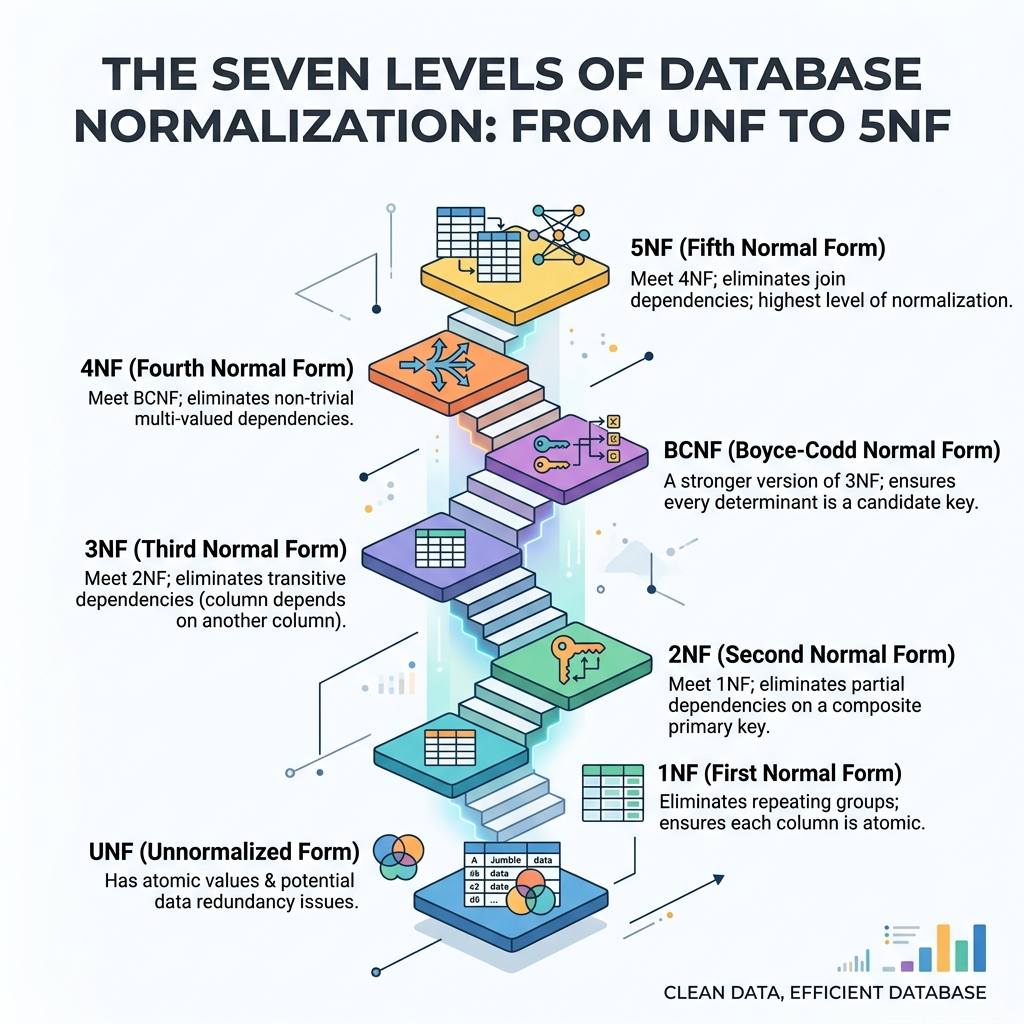
Database normalization is rarely taught as a living timeline, yet the standards governing modern relational design were forged through decades of incremental rigor. As Syamsul Bachri documents in his comprehensive guide, the discipline traces a deliberate arc from Unnormalized Form (UNF) through a strict hierarchy of constraints—ultimately arriving at 5NF—each tier exterminating a species of redundancy that its predecessors could not touch. Understanding this progression reveals why higher normal forms remain relevant, even in an era of JSON columns and vector databases.
The hierarchy moves from structural hygiene to semantic precision:
- 1NF eliminates repeating groups and enforces atomic values.
- 2NF removes partial dependencies against composite keys.
- 3NF eradicates transitive dependencies among non-prime attributes.
- BCNF generalizes functional logic so that every determinant is a candidate key.
- 4NF separates independent multi-valued facts that cause combinatorial bloat.
- 5NF — also called Project-Join Normal Form (PJ/NF) — removes join dependencies that survive all earlier constraints.
The Foundation: 1NF, 2NF, and 3NF
First Normal Form (1NF) lays the relational bedrock. A relation satisfies 1NF when every attribute contains only atomic (indivisible) values and no repeating groups inhabit a single tuple. Before 1NF, an invoice table might stuff multiple line-items into one cell as a comma-separated list, or nest an array of phone numbers inside a customer row. Such structures render searching, indexing, and updating operationally treacherous. By atomizing values into flat rows, 1NF transforms a document-like record into a true mathematical relation, enabling the set operations on which SQL is built.
Second Normal Form (2NF) targets partial dependency. A schema reaches 2NF when it is already in 1NF and every non-prime attribute depends on the entirety of every candidate key, not merely a proper subset. This concern materializes almost exclusively in tables with composite keys. Imagine a university enrollment table with key (StudentID, CourseID) and columns for StudentName, CourseName, and EnrollmentDate. Here StudentName depends only on StudentID, and CourseName only on CourseID — both partial dependencies. The resulting table is vulnerable to update anomalies: change a course name and you must edit every enrolled row; delete the last student and the course name vanishes. Decomposing into student, course, and enrollment tables excises the redundancy and isolates these facts.
Third Normal Form (3NF) deepens the guarantee. In addition to satisfying 2NF, a 3NF relation must contain no transitive dependencies, meaning non-prime attributes cannot depend on other non-prime attributes. The guiding maxim — “the key, the whole key, and nothing but the key” — captures the spirit of 3NF. A canonical violation occurs when an employee table stores DepartmentID, DepartmentName, and DepartmentLocation. Because DepartmentName depends on DepartmentID, and DepartmentID depends on the key, DepartmentName is transitively dependent on the primary key. Extracting department details into their own table prevents inconsistencies where two rows accidentally list different names for the same DepartmentID.
The Tightening Standards: BCNF and 4NF
Despite its practical power, 3NF tolerates certain edge cases. Boyce-Codd Normal Form (BCNF) closes these loopholes by insisting that every determinant be a candidate key, without exemption. A table can satisfy 3NF yet violate BCNF when overlapping candidate keys exist and one prime attribute functionally determines another. For instance, if a student table has two candidate keys — StudentID and Email — and a constraint ties Email to DepartmentAdvisor, the determinant is legitimate but the dependency can still breed anomalies. BCNF resolves this by demanding that any attribute functioning as a determinant must itself be a viable unique identifier, thereby normalizing the structure one step further than 3NF allows.
Fourth Normal Form (4NF) advances beyond functional dependencies to address multi-valued dependencies (MVDs). A relation violates 4NF when it commingles independent multi-valued facts about the same key. Consider an expert table where each row lists a consultant, a technical skill they possess, and a language they speak. If skills and languages are entirely independent sets, the table implicitly stores their Cartesian product: ten skills and ten languages produce one hundred rows for a single consultant. Deleting a language does not remove a skill, yet the schema forces redundant maintenance. By projecting these independent multi-valued attributes into separate relations, 4NF eliminates the combinatorial explosion that functional-dependency theory alone cannot see.
The Pinnacle: Fifth Normal Form (5NF)
Fifth Normal Form represents the culmination of classical relational theory. According to GeeksforGeeks, a database achieves 5NF precisely when no join dependency is present; decomposition is applied specifically to remove redundancy that cannot be eliminated by any lower normal form. Studocu reinforces this definition, describing 5NF as the level of database normalization explicitly designed to curtail redundancy by targeting these join-level relationships.
To violate 5NF, a table must be decomposable into smaller projections that can be joined back together without information loss, where the reassembly reveals a semantic constraint not capturable by keys alone. Picture a three-party contract relation among Agent, Brand, and Supplier. The business rule might state that an agent represents a brand for a supplier only if a valid (Agent, Brand) pairing and a valid (Brand, Supplier) pairing independently exist. If the full table encodes these triples redundantly — implying facts that are semantically derivable from pairwise projections — then the relation harbors a join dependency. The resulting anomalies are insidious: updating one valid pair might invalidate a triple, yet the schema offers no simple functional or multi-valued dependency to flag the error. Decomposing into the pairwise tables removes the redundancy and enforces the constraint naturally.
Practitioners on Reddit’s data engineering forums note that achieving 5NF requires vigilance: the schema must admit no join dependencies beyond those implied by superkeys. In day-to-day OLTP design, violations are rare because most business rules surface as functional or multi-valued dependencies earlier in the hierarchy. Yet in complex domains — supply-chain logistics, financial instrument bundling, or multi-dimensional authorization matrices — 5NF provides the final assurance that a design is proof against lossless-decomposition redundancy.
Why the Progression Still Matters
The staircase from 1NF to 5NF is more than a textbook exercise; it is a taxonomy of integrity guarantees. Modern systems often denormalize deliberately for read throughput, caching hot aggregates in document stores or wide-column engines. But the decision to denormalize is only safe when the underlying relational model is understood well enough to know which guarantees are being traded away.
This distinction grows acute in real-time AI infrastructure, where data anomalies do not merely corrupt reports — they fracture live conversations. Such platforms face unique pressures:
- Conversation state must remain consistent across asynchronous voice and chat channels.
- Context windows fed into LLM prompts cannot tolerate phantom tuples generated by faulty joins.
- Multilingual data multiplies the surface area for anomalies when regional language tables reference the same entities.
If the underlying schema normalizes only to 3NF, a transient join dependency might duplicate customer preference tuples as they propagate from speech-to-text transcriptions in Hindi to LLM context windows in Tamil. Platforms such as CallMissed, which offer production-ready voice agent infrastructure spanning 22 Indian languages and 300+ LLM models, depend on rigorously normalized transaction layers to ensure that a user’s intent — captured once, joined correctly — remains consistent across every channel and model switch. In that context, understanding where 4NF ends and 5NF begins is not academic; it is the difference between coherent context and conversational hallucination at the database layer.
Key Developments in Relational Theory
What Is 5NF? Demystifying Project-Join Normal Form
The Normalization Journey: Where 5NF Sits
Database normalization is conventionally taught as a stepladder of progressively stricter constraints. As outlined in the comprehensive normalization roadmap from Unnormalized Form (UNF) through 1NF, 2NF, 3NF, BCNF, 4NF, 5NF, and even DKNF, each level targets a specific class of data anomaly [3]. First Normal Form enforces atomicity. Second and Third Normal Forms eliminate partial and transitive dependencies. Boyce-Codd Normal Form (BCNF) tightens the screw on functional determinants by ensuring every determinant is a candidate key. Fourth Normal Form (4NF) then attacks independent multi-valued facts that would otherwise force redundant row duplication.
But even a schema that rigorously satisfies 4NF can still harbor a more subtle structural flaw: the join dependency. That is the exclusive territory of Fifth Normal Form (5NF). Also known as Project-Join Normal Form (PJ/NF), 5NF exists to ensure that a table cannot be decomposed into smaller projections and reassembled—via natural join—into a result that exactly matches the original, unless those projections are trivially implied by the table's candidate keys [1][5]. If such a lossless decomposition is possible without every fragment containing a candidate key, redundancy is still lurking in your design, and 5NF has not been reached.
Join Dependency: The Concept 5NF Exists to Kill
To demystify 5NF, you must first understand what joins have to do with redundancy. A join dependency exists when a relation can be broken into two or more vertical subsets—called projections—and those subsets can be naturally joined back together to reproduce the original relation exactly, neither losing rows nor gaining spurious ones. GeeksforGeeks succinctly states that "a database is in 5NF when there is no join dependency present in the table / database" [1].
In lower normal forms, the culprit is usually a functional dependency (A determines B) or a multi-valued dependency (A determines a set of B values independently of C). Join dependencies operate at a higher arity: they emerge when three or more independent attribute sets constrain each other. Formally, a relation is in 5NF if every non-trivial join dependency in it is implied by its candidate keys [7].
Consider the distinction carefully. A candidate key already implies that certain projections can be joined without loss—because the key guarantees unique identification. 5NF asks whether any other, non-key-based join pattern is enforcing structure in your table. If the answer is yes, you have an unconstrained join dependency that should be resolved through decomposition.
The Three-Way Decomposition Pattern
Traditional database pedagogy often loses students at precisely this point, which may explain why a recent deep-dive publication on 5NF—trending on HackerNews with 131 upvotes and 50 comments in under nine hours—argues that "traditional ways of teaching basic topics in relational [design] are unnecessarily confusing" [2]. The confusion usually comes from presenting 5NF as abstract algebra rather than as a practical guard against a specific storage pathology.
The pathology is best understood through a three-way relationship. Imagine a single relation that attempts to capture which consultants are approved for which projects and which skills are used on those projects. If the business reality is actually defined by three independent pair-wise rules—consultant-project approvals, consultant-skill certifications, and project-skill requirements—then storing all three dimensions in one wide table creates redundancy. To maintain consistency, you must replicate rows every time one pairing changes.
If you decompose that wide table into three separate binary relations and find that a natural three-way join reconstructs the original exactly, you have discovered a non-trivial join dependency [6]. The original table was not in 5NF. Although it may have satisfied 4NF (because no single multi-valued dependency was being abused), the three-way interaction was still forcing redundant storage. 5NF corrects this by demanding the split: keep the three pair-wise tables and drop the monolithic three-column table, allowing the database engine to reconstitute the full picture through joins only when needed.
Formal Criteria and the Superkey Test
Academic definitions of 5NF can be intimidating, but the operational test is straightforward once the vocabulary is clear. A relation R is in 5NF if, for every non-trivial join dependency (R1, R2, ..., Rn) that holds in R, each projection Ri is a superkey of R [7]. In other words, you are forbidden from losslessly decomposing the table into smaller pieces unless every one of those pieces contains enough information to identify the original row uniquely.
In practice, validating a schema against this standard follows a recognizable sequence:
- Identify all candidate keys of the relation.
- Enumerate possible non-trivial projections that could participate in a lossless join.
- Verify whether any resulting join dependency is not implied by those candidate keys.
When that condition is met—meaning no such decomposition exists or every valid projection carries a superkey—the database is in Project-Join Normal Form, and no further table splitting can yield a cleaner design without sacrificing the ability to reconstruct the original fact set through joins alone. Because detecting these dependencies manually is arduous, automated schema-design algorithms are often employed to audit complex databases for hidden join dependencies [6].
Practical Recognition: Is 5NF Necessary for Your Schema?
For the vast majority of web applications, stopping at BCNF or 4NF is perfectly defensible. Join dependencies that violate 5NF are comparatively rare; they tend to surface in schemas modeling intricate ternary or n-ary business constraints, such as:
- Supply-chain agreements linking independent suppliers, parts, and projects under specific contractual rules.
- Clinical trials connecting physicians, protocols, and pharmaceutical compounds where enrollment is constrained by pairwise authorizations.
- Regulatory frameworks where compliance checklists intersect with geographic jurisdictions and license types in three-way fashion.
In these cases, failing to normalize to 5NF can lead to update anomalies that are difficult to trace. Changing one pair-wise fact may require coordinated insertions or deletions across multiple rows to avoid logical contradictions. By decomposing into the constituent projections, you isolate each independent fact and let the relational engine reconstitute the complete view through joins. That separation of concerns is the final aesthetic victory of relational design—and the precise boundary that separates a 4NF schema from one that is truly project-join normalized.
In-Depth Analysis: Identifying Join Dependencies

The Hierarchy of Dependencies: Where Join Dependencies Fit
To understand Fifth Normal Form (5NF), you must first recognize where join dependencies (JDs) sit in the taxonomy of relational constraints. In the progression from First Normal Form to 5NF, each stage eliminates a specific type of undesirable dependency. Functional dependencies give us 2NF, 3NF, and BCNF; multivalued dependencies yield 4NF. Join dependencies are the final generalization: a table is in 5NF—also known as Project-Join Normal Form (PJ/NF)—when it contains no non-trivial join dependencies at all [1][5].
Whereas a functional dependency dictates that one attribute determines another, and a multivalued dependency states that one attribute independently determines a set of values, a join dependency asserts that an entire relation can be perfectly reconstructed by joining two or more of its smaller projections. In other words, if your table can be losslessly decomposed into smaller tables and then rebuilt via natural joins without losing or gaining spurious information, a join dependency is present. This is the precise redundancy 5NF is designed to eliminate, reducing redundancy in relational databases beyond what 4NF can achieve [7].
Anatomy of a Join Dependency
Formally, a join dependency * {R₁, R₂, ..., Rₙ} holds on relation R if and only if R is exactly equal to the join of its projections on R₁ through Rₙ. Symbolically:
R = π_{R₁}(R) ⋈ π_{R₂}(R) ⋈ ... ⋈ π_{Rₙ}(R)
Every multivalued dependency is technically a binary join dependency—a special case where n = 2. What makes general join dependencies insidious is that they govern n-way relationships, often involving three or more sets of attributes that appear to correlate within a single table but are actually independent in pairs.
A join dependency is considered non-trivial if none of the projections Rᵢ is equal to R itself, and if the constraint is not already implied by the superkeys of R. If a projection is equivalent to the entire relation, or if the join is guaranteed by key constraints alone, the dependency offers no new structural information and can be ignored for normalization purposes. It is these non-trivial join dependencies that violate 5NF. As GeeksforGeeks notes, the core requirement for achieving 5NF is ensuring no such join dependency remains in the table or database [1].
The Classic Identification Pattern: Ternary Independence
The most reliable signal of a hidden join dependency is a ternary (or higher) relationship in which pairs of attributes are semantically independent, even though all three participate in a valid composite key. Consider the canonical example from database literature:
- An Agent sells certain Products.
- An Agent represents certain Companies.
- A Company makes certain Products.
If you model this in a single table AgentCompanyProduct(agent, company, product), you might find that no single pair of attributes functionally determines the third. However, the valid combinations in the table might be exactly those that survive a three-way join of:
AgentCompany(agent, company)AgentProduct(agent, product)CompanyProduct(company, product)
Here, the original table is the lossless join of three binary projections. The table appears to store meaningful three-way facts, but the real semantics are pairwise. This is the hallmark of a join dependency. The redundancy is subtle: if a new agent starts representing a company, you might spuriously assume they sell all products that company makes, unless the join dependency has been properly decomposed into its separate projections. Without this decomposition, the database forces you to maintain redundant cross-product combinations that could be inferred from the pairwise relationships alone.
The Project-Join Verification Method
Because join dependencies lack the intuitive visual patterns of functional dependencies, you must often verify them algorithmically. Follow this project-join test to confirm whether a suspected 5NF violation exists:
- Ensure 4NF compliance first. Eliminate all multivalued dependencies. If an MVD still exists in your schema, you are not yet ready to test for general join dependencies; handle the binary case before tackling the n-way case [3].
- Identify candidate decompositions. Look for subsets of attributes that form meaningful pairwise or n-way relationships that appear to carry information independent of the full schema.
- Project and join. Create the projections on your candidate subsets, then perform the natural join across all of them. If the resulting relation is exactly identical to the original relation—same tuples, no spurious rows, no lost data—the join dependency is formally confirmed.
- Check semantic independence. Critically, the projections must each represent standalone semantic facts. If one projection is functionally determined by another, or if the decomposition merely reflects a superkey structure, you are dealing with a simpler dependency already covered by BCNF or 4NF, not a true join dependency.
Practitioners should be cautious of null-value joins, which can severely complicate verification. NULL values in join attributes can produce misleading results during decomposition, either filtering out valid tuples or introducing spurious connections that obscure whether a true lossless join exists [6]. Always verify with complete, non-null datasets, and consider the semantics of your domain carefully before declaring a schema to be in 5NF.
Practical Challenges in Detection
Identifying join dependencies is widely regarded as the most conceptually difficult step in normalization. Unlike functional dependencies, which enjoy complete axiomatization through Armstrong's axioms and can be systematically discovered, general join dependencies do not have a comparably simple or complete inference system. This means you cannot always algorithmically deduce every JD that might be implied by a given set of constraints, leaving significant room for human judgment.
Traditional database pedagogy has arguably compounded this confusion. One of the explicit goals of modern database design publications is to "deconstruct the traditional ways of teaching basic topics in relational" theory, precisely because the standard exposition of 5NF is unnecessarily confusing and relies on notation that obscures the underlying intuition [2]. In practice, most production schemas intentionally halt normalization at BCNF or 4NF, addressing 5NF only when an application exhibits the specific anomaly patterns—such as the pairwise independence described above—that signal a join dependency.
If your data model genuinely requires strict 5NF compliance, treat join dependency detection as an act of semantic modeling rather than mechanical rule-checking. Examine whether the tuples in your relation represent a true irreducible n-way fact about your domain, or whether they are merely the emergent intersection of several independent pairwise realities. When it is the latter—when the relation equals the join of its projections and those projections make sense on their own—decomposition into the respective tables eliminates the redundancy and brings the schema into true Project-Join Normal Form.
Real-World Examples: When 5NF Actually Matters

The Fifth Normal Form — or Project-Join Normal Form (PJ/NF) — is frequently filed under “academia only.” Yet join dependencies do not disappear just because a schema stops at Boyce-Codd Normal Form. In systems where three or more independent multi-valued facts intersect, the redundancy 5NF targets becomes a genuine source of production bugs. Understanding when that intersection actually occurs is the difference between a robust relational model and one that quietly corrupts state during routine updates.
The Supply-Chain Ternary: Vendors, Parts, and Projects
Consider a manufacturing firm tracking which vendors supply which parts for which projects. A single table, Vendor_Part_Project, might seem efficient at first glance:
- Acme supplies Bolts and Nuts
- Acme participates in Project Apollo and Project Zeus
If these facts are collapsed into one wide relation, the schema implies a join dependency: because Acme supplies Bolts and Acme works on Project Zeus, the table may incorrectly assert that Acme supplies Bolts to Project Zeus. If the business rule does not actually guarantee that link, the relation stores a redundant — and potentially false — inference. When we decompose the given table to remove redundancy in such cases, we split the ternary relationship into its binary projections, but only after proving the join dependency exists. A database is in 5NF when there is no join dependency present in the table, meaning the original ternary can be reconstructed losslessly from its projections without generating spurious tuples.
This pattern appears constantly in procurement and logistics platforms. Ignoring it produces painful update anomalies: removing a project might inadvertently delete the only record showing a vendor supplies a critical part, or inserting a new project might require duplicating every part the vendor carries. When the underlying business logic truly separates these three dimensions, 5NF is not an aesthetic choice; it is a correctness requirement.
SaaS Configuration Management: Customers, Features, and Regions
Modern multi-tenant SaaS platforms face a subtler 5NF scenario during entitlement modeling. Imagine a relation tracking Customer_Feature_Region that must simultaneously satisfy three independent business facts:
- Which customers have purchased which features
- Which customers operate in which geographic regions
- Which features are legally deployable in which regions
A customer might own Feature X and operate in Region Y, but Feature X might not yet be compliant in Region Y. If the application stores all three attributes in one wide table, a join dependency can illegally reconstruct the tuple (Customer, Feature, Region) even when the business rules prohibit it. The database appears consistent at the row level, but the join of decomposed views produces phantom relationships that never received explicit approval.
In high-velocity CI/CD environments where feature flags change hourly, these phantom joins cause real incidents. Achieving the Fifth Normal Form or Project-Join Normal Form (PJ/NF) requires ensuring that the database schema has no join dependency that allows such invalid reconstructions. Teams often discover this only after their analytics pipeline reports utilization in regions where the feature was never actually launched.
Healthcare Provider Networks: Doctors, Specialties, and Hospitals
Hospital administration systems provide another canonical example. A relation tracking Doctor_Specialty_Hospital seems straightforward until you examine the constraints:
- Dr. Chen is certified in Cardiology and Neurology
- Dr. Chen has admitting privileges at General Hospital and Memorial Hospital
If these facts are stored in one table, the schema implies Dr. Chen practices both specialties at both hospitals. In reality, Dr. Chen may practice Cardiology only at General Hospital and Neurology only at Memorial Hospital. The unconstrained ternary table creates exactly the redundancy 5NF is designed to eliminate.
Healthcare data integrity standards make this expensive. A scheduling application might incorrectly assume all specialty-hospital pairings are valid, leading to appointments booked with providers who cannot perform the required procedure at that location. Decomposing into Doctor_Specialty, Doctor_Hospital, and a separate bridge table for actual practice sites removes the join dependency and prevents the database from asserting facts the real world has not authorized.
Why 5NF Is Back in the Conversation
The renewed interest in 5NF is not merely theoretical. A recent HackerNews discussion by user petalmind on exactly this topic garnered 131 points and 50 comments in just 8.7 hours, signaling that practicing engineers are actively wrestling with when to apply PJ/NF versus stopping at 4NF or BCNF. Part of the friction comes from pedagogy: as the Database Design Book series argues, traditional teaching approaches to 5NF are “unnecessarily confusing,” often burying the practical signal under abstract notation. That confusion leads teams to either over-normalize trivial schemas or under-normalize complex ones.
The comments in such threads typically split between two camps: relational purists who view any join dependency as a bug waiting to happen, and pragmatists who argue that application-level constraints and modern OLTP engines can guard against the same anomalies without costly decomposition.
A Pragmatic Checkpoint Before You Decompose
5NF is essential, but it is not free. Every decomposition into projections demands lossless join guarantees and increases query complexity. Before refactoring a working schema to 5NF, validate the following:
- Confirm the dependency is real. Use functional dependency analysis to prove that a non-trivial join dependency actually exists; don’t decompose ternary relationships that are semantically constrained by other rules.
- Measure write skew. If your table experiences high concurrent insert/update volume on independent multi-valued attributes, join dependency anomalies are more likely to manifest under race conditions.
- Benchmark the join cost. A decomposed 5NF schema may require three or more joins to reconstruct a business view. In read-heavy analytics paths, the integrity gain may not justify the latency.
- Document the business rule. To achieve 5NF, it is essential to ensure that a database schema has no join dependency, which means the underlying logic must be stable enough to encode as a permanent relational constraint.
For most CRUD applications, 3NF or BCNF remains sufficient. But when your domain naturally expresses three or more independent multi-valued facts about the same entity — vendors and parts and projects, customers and features and regions, doctors and specialties and hospitals — stopping short of 5NF leaves a specific class of redundancy in place. Recognizing that class, and knowing when to eliminate it, is what separates a normalized database from a trustworthy one.
5NF vs. Denormalization: Finding the Right Balance
The 5NF Ideal: Zero Join Dependency
At its core, Fifth Normal Form (5NF)—also known as Project-Join Normal Form (PJ/NF)—represents the theoretical ceiling of relational database normalization. According to GeeksforGeeks, a database achieves 5NF precisely when there is no join dependency present in the table. This means every nontrivial join dependency is implied by the superkeys of the relation, ensuring that decomposing the table further would not eliminate any meaningful redundancy. As notes from Studocu emphasize, 5NF is "a level of database normalization designed to reduce redundancy in relational databases" by isolating independent multivalued relationships that survive even 4NF decomposition.
The recent resurgence of interest in this topic—evidenced by a HackerNews post on "5NF and Database Design" climbing to the front page with 131 points and 50 comments in under 9 hours—suggests that engineers are actively revisiting whether extreme normalization still deserves a place in modern stacks. The DatabaseDesignBook publication argues that one goal of contemporary database education should be to deconstruct the traditional ways of teaching basic topics in relational design, implying that the dogmatic pursuit of 5NF often obscures the practical trade-offs that working database administrators face daily. As Syamsul Bachri outlines in a comprehensive normalization guide, the progression from UNF through 1NF, 2NF, 3NF, BCNF, 4NF, and ultimately 5NF (and even DKNF) represents a ladder of increasing constraint—but each rung should be climbed only when the previous one leaves genuine redundancy on the table.
The Performance Cost of Purity
The problem with 5NF is not its logic; it is its physics. Each projection necessary to achieve 5NF introduces a join at query time. In write-heavy transactional systems, maintaining five or six small projections can prevent update anomalies. But in read paths—especially aggregations, search queries, and real-time analytics—those joins compound latency, increase CPU load, and exhaust buffer-pool memory. A Scribd analysis of 4NF and 5NF algorithms highlights a related pitfall: issues with null-value joins can silently corrupt results, produce incomplete result sets, or force expensive outer-join plans when queries span tightly decomposed schemas. The material notes that some employee tuples may carry NULL for the join attribute, making the 5NF ideal operationally expensive to defend at scale.
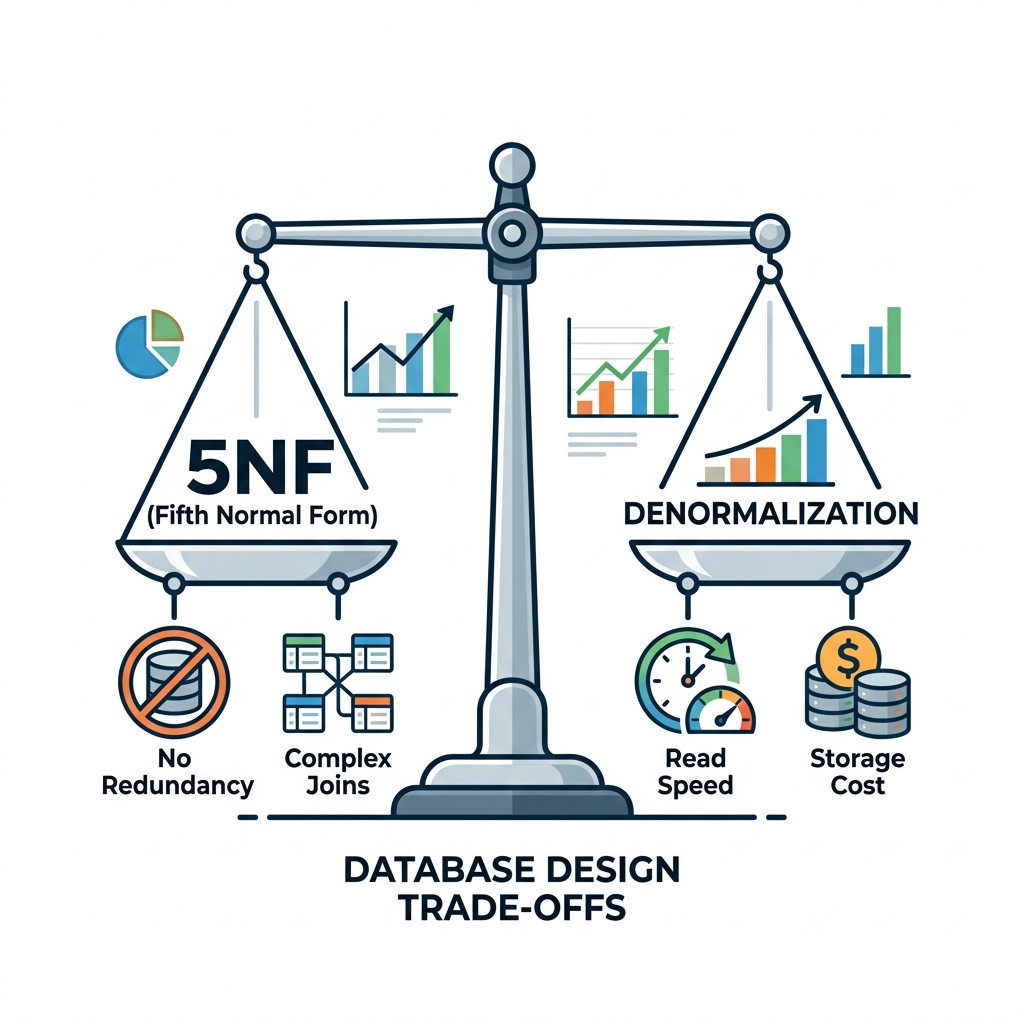
This friction explains why denormalization remains a deliberate, often necessary engineering strategy. Denormalization accepts controlled redundancy in exchange for predictable query performance. It does not signal sloppy design; it signals that the workload has been profiled and that read latency has been prioritized over write-time anomaly avoidance.
A Practical Decision Framework
Finding balance requires moving beyond textbook definitions and benchmarking against real query patterns. The r/dataengineering community emphasizes that to achieve 5NF, it is essential to ensure that a database schema has no join dependency beyond those implied by its superkeys. Yet in production, the more relevant question is whether enforcing that constraint pays for itself. Consider the following strategic filter:
- Start with semantic correctness, not theoretical purity. Before chasing 5NF, verify whether the relation actually contains a nontrivial join dependency that 4NF cannot resolve. Many schemas presented as "needing 5NF" are simply under-modeled at the 3NF or BCNF layer. If no true join dependency exists, further decomposition is performative, not productive.
- Map the critical read path. If a query runs 10,000 times per minute and requires four-way joins across 5NF projections, the microscopic redundancy savings may be dwarfed by compute costs, index-merge overhead, and connection-pool pressure.
- Isolate denormalization behind stable interfaces. When you do denormalize—whether by duplicating columns, pre-computing aggregates, or collapsing projections—treat the redundant data as a derived view, not a source of truth. Maintain the 5NF schema as the canonical model and populate read-optimized tables via change-data capture, triggers, or materialized views.
- Document the consistency contract. Every denormalized field needs an ownership policy and invalidation strategy. Without this, the schema drifts into an unmaintainable state that normalization was originally designed to prevent.
When to Keep It Normalized
5NF still matters in domains where independent multivalued facts intersect without fixed patterns. Classic textbook examples include complex supplier-part-project relationships, configurable product catalogs, or multi-tenant SaaS entitlement matrices where rights, roles, and resources form unpredictable combinations. In these cases, join dependencies are not hypothetical—they are active structural risks. Enforcing 5NF prevents subtle logical inconsistencies, orphaned association records, and update anomalies that application-level validation cannot easily patch.
Even at the infrastructure tier, this tension is visible. AI communication platforms managing high-cardinality relational data must make the same choices. For instance, CallMissed, which routes voice agents and WhatsApp chatbot interactions through 300+ LLM inference models while processing speech-to-text across 22 Indian languages, generates telemetry spanning conversation states, billing events, and model audit logs. Such platforms typically retain normalized schemas—often approaching 5NF—for transactional conversation-state and billing records where anomalies are financially unacceptable. Meanwhile, they denormalize read-only event streams into flat, wide tables to power real-time operational dashboards. The normalization boundary follows the data’s consistency requirements and query velocity, not a universal academic rule.
The Modern Middle Ground
Contemporary databases and architectural patterns have largely dissolved the traditional either/or choice. Materialized views let teams keep a logically normalized model while physically pre-computing join results. Generated columns can inline frequently accessed aggregates without manual denormalization drift. Columnar storage extensions and vectorized query execution reduce the per-join penalty that once made 5NF prohibitive for analytics. On the architecture side, CQRS (Command Query Responsibility Segregation) explicitly separates the normalized write model from denormalized read models, acknowledging that one schema cannot optimally serve both high-integrity ingestion and high-velocity reporting.
Ultimately, 5NF and denormalization are not adversaries; they are tools tuned to different frequencies. 5NF guards against logical decay in complex, join-dependent relationships. Denormalization trades atomicity for speed where the business can tolerate bounded inconsistency. The right design is the one that measures the cost of joins against the cost of anomalies—and makes that choice explicitly rather than by default.
Impact & Implications for Modern Data Engineering

The Resurgence of Relational Rigor in a Post-NoSQL World
The recent Hacker News surge—131 points and 50 comments within 8.7 hours on a deep dive into Fifth Normal Form—signals something important: data engineers are re-examining foundational relational theory after a decade of schema-later exuberance. While GeeksforGeeks succinctly states that a database reaches 5NF when there is "no join dependency present in the table," the practical implications of that statement have never been more relevant. As organizations move from proof-of-concept analytics to production-grade data platforms, the hidden cost of poorly decomposed schemas is becoming impossible to ignore. 5NF, also known as Project-Join Normal Form (PJ/NF), is not merely an academic checkpoint; it is a litmus test for whether your logical model can survive real-world complexity without generating spurious tuples. The trend is clear—engineers who once dismissed normalization as “legacy thinking” are now discovering that join dependencies are the silent killers of data reliability at scale.
5NF and the Modern Data Stack: Lakehouses, ETL, and Curated Zones
The modern data stack is architected around speed. Data lakehouses promise cheap storage and flexible queries, encouraging wide, denormalized tables for BI consumption. Yet this creates a tension. In the operational and curated layers—where data quality actually matters—join dependencies introduced during hasty ETL design can silently corrupt results. When a table has a non-trivial join dependency, joining decomposed projections back together can produce rows that never existed in the source system. For data engineering teams, this translates into:
- Irreproducible analytics pipelines: Report totals that shift based on join order or decomposition strategy, breaking the “single source of truth” promise.
- Compliance risk: In regulated industries such as healthcare and finance, phantom tuples generated by bad schema design amount to audit failures and regulatory penalties.
- Remediation churn: Engineers on Reddit’s r/dataengineering frequently note that achieving 5NF retroactively requires painful rewrites of downstream transformations, often forcing teams to rebuild entire mart layers.
The lesson is not that every lakehouse table must be in 5NF. Rather, the source-of-truth operational databases feeding the lake must be free of join dependencies, or the poison propagates downstream. As Syamsul Bachri’s comprehensive normalization guide illustrates, the journey from UNF to 5NF is a progression of progressively stricter anomaly elimination. Treating the early stages as “good enough” for the core ledger simply defers technical debt into the analytics layer.
Microservices, Event Storming, and Distributed Joins
In distributed architectures, the database is no longer a single monolithic schema. Microservices own domains, and events replace foreign keys. Paradoxically, this fragmentation makes 5NF thinking more critical, not less. When service boundaries are drawn around aggregates, cross-domain facts often bleed into event payloads. If those facts contain multi-valued dependencies that haven’t been projected correctly, reconstructing state via event sourcing becomes non-deterministic.
Consider an e-commerce platform tracking Product–Supplier–Warehouse relationships. In an unnormalized event log, a single event might carry supplier contact details, warehouse locations, and product SKUs. Without applying 5NF decomposition principles, temporal joins across these event streams can recreate invalid states—suggesting a supplier shipped from a warehouse they do not serve. The Studocu notes on 5NF emphasize that its core purpose is to reduce redundancy in relational databases, but in event-driven systems, that redundancy reduction is equally a safeguard against eventual inconsistency. When your state is reconstructed from immutable logs rather than mutable rows, a join dependency is not a theoretical flaw; it is a distributed correctness bug waiting to manifest during recovery.
AI-Driven Metadata and the Multi-Dimensional Surrogate Key Problem
Perhaps the most urgent modern frontier for 5NF is artificial intelligence infrastructure. AI systems do not merely store rows; they manage hyper-dimensional metadata: model versions, prompt templates, inference parameters, language codes, acoustic embeddings, and tenant isolation rules. These datasets are riddled with multi-valued facts that cry out for PJ/NF treatment. A feature store tracking “Model X performs Task Y on Language Z with Latency W” is a classic candidate for join-dependency analysis.
Platforms like CallMissed illustrate why this matters. As an AI communication infrastructure provider routing inference across 300+ LLMs and processing voice data in 22 Indian languages, CallMissed’s internal data planes must track orthogonal dimensions—model provider, language family, acoustic feature set, and customer tenant—without allowing spurious combinations. If a metadata table asserts that “Model X supports Language Y for Tenant Z,” that relationship must be derivable only from valid projections. A join dependency here does not just create bad analytics; it can trigger incorrect routing, sending Hindi speech data to a monolingual English voice agent or billing a tenant for an unsupported model class. In high-stakes AI orchestration, 5NF-compliant schemas function as guardrails against semantic corruption at scale.
The Pedagogical Problem and Practical Trade-Offs
One of the goals of the publication 5NF and Database Design, which drove the recent HN discussion, is to deconstruct traditional ways of teaching basic topics in relational design. That deconstruction is necessary because dogmatic normalization carries its own penalties. Most transactional systems stop at 3NF or BCNF for good reason: the query optimizer overhead and join latency of full 5NF can degrade OLTP performance, and modern distributed SQL engines still struggle with excessive projection joins across regions.
Data engineers should treat 5NF as a diagnostic tool, not a universal mandate. You likely need strict PJ/NF compliance when:
- The domain has unavoidable ternary (or higher-degree) relationships that cannot be expressed as independent binary relations without losslessness.
- Anomaly detection is automated, and spurious joins trigger false positives in ML pipelines or fraud surveillance systems.
- Regulatory lineage requirements demand that every derived tuple in a report provably exists in the base data, leaving no room for phantom projections.
- Multi-tenant SaaS metadata must combine dimensions (language, model, region, compliance tier) where invalid combinations carry direct business or legal risk.
Outside these constraints, pragmatic denormalization remains valid—provided the team understands what dependency they are willingly accepting. Knowing the rules lets you break them safely.
Conclusion: Normalization as Navigational Compass
From the Hacker News front page to enterprise lakehouses, the renewed interest in 5NF reflects a maturing industry. We are past the era of treating databases as opaque persistence layers and entering one where data design determines system correctness. Whether you are building a microservices event mesh, a multilingual AI voice pipeline, or a regulated financial ledger, understanding join dependencies is now a core data engineering competency. The database is in 5NF not because normalization is virtuous, but because in a world of distributed joins, streaming projections, and AI-generated queries, there is no longer room for phantom data.
Expert Opinions: What Database Architects Say

While textbooks often present Fifth Normal Form as the final boss of database normalization, the recent surge of practitioner interest tells a more nuanced story. A submission by author petalmind titled 5NF and Database Design climbed to the top of HackerNews, garnering 131 points and 50 comments within just 8.7 hours—a clear signal that seasoned developers and architects are still wrestling with where project-join normal form fits in modern schema design. That conversation, mirrored across Reddit threads and academic publications, reveals a profession divided not on the mathematics of join dependency elimination, but on its practical return on investment. For every architect who treats 5NF as a purity test, there is another who sees it as a specialized tool kept in reserve for pathological redundancy cases.
The HackerNews Consensus: Theory in the Trenches
The HackerNews community’s rapid engagement with petalmind’s post reflects a broader industry tension: architects respect 5NF’s formal definition—a database is in 5NF when there is no join dependency present in the table (GeeksforGeeks)—yet remain skeptical of its day-to-day utility. In the ensuing discussion, experienced practitioners echoed a familiar refrain: achieving Boyce-Codd Normal Form (BCNF) or 4NF resolves the vast majority of real-world anomalies. For many production systems handling standard transactional data, architects view 5NF as a theoretical checkpoint rather than a deployment requirement.
However, the same cohort acknowledges that 5NF becomes unavoidable in domains where independent multivalued facts interact through a composite key. Supply-chain databases, medical scheduling systems, and advanced entitlement matrices are frequently cited as edge cases where undetected join dependencies silently reintroduce redundancy. The consensus is not that 5NF is irrelevant, but that its application should be diagnostic: employed when anomaly patterns persist despite lower normal forms, not applied universally as a matter of ritual. As one thread of thought emerging from the 50 comments suggests, premature optimization toward 5NF can be as harmful as ignoring normalization entirely, fragmenting schemas before query patterns are fully understood.
Deconstructing the Pedagogy
One reason for the confusion surrounding 5NF, according to database educators, is how the concept has traditionally been taught. A publication featured in the HackerNews discussion argues explicitly that its goal is to "deconstruct the traditional ways of teaching basic topics in relational" design (DatabaseDesignBook). Rather than treating normalization as a linear ladder from 1NF to 5NF—an approach Syamsul Bachri’s Medium overview maps comprehensively from Unnormalized Form (UNF) through to Domain/Key Normal Form (DKNF)—experts increasingly advocate for teaching dependency theory directly.
Architects on daily.dev and other forums note that framing 5NF as simply “better than 4NF” misleads engineers. In practice, Fifth Normal Form is not an incremental improvement but a specialized constraint: the Project-Join Normal Form (PJ/NF). As Studocu’s coursework emphasizes, 5NF is specifically "a level of database normalization designed to reduce redundancy in relational databases" through elimination of non-superkey join dependencies. By decomposing tables only when a non-trivial join dependency exists that is not implied by superkeys, architects avoid over-fragmentation. The traditional pedagogical sequence, while useful for certification exams, often leaves practitioners unprepared to identify the exact conditions where decomposition benefits outweigh query complexity costs. DatabaseStar’s video tutorial series, which offers normalization guidance in plain English, underscores that working architects need pattern recognition—seeing the shape of a join dependency—not just rote memorization of formal definitions.
The Project-Join Reality Check
If online communities are any measure, the gap between understanding 5NF and implementing it remains substantial. On Reddit’s r/dataengineering, practitioners trading implementation advice emphasize that to achieve 5NF—or PJ/NF—it is essential to ensure the schema has no join dependency that survives superkey projection. The thread reveals a common architectural struggle: engineers can spot multivalued dependencies (4NF) using intuitive examples like employee-skill-hobby tables, but join dependencies are more insidious. They often emerge from ternary or higher-order relationships that appear correct under 4NF yet still permit lossless-join decomposition.
Practicing architects voice two primary concerns:
- ORM and tooling gaps. Most modern object-relational mappers and schema migration tools offer no native assistance for 5NF decomposition; the refactoring is manual and error-prone.
- NULL-value fragmentation tax. Aggressive decomposition to satisfy 5NF can explode the number of tables in a schema, compounding NULL-value join issues—a documented complication in relational algorithm literature (Scribd). When a query must reconstruct a logical tuple from five or six physical tables, the performance tax and null-handling complexity frequently override the storage savings of redundancy elimination.
For many teams, the pragmatic choice is to enforce 5NF semantics in application code or through careful API design rather than in the relational layer itself.
When Architects Still Reach for 5NF
Despite the skepticism, database architects deploy 5NF in specific high-integrity contexts where independent facts must remain combinatorially consistent. Violating project-join normal form in these scenarios does not merely waste storage; it permits illegal fact combinations that foreign keys alone cannot suppress. Senior practitioners typically cite three conditions that justify strict PJ/NF enforcement:
- Ternary relationship dominance. When a core business concept links three or more independent dimensions—such as a contract valid only for specific vendor-region-service triples—the join dependency must be explicit in the schema to prevent phantom valid combinations.
- Temporal and bi-temporal databases. Systems tracking historical truth and correction history over time generate overlapping projections that are notoriously prone to reconstruction anomalies if underlying join dependencies are not eliminated.
- High-cardinality entitlement matrices. Financial ledgers, healthcare authorization platforms, and advanced configuration-management databases often manage permissions across multiple independent axes, where a failure to decompose properly can silently grant invalid access patterns.
Formal algorithmic approaches to 5NF schema design exist, yet architects caution that applying them by rote is dangerous. The process demands verifying that every projected relation preserves global data semantics—a step automated tools rarely perform satisfactorily. Consequently, many senior architects report that they achieve 5NF-like schemas not through explicit normalization exercises, but through Domain-Driven Design: bounded contexts naturally separate join-dependent facts into distinct aggregates before the relational model is drafted. By the time entities reach the database, the independent projections have already been isolated, making the resulting schema accidentally compliant with PJ/NF principles without a deliberate normalization campaign.
Modern Data Architectures and AI-Scale Complexity
As data architectures evolve beyond monolithic relational stores, the principles underlying 5NF are finding new relevance in unexpected places. Microservices persistence patterns, event-sourced systems, and AI infrastructure platforms all generate relational footprints that span hundreds of tables. The complexity grows exponentially when conversational AI data enters the mix—voice transcripts, chatbot session states, billing events, and model inference logs must often be reconstructed into coherent temporal views.
Platforms like CallMissed—whose multi-model API gateway routes inference across 300+ LLMs alongside voice agents and speech-to-text pipelines covering 22 Indian languages—exemplify the modern normalization challenge. A single customer interaction might generate join-dependent records across conversation metadata, LLM inference tracking, and regional language processing queues. Database architects building such real-time communication infrastructure note that while distributed NoSQL stores handle ingestion, the analytical warehouses and session-state databases behind them remain relational—and vulnerable to the exact join anomalies 5NF was designed to prevent. Understanding project-join dependencies, therefore, is not academic nostalgia; it is a safeguard against data reconstruction errors in high-throughput, multi-modal systems.
Ultimately, the expert view converges on a single pragmatic truth: 5NF is a scalpel, not a hammer. Architects keep its formalism in their mental toolkit not to impress theoreticians, but to diagnose the rare, costly anomalies that lesser normal forms cannot reach.
What This Means For You
Beyond the Classroom: Why 5NF Resurfaces in Production
Most engineering teams halt normalization at 3NF or BCNF and treat 5NF as an academic ceiling rather than a production tool. Yet the recent HackerNews surge around this topic—131 points and 50 comments in just 8.7 hours—suggests that experienced practitioners are re-examining its value. According to GeeksforGeeks, the formal criterion is unambiguous: "A database is in 5NF when there is no join dependency present in the table." That sounds simple until you realize that join dependencies, unlike functional or multi-valued dependencies, only reveal themselves when three or more independent relationships intersect in a single table.
The Database Design Book post that catalyzed this wave argues that we need to "deconstruct the traditional ways of teaching basic topics in relational" design. Traditional pedagogy often presents 5NF as the final, almost ceremonial step after 4NF, without clarifying when it materially improves data integrity. In reality, 5NF—also known as Project-Join Normal Form (PJ/NF)—matters when a relation can be losslessly decomposed into smaller projections and later rejoined without fabricating spurious tuples. The r/dataengineering community emphasizes this practical framing: "To achieve the Fifth Normal Form (5NF) or Project-Join Normal Form (PJ/NF), it is essential to ensure that a database schema has no join dependency" that introduces phantom rows during reconstruction. Studocu’s notes on the topic further underscore that 5NF is specifically "designed to reduce redundancy in relational databases," but the redundancy it targets is hidden in the algebra of reconstruction, not in the Duplicates your eye can see.
If your schema never reassembles a fact from three or more independent many-to-many relationships, you are unlikely to encounter a harmful join dependency. But if you manage orthogonal configuration matrices—say, consultants, projects, skills, and divisions, where any consultant can have any skill on any project billed to any division—a single wide table invites combinations that violate business reality. 5NF is the antidote to that specific combinatorial pathology, not a universal requirement for every entity.
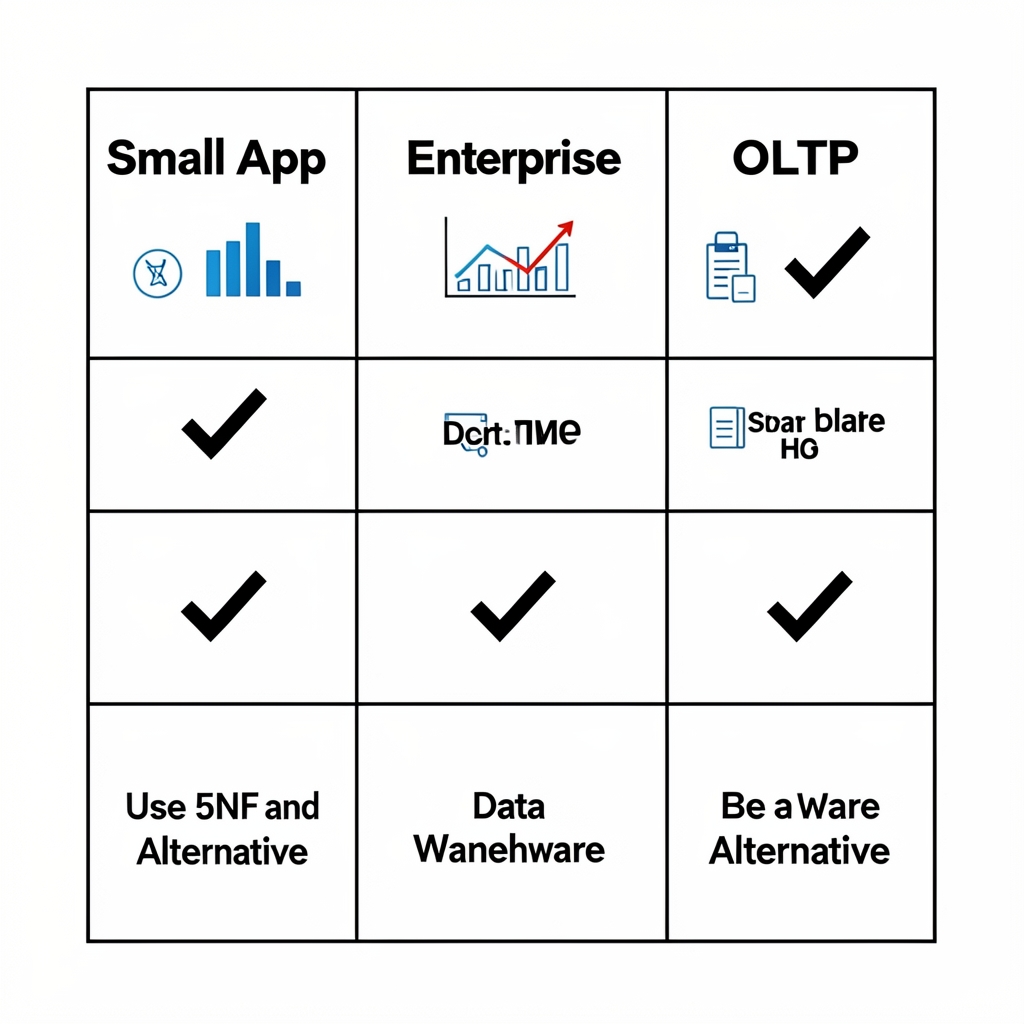
The Decision Matrix: When to Normalize, Stop, or Decompose
The table below translates theory into a pragmatic filter. Rather than prescribing 5NF everywhere, it maps application archetypes against realistic normalization targets and the concrete utility of eliminating join dependencies.
| Application Profile | Target Normal Form | 5NF Benefit | Key Trade-off | When to Apply |
|---|---|---|---|---|
| High-volume OLTP (payments, reservations) | 3NF / BCNF | Minimal; join dependencies are rare in transactional rows | Query overhead from excessive joins outweighs redundancy gains | Avoid 5NF unless update anomalies prove a material risk |
| Multi-dimensional config data (products, skills, locations) | 5NF | Eliminates spurious tuples in complex many-to-many-to-many relationships | Queries require multi-way joins that can degrade read latency | Mandatory when a single fact must be reconstructed from 3+ independent M:N relationships |
| Data warehousing / OLAP | Denormalized (3NF baseline) | Counter-productive for star-schema throughput | Star and snowflake schemas intentionally trade purity for scan speed | Apply only to isolated snowflake dimensions exhibiting join dependencies |
| AI/ML feature stores | 4NF → 5NF | Prevents constraint violations across orthogonal feature sets | Latency increases from multi-way joins during inference | When feature groups have independent, multi-valued dependencies that must remain combinatorially accurate |
| Microservices with bounded contexts | 5NF per service | Enables lossless decomposition of shared domains | Cross-service joins become distributed query challenges | When domain aggregates exhibit true independence and must compose without phantom rows |
| Legacy system modernization | Evaluate case-by-case | Removes decades of embedded join assumptions buried in monolithic tables | Refactoring cost is high; requires dependency analysis before decomposition | Audit first with formal join-dependency analysis, then migrate incrementally |
Look closely at the second row. A table stating which supplier provides which part to which warehouse often appears clean at 3NF because every pairwise relationship is valid. Yet if supplier locations, part catalogs, and warehouse capacities are truly independent business dimensions, storing them together permits illegal combinations upon reconstruction. Decomposing into three binary projections and rejoining them enforces the exact legal set of triples—a canonical 5NF victory. Contrast that with high-volume OLTP systems in the first row. Payment ledgers rarely require three-way independent joins to reconstruct a single financial fact; imposing 5NF would introduce joins without removing meaningful redundancy, violating the engineer's Hippocratic oath to do no harm to latency.
Performance vs. Purity: The Cost of Eliminating Join Dependencies
The normalization journey from UNF to 5NF, outlined by Syamsul Bachri's comprehensive guide covering forms from 1NF through DKNF, is a ladder of escalating purity and escalating join cost. Each rung eliminates a specific anomaly while demanding more from the optimizer. The Database Design Book editorial that helped reignite this debate reminds us that we must "deconstruct the traditional ways of teaching" normalization because academic correctness can collide with operational reality.
In production workloads, denormalization is a deliberate engineering hedge, not a failure of discipline. Data warehouses routinely abandon 5NF compliance to preserve star-schema performance; fact-table scans are simply cheaper than multi-way joins across fragmented dimensions. The 4NF and 5NF literature also warns of subtle hazards such as null-value joins—when decomposed schemas multiply NULL handling bugs across reconstructed rows, a pain point documented in advanced database schema design materials. Profile your actual query plans before decomposing. If phantom tuples remain theoretical under your current concurrency and volume, the cure may be worse than the disease.
A Practical Audit for Your Current Schema
If the matrix above signals that 5NF is relevant to your domain, proceed through a disciplined audit rather than instinctive table splitting:
- Catalog tables that encode three or more independent, multi-valued attributes. If no business rule genuinely spans three orthogonal domains, you have already finished; 5NF offers nothing to solve.
- Execute a decomposition test. Split the candidate table into its smallest binary projections, then rejoin them. If the reconstructed result contains rows absent from the original, you have uncovered a join dependency that 5NF can neutralize.
- Verify lower-normal-form hygiene first. As standard curriculum and GeeksforGeeks remind us, ensure the relation already satisfies 4NF; 5NF is a mop, not a broom, and only cleans residual join dependencies that prior forms cannot reach.
- Benchmark query plans before and after decomposition. PJ/NF correctness is operationally irrelevant if your execution engine cannot perform the multi-way joins efficiently at scale.
- Document the invariant. When you decompose, write down the business rule the split enforces. Future maintainers must understand why three separate tables must remain independent projections of a single, inviolable constraint.
Modern Infrastructure and Relational Rigor
While 5NF originates in classical relational theory, its principles govern any backend that stores multi-dimensional configuration with zero tolerance for phantom associations. Infrastructure platforms such as CallMissed—which orchestrates AI voice agents, multilingual Speech-to-Text across 22 Indian languages, and inference across 300+ LLMs—depend on control-plane schemas where model versions, language codes, and tenant routing rules are orthogonal dimensions. In these architectures, 5NF discipline prevents the database from asserting invalid combinations during lossless reconstruction, ensuring that a regional dialect is never joined to a model variant that does not support it.
Reading the Room: Context Over Dogma
The HackerNews traction around this topic reveals a maturing discipline. Engineers are no longer memorizing normal forms for certification exams; they are debugging production schemas where edge-case redundancy costs engineering hours and customer trust. You do not need to normalize every table to 5NF. You need the vocabulary to recognize when a join dependency is silently corrupting your data, the decision matrix to weigh purity against latency, and the restraint to stop when the business problem has been solved. Start with the shape of your data, profile your joins, and let empirical anomaly detection—not classroom dogma—dictate where the decomposition ends.
Frequently Asked Questions
What is 5NF and Database Design in relational databases?
How can I achieve 5NF in a database schema?
What is the difference between 4NF and 5NF in Database Design?
Why do some experts argue that traditional teaching of 5NF is unnecessarily confusing?
Can you explain 5NF and Database Design using a concrete join dependency example?
At what point in the normalization process should I implement 5NF instead of stopping at 3NF or BCNF?
Conclusion: The Future of Relational Design

The journey from Unnormalized Form to Fifth Normal Form has always been framed as a ladder of increasing purity, yet as discussions on HackerNews and forums like r/dataengineering reveal, practitioners often arrive at 5NF confused rather than empowered. We have traced how Project-Join Normal Form (PJ/NF) — the formal name for 5NF [5][7] — eliminates join dependencies that survive even the most rigorous application of 3NF and BCNF. A database is in 5NF when there is no join dependency present that cannot be inferred from its candidate keys [1], a definition that sounds abstract until you encounter the phantom tuples, spurious reconstructions, and update anomalies it prevents. In an era where data-intensive applications increasingly blend traditional transactions with AI-generated structured events, this final layer of normalization serves as the definitive safeguard against logical corruption.
Deconstructing 5NF for the Working Engineer
One of the most refreshing developments in recent database pedagogy is the push to deconstruct what the Database Design publication and daily.dev communities have rightly called "unnecessarily confusing" traditional teaching methods [2][8]. Instead of treating 5NF as a purely mathematical curiosity reserved for graduate seminars, modern practitioners anchor it in the tangible goal of lossless decomposition. When we decompose a table to remove redundancy, we rely on natural joins to reconstruct the original relation without generating spurious rows. If your schema requires a join of projections that cannot be guaranteed to reassemble cleanly, you have a join dependency — and you are not in 5NF [1][5].
The Medium normalization guides that chart the path from UNF through 1NF, 2NF, 3NF, BCNF, 4NF, 5NF, and even DKNF [3] serve as important reminders that 5NF does not exist in isolation. It is the culmination of a progression: first eliminating repeating groups, then partial dependencies, then transitive dependencies, then multi-valued dependencies, and finally join dependencies. Skip the earlier rungs, and 5NF becomes a fragile theoretical shell. Master them, and 5NF becomes a routine verification step rather than an arcane puzzle. YouTube educators have likewise contributed to this demystification by translating the formal jargon into plain-language decomposition walkthroughs [4], helping engineers visualize exactly where a schema silently violates project-join constraints.
When High-Velocity Data Demands Project-Join Discipline
If there is any doubt that rigorous normalization remains relevant, consider the data architectures underpinning modern AI infrastructure. We are no longer designing schemas for static inventory tables or simple HR hierarchies; we are modeling high-velocity, multi-dimensional interactions generated by voice agents, conversational LLMs, and multilingual inference pipelines. The complexity of these domains creates exactly the kind of n-ary relationships that invite join dependencies.
Production AI communication platforms illustrate this challenge vividly. When a system handles customer interactions across voice, WhatsApp, and API channels — supporting dozens of languages and routing between hundreds of distinct model endpoints — the resulting relational schema spans multiple independent dimensions. A call-record table might link agents, users, language locales, model versions, and channel types in ways that appear correct under 4NF but still harbor hidden join dependencies. Without 5NF discipline, decomposing such tables to "remove redundancy" can silently produce orphan conversation threads, duplicate billing events, or inconsistent analytics dashboards.
Indian startups like CallMissed are already building multilingual AI agents that support 22 regional languages natively, generating data relationships where a single conversation may involve independent dimensions of channel, locale, intent, and LLM version — precisely the profile where undisclosed join dependencies thrive. For these platforms, maintaining join-accurate metadata across speech-to-text transcriptions, LLM inference logs, and WhatsApp conversation threads requires rigorous schema governance. Applying 5NF principles ensures that when an engineer decomposes an interaction table into its project-join components, the natural join of those projections recovers exactly the original tuples — nothing more, nothing less. Platforms like CallMissed demonstrate why understanding project-join normal form is not an academic exercise; at scale, it is operational risk management.
Similarly, any organization building multi-model inference gateways should treat 5NF verification as a prerequisite to scaling. The moment you project a large interaction log across independent attributes — separating, say, model-version tables from prompt-template tables and user-preference tables — you must confirm that the natural join of those projections is both lossless and dependency-preserving. Otherwise, you recreate the null-value join hazards documented in advanced normalization literature [6], where missing cross-product tuples turn reconciliation queries into forensic exercises and quietly erode trust in your data pipeline.
Practical Recommendations for Modern Architects
- Normalize deliberately before denormalizing strategically. Start with a 5NF schema to establish the canonical, anomaly-free structure of your data. Only then should you introduce controlled denormalization for read-performance, fully aware of the insertion, update, and deletion anomalies you are consciously accepting.
- Test with null-valued joins. When verifying a 5NF decomposition, deliberately insert NULL join attributes and observe whether your reassembly queries produce incorrect cross-products or lose legitimate tuples [6]. If they do, your decomposition assumption is incomplete and your projections are not truly independent.
- Map genuine independent relationships. Join dependencies thrive where designers conflate independent dimensions into a single wide table. Audit whether every multi-attribute relationship in your schema represents a true business constraint or merely an artifact of premature table merging. Remember: if a constraint can only be expressed by joining projections, it is a join dependency in disguise.
- Challenge confusing explanations. If your team struggles with 5NF, replace abstract axioms with concrete decomposition exercises. The growing consensus from educators and practitioners [2][8] is that 5NF clicks when engineers watch a projected table fail to reassemble — not when they memorize formal definitions of project-join normal form.
- Treat schema design as product infrastructure. In an era where AI agents generate structured data at machine speed, the cost of a poorly normalized schema compounds exponentially. A join dependency that wastes a few kilobytes in a prototype can destroy query determinism and reporting accuracy in production.
Final Thoughts: Relational Design in the Age of AI
Relational design is not being replaced by vector stores, document databases, or AI-generated schemas; it is being refined by them. The future belongs to engineers who can move fluidly between the rigorous formalisms of PJ/NF [5][7] and the pragmatic demands of distributed, AI-augmented systems. Fifth Normal Form remains the final guardrail — the point at which a schema is provably free of the redundancy patterns that normalization was invented to solve.
As data models grow to encompass not just rows and columns but conversations, inference tokens, speech transcripts, and cross-lingual contexts, the discipline of asking "Can this table be losslessly reconstructed from its projections?" becomes more vital than ever. Whether you are designing a traditional ERP module or the metadata layer beneath a real-time voice agent, the answer defines whether your database remains a source of truth or silently becomes a generator of inconsistencies. In that question, and in the rigorous application of 5NF, lies the future of relational design.
Conclusion
Normalizing beyond 4NF into the Fifth Normal Form represents the frontier of relational database design—one where project-join dependencies are systematically eliminated to protect data integrity at its deepest structural level. As the HackerNews community demonstrated with petalmind's post garnering 131 points and 50 comments within just 8.7 hours, the database engineering world is actively re-examining how we teach and apply 5NF. Whether you are decomposing tables to remove subtle redundancies invisible to BCNF and 4NF, or simply seeking to deconstruct the unnecessarily confusing traditional normalization pedagogy—as modern database design resources advocate—mastering 5NF ensures your schemas remain free of the join anomalies that simpler normal forms cannot detect.
Key Takeaways
- 5NF eliminates join dependency, not just redundancy. While 3NF and BCNF address functional dependencies and 4NF tackles multi-valued dependencies, a database is only in 5NF when it contains no join dependency that cannot be inferred from its candidate keys. As GeeksforGeeks notes, this is the definitive condition for eliminating redundancy through decomposition.
- Project-Join Normal Form (PJ/NF) is practical, not purely academic. Achieving 5NF—or PJ/NF—is essential for schemas where tables must be broken apart without introducing spurious tuples when rejoined. The renewed "5NF and Database Design" discourse argues that traditional teaching approaches are unnecessarily confusing, and that 5NF should be framed as a practical engineering constraint rather than an ivory-tower exercise.
- Decomposition must preserve lossless-join properties. When normalizing from UNF through 1NF, 2NF, 3NF, BCNF, and 4NF up to 5NF, each stage builds upon the last. At the 5NF level, the critical criterion is that every join dependency is implied by the superkeys, ensuring that any valid decomposition can be reconstructed exactly through natural joins without null-value anomalies or phantom rows that silently corrupt query results.
- Normalization is a spectrum, not a universal mandate. Few production databases require every relation to live at 5NF. The goal is risk-aware design: apply 5NF where project-join dependencies create measurable update anomalies, but balance theoretical purity against query performance and operational complexity.
Looking Ahead: Structured Data in an AI-Driven World
As data engineering evolves, the principles underlying 5NF are finding new relevance beyond traditional relational systems. Modern AI inference pipelines and retrieval-augmented generation (RAG) architectures depend on cleanly decomposed, anomaly-free knowledge stores—whether those sit in PostgreSQL, vector databases, or hybrid graph-relational engines. The discipline of eliminating project-join dependencies translates directly into higher-confidence data feeds for large language models and real-time decision systems where a single spurious tuple can propagate into automated workflows.
In this landscape, robust database design and intelligent communication infrastructure increasingly go hand in hand. Organizations building AI-native applications need not only normalized data backends but also seamless ways to interact with that data through conversational interfaces. Platforms like CallMissed are already enabling businesses to deploy AI voice agents and multilingual chatbots—powered by support for 22 Indian languages and access to 300+ LLMs—that rely on precisely structured underlying datasets to deliver accurate, context-aware responses. To explore how AI communication infrastructure is evolving alongside database design best practices, readers can look to solutions such as CallMissed that bridge clean data architecture with production-ready deployment.
So here is the question every data architect should consider as we move deeper into the 2020s: In a world where AI systems consume your schemas directly, is your database normalized enough to prevent a single spurious join from corrupting an automated decision? Start auditing your most critical relations today—because in the era of machine-read data, project-join integrity is no longer just theoretical; it is the foundation of trustworthy computation.
Discussion
Related Posts



Ready to automate customer conversations?
Launch AI voice agents and WhatsApp bots with CallMissed — one API, 22+ Indian languages.