
National Robotics Week 2026: Latest Physical AI Research, Breakthroughs & Resources


What if the software revolution never actually left the server room—until now? During National Robotics Week 2026, running April 4–12, the artificial...
National Robotics Week 2026: Latest Physical AI Research, Breakthroughs & Resources
What if the software revolution never actually left the server room—until now? During National Robotics Week 2026, running April 4–12, the artificial intelligence industry crossed a threshold that researchers have pursued for decades: moving intelligence from the cloud into corporeal machines that touch, adapt, and operate among us. NVIDIA's flagship showcase for the week isn't merely a parade of prototypes; it's a declaration that Physical AI—the fusion of large-scale foundation models with sensorimotor systems—has graduated from research curiosity to production reality.
For years, the robotics field was constrained by what engineers call the sim-to-real gap, where algorithms that thrived in digital environments crumbled under the unpredictability of friction, light, and human contact. But 2026 is different. This National Robotics Week, NVIDIA is highlighting breakthroughs that are bringing AI into the physical world through pioneering technologies that are shaping the future of intelligent machines. Among the most striking is the leap in tactile intelligence: CraftNet AI demonstrated that robots can now gain a human-like sense of touch, detecting when an object begins to slip and adjusting grip force in real time without explicit programming. This single capability—closed-loop haptic feedback powered by neural networks—unlocks applications from precision agriculture to elder care that were previously impossible for rigid automation.
The momentum isn't accidental. It builds on the largest Physical AI advances presented at CVPR, where NVIDIA and its research partners revealed foundation models trained on massive physical-world datasets, enabling zero-shot generalization across robotic morphologies. In other words, a policy learned on one robot arm in San Jose can now transfer to a quadruped in Seoul or a humanoid in Mumbai with minimal fine-tuning. This collapse in transfer learning overhead is slashing deployment timelines from years to weeks, a compression rate that mirrors the disruption we witnessed in digital AI between 2020 and 2023.
Industry observers have distilled the current wave into four shifts quietly rewriting the field:
- AI is "growing up" from narrow perception tasks into embodied reasoning that understands physics, causality, and spatial relationships.
- Simulation-to-reality pipelines are becoming seamless, allowing digital twins to predict physical failure modes before a single hardware component is fabricated.
- Multimodal sensing—combining vision, proprioception, and touch—is merging with transformer architectures to create unified world models for machines.
- Open ecosystems of datasets, SDKs, and pretrained model weights are democratizing access beyond elite research labs and Fortune 500 R&D divisions.
These shifts are exactly why National Robotics Week 2026 matters right now—not as a celebration of distant futures, but as an inventory of tools you can deploy today.
In the sections ahead, we'll dissect the definitive Physical AI research emerging from this year's events, unpack breakthroughs like CraftNet's haptic networks and NVIDIA's latest simulation platforms, and compile the essential resources—datasets, model weights, training frameworks, and hardware blueprints—for builders ready to enter the physical AI stack. We'll also examine how these advances ripple across global supply chains, healthcare systems, and autonomous logistics networks that are being reimagined in real time.
The transformation isn't happening in isolation. Just as robotics is gaining a physical voice, the broader AI communication infrastructure is reaching production maturity—platforms like CallMissed are already enabling businesses to deploy AI voice agents that handle customer interactions around the clock across 22 regional languages, illustrating how the software layer connecting humans to intelligent systems is evolving in parallel with the machines themselves.
Whether you are a robotics researcher training manipulation policies, a startup founder sizing an automation market, or an enterprise engineer evaluating the next wave of operational AI, National Robotics Week 2026 offers an unambiguous signal: the age of Physical AI has arrived. The only question remaining is how quickly you can bring it into your world. Let's explore exactly what breakthroughs are making that possible—and where to start.
Introduction
We are witnessing the moment when artificial intelligence finally steps out of the cloud and into the physical world. During National Robotics Week (April 4–12, 2026), the industry's focus has converged on a single, transformative idea: Physical AI is becoming real. Led by NVIDIA's flagship coverage and a surge of breakthrough research, this year's celebration marks more than an annual observance—it signals an inflection point where intelligent machines stop merely simulating thought and begin interacting with matter, gravity, and human touch in ways that were, until recently, the domain of science fiction.
According to NVIDIA's official National Robotics Week coverage, the company is highlighting "the breakthroughs that are bringing AI into the physical world" ([1]). This framing is deliberate and consequential. For decades, industrial robotics operated on rigid pre-programming and carefully controlled environments. Today, foundation models, real-time perception, and multimodal learning are allowing robots to adapt dynamically to unstructured, chaotic environments. The traditional firewall between "software AI" and "hardware AI" is collapsing, giving rise to a new class of embodied intelligence that can see, reason, grasp, navigate clutter, and even recover from unexpected physical disruptions without human intervention.
Why 2026 Marks a Structural Inflection Point
National Robotics Week has long served as a barometer of industry health and public enthusiasm, but the 2026 edition carries unusual commercial and scientific weight. As noted in NVIDIA's 2025 and 2026 announcements, the industry's focus has evolved from theoretical "pioneering technologies that are shaping the future of intelligent machines" ([2]) to the concrete, large-scale deployment of Physical AI systems already operating in warehouses, laboratories, surgical suites, and agricultural fields. The shift is measurable in engineering velocity: industrial automation projects that once required months of rule-based engineering and manual tuning can now be prototyped in days using AI-driven simulation-to-reality pipelines that train in virtual worlds before touching physical hardware.
One of the most striking research threads surfacing during this year's observance involves CraftNet AI, a tactile perception system explicitly designed to give robots a human-like sense of touch. As highlighted in industry discussions throughout National Robotics Week, CraftNet enables a robotic gripper to detect when an object is slipping and correct its grasp in milliseconds ([7]). This is not a marginal sensor upgrade or a peripheral accessory; it represents the missing link between blind manipulation and genuine dexterous physical reasoning. When coupled with computer vision and force-torque sensing, touch closes the perception loop, allowing machines to handle deformable objects like produce, assemble fragile electronics with sub-millimeter precision, or assist elderly patients with the physical nuance previously reserved entirely for human caregivers.
The Four Quiet Shifts Redefining Robotics
If the media headlines suggest a single monolithic revolution, the reality on the engineering floor is more nuanced and arguably more profound. A National Robotics Week briefing pointed to four shifts that are quietly rewriting how robots get built and used ([5]). While the public gaze often fixates on humanoid flash and viral demo videos, the structural changes beneath the surface tell a more important long-term story:
- AI maturation in embodied systems — As observers summarized it, "AI growing up" means models are transitioning from internet-trained chatbots to physics-grounded controllers that fundamentally understand mass, friction, momentum, and causality. A robot that drops a glass no longer simply detects the error; it increasingly predicts the slip before it happens.
- Simulation-to-reality convergence — NVIDIA's sustained investment in Physical AI, showcased at venues such as CVPR, demonstrates that photorealistic simulation is no longer merely a visualization tool for Hollywood blockbusters. It is now the primary, scalable training ground for robotic foundation models before they ever touch real servos and actuators ([4]).
- Multimodal sensing fusion — The integration of vision, proprioception, lidar, and novel tactile inputs like CraftNet is creating robots that perceive the world through multiple sensory channels simultaneously, much like biological organisms. This fusion reduces uncertainty in perception and enables robustness in lighting-variable or occluded environments.
- Democratization of the robotics stack — Open-weight models, standardized simulators, and cloud-based inference APIs are lowering capital and talent barriers, allowing startups, university labs, and mid-sized enterprises to iterate at velocities previously reserved for a handful of tech conglomerates.
These four shifts collectively explain why National Robotics Week 2026 feels less like a traditional trade expo and more like a quarterly status update on an industry that has quietly crossed the commercial chasm.
Communication as the Next Sensory Layer
As robots gain the ability to see, feel, and navigate, they must also gain the ability to listen and speak. Natural language interaction is rapidly emerging as a critical sensory and control modality for Physical AI. Whether manifesting as humanoid receptionists guiding patients through hospital intake procedures, warehouse cobots verbally confirming pick-list exceptions, or domestic assistants coordinating with elderly users, voice turns a robotic arm into a social collaborator.
The infrastructure required to power these multilingual, low-latency voice interactions shares architectural DNA with the broader real-time AI communication stack. Platforms like CallMissed are already enabling businesses to deploy AI voice agents and WhatsApp chatbots that handle complex customer conversations across 22 Indian languages, leveraging production-ready Speech-to-Text, Text-to-Speech APIs, and a gateway to 300+ LLMs. In the same way that Physical AI extends digital intelligence into manipulation and locomotion, modern communication platforms extend it into dialogue—turning every robotic deployment into a conversational endpoint capable of interfacing naturally with human operators and end-users alike.
What This Series Will Unpack
This National Robotics Week, the unambiguous message from NVIDIA and the broader research community is that the age of Physical AI has arrived—not as a distant technological promise, but as a present-tense engineering discipline with documented papers, shipping hardware, and production deployments ([3]). From tactile breakthroughs like CraftNet to the massive simulation ecosystems discussed at CVPR, the articles of faith that defined early roboticist manifestos are now reproducible data points on assembly lines and in fulfillment centers ([6]).
Over the course of this 13-part series, we will dissect the research papers, open-source toolkits, hardware announcements, and training methodologies defining this precise moment. We will explore how foundation models are being distilled for edge deployment on battery-constrained platforms, how simulation fidelity is being mathematically validated against real-world physics, what the democratization of robotics means for enterprises outside traditional automotive and electronics manufacturing, and where the boundary between human and machine capability is being redrawn week by week.
The robots of 2026 are no longer merely programmed; they are trained, they feel, they reason, and they speak. National Robotics Week is simply the first official calendar entry for an era where intelligence finally has a body.
Background & Context: From Digital Minds to Physical Machines
The Digital-to-Physical Inflection Point
For decades, artificial intelligence existed behind glass. Whether powering search algorithms, recommending content streams, or generating text in chat windows, AI’s influence on the world was profound but indirect—mediated through pixels and keyboards. That era is ending. During National Robotics Week 2026, held April 4–12, the industry marked a symbolic pivot: AI is no longer content to remain digital. NVIDIA’s flagship commemoration of the week explicitly spotlighted “the breakthroughs that are bringing AI into the physical world,” signaling that the technology’s center of gravity is shifting from data centers and screens to factories, warehouses, streets, and homes.
This transition from disembodied intelligence to Physical AI—systems that perceive, reason about, and actively manipulate matter in real time—represents one of the most significant architectural shifts in the field’s history. Unlike previous waves of automation, which relied on pre-programmed routines and rigid environmental controls, today’s physical AI systems leverage foundation-model architectures adapted for spatial reasoning, force dynamics, and multimodal perception. The result is machines that can improvise within unstructured environments rather than merely repeat memorized choreographies.
Anatomy of Physical AI: More Than Mechatronics
Traditional industrial robotics excelled at repetition. Modern Physical AI demands adaptation. At its core, Physical AI refers to intelligent agents that sit at the intersection of computer vision, reinforcement learning, materials science, and mechanical engineering. The discipline is defined by three core capabilities:
- Embodied sensing: Integrating vision, touch, force, and proprioception into a unified perceptual model rather than treating each modality as a separate input stream
- World-model reasoning: Predicting physical outcomes—how an object deforms, slips, or balances—rather than merely classifying static images
- Closed-loop control: Adjusting motor behavior in milliseconds based on real-time environmental feedback rather than following rigid pre-programmed trajectories
According to coverage of National Robotics Week 2026, the field is currently undergoing “four shifts that are quietly rewriting how robots get built and used.” The first of these, described succinctly as “AI growing up,” captures the industry’s maturation from narrow pattern matching to causal physical reasoning. Rather than simply recognizing objects in a scene, next-generation systems must predict how those objects behave under force and how their own mass interacts with the world. This evolution from perception to physical intuition is what separates a camera on a gantry from an intelligent machine.
Sensation, Touch, and the Multimodal Body
A digital mind without a body can afford to ignore friction, texture, and mass. A physical machine cannot. One of the most consequential breakthroughs highlighted during this year’s National Robotics Week involves the resurgence of tactile intelligence. Recent advances in haptic sensing and sensorimotor learning are giving robots the ability to process touch as a continuous data stream rather than a binary switch.
A clear example is CraftNet AI, developed by Sharpa Robotics, which enables robots to detect when “something slip[s] and correcting it”—a deceptively simple task that requires integrating proprioception, pressure modulation, and millisecond-level motor response. Touch, once the missing modality in robotics, is now being woven into AI training pipelines alongside vision and language. When a robot can feel its way through a task, it gains a robustness that cameras alone cannot provide, allowing operation in low-light, occluded, or texture-sensitive scenarios.
This sensory expansion is reflected in the research conference circuit as well. NVIDIA has advanced its Physical AI portfolio at CVPR, historically a computer vision venue that is increasingly becoming a stage for embodied intelligence announcements. The company’s positioning at CVPR underscores a critical trend: the models powering physical AI are scaling to unprecedented sizes and training on multimodal corpuses that include physics simulations, video, and haptic telemetry.
The Convergence Accelerating Adoption
Physical AI is not arriving in a vacuum. Its emergence in 2026 is the product of three converging vectors:
- Generative world models that can simulate physics in high fidelity before a robot ever touches a real object, collapsing the cost of failure
- Edge-compute architectures capable of running billion-parameter models onboard without tethering to distant cloud servers
- Synthetic data pipelines that generate training scenarios impossible to replicate in physical testbeds, from rare weather conditions to micro-gravity assembly
NVIDIA’s sustained emphasis on the discipline—spanning from its National Robotics Week 2026 blog series to its broader robotics research roadmap—reflects the conviction that the infrastructure layer is now mature enough to commercialize. The research community is no longer asking whether Physical AI works at scale, but rather how quickly it can be distributed across heterogeneous hardware platforms and geographic markets.
The Communication Layer: When Physical Machines Meet Human Language
As intelligent machines migrate into public and professional spaces, their mechanical competence must be matched by communicative fluency. A warehouse robot that can lift an irregular package but cannot understand a shouted warning in a regional dialect is only half-capable. Physical AI therefore requires a linguistic layer—real-time voice interaction, multilingual comprehension, and contextual dialogue management—that operates alongside its motor cortex.
Modern robotic communication stacks must deliver:
- Real-time Speech-to-Text in regional languages and dialects
- Low-latency Text-to-Speech for natural verbal responses
- LLM inference gateways that can be swapped based on latency, cost, or capability requirements
This is where communication infrastructure platforms become part of the physical AI stack. While NVIDIA builds the silicon and simulation substrates for embodied reasoning, the human-machine interface demands its own specialized architecture. Platforms like CallMissed exemplify this emerging layer, offering production-ready voice agent infrastructure with Speech-to-Text coverage across 22 Indian languages, alongside access to 300+ LLMs through a unified API. In a future where robotic fleets deploy across linguistically diverse markets, such localized, low-latency communication capabilities are not peripheral features—they are core infrastructure. The robots celebrated during National Robotics Week 2027 will be judged not merely by what they can lift or assemble, but by how naturally they can listen, respond, and collaborate with the humans around them.
What Is Physical AI? Understanding the Paradigm Shift
For years, artificial intelligence thrived in the safe confines of the digital world—recommending movies, generating text, and optimizing ad spend from within climate-controlled data centers. Physical AI represents a fundamental departure from this paradigm. Rather than merely observing and predicting patterns in historical data, physical AI systems perceive, reason about, and directly manipulate the material world in real time. As NVIDIA emphasized during National Robotics Week 2026 (April 4–12), the industry is now coalescing around breakthroughs that are actively "bringing AI into the physical world"—moving intelligence from cloud abstraction to factory floors, surgical suites, and residential spaces. This is not an incremental upgrade to existing robotics; it is a reconceptualization of what machine intelligence can occupy and operate.
From Bits to Atoms: The Core Concept
Traditional machine learning excels in environments where the world is frozen into a dataset. A large language model training on internet text never worries about gravity, friction, or a torque sensor malfunctioning at the worst possible moment. Physical AI, by contrast, is defined by embodiment and closed-loop control. These systems ingest continuous, high-frequency streams of sensor data—vision, lidar, tactile feedback, proprioception, and force-torque measurements—and output motor commands that materially alter their surroundings. The feedback loop is immediate and unforgiving: a misclassification in a chatbot produces an awkward sentence; a misclassification in a warehouse robot produces a crushed package, a shattered component, or a safety incident that halts an entire production line.
This shift demands far more than incrementally better algorithms. It requires a tight marriage of simulation, perception, and real-time edge inference. NVIDIA’s robotics research division has increasingly focused on this triad, using National Robotics Week 2026 to showcase how modern GPU architectures and predictive world models are finally capable of closing the notorious gap between digital rehearsal and physical execution. Where classical robotics relied on explicit programming for every joint movement, physical AI leverages learned behaviors that adapt to environmental stochasticity.
The Anatomy of Physical AI
While exact definitions vary across research labs, physical AI converges on three non-negotiable architectural capabilities:
- Multimodal Perception Beyond Vision: For decades, robotic perception was synonymous with cameras and computer vision. Physical AI expands this aperture to include force, texture, temperature, and spatial compliance. Recent breakthroughs highlighted during National Robotics Week include CraftNet AI, which gives robots a nuanced sense of touch—enabling machines to detect when an object is slipping and autonomously modulate grip pressure in milliseconds. Tactile intelligence long remained a critical bottleneck; its rapid maturation signals that robots are finally acquiring sensory depth comparable to human dexterity, a necessary precondition for unstructured environments.
- World Models and High-Fidelity Simulation: Before a physical AI system ever grips a real object, it typically spends millions of computational hours inside simulated environments. NVIDIA’s advances at CVPR—referenced in the company’s 2026 robotics roadmap—point toward the largest training corpora and physics-accurate simulation environments ever deployed for embodied intelligence. These simulated worlds allow models to encounter statistically rare edge cases—rain-slicked warehouse floors, fragile irregularly shaped objects, unpredictable human movements—without incurring real-world material costs or safety risks.
- Closed-Loop Action and Latency Constraints: Perception without action is merely surveillance. Physical AI must translate noisy sensory understanding into precise, low-level motor responses, often under latency constraints measured in milliseconds. This is where the paradigm diverges sharpest from conversational AI: the cost of a delayed token in a chat interface is negligible to the user experience; the cost of a delayed correction for a bipedal robot or an autonomous surgical arm is physical failure. The control systems must be deterministic where safety demands it, even as the perception stack remains probabilistic.
The 2026 Inflection Point: Four Shifts Rewiring Robotics
National Robotics Week 2026, observed April 4–12, explicitly framed the current moment as an industry pivot point defined by four shifts "quietly rewriting how robots get built and used." While the complete taxonomy spans hardware, software, and deployment models, one shift was named directly: "AI growing up." This maturity is not metaphorical. It manifests in foundation models that generalize across manipulation tasks rather than relying on brittle, hand-coded behaviors for every scenario. A single model, trained on diverse simulated and real-world trajectories, can now adapt to novel objects it has never explicitly encountered—something that would have required weeks of reprogramming and jig redesign just five years ago.
The other shifts visible in the 2026 landscape align with sensory enrichment and scalable automation. National Robotics Week 2026 press materials explicitly spotlighted "AI-Driven Automation & Physical AI's" expanding commercial footprint, while tactile systems like CraftNet demonstrated that a major adjacent shift is sensory—robots migrating from sight-only operation to touch-informed dexterity. NVIDIA’s CVPR showcase further reinforced that massive simulation scale and training infrastructure are accelerating this transformation, collectively suggesting an industry transitioning from narrow, caged industrial arms to adaptive, general-purpose machines that can be redeployed across tasks with minimal reconfiguration.
The Communication Infrastructure Behind Embodied Intelligence
As physical AI systems proliferate beyond controlled factory cages, their interface with human operators becomes a critical design constraint. A warehouse robot may possess world-class manipulation capabilities, but if it cannot parse a shouted safety command, a nuanced verbal instruction, or a regional language variant, it remains dangerously isolated from the humans sharing its workspace. The communication infrastructure underlying physical AI must therefore handle real-time, multilingual, multimodal inputs—spanning voice, text, haptic signals, and eventually gesture.
This is where the infrastructure lessons from modern conversational AI become directly relevant to robotics. Platforms like CallMissed have already solved foundational problems in scalable AI communication: orchestrating inference across 300+ LLMs, delivering Speech-to-Text in 22 Indian languages, and maintaining low-latency voice conversations with sub-second response times. These same orchestration principles—intelligent model routing, latency optimization, noise-robust audio processing, and multilingual comprehension—will underpin how humans speak to robots and how distributed fleets of physical agents coordinate with central reasoning engines. Getting AI into the physical world, as NVIDIA’s National Robotics Week 2026 narrative underscored, is not merely a hardware or simulation challenge; it is an end-to-end integration challenge that spans silicon, world models, and the communication middleware binding them to human intent.
Key Developments
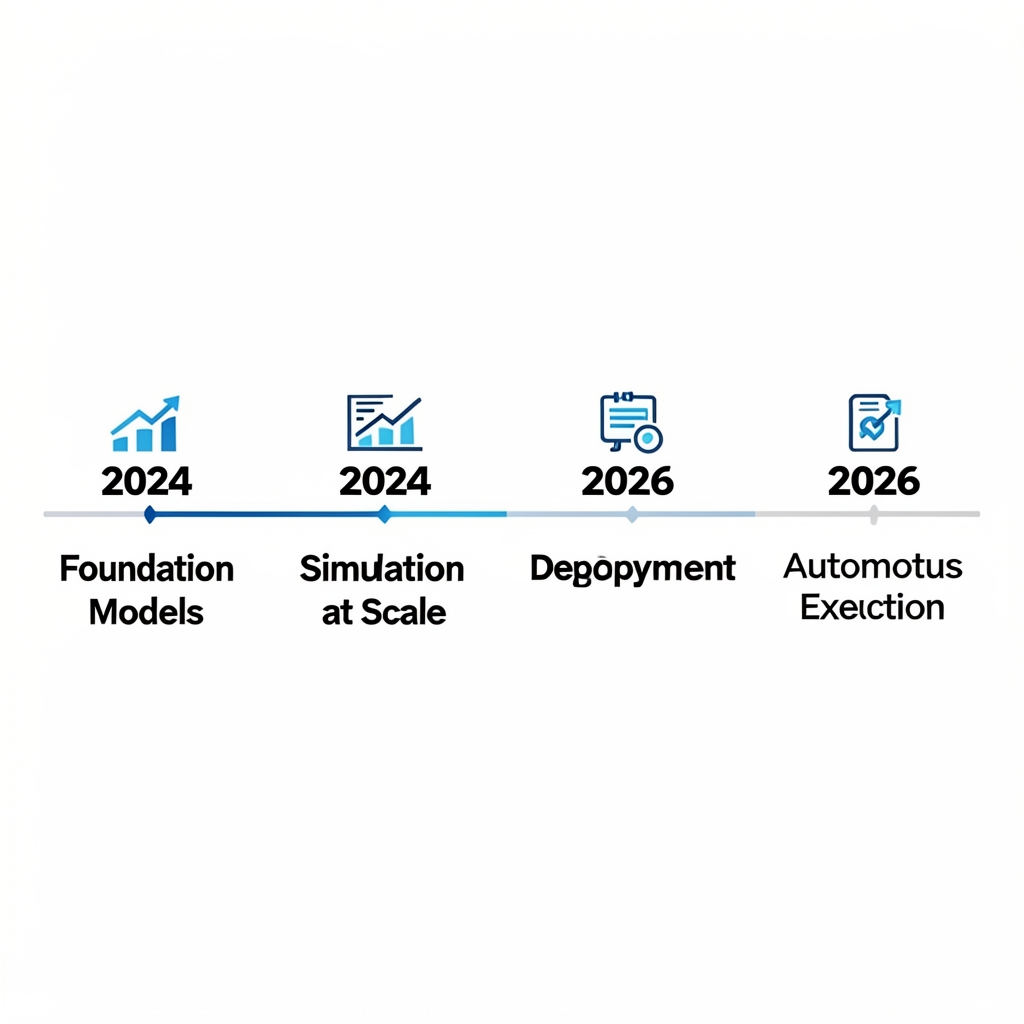
This National Robotics Week (April 4–12, 2026), NVIDIA is highlighting the breakthroughs that are bringing AI into the physical world—and the breadth of those advances is staggering. From pioneering technologies shaping the future of intelligent machines to commercial systems ready for factory floors, the central thesis is clear: physical AI is transitioning from laboratory curiosity to production-grade infrastructure. The evidence spans synthetic training environments that dwarf real-world datasets, manipulators that adjust grip mid-slip based on tactile inference, and software stacks that treat simulation and deployment as a single continuous pipeline rather than disjointed phases. These are not marginal improvements; they represent architectural shifts in how intelligent machines are built, trained, and deployed. To make sense of the density of news emerging from National Robotics Week 2026, the following table breaks down the pivotal developments, their institutional sources, and their practical implications for the robotics ecosystem.
| Breakthrough | Organization / Source | Key Capability | Impact on Physical AI | Announced |
|---|---|---|---|---|
| CraftNet AI Tactile System | Sharpa Robotics | Real-time slip detection with autonomous grip correction | Gives robots human-like touch for delicate, variable grasping | April 2026 |
| NVIDIA Physical AI Platform | NVIDIA Robotics | End-to-end simulation-to-reality toolchain | Eliminates costly fragmentation between training and deployment | National Robotics Week 2026 |
| CVPR Synthetic Dataset | NVIDIA / CVPR | Largest synthetic training corpus for physical AI | Cuts real-world data collection costs and accelerates perception training | CVPR 2025 / 2026 |
| AI-Driven Automation Stack | National Robotics Week 2026 highlight | Autonomous operation in unstructured, human-shared environments | Reduces site-specific engineering for warehouse and service robotics | April 2026 |
| Multimodal Sensory Fusion | Cross-industry research | Integration of vision, haptics, and proprioception | Enables adaptive behavior without hard-coded scenario planning | 2026 |
| "AI Growing Up" Paradigm | Industry consortium (National Robotics Week) | Shift from narrow controllers to generalizable physical intelligence | Marks inflection point from bespoke robots to scalable product platforms | April 4–12, 2026 |
The density of innovation on display reveals a clear pattern: the era of piecemeal robotics—where vision, grasping, locomotion, and planning were isolated engineering fiefdoms—is ending. In its place stands unified end-to-end physical AI. NVIDIA’s 2026 National Robotics Week programming makes this convergence explicit. Rather than treating simulation, training, and edge deployment as separate procurement categories, leading teams now view them as segments of one toolchain. The economic impact is easiest to see in data strategy. By releasing the largest synthetic training datasets for physical AI to date—unveiled at CVPR and amplified during April’s robotics festivities—NVIDIA has slashed the cost of acquiring labeled physical-world data. Teams can now instantiate billions of simulated scenarios, adversarial edge cases included, before a robot’s end effector ever touches a physical object. When synthetic pretraining is combined with real-world fine-tuning, development cycles compress from quarters to weeks.
The Tactile Revolution: Robots That Feel
No capability better illustrates AI truly entering the physical world than the emergence of fine-grained touch. During National Robotics Week 2026, Sharpa Robotics showcased CraftNet AI, a haptic reasoning system summed up by researchers as the ability to detect when an object is slipping and correct for it automatically. Traditional robotic grasping depended on vision-alone feedback or pre-calibrated force thresholds, both of which fail under uncertainty—think of a wet wine glass, a soft fruit, or an oily metal part on an assembly line. CraftNet closes the sensorimotor loop by streaming data from high-density tactile arrays into a neural network trained to predict micro-slip events before they become catastrophic drops. The result is a manipulation policy that reacts to physics rather than merely executing it. For physical AI researchers, this is a watershed moment: touch is no longer an engineering afterthought but a primary sensing modality on par with computer vision, unlocking applications in medical assistance, food handling, and precision manufacturing where failure is expensive and safety is paramount.
AI "Growing Up": From Narrow Tasks to Generalizable Intelligence
National Robotics Week 2026 is also anchored by what insiders have labeled the "four shifts" rewriting robotics architecture. As highlighted across NVIDIA and industry channels during the April 4–12 celebrations, the first identified shift—AI growing up—is the most consequential. It describes a transition away from brittle, single-task controllers (one stack for welding, another for palletizing, a third for navigation) toward generalizable physical intelligence rooted in foundation-style models. These systems are pretrained across massive corpuses of diverse physical tasks and then prompted or fine-tuned for specific deployments, much like large language models shifted NLP in 2023. The consequence is a collapse in integration costs. When a single model architecture can handle unstructured warehouse clutter, variable agricultural terrain, and domestic obstacle avoidance, robots stop being bespoke consulting projects and become repeatable product deployments. Early results from AI-driven automation showcases during the week demonstrate this empirically: autonomous systems are now operating in dynamic, human-shared environments with drastically reduced reliance on site-specific hard coding.
Infrastructure at the Edge: Orchestrating the Physical-Digital Bridge
For all the attention lavished on actuators and cameras, physical AI in 2026 is fundamentally an infrastructure and coordination problem. A contemporary robotic system might simultaneously manage:
- Vision streams at 120 frames per second for object segmentation
- Haptic arrays sampling at kilohertz frequencies for slip detection
- 3D LiDAR point clouds for spatial mapping
- Behavioral foundation models running inference under sub-100-millisecond latency constraints
Building that orchestration layer is not conceptually different from the challenges faced by large-scale digital AI platforms that manage millions of concurrent voice, text, and inference sessions.
Platforms like CallMissed offer a useful architectural parallel. Just as CallMissed provides production-ready voice agent and chatbot infrastructure that switches between 300+ LLMs via a unified API gateway, physical AI demands analogous middleware that can route sensor data to the optimal model without hard-coded rewrites. Latency, fallback policies, and multimodal fusion are critical in both domains. Furthermore, as these robotic systems expand into Indian and other non-English-majority markets, the communication layer becomes vital. Indian startups like CallMissed, which natively support 22 regional languages through speech-to-text APIs, demonstrate the multilingual voice infrastructure that will be required for natural human-robot interaction beyond English-dominated labs. The robots of this decade will not only need to see and feel—they will need to understand and respond across the linguistic diversity of the real world.
Looking Ahead: The Collapsing Sim-to-Real Gap
The final, overarching narrative of National Robotics Week is the rapid dissolution of the simulation-to-reality barrier. With NVIDIA’s latest physics engines and the CVPR synthetic datasets, policies trained entirely in simulation are transferring to physical platforms with minimal domain-randomization overhead. The breakthroughs itemized above coalesce into three strategic implications for the industry:
- Compressed R&D timelines: Synthetic pretraining slashes the need for months of physical testing.
- Capital-efficient scaling: Foundation models allow one trained backbone to serve multiple robot form factors.
- Democratized access: When deployment no longer requires site-specific engineering, mid-market manufacturers can adopt automation previously reserved for automotive giants.
When this sim-to-real capability is stacked atop tactile systems like CraftNet and generalizable model architectures, the result is robots that learn overnight in data centers and perform reliably the next morning on factory floors. Collectively, these developments do not represent isolated research trophies. They are the modular components of a unified physical AI operating system—one being bolted together in public view during April 2026 and poised to define the next decade of intelligent automation.
In-Depth Analysis: How NVIDIA Is Powering the Physical AI Era
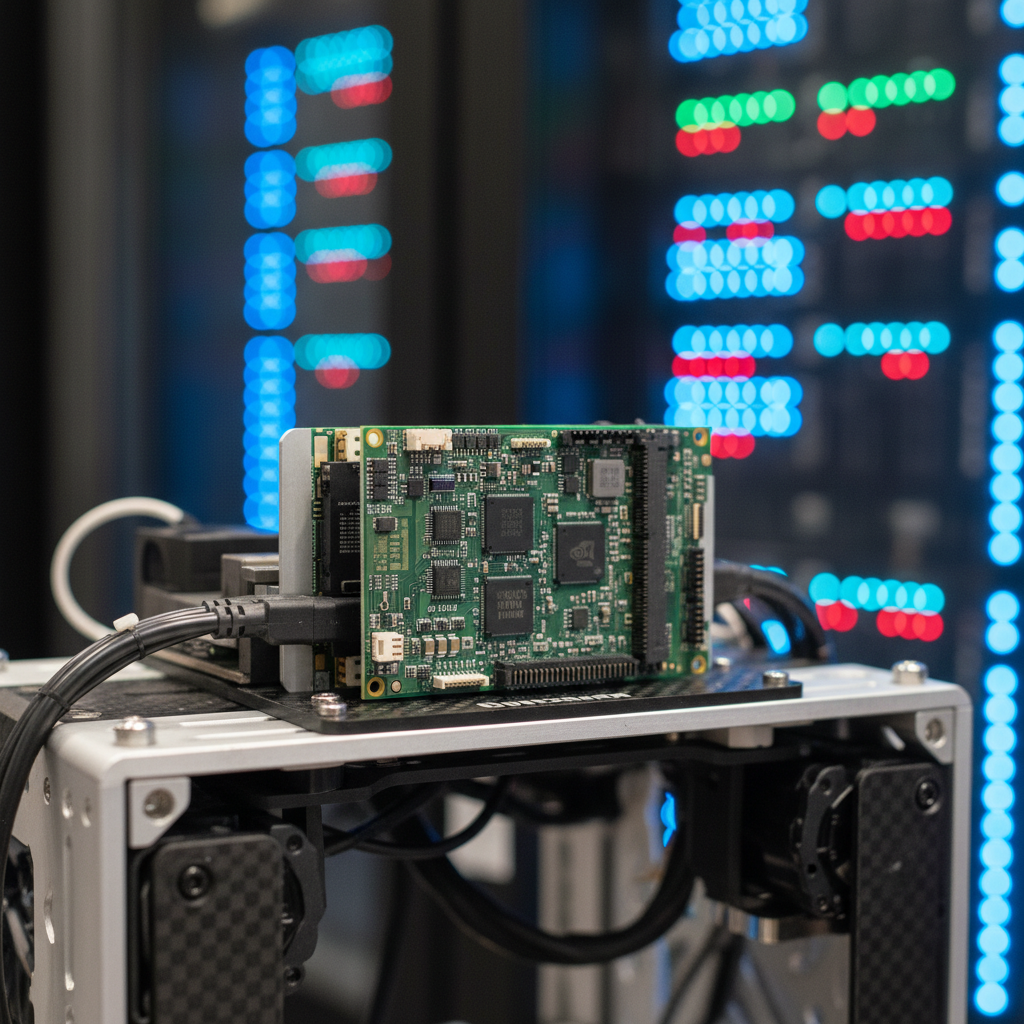
NVIDIA’s dominance in artificial intelligence has long been anchored to data centers and cloud workloads, but National Robotics Week 2026 (April 4–12) makes one trend unmistakable: the company is now the central nervous system of Physical AI. Rather than treating robotics as a vertical niche, NVIDIA is positioning embodied intelligence as the next front in general-purpose computing—one where GPUs, foundation models, simulation engines, and sensory breakthroughs converge to let machines reason through physics rather than merely process it.
The GTC26 Vision: Physical AI as Foundational Infrastructure
At GTC 2026, NVIDIA doubled down on this philosophy with its session “Physical AI for the Real World: A Vision From NVIDIA Robotics.” The presentation framed Physical AI not as a distant research curiosity, but as an imminent infrastructure layer for intelligent machines. This aligns with the company’s broader National Robotics Week messaging, which emphasizes “breakthroughs that are bringing AI into the physical world.”
The significance here is architectural. NVIDIA is no longer content to supply discrete components; it is articulating a full-stack narrative where simulation, training, and deployment happen on a unified continuum. When a single ecosystem controls the silicon (Jetson, Grace Hopper), the simulation environment, and the model distribution channels, it can compress iteration loops that historically slowed robotics development from months to days. For enterprises, this means the barrier to prototyping autonomous systems is falling as fast as the cost of training large language models did two years prior.
From Pixels to Touch: CraftNet and the Sensory Revolution
One of the most concrete breakthroughs highlighted during National Robotics Week is CraftNet AI, a system giving robots a functional sense of touch. Coverage of the week’s announcements notes that robots equipped with this technology can “feel something slip and correct it” in real time—a capability that moves manipulation well beyond vision-only inference.
Why does this matter? Because Physical AI requires more than cameras and lidar. Human-level dexterity depends on haptic feedback loops, and until recently, robotic touch remained a laboratory novelty. By integrating tactile inference into deployable pipelines, the ecosystem around NVIDIA is addressing what many roboticists consider the final bottleneck in general-purpose manipulation. When a warehouse robot can detect texture, pressure, and slippage as dynamically as a human hand, the range of economically viable automation tasks expands exponentially. It is no longer just about seeing an object; it is about understanding how that object behaves when force is applied.
“AI Growing Up”: Four Shifts Rewriting Robotics
An Instagram summary posted during National Robotics Week distilled the current momentum into four shifts “quietly rewriting how robots get built and used.” While only the first shift—“AI growing up”—is explicitly detailed in the recap, the framework itself signals an inflection point for the industry.
This maturation means AI is transitioning from pattern-matching in digital sandboxes to causal reasoning in unstructured environments. Factory floors, agricultural fields, and hospital wards are not sanitized datasets; they contain grease, glare, human unpredictability, and physics that defy rigid scripting. NVIDIA’s emphasis on Physical AI acknowledges that the next leap in capability requires models trained not just on internet text, but on trajectories, forces, material properties, and embodied experience. The official National Robotics Week press materials reinforce this trajectory, explicitly highlighting “AI-Driven Automation & Physical AI’s growth” as defining themes for the 2026 event.
The Compute-Simulation Flywheel
Another critical, if less visible, thread in NVIDIA’s strategy is its presence at CVPR, where the company advanced Physical AI with what National Robotics Week coverage frames as its largest concentrated push into embodied intelligence to date. Computer vision remains the primary perceptual modality for robots, and anchoring Physical AI stories at premier academic venues signals engineering seriousness rather than mere product marketing.
Here, the flywheel effect becomes apparent:
- Synthetic data generation at scale in simulation reduces the need for expensive real-world collection.
- Larger simulation environments improve model robustness against edge cases.
- Better models justify investment in more specialized silicon, which in turn speeds up simulation.
The result is that startups and research labs—which previously needed DARPA-scale budgets to train embodied models—can now access industrial-grade infrastructure through cloud APIs and edge deployments. When simulation fidelity crosses a threshold where the “sim-to-real gap” narrows to single-digit error rates, robotics becomes a software economics problem rather than a hardware physics problem.
Bridging the Human-Machine Divide
Yet for all the advances in silicon and sensors, Physical AI still faces a crucial interface challenge: how do these machines communicate with the humans they work alongside? An industrial arm may execute a flawless pick-and-place sequence, but if a floor manager cannot instruct it in natural language—or receive status updates through familiar channels—the deployment friction remains high.
This is where the communication layer becomes as strategic as the compute layer. Platforms like CallMissed are already enabling businesses to deploy AI voice agents and multilingual conversational interfaces that can sit between human operators and robotic backends. With Speech-to-Text support across 22 Indian languages and Text-to-Speech APIs, such infrastructure ensures that Physical AI is accessible beyond English-centric environments. In global manufacturing hubs or diverse service economies, the ability to route voice commands, WhatsApp alerts, and LLM inference through a single API gateway removes the final barrier to human-machine collaboration.
NVIDIA’s role in the Physical AI era is ultimately that of an accelerant and standard-setter. By unifying the hardware stack, championing tactile inference through projects like CraftNet, and using National Robotics Week 2026 to spotlight structural shifts including the maturation of AI itself, the company is doing more than supplying chips. It is defining the grammar through which intelligent machines interpret the physical world. For enterprises and developers, the implication is clear: the robotics revolution will be built on NVIDIA silicon, but its real-world success will depend on integrating that silicon with sensory modalities, simulation toolchains, and communication stacks that keep the technology grounded in human utility.
Real-World Use Cases and Industry Deployments
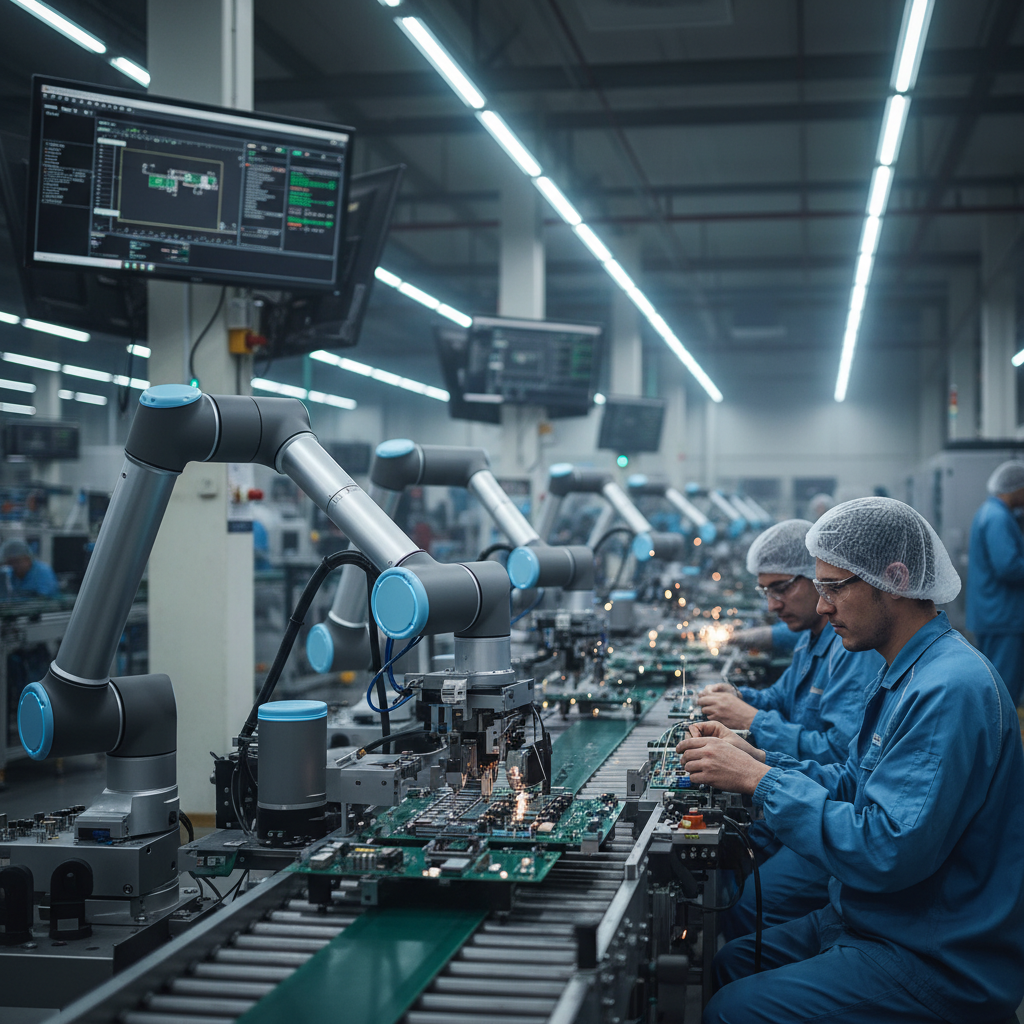
During National Robotics Week 2026, observed April 4–12, NVIDIA underscored a pivotal inflection point: artificial intelligence is finally entering the physical world in production settings, not merely simulated ones. Manufacturing floors represent the most immediate beneficiary, serving as the first large-scale testbed for physical AI. Here, robots are graduating from repetitive, caged automation to adaptive systems capable of handling variation.
A standout breakthrough in tactile intelligence is CraftNet AI, developed by Sharpa, which equips robots with a genuine sense of touch. Recent demonstrations show this system allows robotic grippers to:
- Detect slippage in real time and dynamically correct grasp force mid-operation
- Handle delicate assembly tasks such as precision component insertion and finishing operations
- Modulate surface contact on variable materials without months of reprogramming
By integrating haptic feedback loops with machine learning models trained on physics-aware data, manufacturers are reducing defect rates while reconfiguring production lines faster than traditional automation permits. The shift from blind force-controlled gripping to sensory-aware manipulation is precisely the kind of breakthrough NVIDIA highlighted as redefining intelligent machines in 2026.
Logistics and Warehouse Fulfillment
If manufacturing is the mature beachhead, logistics is the high-growth battleground. Warehouse robotics has evolved rapidly from simple conveyor systems to autonomous mobile robots (AMRs) and articulated pickers operating in chaotic, human-shared environments. According to observations shared during National Robotics Week 2026, the industry is witnessing four structural shifts in how robots are engineered and deployed, with the first being that “AI is growing up”—transitioning from brittle, single-purpose routines to context-aware behaviors.
Modern fulfillment centers now deploy robot fleets that use foundation-model-powered perception to:
- Identify objects in unstructured bins and calculate grasp strategies on the fly
- Navigate around human coworkers without relying solely on pre-mapped floor plans
- Optimize picking paths and palletizing patterns through real-time sensor fusion
The economic driver is unambiguous: labor shortages in logistics are structural, not cyclical, and robots that can adapt to new stock-keeping units without retraining offer a scalable alternative to seasonal hiring spikes. These systems still struggle with highly deformable or transparent objects, but the trajectory points toward fully autonomous sortation and pack-out operations as the hardware and models continue to co-evolve.
Healthcare and Surgical Robotics
Healthcare demands the most rigorous safety and precision standards, making it both the most challenging and most consequential domain for physical AI deployment. During National Robotics Week 2026, the convergence of AI and physical systems was framed as essential to next-generation patient care. Surgical robots are now incorporating real-time haptic feedback and computer vision models that account for tissue deformation and bleeding dynamics—not merely executing a surgeon’s teleoperated commands, but actively stabilizing instruments against physiological motion like respiration or heartbeat.
Beyond the operating room, physical AI is entering rehabilitation and eldercare through intelligent exoskeletons and mobility assistants that interpret patient intent through biomechanical sensors rather than joysticks. These devices must reason about balance, terrain, and user fatigue, then physically respond with appropriate motor support. The breakthrough emphasized by NVIDIA—bringing AI into the physical world—directly enables these applications by closing the latency gap between perception and actuation. As demographics shift and clinical labor becomes scarcer, regulatory frameworks are beginning to accommodate supervised autonomy, moving physical AI from research demos to accredited medical infrastructure.
Agriculture and Autonomous Field Operations
Unstructured outdoor environments pose the ultimate stress test for physical AI. Unlike the controlled lighting and flat floors of warehouses, agricultural robotics must contend with mud, rain, crop variability, and uneven topography. Yet National Robotics Week 2026 highlighted this as an emerging frontier where physical AI is proving its resilience. Autonomous tractors and selective harvesters now leverage multimodal perception—combining LiDAR, spectral imaging, and GPS—to make physical decisions in dynamically changing fields.
These machines must determine:
- How much force to apply when grasping a ripe strawberry versus an unripe one
- How to navigate between rows without crushing root systems
- When to delay field operations based on real-time soil moisture and weather data
The “sim-to-real” transfer techniques championed by NVIDIA allow these systems to train in highly accurate digital twins of specific farms before touching actual soil, reducing both early-season crop damage and deployment risk. As climate volatility increases and agricultural labor pools shrink, intelligent field robots represent a critical path toward yield stability and precision agriculture at continental scale.
Human-Robot Communication and Fleet Orchestration
A frequently overlooked aspect of physical AI deployment is the communication fabric that binds robotic systems to human supervisors and maintenance teams. A factory robot with CraftNet AI touch sensitivity or a warehouse AMR with adaptive routing intelligence is strategically limited if its anomaly alerts do not reach a technician in milliseconds. As physical AI scales, enterprises require conversational interfaces that allow workers to query robot status, schedule maintenance, or issue verbal commands without navigating complex dashboards.
This need is driving adoption of voice-first AI communication layers. Platforms like CallMissed are enabling businesses to deploy voice agents and WhatsApp-integrated chatbots that serve as the liaison between human teams and autonomous systems. With Speech-to-Text support for 22 Indian languages and a multi-model API gateway accessing 300+ LLMs, CallMissed provides the multilingual, real-time communication backbone necessary for global industrial operations where floor supervisors speak diverse regional languages. Whether a technician receives a voice alert about a robotic arm fault or a logistics coordinator queries a warehouse bot via chat, this layer turns isolated physical AI into an integrated, communicative workforce participant.
The Transition From Pilot to Platform
Despite the momentum showcased during National Robotics Week 2026, the transition from laboratory curiosity to industrial infrastructure remains uneven. Real-world deployment requires more than algorithmic dexterity; it demands:
- Ruggedized hardware capable of surviving dust, moisture, and vibration
- Standardized safety certifications for human-robot collaboration zones
- Middleware capable of integrating modern AI with decades-old programmable logic controllers (PLCs)
The theme of AI-driven automation permeating this year’s events signals that the industry is moving past the proof-of-concept phase. Early adopters in automotive, logistics, and agriculture are now running multi-site deployments rather than single-cell pilots. However, cross-industry scaling will depend on establishing common data formats for physical AI training, shared safety protocols, and robust communication APIs that connect edge-deployed robots back to enterprise systems. Physical AI has crossed the threshold from research to reality—the task now is making that reality replicable, reliable, and economically superior to the human-only systems it augments.
The Hardware-Software Convergence Driving Breakthroughs
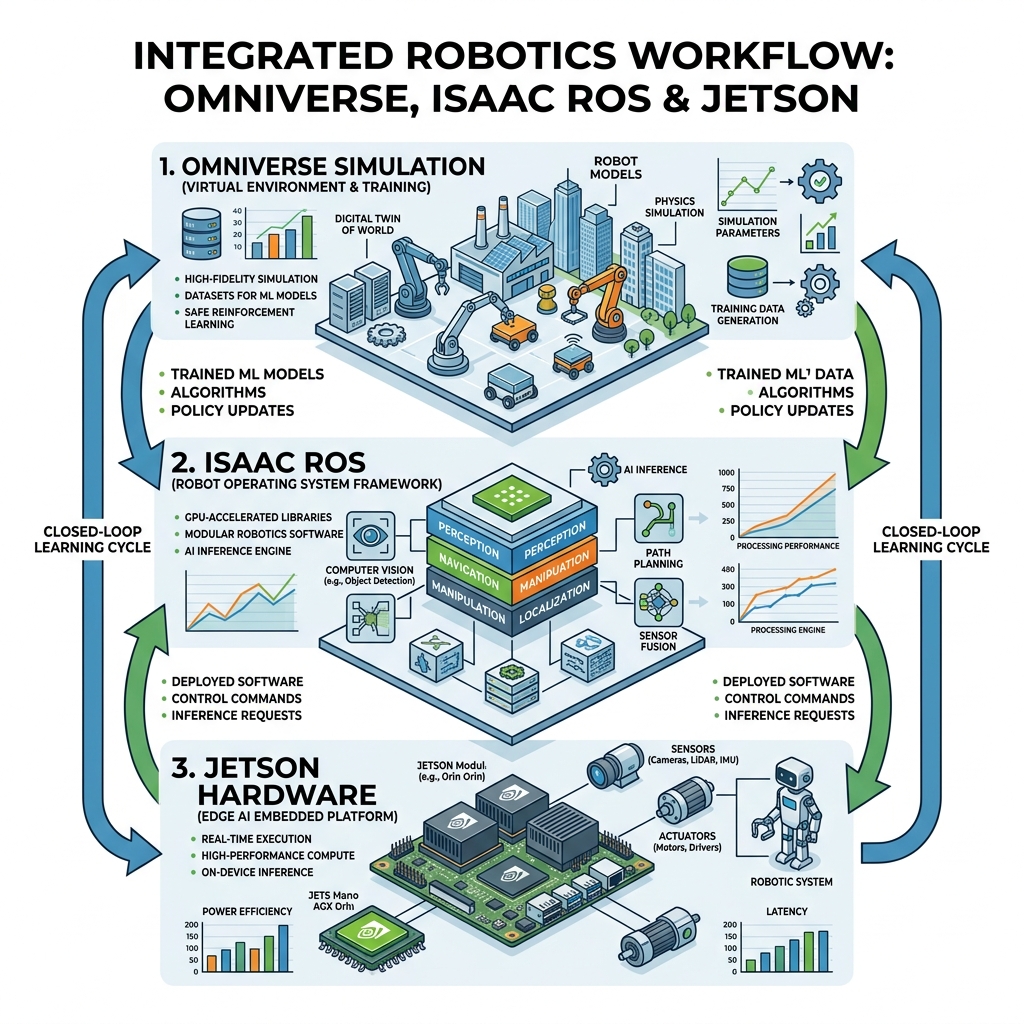
The hardware-software convergence in robotics isn't a new idea, but in 2026, it has accelerated from academic aspiration to commercial imperative. During National Robotics Week (April 4–12, 2026), NVIDIA spotlighted how breakthroughs in physical AI are finally bridging the gap between digital intelligence and mechanical action—a shift that is fundamentally rewriting how robots are built, trained, and deployed. What distinguishes this moment from previous hype cycles is the depth of integration: AI models are no longer external controllers patched onto legacy mechanical platforms. Instead, software architectures now inform hardware design decisions at the earliest prototyping stages, creating feedback loops that compress development cycles from years to months.
The End of the Hardware-Software Wall
For decades, robotics development followed a rigid dichotomy: mechanical engineers optimized actuators and kinematic chains, while software engineers wrote control loops in abstraction. That wall is crumbling. Modern physical AI systems are co-designed from the silicon up, with neural network architectures influencing sensor placement, torque requirements, and even material selection.
Industry observers tracking National Robotics Week 2026 identified four shifts quietly rewriting how robots get built and used, headlined by the maturation of AI itself—what social coverage described as "AI growing up." This maturation means models now reason about physical forces, friction coefficients, and spatial geometry natively, rather than treating the mechanical body as a dumb endpoint. When a foundation model understands inertia and compliance, hardware designers can build lighter, more efficient mechanisms because the software compensates for mechanical simplicity with predictive intelligence. The result is a generation of machines where the boundary between controller and chassis has effectively dissolved.
The characteristics of this converged design approach include:
- Co-optimized sensing and inference — sensors selected specifically for the data requirements of target neural architectures, not legacy industrial standards
- Software-defined mechanics — compliance and damping profiles tuned through model-predictive control rather than fixed hardware parameters
- Model-driven thermal and power budgeting — hardware specifications derived from the inference loads of multimodal transformers running at the edge
Sensory Hardware and Embodied Intelligence
Physical AI requires physical perception, and the most profound convergence points are appearing in multimodal sensory stacks. Breakthrough developments highlighted during this year's National Robotics Week—including CraftNet AI's tactile systems—demonstrate robots gaining a human-like sense of touch. These systems allow machines to detect micro-slippage in grasped objects and autonomously modulate grip force in milliseconds. This is not merely a sensor upgrade; it represents fused hardware-software architectures where tactile sensors generate high-frequency data streams processed by AI models trained specifically on haptic feedback loops.
NVIDIA's robotics research, advanced at CVPR and showcased during National Robotics Week, underscores a broader truth: intelligent machines now require sensor suites that simultaneously serve as data sources for training foundation models, while those same models optimize sensor calibration and noise rejection in real time. Vision transformers process camera inputs alongside force-torque vectors; proprioceptive encoders feed recurrent networks that predict joint fatigue before it occurs. It is a virtuous cycle—more capable hardware generates richer datasets, which trains more sophisticated software, which extracts performance from hardware that would have been considered underpowered five years ago.
From Simulation to Real World at Scale
A converged stack also changes how robots learn. NVIDIA's emphasis on physical AI during National Robotics Week highlighted the industrialization of sim-to-real transfer—training machines inside massive simulation environments before deployment. These digital twins allow robots to rehearse billions of synthetic interactions, develop robust policies in adversarial virtual conditions, and enter the physical world with pretrained motor instincts.
The critical 2026 breakthrough is that edge hardware has become dense enough to run these complex, physics-informed models locally. Warehouse robots, agricultural drones, and clinical assistants cannot tolerate cloud round-trips when fractions-of-a-second delays mean a dropped component or a missed intervention. New generations of edge AI chips and compact system-on-modules now deliver sufficient inference throughput to run multimodal transformers onboard. Coupled with software compression techniques and distillation methods, these hardware advances mean the same models that train in data centers can execute inside power-constrained robot bodies without catastrophic latency.
The Orchestration Layer: Language, Voice, and Fleet Control
As robots gain physical capability, they must also interface seamlessly with human operators and coordinate across distributed fleets. The hardware-software convergence therefore extends beyond the robot chassis into the communication and orchestration stack. Physical AI does not exist in a vacuum; it requires intelligent infrastructure to receive commands, process environmental updates, and relay status across languages and channels.
This is where AI communication infrastructure becomes a component of the converged architecture. Platforms like CallMissed enable businesses to deploy AI voice agents and multilingual interaction layers that function as the nervous system between human stakeholders and physical machines. With Speech-to-Text support for 22 Indian languages and production-ready Text-to-Speech APIs, CallMissed illustrates how regional language AI infrastructure integrates directly with physical AI backends—allowing factory floor managers to command robotic fleets in natural language, or service robots to process safety queries in native dialects without routing through generic cloud translation layers. Furthermore, access to 300+ LLMs through multi-model API gateways lets robotics engineers switch between reasoning models (for task planning) and lightweight models (for real-time edge control) without refactoring their communication stack. In this unified architecture, language understanding is as critical to robot utility as the gripper or actuator.
Implications for the Next Wave of Deployment
The hardware-software convergence is collapsing traditional deployment timelines. When perception, cognition, simulation, and communication are designed as unified systems rather than bolted-on peripherals, robots move from prototype to production faster, fail less often in unstructured environments, and adapt to new tasks through software updates rather than mechanical retrofits.
Enterprises evaluating this shift should recognize three immediate priorities:
- Integrate simulation into product design cycles — digital twin environments are no longer visualization tools; they are training grounds for physical AI models
- Rearchitect edge stacks for multimodal inference — the hardware must support parallel processing of vision, language, and proprioception without cloud dependency
- Deploy communication infrastructure that matches robotic capability — voice, text, and API orchestration layers must be as responsive as the mechanical systems they control
National Robotics Week 2026 framed physical AI not as a distant research frontier, but as an immediate engineering reality. The robots emerging from this converged stack are cheaper to scale, faster to train, and capable of operating alongside humans in cluttered, unpredictable spaces. For organizations across manufacturing, logistics, and healthcare, the strategic imperative has shifted: the question is no longer whether these systems will enter operations, but how quickly their infrastructure boundaries can dissolve to let hardware and software advance as a single, intelligent system.
Impact & Implications for Global Industry and Labor

Manufacturing and Supply Chain Disruption
The breakthroughs NVIDIA spotlighted during National Robotics Week (April 4–12, 2026) signal that artificial intelligence has crossed a critical chasm—from predicting patterns in data to manipulating matter in the real world. The event’s coverage identified four shifts quietly rewriting how robots get built and used, beginning with “AI growing up.” This maturation reflects a move away from brittle, hand-coded factory routines toward adaptive systems that learn from physics-based simulation and deploy into unstructured environments with minimal retrofitting.
For global manufacturing, the most immediate impact is adaptive automation at the point of contact. CraftNet AI, for example, gives robots a sense of touch, enabling them to detect when an object is slipping and correct their grip in milliseconds. When combined with the computer vision advances NVIDIA showcased at CVPR under its Physical AI program, these systems can interpret uneven surfaces, fragile materials, and shifting warehouse loads without human micromanagement. The result is a supply chain capable of absorbing volatility—whether that means reconfiguring assembly lines for smaller batch sizes or maintaining throughput during labor shortages. Enterprises that treat this hardware-software convergence as capital infrastructure rather than experimental R&D during 2026–2027 will likely set the operational benchmark for their industries.
Labor Market Transformation and Skill Displacement
Physical AI does not eliminate jobs categorically; it redraws the boundaries around specific tasks. As the robotics research highlighted this April demonstrates, machines are increasingly absorbing the “3D” workload—tasks that are dirty, dangerous, and dexterous. The tactile and spatial reasoning breakthroughs on display mean that machine operators, quality inspectors, and material handlers will see declining demand for repetitive manual execution, while facing rising demand for judgment-based oversight. The workforce implications break down along three vectors:
- Task bifurcation: Human roles narrow toward exception handling, creative troubleshooting, and calibration, while robots assume routine physical cognition.
- Geographic unevenness: Developed economies facing demographic contraction may deploy physical AI as a labor-force backstop, whereas economies competing historically on wage arbitrage must adapt before capital-efficient robots close the cost gap.
- Reskilling urgency: The next wave of technical education will center on physical AI orchestration—teaching workers to supervise heterogeneous robot fleets, interpret sensor telemetry, and retask cobots through demonstration or natural language rather than conventional programming.
Labor markets that treat this transition as purely a future risk are already behind. The tooling entering production today, showcased during National Robotics Week, requires maintenance ecosystems, simulation technicians, and ethics auditors who understand human-robot proxemics.
Global Economic Realignment
Physical AI is rapidly becoming a determinant of industrial sovereignty. NVIDIA’s concentrated messaging during National Robotics Week 2026 underscores that AI-driven automation capabilities now correlate directly with which nations attract advanced manufacturing and which are bypassed. When robots can perform tactile assembly, real-time defect correction, and adaptive packaging, the economic logic of offshoring weakens. Labor-cost differentials matter less than the density of technical infrastructure—high-fidelity simulation environments, edge inference hardware, and robotics-grade computer vision talent.
This shift favors regionalized production networks. Advanced economies are positioned to reshore pharmaceutical finishing, electronics assembly, and precision component manufacturing not by reverting to expensive manual labor, but by deploying dense clusters of Physical AI systems. Conversely, nations without parallel digital infrastructure or advanced vocational pipelines risk premature deindustrialization. Unlike previous digital divides, the Physical AI gap is harder to bridge because it demands simultaneous mastery of semiconductor access, mechanical engineering, and real-world model training.
Communication Infrastructure for the Physical AI Era
The breakthroughs lauded during National Robotics Week achieve commercial scale only when stitched into cohesive operational ecosystems. A warehouse robot that can feel a slipping package generates value only if it can also report the anomaly, trigger rescheduling, and alert stakeholders across languages and time zones without introducing human latency.
This convergence of physical action and intelligent coordination is where communication infrastructure enters the architecture. Platforms like CallMissed exemplify how the service layer is evolving in parallel: by offering production-ready voice agents, WhatsApp chatbots, and LLM inference across 22 Indian languages, they enable the orchestration layer that surrounds robotic workcells. In practice, a manufacturing hub in Mumbai might deploy tactile robots on the factory floor while CallMissed-managed AI agents simultaneously handle supplier negotiations, customs documentation queries, and customer service in Hindi, Tamil, or Telugu.
As Physical AI proliferates globally, the distinction between robotics and enterprise communication collapses into a single automation fabric. Production schedules spoken into voice agents can trigger robotic fulfillment; chatbot-confirmed purchase orders can activate pick-and-place systems. Forward-looking enterprises will architect their 2026 roadmaps around this unified stack—physical intelligence for matter, multilingual communication platforms for coordination.
Expert Opinions: What Researchers and Founders Are Saying

NVIDIA and the "Physical AI Becomes Real" Moment
This National Robotics Week, observed April 4–12, 2026, NVIDIA’s research communications have centered on a single, unambiguous thesis: physical AI is no longer a research curiosity—it is becoming real. In the company’s official blog coverage of the event, NVIDIA highlighted breakthroughs that are actively "bringing AI into the physical world" rather than merely refining it inside simulation environments. The framing marks a strategic inflection point. Where previous years treated robotics as a domain of incremental sensor upgrades and hardware tweaks, the 2026 narrative treats embodied intelligence as a computing platform in its own right. The event explicitly framed these advances as part of a multi-year arc, with NVIDIA positioning its robotics stack not as an experimental toolkit but as production-grade infrastructure for the next industrial wave.
NVIDIA’s GTC26 session, titled Physical AI for the Real World: A Vision From NVIDIA Robotics, doubled down on this trajectory, presenting a roadmap for how large-scale AI models will govern perception, reasoning, and action in unpredictable environments. Industry observers tracking the event—including voices amplifying the discourse across LinkedIn and tech outlets like VoiceVox—echoed the assessment, noting that the shift from digital intelligence to physical agency is happening faster than many projected, with hardware-software co-design now the dominant paradigm among top-tier research labs.
Founders on the Frontier: Sensation, Slippage, and Real-World Touch
If NVIDIA’s research teams are defining the platform layer, founders are attacking the sensation layer. Among the most cited breakthroughs this National Robotics Week is CraftNet AI, developed by Sharpa Robotics, which gives robots a functional sense of touch. In a LinkedIn post that gained traction during the week, the Sharpa team demonstrated a tactile-feedback system capable of detecting physical slip in real time—a failure mode that has defeated industrial grippers for decades. The team distilled the core challenge into a single, telling phrase: "feeling something slip and correcting it."
Why does this matter? Because grasping remains the bottleneck of physical AI. A robot that can see but cannot feel operates in a world of approximations. By closing the loop between tactile sensing and corrective motor control, CraftNet AI embodies the expert consensus emerging in 2026: the next frontier is not more vision, but more sensation. Founders in the robotics space are increasingly vocal about the reality that laboratory-perfect computer vision crumbles under contact physics, moisture, and material variance. The pivot toward haptic intelligence, as demonstrated by Sharpa and amplified during National Robotics Week, signals that the industry is graduating from passive observation to active, sensory-mediated manipulation. In practical terms, experts expect 2026 to be remembered as the year robots started receiving sensory upgrades that match the sophistication of their cognitive backends.
The Four Shifts Quietly Rewriting Robotics
National Robotics Week 2026 has also served as an annual audit of macro-level trends. Industry observers mapped four shifts that are quietly rewriting how robots get built and used. While the complete framework circulated across social channels including Instagram and tech news outlets, one shift dominated early discourse: AI growing up.
This phrase captures more than model scaling. It refers to the transition from narrow, task-specific controllers to generalist physical AI systems capable of improvisation. As the narrative frame suggests, "AI growing up" means robots are moving from scripted playbooks to context-aware reasoning. The surrounding coverage implies the other three shifts center on:
- The convergence of LLM reasoning with robotic actuation, enabling natural-language task decomposition to directly drive motor planning.
- The collapsing latency and cost of simulation-to-reality transfer, allowing policies trained in synthetic environments to deploy with minimal fine-tuning on physical hardware.
- The commoditization of edge compute powerful enough to run multimodal perception models locally, reducing dependency on cloud-only inference.
Together, these shifts explain why 2026 feels substantively different from prior National Robotics Week events. The conversation is less about mechanical elegance—gear ratios, servo precision—and more about cognitive autonomy.
The Communication Layer: Why Voice and Language Matter
As physical AI systems gain autonomy, the interface between human operators and machines becomes a critical research vector in its own right. Researchers and founders alike are increasingly treating natural-language command-and-control as a safety feature, not merely a convenience. A warehouse robot that can parse verbal stop commands, clarification requests, or multilingual warnings is fundamentally safer than one reliant solely on static code overrides or joystick control.
This is where communication infrastructure intersects with hardware breakthroughs. Platforms like CallMissed are enabling businesses to deploy AI voice agents and WhatsApp chatbots that operate across 22 Indian languages natively, leveraging LLM inference spanning 300+ models. In the context of physical AI, such infrastructure serves as the coordination layer between distributed human teams and autonomous robotic fleets. The same Speech-to-Text and Text-to-Speech APIs that power customer conversations can translate floor-manager directives into actionable robot instructions, bridging the gap between digital reasoning and physical action without forcing every robotics startup to rebuild the linguistic stack from scratch.
Expert Outlook: From Demonstration to Deployment
The dominant sentiment among researchers and founders this National Robotics Week is best described as patience married to urgency. There is widespread agreement—echoed across NVIDIA’s research communications, Sharpa’s tactile AI demonstrations, and the broader discourse on "AI growing up"—that the core components for generalist physical AI are now commercially viable. What remains is integration at scale.
NVIDIA’s emphasis on advancing physical AI at CVPR, paired with its GTC26 session, Physical AI for the Real World, points to an ecosystem strategy: supplying the GPUs, simulation frameworks, and pretrained model architectures upon which founders can build. Meanwhile, hardware-first founders are reminding the field that software without sensation is incomplete. Founders stress that securing venture funding in 2026 increasingly depends on demonstrating real-world contact-hour reliability—metrics like tactile correction latency and slip-recovery rates are replacing demo videos as the currency of credibility. This hardening of expectations mirrors what NVIDIA’s research arm has been signaling: physical AI must survive entropy, not just impress in boardrooms.
As CraftNet AI and similar haptic systems demonstrate, the winning architecture for 2026 and beyond will be multimodal not merely in pixels and parameters, but in pressure, texture, and torque. The expert consensus is clear. Physical AI has crossed the threshold from laboratory demo to production roadmap. What researchers and founders are saying, collectively, is that the age of truly intelligent machines is no longer a future headline. It is a current build, and National Robotics Week 2026 will likely be remembered as the year the industry fully aligned on that fact.
What This Means For You
Physical AI is no longer confined to research papers and NVIDIA keynotes. During National Robotics Week 2026 (April 4–12), the industry consensus became unmistakable: artificial intelligence is growing up and stepping into the physical world. From breakthroughs in robotic touch sensing—such as CraftNet AI allowing machines to feel slippage and adjust grip—to NVIDIA's latest advances in simulation-to-reality pipelines, the technologies showcased this week are rewriting how robots are built, trained, and deployed.
But beyond the headlines and benchmark scores, what does this shift actually mean for builders, business leaders, and everyday users? The answer depends on where you sit in the value chain.
The Bridge Between Digital Intelligence and Physical Action
For years, AI progress was measured in tokens generated, images synthesized, and chatbot accuracy. National Robotics Week 2026 marked an inflection point where AI capabilities began translating directly into physical outcomes. NVIDIA's highlighted research shows that modern robotic systems no longer rely solely on pre-programmed movements; instead, they use foundation models trained in simulation to adapt to friction, weight, and unexpected obstacles in real time.
This evolution demands more than better hardware. It requires multimodal AI stacks that seamlessly integrate computer vision, haptic feedback, natural language understanding, and motion planning. Just as importantly, these physical agents need intuitive interfaces to communicate with humans. Voice commands, multilingual instructions, and real-time status updates are rapidly becoming the control layer for physical AI. Platforms like CallMissed are already enabling this convergence by offering production-ready voice agents, Speech-to-Text APIs supporting 22 Indian languages, and LLM inference gateways that let developers orchestrate 300+ models—effectively giving physical robots the ability to understand and respond naturally to human operators without locking into a single provider.
By Role: How to Prepare for Physical AI
The table below breaks down exactly what the Physical AI revolution means for different stakeholders, when they can expect to feel the impact, and the concrete step they should take today.
| If You Are... | Physical AI Impact on Your Work | Timeline to Impact | First Step to Take |
|---|---|---|---|
| Developer / AI Engineer | You will build multimodal pipelines combining vision, touch (e.g., CraftNet AI), and LLMs to control adaptive robots rather than relying on hard-coded scripts. | 6–12 months | Start experimenting with NVIDIA Isaac Sim and open physical AI datasets for sim-to-real transfer. |
| Business Operator | AI-driven automation will handle semi-structured physical tasks—sorting, packing, inspection—that previously required human judgment and dexterity. | 12–24 months | Audit your operations for repetitive physical workflows with variable inputs that are ripe for intelligent automation. |
| Startup Founder | NVIDIA's open-source physical AI tools and accelerated computing platforms lower the barrier to prototyping adaptive robots for niche verticals. | 3–6 months | Apply to the NVIDIA Inception program and prototype a minimum viable physical AI agent using cloud simulation. |
| Enterprise Leader | Expect measurable ROI from adaptive robotics in logistics, manufacturing, and facilities management, with systems that improve through real-world interaction. | 18–36 months | Launch controlled pilots in closed environments (warehouses, factory floors) before deploying in unpredictable open-world settings. |
| AI Researcher | Foundation models for robotics are emerging as the next frontier after LLMs, with massive datasets and new architectures debuting at events like National Robotics Week. | Now | Focus publications and experiments on generative physical AI, world models, and sim-to-real generalization. |
| Consumer / End User | Interactions with service robots will become conversational and context-aware, driven by natural language processing and tactile sensing. | 24–48 months | Prepare for ambient intelligence where voice or chat commands seamlessly trigger physical actions in your home or workplace. |
Why Communication Infrastructure Matters for Physical AI
The robots highlighted during National Robotics Week 2026 are not only mechanically sophisticated—they are socially integrated. A warehouse robot that can safely grip a fragile package delivers limited value if it cannot report a fault to a floor manager in natural language or receive verbal instructions to adjust its grip mid-task. This is where AI communication infrastructure becomes critical.
Physical AI agents require the same robust API ecosystems that digital AI agents already depend on. Speech-to-Text, Text-to-Speech, and LLM orchestration layers act as the nervous system connecting mechanical capability to human intent. Companies building in this space, including CallMissed, provide the multilingual voice and chat infrastructure that physical AI systems will use as their default interface layer. With support for 22 regional Indian languages and a multi-model gateway spanning 300+ LLMs, such platforms ensure that physical AI deployments are not constrained by language barriers or single-model limitations.
Strategic Takeaways for the Next 24 Months
If National Robotics Week 2026 made one thing clear, it is that the gap between digital AI and physical action is closing faster than many organizations anticipated. Here is how to position yourself:
- Treat simulation as a core competency, not a precursor. NVIDIA's latest research emphasizes that training in high-fidelity simulation is now the primary path to real-world robustness. Invest in simulation-first development cycles rather than viewing simulation as a preliminary testing phase.
- Expect the "touch gap" to close rapidly. Technologies like CraftNet AI demonstrate that robotic haptics are moving from experimental to commercial-grade within this decade. Any physical automation strategy should account for tactile sensing and force feedback within the next 18 to 24 months.
- Plan for multimodal from day one. The winning physical AI architectures will fuse vision, language, and proprioception into unified models. Building siloed perception systems will create technical debt that is expensive to unwind later.
- Consider the human-machine interface early. The most capable physical AI will fail in production if humans cannot direct it intuitively. Embedding voice and conversational layers via communication platforms ensures your robots remain operable by non-technical staff across diverse linguistic markets.
- Watch the policy and safety horizon. As AI moves into physical space, liability frameworks, safety certifications, and labor regulations will evolve faster than software-era governance. Initiating compliance and risk-assessment conversations now will prevent deployment bottlenecks later.
Physical AI is transitioning from a research curiosity to a deployment reality. Whether you are writing the code, signing procurement contracts, or simply preparing to live and work alongside intelligent machines, the groundwork laid during National Robotics Week 2026 is about to fundamentally reshape the physical world around you.
Resource Roundup: Tools, SDKs and Learning Paths

National Robotics Week 2026, observed April 4–12, arrives at a moment when physical AI is crossing from laboratory curiosity to production engineering [5]. According to NVIDIA’s dedicated coverage for the week, the industry spotlight is on breakthroughs that are actively bringing AI into the physical world—embodied systems that perceive, plan, and act in real time [1][2]. A widely circulated summary of the week’s themes identified four shifts quietly rewriting how robots get built and used, beginning with AI itself “growing up”—essentially, foundational models, GPU simulation stacks, and edge inference engines have matured enough that teams can now prototype on software before committing to full hardware fleets [5]. For developers and technical founders, this means the primary constraint is no longer actuator cost but integration velocity and team skill. The following roundup maps the tools, SDKs, and learning paths defining the 2026 physical AI landscape.
NVIDIA Isaac, Omniverse, and the Simulation-First Workflow
NVIDIA’s messaging during National Robotics Week has consistently centered on pioneering technologies shaping the future of intelligent machines, and the practical anchor for that vision is a simulation-first development stack [2][4]. Instead of training policies entirely on physical prototypes, developers increasingly construct digital twins inside NVIDIA Omniverse, a physically accurate environment where lighting, material properties, and sensor noise can be calibrated to match shop floors or outdoor sites. The companion NVIDIA Isaac platform supplies GPU-accelerated perception, manipulation, and navigation libraries, enabling teams to iterate AI behaviors in simulation and deploy them to edge devices such as the NVIDIA Jetson family. This pipeline attacks one of robotics’ most expensive pain points: the reality gap between synthetic data and messy physical dynamics. During GTC 2026, NVIDIA Robotics detailed its roadmap for scaling physical AI to real-world operation, underscoring how these integrated tools compress development cycles from months to days [4]. For resource-constrained startups, the takeaway is that software traction can now precede capital expenditure on hardware.
Open-Source Ecosystem: ROS 2, OpenUSD, and Middleware
If the NVIDIA stack provides the engine room, the open-source ecosystem supplies the plumbing. ROS 2 remains the de facto robotics middleware, but its 2026 relevance lies in tighter integration with OpenUSD (Universal Scene Description) pipelines—an interoperability layer strongly aligned with NVIDIA’s broader ecosystem. This convergence allows mechanical CAD assets, synthetic environments, and runtime scene graphs to share a single semantic language, reducing the translation errors that historically broke sim-to-real transfer. The maturity of these frameworks directly reflects the National Robotics Week observation that AI is “growing up”: developers now expect deterministic real-time performance alongside stochastic neural-network policies [5]. Complementary tools like Nav2 for autonomous navigation and MoveIt for manipulation have stabilized with improved behavior-tree support, giving engineering teams production-grade path planning without custom state-machine development. As National Robotics Week 2026 press coverage notes, the surge in AI-driven automation depends on these interoperable hardware-software interfaces becoming reliable enough for factory floors [8].
Learning Paths and Workforce Readiness
Tooling is only as effective as the developers deploying it. National Robotics Week has always served an educational mandate, and the 2026 physical AI moment demands interdisciplinary fluency spanning mechanical engineering, computer vision, safety systems, and GPU optimization. NVIDIA’s Deep Learning Institute (DLI) offers hands-on labs mapped directly to the breakthrough architectures being promoted this April—including Isaac Sim, Omniverse, and accelerated perception pipelines [1][6]. These courses target the gap between academic ML knowledge and the constraints of embodied systems, covering topics such as synthetic data generation, domain randomization, and Jetson deployment.
Outside vendor ecosystems, university curricula are expanding into tactile sensing and reactive grip control—research tracks recently demonstrated by projects such as CraftNet AI, which enables robots to feel objects slip and adjust grasp force in real time [7]. Self-directed engineers typically progress through three validated stages: first, gaining proficiency in Python/C++ and ROS 2 fundamentals; second, mastering GPU-accelerated simulation and synthetic dataset creation; and third, optimizing models for edge latency and functional safety under ISO/TS 15066 constraints for collaborative robots.
Voice, Language, and the Human-Robot Communication Layer
Physical AI is not solely about motion planning; an embodied agent must also interpret unstructured human commands. As intelligent machines enter warehouses, clinics, and domestic settings, the interaction bottleneck is increasingly multimodal communication—particularly natural-language instruction delivered through speech in noisy, reverberant environments. This is where communication infrastructure converges with robotics. Platforms such as CallMissed provide production-ready voice agent infrastructure that integrates naturally with robotic operating systems: their Speech-to-Text APIs support 22 Indian languages, enabling voice command layers for diverse workforces without requiring in-house acoustic model training. Additionally, CallMissed’s multi-model gateway—offering access to 300+ LLMs—allows roboticists to offload intent parsing, task planning, and contextual memory to cloud-hosted language models while reserving onboard GPU cycles for physics and control. For startups deploying outside English-majority markets, coupling multilingual STT and TTS with physical AI controllers transforms a lab prototype into a field-deployable coworker.
Building Your 2026 Robotics Roadmap
If you are assembling a physical AI stack during National Robotics Week, prioritize composability and proven integration over experimental novelty. The tooling landscape in April 2026 favors disciplined engineering.
- Establish simulation dominance. Use NVIDIA Omniverse or equivalent GPU-accelerated simulators to generate synthetic perception data and stress-test control policies before purchasing hardware [4].
- Anchor on stable middleware. Build atop long-term-support ROS 2 distributions, leveraging Nav2 for navigation and MoveIt for manipulation to avoid reinventing motion primitives.
- Inject communication early. Design multimodal human-in-the-loop interfaces from day one. Managed communication APIs—such as CallMissed’s LLM inference engine and WhatsApp chatbot channels—can handle task approvals, exception handling, and emergency-stop signaling without burdening embedded compute.
- Profile edge-to-cloud latency. Physical AI demands deterministic response times. Benchmark vision and language models on target edge hardware under real network conditions before locking system architecture.
- Engage industry programming. National Robotics Week’s official press and event resources highlight competitions, university partnerships, and vendor showcases that can accelerate hiring and supply-chain relationships [8].
As NVIDIA’s National Robotics Week coverage emphasizes, physical AI is no longer a speculative horizon—it is an executable engineering discipline backed by tangible SDKs, simulation suites, and managed inference services [1][3]. Whether you are calibrating a digital twin, refining a manipulation transformer, or enabling a field technician to direct a cobot in Hindi, Tamil, or Marathi, the message of April 2026 is unambiguous: the tooling has arrived. What separates demonstration from deployment is the speed at which teams can integrate simulation, open-source robotics, and communication layers into a single, reliable physical AI system.
Frequently Asked Questions
As National Robotics Week 2026 (April 4–12) spotlights the accelerating convergence of artificial intelligence and electromechanical systems, global interest in physical AI has reached new heights among robotics engineers, enterprise operations teams, academic researchers, and policy makers tracking workforce transformation. NVIDIAs latest event coverage—spanning tactile breakthroughs like CraftNet AI, massive simulation-to-reality training pipelines, and edge-computing inference stacks—has prompted a wave of practical questions about what these technologies mean for real-world deployment, human-robot collaboration, and long-term automation strategy. The following six answers address the most pressing, search-driven questions surrounding this years landmark breakthroughs, official educational resources, and the modern communication infrastructure required to make intelligent machines truly production-ready across diverse linguistic and industrial environments.
What is National Robotics Week 2026 and why is it significant for physical AI research?
What are the latest physical AI breakthroughs being showcased during National Robotics Week 2026?
How does physical AI differ from traditional industrial robotics?
How do AI communication platforms support the deployment of physical AI and robotics?
Which industries are adopting physical AI and automation fastest after National Robotics Week 2026?
Where can developers find National Robotics Week 2026 resources and research on physical AI?
Conclusion: The Road Ahead for Physical AI
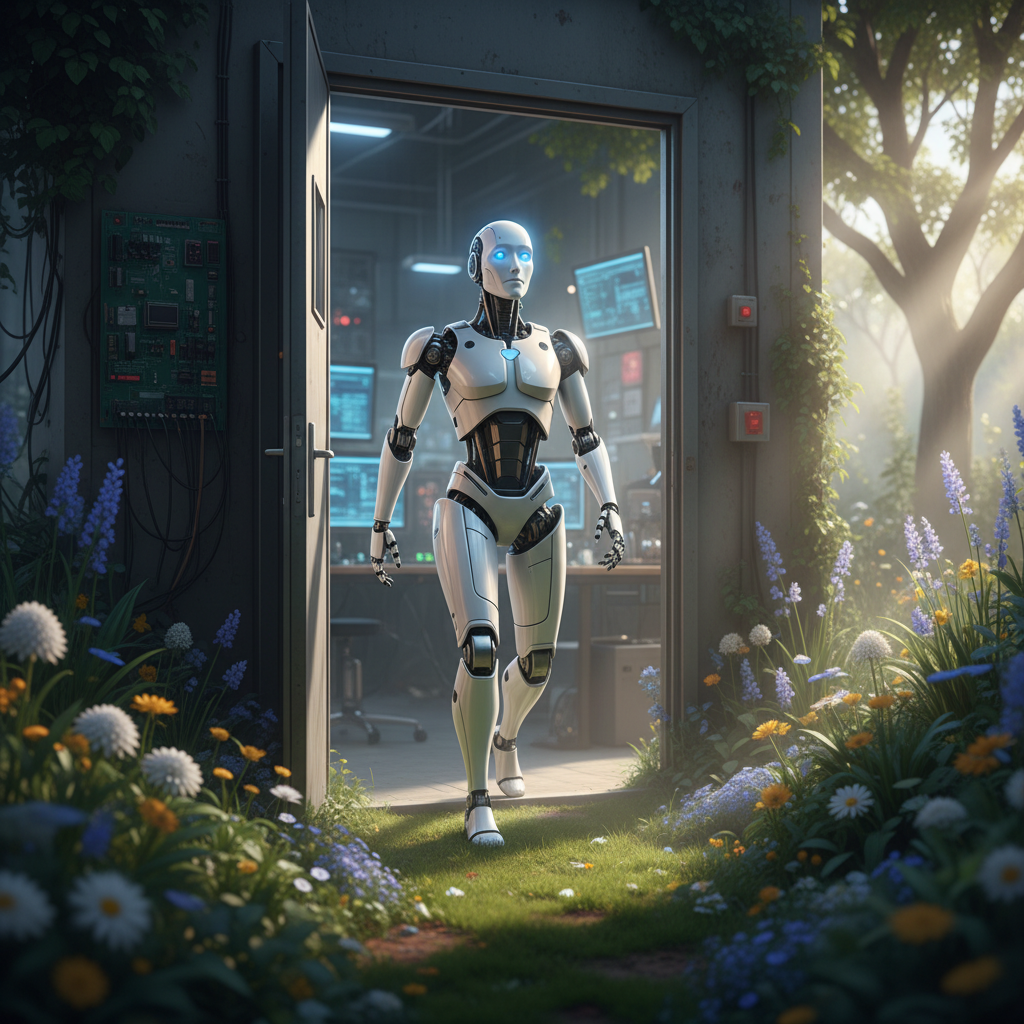
The Inflection Point: When Software Learns to Move
National Robotics Week 2026, observed from April 4–12, arrived at a pivotal moment for the artificial intelligence industry. As NVIDIA emphasized throughout the week, the dominant narrative around AI is undergoing a fundamental refactor: the technology is no longer confined to large language models behind glass screens or recommendation engines running silently in the cloud. Physical AI—systems that perceive, reason about, and act upon the real world—is becoming real. This transition from pure digital cognition to embodied intelligence represents the most significant expansion of AI’s operational footprint since the rise of deep learning itself.
The evidence of this shift was embedded in the week’s central showcases. Industry discussions highlighted four distinct movements that are quietly rewriting how robots get built and used, headlined by the maturation of artificial intelligence as a discipline. The framing of “AI growing up,” as captured in coverage of the week’s trends, distills the essence of this evolution: models are graduating from predicting the next word to predicting the next movement, the next grasp, and the safe path through an unstructured environment. The once-firm boundary between thinking software and acting hardware is dissolving, and National Robotics Week served as the industry’s formal acknowledgment that the era of disembodied intelligence is ending.
The Sensory Revolution: More Than Computer Vision
What distinguished the 2026 showcases was an aggressive expansion of robotic perception beyond traditional vision systems. The breakthroughs highlighted by NVIDIA underscored a truth that researchers have long accepted: sight alone is insufficient for robust physical intelligence. This truth was embodied by innovations like CraftNet AI, which is explicitly giving robots a sense of touch—enabling machines to detect when an object is slipping and correct their grip in real time.
This sensory layer changes the economics of automation entirely. A robot that can interpret pressure, texture, and shear forces can handle delicate produce, insert microscopic components on an assembly line, or provide physical assistance in elder care with a dexterity previously out of reach. When combined with NVIDIA’s advances at CVPR, where the company advanced physical AI research at the computer vision community’s premier global gathering, the result is a convergence of touch, vision, and spatial reasoning that begins to mirror the multimodal richness of human perception. These capabilities are prerequisites for the general-purpose robots that National Robotics Week 2026 positioned on the near-term horizon.
Bridging Embodied Action and Human Communication
Yet the most underappreciated architecture in the physical AI stack may be the communication layer that connects machines to human operators. The robots emerging from this wave will not operate in isolation. They will take verbal instructions on warehouse floors, confirm patient medication deliveries in clinical settings, and escalate exceptions when a package is damaged or a pathway is blocked. The complexity of these interactions demands fluent, multilingual interfaces between human intent and machine execution.
This is where digital communication infrastructure intersects with physical hardware in consequential ways. Platforms like CallMissed are already constructing this interface by deploying AI voice agents and WhatsApp chatbots that integrate directly with operational backends. For physical AI to function in Indian manufacturing hubs, agricultural cooperatives, or regional healthcare clinics, the ability to process spoken commands in native languages is not a luxury—it is a requirement. CallMissed’s Speech-to-Text support for 22 Indian languages and production-ready Text-to-Speech APIs provide the multilingual substrate that physical AI systems need to receive verbal corrections, confirm task completion, and escalate edge cases to human supervisors.
Moreover, the cognitive diversity required for physical tasks far exceeds what any single foundational model can reliably deliver. Simultaneously navigating an unstructured environment, parsing a visual scene for obstacles, generating a collision-free motion plan, and reasoning through a spoken dialogue requires orchestration across a broad ecosystem of specialized AI models. Solutions like CallMissed’s multi-model API gateway, which lets developers route inference across 300+ LLMs, reflect the architectural flexibility that physical AI stacks will increasingly demand. Just as cloud infrastructure democratized software deployment, these cognitive-layer platforms are lowering the engineering barrier for robotics teams to combine perception, reasoning, and action without building every model from scratch.
The Unsolved Equation: Generalization, Cost, and Trust
For all the momentum captured during National Robotics Week 2026, the road ahead remains strewn with challenges that will define the next decade. Generalization is still the central unsolved problem. The gap between a robot performing flawlessly in a simulation or controlled demo and one adapting to a chaotic, unstructured home or factory floor is measured in years of additional research, not months of fine-tuning.
Energy consumption and edge compute present equally formidable barriers. Embodied intelligence requires constant sensory processing and real-time decision-making under tight latency constraints, pushing power requirements far beyond what software-only AI demands. Then there is the question of safety and trust. The press emphasis around AI-driven automation and Physical AI’s commercial promise is justified by the trajectory of the technology, but it must be balanced against the reality that embodied systems carry physics-based risks—collision, entanglement, and environmental damage—that purely digital systems do not. The path from laboratory breakthrough to regulatory approval and mass deployment is nonlinear and expensive.
A New Operating System for the Physical World
Looking beyond the events of April 2026, the trajectory is unmistakable. The research breakthroughs showcased during National Robotics Week—from touch-sensitive manipulation systems that can “feel” a slipping object to NVIDIA’s large-scale physical AI research at CVPR—are not isolated laboratory achievements. They are the modular components of a new physical operating system for civilization. Within this decade, the first widely deployed general-purpose robots will likely become fixtures in logistics networks, hazardous environment maintenance, and assisted living facilities.
What separates this moment from previous robotics hype cycles is the genuine convergence of three maturing forces: the algorithmic sophistication of AI itself, captured by the “AI growing up” theme; the sensory and mechanical hardware breakthroughs enabling environmental interaction; and the communication and inference infrastructure required for seamless human-machine collaboration. The organizations and developers that thrive will be those that treat robotics not as a narrow hardware discipline, but as an integrated challenge spanning simulation, sensing, large-scale model inference, and natural language interaction.
National Robotics Week 2026 will be remembered as the inflection point when the industry stopped asking whether Physical AI was theoretically possible and began asking how quickly it could be deployed responsibly. The speed and wisdom with which we answer that question will determine the shape of human productivity, safety, and daily life for generations to come.
Conclusion
As National Robotics Week 2026 (April 4–12) draws to a close, one thing is unmistakably clear: the boundary between digital intelligence and physical action has never been thinner. NVIDIA’s latest showcase of breakthroughs—from tactile sensing systems like CraftNet that let robots "feel" objects slipping and correct grip in real time, to massive foundation models trained in high-fidelity simulation before ever touching real warehouse floors—signals that physical AI is no longer a research curiosity. It is becoming foundational industrial infrastructure, with AI-driven automation moving from proof-of-concept to production at unprecedented speed across manufacturing, logistics, and healthcare.
The momentum behind this shift can be distilled into several critical takeaways:
- Simulation-to-reality transfer is collapsing deployment timelines. Digital twin environments now allow robots to accumulate millions of hours of virtual training before a single physical step, cutting months from traditional rollout schedules and reducing real-world failure rates dramatically.
- Multimodal perception is replacing single-sensor architectures. By combining vision, tactile feedback, and proprioception, next-generation robots can operate in unstructured, human-centric environments rather than the rigid, pre-mapped floors of legacy automation.
- Generative physical AI is shifting robots from repetition to reasoning. Instead of executing pre-programmed motions, machines are beginning to interpret novel situations and improvise solutions—effectively "growing up" as autonomous agents capable of handling exceptions without human intervention.
- The democratization of robotics stacks is accelerating global innovation. Open datasets, cloud-based simulation platforms, and accessible AI inference are lowering barriers for startups and research labs worldwide, ensuring that physical AI development is no longer confined to a handful of well-funded tech giants.
Looking ahead, the most profound developments may come from the convergence of physical AI and real-time communication infrastructure. As these machines migrate from factory floors into customer-facing roles, healthcare facilities, and last-mile logistics, they will not operate in isolated silos. They will need to coordinate with human workers, enterprise software, and other robotic agents instantaneously, often across linguistic and geographic boundaries. The next frontier is not merely a robot that can dexterously grasp an object in an unfamiliar setting, but one that can seamlessly report exceptions, request clarification via natural language, and adapt to verbal course corrections mid-task without pausing its physical workflow.
This evolution demands an interaction layer as sophisticated as the physical intelligence underneath it. Platforms like CallMissed are already building that layer—offering production-ready voice agents and multilingual chatbot infrastructure that bridge human intent and machine execution across 22 Indian languages and beyond. For businesses preparing to integrate physical AI into their operations, exploring how these communication systems orchestrate human-robot collaboration will be as critical as selecting the hardware itself.
The machinery of the physical world is waking up. The algorithms are ready, the sensors are sharpening, and the training pipelines are scaling. The only remaining question is whether your organization is building the connective tissue to orchestrate it. Will you be ready when the robots don't just work beside you, but truly collaborate with you?
Discussion
Related Posts

Ready to automate customer conversations?
Launch AI voice agents and WhatsApp bots with CallMissed — one API, 22+ Indian languages.