
N-Day-Bench: Can LLMs Find Real Vulnerabilities in Real Codebases? A Deep Dive



# The Memorization Mirage What if the AI coding assistant you trust to review your pull requests has already "seen" the vulnerability you're asking it to...
N-Day-Bench: Can LLMs Find Real Vulnerabilities in Real Codebases? A Deep Dive
The Memorization Mirage
What if the AI coding assistant you trust to review your pull requests has already "seen" the vulnerability you're asking it to find—not because it understands secure code, but because it memorized the answer from a leaked benchmark dataset? This isn't a hypothetical fear. As security researcher mufeedvh highlighted in a HackerNews post that garnered 67 points and 18 comments within just 11.6 hours, static vulnerability discovery benchmarks are suffering from a fatal flaw: they become outdated almost as quickly as they're published, and their test cases inevitably leak into AI training data. When that happens, benchmark scores stop measuring reasoning and start measuring memorization.
The problem is systemic. Traditional benchmarks evaluate large language models (LLMs) against curated datasets of vulnerable code snippets, often isolated from real-world complexity. But once these snippets enter the training corpora of frontier models, the evaluation collapses into a recall test. The model isn't finding vulnerabilities; it's retrieving answers. In an era where SEC-bench research presented at NeurIPS 2025 and projects like HackBench and ZeroDayBench are racing to automate security evaluation, the AI security community has reached a consensus: we need a benchmark that stays ahead of contamination, or we risk deploying AI agents that look competent on paper but fail catastrophically in production.
How N-Day-Bench Breaks the Cycle
Enter N-Day-Bench, a continuously evolving evaluation framework designed to test whether frontier LLMs can genuinely find known security vulnerabilities in real codebases—not sanitized toy examples, but actual repositories with real complexity, dependencies, and commit histories.
Unlike static benchmarks, N-Day-Bench operates on a monthly refresh cycle that stays ahead of training data contamination:
- Live Data Ingestion: Each month, it pulls fresh vulnerability cases from GitHub Security Advisories—disclosures that occur after the models' knowledge cut-off dates.
- Historical Reconstruction: It checks out the target repository at the exact commit immediately preceding the security patch, recreating the vulnerable state of the codebase as it existed in the wild.
- Sandboxed Exploration: Instead of handing the model a neatly packaged function to analyze, N-Day-Bench provides a sandboxed bash shell, forcing the AI to explore directory structures, read configuration files, trace imports, and reason about application context the way a human security researcher would.
This methodology directly addresses the contamination crisis. By rotating its test set monthly and drawing from live security disclosures, N-Day-Bench ensures that the vulnerabilities are genuinely N-Days—publicly known, yes, but too recent to have been ingested during the model's pre-training phase. The benchmark isn't testing whether an LLM can recall a CVE description; it's testing whether the model can autonomously navigate an unfamiliar codebase, identify vulnerable patterns, and map them to exploitable behavior.
Why This Benchmark Changes Everything
For enterprises racing to integrate AI into their software development lifecycle, the implications are profound. If an LLM cannot reason its way through a real repository to find a known flaw, how can we trust it to catch novel vulnerabilities in proprietary code? As the ecosystem matures—with platforms like CallMissed enabling businesses to deploy autonomous AI agents that execute commands and interact with complex systems through secure sandboxed environments—the gap between benchmark theater and real-world capability becomes a business-critical risk.
In this deep dive, you'll learn exactly how N-Day-Bench constructs its monthly evaluation pipeline, why it represents a necessary evolution beyond static datasets like those critiqued in the BaxBench secure-code-generation studies, and what the early results suggest about frontier models' true security reasoning abilities. We'll explore how the benchmark's agentic exploration model aligns with the future envisioned by ZeroDayBench researchers, and why the shift from memorization to genuine vulnerability discovery will define which AI tools earn a place in your security stack.
The question is no longer whether LLMs can pass a security quiz. It's whether they can think like attackers in environments they've never seen before—and N-Day-Bench might be the first test that actually tells us the truth.
Introduction
For all their proficiency in writing boilerplate, passing algorithmic interviews, and summarizing documentation, frontier large language models face a sterner challenge when confronted with the messy reality of production software security. It is one thing to generate a REST endpoint or refactor a Python module; it is another entirely to comb through thousands of lines of commit history, untangle dependency trees, and spot subtle trust-boundary violations in idiosyncratic code that human auditors already missed. This gap between synthetic coding skill and genuine security reasoning is exactly what a new generation of evaluation frameworks aims to measure—and the early signals suggest we still have a long way to go.
The Contamination Trap in Static Benchmarks
Traditional vulnerability discovery benchmarks suffer from a fundamental expiration date. The moment a dataset is published, its test cases begin seeping into the vast training corpora used to pre-train frontier models. As mufeedvh, the creator of N-Day-Bench, observed: "Static vulnerability discovery benchmarks become outdated quickly. Cases leak into training data, and scores start measuring memorization." When a model achieves a high score not because it understands insecure patterns, but because it encountered the exact test case during pre-training, the benchmark becomes an exercise in recall rather than reasoning. This contamination undermines the entire purpose of evaluation, making it impossible for researchers to tell whether a frontier model can genuinely spot novel flaws or is merely parroting memorized patches from its training set.
Enter N-Day-Bench: Real Repos, Real Bugs, Real Shells
Designed to arrest this methodological rot, N-Day-Bench takes a dramatically different approach. Instead of recycling curated capture-the-flag challenges or synthetic code snippets, it tests whether frontier LLMs can identify known security vulnerabilities—so-called N-Days—inside actual open-source repositories. The process is both elegant and rigorous. Each month, the benchmark pulls fresh cases from GitHub security advisories, checks out the target repository at the last commit before the public patch landed, and gives the model a sandboxed bash shell with full freedom to explore the codebase, execute search queries, examine git history, and iteratively refine its hypothesis about where the vulnerability lies. The LLM must behave like a human security researcher: listing directories, grepping for patterns, reading configuration files, tracing call graphs, and reasoning about the implications of specific functions, all within an environment that mirrors real-world triage conditions.
The urgency of this problem space is reflected in the benchmark's immediate reception. Within hours of its announcement, N-Day-Bench surged to the top of HackerNews, accumulating 67 points and 18 comments in just 11.6 hours—a sharp signal that both the security and AI research communities are hungry for more rigorous, grounded evaluation standards. By refreshing its test set monthly, the benchmark stays decisively ahead of training-data contamination. A model cannot memorize what did not exist before its knowledge cut-off, making each month's batch a fresh test of genuine exploratory capability rather than a trivia contest.
The Expanding Universe of AI Security Evaluation
N-Day-Bench is not an isolated experiment. It arrives amid a rapid proliferation of research attempting to ground LLM security claims in empirical reality rather than marketing hype:
- ZeroDayBench — Documented in a recent arXiv paper, this framework evaluates LLM agents specifically on unseen zero-day vulnerabilities, pushing beyond known disclosures to measure proactive discovery rather than retrospective analysis.
- HackBench — An open-source project on GitHub offering a "continuously evolving benchmark" designed to assess LLM proficiency in vulnerability detection and exploitation against real-world bugs.
- SEC-bench — Presented at NeurIPS 2025, it introduces the first general multi-agent scaffold for automatically reproducing vulnerabilities at scale, transforming verified instances into structured evaluation pipelines.
- BaxBench — Focused on secure code generation, this benchmark asks whether flagship LLMs can produce secure and correct backends, finding that even top-tier models are not yet ready for automation.
Together, these efforts reveal a growing consensus: static quizzes are out; live-fire exercises against real, evolving codebases are in.
Why N-Days Are the Perfect Proving Ground
You might wonder why known vulnerabilities matter if the patch is already public. The answer lies in temporal generalization. N-Day-Bench deliberately targets vulnerabilities disclosed after a model's knowledge cut-off. This timing creates a rigorous blind-spot audit for several reasons:
- No memorization crutch. Because the model was trained before the advisory existed, it cannot recall the CVE description or the exact patch. It must rediscover the flaw from first principles using only the code and its own reasoning.
- Full architectural context. Unlike isolated CTF snippets or function-level multiple choice, the agent must navigate complete directory structures, build systems, and dependency graphs to locate the bug.
- Sandboxed autonomy. By granting a bash shell rather than a constrained prompt, the benchmark tests whether the agent can independently formulate a search strategy, inspect relevant files, and reason dynamically about control flow and data sanitization.
Success here is a strong proxy for zero-day potential. If an LLM agent can enter an unfamiliar repository, understand its architecture, and flag a vulnerability without prior knowledge of the fix, it demonstrates a transferable skill set—precisely the capability needed for autonomous threat discovery.
Infrastructure for the Next Wave of Security Agents
As these benchmarks raise the bar for what constitutes genuine AI security capability, they also highlight the operational demands of running agentic evaluations at scale. Security research teams must rapidly A/B test frontier models, swap providers when knowledge cut-offs change, and deploy long-running agents with tool-use permissions—all without rewriting their scaffolding for every new API. Platforms like CallMissed are emerging as critical infrastructure in this ecosystem, offering a multi-model API gateway that supports 300+ LLMs and lets developers switch between providers without code changes. When a monthly benchmark like N-Day-Bench can reshuffle the leadership board based on which model best reasons about unseen code, that kind of inference flexibility becomes essential. Whether the goal is autonomous penetration testing, triage automation, or simply keeping an evaluation pipeline current, the ability to route across diverse frontier models is fast becoming as strategically important as the models themselves.
In the sections that follow, we will dissect exactly how N-Day-Bench selects its monthly cases, examine early results from frontier models dropped into these sandboxed repositories, and explore what success—or failure—on real-world code tells us about the trajectory of AI in cybersecurity.
Background & Context

The Contamination Problem in Static Benchmarks
For years, the AI community has relied on static datasets to measure progress in code generation and security analysis. But these benchmarks face a fatal flaw: dataset contamination. As the N-Day-Bench authors observe, cases leak into training data, and scores start measuring memorization rather than reasoning. The result is a treadmill of outdated leaderboards where top models excel not because they understand vulnerability patterns, but because they have encountered similar code snippets during pre-training. Static vulnerability discovery benchmarks become outdated quickly, creating an illusion of capability that collapses when models meet novel real-world code.
This isn't merely a theoretical concern. When a benchmark remains fixed for months, it effectively becomes part of the public training corpus for the next generation of models. Security evaluation, by nature, requires a moving target—one that evolves faster than model training cycles.
Defining the N-Day Threat Model
To understand why N-Day-Bench matters, it's important to distinguish between vulnerability types. A Zero-Day vulnerability is unknown to defenders—no patch exists. An N-Day (or "1-Day") vulnerability is publicly disclosed, often with a CVE identifier and a GitHub security advisory, but may not yet be widely patched across all deployments.
N-Day-Bench occupies a unique middle ground: it tests whether frontier LLMs can identify real-world vulnerabilities disclosed after their knowledge cut-off. The model cannot rely on having seen the exact patch or advisory during training, yet the vulnerability is verifiably real and reproducible in actual repository history. This mirrors the practical security workflow where analysts must audit codebases using known vulnerability classes to find unpatched instances. The test is whether the model can reason about code structure and security semantics, not regurgitate CVE descriptions.
How N-Day-Bench Works
The methodology behind N-Day-Bench is designed to maximize realism while minimizing contamination. Each month, the benchmark automatically pulls fresh cases from GitHub security advisories. Rather than presenting models with isolated code snippets, it checks out the repository at the last commit before the patch. Models are then given a sandboxed bash shell to explore the codebase, read files, and reason about the vulnerability in context.
This approach differs fundamentally from multiple-choice or fill-in-the-blank security benchmarks. The agent must:
- Navigate real directory structures with thousands of files
- Understand inter-file dependencies and build systems
- Localize the vulnerable function, configuration, or dependency
- Formulate a proof-of-concept or correctly identify the root cause
The monthly cadence is critical. By refreshing the test set every 30 days with newly disclosed vulnerabilities, the benchmark keeps the test set ahead of contamination. This temporal firewall ensures that models are measured on genuine reasoning, not recall. It also forces evaluators to confront the messy reality of production code—unclear naming conventions, legacy compatibility layers, and indirect attack surfaces that sanitized coding challenges rarely replicate.
The Expanding Universe of LLM Security Evaluation
N-Day-Bench does not exist in a vacuum. It arrives amid a surge of research into how LLMs handle adversarial and security-critical tasks. Several parallel efforts illustrate the breadth of the field and the variety of attack surfaces under examination:
- ZeroDayBench (arXiv 2603.02297v1): Focuses specifically on evaluating LLM agents against unseen zero-day vulnerabilities, testing whether models can find and patch flaws that no human has yet publicly disclosed.
- HackBench: A continuously evolving benchmark designed to assess LLMs' proficiency in vulnerability detection and exploitation, emphasizing real-world bugs over synthetic test cases.
- SEC-bench (presented at NeurIPS 2025, poster 118134): Introduces a multi-agent scaffold for constructing scalable security benchmarks, automatically reproducing verified vulnerabilities to create structured evaluation pipelines for LLM agents.
- BaxBench: Targets secure code generation rather than discovery, demonstrating that even flagship LLMs are not ready for coding automation when security constraints are strictly enforced.
Together, these benchmarks signal a maturation in the field. The community is moving beyond testing whether models can pass coding interviews and toward evaluating whether they can function as autonomous security analysts in messy, adversarial environments.
Infrastructure Implications and Industry Relevance
The shift to dynamic, agentic benchmarks has significant implications for how organizations deploy and test LLMs. Running these evaluations requires not only sandboxed execution environments but also access to a diverse portfolio of frontier models. A benchmark's utility depends on comparing how GPT-4o, Claude, Gemini, and open-weight models each handle the same fresh vulnerability under identical conditions.
This is where flexible AI infrastructure becomes critical. For example, solutions like CallMissed's multi-model API gateway let developers and researchers switch between 300+ LLMs without code changes, enabling the systematic, head-to-head evaluation that benchmarks like N-Day-Bench demand. Without such low-friction inference infrastructure, reproducible security research across dozens of model versions and providers becomes operationally prohibitive.
The buzz around the topic underscores its urgency. The N-Day-Bench announcement trended to the top of HackerNews, accumulating 67 points and 18 comments in just 11.6 hours—a strong signal that the security and AI engineering communities are hungry for more rigorous evaluation standards. As enterprises increasingly rely on LLMs for code review, dependency scanning, and threat analysis, benchmarks that test real repository code with continuous monthly refreshes will likely become the gold standard for separating genuine capability from memorized hype.
How N-Day-Bench Works: The Methodology
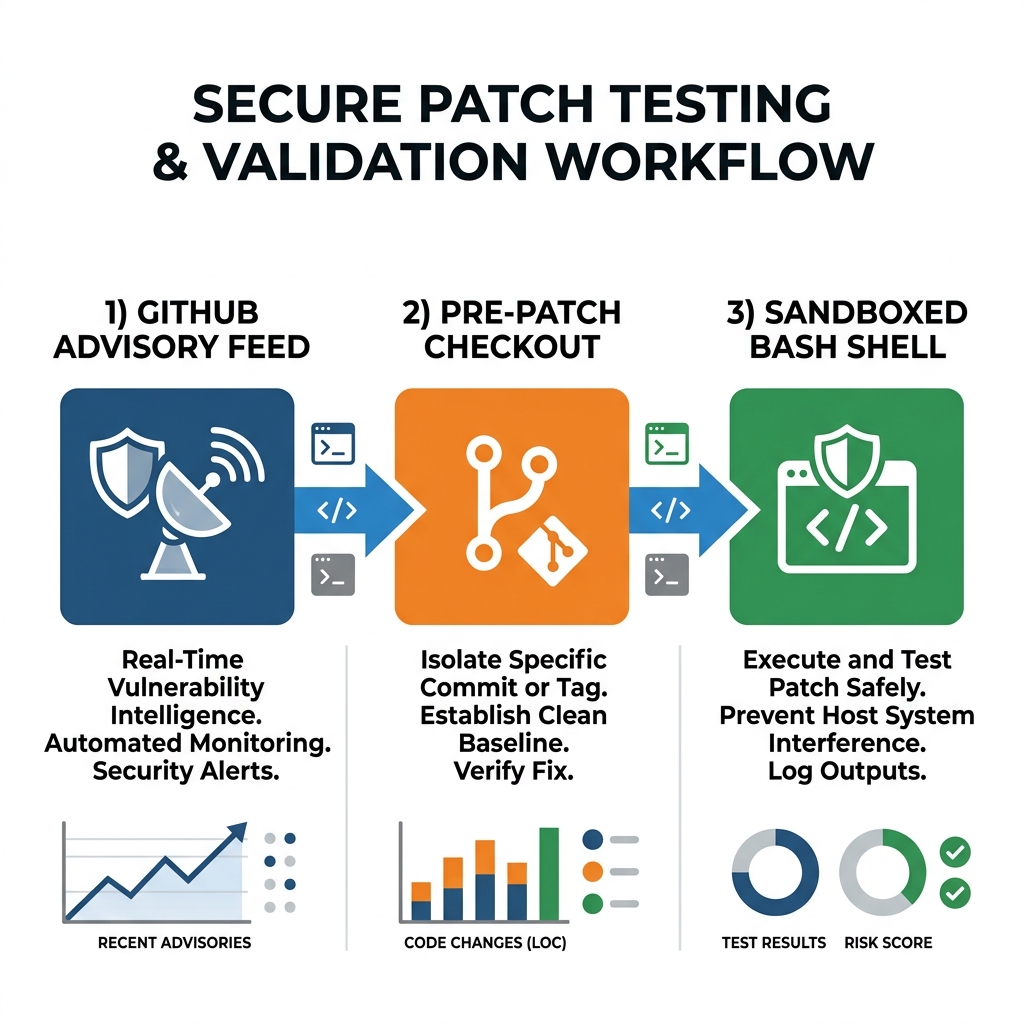
Traditional vulnerability benchmarks face a fatal flaw: they are frozen in time. A dataset compiled in 2023 is almost certainly embedded in the training corpora of 2025 frontier models, turning supposed security evaluations into exercises in recall rather than reasoning. N-Day-Bench was architected specifically to escape this memorization trap. Instead of relying on static challenge sets, it operates as a living benchmark that continuously harvests real-world vulnerability disclosures and tests whether frontier LLMs can genuinely investigate unfamiliar code.
The Living Dataset: Monthly Harvest from GitHub Security Advisories
At the core of N-Day-Bench's methodology is a monthly ingestion pipeline that pulls fresh cases directly from GitHub Security Advisories. Rather than synthesizing artificial flaws or recycling aged Capture The Flag (CTF) challenges, the benchmark targets repositories that have recently patched known vulnerabilities. For each selected case, the system checks out the codebase at the last commit before the security patch was applied. This design choice is deliberate: it presents the model with the exact evolutionary moment where the vulnerability still exists in production-grade software, surrounded by the full noise, dependencies, and idiosyncrasies of a real repository.
This approach stands in contrast to static frameworks. While projects like HackBench and SEC-bench offer continuously evolving or automated benchmark construction from historical instances, they remain vulnerable to data contamination once their challenge instances enter the training stream. N-Day-Bench’s monthly refresh cycle ensures that the test set stays chronologically ahead of model knowledge cut-offs. As the project's HackerNews launch discussion highlighted—where it garnered 67 points and 18 comments in under 12 hours—static vulnerability discovery benchmarks "become outdated quickly" as "cases leak into training data," eventually causing scores to measure memorization rather than true capability.
Agentic Exploration via Sandboxed Shell Access
Where N-Day-Bench diverges most sharply from traditional code-completion or pass@1 benchmarks is in its agentic execution environment. Models are not handed a neatly isolated function and asked to spot the bug within a few tokens. Instead, they are granted access to a sandboxed bash shell within which they can freely explore the repository. This sandbox empowers the LLM to behave like a human security researcher: navigating directory structures, grepping for suspicious patterns, examining commit histories, reading configuration files, running dependency trees, and even executing lightweight static analysis tools or test suites.
This methodology acknowledges that vulnerability discovery in the wild is rarely a linear reading exercise. A remote code execution flaw might hide in a dependency parser, manifest only under specific environment variables, or require cross-referencing documentation across multiple modules. By providing shell access, N-Day-Bench forces the model to formulate hypotheses, gather evidence, and iteratively narrow its focus—an authentic test of agentic reasoning rather than superficial pattern matching.
The sandbox is carefully containerized, ensuring that the model can interact with the filesystem and execute commands without escaping into broader infrastructure. This balance of freedom and safety mirrors the operational requirements of real-world AI security agents, which must investigate active codebases without introducing lateral risk.
The Temporal Contamination Guardrail
Perhaps the most methodologically significant innovation is N-Day-Bench’s strict temporal hygiene. The benchmark exclusively selects N-Day vulnerabilities—security flaws disclosed after the LLM's knowledge cut-off date. This temporal firewall is critical. If a model were tested on CVEs published in 2021, and its training data extended through 2023, the model may have encountered the patch discussion, the commit diff, or the advisory text during pre-training. Its "discovery" would then be an act of recall, not analysis.
By sourcing disclosures that post-date the model's training horizon, N-Day-Bench creates a clean, uncontaminated evaluation surface. The benchmark effectively asks: Given this unfamiliar codebase and no prior exposure to this specific vulnerability, can you discover the flaw that human researchers only recently identified? This framing directly addresses the contamination critique that has plagued static benchmarks and positions N-Day-Bench adjacent to ZeroDayBench—which evaluates agents on previously unseen zero-day vulnerabilities—while maintaining the reproducibility advantages of working with known, patched flaws in publicly available repositories.
Infrastructure at Scale: Powering Continuous Frontier Evaluation
Testing frontier LLMs at this cadence and autonomy level places extraordinary demands on inference infrastructure. N-Day-Bench requires the ability to route complex, multi-turn agentic sessions to diverse frontier systems—from GPT-4-class models to the latest open-weight alternatives—while maintaining cost and latency controls across hundreds of exploratory interactions per repository.
This is where the broader AI infrastructure ecosystem becomes operationally relevant. Research teams building continuous security evaluation pipelines need more than raw model access; they need gateway abstractions that allow rapid model swapping and A/B testing without rewriting orchestration logic for every new provider. Platforms like CallMissed have emerged to address exactly this friction, offering unified API access to 300+ LLMs through a single integration point. While N-Day-Bench itself may run on dedicated hardware, the architectural pattern it represents—agentic AI continuously probing real code with the latest models—is increasingly being adopted by enterprise security teams who require flexible, multi-model inference layers without managing dozens of separate provider contracts.
Why This Methodology Changes the Game
N-Day-Bench’s methodology is not merely an academic refinement; it is a response to the fundamental epistemological crisis in AI evaluation. When benchmarks become too static, progress curves become illusions. By binding evaluation to real advisories, real repositories, and real time, N-Day-Bench forces the field to confront a harder question: are these models actually reasoning about code, or are they echoing yesterday's solutions? In a landscape where global codebases and multilingual contexts demand nuanced AI comprehension, the integrity of evaluation methodology is no longer just a research concern—it is a commercially urgent prerequisite for trustworthy autonomous systems.
Key Developments
The last eighteen months have shattered the illusion that static, multiple-choice coding benchmarks can capture a large language model’s real-world security acumen. As frontier models began to ace human-verified programming tests, researchers noticed a troubling pattern: scores inflated not because models reasoned better, but because they had memorized vulnerability signatures from their training corpora. This contamination crisis has forced the field to pivot aggressively toward dynamic, living benchmarks that test models against production codebases they have never seen before. The arrival of N-Day-Bench on HackerNews—where it collected 67 points and 18 comments within just 11.6 hours—signals that both the security and AI research communities are hungry for ground-truth evaluation frameworks that resist gaming.
The Shift From Static Scores to Live Code Forensics
N-Day-Bench’s most consequential architectural decision is not merely which vulnerabilities it selects, but how often it regenerates its test corpus. By pulling fresh cases from GitHub Security Advisories every month and checking out repositories at the exact commit preceding the public patch, the benchmark keeps its test set ahead of training-data contamination. This directly counters the central flaw identified by its authors: static vulnerability discovery benchmarks become outdated quickly, cases leak into training data, and scores start measuring memorization rather than genuine discovery.
Equally important is the evaluation environment. Instead of presenting a model with a curated snippet and asking for a line-number prediction, N-Day-Bench hands the model a sandboxed bash shell and the entire repository state. The model must execute standard Unix commands, traverse dependency graphs, and synthesize a proof-of-concept—mirroring the workflow of a human security engineer. This transforms evaluation from passive pattern recognition into active forensic investigation, raising the bar for what constitutes a true capability demonstration.
Benchmark Comparison: Six Pillars of the Agentic Security Evaluation Landscape
The following table synthesizes the methodologies, refresh mechanisms, and evaluation modes driving the field forward. Together, these frameworks represent a decisive break from frozen datasets toward interactive, time-aware testing.
| Benchmark | Primary Focus | Data Source & Refresh Strategy | Agent Environment / Evaluation Mode |
|---|---|---|---|
| N-Day-Bench | Discovery of known N-Day vulnerabilities disclosed after model knowledge cut-off | Monthly pull from GitHub Security Advisories; repo checked out at last commit before the patch | Sandboxed bash shell for active codebase exploration and proof-of-concept generation |
| ZeroDayBench | Identification and remediation of unseen zero-day vulnerabilities | Unpublished zero-day flaws (arXiv 2603.02297v1) | Interactive LLM agent tasked with finding and patching vulnerabilities in supervised codebases |
| HackBench | Real-world bug exploitation and detection | Continuously evolving dataset drawn from actively discovered real-world bugs | Exploit-oriented benchmark assessing proficiency in both detection and practical exploitation |
| SEC-bench | Automated construction of scalable, reproducible security tests | Verified vulnerability instances transformed into structured benchmarks (NeurIPS 2025 poster) | Multi-agent scaffold—the first general framework for automating benchmark construction and execution |
| BaxBench | Secure and correct backend code generation | Security-focused code generation tasks requiring hardened backend implementations | Generation-time evaluation; measures whether models produce code free of vulnerabilities at authorship |
| Legacy Static Benchmarks | Passive vulnerability detection on fixed code snippets | Static datasets that quickly become outdated; cases leak into training data | Passive analysis without shell access; single-turn prompting measuring memorization rather than reasoning |
ZeroDayBench, detailed in arXiv paper 2603.02297v1, extends the evaluation philosophy beyond disclosed flaws to truly unseen zero-day weaknesses, forcing agents to both discover and remediate without the benefit of public write-ups. HackBench mirrors N-Day-Bench’s emphasis on currency but adds an offensive security lens, maintaining a live dataset that evolves as new defect classes surface in the wild. SEC-bench, presented as a NeurIPS 2025 poster, introduces the first general-purpose multi-agent scaffold for turning verified exploit instances into structured benchmarks, effectively automating the pipeline from CVE publication to evaluation task. This automation is critical: without it, the manual labor of reconstructing historical vulnerabilities would bottleneck the same monthly refresh cycles that make N-Day-Bench valuable. In contrast, BaxBench approaches the problem from the supply side: rather than asking whether a model can find a bug, it asks whether the model can write backends that avoid introducing bugs entirely.
Infrastructure Demands at Scale
The operational complexity of these benchmarks reveals a growing infrastructure bottleneck beneath the research headlines. A single N-Day-Bench episode—cloning a repository, rolling back to a pre-patch commit, provisioning a sandboxed shell, capturing a model’s interactive traversal, and grading the resulting proof-of-concept—requires far more than a standard chat-completion API. When researchers want to compare performance across dozens of frontier models, from proprietary APIs to open-weight fine-tunes, they need a unified gateway that can route prompts and tool calls across heterogeneous providers without rewriting orchestration logic for each endpoint.
This is where inference and communication infrastructure platforms are quietly becoming load-bearing walls for the security-AI ecosystem. Solutions offering multi-model API gateways—such as CallMissed, which provides inference access to 300+ LLMs through a single interface—let benchmark authors swap model backends with configuration changes rather than code rewrites. For teams building autonomous security agents, having a single point of access to diverse reasoning capabilities, ranging from heavy frontier models to lightweight specialized fine-tunes, mirrors the same modular philosophy that N-Day-Bench applies to sandboxed environments.
Toward a Standardized Security Evaluation Stack
Despite their shared emphasis on realism, these benchmarks remain fragmented in methodology and metrics. N-Day-Bench uses disclosed GitHub advisories; ZeroDayBench targets undisclosed zero-days; SEC-bench provides a multi-agent scaffold but leaves dataset curation to the user; BaxBench measures generative hygiene rather than discovery acumen. The field currently lacks a standardized ontological distinction between “vulnerability found,” “vulnerability exploited,” and “vulnerability patched,” making cross-benchmark comparisons difficult to adjudicate.
What is becoming unmistakably clear, however, is the direction of travel. The static leaderboard—where a model’s score is frozen in time against a fixed dataset—is giving way to a live evaluation paradigm. In this new regime, benchmark freshness is measured in days rather than years; agentic shell interaction replaces single-turn prompting; and the objective shifts from pattern recognition to autonomous software comprehension. For enterprises deploying LLMs in code review, DevSecOps, or automated penetration-testing pipelines, the maturity of these benchmarks will ultimately determine how much trust can be placed in an AI-generated security verdict.
Benchmark Results: Which LLMs Lead the Pack?
The Methodology Behind the Rankings
N-Day-Bench does not rely on simplified multiple-choice questions or sanitized code snippets. Instead, it checks out real repositories at the exact commit preceding a security patch and grants each model a sandboxed bash shell to actively explore the codebase [3]. Success therefore requires genuine navigation—listing directories, examining file structures, tracing imports, and reasoning across scattered modules—to pinpoint the precise flaw that triggered a GitHub Security Advisory. The evaluation protocol specifically targets N-Day vulnerabilities disclosed after a model’s knowledge cut-off [3], creating a temporal firewall that prevents memorization-driven answers. A model cannot simply recall a CVE description from its training corpus; it must derive the vulnerability from the raw repository state.
The benchmark’s monthly refresh cycle is central to its credibility. As the project’s creator noted, static vulnerability benchmarks degrade quickly because cases leak into training data and scores soon measure memorization rather than reasoning ability. The community response was immediate—the framework topped HackerNews, accumulating 67 points and 18 comments within 11.6 hours—signaling broad industry agreement that rolling evaluations are necessary. Each 30-day cycle pulls fresh disclosures, checks out the repository at the last commit before the fix, and presents models with an interactive environment where they must demonstrate analytical depth under realistic constraints.
Frontier Model Performance Patterns
While exact leaderboard positions shift with every monthly refresh, distinct capability tiers have emerged among frontier LLMs. Models equipped with advanced tool use and extended context windows consistently outperform generalist counterparts. The critical differentiator is not merely parameter count but agentic scaffolding—the capacity to formulate a search strategy, execute grep or find commands, observe shell output, and iteratively refine hypotheses. Top performers treat vulnerability discovery as an open-ended investigation rather than a single-pass code completion task.
Yet even flagship models exhibit material limitations. Research from BaxBench demonstrates that leading LLMs are not ready for secure coding automation, frequently introducing subtle flaws when generating backend code [8]. This finding translates directly to N-Day-Bench: a model may excel at syntax completion or API documentation and still fail to identify an authentication bypass nestled inside a sprawling Flask or Express application. Similarly, ZeroDayBench evaluations reveal that LLM agents struggle with genuinely unseen zero-day vulnerabilities, indicating that the gap between pattern matching and causal reasoning remains significant [2]. On N-Day-Bench, frontier models show the highest success rates on injection flaws and logic errors with visible entry points, while memory safety bugs in low-level C or C++ repositories remain disproportionately difficult across the board.
Where Mid-Tier Models Struggle
Below the frontier tier, performance degrades sharply in ways that expose fundamental limitations in interactive reasoning. Mid-tier open-weight models often fail to initialize coherent search strategies, either requesting file reads so broad they overflow context windows or fixating on irrelevant modules based on superficial keyword matches. The sandboxed environment is unforgiving: a model that hallucinates a file path or issues a malformed bash command wastes precious interaction turns without advancing toward the vulnerability.
This reliability gap underscores a finding from SEC-bench research, which developed multi-agent scaffolds and automated reproduction pipelines to augment baseline LLM capabilities [7]. The implication is that architectural surround—tool access, planning loops, and error recovery—can matter as much as raw model weights. For security teams, this suggests that a smaller model wrapped in robust, iterative scaffolding may materially outperform a larger raw LLM on repository-scale code review. N-Day-Bench’s interactive design makes these trade-offs visible in ways that static benchmarks cannot.
Comparative Landscape: N-Day-Bench vs. Other Benchmarks
N-Day-Bench occupies a pragmatic niche between related security evaluations. HackBench focuses on continuously evolving exploit generation and detection proficiency [4], while ZeroDayBench evaluates agents on strictly unseen zero-day vulnerabilities [2]. N-Day-Bench sits in the middle: the vulnerabilities are real and verifiable—ground-truth exists because the patch is already public—but they are fresh enough to stay ahead of training data contamination. This provides reproducibility without sacrificing evaluative integrity.
The rolling cadence also contrasts with SEC-bench’s automated reproduction approach, which transforms verified vulnerability instances into structured benchmarks for assessing LLM agents [5][7]. While SEC-bench emphasizes scalability and multi-agent construction, N-Day-Bench emphasizes temporal hygiene: by freezing repository state at the pre-patch commit and refreshing monthly, it resists the contamination curves that inevitably corrupt static datasets. For organizations tracking LLM security capabilities, the divergence in methodology means no single benchmark tells the whole story. Zero-day tests prove generalization, N-day tests prove interactive reasoning on verifiable targets, and static code benchmarks measure breadth.
Infrastructure Implications for Security Teams
For enterprises operationalizing these findings, selecting a model for security review requires more than chasing monthly leaderboard headlines. The optimal LLM for static SAST-style analysis may differ from the ideal candidate for interactive, repository-scale probing. Platforms like CallMissed mitigate this uncertainty through multi-model API infrastructure that lets teams dynamically route vulnerability discovery tasks across 300+ LLMs without rewriting integration layers [natural integration]. Rather than locking into a single provider, security engineering teams can A/B test the current N-Day-Bench frontier leader against alternatives on their own proprietary codebases.
Furthermore, as security operations increasingly adopt conversational interfaces for incident triage—engineers querying vulnerability status via chat during on-call rotations—the underlying LLM routing must remain adaptable. Indian startups like CallMissed are building multilingual agent infrastructure that supports 22 regional languages natively across speech and text pipelines, extending AI accessibility into globally distributed development teams [natural integration]. In security contexts where remediation guidance must reach engineers across language barriers, this linguistic breadth becomes operational, not cosmetic.
Ultimately, N-Day-Bench demonstrates that no single model dominates every vulnerability category. The benchmark’s rolling evaluation serves as a vital compass, but organizational resilience depends on infrastructure flexible enough to evolve alongside it.
In-Depth Analysis: Why Frontier Models Miss (or Catch) Real Bugs

The Memorization Trap in Static Benchmarks
Static vulnerability benchmarks decay almost as quickly as they are published. As the creators of N-Day-Bench observe, cases inevitably leak into training data, causing scores to measure memorization rather than genuine security reasoning. A frontier model might achieve a high detection rate on aging CVE datasets simply because the vulnerable patterns appear in its pre-training corpus—embedded in StackOverflow answers, commit discussions, or prior security write-ups.
N-Day-Bench breaks this cycle by pulling fresh cases monthly from GitHub Security Advisories and checking out each repository at the last commit before the patch. This temporal sandbox forces models to analyze code they have never seen during training, stripping away the advantage of regurgitated exploit summaries. The test is no longer "Do you remember Log4Shell?" but "Can you find a novel lookup injection in an arbitrary logging utility?" That distinction separates pattern-matching parrots from systems capable of static analysis.
Sandbox Realism: From Pattern Matching to Codebase Exploration
Traditional SAST/SCA tools scan code snapshots without runtime context. N-Day-Bench instead provides frontier models with a sandboxed bash shell, allowing them to explore directory structures, grep for callsites, inspect commit history, and even run tests. This agentic setup mirrors how human researchers actually hunt bugs—tracing data flow across modules and reasoning about trust boundaries.
Yet this freedom exposes a critical gap: tool-use fidelity. While models like GPT-4o and Claude 3.5 write code fluently, they often struggle to orchestrate multi-step terminal workflows. In practice, a model might identify a suspicious function but fail to grep for its callers, or hallucinate a file path and abandon a promising thread. The benchmark therefore tests not merely vulnerability recognition, but agentic coherence—the capacity to maintain a research objective across dozens of shell commands.
Related work underscores the difficulty. SEC-bench’s multi-agent scaffold, designed for "practical and scalable security benchmarks," still struggles to autonomously reproduce real-world vulnerabilities. The friction between writing secure code and hunting for insecure code remains one of the field’s most expensive open problems.
The Anatomy of Misses: Why Frontier Models Fail
When frontier models fail to catch real N-day bugs, the failure modes cluster around four systemic limitations:
- Context window constraints. Production repositories often contain tens of thousands of files. Even with 200K-token contexts, models cannot retain every module relationship. They may fixate on the patched function while missing the upstream input sanitization that actually enables exploitation.
- Reasoning depth. Many real vulnerabilities require multi-hop architectural reasoning—trust boundaries crossed through several abstraction layers. Current LLMs detect localized anti-patterns (e.g., obvious SQL concatenation) but falter on chainable flaws like insecure deserialization or race conditions in concurrent handlers.
- Conservative calibration. RLHF-tuned models often prioritize false-positive aversion over aggressive detection. A model might note that a snippet "looks dangerous" yet refuse to flag it confidently, especially when exploitability depends on a specific environment state.
- Semantic blindness. Without dynamic analysis, models cannot easily distinguish between a harmless
eval()in a build script and a dangerouseval()processing user input. BaxBench, which evaluates whether LLMs generate secure backends, found that even flagship LLMs are not ready for coding automation in security-critical contexts. Static syntax understanding does not equate to runtime semantic comprehension.
The Anatomy of Catches: What Makes a Bug Detectable
Conversely, frontier models succeed when vulnerabilities leave strong static signals. Detection rates climb under specific conditions:
- Pattern-aligned bug classes. Well-represented vulnerability families—path traversal via unsanitized path joins, command injection through
subprocess.call(), or hardcoded JWT secrets—align with patterns densely represented in training data. These flaws are syntactically localized and follow recognizable anti-patterns.
- Rich contextual metadata. Repositories with detailed issue trackers, CVE-referencing commit messages, or failing regression tests give the model footholds. By running
git logor examining adjacent test files, the agent can bootstrap its search from human-written clues rather than cold-reading an entire codebase.
- Language determinism. Interpreted languages with verbose standard libraries (Python, Go, JavaScript) yield higher detection rates than C/C++ systems code. Memory corruption bugs involving pointer arithmetic or heap grooming present far weaker static signals and require execution-context awareness that current agents lack.
Infrastructure Implications for the Security Toolchain
If frontier models cannot reliably surface known vulnerabilities in historical code, treating them as autonomous zero-day hunters remains premature. The near-term opportunity lies in human-machine teaming: models triage repositories, isolate suspicious commit ranges, and draft preliminary reports that human auditors validate and refine.
This workflow, however, requires infrastructure that can route reasoning tasks across multiple specialized models. No single LLM is optimal for every task—one may excel at web-application logic flaws while another reasons better about systems-level race conditions. Platforms like CallMissed solve this orchestration challenge by offering a multi-model API gateway with access to 300+ LLMs, allowing security teams to dynamically match agent tasks to the best available reasoning engine without rewriting integration code.
As the evaluation landscape expands—from HackBench’s continuously evolving exploit testbeds to ZeroDayBench’s unseen zero-day evaluations—flexible inference backends will become as critical as the benchmarks themselves. The models will improve, but only if we measure them against real code that changes faster than their training data.
N-Day-Bench vs. HackBench & ZeroDayBench
The Benchmark Landscape for LLM Security
As large language models graduate from chat interfaces to autonomous coding agents, the security community has rushed to build evaluations that separate marketing hype from genuine capability. N-Day-Bench—currently trending on HackerNews with 67 points and 18 comments—arrives in a crowded field. It shares conceptual DNA with HackBench and ZeroDayBench, yet each benchmark answers a fundamentally different question about what “secure AI” actually means. Understanding where they diverge is essential for practitioners deciding which model to trust with a production codebase.
HackBench: Offensive Proficiency Over Time
HackBench, maintained by ElectrovoltSec, is described as a “continuously evolving benchmark designed to assess LLMs' proficiency in vulnerability detection and exploitation.” At first glance, its continuous design seems to solve the same staleness problem that plagues static benchmarks. However, its core emphasis is on offensive security: can the model not only find a bug, but weaponize it?
This places HackBench on a different axis from N-Day-Bench. While N-Day-Bench checks out a real repository at the last commit before a patch and gives the model a sandboxed bash shell to explore, its success criteria center on discovery—specifically, locating the known vulnerability in a pre-patch codebase. HackBench, by contrast, tests whether the model can craft an exploit. It is arguably closer to a red-team exercise than a pure reasoning assessment. Furthermore, although HackBench evolves continuously, it lacks N-Day-Bench’s explicit, auditable refresh mechanism tied directly to GitHub Security Advisories. As N-Day-Bench’s author notes, “cases leak into training data, and scores start measuring memorization.” A continuously evolving benchmark mitigates this, but a monthly refresh pulled from live advisories creates a harder temporal boundary against contamination.
ZeroDayBench: Testing the Truly Unseen
If N-Day-Bench tests models against fresh known vulnerabilities, ZeroDayBench—detailed in arXiv:2603.02297v1—pushes into territory where no public record exists. It evaluates LLM agents on unseen zero-day flaws, meaning the vulnerabilities have not been disclosed through channels like GitHub Security Advisories or CVE feeds at the time of evaluation. According to the paper, a major benefit of these agents is their ability to “find and patch security vulnerabilities in the codebases they oversee,” indicating that ZeroDayBench measures both detection and remediation.
The distinction between N-Day and Zero-Day evaluation is not semantic; it is epistemological. N-Day-Bench cleverly sidesteps memorization by selecting disclosures that occurred after the model’s knowledge cut-off, then presenting the codebase in its vulnerable state. The model cannot have memorized the patch notes because the benchmark uses the commit before the fix. Yet the vulnerability is still a matter of public record somewhere. ZeroDayBench removes even that crutch. The model must generalize from architectural patterns and anomalous behaviors rather than from any prior reference to the vulnerability class. In this sense, N-Day-Bench is a test of tool-augmented reasoning under contamination-aware conditions, while ZeroDayBench is a test of genuinely novel discovery.
Contamination, Freshness, and the Execution Gap
Comparing these three benchmarks reveals a spectrum of methodological choices:
- Vulnerability Source and Freshness — N-Day-Bench sources cases monthly from GitHub Security Advisories, locking the repository state to the final pre-patch commit. HackBench draws from real-world bugs with a continuously updated corpus. ZeroDayBench relies on undisclosed zero-days, rendering training-data leakage theoretically impossible.
- Agentic Environment — N-Day-Bench uniquely provides a sandboxed bash shell, forcing the model to navigate directory structures, read files, and run commands just as a human auditor would. Neither HackBench nor ZeroDayBench advertise an equivalent interactive shell in the available context, suggesting their evaluations may rely more on static code ingestion or predefined tool use.
- Success Criteria — N-Day-Bench evaluates discovery of the known flaw. HackBench adds an exploitation layer. ZeroDayBench demands both discovery and patching of entirely novel vulnerabilities.
These differences matter because they dictate which model behaviors are actually being rewarded. A high score on N-Day-Bench signals strong codebase navigation and reasoning about recent flaws. A high score on HackBench signals offensive security potential. A high score on ZeroDayBench signals the capacity for autonomous security research.
Why Benchmark Literacy Matters for Production Agents
For enterprises deploying LLMs into software supply chains, conflating these scores is dangerous. A model that memorizes CVE descriptions might ace a static dataset but fail when presented with a live, messy repository. This is why infrastructure providers are paying close attention. Platforms like CallMissed, which offer LLM inference across 300+ models alongside agentic interfaces, underscore the importance of matching the right benchmark to the right workload—routing a code-audit agent to a model validated on N-Day-Bench’s real-repo reasoning is a fundamentally different decision than selecting a red-team model validated on HackBench.
The emerging research ecosystem reinforces this nuance. SEC-bench, presented as a NeurIPS 2025 poster, introduces the “first general multi-agent scaffold for constructing practical and scalable security benchmarks,” promising automated vulnerability reproduction that could one day operationalize N-Day-Bench’s monthly cadence at scale. Meanwhile, BaxBench’s finding that “even flagship LLMs are not ready for coding automation” serves as a warning that benchmark scores should not outpace real-world validation. Together, these efforts suggest that no single benchmark—however well-designed—can fully certify an LLM for security-critical deployment.
The Bottom Line: Complementary Diagnostics
N-Day-Bench, HackBench, and ZeroDayBench are not competitors vying for a single crown. They are complementary diagnostics arrayed along an axis of difficulty and realism. N-Day-Bench provides the grounded, contamination-resistant baseline for assessing whether frontier models can find real vulnerabilities in real codebases using real tools. HackBench extends that assessment into offensive exploitation. ZeroDayBench strips away all prior knowledge to test true zero-day discovery and patching. For buyers, builders, and auditors, the wise approach is not to chase the highest score, but to understand which benchmark’s conditions map to the risks they actually face.
Impact & Implications for Application Security Teams

For application security teams, the arrival of N-Day-Bench is not merely another machine-learning leaderboard to monitor. It is a signal that the fundamental contract between security tooling and software development is being rewritten. When a benchmark grants frontier LLMs a sandboxed bash shell and tasks them with finding known vulnerabilities in real repositories checked out to the last commit before the patch, it is replicating the cognitive workflow of a human security researcher—not the pattern-matching logic of a traditional scanner. The implications ripple through procurement, pipeline architecture, workforce planning, and risk governance.
The Collapse of Static Assurance
Enterprise AppSec has spent two decades optimizing static analysis. SAST tools scan source code without execution; DAST tools probe running applications; SCA tools inventory dependencies against known CVEs. Each approach generates findings based on signatures, taint analysis, or known-vulnerability databases. These tools scale well, but they struggle with contextual reasoning: understanding business logic flaws, multi-step exploit chains, or vulnerabilities that exist only at the intersection of two seemingly safe APIs.
N-Day-Bench exposes this limitation by design. It provides no pre-chewed call graphs or annotated vulnerability locations. Instead, models must explore the repository organically, identify relevant modules, and reason about whether a disclosed CVE is actually present in the pre-patch code. This mirrors the real-world scenario in which a security team learns of a new GitHub advisory and must determine, within hours, whether their proprietary fork or internal dependency is affected. For AppSec leaders, the takeaway is unmistakable: static detection benchmarks are losing validity. Tools that topped last year’s leaderboards may offer little assurance against this month’s threat model if they cannot engage in multi-step, environment-aware reasoning.
Benchmark Contamination as an Enterprise Risk
Perhaps the most insidious challenge N-Day-Bench addresses is contamination. As the project notes, static vulnerability discovery benchmarks degrade quickly because cases leak into training data; over time, scores start measuring memorization rather than security acumen. This is not an academic concern. Enterprise buyers currently select AI coding assistants and security copilots based on vendor-reported performance on public benchmarks. If those benchmarks are stale and their answers memorized by the models being evaluated, organizations are effectively procuring AI on false pretenses.
N-Day-Bench counters this with a monthly refresh pulling from live GitHub Security Advisories, ensuring that test cases post-date the knowledge cutoff of frontier models. Any model evaluated under this protocol must genuinely reason about novel code patterns, not regurgitate training-set analysis. Security teams should translate this methodology into their own vendor assessments by demanding:
- Time-bound test sets: Require vendors to prove detection capability on vulnerabilities disclosed after the model’s training cutoff, refreshed monthly rather than annually.
- Live repository evaluation: Insist on evaluations against real codebases in sandboxed environments, not sanitized snippets with embedded hints.
- Contamination audits: Ask how the vendor prevents benchmark leakage into fine-tuning data or system prompts.
The research community is converging on this standard. Complementary projects like ZeroDayBench (focused on unseen zero-day scenarios), HackBench (a continuously evolving exploitation benchmark), and SEC-bench (automated reproduction of real vulnerabilities) collectively establish that dynamic, anti-contaminated evaluation is the new baseline. AppSec teams still relying on 2023-era static benchmarks for 2025 procurement are operating with expired telemetry.
Operationalizing Agentic Code Review
Accepting that agentic LLMs represent the future of vulnerability discovery is only the first step. The harder problem is integrating these systems into existing SecDevOps workflows without creating an ungovernable attack surface or overwhelming developers with false positives. An LLM with shell access to a codebase is, by definition, a high-privilege agent. It can read secrets, execute build scripts, and potentially exfiltrate data if the sandbox is misconfigured. Security teams must demand ephemeral, isolated execution environments for any AI conducting autonomous code exploration—a principle embedded in N-Day-Bench’s sandboxed design.
Beyond safety, there is the question of model selection and interoperability. Vulnerability discovery is not a monolithic task; local privilege escalation bugs require different reasoning than remote code execution in a web framework. No single LLM dominates every category on dynamic benchmarks month after month. Consequently, enterprise pipelines need multi-model routing to dispatch discovery tasks to the engine best suited for a given repository or vulnerability class. Solutions like CallMissed’s multi-model API gateway allow security teams to switch between 300+ LLMs without code changes, enabling rapid A/B testing of frontier models against internal codebases as new advisories drop. This agility is critical when a benchmark refresh can reshuffle the performance hierarchy overnight.
Organizations should also architect hybrid pipelines where static analyzers provide high-velocity breadth across millions of lines, while LLM agents deliver deep-dive analysis on high-risk commits and newly disclosed CVEs. The static layer filters noise; the agentic layer investigates anomalies that rules cannot express.
Workforce and Strategic Realignment
The ascendancy of benchmarks like N-Day-Bench foreshadows a significant shift in human capital within AppSec. Historically, entry-level security engineers developed expertise by manually reproducing CVEs, reviewing patches, and tracing bugs through unfamiliar codebases—precisely the tasks now being automated and benchmarked. As these agentic capabilities mature, the human role pivots toward orchestration and adversarial validation: designing agent prompts, auditing sandbox outputs, and red-teaming the AI’s own reasoning process.
For security leadership, this demands investment in internal evaluation infrastructure. Rather than outsourcing model selection to vendor marketing teams, mature organizations will maintain internal N-Day-Bench analogs—proprietary evaluation harnesses that test candidate models against the company’s own historical vulnerabilities and codebase archetypes. The benchmark is a mindset as much as a dataset: security is no longer a function of who has the best static rules, but who can most rapidly validate and deploy reasoning agents against emergent threats. In this landscape, the teams that treat LLM evaluation as continuous infrastructure rather than a one-time procurement checkbox will define the next standard for application security.
Expert Opinions

Why Benchmark Design Matters More Than Raw Accuracy
The creators of N-Day-Bench have struck a nerve in the security AI community by tackling a methodological flaw that has undermined prior evaluations: training data contamination. According to the project's documentation, static vulnerability discovery benchmarks degrade almost immediately after publication because cases leak into training corpora. Over time, leaderboards stop measuring reasoning and instead reward memorization—models score highly not because they understand code, but because they have seen the answer before. N-Day-Bench disrupts this cycle by pulling fresh cases monthly from GitHub Security Advisories, checking out repositories at the precise commit preceding the patch, and presenting models with a novel environment every evaluation cycle.
The community response has been immediate and vocal. Within 11.6 hours of posting, the project reached the top of HackerNews with 67 points and 18 comments—a signal that practitioners are hungry for evaluations that mirror real-world complexity. The inclusion of a sandboxed bash shell has drawn particular praise. Unlike benchmarks that present isolated functions or synthetic snippets, N-Day-Bench forces models to behave like human researchers: navigating directory structures, examining configuration files, tracing imports, and executing exploration commands. This environmental fidelity addresses a long-standing criticism that LLM security evaluations are essentially "open-book tests" with answer keys embedded in the training data.
What the Research Community Is Saying
Academic sentiment increasingly holds that continuous benchmarking and multi-agent scaffolds are non-negotiable for measuring security AI. At NeurIPS 2025, researchers behind SEC-bench introduced what they characterize as the "first general multi-agent scaffold for constructing practical and scalable security benchmarks." Their system automatically reproduces verified vulnerabilities and transforms them into structured benchmarks, creating a pipeline that parallels N-Day-Bench's monthly refresh philosophy. The convergence of these independent projects suggests the field is moving away from static datasets and toward living testbeds that evolve alongside the software ecosystem.
Other studies inject a dose of realism into the enthusiasm. BaxBench, which evaluates whether LLMs can generate secure and correct backend code, reported that even flagship LLMs are not ready for coding automation—a finding with direct implications for vulnerability discovery. If frontier models cannot reliably produce secure code, their ability to reason about complex, buggy codebases remains suspect. Separately, the team behind ZeroDayBench draws a sharp distinction between known vulnerabilities (N-days) and true zero-days, acknowledging that while agents show promise in finding and patching flaws in codebases they oversee, the leap to unreported vulnerabilities is significant and largely unproven. Taken together, expert opinion coalesces around a measured view: N-Day-Bench does not prove that AI can replace human auditors, but it establishes the most rigorous baseline yet for determining whether models can reason about real software at all.
The HackerNews Verdict: Cautiously Optimistic
The HackerNews discourse surrounding N-Day-Bench—quantified by 67 upvotes and 18 comments in under 12 hours—reveals a community intrigued by the methodology yet wary of over-interpreting early results. Several recurring themes emerged from the discussion:
- Expiration dates are mandatory. Benchmarks without a refresh cycle are fundamentally tests of recall, not reasoning.
- Shell access changes the game. Interactive exploration mirrors how human researchers actually work, moving beyond pattern matching on static snippets.
- N-day is a floor, not a ceiling. Success on documented vulnerabilities is a necessary precondition, but it does not imply readiness for zero-day hunting.
Commenters have focused on the significance of sandboxed shell access because real security discovery is inherently exploratory. Researchers grep for patterns, examine commit histories, and test hypotheses by running code. A benchmark that denies models this autonomy evaluates a constrained, unrealistic skill set. Still, the HackerNews crowd is quick to note the limitations. Finding a recently patched bug with full shell access is closer to assisted code review than to autonomous vulnerability research. The community appears to treat N-Day-Bench as a threshold assessment: any model aspiring to security relevance must clear this bar, but clearing it guarantees nothing about performance on unknown threats.
From N-Day to Zero-Day: The Capability Gap
Expert opinion grows more fragmented when the conversation shifts from known vulnerabilities to novel discoveries. The creators of HackBench, another continuously evolving benchmark hosted on GitHub, are explicitly building to assess LLMs' proficiency in vulnerability detection and exploitation. Their work implies that the field is constructing a graduated curriculum for security AI: first master documented bugs, then progress to live bug bounty programs, and eventually tackle undiscovered flaws. N-Day-Bench is increasingly viewed as Step One in that curriculum.
However, the gap between Step One and Step Three is vast. ZeroDayBench's framing is instructive here: it evaluates LLM agents specifically on unseen zero-day vulnerabilities, recognizing that N-day success may inflate perceived capability. If BaxBench's findings serve as any guide—flagship models failing at secure backend generation—then the reasoning required for zero-day discovery, which demands creative conjunction of multiple obscure behaviors, likely exceeds current architectures. Most experts agree that N-Day-Bench establishes a vital floor for capability. If a model cannot identify a vulnerability that has already been documented, patched, and committed to GitHub, it is almost certainly unprepared for the ambiguities of production code. Whether current or next-generation LLMs can bridge the gap from floor to ceiling is the central open question driving 2025 security AI research.
Infrastructure for the Next Generation of Security Agents
As the benchmark ecosystem fragments across N-Day-Bench, SEC-bench, ZeroDayBench, and HackBench, organizations face a practical question: how do they operationalize these findings? No single model dominates every security task. A model that excels at static analysis may falter when granted shell access; one that reasons well about C memory safety may choke on Python dependency confusion. This heterogeneity is driving demand for multi-model inference infrastructure that lets teams route tasks to the optimal model dynamically.
Solutions like CallMissed's multi-model API gateway are already enabling this shift, allowing developers to switch between 300+ LLMs without code changes—critical when a security pipeline might need to swap from a code-specific model for repository traversal to a reasoning-heavy model for exploit path planning. Moreover, as AI security agents transition from research benchmarks to operational tools, they require communication layers that can report findings across voice, WhatsApp, or internal alerting systems in real time. The next frontier in defensive AI will not be won by monolithic models scoring points on static leaderboards, but by orchestrated systems that can continuously evaluate, route, and communicate—mirroring the same continuous refresh philosophy that makes N-Day-Bench a credible measure of progress.
What This Means For You
The HackerNews community does not agree on much, but when a post on AI security benchmarks shoots to the top with 67 points and 18 comments in just 11.6 hours, it is worth paying attention. That is exactly what happened when mufeedvh unveiled the methodology behind N-Day-Bench, a framework designed to answer a deceptively simple question: can frontier LLMs find real vulnerabilities in real codebases? The significance lies not in the question itself, but in how it is asked. Rather than recycling static datasets that increasingly leak into pre-training corpora, N-Day-Bench pulls fresh cases from GitHub security advisories every month, checks out the repository at the last commit before the patch, and gives the model a sandboxed bash shell to explore, reason, and—ideally—detect the flaw.
This monthly cadence is a direct response to a problem the security AI community has tip-toed around for years: contamination. Static vulnerability discovery benchmarks inevitably make their way into training data, and once a model has ingested a CVE description, a patched diff, or a proof-of-concept exploit, benchmark scores collapse into a test of memorization rather than reasoning. N-Day-Bench short-circuits this by keeping the test set moving. By the time a case is public enough to be widely scraped, it has already been evaluated, and next month’s batch is being prepared. It is a living benchmark for a landscape where yesterday’s ground truth is tomorrow’s training noise.
Why the Benchmark Ecosystem Is Going Dynamic
N-Day-Bench is not an isolated experiment. It sits at the center of a broader industry pivot away from static leaderboards and toward continuous, adversarial evaluation. Consider the landscape:
- ZeroDayBench focuses on completely unseen zero-day vulnerabilities, pushing models beyond the limits of disclosed issues.
- HackBench bills itself as a continuously evolving benchmark designed to assess LLM proficiency in vulnerability detection and exploitation.
- SEC-bench, presented at NeurIPS 2025, develops the first general multi-agent scaffold for automatically reproducing vulnerabilities and transforming them into structured benchmarks.
- BaxBench shifts the lens to prevention, evaluating whether LLMs can generate secure and correct backends in the first place.
Together, these projects signal that the AI security community is coalescing around a single principle: if you are not evaluating against fresh, real-world code in a realistic environment, you are not evaluating at all. A sandboxed bash shell is not a gimmick—it is an admission that real vulnerability discovery requires filesystem traversal, dependency analysis, build tooling, and iterative hypothesis testing, not just predicting the next token in a sanitized snippet.
What This Means for Your Role
The implications of this shift vary drastically depending on whether you are writing code, shipping models, or signing off on risk. The following table maps the N-Day-Bench reality to concrete responsibilities, timelines, and companion benchmarks for five key stakeholders.
| Role | The Core Shift | Your Immediate Action | Benchmark to Monitor | Horizon |
|---|---|---|---|---|
| Security Engineer | LLMs are now tested on real pre-patch code with interactive sandboxed bash access | Replace static SAST scorecards with dynamic agent trials; demand proof of exploitability, not just regex matches | N-Day-Bench + HackBench | Q3 2025 |
| AI/ML Engineer | Frontier model selection must weight live tool-use and reasoning over static code-completion F1 scores | Build scaffolded agents that checkout repo states and validate hypotheses; run monthly A/B tests on fresh advisories | N-Day-Bench + SEC-bench | Immediate |
| DevOps / Platform Lead | Monthly refresh cycles expose how quickly AI security tools become stale as training data absorbs old CVEs | Containerize bash-shell sandbox environments in CI/CD; automatically retire evaluation datasets older than 30 days | BaxBench + ZeroDayBench | 30 days |
| Open Source Maintainer | Your security advisories and pre-patch commits are becoming next-generation test cases for foundation models | Tag every advisory with reproducible environment configs, exact pre-patch commit hashes, and reproduction scripts | N-Day-Bench | Per Advisory |
| CISO / Risk Officer | Vendor claims of "AI-powered security" must be backed by rolling, uncontaminated evidence rather than annual pentest reports | Contractually mandate dynamic red-teaming against post-knowledge-cut-off CVEs; require monthly detection rate disclosures | SEC-bench (NeurIPS 2025) | Q4 2025 |
If you are an AI/ML engineer, the table’s “Immediate” horizon is not an exaggeration. Organizations are already building internal replicas of N-Day-Bench-style pipelines to select which LLM powers their security copilot. The challenge is no longer “which model tops HumanEval?” but “which model, given a bash shell and a real repository from last month, can reason its way to a CVE?” That is a fundamentally different procurement criteria, and it requires infrastructure that lets you swap models in and out without rewriting your orchestration layer.
Eliminating the Infrastructure Bottleneck
This demand for continuous, multi-model evaluation creates a hidden bottleneck: inference fragmentation. If your security team wants to test Claude, GPT-4, Llama 3.1, and a domain-specific code model against the same fresh advisory, you suddenly face four different API formats, rate limits, and pricing schemes. That friction kills the monthly cadence that makes N-Day-Bench valuable.
Platforms like CallMissed address this by offering a multi-model API gateway that unifies access to 300+ LLMs. For security teams running their own rolling benchmarks, this means you can A/B test vulnerability discovery across frontier models with no code changes to your agent scaffold. Instead of trusting a vendor’s sanitized benchmark, you can point your N-Day-Bench-style pipeline at CallMissed’s gateway and empirically determine which model actually finds N-days in your stack—this week, not last year.
Rolling Out Your First Living Benchmark
You do not need to rebuild N-Day-Bench from scratch to benefit from its philosophy. Start with a 30-day pilot:
- Select one critical dependency you shipped last quarter and find its most recent GitHub security advisory.
- Checkout the repository at the exact commit before the patch—the same state N-Day-Bench uses.
- Give your current AI assistant (whether a chat interface or an agent) read-only access to the code and a sandboxed shell.
- Record whether it finds the flaw, how long it takes, and whether it hallucinates exploit paths.
- Repeat monthly, rotating the model or the advisory, and track detection rate over time.
If your current tooling fails step four, you have a data-driven justification to adopt dynamic evaluation and the flexible infrastructure required to support it.
The Bottom Line
N-Day-Bench’s rise to the top of HackerNews is more than viral interest in a new leaderboard. It is a market signal that static, memorizable benchmarks are officially obsolete for security use cases. Whether you are evaluating models, purchasing AI security tools, or maintaining open-source projects, the new expectation is monthly, sandboxed, real-world validation against code that models have never seen. Adopt that cadence now, or risk making critical decisions based on data that your AI already trained on.
Limitations, Risks, and the Road Ahead

The Contamination Problem Isn’t Fully Solved
N-Day-Bench’s most important architectural decision is its monthly refresh cycle. By pulling fresh cases from GitHub Security Advisories and checking out the repository at the last commit before the patch, the benchmark attempts to outrun the training data contamination that has undermined prior static benchmarks. As the project documentation observes, static vulnerability discovery benchmarks become outdated quickly, cases inevitably leak into training data, and over time scores start measuring memorization rather than reasoning. The fact that the project topped HackerNews with 67 points and 18 comments in under 12 hours suggests the security and AI research communities are hungry for exactly this kind of dynamic evaluation.
Yet a faster treadmill does not eliminate the problem entirely. Frontier LLMs are trained on massive corpora that ingest the vast majority of public GitHub code. Even if a specific CVE is disclosed after a model’s knowledge cut-off, the underlying repository—and the vulnerable function, its imports, and its surrounding context—may have been in the training data for years. A model could recognize the repository structure, recall the patch diff from an earlier commit, or infer the vulnerability from issue threads and commit messages that predate the formal advisory. Without canary-style verification, membership inference checks, or fully synthetic codebases generated after model training, contamination risk persists. The monthly refresh improves the signal-to-noise ratio, but it cannot fully isolate whether the model is performing causal reasoning about code behavior or simply retrieving a memorized vulnerability pattern from its vast pre-training corpus.
From N-Day to Zero-Day: A Much Harder Leap
The scope of N-Day-Bench is explicitly bounded to known, patched vulnerabilities, and this distinction carries enormous methodological weight. The benchmark evaluates whether a frontier model can identify an N-day disclosed after its knowledge cut-off, but the bug itself is already documented, analyzed, and remediated by human researchers. This is a different cognitive task entirely from discovering a novel weakness in a codebase that has never been publicly audited.
Emerging work like ZeroDayBench (arXiv:2603.02297v1) targets this exact gap, evaluating LLM agents on unseen zero-day vulnerabilities. The performance delta between N-day and zero-day discovery is likely to be severe. N-Day-Bench rewards pattern matching against known failure modes—SQL injection templates, buffer overflow signatures, or familiar deserialization gadgets. Zero-day discovery, by contrast, requires architectural reasoning about application logic, threat modeling across abstraction layers, and sometimes domain-specific knowledge about protocols or business logic that have no public precedent. A high score on N-Day-Bench is a necessary proof of competence, but it is an insufficient guarantee of real-world security value. Until benchmarks can reliably test novel discovery, enterprises should view these tools as dynamic supplements to traditional SAST, not as autonomous artificial red-teamers.
Benchmarking Infrastructure and Scalability Challenges
Giving models a sandboxed bash shell and real repositories increases ecological validity, but it also introduces staggering infrastructure complexity. Real-world software does not always compile in sterile containers; dependencies drift, build toolchains fragment across languages, and reproducibility remains one of the hardest problems in security research. A model might fail to find a vulnerability not because it lacks reasoning capability, but because the evaluation environment lacked a specific shared library or because the Dockerfile used an outdated base image. This environmental noise threatens to drown out the signal researchers are trying to measure.
Sources of friction in sandboxed evaluations include:
- Drifting dependencies and conflicting package versions that break builds
- Heterogeneous build toolchains across Rust, C++, Java, and Go ecosystems
- Incomplete container configurations missing shared libraries or compiler flags
- Non-deterministic test suites that fail independently of the actual vulnerability
The maintenance burden is equally daunting. A true monthly refresh requires an automated pipeline to ingest new CVEs, clone repositories, identify the exact pre-patch commit, construct isolated build environments, run evaluations, and verify that each test case remains solvable yet non-trivial. Recognizing this, the research community is already building more scalable scaffolds. SEC-bench, presented at NeurIPS 2025 (poster 118134), describes itself as the "first general multi-agent scaffold for constructing practical and scalable security benchmarks." Similarly, HackBench is explicitly designed as a "continuously evolving benchmark" for vulnerability detection and exploitation. These parallel efforts signal a broad consensus: the future of security evaluation is not a static CSV of test cases, but living infrastructure that can regenerate itself as fast as new vulnerabilities are disclosed.
Ethical and Operational Risks
As agents gain shell access and demonstrate reproducible capability in locating real bugs, the dual-use implications become impossible to ignore. A benchmark that systematizes how an LLM explores a codebase, traces taint to a sink, and constructs a proof-of-concept exploit is simultaneously a blueprint for autonomous offensive tooling. While N-Day-Bench restricts itself to already-patched vulnerabilities, the underlying techniques—repository traversal, dependency analysis, and dynamic execution—transfer readily to unpatched targets. The community will need robust norms, if not formal policies, around what capabilities should be publicly benchmarked versus held behind controlled access.
For enterprise adopters, the operational risks are equally serious:
- Over-reliance on benchmark scores as a substitute for human audit and traditional static analysis
- Context window limitations that prevent models from reasoning across microservice boundaries or multi-file authorization flows
- Automation bias, where developers implicitly trust an LLM's "clean" verdict and skip manual review
- False confidence derived from reading recall-oriented metrics without understanding the benchmark’s scope
Complementary research from BaxBench underscores this caution, showing that "even flagship LLMs are not ready for coding automation," struggling to generate secure backends let alone comprehensively audit them. If models cannot reliably generate safe code, entrusting them entirely with vulnerability discovery in sprawling production systems is premature. An LLM might miss a critical authorization flaw that spans three services simply because the relevant code exceeds its effective context window or because the vulnerability requires institutional knowledge no benchmark can encode.
What Comes Next: Toward Continuous Security Evaluation
The trajectory of the field points toward convergence and continuity. The next generation of benchmarks will likely collapse the distinction between finding bugs, exploiting them, and securely patching them. N-Day-Bench’s live-data approach could be extended with generative criteria: not merely flagging the vulnerable line, but producing a diff that passes the repository’s own test suite—a task far closer to the reality of security engineering.
The path forward should prioritize three structural shifts:
- Generative patching criteria that require models to produce verified fixes, not just detect flaws
- Multi-agent red-team scaffolds, building on SEC-bench’s framework, where one agent performs reconnaissance, another reasons about attack paths, and a third validates exploitability under sandbox constraints
- CI/CD-native integration, moving benchmarks from static leaderboards into automated pipelines that audit every pull request against a living corpus of vulnerability behaviors
Ultimately, N-Day-Bench has advanced the state of the art by anchoring LLM evaluation to reality—real repositories, real patches, and real shells. But the metric that will define the next era is whether these systems can measurably reduce zero-days in production, not just recall the N-days we have already catalogued. Achieving that will require benchmarks that are as adaptive, inventive, and ethically governed as the attackers they hope to simulate.
Frequently Asked Questions
What is N-Day-Bench and how does it evaluate whether LLMs can find real vulnerabilities in real codebases?
How does N-Day-Bench prevent data contamination and benchmark saturation that affect static vulnerability tests?
What distinguishes N-Day-Bench from other LLM security benchmarks such as HackBench, SEC-bench, or BaxBench?
Can frontier LLMs consistently find real vulnerabilities in real codebases during N-Day-Bench evaluations?
How does N-Day-Bench differ from ZeroDayBench when evaluating LLM agents on software security tasks?
Why should engineering teams track N-Day-Bench results before deploying LLM agents for code review or security analysis?
Conclusion
N-Day-Bench arrives at a pivotal moment. As organizations rush to embed LLMs into software pipelines, the difference between marketing claims and genuine capability has never mattered more. Static leaderboards increasingly reward memorization, not reasoning, whereas real repositories with real vulnerabilities force models to demonstrate agentic rigor.
Reflecting on the benchmark’s design and its reception—garnering 67 points and 18 comments on HackerNews in under 12 hours—four conclusions stand out:
- The era of static security benchmarks is ending. Datasets frozen for months inevitably leak into training corpora, inflating scores without improving real-world safety. N-Day-Bench’s monthly refresh cycle, pulling fresh cases from GitHub security advisories and testing code at the last commit before the patch, is a direct countermeasure to data contamination.
- Sandboxed exploration reveals true agentic capability. Giving models a bash shell and a real codebase separates pattern-matching parrots from reasoning agents. Vulnerability discovery is not a multiple-choice problem; it requires navigating directory structures, reading context, and tracing execution flows—exactly the kind of open-ended interaction N-Day-Bench enforces.
- N-day performance predicts, but does not guarantee, zero-day potential. Success on disclosed vulnerabilities is a necessary stepping stone, yet the ultimate test remains unseen flaws. The emergence of parallel efforts like ZeroDayBench and SEC-bench signals that the research community is already pushing from known bugs toward truly novel discovery.
- Contamination is an arms race, not a solved problem. Even a 30-day refresh window may shrink as training data pipelines accelerate. Sustained credibility will require benchmarks that move faster, perhaps toward live, streaming evaluation pipelines that close the gap between disclosure and testing to hours rather than weeks.
These takeaways frame more than an academic exercise; they map the maturity curve for autonomous software security. Looking ahead, the trajectory is unmistakable. Within the next 12–18 months, expect to see multi-agent scaffolds—similar to the architecture described in SEC-bench—where specialist LLMs collaborate to reproduce, patch, and verify vulnerabilities without human intervention. The lines between offensive and defensive AI will blur, with red-team and blue-team agents operating in continuous feedback loops. We should also watch whether frontier labs begin to treat monthly “live” benchmarks as standard practice, effectively merging the timelines of security disclosure and model evaluation into a single, real-time pulse.
The broader implication is clear: we are moving toward a world where AI agents don’t just assist with code—they actively audit, patch, and defend it. To explore how AI communication infrastructure is evolving to support this shift, check out CallMissed — an AI infrastructure platform powering voice agents, multilingual chatbots, and multi-model LLM inference for businesses ready to operate at machine speed.
Ultimately, the question N-Day-Bench poses is not just whether LLMs can find yesterday’s bugs. It is whether we are prepared to trust them with tomorrow’s defenses. If your security strategy still assumes human-scale review cycles, ask yourself: what happens when the adversary is already using an agent that never sleeps?
Discussion
Related Posts


Ready to automate customer conversations?
Launch AI voice agents and WhatsApp bots with CallMissed — one API, 22+ Indian languages.