
Real-Time AI Voice Agents Need Operational Design, Not Just Low Latency


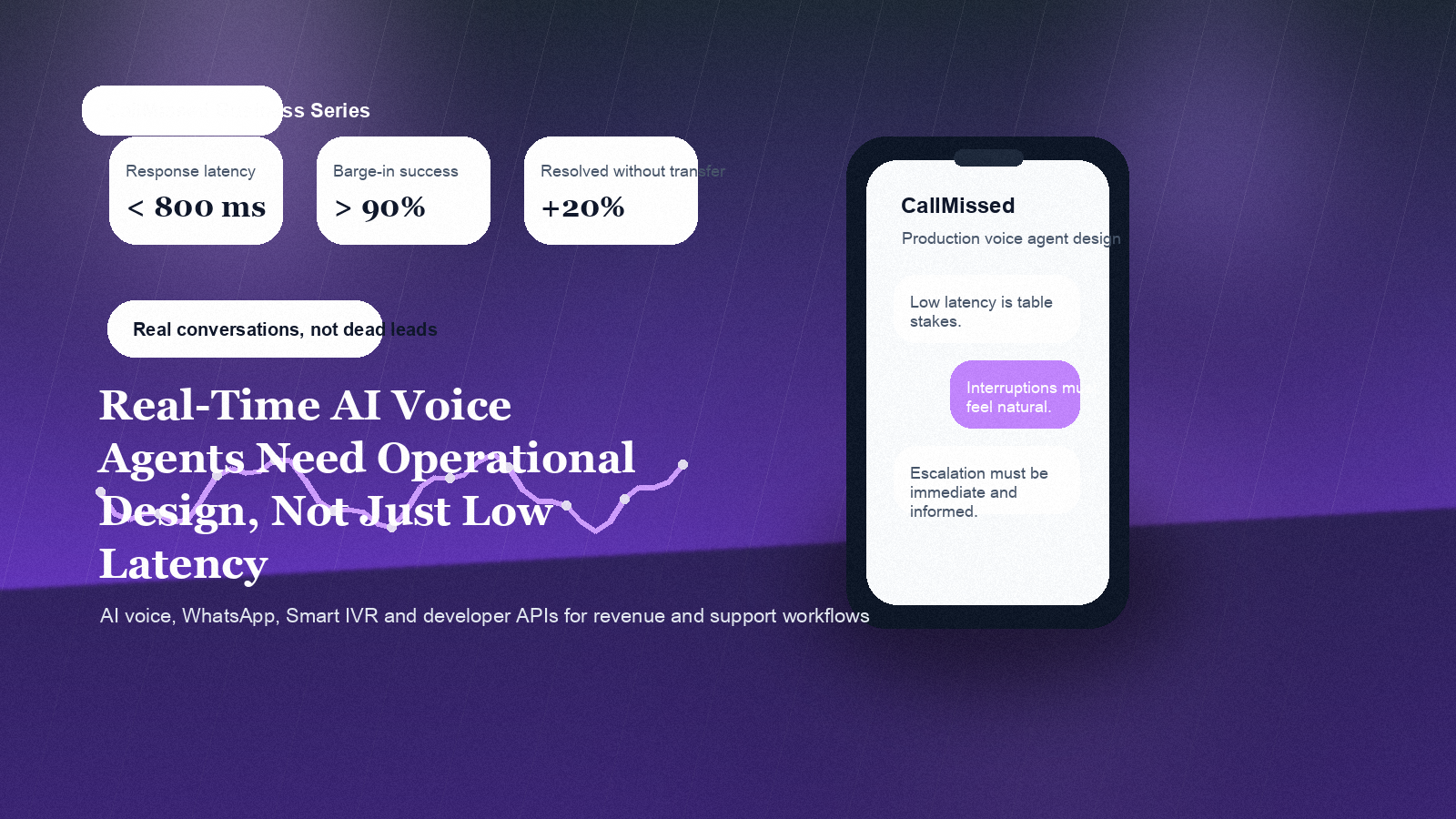
Real-Time AI Voice Agents Need Operational Design, Not Just Low Latency explains how CallMissed combines AI voice agents, WhatsApp automation, Smart IVR, and developer APIs for production workflows.
Real-Time AI Voice Agents Need Operational Design, Not Just Low Latency
Real-time voice agents create an unusually high bar because customers judge them moment by moment. A text chatbot can pause for a beat and still feel acceptable. A phone agent cannot. Silence feels broken. Overly long answers feel unnatural. Poor interruption handling feels robotic. That is why building voice AI is not only a model problem. It is a systems problem that spans speech recognition, turn detection, reasoning, speech synthesis, and escalation design. Businesses that understand this difference deploy voice agents that feel helpful instead of uncanny.
CallMissed is relevant here because the product is positioned as AI communication infrastructure for businesses that want WhatsApp chatbots, AI voice call agents, Smart IVR, multilingual speech, and OpenAI-compatible APIs in one operational stack. The article below is therefore not framed as generic AI commentary. It is framed around the exact workflows where that infrastructure becomes commercially useful.
The business problem behind the keyword
The hardest part of voice AI is that everything is exposed. If speech recognition misses the intent, the model reasons on the wrong input. If the response comes back late, the caller loses confidence. If the voice is clear but the handoff is clumsy, the entire interaction still feels low quality.
Operational design matters because voice is less forgiving than chat. The workflow must know when to answer briefly, when to confirm, when to slow down, when to interrupt itself, and when to transfer immediately.
Teams that treat voice as “just another channel” usually end up with demos that sound impressive in testing but create friction under real production traffic.
Where legacy workflows usually break
- Many projects benchmark only model latency and ignore the rest of the path: audio transport, STT, endpointing, TTS, network conditions, and barge-in handling.
- Others overfit to scripted calls. A voice agent sounds good in a lab, then struggles when callers speak quickly, interrupt, switch languages, or ask follow-up questions mid-answer.
- A common failure is escalation without context. The AI gives up, the call transfers, and the live agent has no idea what the customer already said.
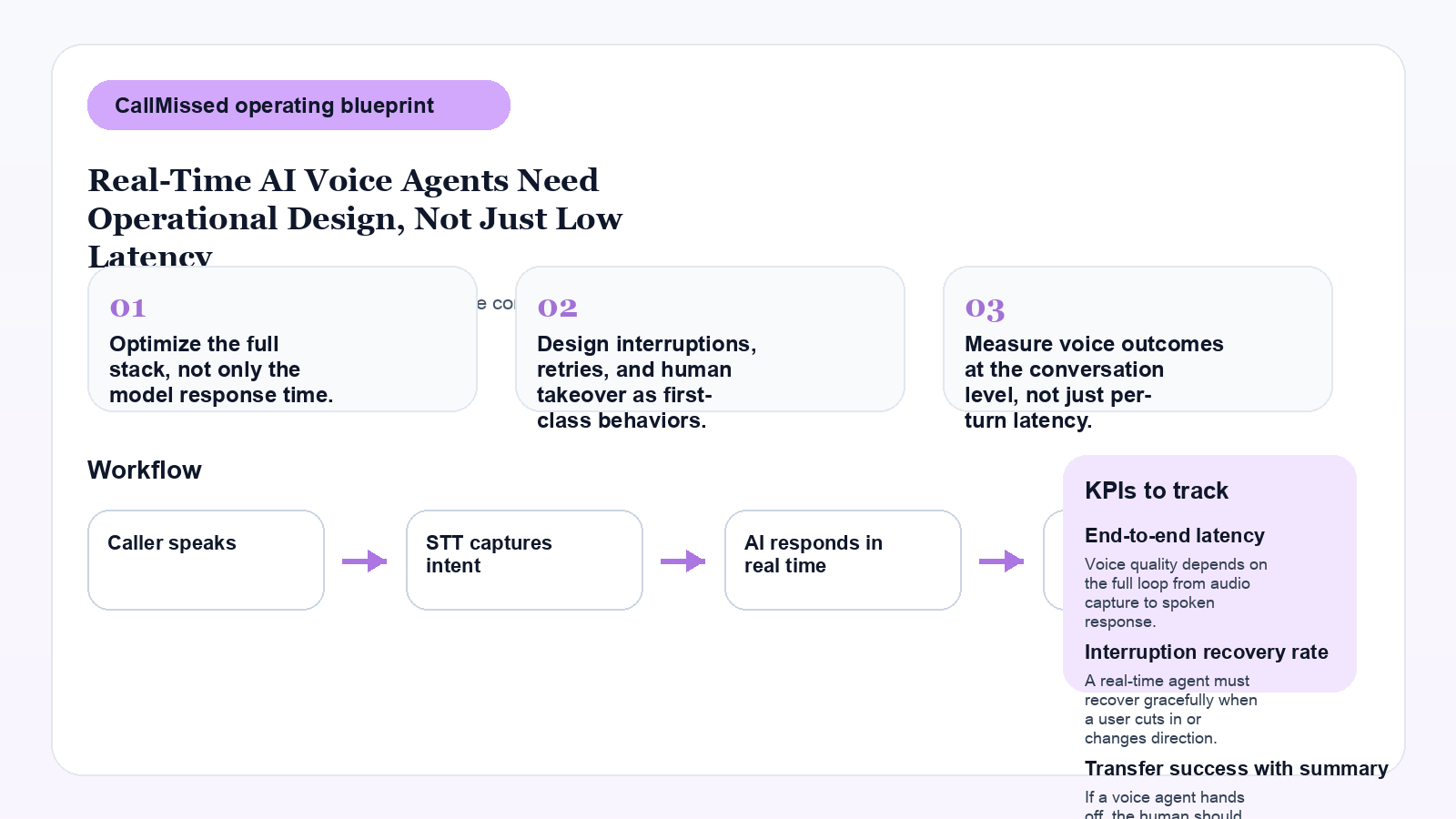
What CallMissed changes in this workflow
CallMissed aligns with this problem because the product is designed around AI voice call agents, real-time speech infrastructure, Smart IVR, and multilingual support rather than only text generation.
The platform’s voice architecture and OpenAI-compatible APIs make it easier to pair live voice interaction with the rest of the communication stack, including WhatsApp continuation, logging, and multi-model routing.
That matters because the best production voice systems are not isolated bots. They are connected workflows that can continue after the call, escalate intelligently, and be measured with the same discipline as a support or sales operation.
CallMissed documentation also reinforces the product building blocks behind this angle: AI-powered communication APIs, WhatsApp chatbots, AI voice call agents, Smart IVR, OpenAI-compatible endpoints, multilingual STT across 22 Indic languages plus English, and TTS options designed for telephony and app workflows. Those are not abstract features. They shape how fast a team can ship and refine a production conversation system.
A practical workflow blueprint
- Set strict latency budgets for every stage of the voice loop, not only the model. If the full path is too slow, callers will notice regardless of which component caused it.
- Design the first ten seconds carefully. Greeting, consent language, intent capture, and interruption behavior shape trust early.
- Keep early responses short. Voice agents feel smarter when they advance the call quickly rather than delivering long explanations by default.
- Trigger human takeover aggressively for policy-heavy, emotional, or high-value conversations where the cost of a bad answer exceeds the value of automation.
- Pair the call flow with post-call messaging so confirmations, links, and summaries land in WhatsApp when the spoken interaction ends.
High-value use cases
- Order support teams can use voice agents to answer tracking and status questions at peak times without overwhelming live staff.
- Appointment-heavy businesses can use real-time voice to capture urgency and availability before finishing details asynchronously.
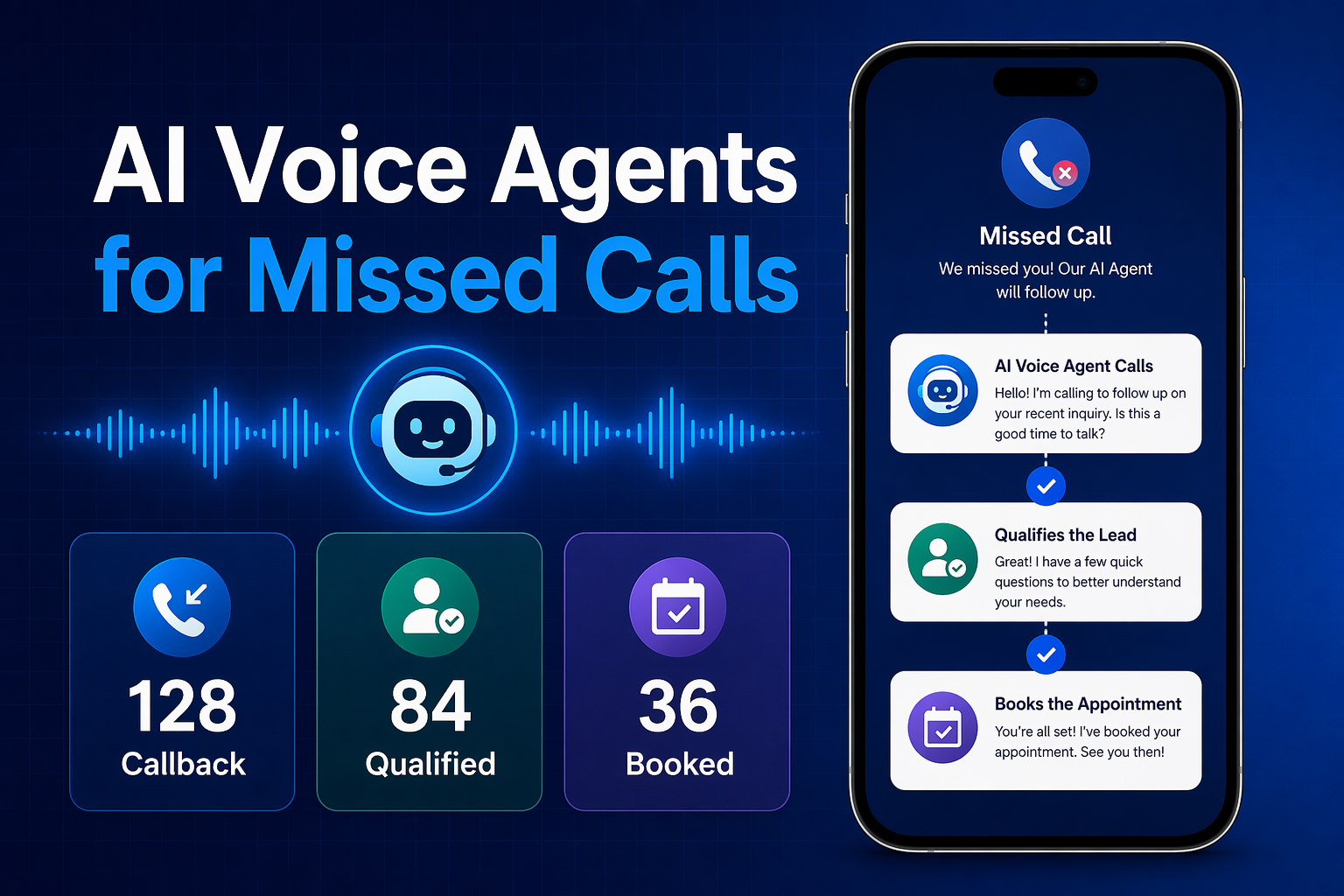
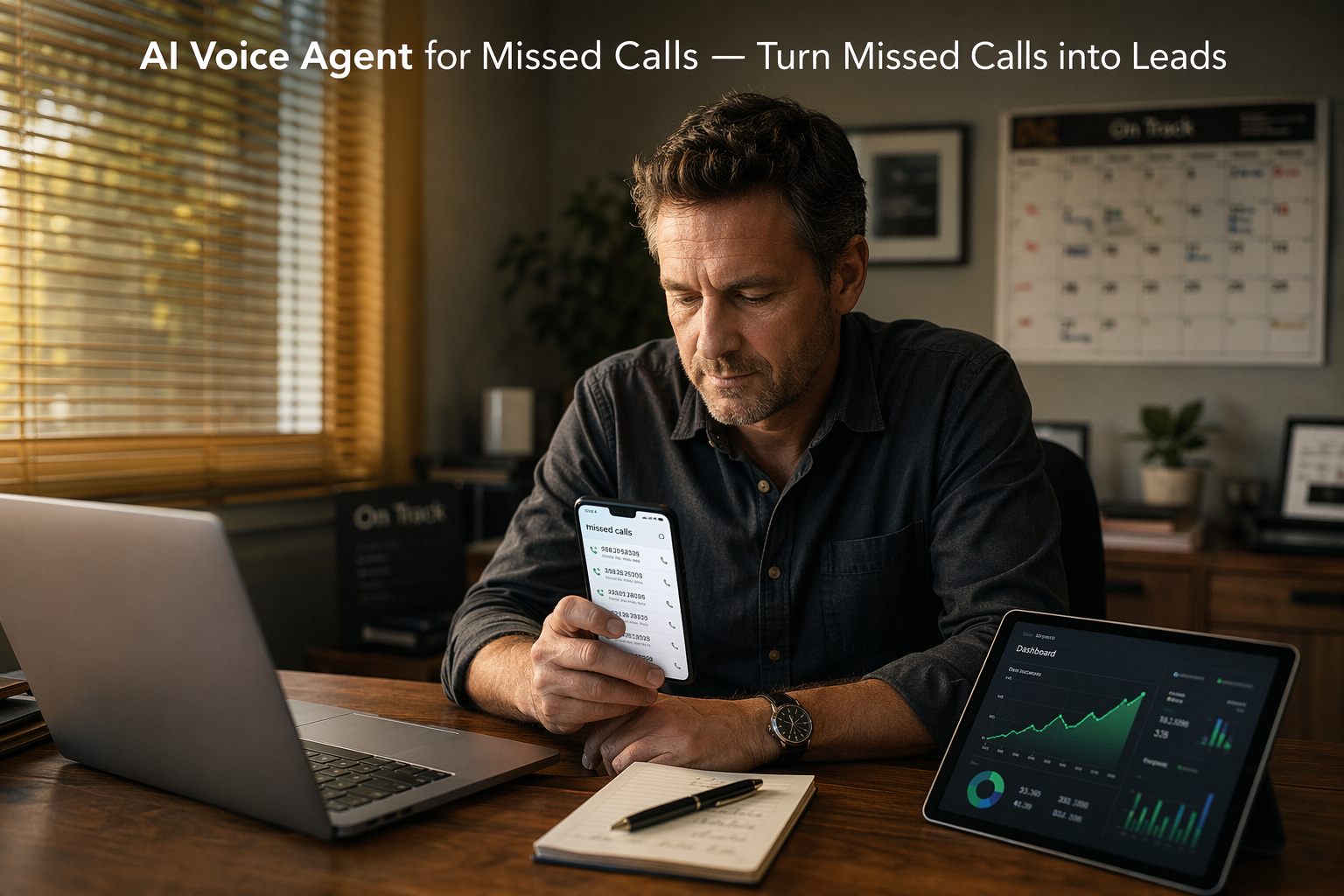
- Local services can handle after-hours inbound calls with a natural first response instead of voicemail black holes.
- SaaS and B2B service desks can triage inbound support by severity before routing to the correct operator or queue.
Rollout checklist for operations teams
- Judging quality only by a synthetic “human-like” score instead of business outcomes and interruption success.
- Allowing the agent to speak in long paragraphs. Voice works better with concise turns and frequent confirmation.
- Ignoring the importance of live escalation design. A fast bot that hands off badly still creates a poor experience.
- Testing only clean audio or only one language variety before rollout.
Why this matters commercially
The reason real-time AI voice agents deserves executive attention is simple: conversation quality affects revenue, service cost, and brand trust at the same time. When a business improves how quickly it answers, how consistently it qualifies or resolves, and how cleanly it moves between voice and WhatsApp, the gains show up in real operating lines such as booked appointments, recovered leads, lower support backlog, and fewer repeat contacts. This is why communication infrastructure is a growth lever rather than a cosmetic feature.
A workflow like this also compounds operationally. Once the business has clear prompts, escalation logic, and measurement in place, the same structure can be reused across new campaigns, locations, or customer segments. In practical terms, that means the first successful automation does not remain a one-off win. It becomes a template the team can improve and repeat.
Leaders should therefore evaluate this category the same way they evaluate any other operational investment: how much manual effort does it remove, how much customer demand does it preserve, and how quickly can the team adapt the workflow when products, seasons, or policy requirements change. CallMissed is useful in that frame because it gives teams one place to coordinate AI voice, WhatsApp, Smart IVR, multilingual speech, and developer integrations instead of rebuilding the communication layer for every experiment.
A 30-day pilot plan
- Pick one workflow where customer intent is already clear and measurable, such as missed-call recovery, booking confirmations, or order-status support.
- Define the non-negotiables before launch: latency threshold, escalation triggers, language support, and the exact outcome metric the business cares about.
- Review transcripts or call summaries daily in week one so the team can tighten prompts, remove repetitive questions, and correct weak handoff phrasing quickly.
- Compare the pilot against the manual baseline using conversation-level outcomes, not vanity metrics like message count or raw automation rate.
- Expand only after the workflow proves it can protect customer experience while improving speed, throughput, or conversion.
What strong human handoff looks like
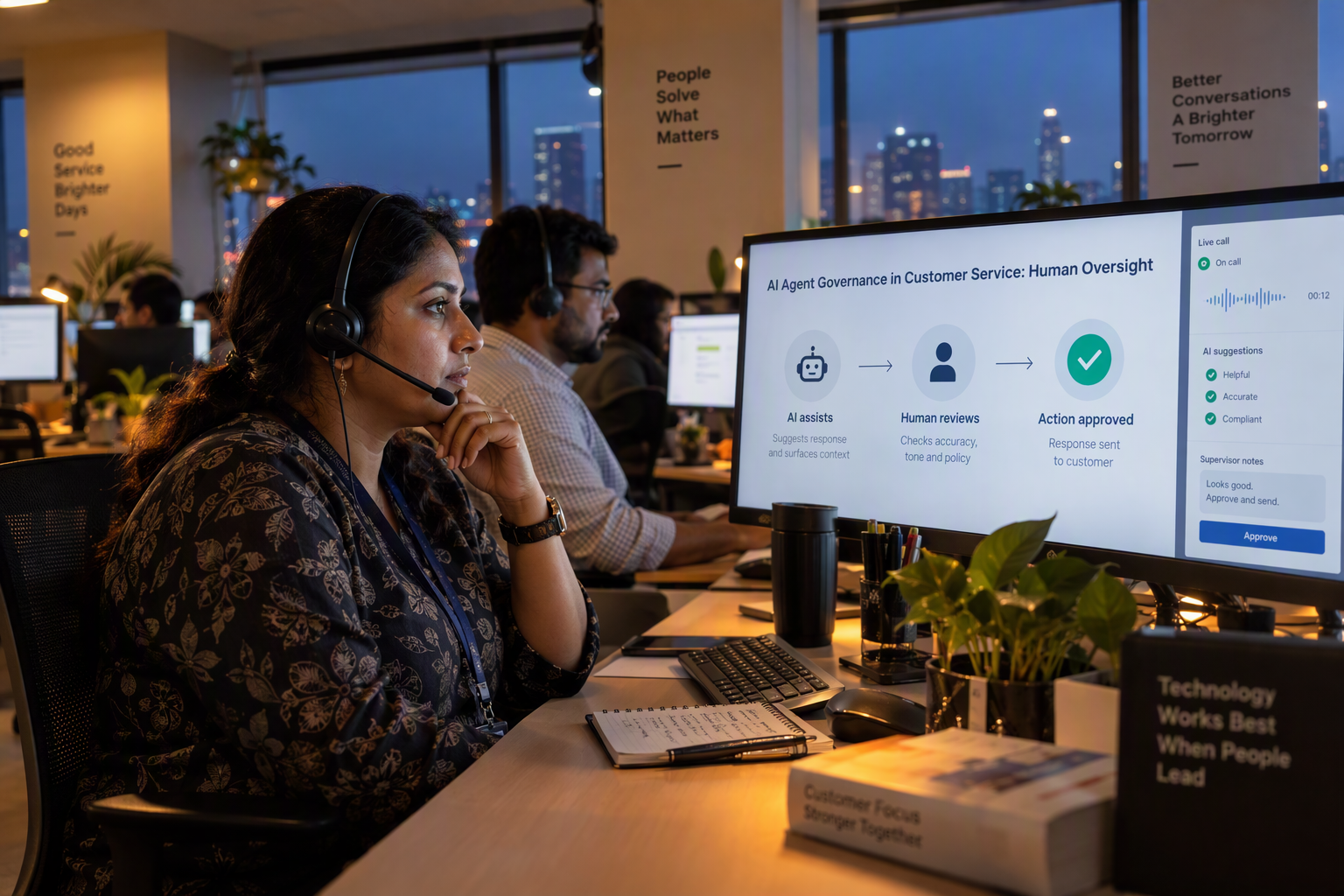
A good handoff does not merely transfer the customer. It transfers the conversation state. The human should receive the reason for contact, the important entities already captured, the customer’s tone or urgency, and the recommended next action. When that summary is missing, the customer experiences escalation as a reset. When it is present, escalation feels like continuity. In other words, the difference between poor automation and useful automation is often the quality of the handoff rather than the quality of the first answer alone.
This is one of the more practical reasons to think about CallMissed as infrastructure. The value is not simply that the platform can answer on voice or WhatsApp. The value is that both channels can participate in one operating workflow where summaries, routing, and next steps are structured enough to support human teams instead of interrupting them.
Metrics that matter
| Metric | Why it matters |
|---|---|
| End-to-end latency | Voice quality depends on the full loop from audio capture to spoken response. |
| Interruption recovery rate | A real-time agent must recover gracefully when a user cuts in or changes direction. |
| Transfer success with summary | If a voice agent hands off, the human should inherit the call with useful context. |
The important operating principle is that conversation automation should be judged at the workflow level, not at the prompt level. Businesses do not buy “good AI replies” in isolation. They buy fewer dropped leads, faster service loops, lower manual coordination, better routing, and more reliable communication across voice and WhatsApp. If a workflow does not move those outcomes, the automation is decorative rather than useful.
Common mistakes to avoid
- ('What makes a real-time voice agent feel good?', 'Fast response, reliable interruption handling, short answers, and clean escalation are usually more important than sounding flashy.')
- ('Why is latency not the whole story?', 'Because callers experience the full loop: recognition, reasoning, speech output, and handoff. Any weak point can break the interaction.')
- ('How does CallMissed help?', 'CallMissed provides AI voice call agents, multilingual speech support, Smart IVR, and an integration-ready communication stack for production workflows.')
- ('When should a human take over?', 'When the task becomes high-stakes, emotionally sensitive, policy-heavy, or commercially important enough that risk outweighs automation value.')
- ('What should operators measure?', 'Track end-to-end latency, interruption recovery, resolved-without-transfer rate, and transfer quality with summary.')
FAQ
Product references
- CallMissed Introduction: https://docs.callmissed.com/docs/introduction
- CallMissed Quickstart: https://docs.callmissed.com/docs/quickstart
- CallMissed Speech to Text: https://docs.callmissed.com/docs/speech-to-text
- CallMissed Text to Speech: https://docs.callmissed.com/docs/text-to-speech
- CallMissed Chat Completions: https://docs.callmissed.com/docs/chat-completion
Conclusion
real-time AI voice agents is valuable because it sits at the intersection of customer intent, operational speed, and workflow design. The businesses that win here are not the ones that bolt AI onto a contact form or a phone tree. They are the ones that redesign the communication loop so voice, WhatsApp, escalation, and measurement all reinforce each other. CallMissed fits that conversation because its product surface already matches the real implementation needs: AI voice, WhatsApp, Smart IVR, multilingual speech, and familiar developer APIs.
Discussion
Related Posts
Ready to automate customer conversations?
Launch AI voice agents and WhatsApp bots with CallMissed — one API, 22+ Indian languages.