
Muse Spark Rolling Into WhatsApp Will Raise Expectations for Business Messaging


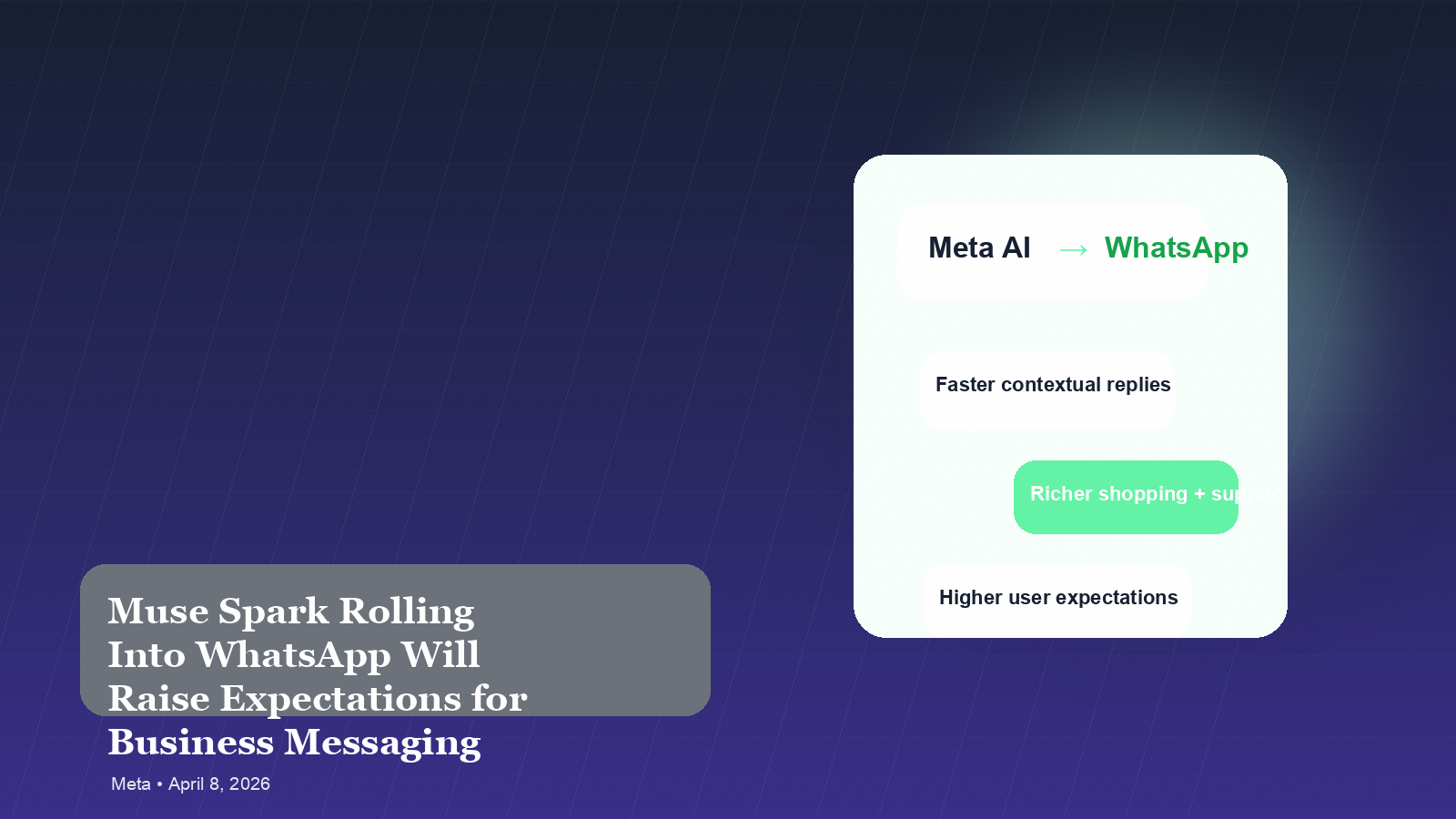
Muse Spark Rolling Into WhatsApp Will Raise Expectations for Business Messaging explains what this AI launch means for CallMissed-style voice, WhatsApp, Smart IVR, and customer workflow automation.
Muse Spark Rolling Into WhatsApp Will Raise Expectations for Business Messaging
Meta published Introducing Muse Spark: MSL’s First Model, Purpose-Built to Prioritize People on April 8, 2026, and the announcement matters because it points to where the AI market is heading for communication-heavy products. This is not generic model news. It is a signal about how customer-facing workflows, agent runtimes, voice systems, and business messaging are being rebuilt.
For CallMissed, the relevance is direct. The product is positioned as AI communication infrastructure with WhatsApp chatbots, AI voice call agents, Smart IVR, multilingual speech APIs, and OpenAI-compatible endpoints. That means each of these launches should be evaluated through one practical lens: does it improve how businesses answer, route, follow up, and complete customer work across channels?
What the source actually says
- Meta said Muse Spark currently powers the Meta AI app and website and will roll out to WhatsApp, Instagram, Facebook, Messenger, and AI glasses in the coming weeks.
- Meta frames Muse Spark as a fast, powerful model purpose-built for product experiences.
- The rollout matters because WhatsApp is a primary business communication channel in many markets.
The primary source is here: Introducing Muse Spark: MSL’s First Model, Purpose-Built to Prioritize People. In this article, the important move is not only the feature list. It is the direction of travel: more production readiness, more deployment maturity, more observability, better real-time performance, or stronger cost discipline depending on the topic.
Why this trend matters now
When AI capabilities arrive in consumer messaging products, they do more than add features. They reset expectations. Users start to expect faster answers, richer context, and more natural follow-up from every business chat they open.
That matters for business messaging providers because they are compared not only with other business tools, but increasingly with the best consumer AI experiences people touch daily.
The operational result is that WhatsApp automation must become more context-aware, more channel-native, and better at knowing when to escalate instead of stalling.
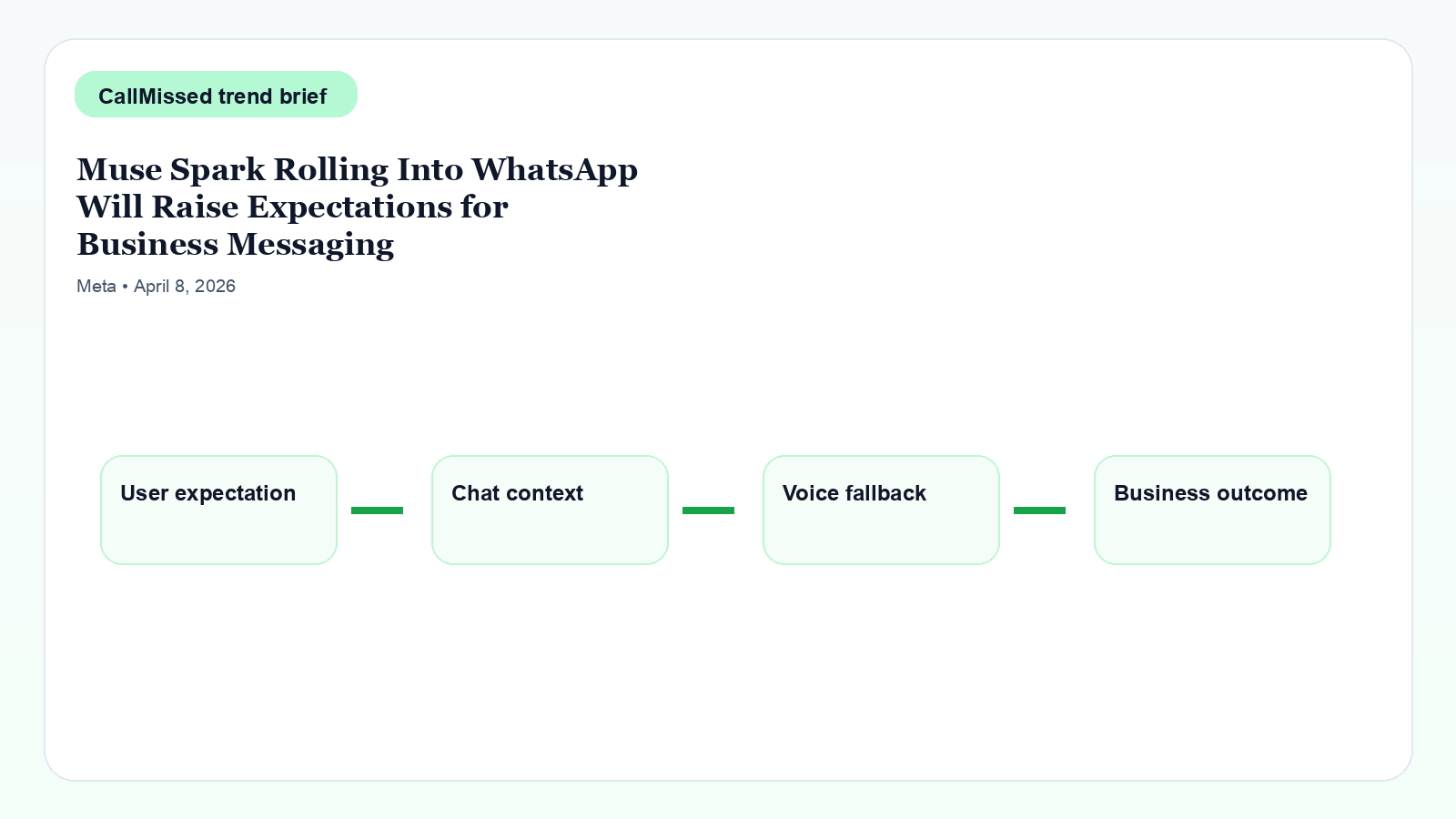
What this means for CallMissed
CallMissed is directly exposed to this trend because WhatsApp is already central to its business model. The platform helps businesses deploy WhatsApp chatbots and connect them to broader communication workflows.
Meta’s rollout reinforces the need for business messaging products to feel intentional, not transactional. That means better summaries, better routing, and stronger continuity between chat and voice.
The more consumer AI raises the baseline, the more business products like CallMissed need to win on workflow quality and operational usefulness rather than generic bot messaging.
CallMissed documentation reinforces the same architectural story. The platform offers AI-powered communication APIs, WhatsApp business workflows, voice-call agents, Smart IVR, speech-to-text in 22 Indic languages plus English, text-to-speech options for telephony, and OpenAI-compatible endpoints. Those verified capabilities make the product a natural surface for turning this market momentum into real business workflows instead of one-off experiments.
Practical operating blueprint
- Design WhatsApp flows that feel like progress, not like form fills. Each turn should move the customer toward a real next step.
- Use voice escalation when the customer is stuck, emotional, or carrying a task that is easier to resolve through spoken clarification.
- Preserve conversation state aggressively. Consumer AI has trained users to expect context retention, so repeated questions feel worse than before.
- Pair AI convenience with business discipline: clear handoff notes, event logs, and measurable outcomes.
- Review chat drop-off points the same way you would review funnel abandonment in sales or support operations.
Where teams can use this immediately
- Lead qualification flows where immediate, well-structured answers keep prospects warm.
- Support automation that starts in chat but escalates to voice for ambiguity or urgency.
- Order and booking workflows where the customer wants quick guidance plus a persistent thread for confirmation.
- India-focused customer communication stacks where WhatsApp is a default business surface rather than a side channel.
Commercial perspective
The reason WhatsApp AI business messaging matters is that communication systems sit near revenue and support cost at the same time. When a company answers faster, routes more accurately, preserves context across channels, and lowers repetitive agent work, the gains show up in booked appointments, recovered leads, faster ticket flow, lower backlog, or healthier margins. That is why these infrastructure and model announcements matter even when they seem technical on the surface.
The other important shift is buyer expectation. Enterprise teams increasingly expect AI communication platforms to look like serious software infrastructure: secure enough to deploy, measurable enough to improve, and flexible enough to fit the business’s chosen channels and workflows. Products that only sound impressive in demos will lose to products that make the day-to-day operating loop cleaner.
Risks and mistakes to avoid
- Relying on static menu trees while consumer AI experiences become more contextual and adaptive.
- Treating WhatsApp as a notification channel only, instead of as an active workflow surface.
- Letting the AI sound clever without making the next business action easier.
- Ignoring voice integration even when the customer clearly needs faster clarification than chat can provide.
Metrics to review after rollout
| Metric | Why it matters |
|---|---|
| Chat progression rate | Good messaging AI keeps the customer moving toward resolution or conversion. |
| Cross-channel handoff quality | WhatsApp gains value when chat and voice work as one workflow rather than separate queues. |
| Repeated-question rate | Context retention quality is visible when customers do not need to repeat themselves. |
The common trap in AI communication programs is optimizing for the wrong layer. Teams celebrate a model change, a voice upgrade, or a faster runtime while the actual workflow remains fragmented. The right question is always the same: did the customer interaction become easier to complete, and did the business spend less manual effort to complete it?
FAQ
Why does Muse Spark on WhatsApp matter for businesses?
How does this affect CallMissed?
What should teams improve first?
What should be measured?
Sources
- Meta (April 8, 2026): Introducing Muse Spark: MSL’s First Model, Purpose-Built to Prioritize People
- CallMissed Introduction: https://docs.callmissed.com/docs/introduction
- CallMissed Quickstart: https://docs.callmissed.com/docs/quickstart
- CallMissed Speech to Text: https://docs.callmissed.com/docs/speech-to-text
- CallMissed Text to Speech: https://docs.callmissed.com/docs/text-to-speech
- CallMissed Chat Completions: https://docs.callmissed.com/docs/chat-completion
Conclusion
Muse Spark Rolling Into WhatsApp Will Raise Expectations for Business Messaging is important because it shows how quickly the market is professionalizing around communication AI. The lesson for CallMissed is not to chase every logo or every launch headline. The lesson is to keep building the operational layer where these advances become useful: voice, WhatsApp, Smart IVR, multilingual understanding, measured routing, and clean handoffs. That is where real business value appears.
Discussion
Related Posts

Ready to automate customer conversations?
Launch AI voice agents and WhatsApp bots with CallMissed — one API, 22+ Indian languages.