
Cloudflare Agent Cloud Shows How Enterprise AI Agents Are Becoming Deployable Infrastructure


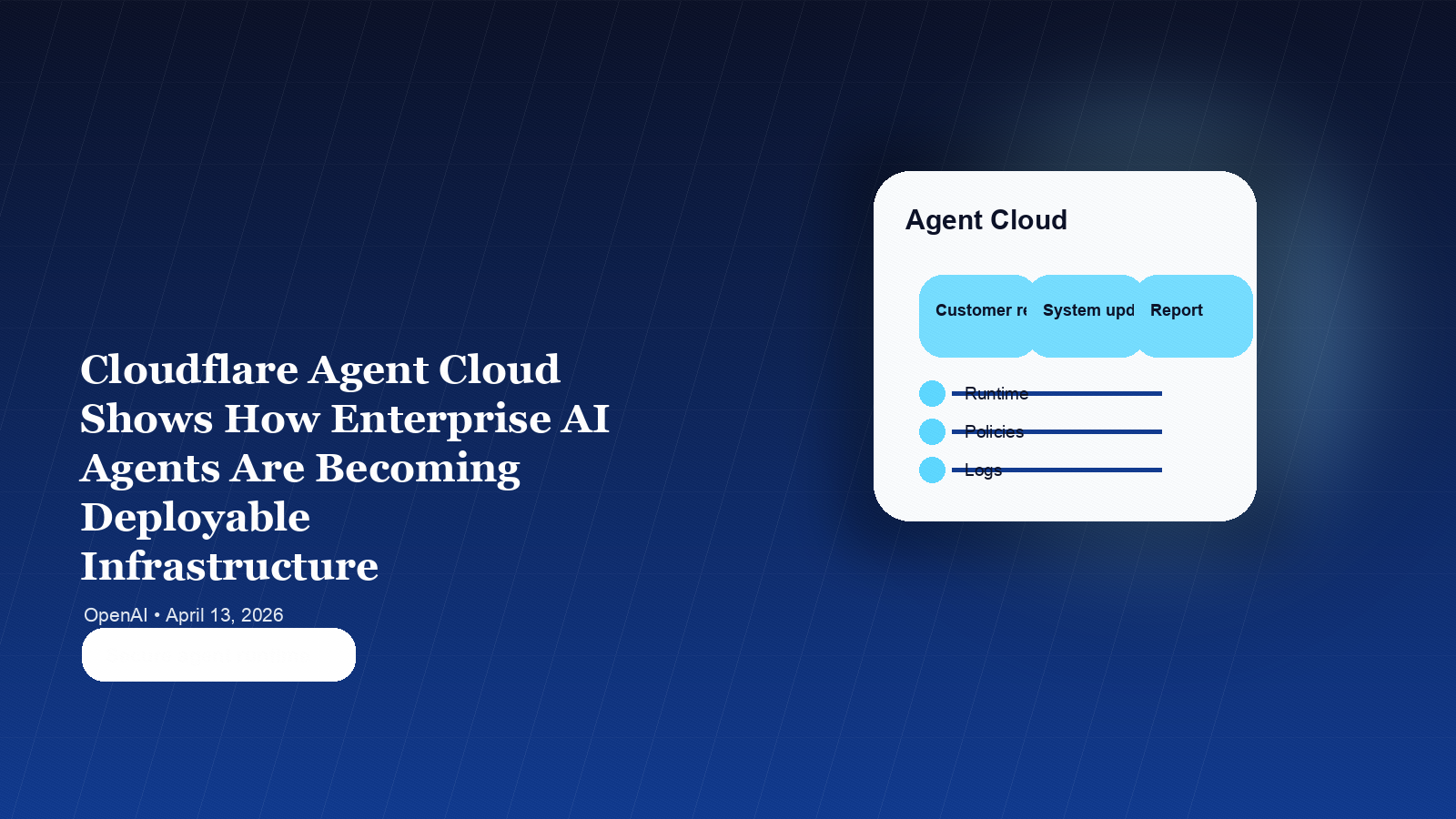
Cloudflare Agent Cloud Shows How Enterprise AI Agents Are Becoming Deployable Infrastructure explains what this AI launch means for CallMissed-style voice, WhatsApp, Smart IVR, and customer workflo...
Cloudflare Agent Cloud Shows How Enterprise AI Agents Are Becoming Deployable Infrastructure
OpenAI published Enterprises power agentic workflows in Cloudflare Agent Cloud with OpenAI on April 13, 2026, and the announcement matters because it points to where the AI market is heading for communication-heavy products. This is not generic model news. It is a signal about how customer-facing workflows, agent runtimes, voice systems, and business messaging are being rebuilt.
For CallMissed, the relevance is direct. The product is positioned as AI communication infrastructure with WhatsApp chatbots, AI voice call agents, Smart IVR, multilingual speech APIs, and OpenAI-compatible endpoints. That means each of these launches should be evaluated through one practical lens: does it improve how businesses answer, route, follow up, and complete customer work across channels?
What the source actually says
- OpenAI said millions of enterprises can access frontier models inside Cloudflare Agent Cloud.
- The post explicitly frames Cloudflare as a secure, production-ready path for agents to respond to customers, update systems, and generate reports.
- OpenAI also highlighted Codex harness availability inside Cloudflare Sandboxes for building and testing agents.
The primary source is here: Enterprises power agentic workflows in Cloudflare Agent Cloud with OpenAI. In this article, the important move is not only the feature list. It is the direction of travel: more production readiness, more deployment maturity, more observability, better real-time performance, or stronger cost discipline depending on the topic.
Why this trend matters now
The trend is no longer just about smarter models. It is about whether an enterprise can deploy agents in an environment that operations and security teams will actually approve.
For communication products, deployment quality matters because customer-facing agents touch live systems, records, message queues, call flows, and business logic. That raises the standard far beyond a chatbot demo.
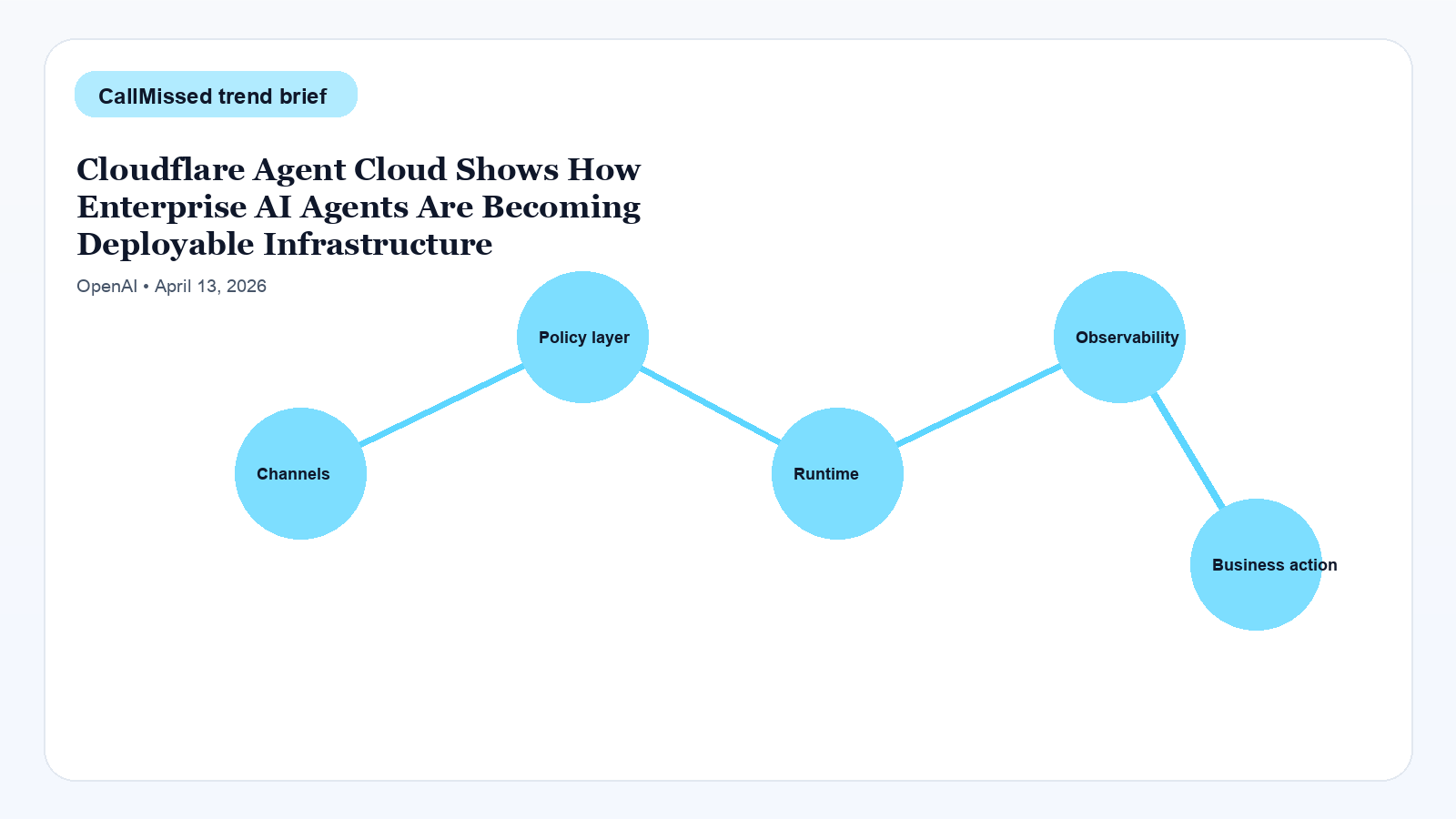
A secure agent runtime also changes go-to-market strategy. Teams can move from experimental pilots to scoped workflows with real uptime expectations, observability, and access controls.
What this means for CallMissed
CallMissed sits at the communication layer where AI voice agents, WhatsApp chatbots, Smart IVR, and workflow automation meet production infrastructure. That makes this launch directly relevant.
A platform like CallMissed benefits from the broader normalization of agent infrastructure because customers increasingly expect AI communication tools to be deployable, secure, and integrated with the rest of the stack.
The product story becomes stronger when voice and messaging automation can be described not as isolated bots, but as operational agents participating in secure business workflows.
CallMissed documentation reinforces the same architectural story. The platform offers AI-powered communication APIs, WhatsApp business workflows, voice-call agents, Smart IVR, speech-to-text in 22 Indic languages plus English, text-to-speech options for telephony, and OpenAI-compatible endpoints. Those verified capabilities make the product a natural surface for turning this market momentum into real business workflows instead of one-off experiments.
Practical operating blueprint
- Define one production workflow first, such as missed-call recovery or order-status escalation, before trying to deploy a general-purpose agent.
- Separate communication logic from sensitive back-office actions so the AI can guide, summarize, and route without receiving broad permissions by default.
- Use audit-friendly summaries and event logs so every agent-triggered action can be reviewed after the fact.
- Reserve stronger reasoning models for exception handling while keeping everyday channel traffic on latency-aware routes.
- Treat infrastructure choices as part of product design, because deployment constraints shape what customers will actually trust in production.
Where teams can use this immediately
- Customer support teams that need AI to triage issues, update systems, and keep a traceable activity log.
- Sales operations that want AI follow-up across voice and WhatsApp without granting unbounded system access.
- Regulated internal workflows where agents need to reason over policies but still operate inside controlled environments.
- SaaS platforms that want to embed communication agents for many customers without reinventing runtime isolation each time.
Commercial perspective
The reason enterprise AI agent infrastructure matters is that communication systems sit near revenue and support cost at the same time. When a company answers faster, routes more accurately, preserves context across channels, and lowers repetitive agent work, the gains show up in booked appointments, recovered leads, faster ticket flow, lower backlog, or healthier margins. That is why these infrastructure and model announcements matter even when they seem technical on the surface.
The other important shift is buyer expectation. Enterprise teams increasingly expect AI communication platforms to look like serious software infrastructure: secure enough to deploy, measurable enough to improve, and flexible enough to fit the business’s chosen channels and workflows. Products that only sound impressive in demos will lose to products that make the day-to-day operating loop cleaner.
Risks and mistakes to avoid
- Confusing agent hosting with agent governance. Deployment alone does not solve permission design or fallback behavior.
- Giving the agent too many connected tools too early. Production rollouts should start with narrow scopes and observable actions.
- Judging success by message count instead of business outcomes such as containment, response time, or manual time saved.
- Ignoring how voice and chat agents share context. A secure runtime still needs a coherent communication workflow.
Metrics to review after rollout
| Metric | Why it matters |
|---|---|
| Time to safe deployment | Shows whether the team can move from pilot to production without rewriting the whole workflow. |
| Auditable agent actions | Customer operations need a clear record of what the agent said, triggered, or changed. |
| Fallback rate | A strong deployment model still needs to surface where the agent cannot proceed safely. |
The common trap in AI communication programs is optimizing for the wrong layer. Teams celebrate a model change, a voice upgrade, or a faster runtime while the actual workflow remains fragmented. The right question is always the same: did the customer interaction become easier to complete, and did the business spend less manual effort to complete it?
FAQ
Why does Agent Cloud matter for communication products?
How is this relevant to CallMissed?
What should teams deploy first?
What metric matters most?
Sources
- OpenAI (April 13, 2026): Enterprises power agentic workflows in Cloudflare Agent Cloud with OpenAI
- CallMissed Introduction: https://docs.callmissed.com/docs/introduction
- CallMissed Quickstart: https://docs.callmissed.com/docs/quickstart
- CallMissed Speech to Text: https://docs.callmissed.com/docs/speech-to-text
- CallMissed Text to Speech: https://docs.callmissed.com/docs/text-to-speech
- CallMissed Chat Completions: https://docs.callmissed.com/docs/chat-completion
Conclusion
Cloudflare Agent Cloud Shows How Enterprise AI Agents Are Becoming Deployable Infrastructure is important because it shows how quickly the market is professionalizing around communication AI. The lesson for CallMissed is not to chase every logo or every launch headline. The lesson is to keep building the operational layer where these advances become useful: voice, WhatsApp, Smart IVR, multilingual understanding, measured routing, and clean handoffs. That is where real business value appears.
Discussion
Related Posts


Ready to automate customer conversations?
Launch AI voice agents and WhatsApp bots with CallMissed — one API, 22+ Indian languages.