
Self-Hosting LLMs in 2026: When It Pays Off



The honest 2026 math on self-hosting LLMs — break-even volumes, hidden engineering costs, model picks, and when regulatory drivers override the cost question.
"We should self-host an open-source model" gets pitched in nearly every AI engineering meeting in 2026. Sometimes it is the right call. Often it is not. The math is more nuanced than "API is expensive, so let us run our own GPU" — and the hidden costs are where most teams get caught.
The simple version of the math
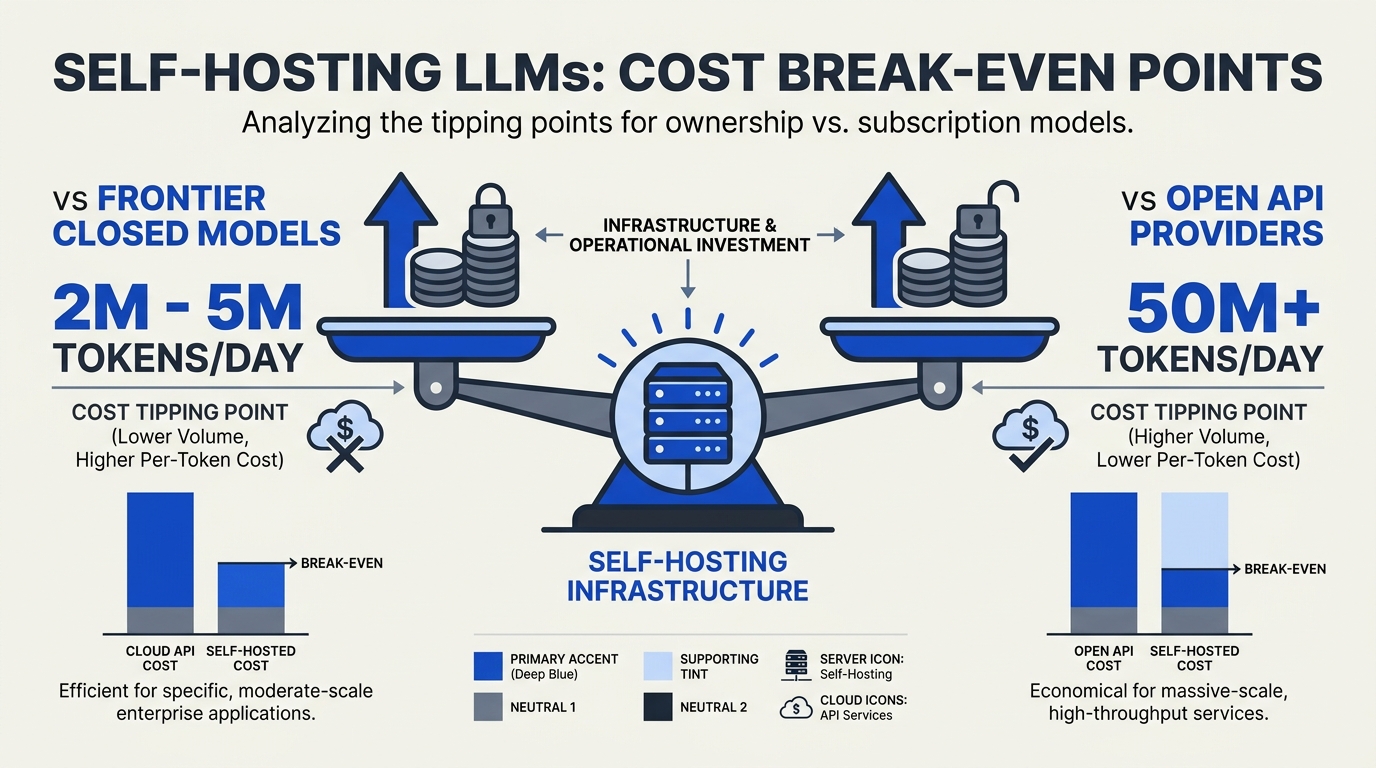
For a steady inference workload, self-hosting break-even depends on three numbers: tokens per day, $/hour for the GPU, and the API price you would otherwise pay.
A reasonable rule of thumb across 2026 reports:
- vs frontier closed models (GPT-class, Claude-class): break-even around 2M–5M tokens/day. (premai blog) [Unverified — heavily workload-dependent]
- vs open-model API providers (Together, Fireworks, Groq, etc.): break-even shifts to 50M+ tokens/day because those providers run optimized infrastructure at scale and pass thin margins on. [Unverified]
In other words: if you are competing with a frontier API, the cross-over comes earlier. If you are competing with another open-model provider, you are unlikely to win on cost unless you are at hyperscale.
The hidden costs
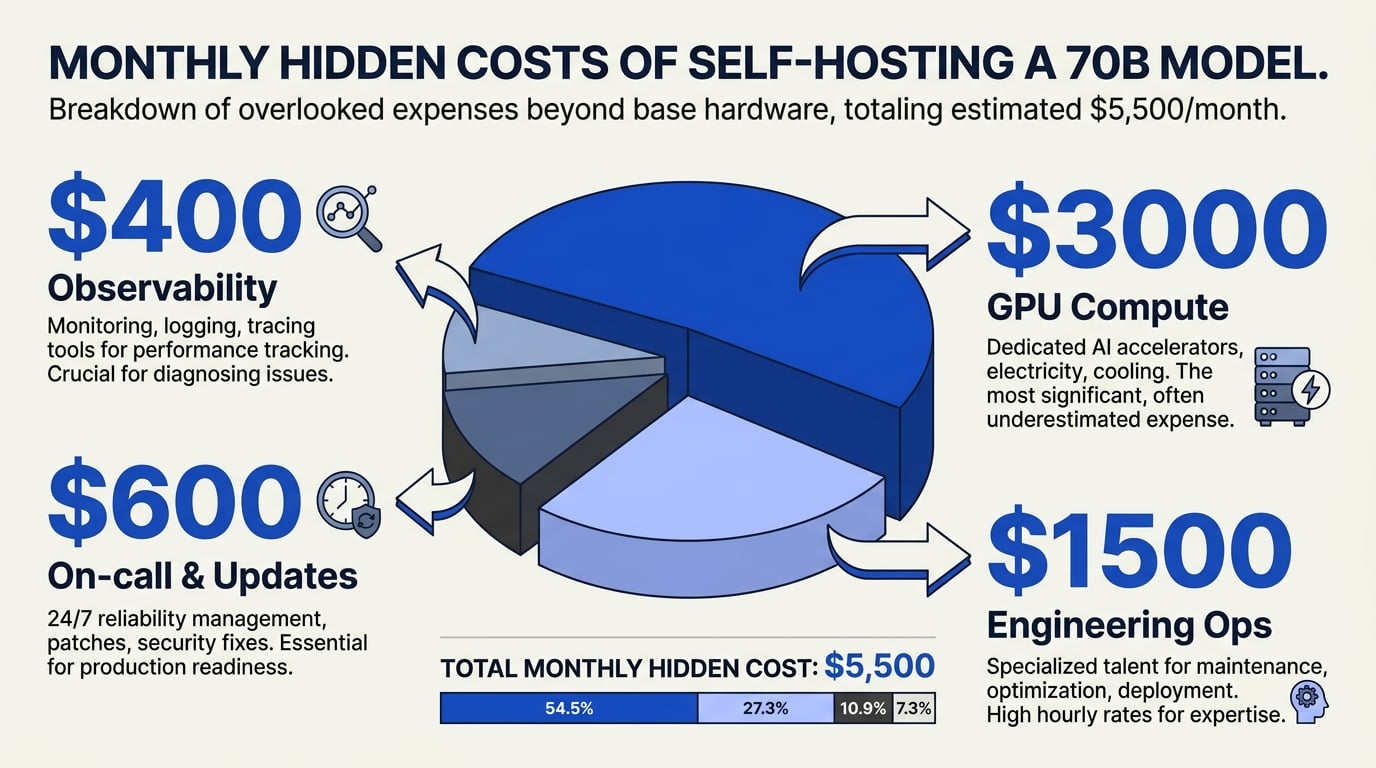
The naive math is GPU $/hour ÷ tokens/hour. The actual math includes:
| Cost | Typical monthly |
|---|---|
| GPU compute (single H100 reserved) | ~$2,000–4,000 |
| Engineering ops (10–20 hrs at senior rates) | $750–3,000 |
| Observability, alerting, autoscaling | $200–500 |
| Model updates and fine-tune iterations | variable |
| On-call burden | "free" until 3am |
The engineering cost is the line item most teams under-budget. Production self-hosted LLM serving — autoscaling, GPU draining, model versioning, batch shaping, KV-cache reuse, eviction policies, observability, on-call — is real platform work.
[Unverified — sourced from premai] One commonly-cited estimate budgets $3,000–5,000/month total for serving a 70B model on A100/H100 infrastructure, accounting for all hidden costs. That is a fair starting line.
Models worth self-hosting in 2026
The open-weight ecosystem in 2026 is competitive enough that you can match many closed-API behaviors. Notable options: [Inference]
- Llama 4 family (Meta) — multimodal, long context, broad ecosystem support
- Qwen 3 / Qwen 2.5 Coder series — strong reasoning, especially on code
- DeepSeek V3 / R1 family — strong reasoning per dollar
- Mistral Small 3 / Mistral Large 2 — European-licensed, multilingual
- Gemma 3 (Google) — small-to-medium models, strong on knowledge
For coding workloads, Qwen 2.5 Coder 32B and Devstral Small are reported to handle the bulk of code completion and debugging at competitive quality. (premai) [Unverified]
When self-hosting wins regardless of cost
Cost is one axis. The others sometimes dominate:
- Data residency / regulatory — EU customers under GDPR or industry regulators (HIPAA, FINRA, FedRAMP) may require all data to stay in your VPC. Self-hosted is the cleanest answer.
- Air-gapped deployments — defense, intelligence, on-prem hospital systems. APIs are not an option.
- Custom fine-tuning — you own a fine-tuned model and want it served beside other proprietary systems.
- Latency to user — co-locating inference next to your application can shave hundreds of milliseconds versus calling an API across regions.
- Vendor lock-in mitigation — having a credible self-hosted fallback is itself negotiating leverage with API vendors.
What self-hosting does NOT save you from
- GPU scarcity during demand spikes — if you reserve H100s, you have them. If you rely on spot, you compete with everyone else when capacity tightens.
- Egress — high egress between your serving cluster and your application is real money.
- Compliance and security work — your own model serving has its own attack surface, audit logs, and access controls. The work moves from "trust the vendor" to "do it yourself."
A reasonable decision flow
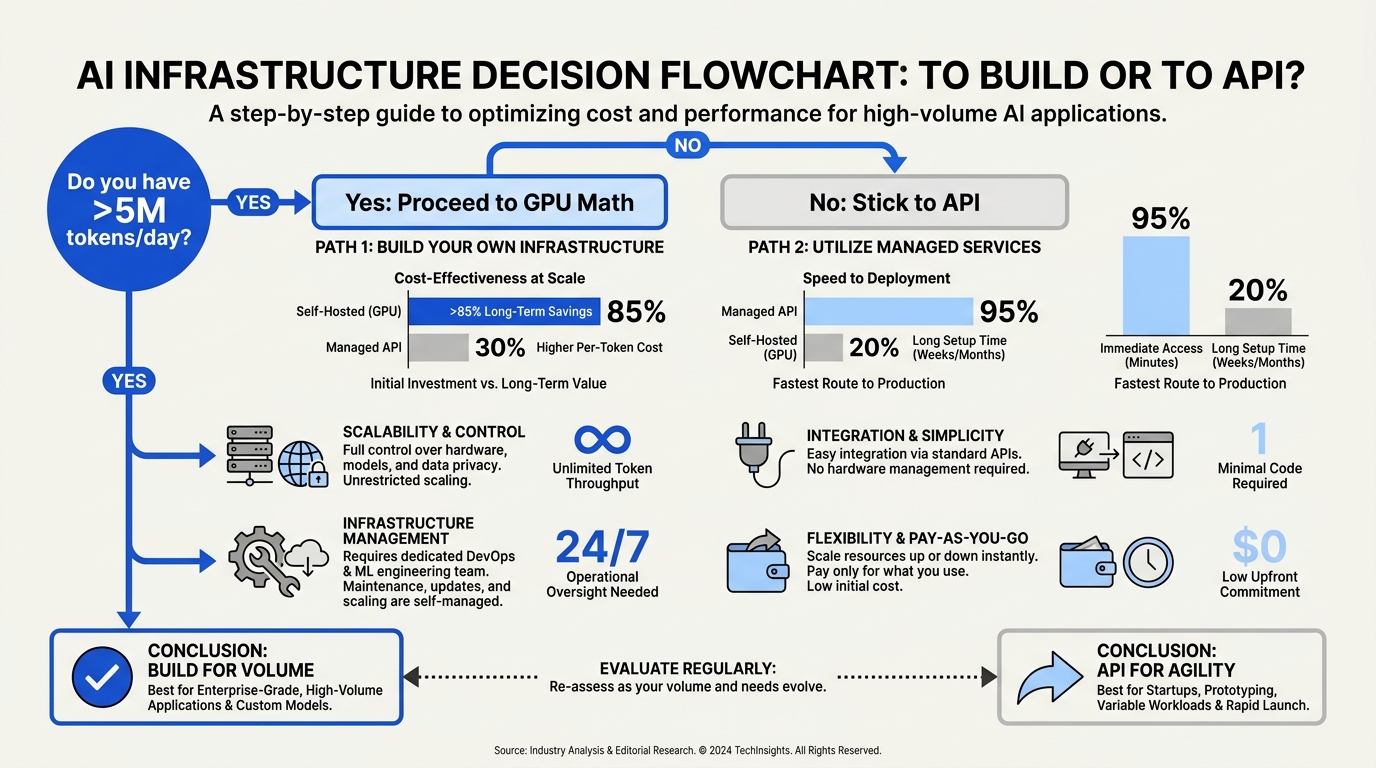
Is your workload subject to data residency / regulatory constraints?
  yes → self-host (or sovereign-cloud API), regardless of cost math
  no  → continue
Are you above ~50M tokens/day on a stable workload?
  no  → use APIs; revisit when volume crosses ~10M/day
  yes → continue
Do you have an SRE/ML platform team with GPU experience?
  no  → use a managed open-model provider (Together, Fireworks, Groq)
  yes → self-host with vLLM / SGLang / TensorRT-LLM
The middle path — managed open-model providers — is the right answer for many teams who want open-model economics without operational burden. Together AI, Fireworks AI, Groq, and AWS Bedrock for open models all run optimized infrastructure and price aggressively.
A worked example
A team running a customer-support summarizer at 30M tokens/day:
- GPT-4-class API: ~$36,000/month [Speculation]
- Open-model API (Together / Fireworks Llama-3.3-70B): ~$6,000/month [Speculation]
- Self-hosted on 2x H100 reserved: ~$5,000/month compute + $2,000 ops = $7,000
In this case the open-model API wins on total cost and operational simplicity. Self-hosting only pulls ahead with serious utilization above ~50M tokens/day, or with a residency requirement that takes the API options off the table. [Speculation]
Bottom line
In 2026, API-by-default is still the right answer for most teams. The exceptions are the regulated, the air-gapped, the very-high-volume, and the teams with a strategic reason to control the stack end-to-end. If you are evaluating self-hosting on cost alone, do the full math — including the $750–3,000/month of engineering time you might be discounting.
Frequently Asked Questions
At what volume does self-hosting actually pay off?
Which open model should I self-host in 2026?
Can I self-host without a dedicated infra team?
Discussion
Related Posts


Ready to automate customer conversations?
Launch AI voice agents and WhatsApp bots with CallMissed — one API, 22+ Indian languages.