
LoRA and Distillation: A Practical Guide for 2026


A 2026 practical guide to LoRA, QLoRA, and distillation — when to use each, default hyperparameters, dataset quality, the toolchain, and shipping to production.
In 2026, a single consumer GPU is enough to specialize a 7B model on your domain in an afternoon. That is not a research milestone — it is the default. The two techniques that made it possible are LoRA (Low-Rank Adaptation) and QLoRA (Quantized LoRA), with distillation as the cousin that compresses big models into small ones. Here is the practical playbook.
What LoRA actually does
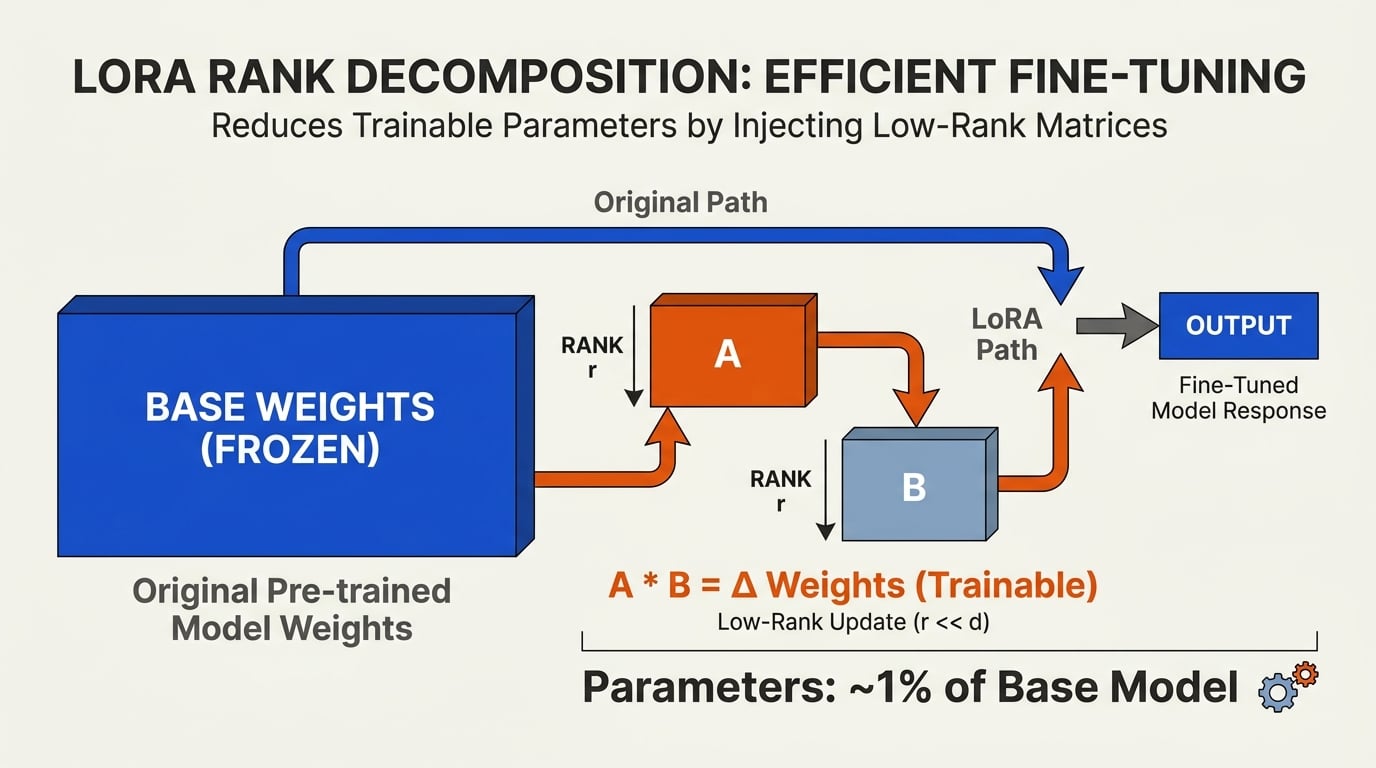
A 7B-parameter model has about 7 billion weights. Full fine-tuning updates all of them — that is expensive (16-bit weights need ~14 GB just to hold gradients) and overkill for most adaptation tasks.
LoRA freezes the base model and inserts small rank-r trainable matrices alongside the original weights. Only the LoRA matrices are updated during training. The math: a d × d weight matrix becomes d × d + d × r + r × d, where r is typically 8–32. You end up training 0.1–1% of the original parameters.
The result: roughly the same task quality as full fine-tuning, with 10–100× less GPU memory and dramatically faster iteration. (effloow guide)
QLoRA: LoRA on a 4-bit base
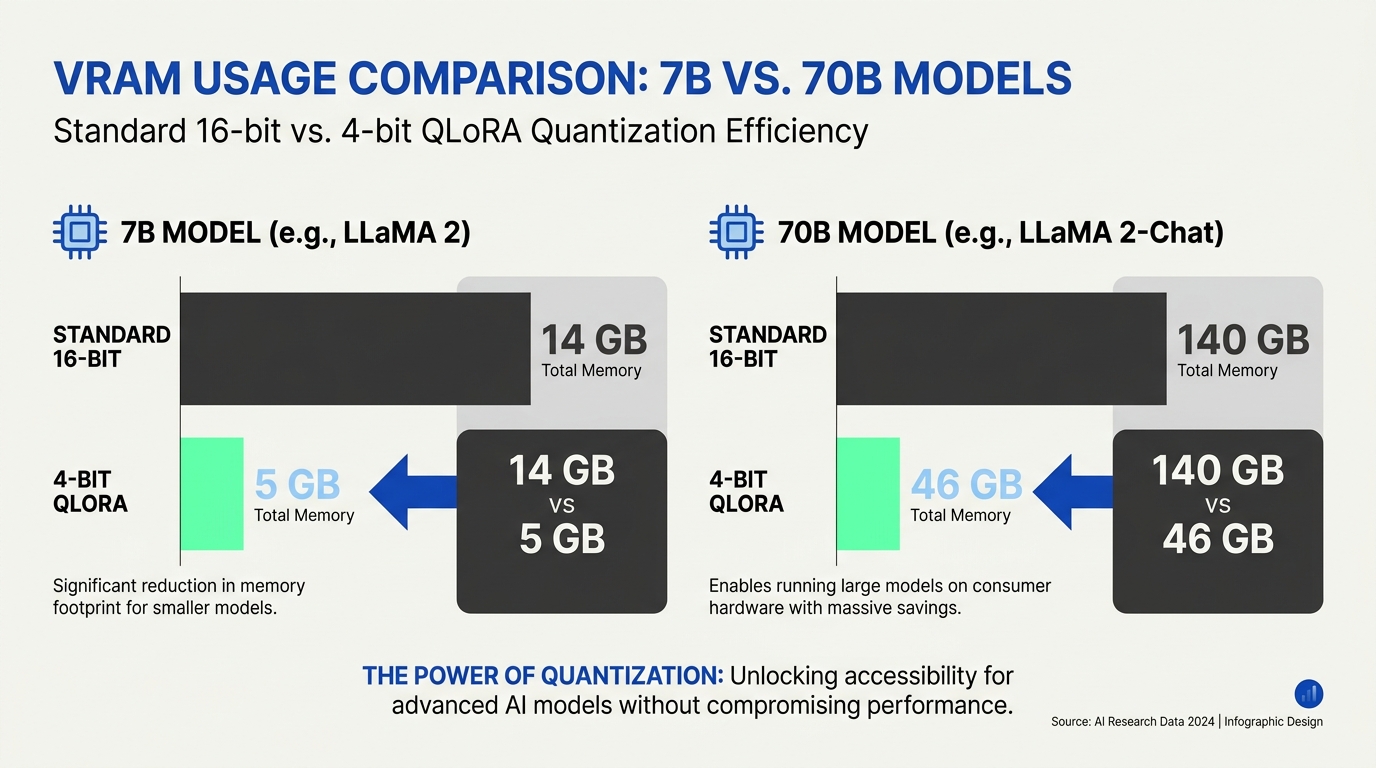
QLoRA goes further. Quantize the base model to 4-bit NF4 during training; train LoRA adapters on top. The base never updates, so its quantization is fine. You get most of LoRA's quality at a fraction of the memory.
Reported memory math:
- A 7B model needs ~14 GB at 16-bit; with 4-bit QLoRA it fits in 5–6 GB
- A 70B model drops from ~140 GB to ~46 GB — fitting on a single A100 80 GB
Quality gap: QLoRA reportedly retains 80–90% of full fine-tuning performance, versus LoRA's 90–95%. ([effloow]) [Unverified]
For most production adaptation tasks, the QLoRA gap is below the noise floor of your eval. For high-stakes tasks, run LoRA in 16-bit if you have the VRAM.
Default hyperparameters that work
Across the practitioner sources reporting in 2026, the defaults that ship: (effloow, DEV Community)
r            = 16
alpha        = 16            # alpha ≈ r is a safe default; some recipes use 2r
target_modules = "all-linear" # train all linear layers, not just q/k/v
dropout      = 0.05
learning_rate = 2e-4         # for LoRA; 1e-4 for QLoRA
batch_size   = 4              # adjust to fit memory
gradient_accumulation = 4     # effective batch 16
epochs       = 3              # 1-3 is enough; more often overfits
Modern stacks (Unsloth, Axolotl, TRL) start here. Adjust if your eval tells you to. The biggest wins from hyperparameter sweeps are usually in dataset quality, not in r or alpha.
Dataset quality > dataset size
The single most useful 2026 insight: 500 clean examples outperform 5,000 noisy ones for most adaptation tasks. ([effloow])
A "clean example" means:
- Input matches your real production input distribution
- Output is what you actually want — schema, tone, length, content
- No contradictions across examples
- No leaked answers, no formatting inconsistencies
Spend more time on data curation than on hyperparameter sweeps. The 80/20 sits on the data side, not the training side.
The 2026 toolchain
- Unsloth — speed-focused; reportedly 2× faster training than vanilla on consumer GPUs. Best for "I want to fine-tune on my RTX 4090 in an afternoon."
- Axolotl — YAML-driven pipelines for repeatable runs. Best for "I want this in a git repo and a CI job."
- TRL (Transformer Reinforcement Learning) — Hugging Face's library; supports SFT, DPO, KTO, ORPO. Best for "I want preference-based training, not just SFT."
- Hosted fine-tune APIs — OpenAI, Anthropic, Together, Fireworks. Best for "I do not want to run training infrastructure."
Pick based on team skill and infra preference. The model quality from any of them is comparable when the data is the same.
Distillation: a different shape
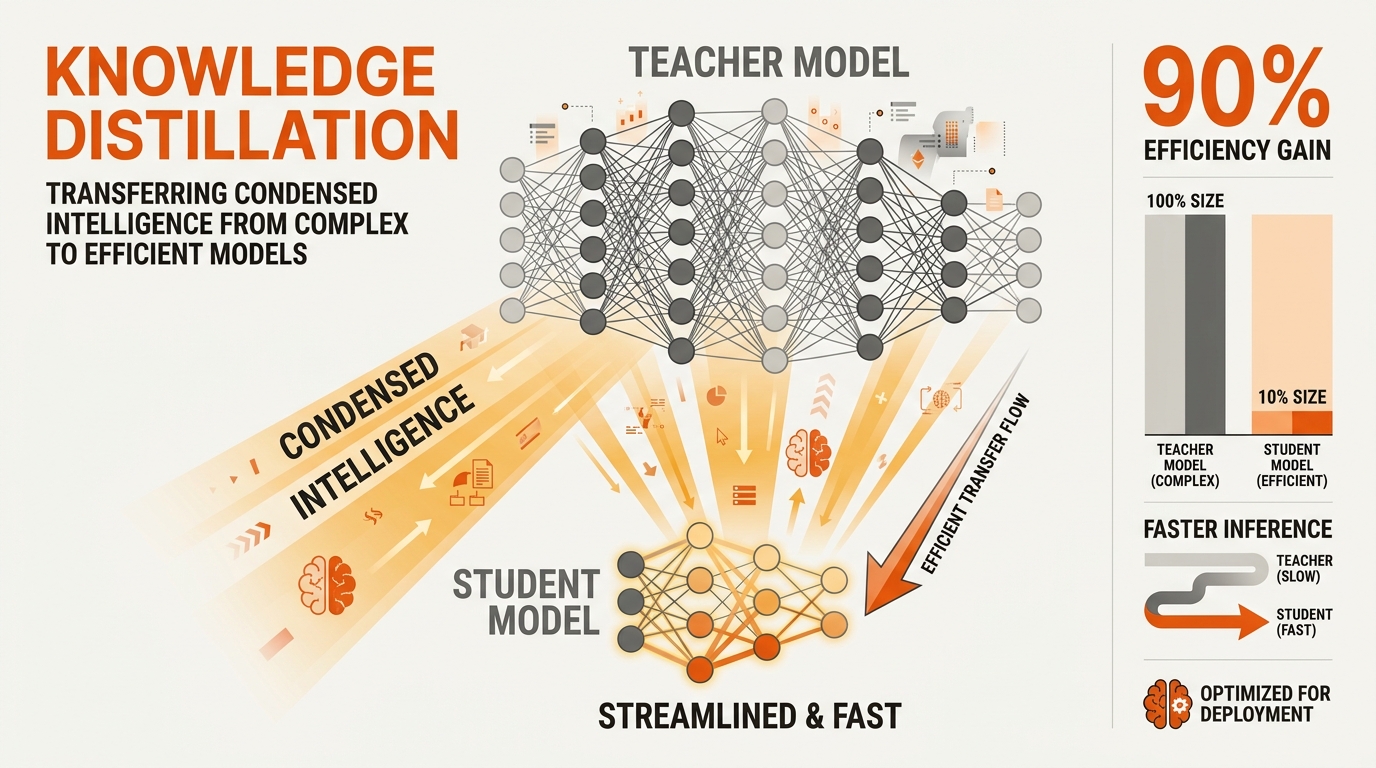
Distillation is the other way to shrink a model: train a small "student" model to mimic the outputs of a large "teacher" model.
Two flavors:
- Hard-label distillation — student trains on teacher's generated outputs as ground truth. Simple; works with any black-box teacher.
- Soft-label distillation — student trains on teacher's full output distribution (logits). More sample-efficient, but requires logit access (only available for open-weight teachers).
Distillation makes sense when:
- You have a frontier model performing well and want to deploy a smaller, cheaper version
- The task is narrow enough that a 7B student can match the frontier teacher
- You can generate enough teacher outputs (typically 10K–100K) for the student to learn from
It does not make sense for very broad tasks (general chat) — the gap between 7B and frontier-class is too wide for a small student to close.
A worked example: shrinking a frontier model
Hypothetical workflow for distilling a frontier model onto a 7B local model for a structured-extraction task: [Speculation]
- Run the frontier model on 50K representative inputs, capture (input, output) pairs
- Filter for outputs that pass schema validation and a heuristic quality check
- LoRA fine-tune Qwen 2.5 7B (or similar) on the filtered set
- Evaluate on a held-out test set; the student typically reaches 90–95% of teacher quality on the narrow task
- Deploy the LoRA-adapted student on a single L40S; cost drops 20–50× per request
The economics flip past ~50K–200K daily calls — below that, paying the frontier API is simpler and cheaper.
Common pitfalls
- Catastrophic forgetting — training too long or too aggressively makes the model worse at general tasks. 1–3 epochs is usually enough.
- Reward hacking on DPO/RLHF — preference-based training can teach the model to game the reward signal. Always have a held-out human eval.
- Eval drift — without a frozen test set, "improvements" can be self-referential. Pick your eval set before training; never look at it during training.
- Overfitting on small datasets — with 500 examples and r=64, you can easily overfit. Start at r=8–16 and grow only if the eval supports it.
- Adapter merge surprises — merging the LoRA back into the base model for serving sometimes shifts behavior subtly. Test serving the merged weights before shipping.
When to skip fine-tuning entirely
Before you train anything, ask: would prompt engineering with structured output, few-shot examples, and a stronger model close the gap? Often the answer is yes, and you save weeks. Fine-tune only after prompting hits a ceiling and the volume justifies the engineering cost.
Bottom line
LoRA and QLoRA in 2026 are routine, not exotic. A small team with a well-curated 500-example dataset can ship a domain-adapted 7B model in days, run it on cheap hardware, and match a frontier API on the narrow task at a fraction of the cost. Distillation extends the same idea: take what a big model knows about your task and pour it into a small model you can afford to run. The hard part is data quality, not training math.
Frequently Asked Questions
Should I use LoRA or QLoRA?
How many examples do I need to fine-tune?
When should I distill instead of fine-tune?
Discussion
Related Posts


Ready to automate customer conversations?
Launch AI voice agents and WhatsApp bots with CallMissed — one API, 22+ Indian languages.