
Hiring AI Engineers in 2026: Skills That Actually Matter



What to look for when hiring AI engineers in 2026 — eval engineering, retrieval, agent debugging, MLOps for LLMs, and the skills that are overrated.
The "AI engineer" role in 2026 is not the same role it was in 2023. Most teams have moved past the era when "knows how to call the OpenAI API" qualified someone as an AI engineer. The skills that actually correlate with shipping production AI features have shifted, and so has the interview design that screens for them. Here is what we are seeing across hiring panels in 2026, and what to weight.
What the role looks like now
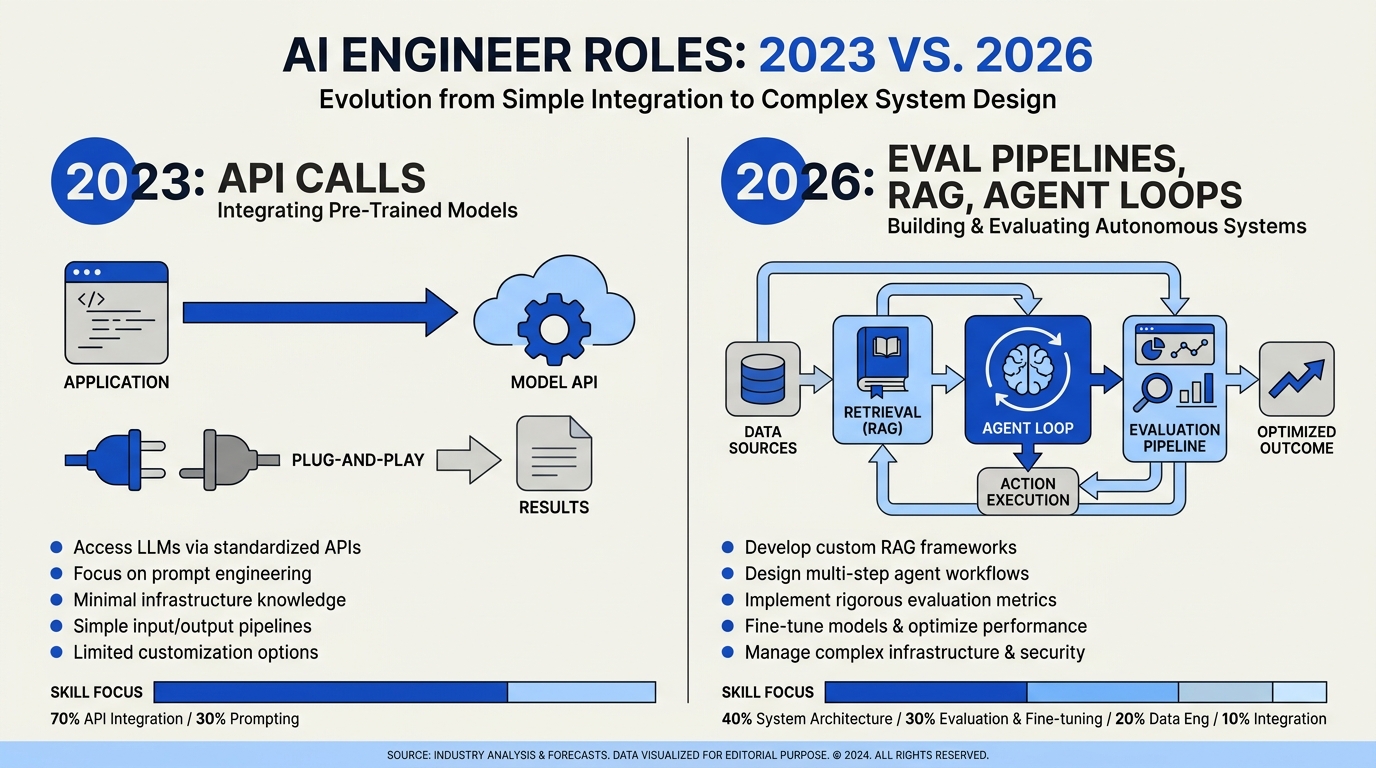
A modern AI engineer in 2026 typically owns one or more of these surfaces:
- Eval design and continuous evaluation in CI
- Retrieval and RAG pipelines, including chunking, reranking, hybrid search
- Agent loops with tool use, error recovery, and step budgets
- Production observability for LLM calls — traces, tokens, cost, latency
- Cost-aware routing across models and providers
- Prompt engineering at production scale (templates, versioning, regression tests)
Notice what is not on the list: training models from scratch. Outside frontier labs and a handful of vertical labs, almost no AI engineering job involves training a base model in 2026. Even fine-tuning is a relatively narrow slice of the work. The bulk of value creation lives in the layer above the model.
Skills that actually move the needle
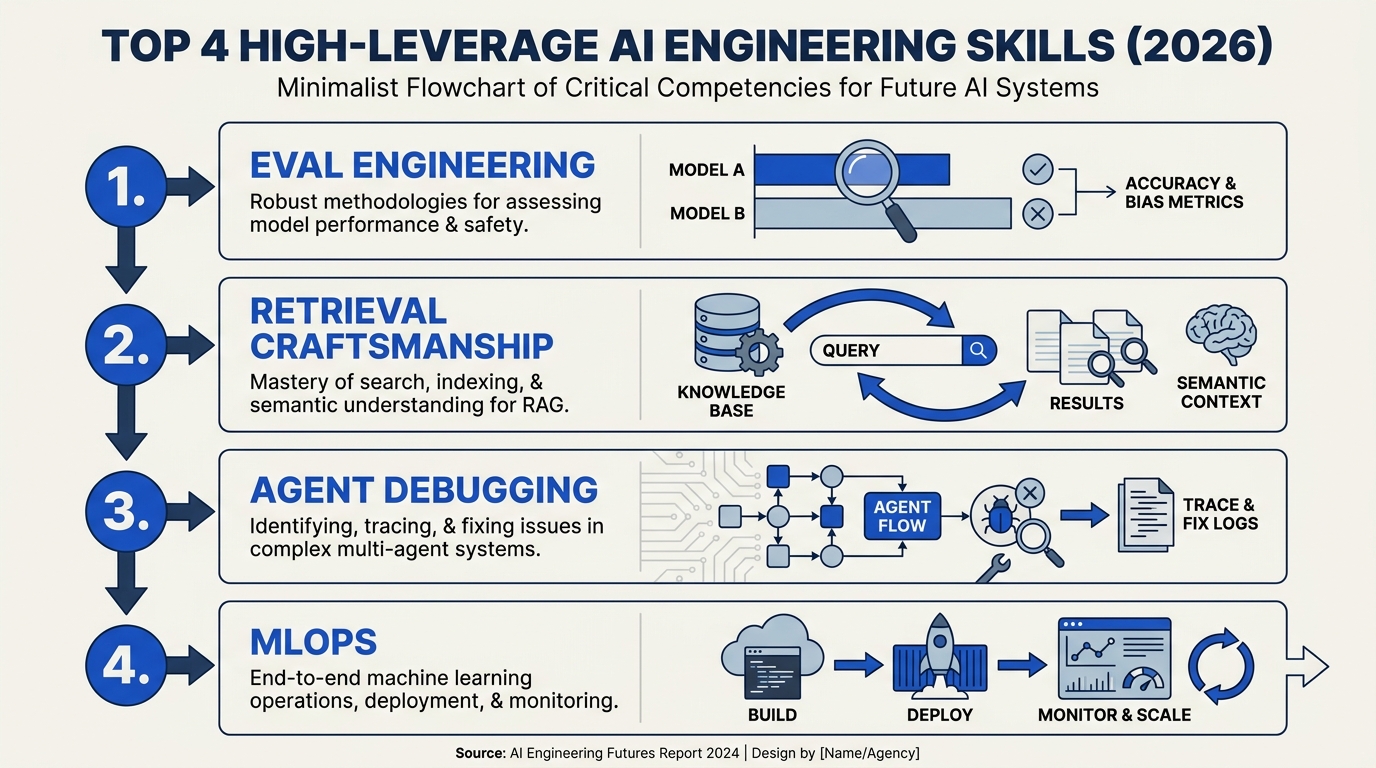
1. Eval engineering
The single highest-leverage skill in 2026. An engineer who can take a vague product requirement and turn it into a robust offline + online eval suite — graded examples, golden sets, LLM-as-judge calibration, slice analysis — is worth multiples of an engineer who can only "get the prompt to work once."
Test for it: hand a candidate a half-written prompt and a small dataset and ask them to design the eval. Watch what they ask about edge cases, label noise, and slice cuts.
2. Retrieval craftsmanship
RAG is no longer "use OpenAI embeddings + cosine similarity." Production RAG involves chunking strategy, hybrid (sparse + dense) retrieval, reranking, query rewriting, metadata filtering, and re-ranking model choice. Engineers who have shipped this end-to-end have a calibrated view on tradeoffs that does not transfer from a tutorial.
3. Agent debugging
When a multi-step agent silently fails, the skill is reading traces, identifying which step went sideways, and either fixing the prompt, tightening the tool, or restructuring the loop. This is closer to debugging distributed systems than writing code. Test it with a recorded broken agent run and ask the candidate to diagnose.
4. MLOps for LLM apps
Versioning prompts, datasets, and evals. CI gates that run evals before deploy. Canary rollouts of new models. Cost monitoring. This sounds like vanilla ops but the patterns are different — specifically because models are non-deterministic and outputs are graded, not tested.
5. Cost and latency awareness
A senior 2026 AI engineer reflexively asks "what is this going to cost per call, and what is the p95 latency budget?" before writing the code. Junior engineers ship features that work in dev and bankrupt the company in prod.
What is overrated

A few skills are heavily marketed and weakly correlated with shipping:
- Knowing every prompt-engineering technique. Most production prompts are short and refined through evals, not by applying named techniques.
- Building agents from scratch with no framework. Most teams use a framework or a thin wrapper. Re-implementing reduces ownership of the parts that matter (evals, observability) for the parts that don't.
- Deep RL / RLHF expertise. Outside frontier labs and a few vertical post-training shops, this is rarely on the critical path.
- Fine-tuning everything. Most "we need fine-tuning" hypotheses fail an honest cost-benefit analysis once you compare against better prompts + better RAG + better evals.
How to interview

The pattern that calibrates well:
- A take-home eval task. Give a small dataset, a target behavior, and 2-4 hours. Ask them to ship a working pipeline + an eval that scores it. You learn more from this than from any whiteboard problem.
- A trace-reading exercise. Show a real broken agent trace. Ask them to diagnose. Senior engineers form hypotheses about which step failed and why; juniors describe what they see.
- A cost-and-latency design question. "Customer wants this feature. P95 latency target 2s. Budget $0.05 per call. Walk me through your design." Listen for whether they think about model choice, caching, batching, fallbacks.
- A skip-the-hype check. Ask about a recent paper. Strong candidates have a calibrated view of which research transfers and which doesn't. Hype-followers will overstate the impact.
Compensation and structure
[Inference] Senior AI engineer comp in major US markets in 2026 sits roughly in the $250K-$450K total range, with frontier labs above that. India, EU, and rest-of-APAC have closed the gap somewhat as remote norms persist, but local-currency comp varies by 2-3x.
Team structures vary. The most effective pattern we are seeing:
- A small "AI core" team (2-5 engineers) owning evals, infra, and shared prompts/tools
- AI engineers embedded in product squads, owning a feature end-to-end
- A platform-engineering layer they share
The anti-pattern: a centralized "AI team" that ships features for the rest of the company. It bottlenecks fast and decouples the engineering from the product context.
Where to find them
AI engineers in 2026 mostly come from three pools:
- Backend / distributed-systems engineers who picked up evals and retrieval
- ML / data-science folks who learned production engineering
- Product engineers who became obsessed with shipping AI features
The first pool is usually the easiest to retrain. The third tends to ship the best features. Pure ML researchers without engineering chops are usually the wrong fit for the job we are describing.
Frequently Asked Questions
Do AI engineers need to know how to train models?
How important is fine-tuning experience?
Is a take-home interview the right format for AI roles?
Discussion
Related Posts


Ready to automate customer conversations?
Launch AI voice agents and WhatsApp bots with CallMissed — one API, 22+ Indian languages.