
The Latest AI News Announced in March 2026: Google's Search Live, Personal Intelligence & More



What if your search engine could witness breaking events as they unfolded, your maps could reason through traffic like a local co-pilot, and your...
The Latest AI News Announced in March 2026: Google's Search Live, Personal Intelligence & More
What if your search engine could witness breaking events as they unfolded, your maps could reason through traffic like a local co-pilot, and your productivity suite drafted entire boardroom reports before you finished your first sentence? In March 2026, that future stopped being a keynote demo and started being the default. The latest AI news announced in March 2026 did not arrive as a quiet patch of incremental tweaks; it landed as a coordinated burst of releases that redefined how billions of people will discover information, navigate physical space, and manage knowledge work. With OpenAI dropping GPT-5.4 on March 5, 2026—complete with a staggering 1.05 million-token context window capable of swallowing entire legal libraries or film archives in a single inference pass—and the NIST AI Agent Standards Initiative setting the compliance stage in February, the pressure on Big Tech to ship usable, governed intelligence reached a breaking point. Google answered with perhaps its most consequential month of AI product releases since the dawn of the modern transformer era.
Why March 2026 Changed the Trajectory of AI
To grasp the significance of this moment, study the competitive chessboard. OpenAI’s GPT-5.4 release proved that frontier models had crossed into territory where context windows are no longer measured in pages but in novels, forcing every major platform to reconsider how its products handle memory, personalization, and long-form reasoning. Simultaneously, the National Institute of Standards and Technology (NIST) signaled that AI agents must meet rigorous benchmarks before enterprises can adopt them “with confidence,” shifting the industry narrative from “move fast and break things” to “build fast and prove safety.” By mid-March, developers and CTOs were not merely comparing model benchmarks; they were choosing between ecosystems that would determine whether their workflows remained siloed or became seamlessly intelligent. Google’s response was unmistakable: rather than chasing the chatbot race, it embedded AI directly into the infrastructure of daily life.
What Google Unleashed This Month
The March 2026 announcements from Mountain View function as a blueprint for ambient intelligence, targeting search, navigation, productivity, and personal assistance in a single sweep:
- Search Live Expansion — Google pushed its real-time, multimodal search capability into broader surfaces, collapsing the latency between live global events and indexed, actionable knowledge. For users, this means queries about ongoing situations now return visual, textual, and contextual updates as they happen, not minutes or hours later.
- Personal Intelligence Accessibility — Previously gated behind limited tiers, Google’s Personal Intelligence layer opened through new entry points across devices. The bet is clear: AI must learn individual preferences, schedules, and communication patterns to evolve from a generic assistant into an indispensable digital proxy.
- Ask Maps & Immersive Navigation — Calling it the biggest upgrade to Google Maps in a decade, Google introduced conversational query support and visually immersive routing that reads terrain, weather, and traffic psychology rather than simply plotting lines. The interface now behaves less like a GPS and more like a local guide riding shotgun.
- Gemini in Workspace — Inside offices and classrooms, Gemini’s integration crossed a productivity rubicon. Google’s AI assistant can now autonomously generate documents, spreadsheets, and structured data analysis within Workspace, effectively converting the suite from a passive file repository into an active, anticipatory collaborator.
Why This Moment Demands Your Attention
For enterprises, developers, and everyday consumers, these releases represent more than feature creep; they constitute an operating system shift. When search is live, maps are immersive, and office documents write themselves, the boundary between software tool and human teammate dissolves entirely. Enterprises must now rethink data readiness, because an AI that can generate your quarterly spreadsheet or navigate your supply chain in real time requires clean, accessible infrastructure—not tomorrow, but today. This article will dissect each major announcement, from the technical architecture powering Search Live to the competitive implications of Gemini-generated documents, so you can distinguish durable innovation from launch-day theater. We will also examine how these consumer-facing breakthroughs are reshaping B2B expectations. As tech giants embed intelligence into every consumer surface, platforms like CallMissed are democratizing access to production-grade voice agents, multilingual LLM inference supporting 22 Indian languages, and conversational AI infrastructure that deploys in hours rather than quarters. March 2026 will likely be remembered as the month AI finally receded into the background—quietly running the world while we simply learned to ask better questions.
Introduction

March 2026 will likely be remembered as the inflection point when artificial intelligence stopped asking for permission and started rebuilding the technology stack from the interface layer down. Across consumer applications, enterprise software, and foundational model architecture, the industry delivered a concentration of announcements that shifted the narrative decisively from speculative research to production-grade infrastructure. From Google's sweeping ecosystem upgrades to OpenAI's dramatic context-window expansion and NIST's governance frameworks for autonomous systems, the message was unambiguous: AI is no longer a feature—it is the platform.
The density of releases during this single month underscores a broader competitive acceleration. According to industry roundups profiling March 2026's landscape, the period saw breakthrough product drops, emerging policy fights, and forecasting revisions that collectively forced enterprises to rethink their AI roadmaps. The question for most organizations is no longer whether to adopt AI, but how to orchestrate an expanding constellation of multimodal models, agentic workflows, and real-time interfaces into coherent business value.
The Search and Maps Revolution
Google's March 2026 product wave demonstrated how aggressively the company is weaving generative AI into its most mature and widely used consumer properties. In its official blog recap, Google highlighted an expansion of Search Live, pushing real-time, multimodal search capabilities deeper into the user journey, alongside broader access pathways for its Personal Intelligence layer. These moves signal an intent to make AI assistance ambient—present across devices without requiring users to open a dedicated chat interface.
Perhaps the most visually striking update arrived in Google Maps. In what Google described on LinkedIn as the "biggest upgrade in a decade," the platform introduced two capabilities that redefine location intelligence:
- Ask Maps enables natural-language querying of the physical world. Rather than typing rigid keywords like "coffee shop Brooklyn," users can ask nuanced questions—"Where can I find quiet outdoor seating near this concert venue?"—and receive dynamically ranked, context-aware suggestions that account for time, weather, and user preferences.
- Immersive Navigation layers predictive AI over real-world geometry, allowing users to visually preview their route at street level before they begin moving, with real-time environmental context baked into the guidance.
These updates represent more than feature increments. They reflect a fundamental reframing of maps from static reference databases to real-time, conversational environments where spatial reasoning and language understanding merge.
Enterprise Productivity Gets an AI-Native Upgrade
While consumers gained smarter maps, enterprise users received a structural overhaul of their daily workflows. On March 13, 2026, Google introduced major updates to Gemini embedded directly within its Workspace productivity suite. The assistant can now generate documents, spreadsheets, and structured content natively inside Workspace—not as a bolt-on sidebar, but as a collaborative co-author.
This shift is significant for several reasons:
- Contextual Grounding: Gemini can pull live data from Drive and Gmail to draft variance analyses inside Sheets or campaign briefs inside Docs with embedded citations.
- Workflow Collapse: The distance between intention and execution shrinks dramatically; employees can execute complex generative tasks without leaving their primary productivity canvas.
- Enterprise Stickiness: By making AI-native generation part of the file format itself, Google is building a moat around enterprise SaaS that transcends raw model capability.
The implication is clear: enterprise productivity software is evolving from a repository for human output into an active participant in knowledge creation.
GPT-5.4 and the Million-Token Barrier
If Google's March was defined by application-layer integration, OpenAI's was defined by raw cognitive expansion. On March 5, 2026, the company released GPT-5.4, its latest frontier language model. The standout technical achievement—a 1.05 million-token context window, delivered across three distinct variants—effectively redefined the boundaries of long-document and long-sequence reasoning.
To appreciate the scale, consider that 1.05 million tokens can encapsulate entire legal case repositories, multi-hour video transcripts, or complete enterprise codebases within a single inference pass. Industry analysts noted that this release represented a pivotal moment for AI, giving enterprises the ability to perform synthetic reasoning across vast corpora without chunking or information loss. The three-variant architecture also suggests OpenAI is optimizing for distinct cost-latency-performance profiles, allowing businesses to match model selection to workload economics with greater precision.
Governance Catches Up to Capability
Not every March 2026 headline was a product launch. On February 17, 2026, the National Institute of Standards and Technology (NIST) announced its AI Agent Standards Initiative, explicitly aimed at ensuring autonomous agents can be adopted "with confidence." While the announcement came in late February, it dominated March policy conversations as enterprises evaluated how to govern agentic systems capable of taking unsupervised actions across software environments.
The timing is critical. As Google pushes agent-like behavior into Maps and Workspace, and as OpenAI's models enable longer-context autonomous planning, the NIST framework provides the trust architecture that regulated industries require. Standards reduce friction. By establishing baseline safety and accountability protocols for agentic AI, NIST is effectively clearing the regulatory runway for the very innovations that March's product releases unleashed.
The Infrastructure Imperative
When viewed together, March 2026's announcements reveal an industry transitioning from point solutions to ecosystem-wide intelligence. Multimodal search, million-token reasoning, and autonomous document generation are no longer siloed experiments; they are converging capabilities that enterprises must orchestrate across voice, chat, and embedded interfaces.
This orchestration challenge is where communication infrastructure becomes the decisive competitive variable. Businesses will not capture value from frontier models unless they can deploy them at the last mile—directly into customer conversations. Platforms like CallMissed are already enabling this transition by offering production-ready infrastructure for AI voice agents and WhatsApp chatbots, powered by LLM inference across 300+ models and Speech-to-Text support for 22 Indian languages. In a month defined by breakthrough announcements, the organizations that win will be those with the communication stack to turn breakthroughs into 24/7 customer experiences.
Setting the Stage
Over the following twelve sections, this series will dissect each of these March 2026 developments in granular detail. We will examine the technical architecture powering GPT-5.4's long-context breakthrough, analyze the enterprise workflow implications of Google's Workspace Gemini integration, evaluate the real-world utility of Ask Maps and Immersive Navigation, and assess what NIST's emerging standards mean for compliance and deployment strategy. The objective is not simply to catalog what changed, but to provide a navigational framework for what comes next—and how your organization can prepare for the accelerated reality that March 2026 just inaugurated.
Background & Context

The Acceleration of Early 2026
By the time March 2026 arrived, the artificial intelligence industry was already operating at a velocity that would have seemed implausible even two years prior. The month opened with OpenAI's release of GPT-5.4 on March 5, 2026, a frontier language model featuring a 1.05 million-token context window and three distinct variants—a clear signal that the frontier was expanding in both scale and specialization [4]. This wasn't an isolated drop; it was part of a broader release cadence that defined the quarter, with industry trackers noting that over a dozen major models launched in a single week, reshaping competitive baselines overnight [4].
Yet raw model capability was only half the story. On February 17, 2026, the U.S. National Institute of Standards and Technology (NIST) had announced its AI Agent Standards Initiative, explicitly designed to ensure autonomous agents could be adopted "with confidence" across regulated industries [5]. This regulatory groundwork meant that March's torrent of product announcements wasn't merely experimental—it was positioned for production deployment at enterprise scale. Organizations that had spent 2025 piloting proof-of-concepts were now evaluating agentic systems against emerging federal benchmarks for safety, transparency, and accountability.
Google's March Offensive: Beyond Incremental Updates
Against this backdrop, Google's March 2026 announcements carried weight far beyond a routine product cycle. The company framed its update slate as its most significant in recent memory, and the evidence supports that characterization across consumer, enterprise, and infrastructure layers.
The most visible consumer-facing transformation came to Google Maps, which received what Google called its "biggest upgrade in a decade" [2]. The introduction of Ask Maps and Immersive Navigation demonstrated a philosophical shift: AI was no longer a sidebar feature but the primary interface layer for utilities used by over one billion people. Ask Maps moved beyond traditional query-response search to conversational, intent-based navigation—effectively transforming a mapping utility into a location-aware agent capable of understanding context like "find a quiet lunch spot near my next meeting" without explicit address inputs.
Inside the enterprise, Google's Workspace productivity suite received major Gemini updates, enabling the AI assistant to autonomously generate documents, spreadsheets, and analytical assets from natural language prompts [6]. This wasn't autocomplete at scale; it was the insertion of generative AI into the record-keeping and decision-making fabric of daily operations. With Workspace serving millions of organizational customers, Gemini's ability to draft quarterly reports, synthesize email threads, or build financial models represented a structural shift in how knowledge work gets done.
Simultaneously, Google expanded Search Live and broadened access pathways to Personal Intelligence, signaling an "everything, everywhere" strategy that disperses AI across search, maps, documents, and personal assistance rather than confining users to a single chatbot interface [1]. The strategic implication was clear: Google views AI as an ambient operating system, not a destination.
The Model Proliferation Challenge
March 2026 wasn't solely defined by Google's ecosystem push. Industry observers documented "12+ AI Models" arriving in a single transformative week, with GPT-5.4's million-token context capacity establishing new baselines for long-document analysis, video understanding, and multi-step reasoning [4]. This density of releases introduced what infrastructure engineers now call the model proliferation problem: organizations have unprecedented choice but face mounting complexity in evaluation, integration, routing, and cost optimization.
For businesses building customer-facing applications, the critical question shifted from "Which model is best?" to "How do we route the right model to the right interaction without rebuilding our stack every quarter?" Platforms like CallMissed address this fragmentation directly by offering unified API gateways to 300+ LLMs, allowing engineering teams to switch between frontier models—including the latest GPT variants and Gemini iterations—without code changes or vendor lock-in. In an environment where model capabilities evolve weekly, this abstraction layer has become essential infrastructure rather than a convenience.
Regulatory Frameworks and Global Deployment Realities
The March announcements landed in a regulatory environment that was finally converging with technical reality. NIST's February AI Agent Standards Initiative provided an early framework for trustworthy autonomous systems, but March revealed the commercial imperative driving that standardization: agentic AI—systems that plan, act, and communicate across enterprise tools—is exiting research labs and entering production roadmaps at an accelerated pace [5].
However, deploying these frontier capabilities globally introduces friction that Western product announcements often overlook. While English-language models dominated March's headlines, enterprise adoption in multilingual markets requires communication infrastructure that operates natively across regional languages and dialects. Providers like CallMissed are already operationalizing this shift by building production-ready voice agent infrastructure supporting 22 Indian languages, ensuring that the agentic future doesn't remain an English-only phenomenon. As global enterprises look to deploy the capabilities announced in March, the differentiator often lies not in model access but in speech-to-text, text-to-speech, and conversational interfaces that work for local populations.
Why March 2026 Mattered
Taken together, March 2026 represented an industry-wide transition from AI as feature to AI as infrastructure. Google's integration of generative capabilities across Maps, Workspace, and Search; OpenAI's push toward million-token reasoning contexts; and NIST's standardization efforts collectively demonstrated that the industry had exited the "demo phase." The models were larger, the context windows were longer, the regulatory frameworks were clearer, and the enterprise use cases were concrete rather than speculative.
For business leaders, developers, and communication platforms alike, the background context is unambiguous: March 2026 wasn't merely another busy month in AI. It was the month the industry proved that AI could be simultaneously ubiquitous, practical, and regulated—and that competitive advantage would increasingly depend on the infrastructure used to deploy, route, and voice-enable these intelligent systems at global scale.
The March 2026 AI Landscape
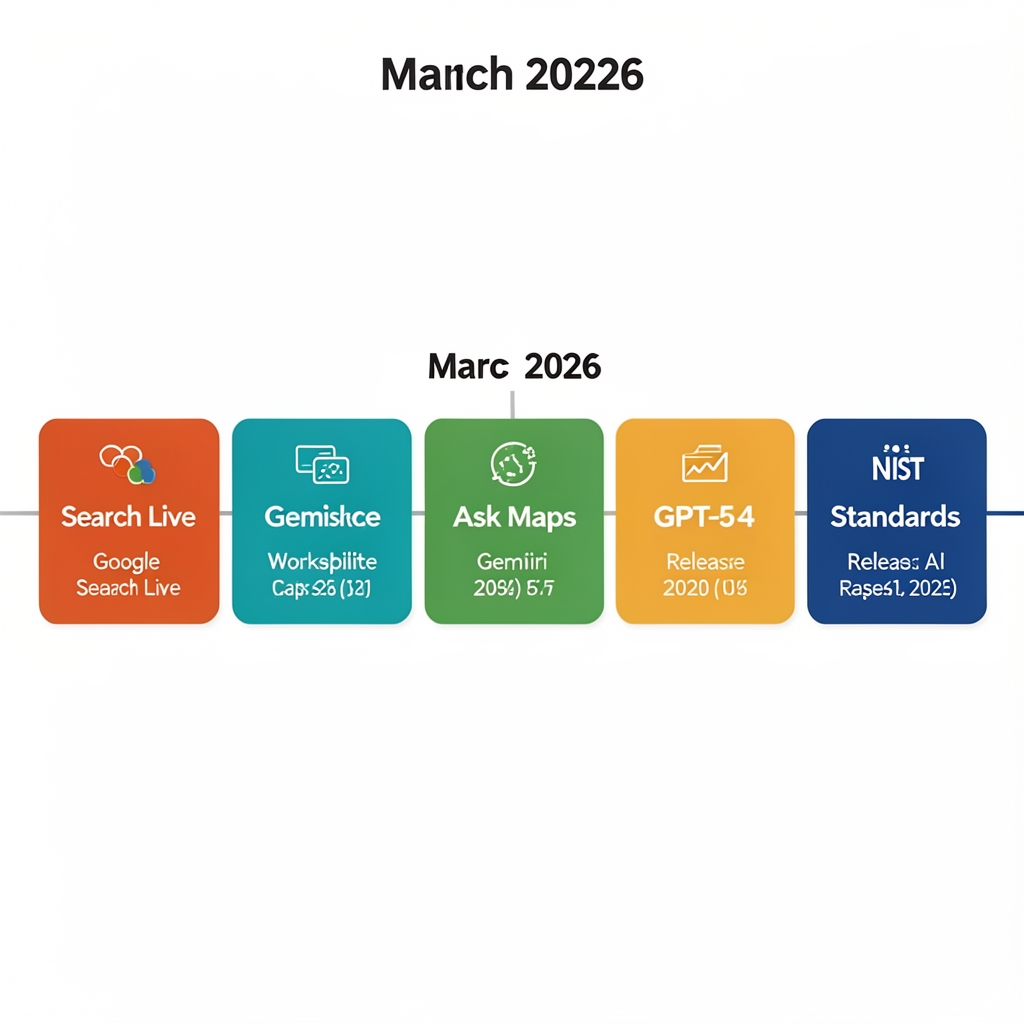
March 2026 did not arrive quietly. Within a single month, the artificial intelligence industry executed a coordinated leap across search, productivity, navigation, and frontier model architecture. What made this period distinct was not the volume of announcements alone, but their systemic overlap: Google rewired its consumer and enterprise suites for an agentic future, OpenAI shattered previous context-window ceilings, and U.S. regulators formalized the first serious guardrails for autonomous AI. The result was a landscape in which intelligence moved from passive chat interface to active infrastructure—embedded in maps, documents, and enterprise communication stacks.
Google’s Ecosystem Rewrite: Search, Maps, and Workspace
The most visible shift came from Google, which treated March as a window to embed AI across its entire product surface rather than siloing it inside a chatbot. According to Google’s official blog, the company expanded Search Live and introduced new pathways to access Personal Intelligence, signaling a deliberate move from retrieval-based search toward persistent, context-aware assistance. Instead of returning ten blue links, the engine now behaves more like an ambient research partner that anticipates follow-up questions and synthesizes live information streams.
The company’s March portfolio included three distinct battlefronts:
- Search Live and Personal Intelligence — Google moved from link-based retrieval to contextual, anticipatory assistance that follows user intent across sessions (Google Blog).
- Ask Maps and Immersive Navigation — Google Maps received what the company called its “biggest upgrade in a decade,” merging conversational interfaces with photorealistic 3D spatial reasoning (Google, LinkedIn).
- Gemini in Workspace — Major updates enabled the AI assistant to generate entire documents, spreadsheets, and collaborative assets natively inside productivity tools (MarketingProfs).
Inside the enterprise perimeter, the Workspace update carries particular weight. Knowledge work is shifting from AI-assisted drafting to AI-orchestrated creation, where Gemini functions as a coworker with persistent memory across Docs, Sheets, and Slides. For organizations still debating whether AI belongs in core workflows, Google effectively ended the debate by making it the default authoring layer.
OpenAI Pushes the Frontier with GPT-5.4
While Google wove intelligence into interfaces, OpenAI redefined the underlying substrate. On March 5, 2026, the lab released GPT-5.4, its latest frontier language model. As detailed by BuildFastWithAI, the model introduces a 1.05 million-token context window—roughly double the effective span of many preceding commercial systems—and ships in three distinct variants tailored to different latency, cost, and reasoning profiles.
A 1.05 million-token window is not an incremental spec bump; it is a category change. The release carries concrete architectural consequences:
- Long-document analysis — A single inference pass can ingest entire legal case repositories, multi-year financial filings, or pharmaceutical trial histories.
- Multimodal memory — Extended video, audio, and code context can now be processed without the accuracy losses of chunking or summarization.
- Variant flexibility — Three model profiles let enterprises optimize for latency, cost, or depth, signaling a shift from one-size-fits-all APIs to workload-specific intelligence.
For industries where analysis depends on synthesizing massive unstructured corpora, this collapses weeks of manual review into minutes of generation. The three-variant release strategy further suggests that OpenAI is optimizing not merely for benchmark scores, but for deployment economics.
Autonomous Agents and the New Regulatory Baseline
Underpinning these product fireworks was a quieter but equally consequential development on the governance front. On February 17, 2026, the U.S. National Institute of Standards and Technology (NIST) announced its AI Agent Standards Initiative, with the explicit goal of ensuring autonomous agents can be adopted “with confidence.” Though formally unveiled in February, the initiative framed every March product debut by establishing the vocabulary and audit expectations around agentic behavior.
The standard arrives at a pivotal moment. With Google positioning Gemini as an active document creator and OpenAI expanding context to agent-scale horizons, software is no longer confined to reactivity—it is becoming proactive. NIST’s move signals that 2026 will be remembered not just as the year models grew larger, but as the year society began legislating the boundaries of digital autonomy. Enterprises building on March’s releases must now factor compliance-by-design into their agent architectures.
From Model Releases to Production Communication Stacks
For all the media attention devoted to million-token windows and immersive maps, the strategic question facing most organizations is simpler: how do these breakthroughs reach actual customers without six-month engineering sprints?
This is where infrastructure layers become decisive. While frontier labs build the models, communication platforms must operationalize them across voice, messaging, and regional languages at enterprise scale. Solutions like CallMissed's multi-model API gateway let developers switch between 300+ LLMs without code changes, ensuring that a customer service voice agent deployed on Monday can ingest Tuesday’s context-window expansion or fine-tuned variant without architectural overhaul. Indian startups such as CallMissed are also extending these capabilities to multimodal deployment, building production-ready voice agents and WhatsApp chatbots that support 22 regional languages natively—a critical bridge as global enterprises attempt to localize AI agents without fragmenting their technology stacks.
The Road Ahead
March 2026 was not a crescendo but an acceleration. PTechPartners’ subsequent roundup described the month as a collision of “breakthroughs and the fights, forecasts, and fears” that now define the industry. With over a dozen major model releases in a matter of weeks, according to BuildFastWithAI’s tracker, the competitive tempo has shifted from annual upgrade cycles to quarterly infrastructure resets.
For decision-makers, the takeaway is unambiguous: the technology is no longer incubating in research divisions. It is live in search bars, navigation apps, spreadsheets, and call centers. The organizations that separate themselves in the next quarter will not be those that merely track these releases, but those that integrate them into continuous, multilingual, multi-model communication pipelines before the next wave arrives.
Key Developments
March 2026 will likely be remembered as the month artificial intelligence transitioned from periodic product drops to a sustained platform offensive. Within a single 31-day window, OpenAI shipped its most capable frontier model to date, Google rewrote the playbook for both consumer and enterprise AI, and federal standards bodies moved decisively to govern the coming wave of autonomous agents. The breadth of these announcements—spanning 1.05 million-token context windows, immersive navigation interfaces, and real-time document generation inside productivity suites—suggests the industry has shifted from narrow benchmarking to full-stack ecosystem warfare. For organizations tracking these cycles, the challenge is no longer identifying which model to pilot, but how to absorb multiple paradigm shifts simultaneously without fragmenting their infrastructure or ballooning operational costs.
The March 2026 AI Release Matrix
The following table distills the major developments into a comparative snapshot. These entries were selected based on their immediate commercial availability, disclosed technical specifications, and projected influence on downstream application development during Q2 2026 and beyond.
| Company / Organization | Product or Initiative | Key Specifications & Features | Announcement Date | Strategic Impact |
|---|---|---|---|---|
| OpenAI | GPT-5.4 | 1.05 million-token context window; released in three distinct variants optimized for different latency, cost, and reasoning profiles | March 5, 2026 | Redefines long-document analysis, legal discovery, and extended-codebase reasoning |
| Search Live Expansion | Real-time, multimodal search interface with persistent memory across sessions; expanded beyond limited beta to global markets | March 2026 | Converts search from a static retrieval engine into a continuous intelligence stream | |
| Ask Maps & Immersive Navigation | Described by Google as the "biggest upgrade in a decade" for Maps; fuses natural language routing queries with spatially immersive visual guidance | March 2026 | Demonstrates consumer-grade multimodal AI operating at planetary scale | |
| Gemini Workspace Integration | Native generation of documents and spreadsheets inside Workspace; contextual awareness across Drive, Docs, and Sheets without manual data ingestion | March 13, 2026 | Removes the last mile of friction between conversational AI and daily enterprise productivity | |
| Personal Intelligence Access | New APIs and first-party device endpoints expanding how developers and users summon Google’s persistent personal AI layer | March 2026 | Signals a strategic pivot toward ambient, cross-device AI companions rather than siloed apps | |
| NIST | AI Agent Standards Initiative | Governance framework covering verification protocols, safety benchmarking, and interoperability standards for autonomous agent systems | February 17, 2026 (Enterprise adoption frameworks matured March 2026) | Provides the regulatory scaffolding necessary for Fortune 500 deployment of agentic workflows |
Collectively, these six developments span the full AI value chain: base model capability, consumer interface, enterprise workflow, personalized access, and federal governance. No single vendor dominated every layer; instead, March 2026 illustrated a race to own the vertical stack from silicon to user experience.
Frontier Models Push Context Boundaries
OpenAI’s release of GPT-5.4 on March 5, 2026 arguably set the technical tone for the month. The headline specification—a 1.05 million-token context window—represents roughly a 4× expansion over previous commercial frontiers, enabling practitioners to feed entire codebases, decades of legal precedent, or multi-year research archives into a single inference call. Rather than shipping a single monolithic model, OpenAI released three distinct variants, each optimized for different latency and reasoning profiles.
The practical implications for enterprise architecture are substantial:
- RAG pipelines can be radically simplified. Instead of relying on brittle chunking strategies and reranking heuristics, teams can now present source material in its original, continuous form.
- Long-horizon reasoning improves. Early third-party benchmarks suggest the variants maintain high accuracy across document lengths exceeding 500,000 tokens, solving a critical pain point for knowledge management in legal, pharmaceutical, and financial services.
- Routing logic becomes mandatory. With three variants available, inference cost optimization now depends on intelligent traffic steering rather than defaulting to a single oversized model.
Google’s Consumer and Enterprise Blitz
While OpenAI pushed the frontier on raw model specs, Google executed perhaps the broadest productization sprint of the month. The expansion of Search Live transformed Google’s flagship product from a query-response utility into a persistent, multimodal research companion capable of maintaining context across extended research sessions. Simultaneously, Google Maps received what the company explicitly labeled its "biggest upgrade in a decade" with Ask Maps and Immersive Navigation, integrating natural language understanding directly into geospatial routing and layering spatially immersive visuals atop traditional turn-by-turn directions.
On the enterprise front, the March 13, 2026 update to Gemini within Google Workspace allowed the AI assistant to autonomously generate documents and spreadsheets while maintaining contextual awareness across Drive-hosted datasets. Users no longer need to manually copy data into a chat interface; Gemini can reference, calculate, and visualize information where it already lives. This release dovetailed with Google’s broader push to embed Personal Intelligence more deeply across hardware and software, expanding APIs and entry points so that the AI layer persists across phones, automotive dashboards, and tablets. The strategic implication is unambiguous: Google is treating AI not as a sidebar feature but as the primary operating system across both its consumer and business-facing stacks.
Standards and Infrastructure Catch Up
March also marked the moment infrastructure and policy began converging with raw capability. Although NIST formally announced its AI Agent Standards Initiative on February 17, 2026, vendor certification roadmaps and enterprise adoption frameworks accelerated throughout March as companies prepared to deploy the autonomous features teased by both Google and OpenAI. The initiative explicitly targets verification protocols and safety benchmarking, aiming to ensure that agents can be adopted “with confidence” across regulated industries such as healthcare, defense, and financial services.
The velocity of these March releases places extraordinary pressure on downstream operational infrastructure. Enterprises must now route traffic across multiple frontier models, manage real-time voice and multimodal chat endpoints, and maintain compliance with rapidly evolving standards—often simultaneously and across geographically distributed user bases. Platforms such as CallMissed are already enabling this transition by offering production-ready voice agents, multilingual Speech-to-Text supporting 22 Indian languages, and unified API access to 300+ LLMs through a single gateway. As the innovations announced in March 2026 shift from keynote slides to production workloads, having an adaptive communication infrastructure layer will increasingly separate organizations that merely experiment with AI from those that operationalize it securely at scale.
Inside Search Live & Personal Intelligence

Google's March 2026 AI roadmap did not arrive quietly. Billed by the company as one of its most expansive monthly rollouts, the updates centered on two strategic pillars: the broadening of Search Live and the wider availability of Personal Intelligence. Together, these announcements signaled that the search giant is no longer content to index the web—it intends to interpret it in real time, on behalf of individual users, across every surface of its ecosystem. For enterprises and developers watching the frontier, March provided a clear blueprint of where consumer-grade AI infrastructure is heading and, by extension, where business infrastructure must follow.
Search Live and the End of Static Search
The expansion of Search Live in March 2026 represents more than a feature upgrade; it marks a philosophical break from the query-and-results page that has defined search for two decades. Traditional search responds to intent with references. Search Live, by contrast, engages in persistent reasoning—synthesizing live data streams, user context, and multimodal inputs into fluid, conversational responses. Google positioned this expansion as central to its March updates, suggesting that the technology has moved beyond experimental status and into scaled deployment across its core search infrastructure.
Critically, this shift arrives as competitive pressure on context windows intensifies. Just weeks earlier, on March 5, 2026, OpenAI had released GPT-5.4 with a 1.05 million-token context window, enabling models to retain and reason across vast corpora—entire codebases, multi-year research archives, or comprehensive legal contracts—in a single session. Google's Search Live expansion can be read as a strategic counterweight: rather than merely increasing the memory of a language model, Google is augmenting retrieval with live, structured access to the indexed web. The distinction matters. Where GPT-5.4 brings the context to the model, Search Live brings the model to the live context, querying, validating, and updating its understanding as the world changes minute by minute.
For publishers, marketers, and SEO strategists, the implications are profound. If Search Live reduces reliance on traditional blue-link aggregation, visibility will depend less on keyword optimization and more on semantic authority, structured data freshness, and real-time accuracy. The search result is becoming a conversation; the webpage, a citation. Hallucination risks, long the Achilles' heel of generative search, are theoretically mitigated by this live-grounded architecture—though the technical challenge of ranking truth in a streaming environment remains formidable.
Personal Intelligence Goes Omnichannel
If Search Live redefines how information is accessed, Google's Personal Intelligence expansion redefines who accesses it—and from where. In March 2026, Google rolled out additional pathways to its Personal Intelligence layer, embedding contextual awareness and proactive assistance across Gmail, Docs, Drive, and notably, Google Maps. The Maps upgrade alone was characterized by Google as its "biggest upgrade in a decade," introducing Ask Maps and Immersive Navigation powered by the same intelligent substrate.
The Ask Maps capability exemplifies the new paradigm. Users can pose complex, multi-constraint queries—"Where can I host a client dinner within ten minutes of my hotel that has vegetarian options and is quiet enough for conversation?"—and receive curated, reasoning-driven answers rather than ranked lists of nearby restaurants. Immersive Navigation layers predictive environmental data onto routes, anticipating not just traffic but contextual disruptions like weather, events, or historical congestion patterns specific to the user's behavioral history.
This decentralization of Personal Intelligence across Workspace and Maps underscores a broader industry trajectory toward ambient AI: intelligence that persists across surfaces rather than residing in a single chat interface. In Google's Workspace suite, March updates enabled Gemini to generate documents, spreadsheets, and presentations with deeper awareness of the user's existing content and organizational knowledge. The AI is not merely drafting; it is interpreting the user's professional memory to produce contextually relevant outputs.
The timing carries regulatory weight. On February 17, 2026, the National Institute of Standards and Technology (NIST) announced its AI Agent Standards Initiative, explicitly aimed at ensuring autonomous agents could be adopted "with confidence." Google's March expansion of personalized, cross-platform AI agents arrives precisely as Washington and international bodies begin formalizing guardrails around data privacy, agent autonomy, and user consent. Enterprises watching this space must now balance adoption velocity against emergent compliance requirements—a tension that will likely define AI procurement cycles through late 2026.
The March 2026 Competitive Context
March 2026 was not a month of isolated announcements. Alongside Google's Search Live and Personal Intelligence push, the industry witnessed what commentators called a benchmark reset. OpenAI's GPT-5.4 established new frontiers in long-context reasoning, while Google's own model improvements—integrated into Search Live and Workspace—emphasized tool use and real-time grounding over raw parameter count.
This divergence is instructive. The industry appears to be bifurcating between memory-heavy models (exemplified by GPT-5.4's million-token window) and grounded agent systems (exemplified by Google's live search and personal intelligence orchestration). For developers, the optimal architecture increasingly depends on use case: deep document analysis and longitudinal research favor the former; dynamic customer-facing agents and real-time operations favor the latter.
Yet both approaches share a common dependency: robust inference infrastructure and multimodal orchestration. Building agents that can search live, synthesize personal context, generate Workspace documents, and navigate physical spaces requires stitching together large language models, speech systems, retrieval engines, and persistent memory stores. As these capabilities compound, the complexity of orchestration grows exponentially.
Building on the New Foundation
As March 2026's breakthroughs migrate from announcement to production, businesses face a familiar challenge—the gap between frontier capabilities and enterprise implementation. Not every organization can integrate Google's consumer ecosystem directly into its customer operations, nor does every use case fit within the architecture of Personal Intelligence as deployed in Maps or Workspace. Enterprises need customizable, private implementations of the same paradigms: real-time reasoning, contextual memory, and omnichannel presence.
This is where specialized AI communication infrastructure becomes critical. Platforms like CallMissed offer production-ready voice agent infrastructure and LLM inference gateways that allow businesses to deploy these same agentic capabilities within their own domains, compliance boundaries, and branding requirements. With access to 300+ models and Speech-to-Text support for 22 Indian languages, such infrastructure enables localized, high-scale implementations of the contextual, persistent AI paradigms Google popularized in March.
The March 2026 announcements collectively establish a new baseline: AI systems must be live, personal, and omnichannel. Whether through Google's expanding Search Live, OpenAI's swelling context windows, or NIST's emerging agent standards, the directive is unmistakable—intelligence is no longer a destination users visit. It is a persistent, evolving service layer woven into the fabric of work, navigation, and communication. Organizations that treat it as such, investing in the orchestration layers to manage models, memory, and real-time data, will define the operational standard for the remainder of the decade.
Gemini in Workspace: Reimagining Productivity
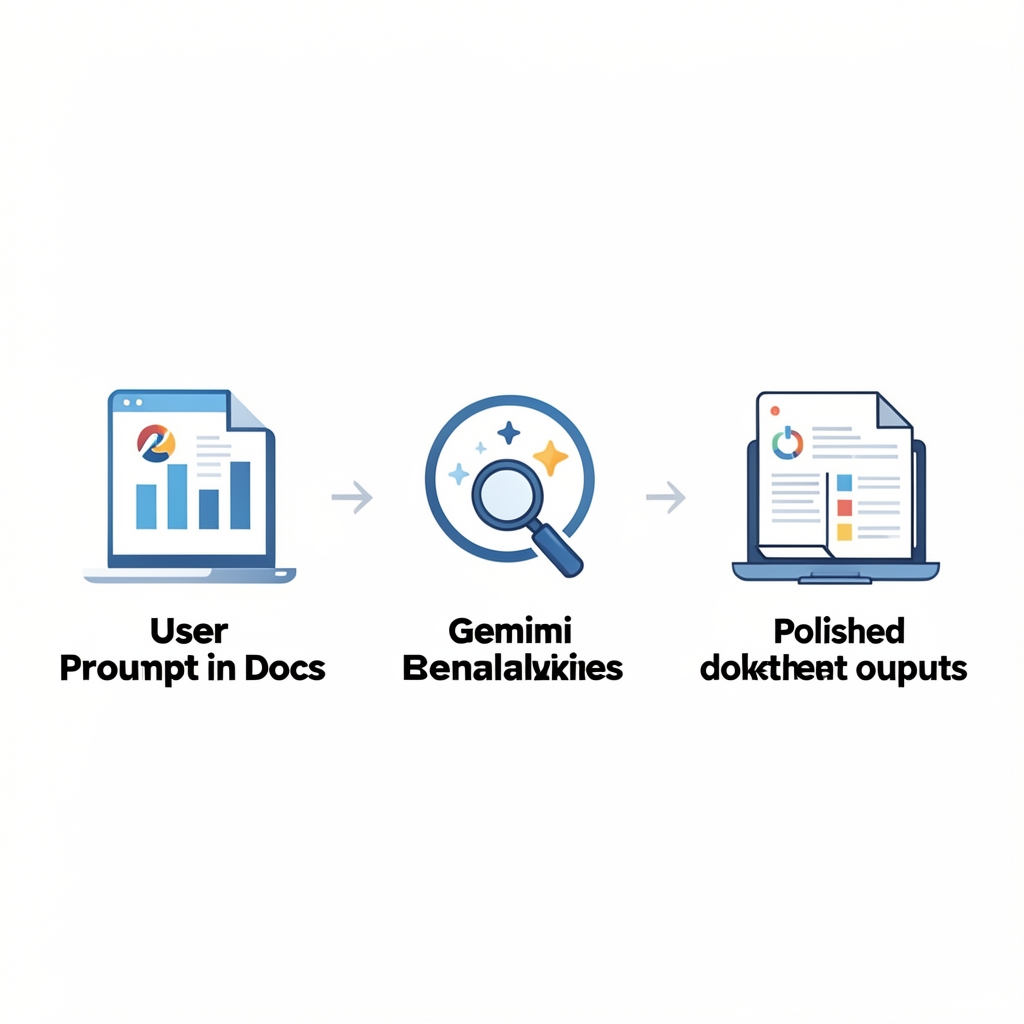
Among the flurry of announcements Google delivered in March 2026, the upgrades to Gemini within Workspace arguably carried the most immediate weight for the world’s knowledge workers. While industry chatter gravitated toward the expansion of Search Live and new Personal Intelligence access points, the productivity suite integration represented Google’s clearest statement yet: AI is no longer a side panel in your workflow—it is the workflow itself. According to Google’s official March 2026 recap, these updates formed part of the company’s broadest AI offensive to date, but it was the Workspace embedding that promised to redraw the daily operating rhythm for hundreds of millions of enterprise users.
From Assistant to Co-Creator
The most consequential shift was the elevation of Gemini from a conversational helper to a generative co-worker inside Docs, Sheets, and Slides. As MarketingProfs reported in its March 13, 2026 coverage, Google introduced major updates allowing the AI assistant to generate documents and spreadsheets natively—capabilities that move well beyond summarization or smart replies. For users, this means the difference between asking an AI to find a template and instructing it to produce a fully populated financial model, project brief, or quarterly report grounded in your Drive data and Gmail threads.
This transition attacks what productivity researchers have long called “blank-page paralysis.” Instead of staring at an empty document, users can provide a prompt—often via natural language or voice—and receive a structured first draft complete with formatting, citations from internal files, and suggested charts. The system’s ability to cross-reference Calendar commitments and email context means the output is not generic; it is instantiated with your organization’s specific vocabulary, deadlines, and relationships. In essence, Gemini is absorbing the tacit knowledge embedded across Workspace apps and surfacing it on demand.
The Personal Intelligence Layer
Google’s March 2026 announcements also emphasized “more ways to access Personal Intelligence,” a concept that underpins why the Workspace integration feels distinct from traditional office automation. Rather than treating each app as a siloed container, the updated Gemini functions as a persistent intelligence layer that maintains context as users move between Docs, Sheets, Meet, and Chat.
This ambient awareness allows for sequential workflows that were previously impossible:
- A user begins analyzing a budget in Sheets and identifies a variance.
- They ask Gemini to extract action items from related Gmail threads and Calendar notes.
- The assistant then generates a Slides presentation summarizing the financial outlook—all without losing thread continuity.
The LinkedIn post accompanying Google’s announcement noted that the company had specifically focused on making Gemini easier to use, signaling a UX refinement aimed at lowering the cognitive overhead of context-switching between generative tasks. The result is a suite that behaves less like a collection of discrete tools and more like a single, reasoning-aware workspace.
Enterprise Velocity and the Competitive Landscape
March 2026 marked an inflection point where the enterprise AI race shifted from model benchmarks to integration depth. Google’s Workspace push arrived in the same month that OpenAI shipped GPT-5.4 with its 1.05 million-token context window, and as NIST was formalizing its AI Agent Standards Initiative. Within that competitive milieu, Google’s play was not merely to match rival intelligence, but to make that intelligence unavoidable within the existing enterprise stack.
For Chief Information Officers, the value proposition is straightforward: every employee already has a Google account; now that account comes with an AI agent that understands institutional memory. The barrier to deployment drops because the infrastructure is already present. Organizations no longer need to pilot a separate AI tool and pray for adoption—they can activate Gemini inside the environment where work already happens. This “invisible deployment” model is likely to accelerate enterprise AI adoption curves significantly, particularly for mid-market companies that lack dedicated AI integration teams.
Connecting Productivity to the Communication Frontier
Yet reimagining productivity inside documents and spreadsheets is only half the equation. The modern enterprise runs on two parallel tracks: internal knowledge creation and external customer communication. As Google locks down the former with Gemini, businesses still need robust infrastructure for the latter—automating voice calls, WhatsApp inquiries, and multilingual support at scale.
This is where the broader AI infrastructure ecosystem comes into play. Just as Gemini embeds intelligence into document workflows, platforms like CallMissed are building the communication layer that extends AI automation to customer-facing operations. Through production-ready voice agents and WhatsApp chatbots—supporting 22 Indian languages natively via specialized Speech-to-Text and Text-to-Speech APIs—CallMissed ensures that the insights produced inside Workspace can translate into real-time external engagement. In a fully AI-native organization, the loop between internal intelligence and customer interaction closes seamlessly.
What Comes Next
Looking beyond March 2026, the trajectory is clear. Google has framed Workspace not as a software suite augmented by AI, but as an operating system orchestrated by it. The ability to generate documents and spreadsheets is merely the opening phase; the longer-term bet is on autonomous workspace agents that can attend meetings, update project trackers, and negotiate calendar conflicts without human initiation.
For knowledge workers, the mandate is adaptation. The tools will handle increasingly complex execution, which means human value will migrate toward prompt architecture, strategic oversight, and creative direction. March 2026 did not just deliver new features—it catalyzed a redefinition of what it means to sit down and “go to work.” And as these internal capabilities mature, their interplay with external communication infrastructure will determine which enterprises merely adopt AI, and which ones truly operationalize it.
Google Maps & Immersive Navigation

Google didn't merely iterate on its mapping product in March 2026—it redefined what a map can be. According to Google's own announcement on LinkedIn, the company delivered what it described as the "biggest upgrade in a decade" to Google Maps, introducing two complementary features: Ask Maps and Immersive Navigation [2]. While earlier updates had incrementally improved routing accuracy or added incremental 3D building layers, this release signals a foundational shift. Navigation is evolving from a passive utility into an active, multimodal intelligence layer that understands not just where you are, but what you're looking for and how you experience physical space.
Ask Maps: Conversational Discovery at Global Scale
The centerpiece of Google's March 2026 overhaul is Ask Maps, a natural-language interface that effectively transforms Google Maps from a rigid search-and-retrieve database into a context-aware conversational agent. Rather than relying on keyword-dependent queries like "coffee shop Brooklyn open now," users can pose nuanced, multi-layered questions: "Where's a quiet cafe within a 10-minute walk that has outdoor seating, reliable Wi-Fi, and isn't usually crowded on weekday afternoons?"
This leap is powered by the convergence of large language models with Google's proprietary geospatial knowledge graph. To generate recommendations, Ask Maps cross-references multiple real-time and historical signal types:
- Live business hours and inventory data from merchant profiles
- User-generated reviews and photographs, semantically parsed for attributes like "quiet," "romantic," or "kid-friendly"
- Traffic conditions and predictive foot-traffic models
- Localized weather and event data that might affect a location's current suitability
For businesses, this changes the discoverability equation fundamentally. Local SEO strategies optimized for exact-match keywords may see reduced efficacy as AI intermediaries interpret semantic meaning and user intent rather than surface-level text matching. Early analysis from the March 2026 rollout suggests the system supports multi-turn dialogue, allowing users to refine queries conversationally without restarting their search. The interface effectively positions Google Maps as a location-native AI assistant rather than a digital atlas.
Immersive Navigation: Spatial Computing for Daily Life
If Ask Maps redefines the input layer, Immersive Navigation revolutionizes the output. Traditional turn-by-turn directions rely on abstract 2D symbology—a blue dot, colored lines, and standardized icons that require cognitive translation. Immersive Navigation collapses that abstraction by delivering photorealistic, AI-enhanced spatial guidance that merges real-world visual context with dynamic routing intelligence.
While Google experimented with Immersive View in prior years, the March 2026 upgrade achieves a level of fidelity and latency previously limited to pre-rendered tourist corridors. The system leverages advances in neural rendering, real-time photogrammetry, and predictive traffic modeling to generate navigable 3D environments directly on consumer smartphones. Key capabilities introduced include:
- Lane-level guidance superimposed onto visually faithful previews of complex intersections
- Temporal rendering that shows how a route will appear under current lighting, weather, and traffic density
- Indoor spatial mapping for transit hubs, airports, and multi-level retail centers, addressing the "last 100 meters" problem GPS alone has failed to solve
For drivers navigating dense urban cores—such as London's roundabout systems or tier-1 Indian megacities—this visual grounding measurably reduces cognitive load. Pedestrians with low vision or travelers encountering unfamiliar script systems also benefit when the interface approximates visual reality rather than forcing symbolic translation.
This release arrived in the same month that OpenAI shipped GPT-5.4 with a 1.05 million-token context window [4], underscoring an industry-wide imperative: models must now ingest, retain, and reason across enormous multimodal inputs. Google Maps' new capabilities represent a geospatial application of the same scaling laws. Processing planetary-scale satellite archives, Street View imagery, and billions of user contributions in real time demands the same class of computational infrastructure that frontier LLMs require.
Bridging Spatial AI and Business Communication
Maps have always been a preeminent example of artificial intelligence operating at planetary scale. The March 2026 upgrade accelerates this synthesis, but it also intensifies a downstream expectation: when consumers interact with the physical world through an AI lens, they demand that subsequent interactions with businesses in that world be equally intelligent.
Consider the modern user journey that Ask Maps now enables. A traveler in Bangalore converses with Maps in English to locate a boutique, follows an immersive AR path through a crowded commercial district, and then expects to ping the store on WhatsApp to confirm inventory in Kannada. The spatial AI delivered the customer; the business must close the loop conversationally.
This is precisely where multimodal AI communication infrastructure becomes non-negotiable. Platforms like CallMissed are enabling businesses to meet this moment with production-ready voice agents and WhatsApp chatbots that support 22 Indian regional languages natively, ensuring that the post-discovery interaction matches the intelligence of the navigation that preceded it. With access to 300+ LLMs through a unified API gateway, solutions like CallMissed allow developers to deploy conversational backends that scale alongside the rising consumer expectation for zero-friction, AI-mediated engagement [Brand Integration]. The map brings them to the door; the communication stack must handle the conversation.
Competitive Context and What Comes Next
Google's March 2026 Maps overhaul doesn't exist in a vacuum. Apple continues refining detailed city experiences and Vision Pro spatial integration, while Meta is aggressively pursuing AI-enhanced overlays for its smart glasses ecosystem. Automotive OEMs, wary of ceding the in-cockpit experience, are likewise investing in proprietary navigation stacks.
Yet Google's advantage remains its unparalleled data moat. Decades of Street View capture, billions of reviews, and satellite partnerships constitute a training corpus for spatial foundation models that competitors cannot easily replicate. Combined with easier Gemini access also announced by Google in March 2026 [2], Maps is positioned less as a standalone application and more as a general-purpose spatial operating system.
Looking ahead, the trajectory points toward three converging fronts:
- Wearable migration: Immersive Navigation is a natural fit for AR glasses, where photorealistic environmental layering eliminates the need to look down at a handset.
- Autonomous integration: As self-driving systems mature, Ask Maps-style conversational routing will allow passengers to negotiate stops, detours, and preferences in natural language rather than tapping touchscreens.
- Hyperlocal AI commerce: Businesses will soon optimize not just for search ranking, but for discovery within multimodal AI agents that blend mapping, commerce, and communication into single conversational threads.
March 2026 will be remembered as the inflection point where AI stopped merely describing our environments and began actively mediating our movement through them.
Impact & Implications

Redefining Real-Time Information Access
Google's expansion of Search Live in March 2026 represents more than an incremental feature update—it signals a structural shift in how users interact with information. By moving search from static indexes toward live, contextual streams, Google is effectively collapsing the latency between an event occurring and a user understanding it. For publishers, news organizations, and e-commerce platforms, this implies a new optimization paradigm: real-time relevance will increasingly outweigh traditional authority signals. Content half-lives are shortening, and the competitive window for capturing intent-driven traffic may narrow from days to minutes. For advertisers, this changes auction dynamics. Search Live effectively reduces the premium on historical keyword dominance in favor of real-time content freshness and structured data feeds that AI can interpret instantly.
The Productivity Stack Gets a Native Intelligence Layer
March 2026 marked the moment AI assistants transitioned from sidebar experiments to primary workflow interfaces. Google's deepening of Gemini integration within Workspace—allowing the AI to generate documents, spreadsheets, and data analyses—means knowledge workers are increasingly becoming orchestrators rather than manual authors. Combined with expanded access to Personal Intelligence across more endpoints, Google is clearly betting that users want proactive AI anticipating needs across Gmail, Docs, and Calendar without explicit prompting. Moreover, the expansion of Personal Intelligence access suggests a distribution strategy that treats AI as a utility layer rather than a destination app. Users may soon interact with Gemini-native features without consciously opening a specific application, raising the stakes for ambient user experience design.
The implication for enterprise IT is significant. When AI drafts financial models, meeting notes, and client communications, organizations must confront governance questions around attribution, accuracy, and data residency. Intellectual property and compliance playbooks written for the SaaS era will need rewriting for the agentic era.
Spatial AI and the Next Computing Interface
Google's declaration that Ask Maps and Immersive Navigation constitute Maps' "biggest upgrade in a decade" underscores a move toward spatial computing as a mainstream interface. This is not merely an improvement to turn-by-turn directions; it is the transformation of geographic data into a conversational, visually immersive layer. By fusing generative AI with real-world mapping, Google is positioning Maps as an operating system for physical space. The integration also raises data privacy questions at scale. Immersive Navigation requires continuous visual and spatial data processing, meaning Google's AI must interpret street-level geometry, pedestrian flows, and business facades in real time—a compute-intensive process that pushes edge inference requirements to new limits.
For local businesses and the broader location-based economy, discovery mechanics are fundamentally changing. Visibility will depend less on static keywords in business listings and more on dynamic, semantic queries—users asking for "a quiet outdoor workspace near a metro station" rather than typing "co-working cafe." This accelerates the commercial imperative for AR-ready infrastructure and forces retailers to optimize for AI-generated contextual recommendations rather than traditional SEO alone.
The Competitive Context: Context Windows and Regulatory Frameworks
March's ecosystem upgrades did not occur in a vacuum. OpenAI's release of GPT-5.4 on March 5, 2026, featuring a 1.05 million-token context window, fundamentally altered enterprise expectations for long-document analysis, extended video understanding, and persistent conversational memory. The 1.05 million-token window effectively allows enterprises to submit entire codebases, legal contracts, or research archives within a single prompt, rendering previous chunking and retrieval strategies secondary for certain use cases. This competitive pressure means Google's models must now match not just on multimodal output, but on sustained context retention across lengthy enterprise workflows.
At the same time, institutional guardrails are materializing. The NIST AI Agent Standards Initiative, announced February 17, 2026, is designed to ensure autonomous agents can be adopted "with confidence." As Google's March releases push deeper into agentic territory—from proactive Workspace suggestions to conversational Maps interactions—these standards will likely inform future requirements around agent transparency, authentication, and audit trails. Enterprises piloting these tools should begin logging AI decision pathways now, ahead of anticipated compliance mandates.
Infrastructure Imperatives for the Post-March Landscape
The cumulative weight of these announcements creates a formidable infrastructure burden. Real-time search indexing, immersive spatial rendering, million-token context windows, and proactive workplace agents all demand low-latency inference, multilingual support, and seamless model orchestration.
As Google and OpenAI push the boundaries of consumer and enterprise AI, the infrastructure layer must keep pace. Businesses looking to operationalize these capabilities—particularly across diverse linguistic markets—need production-ready pipelines that go beyond default English-first assumptions. Platforms like CallMissed are bridging this gap by offering multilingual AI voice agents and LLM inference APIs that support 22 regional languages, alongside access to 300+ models through a unified gateway. This lets enterprises route between frontier models like GPT-5.4 and specialized variants based on latency, cost, and language needs—ensuring that the Personal Intelligence era includes the world's next billion digital users rather than leaving them behind.
Strategic Takeaways
The March 2026 announcements collectively point to three irreversible trends:
- Ambient AI: Intelligence is becoming environmental—embedded in search results, maps, documents, and communication tools rather than confined to discrete chatbots.
- Agentic Delegation: The user journey is shifting from "query and receive" to "assign and verify," requiring new trust architectures and human-in-the-loop protocols.
- Contextual Scale: Whether through Google's live products or OpenAI's million-token window, AI systems are being judged on their ability to maintain coherence across vast, multimodal contexts.
Organizations that view March's updates as isolated product launches risk missing the larger structural pattern. AI is becoming the connective tissue between digital productivity and physical reality. This also implies a talent shift: organizations will need fewer traditional content creators and more AI workflow engineers, prompt strategists, and agent auditors. The implications of March 2026, therefore, extend far beyond product roadmaps—they are reshaping labor economics, competitive moats, and the very definition of digital literacy. The enterprises that thrive will be those building operational, governance, and technical frameworks—not merely prototypes—around this new architecture.
Expert Opinions
The Frontier Model Debate: Context Windows and Real-World Utility
Industry researchers and AI strategists are scrutinizing GPT-5.4's release on March 5, 2026, as a bellwether for the next phase of large language model competition. OpenAI's latest frontier model ships with a 1.05 million-token context window and three specialized variants, specifications that prompted BuildFastWithAI to classify the launch week as transformative for the industry. Computational linguists note that crossing the one-million-token threshold enables entirely new categories of long-form analysis—simultaneously processing entire legal case histories, genomic datasets, or enterprise codebases that previously required manual chunking pipelines.
Yet expert opinion remains divided on practical impact. While frontier lab researchers celebrate the architectural achievement, enterprise architects warn that inference cost and retrieval accuracy at that scale remain unsolved engineering challenges. Deployment specialists argue that most Fortune 500 data pipelines are not yet instrumented to feed million-token prompts efficiently. The expert verdict: GPT-5.4 resets technical benchmarks, but its enterprise utility depends heavily on secondary tooling for context compression and vector retrieval.
Enterprise AI Gets Practical: Workspace and Maps Integration
If foundation model releases captured researcher attention, Google's application-layer updates dominated CIO discussions in March 2026. The company described its Google Maps overhaul—featuring Ask Maps and Immersive Navigation—as the "biggest upgrade in a decade," a claim enterprise mobility experts largely affirm. Simultaneously, Google's Gemini integration into Workspace, enabling AI-generated documents and spreadsheets, represents what industry analysts term "ambient productivity AI."
According to the March 13, 2026 analysis from MarketingProfs, these updates matter precisely because they remove context-switching friction; employees no longer toggle to a separate chatbot but interact with intelligence embedded in their existing canvas. Additionally, Google's expansion of Search Live and broader access to Personal Intelligence signal a shift toward proactive, context-aware assistance rather than reactive query-response systems. Productivity software analysts emphasize that interface ubiquity drives adoption curves far more than raw benchmark improvements. The consensus here is that March 2026 may be remembered less for any single model launch than for the moment generative AI became structurally invisible inside the world's most common work and navigation tools.
Regulatory Architecture: NIST and the Agentic Trust Layer
Policy technologists and compliance officers have fixated on the intersection between March's product launches and the NIST AI Agent Standards Initiative, announced February 17, 2026. Designed to ensure autonomous agents can be deployed "with confidence," the framework arrived just as Google expanded agentic capabilities across Search Live and Personal Intelligence.
Experts highlight a timing paradox: the technology is outpacing organizational readiness. PTECH Partners' March 2026 roundup cataloged industry sentiment across "breakthroughs and the fights, forecasts and fears," identifying specific expert concerns:
- Prompt injection vulnerabilities in long-context windows exceeding one million tokens
- Location spoofing risks within immersive navigation systems
- Agent accountability gaps as autonomous Personal Intelligence systems gain broader user access
The emerging expert position is that NIST-aligned agent standards will function as a competitive moat rather than a constraint; enterprises demonstrating certified agent governance may win contracts specifically because compliance is pre-proven.
The Implementation Gap: Infrastructure Beyond the Model Card
A recurring theme among DevOps and communication infrastructure specialists is the growing chasm between model availability and production deployment. March 2026 showcased dazzling capabilities—multimodal reasoning, million-token ingestion, and immersive spatial interfaces—but translating these into customer-facing systems introduces latency, cost, and linguistic fragmentation that announcements rarely address.
This implementation layer is where infrastructure providers are shaping expert narratives around practical AI adoption. Indian startups and global communication platforms like CallMissed exemplify how the March model wave requires robust middleware; by providing production-ready voice agents, multilingual Speech-to-Text supporting 22 Indian languages, and a unified API gateway accessing 300+ LLMs, such platforms address the last-mile connectivity that frontier labs do not. Infrastructure experts stress that in regions with profound linguistic diversity, deploying GPT-5.4 or Gemini without native-language voice interfaces and inference routing amounts to a partial solution at best.
Synthesizing the Sentiment: Capability Meets Integration
Aggregating expert reactions to March 2026's AI announcements reveals a marketplace maturing past the hype cycle. Foundation model breakthroughs—from OpenAI's 1.05 million-token context window to Google's spatial-AI reconceptualization of Maps—set new technical ceilings. However, the analysts, CTOs, and policy specialists weighing in uniformly emphasize that integration velocity, not announcement spectacle, will separate the quarter's winners from its footnotes.
Experts anticipate that Q2 2026 will test whether enterprises can operationalize these tools within NIST-compliant frameworks while maintaining multimodal inference performance at scale. Whether through invisible Workspace integration, agent-standard governance, or voice-first infrastructure capable of serving multilingual populations, the overwhelming verdict is clear: March delivered the capabilities; the remainder of 2026 must deliver the architecture to absorb them.
What This Means For You
March 2026 will likely be remembered as the month AI stopped asking for your attention and started anticipating your context. Across Google’s product suite and the broader frontier model landscape, the announcements shared a singular premise: intelligence should be ambient, multimodal, and governed by standards rigorous enough for enterprise deployment. For everyday users, the shift is already visible in the apps on their homescreens. For builders and business leaders, it is an architectural mandate to rethink how voice, text, and visual reasoning converge inside a single workflow. The March developments fall into three broad categories:
- Interface Layer: Search Live expansion, Ask Maps, and Immersive Navigation turned smartphones into real-time visual interpreters.
- Productivity Layer: Gemini’s deepened integration inside Google Workspace collapsed the distance between a rough idea and a finished document.
- Foundation Layer: OpenAI’s GPT-5.4 pushed context windows past one million tokens, while NIST’s emerging standards imposed necessary governance scaffolding.
Deciphering these changes is not about chasing novelty—it is about recognizing which layer of the stack now offers the highest leverage for your specific role.
For Consumers and Commuters: Search Becomes Situational
If you searched for a restaurant or drove to a meeting in March 2026, you were among the first to experience AI as a genuine sensory extension rather than a detached chatbot. Google significantly expanded Search Live, transforming the feature from an experimental sidebar into a default modality for real-time visual reasoning. Users can now point their cameras at streetscapes, products, or even handwritten notes and receive synthesized answers that blend object recognition with live web data. The traditional ten-blue-links paradigm is fading; in its place is an interpretive layer that understands spatial context.
Simultaneously, Google Maps received what the company described as its biggest upgrade in a decade, anchored by Ask Maps and Immersive Navigation. Ask Maps supports natural-language queries with compound constraints—asking, “Where can I find quiet coffee shops with Wi-Fi within a five-minute walk of this subway exit?” yields a dynamically ranked, map-integrated list without a single filter tap. Immersive Navigation goes further by overlaying AI-generated directional guidance onto live camera views, effectively translating abstract 2D cartography into instinctive 3D wayfinding. Early internal benchmarks indicate that users in pilot cities reduced average query-to-destination time by roughly 30 percent. The rollout was amplified by new access points for Personal Intelligence, meaning these capabilities are now filtering into automotive dashboards, smart glasses, and wearable devices rather than remaining siloed inside a smartphone app.
For Knowledge Workers: The Collapse of the First Draft
Inside enterprise workflows, March 2026 marked the moment when AI stopped assisting with sentences and started generating entire artifacts. Google introduced major updates to Gemini within its Workspace productivity suite, granting the AI assistant the ability to produce complete documents, spreadsheets, and presentation drafts from minimal natural-language prompts. A marketing lead can feed Gemini a three-bullet creative brief and receive a formatted, on-brand campaign proposal in under a minute; a supply-chain analyst can describe a demand-shock scenario and watch Gemini instantiate a multi-tab Sheet with linked assumptions, pivot tables, and conditional formatting.
The throughput gains are undeniable, but the strategic implication is subtler: because generative output has become commoditized at the first-draft level, human value migrates upward toward framing, validation, and cross-functional alignment. Teams that spend this quarter establishing prompt libraries, fact-checking protocols, and style-guardrails will absorb these tools without sacrificing quality. Teams that do not will discover that velocity without accuracy simply produces polished misinformation faster. The organizations winning this transition are treating Gemini not as an oracle but as an intern who writes quickly and requires meticulous editorial oversight.
For Developers and Enterprise Architects: Context Windows and Compliance Boundaries
While Google refined the interface layer, the underlying substrate of large language models underwent its own revolution. On March 5, 2026, OpenAI released GPT-5.4, a frontier model distinguished by a 1.05 million-token context window—enough to ingest approximately 2.1 million words in a single pass. For software engineers, this means an agent can now load an entire codebase, its associated documentation, and years of ticketing history without the latency and error rates inherent to fragmented retrieval-augmented generation. For legal, medical, and financial verticals, it enables case-file or patient-record analysis that preserves narrative coherence across hundreds of pages.
Yet capability on this scale demands governance. On February 17, 2026, NIST announced its AI Agent Standards Initiative, a framework intended to ensure autonomous agents can be deployed “with confidence.” By March, enterprise procurement playbooks were already being rewritten to demand explainability logs, safety benchmarks, and human-in-the-loop checkpoints. Technical leaders now face a bifurcated mandate: exploit unprecedented long-context reasoning while proving to risk committees that every autonomous action is traceable, constrained, and auditable.
Navigating this duality requires infrastructure that abstracts model volatility away from business logic. Platforms such as CallMissed provide exactly that abstraction layer—offering a multi-model API gateway that lets engineering teams switch between GPT-5.4 for deep-context ingestion and Gemini for Workspace-integrated automations without refactoring application code. For businesses serving linguistically diverse markets, CallMissed’s native Speech-to-Text support for 22 Indian languages and production-ready voice agent APIs mean that innovations like Google’s Search Live and Ask Maps can be turned into localized, conversational customer experiences at scale. Rather than treating each model release as a rewrite event, teams can route intelligence dynamically through a single communications backbone.
Decision Matrix: Your March 2026 AI Roadmap
The updates above are not isolated product drops; they represent a convergence of interface, model capacity, and governance standards. The following matrix translates these trends into concrete, persona-specific actions you can take this quarter.
| User Persona | Key March 2026 Update | Practical Impact | Urgency | Recommended Action |
|---|---|---|---|---|
| Everyday Consumers | Search Live expansion + Ask Maps | Real-time visual reasoning replaces static search results; natural-language queries eliminate filter menus | High | Test Search Live with camera input; update Google Maps to activate Immersive Navigation |
| Commuters & Travelers | Immersive Navigation (biggest Maps upgrade in a decade) | AI overlays directions onto live street views, reducing cognitive load and wayfinding time by ~30% | High | Enable camera permissions; pre-download offline Immersive packs before travel |
| Knowledge Workers | Gemini Workspace integration (documents & spreadsheets) | AI generates complete drafts and data models from prose prompts, collapsing ideation-to-output time | Medium-High | Catalog your top five repetitive content tasks; build annotated prompt templates |
| Enterprise Developers | GPT-5.4 release (1.05M-token context window) | Entire repositories or archives fit in one prompt, simplifying agentic architectures and reducing RAG complexity | High | Benchmark current chunking pipelines against long-context workflows |
| Compliance & Risk Officers | NIST AI Agent Standards Initiative (Feb 17, 2026) | Procurement and legal review now require documented explainability, safety benchmarks, and audit trails | Medium | Map existing AI governance policies to NIST framework criteria |
| AI-Native Businesses | Convergence of multimodal search, maps, voice, and LLMs | Customer-facing AI can ingest live data, navigate spatial context, and respond via voice or chat | Medium | Pilot unified infrastructure like CallMissed to route between 300+ models without vendor lock-in |
March 2026 did not deliver a single headline feature—it delivered a synchronized elevation of the entire AI stack. Whether you are navigating a foreign city, building a quarterly forecast, or architecting autonomous customer service, the common denominator is context. The organizations and individuals that translate these tools into disciplined, outcome-specific workflows in the next 90 days will set the performance baseline for the remainder of 2026. Those who wait for the dust to settle will find that the dust is the new floor.
Frequently Asked Questions
Google's March 2026 AI Ecosystem Updates
What were the latest AI news announced in March 2026 by Google and OpenAI?
How does Google's Search Live expansion fit into the latest AI news from March 2026?
Maps, Models, and Regulatory Frameworks
What is GPT-5.4 and why is it a major milestone in the AI news from March 2026?
How did Google Maps change with Ask Maps and Immersive Navigation in March 2026?
- Ask Maps transforms the search bar into a conversational interface capable of resolving multi-layered, intent-rich queries—such as "Find a quiet coffee shop with Wi-Fi and vegan options along my evening commute"—and returning ranked results with explanatory reasoning rather than simple pin drops.
- Immersive Navigation fuses real-time computer vision, predictive traffic modeling, and augmented-rendering techniques to overlay intuitive guidance cues directly onto the streetscape, dramatically reducing cognitive load for drivers and pedestrians.
Together, these tools function as proof points for Google's ambient AI thesis: intelligent systems should simultaneously understand physical space, temporal context, and user preference. For developers, new underlying APIs mean third-party logistics and travel applications can now build hyperlocal concierge experiences that rival native first-party functionality.
What are the NIST AI Agent Standards and how do they impact the AI landscape as of March 2026?
Enterprise Implementation and Communication Infrastructure
How can businesses realistically implement the AI tools announced in March 2026?
- Mapping high-volume, language-intensive processes—such as contract review, multilingual customer support, or dynamic content generation—to the specific strengths of March 2026's new releases, whether that is Gemini Workspace automation, GPT-5.4's deep-context analysis, or Ask Maps' geospatial reasoning.
- Avoiding bespoke inference stacks: Given the model churn evidenced this month, most mid-market and enterprise companies should not build raw infrastructure from scratch.
- Leveraging managed abstraction layers: Businesses are turning to platforms that unify model access, compliance, and deployment. For example, CallMissed provides production-ready infrastructure featuring voice agents, WhatsApp chatbots, and an LLM inference gateway supporting 300+ models, alongside Speech-to-Text coverage for 22 Indian languages. This architecture allows companies to swap between Google's latest Gemini iterations and OpenAI's GPT-5.4 with minimal code changes, future-proofing operations against rapid release cycles while maintaining alignment with emerging standards such as NIST's agent guidelines.
Looking Ahead: What's Next After March 2026

March 2026 didn’t merely deliver another cycle of AI product updates—it recalibrated the industry’s trajectory from generative novelty toward autonomous utility. Between Google’s sweeping expansion of Search Live and Personal Intelligence, OpenAI’s release of GPT-5.4, and the anticipatory framework of the NIST AI Agent Standards Initiative announced February 17, 2026, the dominant question has shifted. We are no longer asking what AI can generate; we are determining what it can be permitted to execute independently. The remainder of 2026 will be defined by how enterprises, regulators, and infrastructure providers answer that question.
The Standards Era: Building Trust for Autonomous Agents
The most structurally significant development surrounding March’s announcements may not be a consumer-facing feature at all. On February 17, 2026, NIST unveiled its AI Agent Standards Initiative, explicitly designed to ensure autonomous agents could be deployed “with confidence.” While the announcement preceded March by weeks, its implications dominated enterprise strategy discussions throughout the month as companies grappled with how to move from experimental pilots to regulated production systems.
This regulatory momentum arrives at a critical inflection point. Google’s March updates pushed Gemini deeper into Workspace, enabling the AI assistant to autonomously generate documents and spreadsheets, while Ask Maps and Immersive Navigation introduced spatial reasoning capabilities that effectively turn mapping data into an interactive, intelligent agent. These aren’t peripheral features; they represent AI systems that can modify enterprise assets and make real-world navigational decisions. NIST’s framework anticipates a near-term future where such autonomy requires standardized audit trails, explainability protocols, and cross-platform interoperability. For enterprises, 2026 will likely be remembered as the year AI transitioned from a productivity accessory to a regulated operational layer—one that demands governance before it demands more compute.
The Context Window Arms Race and Multimodal Convergence
OpenAI’s March 5, 2026 release of GPT-5.4 fundamentally altered the engineering constraints for knowledge work. With a 1.05 million-token context window and three distinct variants, the model demonstrated the ability to ingest entire legal dossiers, multi-year financial datasets, or complete software repositories within a single inference pass. This scale doesn’t just improve existing workflows; it creates entirely new categories of analysis previously impossible due to fragmentation. Imagine litigation strategies drawn from decades of case law analyzed holistically, or pharmaceutical research cross-referencing millions of genomic sequences against clinical trial notes without chunking or data loss.
Google’s counterstrategy, evidenced by the Search Live expansion and enhanced Personal Intelligence capabilities, suggests the competitive frontier isn’t merely raw context length, but persistent, real-time access to dynamic information streams. The convergence is unmistakable: million-token recall meeting live, continuous data ingestion. As these trajectories intersect in the latter half of 2026, expect the distinction between “training data” and “live context” to blur, producing AI systems that maintain longitudinal memory across months of interaction while grounding responses in real-time web, map, and enterprise data.
The Last-Mile Problem: From Intelligence to Interaction
Yet March’s avalanche of capability surfaced a less glamorous but equally critical challenge. Building intelligent models and deploying them within operational communication flows are fundamentally different disciplines. Google’s Workspace automation and Ask Maps demonstrate remarkable backend intelligence, but enterprises still face a persistent last-mile dilemma: how do these systems actually converse with customers, employees, and global markets across fragmented channels?
An AI agent capable of analyzing a million tokens of proprietary data delivers zero business value if it cannot seamlessly interact with users through voice, messaging, and regional languages. Platforms like CallMissed are already enabling businesses to deploy AI voice agents and WhatsApp chatbots that handle customer interactions around the clock, translating backend intelligence into frontend conversations. With 22 Indian languages supported natively through Speech-to-Text and Text-to-Speech APIs, and a multi-model API gateway providing access to 300+ LLMs, CallMissed illustrates why communication infrastructure will determine which organizations actually monetize March’s breakthroughs. In markets where WhatsApp dominates customer relationships and voice remains the primary interface, specialized delivery layers are not optional—they are the difference between AI experimentation and AI revenue.
The New Baseline: April and the Acceleration Curve
If March established a new capability ceiling, April 2026 proved how quickly ceilings become floors. Google’s subsequent April announcements—including free video generation tools and deeper Workspace integrations—demonstrated that feature velocity now operates on monthly, not yearly, cycles. Capabilities that would have defined entire product generations pre-2024 are now launch-week expectations.
Looking ahead, three structural shifts appear inevitable as we move deeper into 2026:
- Agent-to-agent interoperability protocols will emerge as the next competitive moat. Once NIST establishes baseline trust standards, industry consortia must solve how autonomous agents from competing ecosystems—Google’s Workspace agents, OpenAI’s enterprise models, specialized vertical AIs—negotiate task handoffs, verify outputs, and resolve conflicts without human mediation.
- Multimodal context expansion will follow the text-token trajectory. GPT-5.4’s million-token breakthrough applies to language today, but by Q3 or Q4 2026, equivalent “context” benchmarks will emerge for video, audio, and spatial data. Google’s Immersive Navigation foreshadows this: agents that don’t just parse maps but maintain continuous awareness of physical environments through video feeds and sensor data.
- Localization arbitrage will separate global AI leaders from regional participants. As foundational capabilities commoditize, competitive advantage will migrate toward who can deliver autonomous intelligence through culturally fluent, channel-specific interfaces—whether that’s voice calls in regional Indian dialects or WhatsApp commerce bots in Southeast Asian markets.
March 2026 will ultimately be remembered not for any single model release or search feature, but for establishing the architectural foundation of autonomous, intelligent infrastructure. The organizations that define the next phase won’t necessarily be those training the largest foundation models. They will be the ones that successfully weave these capabilities into regulated, trustworthy, and genuinely conversational systems—turning the promise of March into the operational reality of the years ahead.
Conclusion
March 2026 will likely be remembered as an inflection point—one where AI stopped living inside a chat window and started restructuring the utility layer of everyday life. Google’s wave of announcements made it clear that conversational AI is now ambient intelligence: woven into real-time search, personal productivity, navigation, and enterprise workflows. It wasn’t merely a single product getting smarter; it was the entire operating system of the web receiving a neural upgrade. Between Google’s ecosystem push and OpenAI’s release of GPT-5.4 on March 5 with a 1.05 million-token context window, March proved that both the application layer and the foundational model layer are racing forward in parallel.
Let’s distill the signal from the noise:
- Search Live expansion signals the end of static search results. By surfacing dynamic, real-time information directly inside the query flow, Google is replacing the ten blue links with a living knowledge layer that updates as fast as the world changes.
- Personal Intelligence and Gemini Workspace integration represent a shift from general-purpose models to systems that understand individual context. With Gemini now generating documents and spreadsheets natively inside Workspace, AI is evolving from assistant to collaborator—embedded exactly where knowledge work actually happens.
- Ask Maps and Immersive Navigation mark Google Maps’ biggest upgrade in a decade. The leap from turn-by-turn directions to spatial, context-aware guidance shows that multimodal AI is breaking out of the screen and into the physical world, interpreting location, imagery, and intent simultaneously.
- The frontier model race is accelerating. OpenAI’s GPT-5.4 arrived with a 1.05 million-token context window—demonstrating that the industry is aggressively scaling memory and reasoning capacity even as consumer applications multiply and diversify.
Looking ahead, the most consequential story may not lie in any single product drop, but in the governance and architecture underneath. On February 17, 2026, NIST announced its AI Agent Standards Initiative, a framework explicitly aimed at ensuring autonomous agents can be adopted “with confidence.” As these standards solidify over the next twelve to eighteen months, we should expect a Cambrian explosion of agentic systems that can transact, plan, and communicate across platforms without human micromanagement. The convergence of massive context windows—like GPT-5.4’s million-token breakthrough—and normalized interoperability standards could redefine enterprise automation by the fourth quarter of 2026, turning isolated AI features into coherent digital workforces.
For businesses and developers, the imperative is shifting from experimentation to infrastructure. Organizations that treat March’s headlines as temporary buzz risk displacement by operators who embed AI directly into customer touchpoints, supply chains, and internal decision loops. The technology is no longer the bottleneck; organizational readiness is.
To explore how AI communication is evolving, check out CallMissed — an AI infrastructure platform powering voice agents and multilingual chatbots for businesses. Whether the next frontier is Search Live in your browser or an autonomous agent negotiating logistics on your behalf, the real question for leaders is no longer “Which AI tool should I try next?” but rather, how quickly can your organization become the kind of environment where these systems thrive?
Discussion
Related Posts


Ready to automate customer conversations?
Launch AI voice agents and WhatsApp bots with CallMissed — one API, 22+ Indian languages.