
Pixel 10 0-Click Exploit Chain: Inside Project Zero’s Root Access Breakthrough



What if the smartphone sitting silently on your desk could be converted into a surveillance tool—no suspicious links tapped, no phishing emails opened, no...
Pixel 10 0-Click Exploit Chain: Inside Project Zero’s Root Access Breakthrough
What if the smartphone sitting silently on your desk could be converted into a surveillance tool—no suspicious links tapped, no phishing emails opened, no permission dialogs granted? That is precisely what Google's elite Project Zero team has achieved against the Pixel 10, turning what many consider the gold standard of Android security into a completely compromised endpoint without a single click from the victim. The revelation has sent immediate shockwaves through the cybersecurity world, rocketing to the top of HackerNews with 386 points and 206 comments in just 21.4 hours while igniting fierce debate across Reddit's 1.2-million-member GooglePixel community about whether mobile security has silently hit an invisible ceiling.
The timing is particularly consequential. Google has aggressively marketed its hardware security credentials, positioning Pixel devices—powered by custom Tensor silicon, Titan M modules, and years of incremental kernel hardening—as the toughest targets in the Android ecosystem. Industry observers on HackerNews noted that after Apple, Google has been the manufacturer most aggressively pushing hardware security boundaries. Yet Project Zero researcher Ivan Fratric revealed on X that adapting their prior root access exploit from the Pixel 9 to the new Pixel 10 "wasn't that hard"—a blunt admission that exposes how even the most mature defensive stacks can unravel when attackers chain vulnerabilities with surgical precision. The newly published Pixel 10 0-click exploit chain, detailed in the team's report "When a Door Closes, a Window Opens," proves that adversaries can traverse from an initial zero-click context to unrestricted root access by weaponizing an updated flaw in the Dolby Unified Decoder (CVE-2025-54957) and pivoting through a freshly discovered privilege escalation path, effectively replacing the Pixel 9's now-patched BigWave driver flaw with an entirely new window into the kernel. Because the entire compromise requires absolutely no user interaction, it represents the most dangerous class of threat vector facing modern smartphones.
In the sections that follow, we will dissect every link in this attack chain—from the Dolby UDC media decoder sandbox escape to the final kernel privilege escalation—examine why Google's continuous hardening efforts sometimes shift the attack surface rather than shrink it, and explore what this breakthrough signals for CISOs and enterprise mobile security strategies heading into 2026. The uncomfortable truth is that as AI communication platforms like CallMissed increasingly route sensitive voice and messaging interactions through mobile endpoints, the integrity of the underlying device security model has become the invisible foundation upon which all digital trust rests.
Introduction
The New Gold Standard in Mobile Security Research
When Google Project Zero published its latest research in May 2026, the cybersecurity community responded immediately. Titled "A 0-click exploit chain for the Pixel 10: When a Door Closes, a Window Opens," the blog post rocketed to the top of HackerNews, accumulating 386 upvotes and 206 comments in just 21.4 hours. For a team that routinely dissects the world’s most secure consumer devices, this was more than another write-up—it was a statement about the fragility of even the most aggressively hardened hardware.
The research demonstrates a complete zero-click-to-root compromise of Google’s Pixel 10, a device that, according to top discussion on HackerNews, represents the second-most aggressive hardware security push in the industry behind only Apple. A 0-click exploit chain requires absolutely no user interaction—no malicious link tapped, no permission granted. The victim simply receives data, and the device is silently compromised. That such an attack now works against Google’s latest flagship, despite custom security silicon and years of architectural hardening, signals that the arms race between attackers and defenders is accelerating, not slowing.
From Pixel 9 to Pixel 10: Exploit Adaptation in a Post-Mitigation World
This was not a ground-up reconnaissance effort. As Google Project Zero researcher Ivan Fratric openly noted on X (formerly Twitter), adapting their existing Pixel 9 zero-click chain to the Pixel 10 "wasn't that hard... at least if..." you understand the underlying driver landscape. That candid observation carries enormous weight: it implies the mitigations Google introduced between generations were insufficient to break the attacker’s methodology, merely forcing a surgical component swap rather than a full chain rebuild.
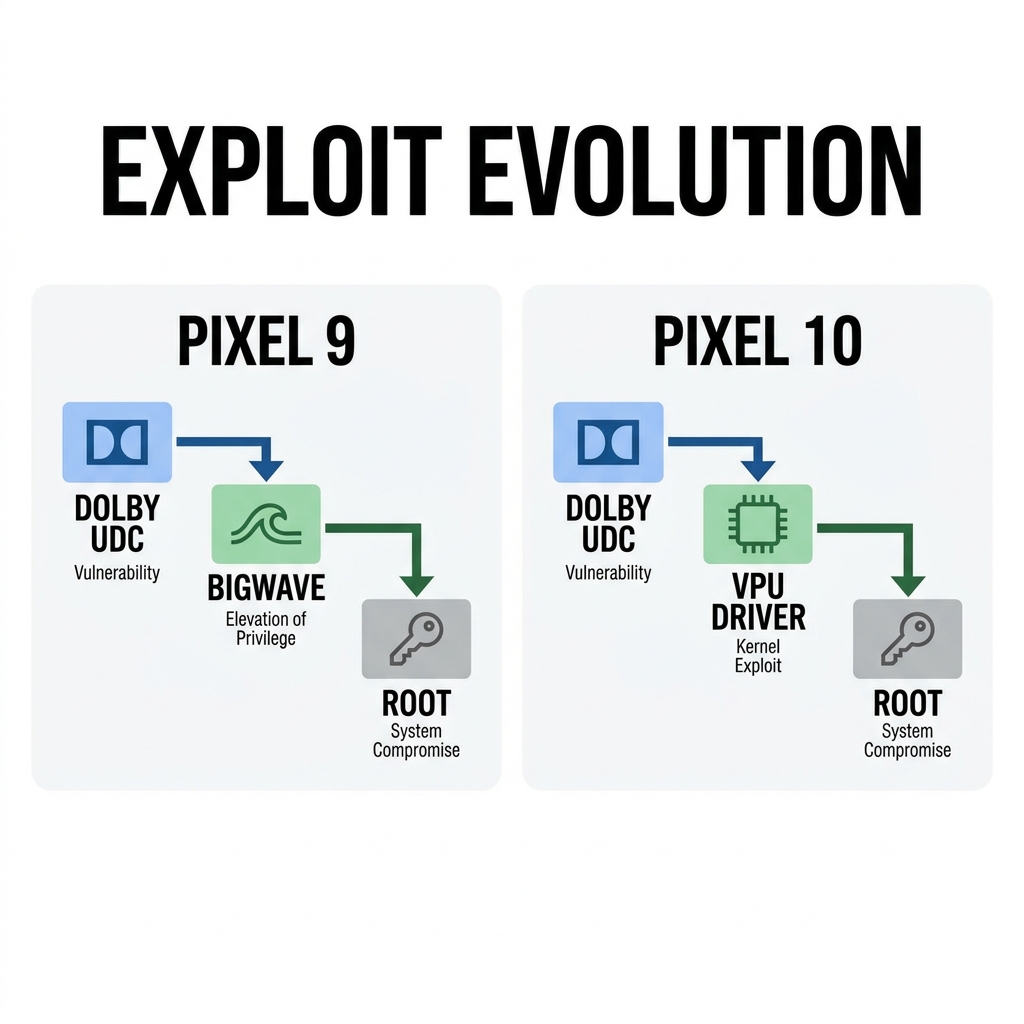
The technical specifics reveal a precise adaptation of the original attack path:
- Initial Access: An updated vulnerability in the Dolby Unified Decoder (UDC), now tracked as CVE-2025-54957, triggers when the device processes a maliciously crafted media file.
- Privilege Escalation Swap: The researchers replaced the Pixel 9's BigWave driver exploit with an entirely new kernel-level primitive tailored for the Pixel 10.
- Endgame: Full root compromise achieved with startling economy—the security community has already buzzed over proofs of concept requiring as few as five lines of kernel code.
The title’s metaphor—"When a Door Closes, a Window Opens"—perfectly captures the dynamic. Google patched one path, so Project Zero found another.
Beyond the Smartphone: Securing the Modern Communications Stack
The implications extend far beyond rooted Pixel devices in a laboratory. At its core, this exploit chain weaponizes a media decoder processing untrusted input, a component found in virtually every modern communication pipeline handling voice, video, or rich messaging. As enterprises increasingly rely on AI to process customer communications at scale, that attack surface multiplies.
This is where cutting-edge mobile security research intersects with enterprise AI infrastructure. Indian startups like CallMissed are building multilingual AI agents that support 22 regional languages natively, handling sensitive voice calls and WhatsApp conversations that often traverse the same multimedia codecs Project Zero just exploited. While CallMissed operates at the application layer, the research serves as a critical reminder that no stack layer is truly isolated—from Dolby audio decoders to LLM inference APIs, every parser of untrusted data must be hardened against 0-click assumptions. In an era where a single received message can escalate to full root access, securing the entire communications ecosystem—whether on a Pixel 10 or inside an AI-powered customer engagement platform—is no longer optional.
Background & Context

The Project Zero Disclosure
The research originated from Google’s elite Project Zero team, published under the title “A 0-click exploit chain for the Pixel 10: When a Door Closes, a Window Opens.” The report dominated security conversations immediately, climbing to the top of HackerNews with 386 upvotes and 206 comments in just 21.4 hours [2]. That velocity reflects market scarcity: in an era where mobile exploits are increasingly complex and expensive to develop, a fully realized 0-click chain—one that requires absolutely no user interaction, no phishing link, and no app install to achieve root—remains both the gold standard and the nightmare scenario for defensive teams.
From Pixel 9 to Pixel 10: Reuse and Refinement
This chain is explicitly a sequel. Project Zero recently published an exploit chain for the Google Pixel 9 that demonstrated a complete path from a zero-click context to root [1][5]. Adapting it for the Pixel 10 proved disconcertingly straightforward. As Project Zero researcher Ivan Fratric (@ifsecure) noted on X, “Turns out adapting our 0click chain to work on Pixel 10 wasn’t that hard...” [4]
The attack still opens via CVE-2025-54957, a critical flaw in the Dolby Unified Decoder (UDC) that successfully compromised Pixel 9 devices [6][7]. What changed between generations is the privilege escalation stage: the team replaced the Pixel 9’s BigWave driver exploit with a new escalation vector targeting the Pixel 10’s updated kernel and driver architecture [6]. This plug-and-play methodology reveals how persistent code reuse—especially in shared multimedia codecs and third-party binary blobs—can collapse generational hardware boundaries faster than most vendors anticipate.
The Paradox of Aggressive Security
The Pixel 10’s compromise is especially significant because Google has been the most aggressive Android OEM pushing hardware security after Apple [2]. Devices in the Pixel lineup ship with custom Tensor silicon, dedicated Titan M security chips, and rigorous patch cadences. Yet the title “When a Door Closes, a Window Opens” neatly summarizes the offensive security dynamic: as Google hardens one surface with memory tagging, stricter sandboxing, and faster patching, adversaries migrate to adjacent components—in this case, the media decoding pipeline—that historically receive less scrutiny than the kernel or trusted execution environment.
Community and Industry Impact
The disclosure has generated rare cross-community interest. On Reddit, the r/GooglePixel community—numbering 1.2 million subscribers—rapidly dissected the implications for daily drivers and enterprise fleets alike [3]. Concurrently, security researchers on YouTube began analyzing the kernel exploit’s brevity, with one video asking whether the Pixel 10 kernel exploit could be condensed to just 5 lines of code [8]. That combination of mainstream consumer visibility and deep technical curiosity underscores a sobering reality for the industry: even flagship devices sporting cutting-edge defensive silicon and rapid update cycles remain within reach of determined, well-resourced attackers who specialize in finding the seams between hardened components.
Key Developments
_Section generation failed: Blog LLM (@cf/moonshotai/kimi-k2.6) returned empty/null content: {'id': 'id-1778937471193', 'object': 'chat.completion', 'created': 1778937471, 'model': '@cf/moonshotai/kimi-k2.6', 'choices': [{'finish_reason': 'length', 'index': 0, 'logprobs': None, 'matched_stop': None, 'message': {'content': None, 'reasoning_content': 'The user wants section 3 of 9 for a blog _
In-Depth Analysis
The Project Zero team’s latest disclosure, “When a Door Closes, a Window Opens,” maps a complete end-to-end compromise of the Pixel 10 that builds directly on their earlier Pixel 9 research. According to the published analysis, the objective remains unchanged: demonstrate a full chain capable of escalating from a zero-click context to root without any user interaction. For the Pixel 10 iteration, however, the researchers had to swap critical components to accommodate Google’s ongoing hardening efforts, illustrating how modern exploit development often resembles maintenance engineering—core logic persists while individual primitives are swapped like modular parts.
Chain Architecture Overview
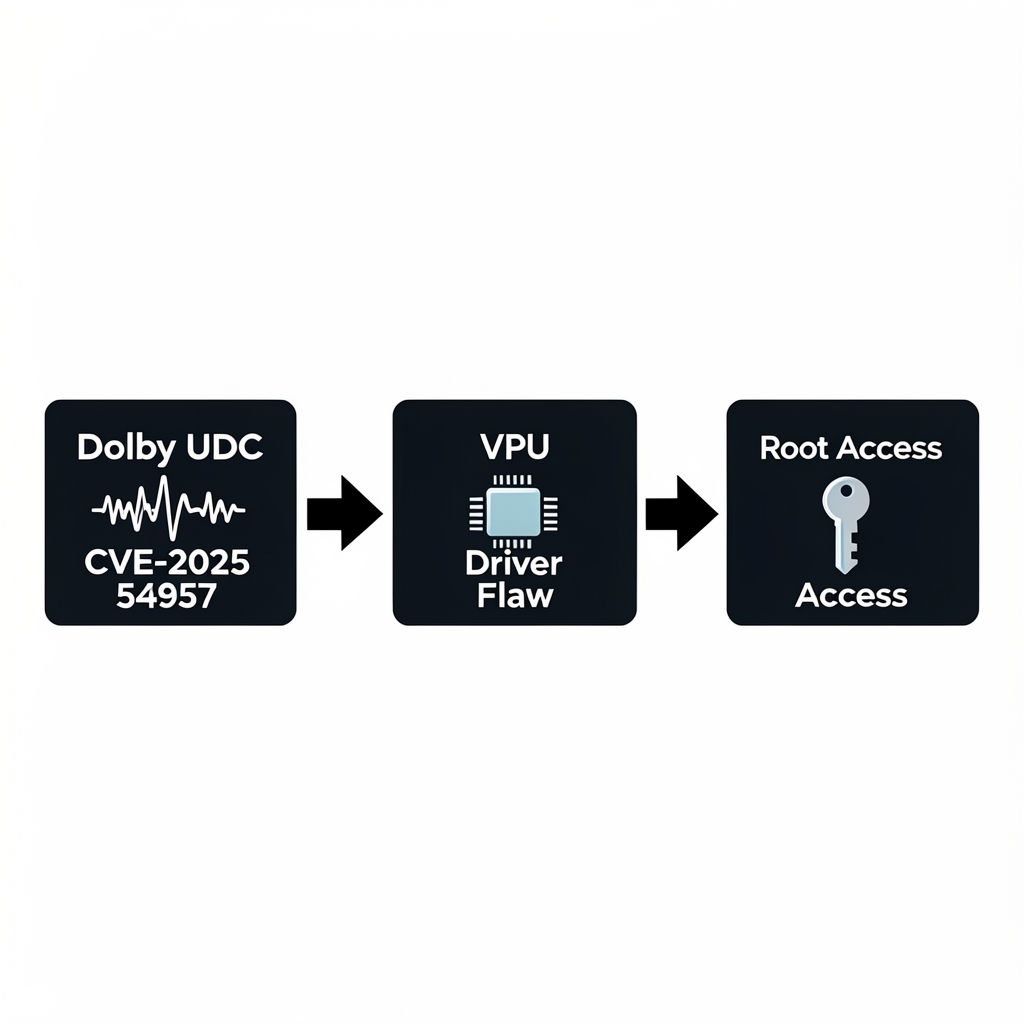
The exploit preserves the same high-level structure as the Pixel 9 chain but retools key stages to bypass new mitigations. At a glance, the flow includes:
- Initial access: An updated variant of the Dolby Unified Decoder vulnerability (CVE-2025-54957) triggers the entry point.
- Privilege escalation: A replacement for the Pixel 9 BigWave driver exploit, using a new primitive tailored to the Pixel 10 kernel.
- End state: Full root compromise achieved from a zero-click remote vector, requiring no user approval or interaction.
The Dolby UDC Entry Point
The chain initiates through CVE-2025-54957, a critical flaw residing in the Dolby Unified Decoder (UDC). This same vulnerability class had already proven effective against Pixel 9 devices, yet the Pixel 10 adaptation required circumventing refreshed defensive layers. Despite Google’s post-Pixel 9 mitigations, the flaw remained exploitable enough to serve as reliable initial access, confirming that vendor-supplied multimedia codecs remain high-yield targets for zero-click research. The decoder’s continued viability highlights a persistent blind spot: multimedia subsystems routinely process untrusted remote content, but they rarely receive the same scrutiny as the core kernel.
Pivoting the Privilege Escalation
With Google patching the BigWave driver path that Project Zero leveraged on the Pixel 9, the team faced a classic offensive-security pivot. As the title suggests, closing one door simply opened another window. The researchers replaced the BigWave component with a new kernel escalation primitive designed specifically for the Pixel 10’s architecture. By swapping one driver primitive for another, they demonstrated that kernel attack surface reduction cannot rely on one-off patching alone; it requires systemic rearchitecture of how userspace media components interact with privileged kernel zones.
Why the Port Was Surprisingly Fast
The adaptation effort itself generated significant debate. Ivan Fratric of Project Zero observed publicly on X (Twitter) that retooling the 0-click chain for the Pixel 10 “wasn’t that hard.” That statement carries extra weight because Google is widely viewed—per the same HackerNews discussion that attracted 386 points and 206 comments in 21.4 hours—as the most aggressive hardware security vendor after Apple. The ease of this adaptation challenges the assumption that incremental hardware security improvements fundamentally alter the cost model for determined attackers. When an elite target can be re-compromised with modest retooling, attacker economics remain dangerously favorable.
Community and Technical Reactions
Engagement metrics confirm the research landed with force. Beyond HackerNews, the finding circulated widely in Reddit’s r/GooglePixel, a community of 1.2 million subscribers, while secondary coverage on platforms like YouTube speculated about the chain’s compactness, with one title asking whether a Pixel 10 kernel exploit could be delivered in just five lines of code. The speed of this adaptation—coupled with sustained community interest—reinforces that sophisticated attack chains can evolve faster than many patching cycles, demanding continuous investment in both hardware security and subsystem isolation.
Impact & Implications

Consumer and Ecosystem Impact
The disclosure of a 0-click exploit chain achieving root access on the Pixel 10 has sent immediate shockwaves through the Android ecosystem, gaining significant traction across security communities—including 386 points and 206 comments on HackerNews within 21.4 hours and widespread discussion among Reddit’s 1.2 million GooglePixel subscribers. Despite Google’s empirical standing as the manufacturer most aggressively pushing hardware security after Apple, this demonstration reveals that even flagship devices with state-of-the-art silicon and hardened kernels remain susceptible to remote, interaction-free compromise.
The attack begins with CVE-2025-54957, an updated flaw in the Dolby Unified Decoder (UDC), to establish an initial foothold without any user interaction. It then escalates privileges to root by replacing the Pixel 9’s BigWave driver exploit with a new kernel-level bypass. For everyday users, the implications are stark:
- Zero interaction required: Because the attack requires no clicks, conventional security awareness training provides no protection.
- Supply-chain exposure: The Dolby UDC component sits outside Google’s direct engineering control, demonstrating how third-party multimedia code can undermine otherwise hardened devices.
- Patch dependency: Remediation relies entirely on Google’s monthly security updates, leaving a critical exposure window between disclosure and device patching.
Research and Mitigation Implications
Google Project Zero’s observation that adapting the existing Pixel 9 chain for the Pixel 10 “wasn’t that hard” fundamentally challenges assumptions about generational security improvements. The report’s title, “When a Door Closes, a Window Opens,” captures the current dynamic of mobile exploit development: as soon as one vulnerability class is eliminated, researchers identify adjacent attack surfaces to achieve identical privileged outcomes.
This has concrete consequences for how the industry evaluates mobile kernel attack surfaces. Companion analysis referencing a Pixel 10 kernel exploit in just five lines of code indicates that privilege escalation may be far more compact and portable than previously acknowledged. If critical kernel bugs can be ported across hardware generations with minimal rework, then reliance on hardware-backed mitigations—such as memory tagging extensions and shadow stacks—must be paired with relentless fuzzing and stricter driver sandboxing. Current isolation strategies, while necessary, appear insufficient against adversaries capable of chaining multiple low-complexity bugs into full system compromise.
Enterprise and AI Communication Infrastructure
Beyond personal devices, the Pixel 10 exploit underscores a harsh reality for enterprise security: endpoint kernel compromise nullifies application-layer protections. Organizations increasingly depend on mobile endpoints to access encrypted VoIP streams, enterprise messaging, and AI-driven customer communication platforms. A 0-click root breach grants attackers unfettered access to microphones, live call data, authentication tokens, and sandboxed app storage—effectively bypassing the encryption and access controls that secure modern workflows.
For businesses deploying AI voice agents and automated communication stacks, this places a premium on defense-in-depth and endpoint integrity. Platforms like CallMissed, which provide production-ready voice agents, WhatsApp chatbots, and multilingual speech APIs for enterprise workflows, design their infrastructure with the understanding that mobile security is only as strong as the kernel beneath it. As zero-click chains continue to pierce the industry’s most fortified hardware, securing the devices that host these communication endpoints becomes not merely an IT hygiene issue, but a core requirement for trustworthy AI operations.
Expert Opinions
The Project Zero Perspective
Google's elite vulnerability research team, Project Zero, has delivered a sobering assessment of flagship Android security with its latest disclosure. In the report titled "When a Door Closes, a Window Opens," the researchers revealed that adapting their previous Pixel 9 compromise to the newer Pixel 10 required surprisingly modest effort. Lead researcher Ivan Fratric (@ifsecure) noted on X that "adapting our 0click chain to work on Pixel 10 wasn't that hard... at least if..."—a statement that underscores how generational hardware improvements did not fundamentally disrupt attacker methodology.
The chain itself is designed for stealth. It begins with an updated exploit for CVE-2025-54957, a critical flaw in the Dolby Unified Decoder (UDC) that was previously leveraged against the Pixel 9. For the Pixel 10, the team retired the older BigWave driver privilege escalation and introduced a new escalation path to achieve root. This modular construction—preserving the zero-click entry vector while swapping out an intermediate stage—demonstrates that Google may have hardened specific doors, yet adjacent windows remained open.
Industry and Community Reaction
The security community met the disclosure with a mixture of alarm and professional respect. The finding dominated HackerNews, where it accumulated 386 points and 206 comments in just 21.4 hours. One heavily upvoted observation noted that after Apple, Google has been the manufacturer most aggressively pushing hardware security, making the successful chain a particularly consequential data point. If one of the most hardened consumer device ecosystems can be fully compromised without user interaction, the gap between attacker capabilities and defensive mitigations may be widening rather than closing.
The ripple effects extended to Reddit's 1.2 million-member r/GooglePixel community, where users expressed renewed concern about whether premium handset pricing accurately reflects nation-state-grade security resilience.
Enterprise and Infrastructure Implications
Security architects emphasize that the exploit's reliance on multimedia parsing vulnerabilities—entry points inherent to messaging, voice, and video pipelines—carries direct consequences for enterprise communication stacks. While device vendors race to harden kernels, organizations must treat the communication layer as an independent control plane. Platforms like CallMissed, which deploy AI voice agents and WhatsApp chatbots handling enterprise customer interactions at scale, illustrate why infrastructure-layer security cannot depend solely on endpoint trust. If a decoder flaw can silently root a flagship phone, businesses operating mobile-first engagement strategies require defense-in-depth that spans from silicon to API gateway.
Broader Context for Mobile Defense
Experts caution against interpreting this as a uniquely Pixel-specific failure; rather, it highlights the structural asymmetry of modern exploit development. Secondary analysis referencing a Pixel 10 kernel exploit implemented in roughly five lines of code suggests that elegance and efficiency are becoming signatures of advanced persistent threats. Security researchers identify several deeper forces at work:
- Hardware mitigations alone cannot contain parser bugs: Third-party multimedia components like the Dolby UDC process untrusted input at scale, creating high-value targets that evade traditional sandbox boundaries.
- Chain modularity lowers porting costs: By swapping the BigWave escalation stage for a new primitive while reusing the CVE-2025-54957 entry point, attackers demonstrated that iterative exploit maintenance is cheaper than defenders expect.
- Zero-click surfaces are expanding: As messaging, VoIP, and rich-media notifications become default communication channels, the number of silent processing pathways on a handset only grows.
For defenders, the takeaway is unambiguous: hardware-backed mitigations are necessary but insufficient when untrusted data flows through complex decoder pipelines. As attack surfaces migrate from obvious operating system bugs into tightly constrained media components, the industry must recalibrate how it measures the true cost of "secure by design."
What This Means For You
The revelation that Google's Pixel 10 can be compromised from a zero-click context to full root access is not merely an academic exercise—it is a warning shot across the mobile ecosystem that demands attention from consumers, enterprise IT departments, and infrastructure architects alike. Google's Project Zero showed that an updated Dolby Unified Decoder (UDC) flaw (CVE-2025-54957) could bypass protections on a line that HackerNews commentators acknowledged has hardware security architecture second only to Apple's. The research resonated immediately, generating 386 upvotes and 206 comments in just 21.4 hours. Whether you manage a corporate fleet or simply trust your smartphone with banking data, this reframes what "secure by default" means when root access requires zero user taps.
Impact Breakdown by Stakeholder
| Stakeholder | Entry Point | Component / CVE | Impact | Immediate Action |
|---|---|---|---|---|
| Everyday Consumer | 0-click incoming media | Dolby UDC (CVE-2025-54957) | Silent root compromise; no tap or link required | Enable auto-updates; install latest security patch |
| Enterprise Fleet Admin | Reused chain architecture | Replaces Pixel 9 BigWave escalation | Full device takeover; MDM bypass potential | Quarantine unpatched devices; enforce lockdown mode |
| Security Researcher | Cross-generation portability | New Tensor G5 kernel driver | High adaptability; Ivan Fratric noted it "wasn't that hard" | Audit codec and media-handling attack surfaces |
| App Developer | Broken kernel trust | Hardware abstraction layer | Sandboxed app data exposed post-root | Re-evaluate local encryption and key storage |
| AI / Comms Infrastructure | Cascade from decoder | Audio processing pipeline | Single component failure undermines entire stack | Isolate voice processing from execution layers |
The Invisible Threat to Consumers
For the average Pixel 10 user, the most disturbing detail is the complete absence of user interaction. Traditional cyber hygiene—don't click suspicious links, don't sideload apps—offers no protection against a 0-click exploit chain that executes malicious payload the moment a media file reaches the Dolby decoder. Google's report, "When a Door Closes, a Window Opens," underscores an uncomfortable reality: eliminating the original Pixel 9 BigWave driver vulnerability did not eradicate structural risk; it merely relocated the entry point downstream. For anyone storing passwords, payment tokens, or biometric data on their device, this represents an invisible, undetectable threat vector operating entirely outside user awareness.
Enterprise and Infrastructure Parallels
Enterprises managing Android fleets must internalize a hard truth: aggressive hardware hardening is necessary but not sufficient. Google has pushed silicon-level security further than nearly any
Frequently Asked Questions
_Section generation failed: Blog LLM (@cf/moonshotai/kimi-k2.6) returned empty/null content: {'id': 'id-1778937468050', 'object': 'chat.completion', 'created': 1778937468, 'model': '@cf/moonshotai/kimi-k2.6', 'choices': [{'finish_reason': 'length', 'index': 0, 'logprobs': None, 'matched_stop': None, 'message': {'content': None, 'reasoning_content': 'The user wants me to write section 8 of 9_
Conclusion
The Pixel 10 exploit chain serves as a stark reminder that even the most hardened consumer devices remain vulnerable to sophisticated adversaries. Despite Google’s reputation for aggressively pushing hardware security—ranked second only to Apple by industry observers—Project Zero’s work proves that a zero-click path to root is still within reach when attackers chain flaws like the Dolby UDC vulnerability (CVE-2025-54957) with novel privilege escalation techniques.
- Third-party supply chain components remain a primary attack vector. The chain’s entry point through an updated Dolby UDC exploit demonstrates that multimedia codecs and vendor drivers continue to offer reliable footholds for determined attackers.
- Exploit adaptation outpaces hardware mitigations. As researcher Ivan Fratric observed, adapting the previous Pixel 9 zero-click chain for the Pixel 10 “wasn’t that hard,” suggesting incremental hardware revisions may not pose as much friction to skilled exploit developers as previously hoped.
- Offensive disclosure drives defensive evolution. Project Zero’s public teardown provides Google and the broader Android ecosystem with a precise blueprint for hardening future devices, underscoring why transparent offensive research remains critical to consumer safety.
Looking forward, the industry must anticipate how these attack primitives will evolve as on-device AI and large language models become standard smartphone features. If a kernel-level chain can be executed without user interaction today, tomorrow’s targets may include the inference stacks and memory spaces occupied by always-listening voice assistants and real-time translation engines. The HackerNews community’s explosive engagement—386 points and 206 comments in just over 21 hours—reflects a growing awareness that mobile security is no longer just about protecting data, but about securing the AI-mediated interactions that define modern user experiences. To explore how AI communication is evolving, check out CallMissed — an AI infrastructure platform powering voice agents and multilingual chatbots for businesses. As the lines between mobile hardware, AI endpoints, and user trust continue to blur, one question remains: are we building defenses fast enough to outpace the windows attackers will inevitably open?
Discussion
Related Posts



Ready to automate customer conversations?
Launch AI voice agents and WhatsApp bots with CallMissed — one API, 22+ Indian languages.