
On-Device AI in 2026: Apple Intelligence, Phi, and the Local LLM Renaissance



Local LLMs got useful in 2026. What runs on a MacBook, what runs on a phone, when to use cloud frontier models instead — a 2026 field guide.
For most of LLMs' history, "local model" meant either "demo-quality" or "you own a GPU." In 2026 that has shifted. Small models tuned for consumer hardware are crossing the threshold of usefulness — not parity with frontier models, but good enough that real apps are shipping with on-device inference as the primary path. Here is where the field is.
What changed
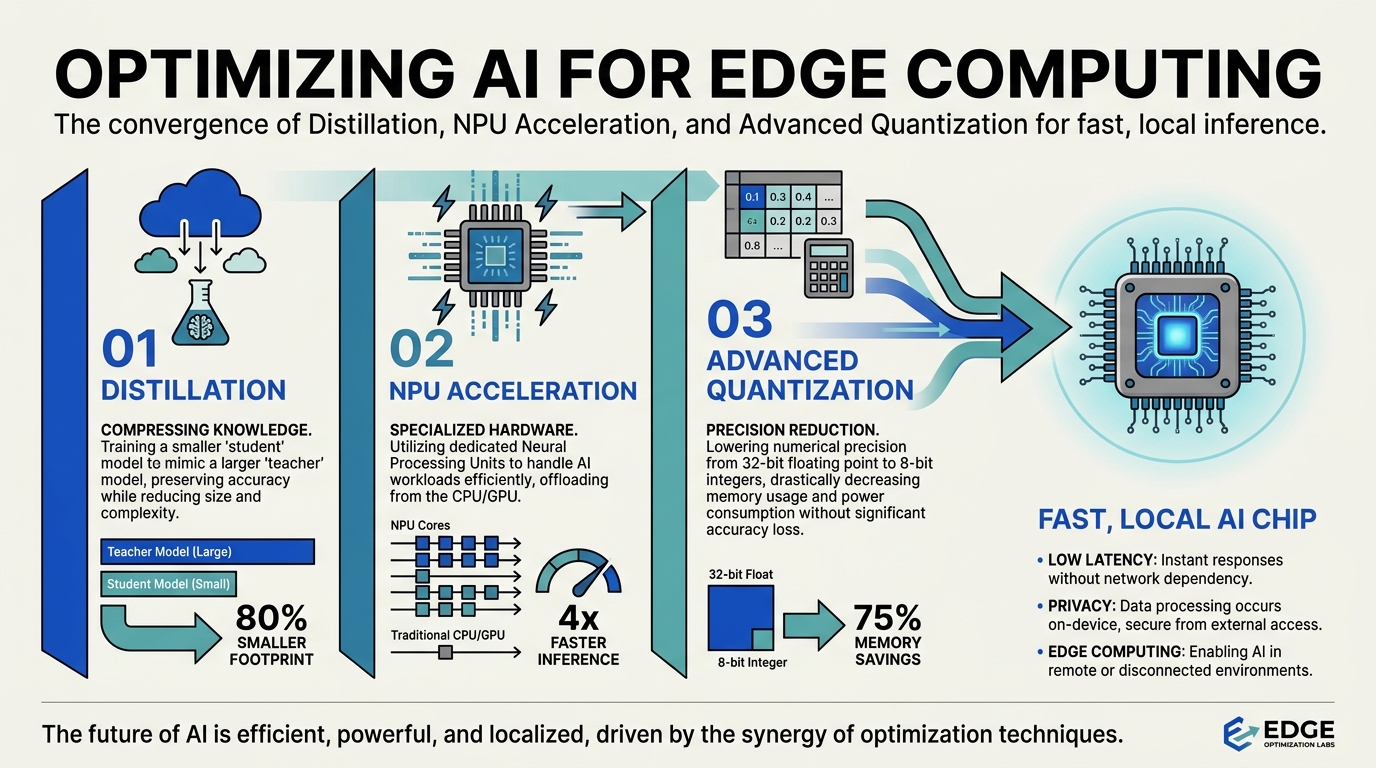
Three things converged:
- Distillation matured. Small models (3B–8B) trained on outputs of large models pick up surprisingly competent behavior on focused tasks. Phi-4, Gemma 3, and the open-weight Llama 4 Scout are dramatically better than equivalents from 18 months ago.
- Consumer NPUs caught up. Apple Silicon, Snapdragon X, and Qualcomm Hexagon now hit usable token-per-second numbers on quantized 4–8B models. M4 / M5 Macs run 8B models at 30+ tokens/sec; recent flagship phones do 5–10B-class models at conversational speed.
- Quantization got better. 4-bit quantization with smarter calibration loses much less accuracy than it did in 2024. A quantized 8B model on a laptop is now in the same neighborhood of quality as a full-precision 8B model from two years ago.
Add up these three trends and "useful local LLM" is no longer hypothetical.
Apple Intelligence
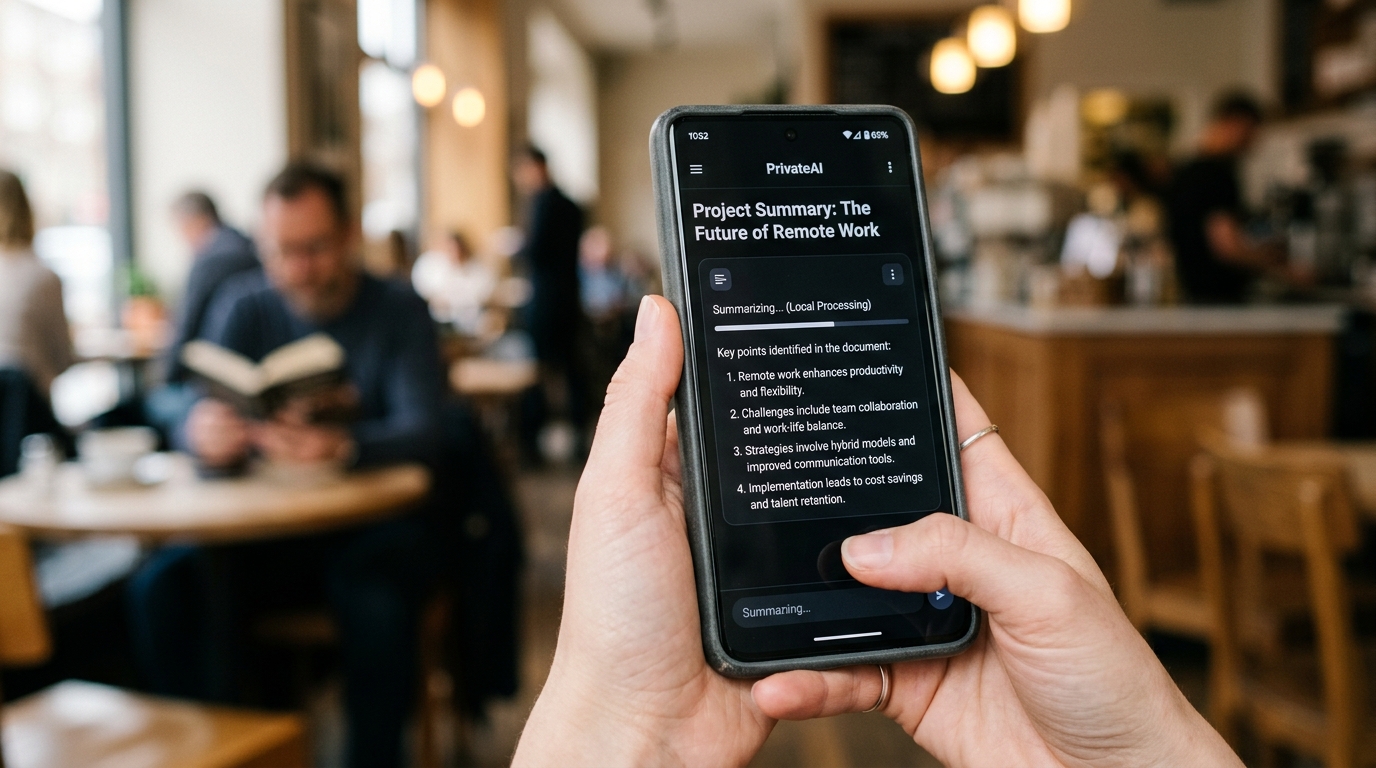
Apple's on-device foundation model — bundled into recent iOS and macOS releases — is the single largest deployment of local AI. Estimates put it in the few-billion-parameter range, with task-specific LoRA adapters loaded on demand for things like writing tools, summarization, and Siri augmentation. The model is private by design: queries run on-device for most use cases, with Private Cloud Compute as the fallback for harder requests.
What is interesting is not the model's raw capability — it is unimpressive against frontier cloud models. What is interesting is the trust model. For the first time, hundreds of millions of users have an LLM that does not send their data anywhere. That changes which use cases are viable at all. [Inference]
Phi-4 and the Microsoft small-model bet
Microsoft's Phi family — Phi-3, Phi-3.5, Phi-4 — is the open-weight counterpart to Apple's bet. Phi models are small (3B–14B), trained heavily on synthetic and curated data, and punch above their weight class on reasoning benchmarks. Phi-4 (14B) approximates the behavior of older 70B models on focused tasks at a fraction of the inference cost.
The Phi-4-mini variant (3.8B) is in the consumer-laptop sweet spot. Quantized to 4-bit it runs comfortably on 16 GB MacBooks and 8 GB Windows laptops with NPU acceleration.
Gemma 4 and Google's small-model release
Google released Gemma 4 in April 2026 — including gemma-4-26b-a4b-it and gemma-4-31b-it — alongside the broader Gemini 4 push. The smaller variants are usable on consumer hardware; the larger ones target prosumer GPUs (a 24GB workstation card runs the 31B comfortably). Gemma 4 is open-weight, ships on Hugging Face, and has solid out-of-the-box quantization support.
Llama 4 Scout
Meta's Llama 4 Scout (17B active, 109B total via mixture-of-experts) is the open-source dark horse for high-end local deployment. The MoE architecture means the active parameter count fits in consumer memory while the total parameter count gives the model real capability. On a Mac with 64GB unified memory, Scout with 4-bit quantization is the strongest local model widely available in 2026.
The 10M-token context window is wasted on most chat interactions but unlocks document-heavy local use cases — legal analysis on private documents, codebase-wide reasoning offline, etc.
What local models are actually good at
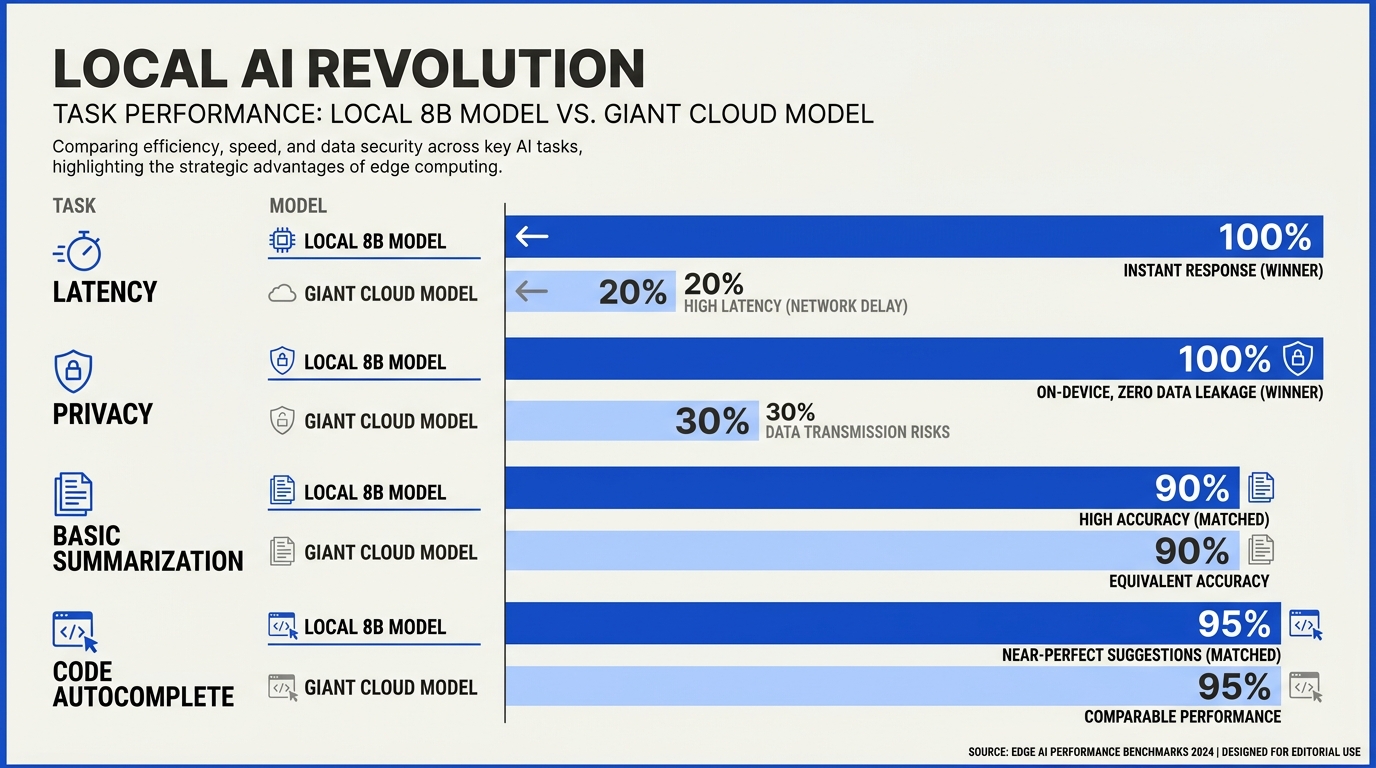
Three categories of use case have crossed the line from "demo" to "ship it":
- Summarization and rewriting. Email summaries, document compression, tone adjustments. The work is bounded, the input is short, the failure mode is "draft you edit before sending."
- Classification and extraction. Email triage, expense categorization, structured-data extraction from receipts. Small models are very good at narrow, well-defined classification tasks.
- On-device assistant features. "Find my notes about X," "what did I say in this thread," semantic search on local data. The latency win and privacy story are both compelling.
What they are still bad at
Three categories where cloud frontier models remain ahead:
- Long-form reasoning. Multi-step math, legal reasoning, complex planning — local models drop off a cliff past simple flows.
- Tool use at scale. Native tool-calling support is improving but flaky; production agents still want frontier models.
- Cross-domain breadth. Frontier models know more facts. Period. A small model fine-tuned on your domain can match or beat them in that domain, but loses on anything outside it.
The hybrid pattern
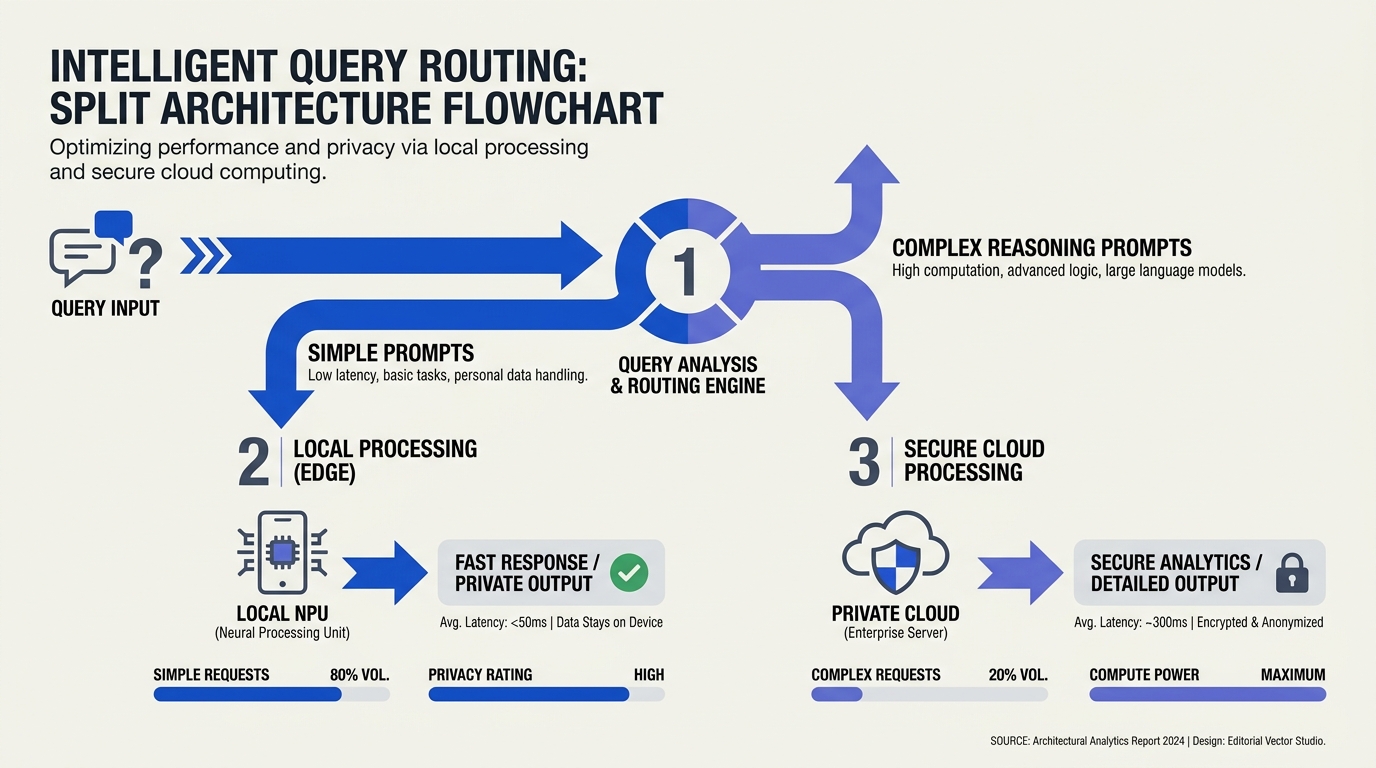
The winning architecture in 2026 is not "all local" or "all cloud" — it is route by use case. Local models handle the high-frequency, low-stakes, latency-sensitive cases. Cloud models handle the complex, infrequent, high-value cases. Apple Intelligence + Private Cloud Compute is a literal implementation of this pattern; most production apps building serious local features end up with a similar two-tier design.
The mental model: local for "what" and "where," cloud for "why" and "how." Local for retrieving and classifying. Cloud for reasoning and generating.
Where this is going
By 2027 expect 8–14B models to be the default local tier and frontier models to remain cloud-only — the gap on the low end is closing fast, but the frontier keeps moving. The interesting question is not whether local AI will be useful (it already is) but whether the cloud-default UX of consumer apps shifts to local-first. Apple is making that bet aggressively. Whether the rest of the industry follows is the story of the next 18 months.
Discussion
Related Posts


Ready to automate customer conversations?
Launch AI voice agents and WhatsApp bots with CallMissed — one API, 22+ Indian languages.