
Fine-Tuning vs RAG: The 2026 Decision Framework


A 2026 framework for choosing between fine-tuning and RAG — what each does, when each wins, and the hybrid pattern that most production systems actually use.
"Should we fine-tune or do RAG?" is a question that has lost most of its drama. By 2026 the field has settled on a clear answer: they do different things, and most production systems use both. The interesting question is no longer "which one?" but "what belongs in which?"
The single most useful mental model
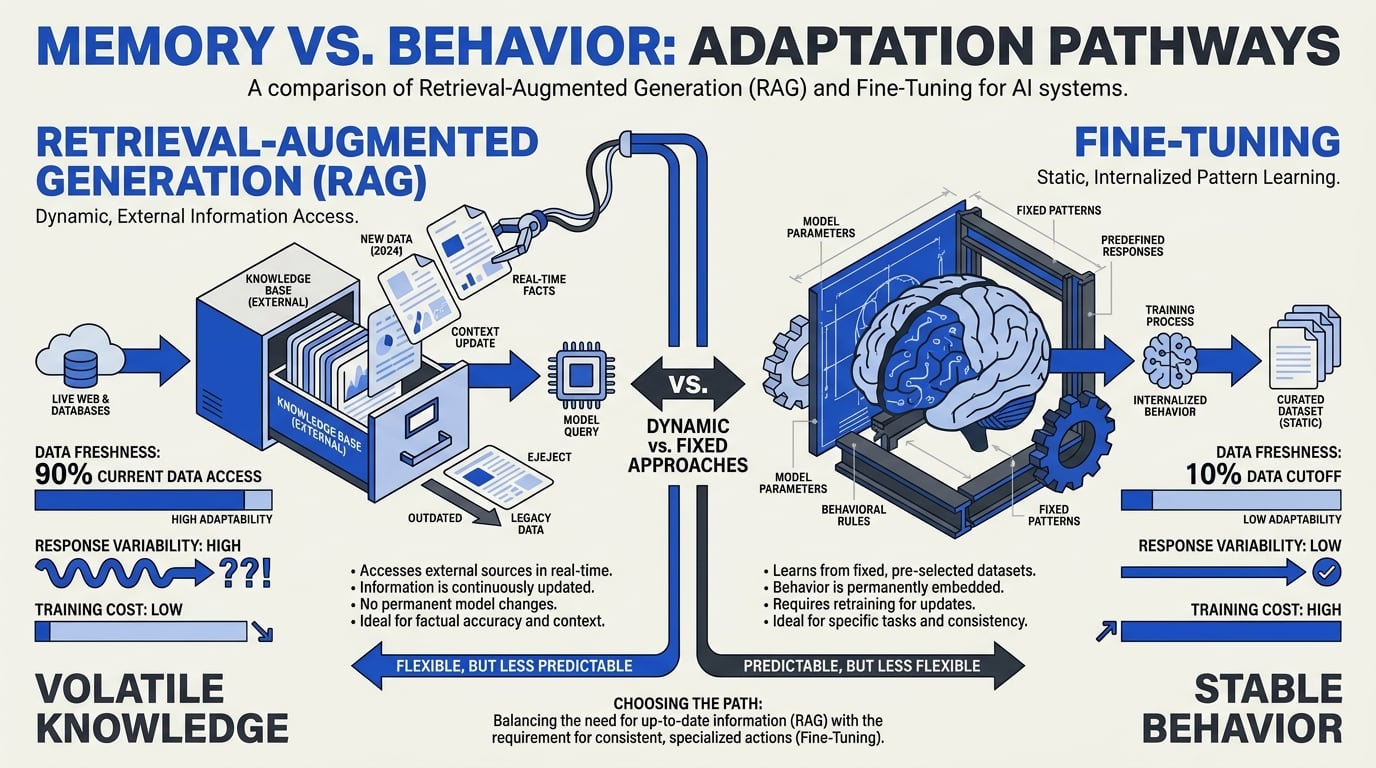
RAG changes what the model can see right now. Fine-tuning changes how the model tends to behave every time.
That distinction does most of the architectural work. (Medium on RAG vs FT)
- RAG = volatile knowledge. Anything that changes often, anything that needs citations, anything you might add to or remove from at runtime.
- Fine-tuning = stable behavior. Output format, tone, response style, structured-output schemas, decision policies that should hold across all inputs.
If you find yourself trying to fine-tune in your knowledge base, stop. If you find yourself stuffing brand voice into every system prompt, you have a fine-tuning shape.
When RAG wins
Choose RAG when:
- The knowledge is large or changing — documentation, product catalogs, internal wikis, support history. Re-training every time is impractical.
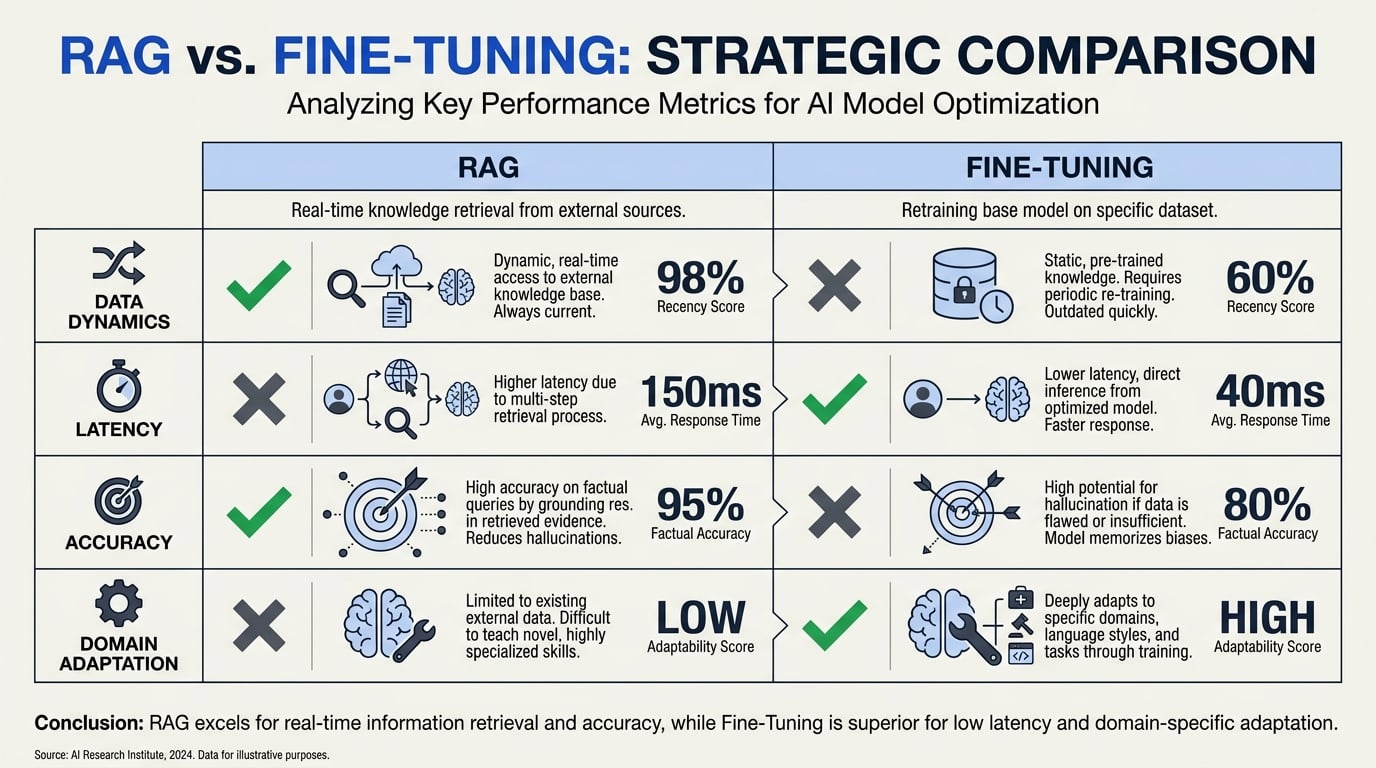
- You need citations or provenance — compliance, audit, "where did this answer come from?" Fine-tuned models cannot point at a source document.
- Data governance separates source from model — the same model serves multiple knowledge bases; the data must remain isolable per tenant or per workspace.
- You do not have labeled training data — you have documents, but not "input → ideal output" pairs.
- Time-to-deploy matters — RAG ships in days; fine-tuning ships in weeks.
The ScalaCode 2026 guide puts this plainly: choose RAG when the information the model needs is large or dynamic, you need provenance, or you simply do not have training data. (scalacode)
When fine-tuning still wins
Fine-tuning has not gone away. It still wins when:
- You need consistent behavior — brand voice, persona, structured-output schemas that prompting cannot reliably enforce.
- Latency budget is tight — RAG adds retrieval latency (50–500 ms typical). For sub-second total budgets, that hurts.
- You need a small model to do a frontier-model job — fine-tuned 7B can match GPT-4 on a narrow task at 10–50× lower cost. The economics flip past ~50K daily calls. [Inference]
- The behavior is policy, not knowledge — "always reply in two paragraphs," "never recommend product X," "extract JSON with this exact schema."
- You have evaluation data — labeled examples make fine-tuning meaningfully better than prompting alone.
The hybrid pattern (the 2026 default)
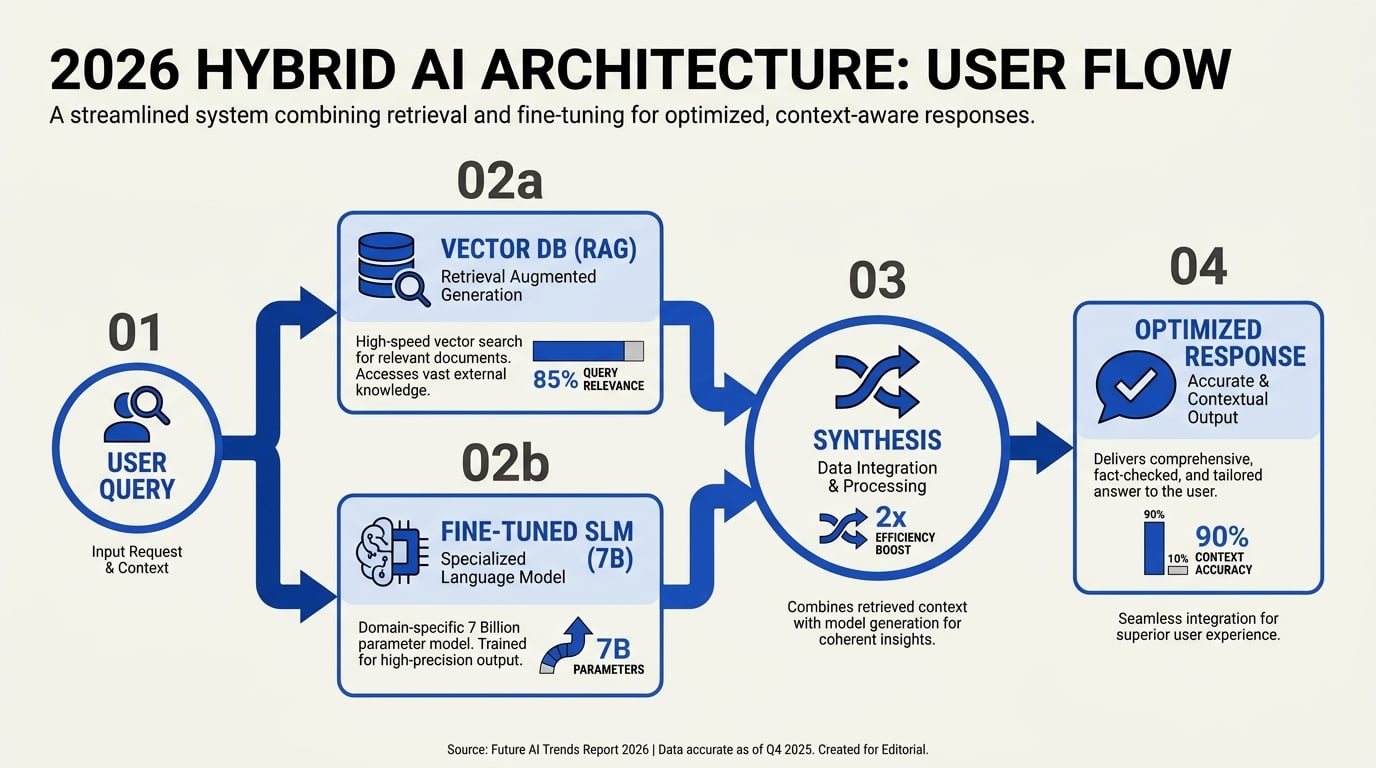
Most production systems in 2026 use both:
fine-tuned model = behavior layer (style, schema, policy)
       +
RAG retrieval  = knowledge layer (volatile facts, citations)
       +
prompting      = instruction layer (per-request guidance)
A reported figure: roughly 60% of production deployments across 2025–2026 use both fine-tuning and RAG together. (scalacode) [Unverified]
The right pattern: fine-tune the small model on stable behavior (response shape, brand voice, decision policy); use RAG to inject knowledge; use prompting for per-request guidance. Each layer does what it is best at.
What fine-tuning actually means in 2026
The word "fine-tuning" covers a wide range:
- Full fine-tuning — every weight updated. Expensive, rare in practice.
- LoRA — low-rank adapters trained on top of frozen weights. Cheap, fast, the default in 2026.
- QLoRA — LoRA on a 4-bit-quantized base. Even cheaper; runs on consumer hardware. ~80–90% of full FT performance.
- DPO / RLHF — preference-based optimization. Right when you have pairs of "preferred vs not preferred" outputs.
- Hosted fine-tune — OpenAI, Anthropic, and others offer fine-tuning APIs on closed models. Easiest path; you trade flexibility for simplicity.
For most teams in 2026, LoRA on an open model or hosted fine-tune on a small closed model is the right starting point.
A decision matrix
| Scenario | Pick |
|---|---|
| "Help me with our product docs" | RAG |
| "Always respond in our brand voice" | Fine-tune |
| "Extract this exact JSON schema reliably" | Fine-tune (or strict structured output) |
| "Answer with citations from our policy library" | RAG |
| "Run cheaply at high volume on a narrow task" | Fine-tune small model + RAG for facts |
| "Multi-language customer support over a knowledge base" | RAG (with multilingual embeddings) |
| "Code in our internal style with our internal patterns" | Fine-tune + RAG (codebase examples) |
Common mistakes
- Fine-tuning your knowledge base. You will fight model drift forever, you will lose citations, and your knowledge will go stale on day two. Use RAG.
- RAG-ing your style guide. Stuffing brand voice into every prompt costs tokens and rarely yields consistency. Fine-tune behavior.
- Skipping evaluation. Both approaches need a held-out test set with realistic queries. Without it, you cannot tell when something regresses.
- Fine-tuning before prompt engineering. A well-engineered prompt with structured output and few-shot examples often closes 70% of the quality gap. Prompt first; fine-tune what remains.
Cost shape
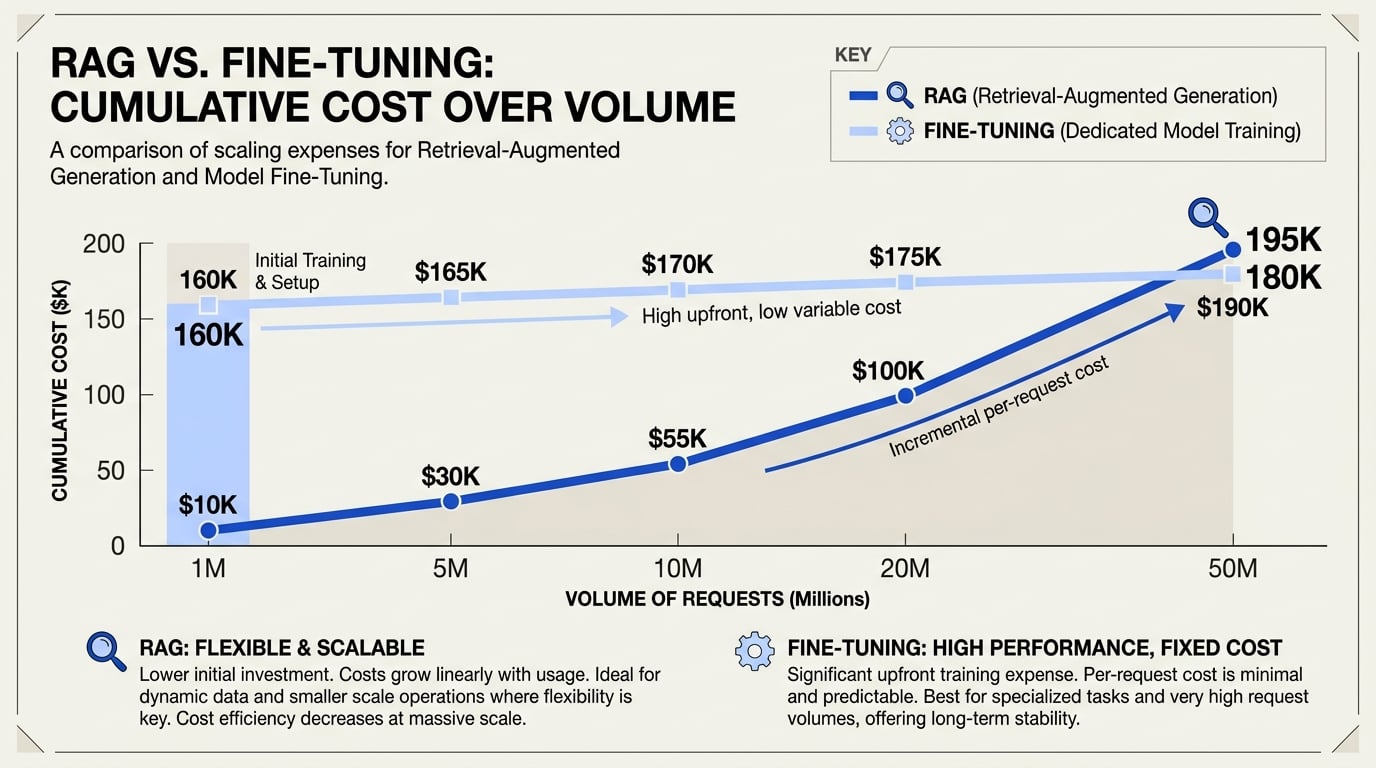
[Speculation] A rough comparison for a typical mid-volume workload:
| Approach | Setup cost | Per-request cost | Iteration speed |
|---|---|---|---|
| Prompting only (frontier model) | low | high | hours |
| Prompting + RAG | low-medium | medium-high | days |
| Hosted fine-tune | medium | medium | weeks |
| LoRA on open model + self-hosted | medium-high | low | weeks |
| LoRA + RAG | medium-high | low-medium | weeks |
The cheapest per-request option (LoRA + self-hosted) has the highest setup cost. The fastest to ship (prompting) has the highest per-request cost. Pick the spot on the curve that matches your volume and time-to-deploy constraints.
Bottom line
In 2026, fine-tuning vs RAG is a false choice. RAG is the right home for facts, citations, and changing knowledge. Fine-tuning is the right home for stable behavior, format consistency, and shrinking the model footprint at high volume. Most production systems use both; the only question is which layer carries which kind of information.
Frequently Asked Questions
When is RAG enough on its own?
Should I fine-tune or just use a longer prompt?
Will fine-tuning a model on my docs save money over RAG?
Discussion
Related Posts


Ready to automate customer conversations?
Launch AI voice agents and WhatsApp bots with CallMissed — one API, 22+ Indian languages.