
Measuring AI ROI: Beyond 'Productivity Gains'



A 2026 framework for measuring AI ROI that survives a CFO audit — cost-out, revenue-in, quality, and time-to-X. Plus the over-claims to watch for.
"AI saved us 30% on engineering productivity" is the most common claim in 2026 board decks and the least defensible one. The number is rarely measured and almost never attributed cleanly. If you are spending real money on AI tools, you owe yourself a real ROI framework. Here is one that holds up to skeptical scrutiny.
Why "productivity gains" rarely survive an audit

The classic AI ROI claim — "we saved X hours per engineer per week" — fails three tests:
- Counterfactual. Would the work have been done anyway, just slower? Or was it work that would not have happened at all without the AI?
- Attribution. Did the AI save the time, or did the engineer ship faster because they were also using a better IDE, a better model in their head from a side-project, or had less meeting load that week?
- Translation to dollars. Saved hours are not saved money unless the company actually re-deploys the time, fires the people, or sells the saved capacity.
A defensible AI ROI claim handles all three.
The four ROI categories that hold up
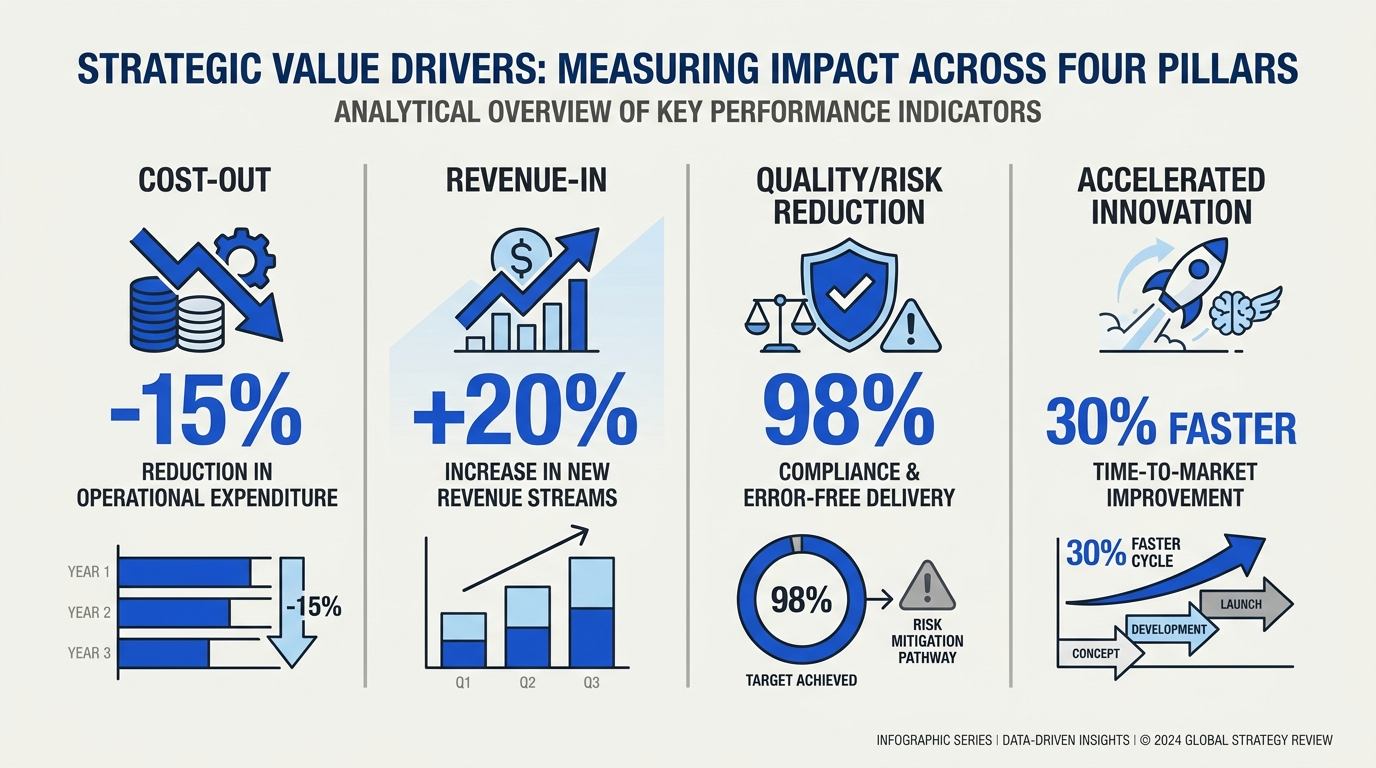
Across 2026 enterprise AI deployments, the categories that survive an honest CFO audit:
1. Cost-out (replaced spend)
The AI takes over a workload that previously had a budget line. Customer support tickets that were going to a BPO. Document processing that was going to a vendor. Calls that were going to an outsourced call center. The ROI is the budget line you delete, minus the AI cost. This is the cleanest category.
To attribute: track the units before and after (tickets, documents, calls), confirm the underlying workload did not change, divide saved spend by AI spend.
2. Revenue-in (new revenue attributable to AI)
A new product feature, a new sales motion, a new conversion path that demonstrably moves a metric you already track. Example: an AI sales agent that generates qualified leads, where the leads carry an attribution tag and the close rate is comparable to other channels.
To attribute: instrument the feature, run an A/B or hold-out test, confirm the lift survives a multi-week observation window. Revenue attribution should never rely on self-reported productivity.
3. Quality / risk reduction
Fewer errors, faster compliance, better decisions. Harder to translate to dollars, but possible if you have a baseline error cost. Example: a contract-review AI that catches missing clauses; baseline cost per missed clause is known from historical disputes.
The pitfall: don't claim quality wins without the baseline. "Our model accuracy is 97%" is not an ROI statement unless you can say what 1% of error costs.
4. Time-to-X compression
The team ships features in 4 weeks instead of 8. The deal closes in 30 days instead of 90. The new hire is productive in 2 weeks instead of 6. These compress the cycle of value creation. The ROI is the value of the earlier delivery.
To attribute: hold the workload constant, measure cycle time before and after, multiply by the per-cycle value. This works only if you have stable cycle definitions.
What does NOT count as ROI
A list of common claims that do not survive audit:
- "Hours saved" — unless you can show the hours were re-deployed to revenue-generating work or eliminated from headcount cost
- "Faster onboarding" — unless you can attribute it to AI rather than to a better runbook the team also updated
- "Higher developer satisfaction" — useful, but not ROI
- "More content produced" — only if the additional content moves a downstream metric
- "Fewer support tickets" — only if the volume reduction is from AI deflection, not from product changes that happened concurrently
A simple measurement framework
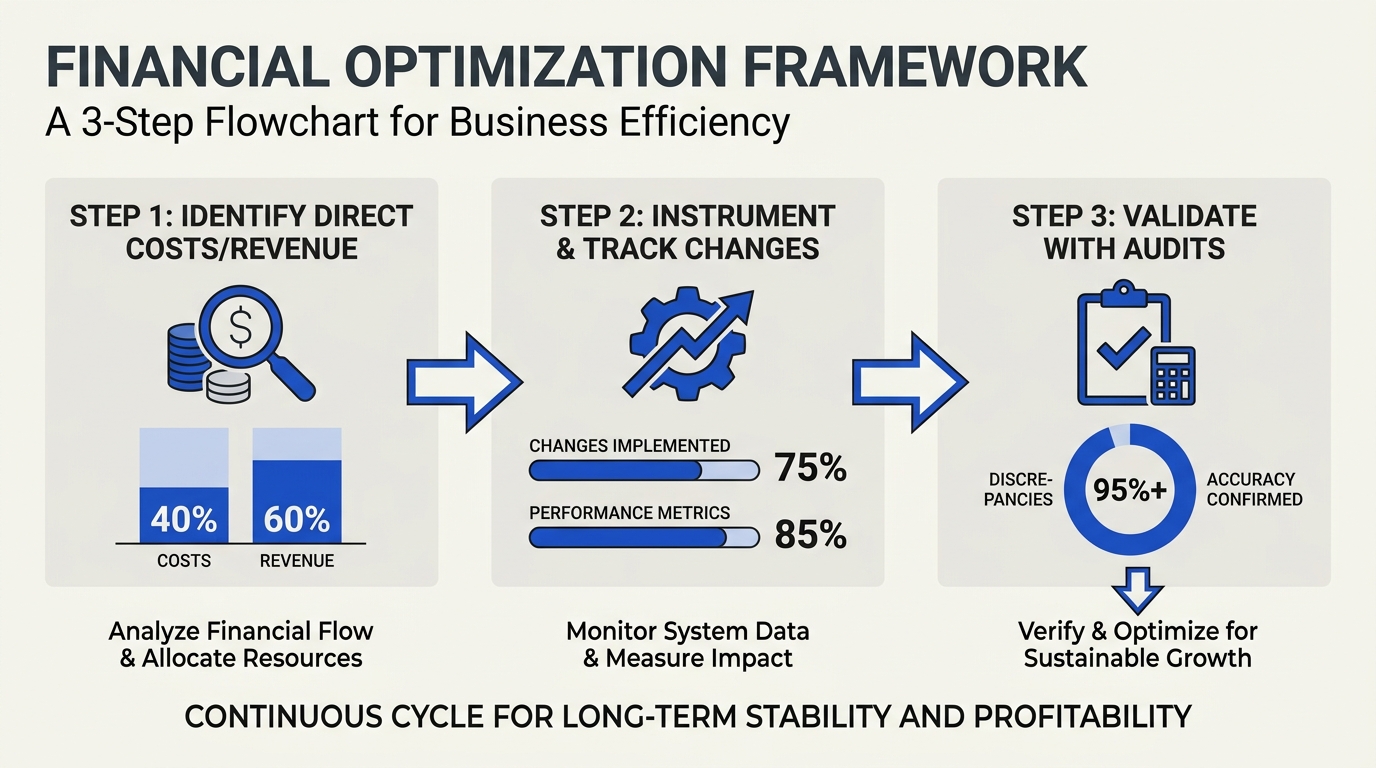
For any AI initiative, define before you ship:
- The metric — a single, pre-existing business KPI you expect AI to move
- The baseline — the metric value over the prior 4-8 weeks
- The cost — fully loaded AI spend (model + infra + team time)
- The hold-out — a population, time period, or workflow segment that does not get the AI
- The decision rule — what threshold of improvement on the metric, sustained over what period, would justify the cost?
Skip step 4 (hold-out) and your ROI claim is correlation, not causation.
Common over-claims to watch for

[Inference] Across 2026 AI vendor case studies, the most frequent over-claims:
- "3x productivity" — usually a self-reported survey, not measured output
- "50% cost reduction" — often before counting the AI's own cost, the integration work, or the human review layer
- "99% accuracy" — often on a curated benchmark, not the customer's distribution
- "Replaced N FTEs" — if the FTEs are still on payroll, this is not yet realized
When evaluating a vendor's case study, ask: was there a hold-out? What was the baseline metric? What is the AI's full loaded cost? Three honest answers will tell you whether the claim holds.
What "good" looks like
A defensible AI ROI report includes, at minimum:
- One pre-existing business KPI as the success metric
- A baseline period and a measurement period of similar length
- A hold-out group, time period, or workflow segment
- Fully loaded cost (model + infra + integration + ongoing team time)
- A confidence interval or significance test on the result
- An honest accounting of what changed besides the AI
If your AI dashboard shows "37% faster" with no baseline, hold-out, or cost — it is a marketing slide, not an ROI report.
How long to wait before measuring
Most production AI deployments stabilize between weeks 6 and 12 after rollout. Pre-week-4 numbers are usually noise — adoption is climbing, prompts are still being refined, edge cases are still surfacing. Plan a 12-week first measurement window, with a refresh at 6 months once the deployment is in steady state.
Bottom line
AI ROI is real. It is not always large, and it is rarely what the launch deck claimed. The teams getting it right are the ones who agreed on the metric, the baseline, the hold-out, and the cost before the rollout, not after. Set the bar high; the projects that clear it are the ones worth scaling.
Frequently Asked Questions
How long should I wait before measuring AI ROI?
Is "hours saved" a valid ROI metric?
How do I attribute revenue lift to AI specifically?
Discussion
Related Posts



Ready to automate customer conversations?
Launch AI voice agents and WhatsApp bots with CallMissed — one API, 22+ Indian languages.