
Enterprise AI Agents ROI in 2026: Costs, Metrics and Payback



Measure enterprise AI agent ROI with cost per completed task, adoption, exception rates, payback and a practical production scorecard.
Enterprise AI Agents ROI in 2026: Costs, Metrics and Payback
The promise of AI agents in the enterprise is alluring: software that handles customer inquiries, processes documents, reconciles transactions, and executes workflows without constant human oversight. In 2026, the technology is real. But the return on investment is not guaranteed. Data from AgentMarketCap, Olakai, BananaLabs, and NextWave Insight paint a nuanced picture: while adoption is accelerating, the majority of deployments fail to deliver measurable returns.
The Deployment-to-Value Gap
Enterprise AI agents ROI is created only when an agent is adopted in production and completes valuable workflows at a lower total cost, faster cycle time, or higher service level than the previous process. A strong model demonstration is not sufficient. If employees avoid the system, integrations fail, exceptions are frequent, or every output requires human approval, apparent gains in model capability may never become financial returns.
Published adoption and failure-rate estimates should be interpreted cautiously. Studies often use different definitions of an “agent,” “production,” “failure,” and “ROI,” while some widely repeated figures originate from vendor surveys or secondary aggregators. As of July 2026, the defensible conclusion is not that one universal percentage of agent projects succeeds or fails. It is that many organizations still face a material gap between a technically successful pilot and sustained business value.
The most important measurement shift is from testing what the model can produce to measuring what the production workflow completes.
Pilot metric vs business metric
| Pilot metric | Business metric | Why the distinction matters |
|---|---|---|
| Demo accuracy | Production task completion | An accurate response has limited value if the agent cannot finish the end-to-end workflow. |
| Task completion in a test set | Successful completion across live cases | Production traffic includes ambiguous requests, missing data, policy constraints, and edge cases. |
| Model or token cost | Cost per completed task | True cost includes integrations, monitoring, retries, human review, security, and support. |
| Response latency | End-to-end cycle time | A fast answer does not help if approvals, handoffs, or system updates remain slow. |
| Error rate | Escalation and exception rate | Exceptions transfer work back to employees and can eliminate expected labor savings. |
| Benchmark improvement | Financial outcome | Better scores matter only when they improve revenue, cost, risk, capacity, or customer retention. |
Production adoption is the first constraint. Usage should be measured among the employees, customers, or transactions for which the agent was designed—not across the company as a whole. Low adoption may indicate poor workflow fit, insufficient trust, weak training, unclear accountability, or a user experience that adds steps instead of removing them.
Workflow completion is the next constraint. An agent that drafts an answer but cannot authenticate a customer, retrieve current records, apply policy, update the system of record, or confirm the outcome is assisting with a task rather than completing it. That assistance may still be valuable, but its economics should be evaluated accordingly.
Exception rates and human review determine how much automation survives in practice. Teams should track the percentage of cases completed without intervention, the time reviewers spend per case, retry rates, escalations, reversals, and the cost of incorrect actions. Human oversight is often necessary for sensitive or high-impact decisions, but it must be included in the operating model and ROI calculation.
Integration and change management therefore matter as much as model selection. Reliable access to systems, permissions, data, audit trails, fallback paths, process ownership, employee training, and incident response all affect realized value. A practical enterprise AI agents ROI assessment compares fully loaded deployment and operating costs with verified improvements in completed-work volume, cycle time, service quality, revenue, or avoided cost. The deployment-to-value gap closes only when those improvements persist at production scale.
Real ROI Numbers
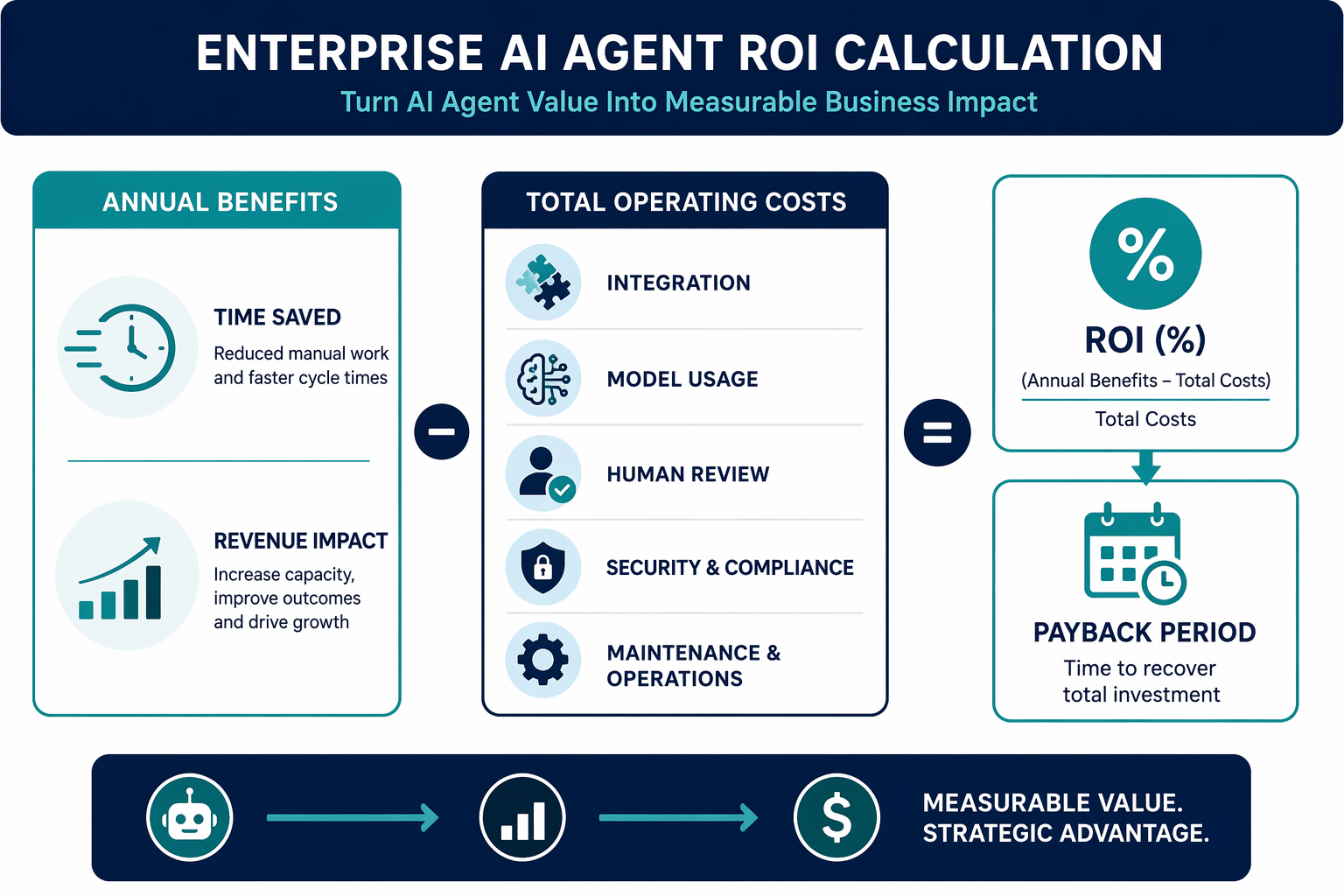
There is no defensible universal AI agents ROI benchmark. A CFO-ready estimate must begin with one defined workflow, a measurable counterfactual, accepted completions rather than attempted tasks, and the full cost of operating the agent. Vendor case studies can identify possible use cases, but unless methods and underlying data are disclosed, they should be treated as vendor-reported examples—not independent evidence or transferable forecasts.
Independent research also argues against assuming that AI automatically produces savings. A 2025 Quarterly Journal of Economics field study found that a generative AI assistant increased customer-support productivity by 15% on average, but it studied human augmentation, not autonomous agents or audited financial ROI (Brynjolfsson, Li and Raymond). In a separate 2025 randomized study, METR found that experienced open-source developers using then-current AI tools took 19% longer on the measured tasks despite expecting to work faster. Neither result is an enterprise AI agents ROI benchmark; together, they show why each workflow needs its own controlled baseline.
Use four linked measures.
1. Successfully completed tasks
Successful tasks = eligible task volume × adoption rate × completion rate × acceptance rate
Where:
- Adoption rate is the share of eligible tasks actually routed through the agent.
- Completion rate is the share the agent claims to finish without escalation.
- Acceptance rate is the share that passes quality checks without material correction, rework or customer harm.
Using attempted tasks or claimed completions in the denominator can make AI agents ROI look better while hiding failures and human cleanup.
2. Risk-adjusted annual benefit
Labor capacity value = successful tasks × minutes saved per task ÷ 60 × loaded hourly labor cost
Risk-adjusted annual benefit = realized labor savings + incremental gross profit + avoided expected losses − agent-caused expected losses
Calculate expected losses as:
Expected loss = probability of event × financial impact
Avoided expected losses should compare the agent workflow with the baseline:
Avoided expected loss = (baseline probability − agent-workflow probability) × financial impact
Keep labor capacity value separate from realized cash savings. Saved time becomes cash value only when it reduces overtime, contractor spending or headcount requirements, avoids a planned hire, or creates measurable additional output. If employees merely have more available time, report it as capacity—not booked savings.
Risk adjustments should cover material consequences such as incorrect transactions, customer remediation, regulatory exposure, privacy incidents, service-level failures and human escalation. This follows the measurement and risk-management approach in the NIST Generative AI Profile and the U.S. Government Accountability Office AI Accountability Framework, rather than assuming every completed task has equal value.
3. Fully loaded cost per successfully completed task
Recurring cost per successful task = annual operating cost ÷ successful tasks
Fully loaded cost per successful task = (annual operating cost + annualized implementation cost) ÷ successful tasks
Annual operating cost should include failed attempts and the humans required to supervise them:
| Cost category | Typical items | Treatment |
|---|---|---|
| Implementation | Workflow design, development, evaluation, deployment and training | Initial; annualize separately when comparing unit economics |
| Integrations | CRM, ERP, telephony, identity and data connections | Initial and recurring |
| Model and infrastructure | Tokens, model calls, speech processing, retrieval, storage and compute | Recurring; usually volume-based |
| Observability | Logs, traces, evaluations, monitoring, analytics and alerts | Recurring |
| Human oversight | Approvals, escalations, quality assurance and exception handling | Recurring |
| Security and compliance | Risk assessments, access controls, testing, audits and legal review | Initial and recurring |
| Maintenance | Prompt and workflow changes, model migrations, incident response and regression testing | Recurring |
| Failure costs | Refunds, rework, remediation and other agent-caused losses | Include as expected losses, without double counting |
Report both recurring and fully loaded unit cost. The first helps with ongoing routing decisions; the second prevents implementation spending from disappearing from the AI agents ROI calculation.
4. ROI and payback
For the first year:
First-year ROI % = (risk-adjusted annual benefit − annual operating cost − initial implementation cost) ÷ (annual operating cost + initial implementation cost) × 100
For steady-state operations:
Steady-state ROI % = (risk-adjusted annual benefit − annual operating cost) ÷ annual operating cost × 100
For a simple payback estimate, assuming benefits and costs accrue evenly:
Payback months = initial implementation cost ÷ ((risk-adjusted annual benefit − annual operating cost) ÷ 12)
If utilization ramps gradually, use monthly cash flows instead. Payback is the first month in which cumulative net cash benefit equals or exceeds the initial investment. If recurring net benefit is zero or negative, the project has no payback under the stated assumptions.
Transparent hypothetical example—not a customer result or benchmark
Assume an enterprise has 120,000 eligible service requests per year. The following inputs are hypothetical:
| Assumption | Value |
|---|---|
| Adoption rate | 70% |
| Agent completion rate | 55% |
| Acceptance rate after quality checks | 94% |
| Minutes saved per accepted completion | 8 |
| Loaded labor cost | $45 per hour |
| Share of labor capacity converted into cash savings | 35% |
| Incremental gross profit | $90,000 |
| Avoided expected losses | $60,000 |
| Agent-caused expected losses | $45,000 |
| Annual operating cost | $140,000 |
| Initial implementation cost | $100,000 |
Successfully completed tasks are:
120,000 × 70% × 55% × 94% = 43,428
The gross labor capacity value is:
43,428 × 8 ÷ 60 × $45 = $260,568
Only 35% is assumed to become cash savings through avoided hiring, overtime or external spending:
$260,568 × 35% = $91,199
Risk-adjusted annual benefit is:
$91,199 + $90,000 + $60,000 − $45,000 = $196,199
Recurring cost per successful task is:
$140,000 ÷ 43,428 = $3.22
If implementation cost is annualized over three years solely for unit-cost comparison:
($140,000 + $100,000 ÷ 3) ÷ 43,428 = $3.99 per successful task
First-year AI agents ROI is negative:
($196,199 − $140,000 − $100,000) ÷ $240,000 × 100 = −18.3%
Steady-state ROI is positive:
($196,199 − $140,000) ÷ $140,000 × 100 = 40.1%
Simple payback is approximately:
$100,000 ÷ (($196,199 − $140,000) ÷ 12) = 21.4 months
This example illustrates why positive steady-state AI agents ROI does not guarantee positive first-year ROI or a fast payback.
Finally, recalculate low, base and high cases for adoption, accepted completion rate, cash-realization rate, human-review cost, model usage and expected losses. Compare results against a measured baseline or phased control group where practical. The investment case should survive conservative assumptions—not depend on every attempted task being successful, every saved minute becoming cash, or vendor-reported outcomes transferring unchanged to a different enterprise.
Case Studies
TELUS offers a useful example of AI deployed across a large workforce rather than confined to a single chatbot. The telecom has publicly described extensive employee use of generative AI tools and reports material productivity and financial benefits. However, those figures are company-reported and may combine time savings, cost avoidance, revenue contribution, and other modeled benefits.
The practical lesson is to measure adoption at the workflow level. Track completed tasks, active users, time saved per task, and the percentage of outputs accepted without substantial correction. Do not convert every saved minute into cash unless it reduces paid hours, contractor spending, backlog, or hiring demand.
Klarna
Klarna’s customer-service assistant demonstrates why high-volume support is an attractive agent use case. The company has reported that its OpenAI-powered system handles a substantial share of customer conversations and reduces resolution time. Its public claims about profit contribution and human-equivalent workload are useful directional evidence, but they should not be treated as independently audited ROI benchmarks.
Enterprises should evaluate support automation using containment rate, repeat-contact rate, resolution quality, escalation volume, and cost per successfully resolved issue—not conversation volume alone. Human access also matters: an agent that lowers initial handling costs but creates repeat contacts, complaints, or customer churn can destroy value elsewhere.
JPMorgan COIN
JPMorgan’s Contract Intelligence, commonly called COIN, is a document-processing system associated with reviewing commercial loan agreements. It illustrates a different form of enterprise automation: extracting terms, identifying clauses, and reducing repetitive legal review. COIN also predates the current wave of generative AI agents, so it is better viewed as an intelligent document-processing precedent than as proof that autonomous agents can replace legal judgment.
For similar deployments, count documents processed, reviewer minutes per document, extraction accuracy by field, exceptions, and downstream errors. High-risk or ambiguous documents should remain in a human-review queue.
| Workflow | Measurable unit | Hidden cost | Best ROI signal |
|---|---|---|---|
| Customer-service automation | Issues resolved without recontact | Escalations, quality monitoring, knowledge-base maintenance | Lower cost per resolved issue with stable satisfaction and retention |
| Employee productivity assistant | Accepted outputs or completed tasks | Training, licenses, verification time, change management | Reduced cycle time or backlog without increased rework |
| Contract and document processing | Documents or fields validated | OCR failures, specialist review, audit controls | Fewer reviewer hours and exceptions at an agreed accuracy threshold |
| Multi-step operational agent | Transactions completed successfully | Integration, observability, retries, security controls | Higher straight-through processing with stable error and loss rates |
How to Apply These Examples
Build the business case from a controlled baseline. Select one repetitive, measurable workflow; record its current labor, error, delay, and escalation costs; then run the agent and comparison process in parallel. Include model usage, software licenses, integration, governance, security, monitoring, human review, and remediation in total cost.
Finally, separate gross benefit from realized financial impact. Reported corporate savings can exclude implementation costs or value time that was freed but never converted into lower spending or additional output. The strongest ROI evidence is visible in budgets and operations: fewer outsourced hours, avoided hiring, shorter queues, increased throughput, or reduced losses—while quality and customer outcomes remain within predefined limits.
Why Most Deployments Fail
Most deployments fail because teams optimize the model before validating the workflow, economics, and operating controls. In priority order, the most common failure modes are:
- Choosing the wrong workflow. Broad, ambiguous tasks are difficult to automate reliably and measure financially. Strong starting points are high-volume, repeatable workflows with clear inputs, decision rules, owners, and business outcomes. If the process is already inconsistent, adding an agent usually scales that inconsistency.
- Operating without a baseline. Teams cannot demonstrate enterprise AI agents ROI if they do not know the current cost, cycle time, error rate, escalation rate, or customer satisfaction level. Activity metrics—such as conversations handled—do not show whether the agent created value. A credible ROI calculation requires a pre-deployment baseline and a counterfactual, such as a control group or phased rollout.
- Unreliable tool use. An agent may communicate fluently while calling the wrong API, selecting an incorrect record, or taking an action without sufficient context. Production systems need constrained permissions, input validation, structured outputs, testing, and confirmation steps for consequential actions.
- Poor data access. Agents underperform when knowledge is incomplete, outdated, duplicated, or inaccessible. Retrieval quality, system integration, identity resolution, and data ownership often matter more than model selection.
- Missing human fallback. Not every request should be automated. Without confidence thresholds, escalation rules, and clear ownership, edge cases become customer-facing failures. Human review should be designed into the workflow rather than added after an incident.
- Security and compliance gaps. Excessive access, weak audit trails, unmanaged sensitive data, and unclear retention policies can block production approval. Governance must cover authentication, authorization, logging, privacy, vendor risk, and rollback procedures.
- Low employee adoption. Employees will bypass an agent that adds steps, produces inconsistent results, or threatens established roles. Adoption requires workflow integration, training, transparent limitations, feedback channels, and incentives tied to better outcomes—not simply usage.
- Uncontrolled scaling costs. A successful pilot can become uneconomic when usage expands. Model calls, retrieval, integrations, monitoring, human review, and exception handling all contribute to total cost. Unit economics should be tracked by completed outcome, not by prompt or conversation alone.
To improve the probability of success:
- Select one bounded workflow with sufficient volume and a measurable financial outcome.
- Record the baseline for cost, quality, speed, risk, and customer or employee experience.
- Set target KPIs and stop criteria before development begins.
- Test tools, data, permissions, and edge cases in a controlled environment.
- Create human escalation and rollback paths before production launch.
- Complete security, privacy, and compliance reviews with auditable controls.
- Pilot with real users, measure adoption, and gather feedback.
- Scale only when incremental benefits exceed fully loaded operating costs.
The Path to Positive ROI
The fastest path to positive ROI is to prove one bounded workflow, measure it against an agreed baseline, and scale only when the agent meets organization-specific financial, operational, and risk thresholds. Do not begin with a broad “AI transformation.” Begin with a decision that can be made within 90 days.
Choose a high-volume workflow with clear inputs, outputs, owners, and escalation paths. Customer service triage, invoice processing, appointment scheduling, and routine account updates can be suitable when they are repetitive enough to measure and sufficiently bounded to control. Define the expected financial outcome before deployment, including which costs should decline, which outcomes should improve, and how benefits will be attributed to the agent.
Days 1-15: Establish the baseline
- Document the current workflow, transaction volume, staffing, systems, failure modes, and compliance requirements.
- Measure completion rate, exception rate, cost per completed task, cycle time, quality, adoption, and risk incidents using existing human-led operations.
- Include fully loaded costs such as labor, supervision, software, infrastructure, integration, security review, and rework.
- Set go/no-go thresholds based on the organization’s baseline, customer commitments, risk tolerance, and required return—not generic industry benchmarks.
- Confirm data access, system owners, executive sponsorship, and a named operational owner.
Days 16-45: Run a narrow pilot
Build the integration first and the AI workflow second. The agent must be able to read the required systems, take approved actions, write results back, and transfer exceptions with context.
Limit the pilot to one channel, user group, transaction type, or customer segment. Run the agent alongside human handlers or require human approval for consequential actions. Log every agent action, tool call, output, latency, cost, escalation, and override. Review failures by category rather than treating them as isolated prompt problems.
Days 46-75: Move to controlled production
Allow the agent to handle an approved share of eligible work while maintaining human fallback. Use routing rules to exclude ambiguous, sensitive, high-value, or regulated cases unless controls have been validated.
Compare production results with the baseline and, where practical, a comparable human-handled group. Track downstream effects such as repeat contacts, reopened tickets, corrections, customer complaints, and supervisor workload. Apparent labor savings are not ROI if costs reappear as rework or risk.
Days 76-90: Make the scale decision
Use a preapproved scorecard rather than enthusiasm or isolated demonstrations:
| Measure | Go when | No-go or remediate when |
|---|---|---|
| Completion rate | Meets the organization’s target for eligible tasks | Falls below the agreed operational threshold |
| Exception rate | Stays within staffing and service capacity | Creates an unsustainable review queue |
| Cost per completed task | Beats the approved baseline after all costs | Savings disappear after integration, review, or rework |
| Cycle time | Meets the workflow’s service target | Delays customers or downstream teams |
| Quality | Matches the organization’s accuracy and outcome standard | Error severity or rework exceeds tolerance |
| Adoption | Users consistently accept and complete the workflow | Workarounds, overrides, or abandonment remain high |
| Risk | Operates within legal, security, privacy, and brand limits | Any defined stop condition or material control gap occurs |
Scale only if the scorecard passes for a sustained evaluation period. If it does not, narrow the scope, improve controls or integration, and retest. This stage-gated approach makes the ROI case auditable and prevents pilot success from being mistaken for production readiness.
Frequently Asked Questions
How do enterprises calculate AI agents ROI?
What costs belong in the calculation?
How long does payback take?
Should enterprises build or buy AI agents?
How should saved time be valued?
Which workflows produce the clearest ROI?
How does human review affect ROI?
Discussion
Related Posts



Ready to automate customer conversations?
Launch AI voice agents and WhatsApp bots with CallMissed — one API, 22+ Indian languages.