
The AGI Debate in 2026: Definitions, Disagreements, Stakes



How OpenAI, Anthropic, DeepMind, and Meta define AGI, where the timelines diverge, and why the debate matters for builders, regulators, and capital allocators.
"AGI" is a four-letter word that means different things to different people. In 2026 the term is invoked by the leadership of every frontier AI lab, by regulators, by VCs, and by builders — and most invocations talk past each other because the underlying definitions don't match. Here is the debate as it actually stands, the major positions, and why it matters even if you don't care about philosophy.
Why the definition matters
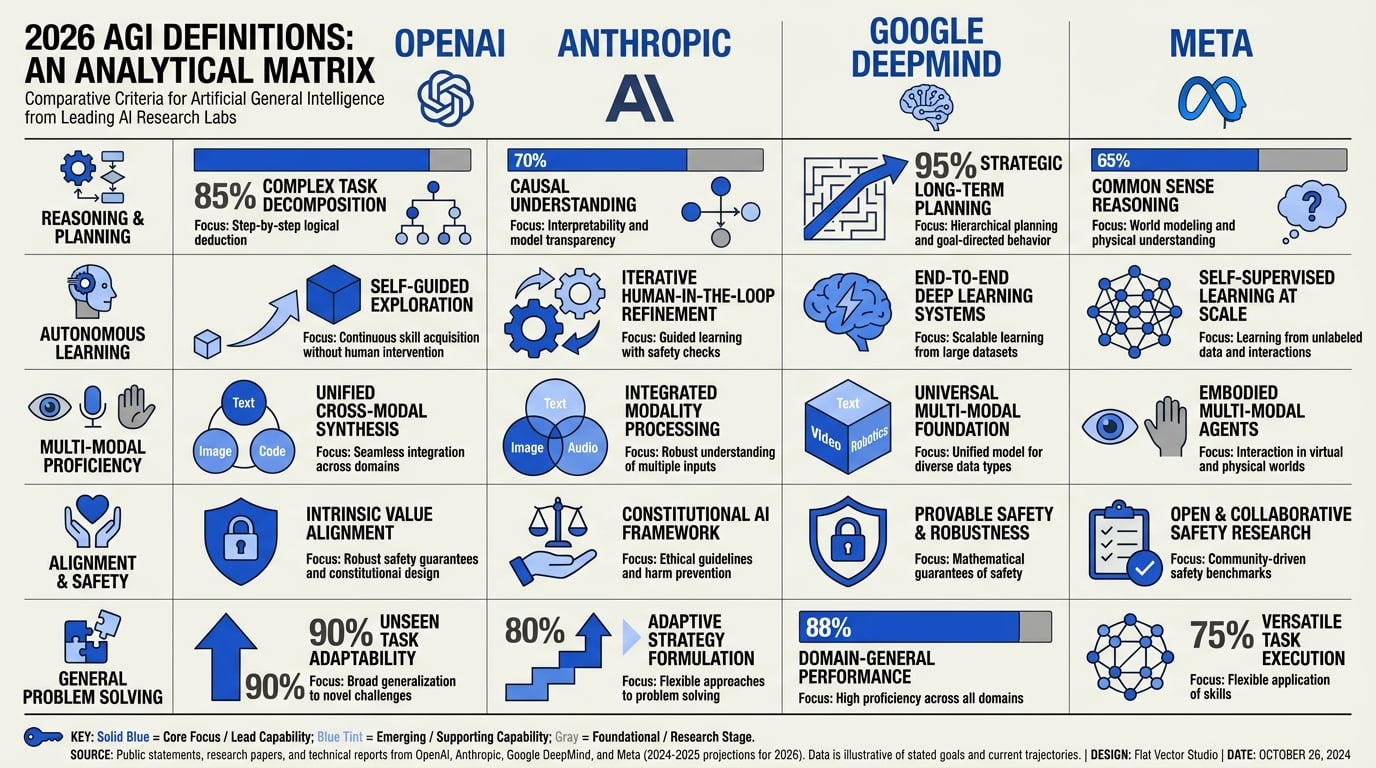
Every claim about "when AGI arrives" is a claim about a definition. The major labs use materially different ones, as documented in comparative analyses:
OpenAI
Officially defines AGI as "highly autonomous systems that outperform humans in most economically valuable tasks." The Microsoft-OpenAI 2023 agreement adds a specific commercial threshold — AGI is considered achieved when a model generates $100B in potential profits. This makes the definition partly economic and partly capability-based.
Anthropic
CEO Dario Amodei has publicly avoided the word "AGI," calling it "a marketing term." His preferred framing is "a country of geniuses in the data center" — a system smarter than a Nobel Prize winner in most subjects. He has discussed timelines as soon as 2026 in his "Machines of Loving Grace" essay.
DeepMind
Google DeepMind researchers proposed a 2023 framework with five performance levels: emerging, competent, expert, virtuoso, and superhuman, evaluated on a wide range of non-physical tasks. "Competent AGI" requires outperforming 50% of skilled adults in a wide range of tasks; "superhuman AGI" requires the same threshold but at 100%.
Meta
Yann LeCun has been publicly skeptical of imminent AGI; Meta's framing emphasizes "advanced machine intelligence" rather than AGI specifically and points to missing capabilities (planning, world models, persistent memory) as gating.
These four labs cannot all be right at once because they are pointing at different things. A model can satisfy OpenAI's definition (economically valuable task performance) without satisfying DeepMind's (superhuman across all tasks) or Anthropic's (genius across all subjects).
The four main positions in the debate
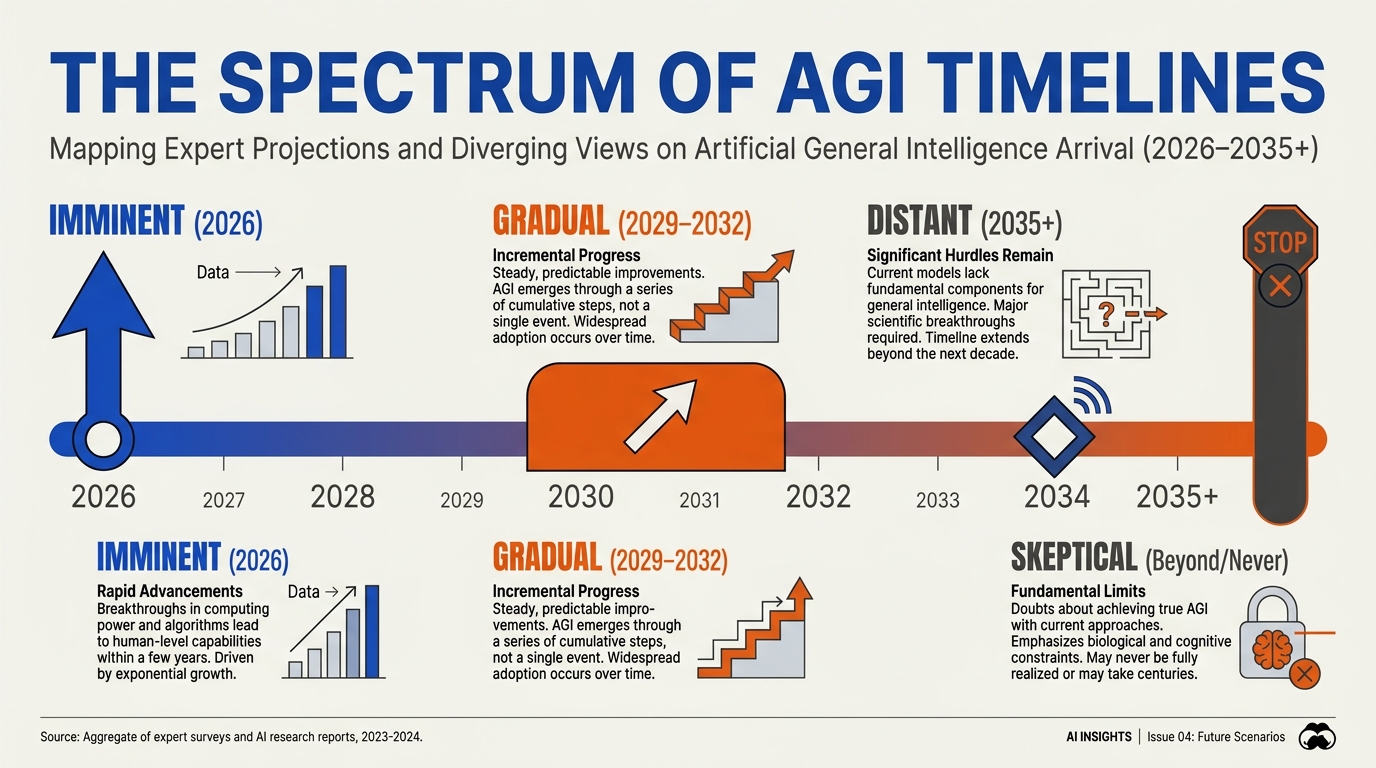
Position 1: AGI is imminent (2025-2028)
Held by parts of OpenAI leadership, Anthropic's CEO, and a chunk of the AI-safety-adjacent community. Argument: scaling laws have not broken, model capabilities have continued to improve, autonomous coding agents and reasoning models suggest we are close to the ability to do most intellectual labor.
Position 2: AGI is mid-term (2030-2040)
Held by significant fractions of academic AI researchers, much of DeepMind's published research, and many large-tech AI leaders. Argument: capability progress is real but uneven; reasoning, planning, and physical-world generalization are well below human; multiple research breakthroughs separate current models from "general."
Position 3: AGI is far or unclear (2050+ or never on current paradigm)
Held by Yann LeCun and many academic researchers. Argument: current architectures lack world models, persistent memory, and the ability to plan with abstract concepts; transformer scaling will plateau; we need new paradigms.
Position 4: "AGI" is the wrong abstraction
Held by some serious researchers across the spectrum. Argument: "general intelligence" is not a single thing; capabilities decompose into many specialized components; the binary "have we built AGI yet?" question obscures what is actually happening, which is rapid progress on some tasks and slow progress on others.
What's actually measurable
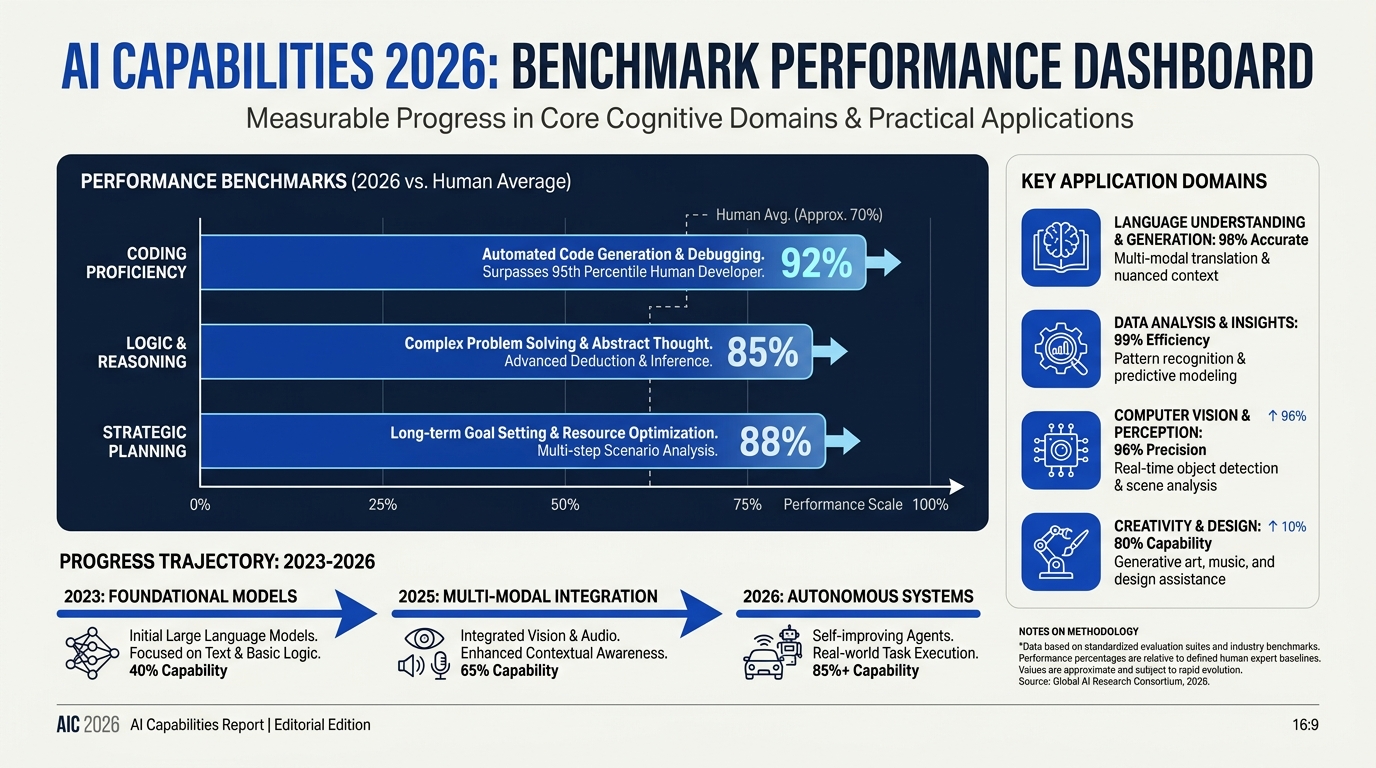
Behind the rhetoric, there are measurable benchmarks:
- MMLU and successors for broad knowledge — frontier models score above human expert averages in 2026
- SWE-Bench for software engineering — frontier models solve a meaningful fraction of real GitHub issues unaided
- Math olympiad benchmarks — frontier reasoning models score competitively at International Mathematical Olympiad level on many problems
- GAIA, AgentBench for agentic tasks — frontier agents solve some multi-step real-world tasks; reliability remains below human
- ARC-AGI for abstract reasoning — modern reasoning models have made substantial progress but did not fully solve the original benchmark; ARC-AGI-2 raised the bar
Across these, the picture is consistent: dramatic and continuing capability gains on well-defined tasks, persistent gaps on long-horizon autonomous work, novel reasoning, and physical-world generalization.
Why the debate matters for builders

Even if you find the philosophical debate tedious, the practical implications:
Roadmap planning
If frontier capability is plateauing, your product roadmap can rely on current model behavior for 5+ years. If capability is doubling annually, your competitive moats erode fast. Different positions imply different product strategies.
Compute and capital allocation
Massive infrastructure investment is being driven by scaling assumptions. A capability plateau would invalidate trillions of dollars of capex commitments. The debate is materially load-bearing for energy, real estate, and chip markets.
Hiring and skills
If general-purpose agents will subsume most knowledge work in 5 years, you hire and retrain very differently than if specialized AI tools augment human work for the next 20.
Regulation
The EU AI Act, US executive orders, UK AI Safety Institute, and various national policies all premise some position on capability trajectories. Builders are the eventual targets of those policies.
What to do if you don't have a strong opinion
A pragmatic stance for builders without a deep position on AGI timelines:
- Build for current capability + small extrapolation. Plan for 1-2 years of capability growth at the recent rate; revisit annually.
- Don't bet your company on a specific timeline. Strategies that require AGI by 2027 OR strategies that require no AGI before 2040 both have high fragility.
- Track real benchmarks, not lab CEO statements. Public benchmark progress is more informative than executive interviews.
- Build capabilities you control. Data, evals, integrations, distribution, customer relationships — these are robust to whatever the foundation models do.
The debate's most under-discussed question
The most consequential open question is not "when does AGI arrive" but "does AGI as defined by any major lab even matter the way they say it does?" Capability gains in narrow areas (coding, math, search synthesis) are already reshaping work; broad capability gains across all human tasks may matter less practically than the headlines suggest if the narrow gains are sufficient to displace a lot of labor first.
Frequently Asked Questions
Why don't AI labs share an AGI definition?
What does Dario Amodei mean by "country of geniuses in the data center"?
Should I plan my product roadmap around AGI arriving?
Discussion
Related Posts


Ready to automate customer conversations?
Launch AI voice agents and WhatsApp bots with CallMissed — one API, 22+ Indian languages.