
1,700 Jobs Lost in Indian Startup Layoffs in Q1 2026: How AI Adoption Is Redefining Hiring



What if the 1,700 startup layoffs recorded across India in Q1 2026 are not a recession warning, but the opening act of a workforce revolution? While...
1,700 Jobs Lost in Indian Startup Layoffs in Q1 2026: How AI Adoption Is Redefining Hiring
What if the 1,700 startup layoffs recorded across India in Q1 2026 are not a recession warning, but the opening act of a workforce revolution? While headlines reflexively frame these cuts as another casualty of tighter venture funding and delayed IPOs, a more structural—and disruptive—force is accelerating the restructuring: artificial intelligence. Major names including Livspace, Flipkart, and Zupee have slashed roles as they pivot toward AI-led operations, joining a global technology sector that has already eliminated over 1 lakh positions in 2026 even as investors funnel roughly $725 billion into AI infrastructure worldwide. The message from boardrooms is unambiguous—operational efficiency is no longer measured by headcount, but by algorithmic throughput and autonomous output.
This shake-up extends far beyond the factory floor or routine back-office tasks. Indian startups are now aggressively deploying large language models, autonomous voice agents, predictive analytics, and code-generation tools to replace knowledge-work functions that, until eighteen months ago, demanded dedicated human teams. For professionals embedded in product management, customer success, content operations, performance marketing, and software QA, the threat—and the adjacent opportunity—is immediate. Data from the first quarter reveals that startup layoffs in India rose sharply not merely from cyclical financial distress, but from a deliberate, permanent recalibration toward AI-driven efficiency. Yet the same market is simultaneously witnessing record salary surges for AI infrastructure engineers, prompt specialists, and machine-learning architects. The result is a sharply bifurcated labor market where routine digital skills face rapid devaluation while AI-native competencies command unprecedented premiums.
In this article, you will learn:
- Why AI adoption is redefining hiring across India’s tech-adjacent industries and what metrics investors now prioritize over team size
- Which specific roles face the highest displacement risk in 2026—and which categories are repositioning themselves as “AI-proof”
- How leading startups are balancing immediate workforce reductions with long-term AI infrastructure investments
- What professionals, hiring managers, and founders must do to remain relevant in a market that increasingly values outcome-based talent over traditional headcount
As this transition accelerates from experiment to enterprise standard, the tooling choices startups make have become decisive competitive differentiators. Platforms like CallMissed are already enabling companies to deploy AI voice agents and multilingual communication stacks that handle 24/7 customer operations with minimal human oversight, illustrating how quickly labor-saving AI has moved from pilot projects to production-floor reality. The 1,700 jobs lost this quarter are not merely statistics on a spreadsheet; they are early, unavoidable data points in a fundamental rewrite of India’s employment playbook.
Introduction

The Indian startup ecosystem entered 2026 with a sobering statistic: approximately 1,700 jobs were slashed in the first quarter alone, marking one of the sharpest spikes in domestic layoffs in recent years. Headlines from Livspace, Flipkart, and Zupee dominated the news cycle, each announcing significant workforce reductions as they pivoted toward AI-led operations. Yet this figure, reported by Financial Express and corroborated across industry trackers, is neither an isolated downturn nor a simple cost-cutting story. It is a signal of a deeper structural reset—one where artificial intelligence is not merely automating tasks but fundamentally redefining what it means to hire, manage, and measure talent in a tech-adjacent environment.
To understand the scale of this transformation, look beyond India’s borders. Global tech layoffs have now crossed 1 lakh (100,000) roles in 2026, even as venture and corporate investment into AI infrastructure has surged past $725 billion worldwide, according to Times of India reports. The juxtaposition is stark: capital is flooding into AI capabilities while human headcounts contract. Indian startups are not immune to this global recalibration. Facing tighter funding corridors and renewed investor pressure for capital efficiency, founders are increasingly turning to outcome-based operational models—replacing traditional headcount-driven growth with AI-augmented productivity metrics.
The Anatomy of Q1 2026 Layoffs
The restructuring follows a distinct pattern across sectors:
- Customer support divisions are shrinking as conversational AI and voice agents resolve Tier-1 queries without human intervention
- Marketing and sales operations are consolidating as LLM-powered tools manage content generation, lead qualification, and multilingual outreach at scale
- Engineering and design teams are being restructured around AI-augmented development, where fewer engineers orchestrate autonomous coding and design systems
- Back-office functions are being absorbed by intelligent automation platforms that process documentation, scheduling, and data entry
This shift is visible across the operational stack. Platforms like CallMissed exemplify the infrastructure driving this transition—enabling Indian startups to deploy AI voice agents and WhatsApp chatbots natively across 22 Indian languages, allowing companies to maintain 24/7 customer communication without proportional increases in human staffing. Such capabilities directly influence hiring plans: why scale a support team linearly when AI communication infrastructure can handle seasonal spikes?
A Funding Winter Meets an AI Spring
What makes the Q1 2026 data particularly noteworthy is its divergence. While layoffs accelerated, certain technical and strategic roles within the same ecosystem have commanded record compensation packages. As NDTV noted in its analysis of "The Great AI Reset," the real threat is not necessarily the machine itself, but the mismatch between legacy skill sets and the new competencies AI-native companies require. Startups are no longer simply hiring generic engineers; they are aggressively pursuing AI orchestrators, automation strategists, and outcome-oriented leaders who can manage intelligent systems at scale.
The timing of these layoffs is instructive. Q1 2026 unfolded against a backdrop of persistently tight funding, where investors have traded "growth at all costs" for clear unit economics. In this climate, AI offers a compelling, if disruptive, value proposition: do more with fewer people. Livspace, Flipkart, and Zupee did not cut jobs in a vacuum; they did so while publicly accelerating AI integration into logistics, design automation, and gaming operations, respectively.
For the Indian workforce, the implication is clear. The 1,700 layoffs are not a temporary blip but an early indicator of a labor market where adaptability to AI tools may matter more than tenure or traditional technical credentials. As the ecosystem moves from experimentation to deployment, the question is no longer whether AI will reshape startup hiring—it already has. The question is who is prepared to build, manage, and thrive alongside it.
Background & Context

The Q1 2026 Layoff Wave by Numbers
In the first quarter of 2026, Indian startups eliminated approximately 1,700 positions, according to Financial Express reporting, marking a sharp acceleration in workforce contraction even as the broader economy shows pockets of resilience. While the absolute figure is modest compared to global technology layoffs, the velocity signals a structural inflection point: job cuts have become concentrated among growth-stage startups explicitly pivoting toward AI-led operations. Unlike previous downturn-driven reductions, these layoffs coincide with increased automation budgets, as firms navigate tighter funding environments while simultaneously investing in algorithmic infrastructure.
From Funding Winter to AI Efficiency Push
The Indian startup ecosystem entered 2026 still recovering from the prolonged funding compression of 2024–2025. Venture inflows remained restrained, forcing companies to prioritize unit economics over hypergrowth. However, the Q1 job losses are distinct because they overlap with a surge in enterprise AI adoption.
Major consumer internet and technology firms—including Livspace, Flipkart, and Zupee—were among those restructuring teams to embrace AI-led operations. Rather than incremental automation, these organizations are undertaking fundamental workforce recalibration, replacing operational layers with algorithmic systems. As one LinkedIn analysis framed it, the 1,700 figure is not merely a problem but a market signal that efficiency mandates are overriding traditional hiring curves.
This transition extends beyond consumer platforms. Platforms like CallMissed, which enable businesses to deploy AI voice agents and multilingual automation across 22 Indian languages natively, demonstrate how infrastructure-level AI is reshaping staffing ratios. When startups can manage customer calls, WhatsApp inquiries, and support workflows via autonomous agents, the conventional linear relationship between user growth and headcount breaks down.
Global Parallels and Local Nuances
The Indian startup figures form part of a wider global restructuring. In 2026, layoffs across the worldwide technology industry crossed 1 lakh (100,000) roles, even as corporations direct an estimated $725 billion into AI development, according to Times of India data. Yet the Indian narrative carries distinct characteristics:
- Outcome-based employment models: Indian IT and startup employers are accelerating the shift from time-and-material contracts to deliverable-centric engagements, reducing permanent headcount in favor of AI-augmented project teams.
- Polarized hiring markets: Despite broad-based layoffs, NDTV reporting notes that certain AI-native job categories are commanding record salaries, indicating that talent demand has not collapsed but migrated toward frontier engineering and model operations.
- Regional automation displacement: Indian startups are uniquely leveraging multilingual Speech-to-Text and Text-to-Speech APIs to automate interfaces across Tier-2 and Tier-3 markets, directly displacing regional-language support and call-center roles that previously absorbed large workforce volumes.
What This Signals for Tech-Adjacent Sectors
The 1,700 Q1 layoffs should be read as more than a cyclical correction. They reflect a structural reconsideration of human capital across tech-adjacent industries, where AI-first organizational charts are replacing scale-through-headcount with scale-through-inference. The roles most vulnerable to displacement are repetitive, workflow-based positions in support, operations, and coordination—precisely the functions that large language models, voice agents, and automation APIs now execute at scale. For professionals and employers alike, the message is unambiguous: efficiency is no longer a headcount function; it is an infrastructure decision.
Key Developments
The Q1 2026 Retrenchment in Context
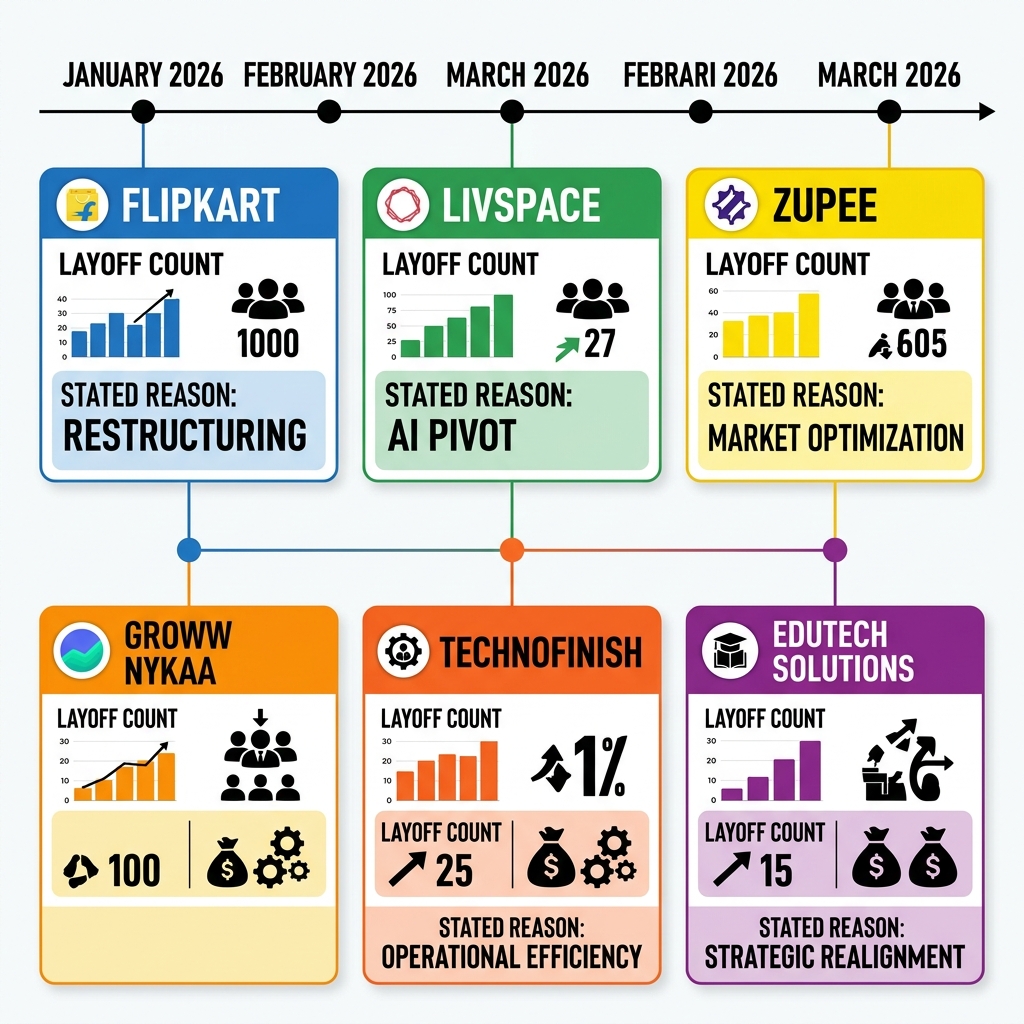
The opening quarter of 2026 delivered a stark verdict: Indian startups shed approximately 1,700 jobs, but the headline number only hints at the structural shifts beneath the surface. Rather than indiscriminate cost-cutting, the layoffs reflect three converging forces:
- AI-driven efficiency reaching production-grade maturity,
- tighter funding environments forcing leaner organizational design, and
- a strategic pivot toward outcome-based labor models over headcount growth.
From e-commerce incumbents to gaming unicorns, companies are rearchitecting their operating models around automation.
| Company / Segment | Q1 2026 Impact | Primary Driver | AI / Strategic Pivot | Labor Market Signal |
|---|---|---|---|---|
| Livspace | Major workforce reduction | AI-led operational efficiency | Pivot to AI-led operations | Design/tech-adjacent roles vulnerable |
| Flipkart | Significant layoffs reported | Automation & cost optimization | AI-led operations & logistics | E-commerce operations being redefined |
| Zupee | Significant headcount cuts | Funding pressure plus AI efficiency | AI-led operations pivot | Gaming/entertainment tech slimming |
| Indian Startups (Aggregate) | ~1,700 jobs cut in Q1 2026 | AI adoption plus tighter funding | Systemic shift to lean teams | Sharpest Q1 layoff wave in recent cycle |
| Global Tech Industry (2026) | >100,000 jobs eliminated | $725 billion enterprise AI spend | AI replacing routine tasks | Massive capital reallocation to automation |
| Indian IT Services | Reduced fresher hiring intake | Outcome-based delivery mandates | AI integrated across pipelines | Structural shift from FTE to output pricing |
These developments illustrate a fundamental reallocation of capital and talent. Livspace, Flipkart, and Zupee each explicitly redirected strategy toward AI-led operations, suggesting that the cuts are permanent workforce transitions rather than cyclical corrections. For Flipkart, this means logistics and customer-experience layers are increasingly algorithmic; for Livspace, design and project-management workflows are being automated; and for Zupee, lean engineering teams now maintain AI-first gaming platforms. None of these moves imply a hiring rebound once market sentiment improves—they reflect surgical, technology-driven restructuring.
The aggregate startup data is equally telling. The roughly 1,700 job losses in Q1 2026 arrived alongside reports that Indian IT is shifting decisively toward outcome-based models, where vendors are paid for deliverables rather than headcount. This breaks the traditional hiring escalator that once absorbed millions of engineering graduates annually. Companies no longer benchmark success by team size but by output velocity automated through AI-assisted pipelines.
Zooming out, the global technology sector has surpassed 1 lakh layoffs in 2026 even as investment in AI infrastructure hits $725 billion, according to industry data. That divergence—record capital inflows into intelligent systems alongside record human displacement—suggests we are past the experimentation phase and into genuine labor substitution at scale. Engineers in conventional QA, support, and maintenance roles face the steepest cliffs, while AI infrastructure and model-ops specialists command premium compensation.
For early-stage companies trying to balance runway with growth, the new playbook favors AI-native infrastructure over headcount expansion. CallMissed and similar platforms reflect this reality, providing startups with voice agents, WhatsApp automation, and LLM inference APIs that maintain customer operations around the clock without proportional staffing. The result is not simply fewer jobs, but an entirely different morphology for how tech companies scale—one where a twenty-person team can deliver the operational footprint that once required two hundred.
In-Depth Analysis
The Convergence of Capital Constraints and AI Capability
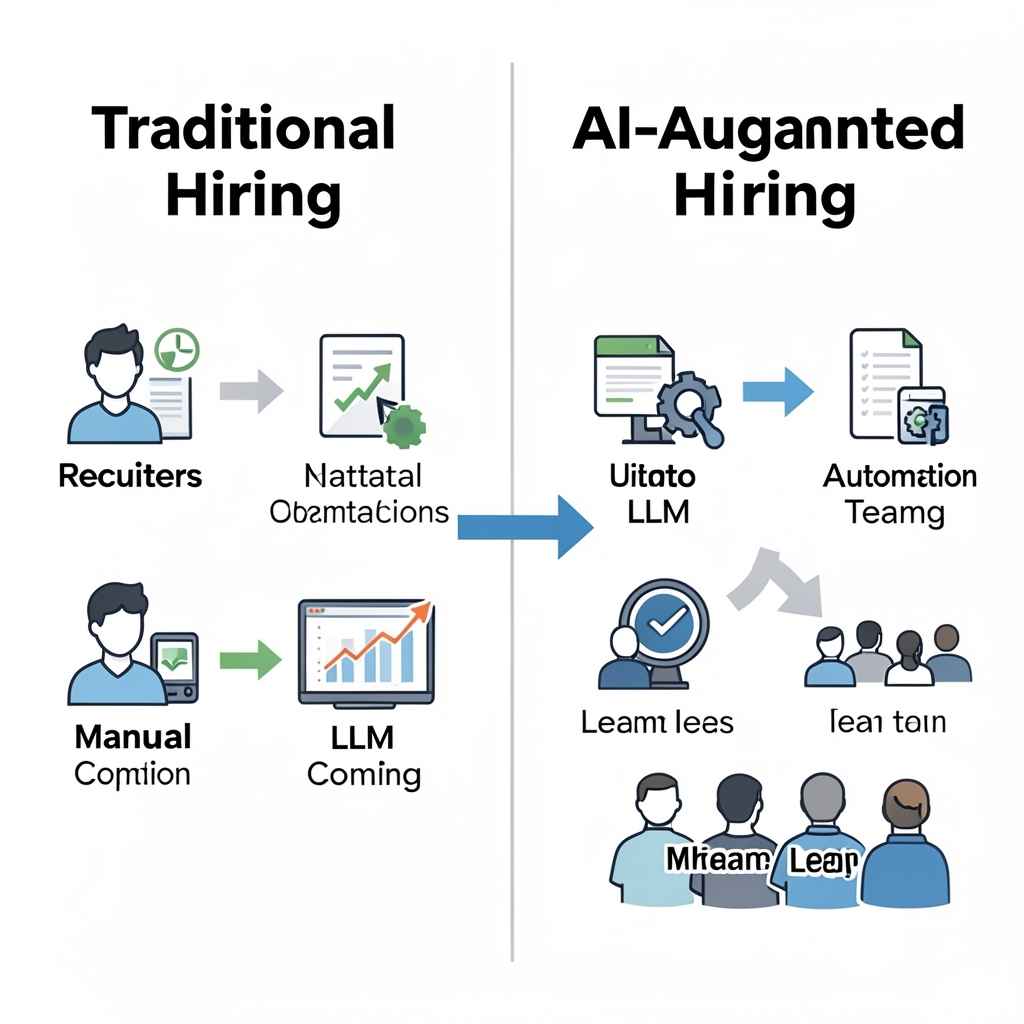
The 1,700 job cuts in Q1 2026 cannot be viewed in isolation as a labor market correction. They represent the collision of two powerful forces: a persistent funding winter that has made capital efficiency non-negotiable, and the maturation of AI tools that can now execute tasks previously requiring large teams. Companies like Livspace, Flipkart, and Zupee aren't trimming excess—they're fundamentally re-architecting their operations around AI-led workflows.
According to the Financial Express, startup layoffs rose sharply this quarter as firms adopted AI-driven efficiency measures while navigating tighter funding channels. This dual pressure has created a scenario where maintaining pre-2024 team structures is viewed as a competitive disadvantage. Startups that raised capital during the 2021 boom built teams optimized for growth-at-all-costs; today's investors demand profitability metrics that AI-enhanced lean teams can deliver faster.
Displaced Roles vs. Rebuilt Careers
The narrative around these layoffs often assumes a simple substitution—machines replacing humans. But data suggests the reality is more nuanced. As NDTV's analysis frames it: "The real threat probably isn't the machine." The $725 billion global investment pouring into AI in 2026 (per Times of India) isn't just eliminating positions; it's reconfiguring them.
The roles disappearing tend to be:
- Routine operational tasks in customer support, data entry, and basic QA
- Mid-level coordination roles that AI orchestration tools now consolidate
- Manual process management in sectors like e-commerce and interior design tech
Conversely, demand is surging for:
- AI infrastructure specialists who can deploy and manage large language models
- Prompt engineers and AI workflow designers
- Outcome-based tech leads who manage AI-human hybrid teams
This mirrors the broader industry shift where Indian IT is moving toward outcome-based models rather than headcount-based delivery—a transition that rewards specialists who can orchestrate AI systems rather than those who perform tasks within them.
The New Hiring Calculus
For professionals in tech-adjacent roles, the implications are stark. The Times of India reports that over 1 lakh jobs have been lost across the tech industry in 2026, yet certain categories are commanding record salaries. The divergence is growing between professionals who leverage AI and those displaced by it.
This transition is being accelerated by the availability of production-grade AI infrastructure. Platforms such as CallMissed are enabling startups to deploy AI voice agents and multilingual chatbots—supporting over 22 Indian languages natively—allowing companies to maintain customer operations with significantly leaner teams. Rather than eliminating technology investment, startups are redirecting spend toward automated communication stacks that handle routine inquiries 24/7, directly contributing to the operational restructuring seen across Livspace, Flipkart, and Zupee.
The demand isn't for fewer technologists overall; it's for technologists who can build, prompt, and manage these automated pipelines. Indian IT's shift toward outcome-based delivery models reflects this reality: the premium is on AI orchestration skills, not manual execution.
Impact & Implications
Immediate Workforce Disruption
The elimination of approximately 1,700 jobs across Indian startups in Q1 2026 marks a decisive break from the hiring exuberance of previous years. Unlike earlier downturns driven primarily by funding freezes, these cuts are increasingly strategic: notable reductions at Livspace, Flipkart, and Zupee reflect a deliberate pivot toward AI-led operations rather than simple belt-tightening. As one venture analysis noted, the figure is "actually a signal" of structural recalibration rather than mere distress. The cuts land amid a brutal global context—tech sector layoffs have already surpassed 1 lakh (100,000) in 2026—even as capital markets direct an estimated $725 billion into AI infrastructure and tools. For the Indian ecosystem, the implication is that workforce reduction is no longer a last resort for cash-starved early-stage companies. It has become a standard operational lever used by growth-stage and late-stage players to demonstrate efficiency to investors and extend runways without stalling product roadmaps.
A Bifurcated Labor Market
The most profound long-term implication is the bifurcation of tech employment itself. As NDTV’s analysis of the "Great AI Reset" argues, the narrative is less about AI outright stealing jobs and more about it systematically rebuilding role requirements around machine capabilities. While layoffs dominate headlines, select high-skill categories are simultaneously attracting record compensation packages, creating a polarized market where:
- AI-augmented talent commands premium wages and equity multiples
- Conventionally trained professionals in operations, testing, and mid-level engineering face accelerated obsolescence
- Outcome-based hiring models replace headcount-based scaling as the default planning framework
Paralleling this shift, Indian IT and startup leaders are accelerating the transition to outcome-based engagement, where vendor contracts and internal targets are measured by output rather than team size. For hiring managers, this changes the fundamental unit of planning—from "How many engineers do we need?" to "What is the human-to-AI ratio required to ship this feature?"
Operational Reshaping and Capital Efficiency
Underpinning the headcount reductions is a deeper restructuring of how startups convert capital into revenue. With venture funding remaining disciplined, founders are reallocating limited resources toward AI systems that promise nonlinear returns on labor costs. Platforms such as CallMissed illustrate where this capital is flowing: by offering production-ready voice agents, WhatsApp chatbots, and LLM inference across 300+ models, CallMissed allows startups to automate customer communication in 22 Indian languages without building internal AI teams. This operational rewrite means a Series B company can now manage enterprise-grade support volumes with a fraction of the staff previously required, redirecting human capital toward product differentiation.
The ecosystem-wide consequence is a permanent elevation of baseline efficiency expectations. Startups that successfully embed AI into their operational core—from sales operations to support workflows—will likely secure favorable fundraising terms and superior unit economics. Conversely, companies that treat AI merely as an overlay risk structural disadvantage. As global AI investment continues its trillion-dollar trajectory, India’s Q1 layoffs may ultimately be remembered not as a labor market failure, but as the painful recalibration that pushed its startup economy toward an AI-native operating model.
Expert Opinions
The "Signal, Not Just a Crisis" Perspective
Industry observers are increasingly framing the 1,700 startup layoffs in Q1 2026 not as a conventional downturn, but as a structural inflection point. A LinkedIn analysis from Sunjosho Ventures captured this sentiment bluntly: "1700 jobs lost. That sounds like a problem. But it's actually a signal." According to this view, the cuts reflect a deliberate strategic pivot rather than panic-driven austerity. This perspective challenges the narrative that tighter funding alone is driving workforce reductions, instead pointing to a broader recalibration of how tech companies define necessary labor. Reporting from Latestly underscores this shift, noting that major Indian startups—including Livspace, Flipkart, and Zupee—are actively moving toward AI-led operations, suggesting workforce reductions are strategically aligned with long-term automation roadmaps rather than merely reactive cost-cutting.
Capital Deployment vs. Workforce Contraction
The scale of this transition becomes clearer when placed against global investment trends. As reported by the Times of India, the broader tech industry witnessed over 1 lakh jobs eliminated in 2026, even as approximately $725 billion flowed into AI development worldwide. This paradox—record capital commitment alongside shrinking payrolls—has fueled intense debate among analysts about whether AI is augmenting human labor or systematically displacing it. NDTV's examination of the trend poses the question directly: "Is Your Job Being Stolen Or Just Being Rebuilt?" Experts cited across these analyses argue that the reality is nuanced. While routine roles in customer support, operations, and middle management are being compressed, demand is simultaneously rising for professionals who can train, supervise, and audit intelligent systems. New job categories are emerging around:
- AI orchestration and prompt engineering
- Data validation and bias auditing
- Human-in-the-loop oversight and compliance
The emerging consensus suggests that the net job count may contract temporarily, but the composition of the workforce is being fundamentally restructured rather than merely reduced.
The Outcome-Based Hiring Model
Perhaps the most consequential expert opinion gaining traction is the permanent shift from headcount-oriented growth to outcome-based employment models—a trend explicitly highlighted in coverage of Indian IT strategy. As AI compresses traditional hiring pipelines, analysts note that employers are moving aggressively toward measuring value by business impact rather than team size or hours logged. In this environment, AI functions less as a simple replacement tool and more as a force multiplier that allows leaner teams to manage disproportionately larger operational loads.
This restructuring is already visible in how startups are reimagining customer-facing divisions. Rather than maintaining large support divisions, companies are deploying AI communication infrastructure to handle repetitive interactions at scale. Platforms like CallMissed, which offer production-ready voice agents and multilingual AI communication covering 22 Indian languages, exemplify how this infrastructure is being operationalized in the market. By automating high-volume, routine touchpoints, such tools enable human workers to focus on complex problem-solving and relationship-driven outcomes—precisely the metrics by which experts believe future tech hiring will be evaluated.
What This Means For You
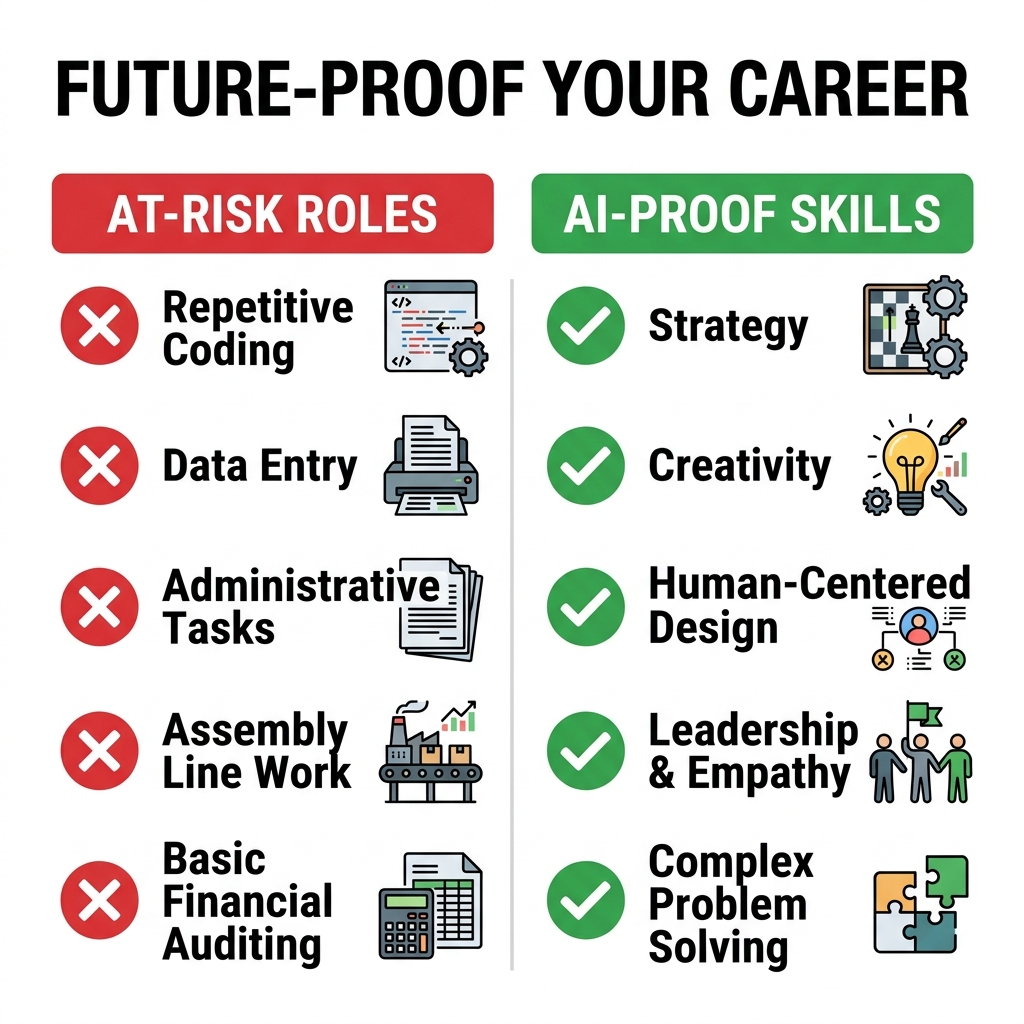
The Q1 2026 wave that eliminated roughly 1,700 positions at Indian startups is not a temporary market correction—it is a structural reset. With Livspace, Flipkart, and Zupee aggressively pivoting toward AI-led operations, and global tech layoffs crossing 1 lakh in 2026 even as $725 billion flows into AI infrastructure, the message is unambiguous: repetitive execution is being automated, and economic value is migrating toward those who can architect, manage, and optimize intelligent systems. As NDTV’s reporting underscores, while thousands are being laid off, certain specialized job categories are simultaneously commanding record salaries, creating a sharply bifurcated labor market.
Whether you are a fresh graduate entering an uncertain hiring landscape, a mid-level professional in a tech-adjacent function, or a founder rethinking your org chart, the implications are immediate. Understanding where your current skill set sits on the risk-opportunity spectrum is no longer optional—it is survival.
The AI Hiring Landscape: Where You Stand
The table below maps how AI adoption is reshaping specific professional profiles across the Indian startup ecosystem, drawing directly from the Q1 2026 displacement data and emerging compensation trends.
| Role Profile | Displacement Risk in 2026 | Driving Factor | Strategic Pivot | Compensation Trend |
|---|---|---|---|---|
| Routine QA / Software Testing | High | AI-driven test automation replacing manual verification cycles | Shift to LLM validation, AI ops, and security testing | Flat to declining |
| Customer Support / Operations | High | AI voice agents and chatbots absorbing Tier-1 query resolution volume | Train in conversation design, escalation architecture, and AI-agent quality assurance | Downward pressure |
| Generic Data Reporting / Entry | Critical | Automated dashboards and generative BI eliminating manual compilation | Pivot to data engineering, pipeline architecture, or strategic business analytics | Declining |
| Product & Program Managers | Low | Need for human strategic oversight in AI integration and outcome-based roadmaps | Lead cross-functional AI adoption and define outcome-based delivery metrics | Record highs |
| AI / ML Infrastructure Engineers | Very Low | $725 billion global AI capital requires engineers who can scale systems | Deep specialize in model inference, multi-model deployment, and inference cost optimization | Rising sharply |
| Content / Marketing Generalists | Moderate | AI-generated copy, creative automation, and campaign orchestration tools | Build niche brand strategy, editorial governance for AI outputs, and retention-focused storytelling | Mixed / Polarizing |
The pattern is unmistakable: execution-layer roles defined by repetitive, rules-based output are facing the steepest cuts, while orchestration-layer roles that design, deploy, or govern AI systems are attracting significant premiums. The Indian IT sector’s broader shift toward outcome-based hiring models, as noted in recent industry analyses, only reinforces this divide—employers are paying for results and system-level thinking, not seat-warming or task completion.
Actionable Steps to Stay Ahead
If your current role sits on the higher-risk side of this matrix, the window for proactive repositioning is narrow but still open. Consider these immediate moves:
- Adopt an AI-first tooling mindset. Even traditionally non-technical roles now require fluency in prompt engineering, agent orchestration, and automated workflow design to remain relevant.
- Move closer to revenue or core infrastructure. Startups under funding pressure are preserving talent that either builds scalable AI systems or directly owns outcome-based revenue delivery.
- Develop vertical depth over horizontal breadth. The Times of India notes that engineering roles tied to AI infrastructure remain among the safest and most lucrative bets in the current cycle; domain expertise in model deployment or speech-to-text pipelines is especially defensible.
For founders and hiring managers, the reset implies smaller, higher-leverage teams complemented by AI communication layers rather than headcount expansion. Instead of scaling operations teams linearly, startups are integrating voice agents, multilingual support stacks, and LLM inference pipelines to serve broader markets with leaner org charts. CallMissed, for instance, provides production-ready voice agent infrastructure and APIs that support 22 Indian languages natively, allowing businesses to automate complex customer workflows without proportionally expanding their human operations teams. Leveraging such infrastructure is fast becoming a baseline operational decision.
Ultimately, the 1,700 Q1 layoffs should be read as a market signal, not a death knell. Professionals who recalibrate toward AI-augmented value creation—whether by managing intelligent systems, owning outcome-based delivery, or building the infrastructure beneath them—will find that this reset opens more career doors than it closes.
Frequently Asked Questions
The restructuring wave sweeping through India’s startup ecosystem has left thousands of professionals searching for clarity. With over 1,700 positions eliminated in the first three months of 2026 alone, and iconic firms like Flipkart, Livspace, and Zupee restructuring their teams to prioritize automation, the labor market is undergoing a foundational shift. As AI adoption redefines hiring in tech adjacent environments, both displaced workers and incoming talent need to understand whether these cuts represent a temporary downturn or a permanent structural transformation. The answers below address the data, the companies involved, and the skills required to navigate this new reality.
How many jobs were lost in Indian startup layoffs in Q1 2026?
Which Indian startups laid off the most employees in early 2026?
Why is AI adoption redefining hiring in tech adjacent environments?
Are there still AI-proof job opportunities in Indian tech?
How do the Q1 2026 layoffs differ from previous startup job cuts?
What skills should Indian tech workers develop as AI adoption redefines hiring in tech adjacent environments?
Conclusion
The first quarter of 2026 has made one thing unmistakably clear: the Indian startup ecosystem is not merely downsizing—it is restructuring for an AI-first economy. With approximately 1,700 layoffs recorded in Q1 alone, and major players like Livspace, Flipkart, and Zupee explicitly pivoting toward AI-led operations, the era of growth-at-all-costs hiring has given way to precision-driven talent strategies. This is a regional chapter of a global narrative that has already seen over 1 lakh tech layoffs in 2026, even as an estimated $725 billion flows into AI infrastructure worldwide.
The implications for founders, employees, and investors can be distilled into a few critical takeaways:
- Operational efficiency is now the primary hiring filter. Startups are leveraging AI not to eliminate teams entirely, but to compress operational bloat—replacing routine execution roles with smaller, AI-augmented workforces.
- The "tech adjacent" job market is polarizing. Roles that involve judgment, creativity, and complex stakeholder management are growing more valuable, while repetitive workflows in customer support, content operations, and middle-management coordination face rapid compression.
- Capital allocation follows capability, not headcount. As funding remains tight, investors are rewarding startups that demonstrate AI-driven unit economics rather than pure team scale, a shift that will permanently alter startup DNA.
- Reskilling is the only viable hedge. The engineers and operators who will thrive are those treating AI as infrastructure to master, not a competitor to resist.
Looking ahead, the second half of 2026 will likely reveal which Indian startups successfully transition to outcome-based operating models—and which simply shrink. Watch for early policy signals around AI labor standards, the emergence of AI-human hybrid roles, and whether new job creation in AI deployment and agent orchestration outpaces displacement in traditional SaaS and e-commerce functions.
To explore how AI communication is evolving, check out CallMissed — an AI infrastructure platform powering voice agents and multilingual chatbots for businesses navigating this new operational reality.
The question is no longer whether AI will fundamentally change how Indian startups hire. It is whether your organization is building the workflows of tomorrow, or becoming obsolete inside them. Which side will you be on?
Discussion
Related Posts



Ready to automate customer conversations?
Launch AI voice agents and WhatsApp bots with CallMissed — one API, 22+ Indian languages.