
Voice Agent Architecture in 2026: LiveKit, Pipecat, and the End of the Pipeline


How LiveKit Agents, Pipecat, and Vapi differ architecturally in 2026 — and why the "STT → LLM → TTS" pipeline mental model is breaking down.
For most of voice AI's history, the mental model was a pipeline: microphone → STT → LLM → TTS → speaker. Each stage was a discrete component, and the framework's job was to connect them. By 2026 that model is breaking down — partly because of multimodal models that fuse stages, partly because of architectures that abandon the linear flow entirely. Here is how the leading frameworks differ, and where they are going.
Vapi: the managed product
Vapi hands you a finished voice agent platform. You configure system prompts, model choice, voice, and tools through a UI; Vapi runs the rest. Latency is competitive, the abstraction is high, and you can ship a working voice agent in an afternoon.
Strengths: Fastest time to first conversation. Strong defaults for common use cases.
Weaknesses: Limited control over the pipeline internals. Per-minute pricing scales linearly; at high volume the unit economics push you to lower-level frameworks.
The 2026 consensus is to start on Vapi (or Retell) for anything below ~10k minutes/month while you validate the use case, then migrate when volume crosses the threshold.
Pipecat: the explicit pipeline
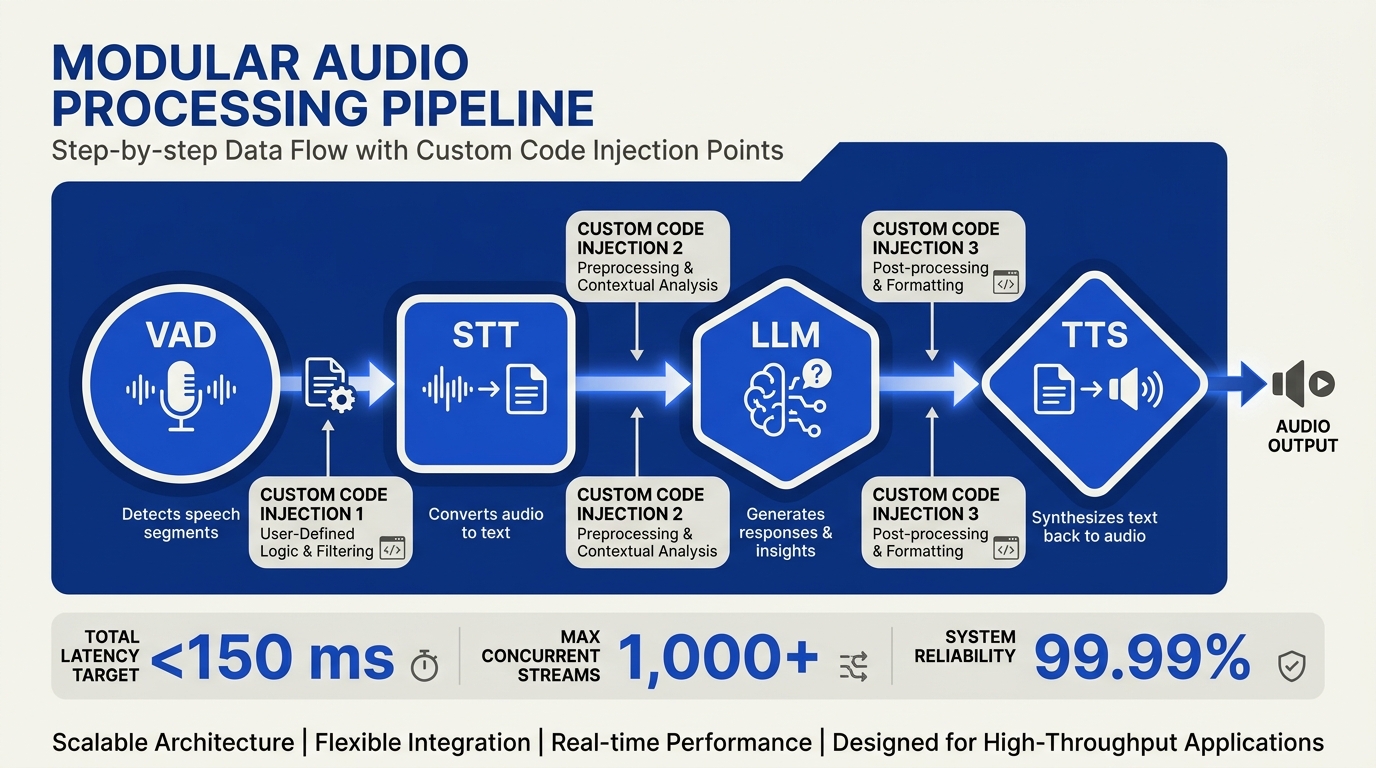
Pipecat takes the opposite approach. The pipeline is explicit code. Every step — VAD, STT, LLM call, TTS, audio output — is a node, and you wire them together in Python. You can insert custom logic between any two nodes, run nodes in parallel, fork the conversation based on intermediate results, or replace any single node with your own implementation.
Strengths: Maximum control. Best fit when your conversation flow is unusual — multi-party, multi-modal, or has unusual side effects (database writes, transactions, video).
Weaknesses: More code to write and maintain. The pipeline metaphor is also where its limitations show — see below.
LiveKit Agents: the room model
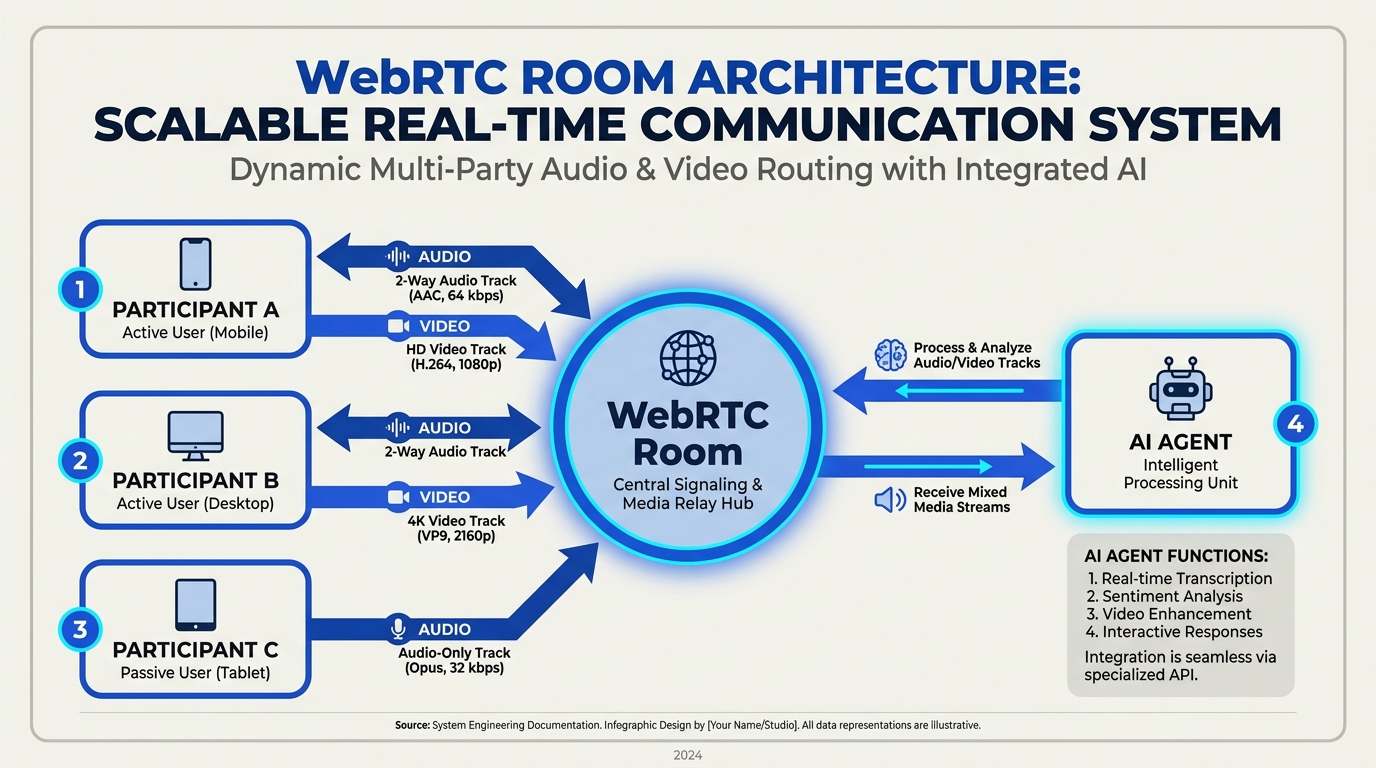
LiveKit takes a third approach: instead of a pipeline, your agent joins a WebRTC room. The room is an event-driven space where audio (and video, and data) tracks flow. Your agent subscribes to incoming tracks, publishes outgoing tracks, and reacts to events — user joined, user spoke, user disconnected. There is no linear pipeline; there is a stateful participant.
This sounds abstract but it matters in practice. LiveKit Agents went 1.0 in April 2025 and as of April 2026 is on Python 1.5.x with adaptive interruption handling and native MCP tool support. The room model is what makes multi-party voice and asymmetric latency budgets work cleanly.
Strengths: First-class WebRTC, built-in scaling (rooms map to media servers), supports video and screen-share natively, MCP tool integration.
Weaknesses: The room mental model takes longer to learn than a pipeline.
Why the pipeline model is breaking down

Three things are pulling apart the STT → LLM → TTS chain:
1. Multimodal models fuse stages
GPT-4o and Gemini 3 Pro accept audio input directly. The "STT" stage becomes a model call that returns both a transcript and a richer representation the LLM can act on. The TTS step is starting to fuse the same way — models that emit audio tokens directly without a separate TTS pass.
For voice agents using these models, the linear pipeline collapses to a single call. Pipecat-style explicit pipelines have to model that as a single node; LiveKit-style rooms model it naturally.
2. Interruption is not a stage
The pipeline model has no clean place for interruption handling. The user starting to speak while the agent is mid-sentence is a cross-stage event — it must cancel the LLM, halt the TTS, flush the audio buffer, and restart endpointing, all atomically. Pipelines bolt this on. Event-driven architectures handle it natively.
3. Tool calls and side effects break linearity
A voice agent that books a meeting, looks up a customer, or sends an email is not a linear flow. It is the LLM emitting a tool call, the framework executing it (possibly with a long latency), and resuming generation. Pipelines either pause everything or hand the user awkward filler ("let me check on that"). Event-driven architectures interleave gracefully — the agent can speak filler, run the tool in parallel, and stitch the result into the next utterance.
What this means for builders
Three practical takeaways for picking a voice framework in 2026:
- If your conversation logic is simple, start on a managed platform (Vapi, Retell, etc.). Your time is worth more than the framework difference.
- If your conversation logic is unusual — multi-party, transactional, video-coupled — pick LiveKit Agents. The room model is built for it.
- If you need surgical control of every stage and you have engineers who enjoy the work, pick Pipecat. The explicit pipeline is the right tool for truly custom flows.
The right framework is the one whose mental model matches your conversation. Pipelines for linear flows. Rooms for stateful, event-driven, multi-party flows. Managed products for prototyping.
The next architectural shift
By late 2026, expect the picture to shift again. Models that emit audio directly (the GPT-4o-audio and Gemini-3-audio class) will keep collapsing the pipeline. The frameworks that survive will be the ones whose abstraction handles both the pipeline-fused-into-one-call case and the legacy multi-stage case from one codebase. LiveKit's room model is best positioned for that. [Inference]
The pipeline mental model served the field well from 2022 through 2025. In 2026 it is becoming the wrong abstraction for a growing share of use cases. If you are starting a new voice project, pick a framework whose mental model has room to grow.
Discussion
Ready to automate customer conversations?
Launch AI voice agents and WhatsApp bots with CallMissed — one API, 22+ Indian languages.