
Why Model Context Protocol (MCP) Won the Agent Integration Wars



How Model Context Protocol went from Anthropic standard to industry default in 16 months — and what it means for AI agent builders.
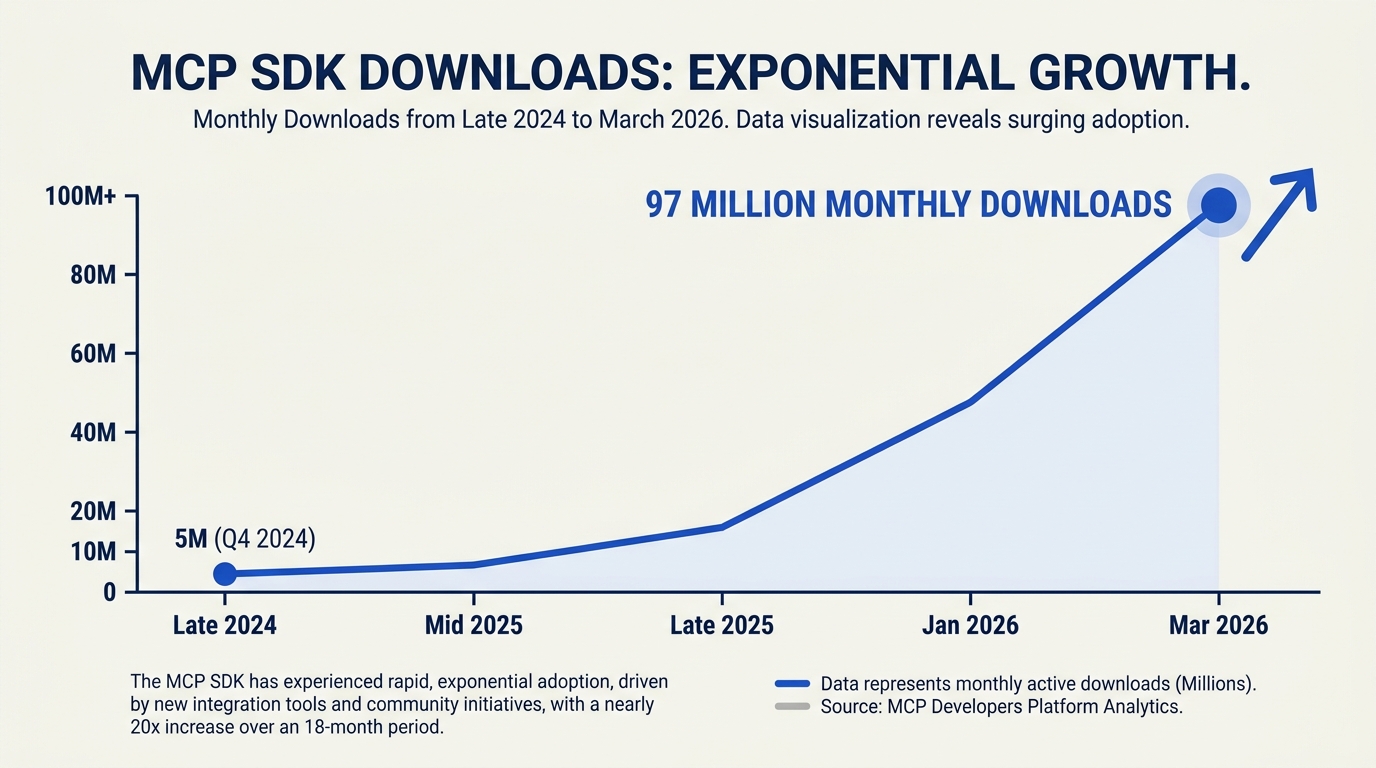
Eighteen months ago Model Context Protocol (MCP) was an Anthropic-released standard with a small reference implementation and a handful of integrations. As of March 2026, monthly SDK downloads passed 97 million, over 10,000 active public MCP servers exist, and 78% of enterprise AI teams report at least one MCP-backed agent in production. The protocol has effectively become the default way to wire tools into AI agents.
How did this happen so fast, and what does it mean for builders?
What MCP actually is
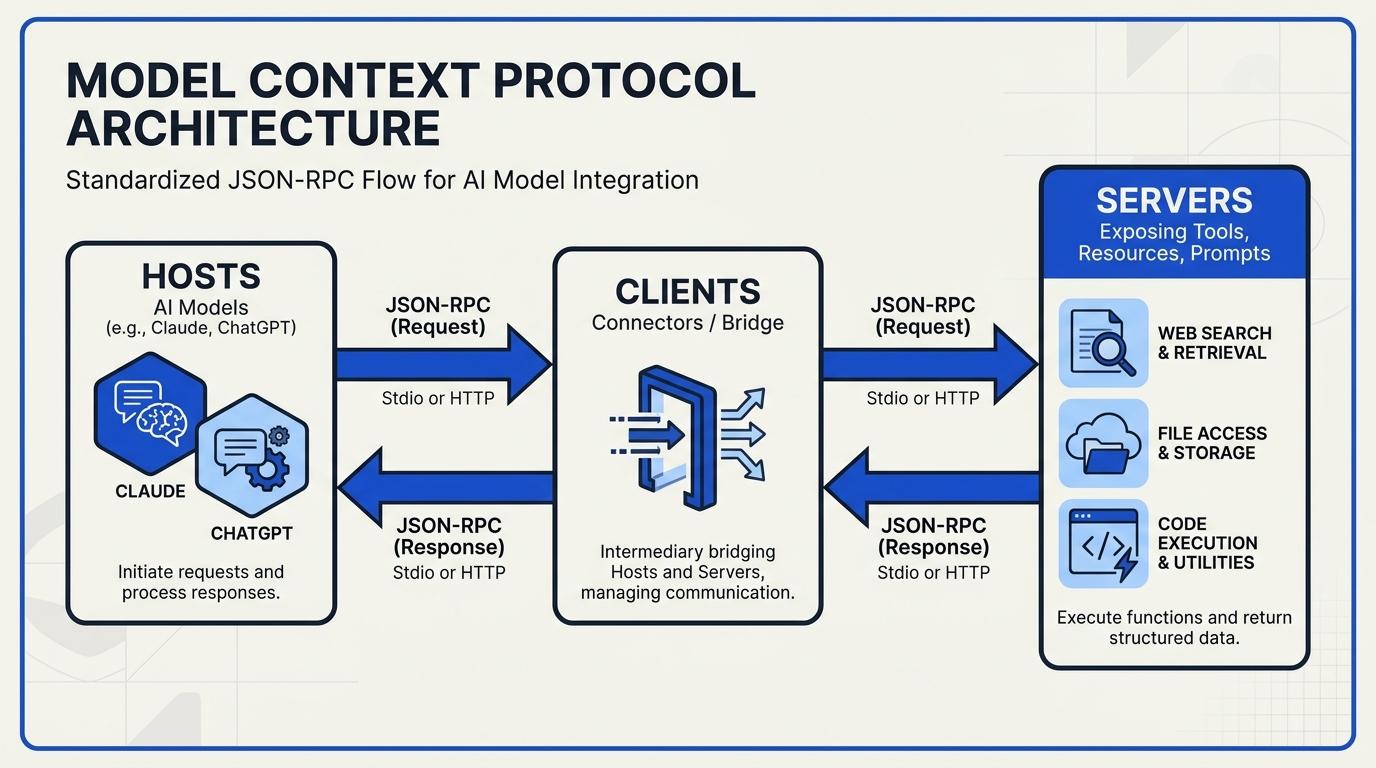
MCP is a small protocol with three pieces:
- Hosts — applications that run AI models (Claude Desktop, ChatGPT desktop, Cursor, Replit, etc.)
- Clients — connectors inside hosts that talk to servers
- Servers — small services that expose tools, resources, and prompts to a client over JSON-RPC
The wire format is JSON-RPC over stdio or HTTP/SSE. The schema is intentionally narrow: tools have names, descriptions, and JSON Schema input definitions; resources are URIs the model can read; prompts are reusable templates.
That is the entire surface. Smaller than OpenAPI, smaller than gRPC, intentionally so.
Why it won
Three reasons MCP outran every alternative:
1. The lab that proposed it built the first reference host
Anthropic shipped Claude Desktop with MCP built in. From day one there was a real, working host that real developers used. Every other "agent integration standard" in 2024–2025 was a spec without a host. MCP arrived with one.
2. It is small enough to fit in an evening
A useful MCP server can be written in 50 lines of Python or TypeScript. The barrier to producing a server is so low that the long tail of integrations — Notion, Slack, Linear, Postgres, Redis, the user's own internal tools — got built by individuals, not vendors. A standard with 10,000 servers in 18 months is one that did not require any vendor's permission.
3. The competing labs gave up and adopted it
By early 2026, OpenAI's ChatGPT desktop app, Google DeepMind, Microsoft (Semantic Kernel and Azure OpenAI), Salesforce Agentforce, Block, Cloudflare, and Replit all support MCP. The protocol crossed from "Anthropic-led standard" to "industry-default standard" sometime between July 2025 and February 2026. The adoption was not coordinated — it was each lab independently deciding the cost of not supporting MCP exceeded the cost of building yet another integration layer of their own.
This is how protocols win. Not by committee. By being good enough that fighting them is more expensive than adopting them.
What "won" means in practice
The 78% enterprise adoption number deserves unpacking. It does not mean 78% of agents use only MCP. It means 78% of enterprise AI teams have at least one MCP-backed agent in production. The protocol is the lowest-friction way to add tools, so it absorbs the long tail of integrations even when teams have other internal frameworks.
The 41% of enterprises that have built a custom internal MCP server is the more telling number. That is companies wrapping their proprietary systems of record — CRMs, internal databases, expense systems — in MCP servers so any AI assistant in the organization can call them. The protocol is becoming the company's internal AI integration layer, not just an open-source curio.
What MCP is not
Three things MCP does not solve:
- Authentication. MCP defers to the transport. OAuth, API keys, mTLS — your problem. There is no MCP "auth standard" yet.
- Permissions. Any tool exposed by an MCP server is callable by the agent. Per-user authorization, role-based access, audit trails — implement these in the server itself.
- Versioning. The protocol has version negotiation but does not solve the problem of a tool's semantics changing over time. A server that renames a parameter still breaks every client that depends on it.
Treat MCP as the wire format. Everything above the wire — auth, perms, versioning, observability — is still your responsibility.
What builders should do

Three concrete moves for 2026:
- Stop writing custom integration code for AI agents. If a tool needs to be agent-callable, wrap it in an MCP server. The pattern is well-established and the SDKs are mature.
- Audit your internal API surface. Every internal API that an agent might want to call is a candidate for MCP exposure. The cost of wrapping it is low; the value compounds as more agents come online.
- Treat MCP servers as a first-class deployment artifact. They have the same operational properties as your internal services — health checks, logs, version management, security posture. Run them like services, not scripts.
The next phase
The interesting MCP question for late 2026 is not "will it win" — that fight is over. The question is what gets built on top. Some emerging directions:
- Server marketplaces and signing — a public MCP server is currently trust-on-first-use; expect signed servers and a verification ecosystem.
- Authorization standards — vendor-neutral patterns for "this user is allowed to call this tool with these arguments."
- Observability — distributed tracing across MCP boundaries so an agent's tool calls can be debugged end-to-end.
- Composability — MCP servers that expose other MCP servers, building higher-level abstractions.
If you are betting on the agent ecosystem, MCP is the substrate. The next layer is where most of the next year's interesting startups will live.
Discussion
Related Posts


Ready to automate customer conversations?
Launch AI voice agents and WhatsApp bots with CallMissed — one API, 22+ Indian languages.