
GPU Scarcity 2026: H100 vs H200 vs B200 Supply and Pricing



Compare H100, H200 and B200 GPU supply, memory and price ranges for 2026. Use a practical matrix to choose what to rent or buy.
GPU Scarcity 2026: H100 vs H200 vs B200 Supply and Pricing
"GPU shortage" was the defining infrastructure story of 2023 and 2024. By 2026 the story has shifted — but it has not gone away. Hopper-generation supply has loosened, Blackwell is ramping but constrained, and the gap between "what you can buy on a credit card" and "what you can buy with a multi-year commit" has only widened. Here is the picture as of mid-2026.
H100: from scarce to soft
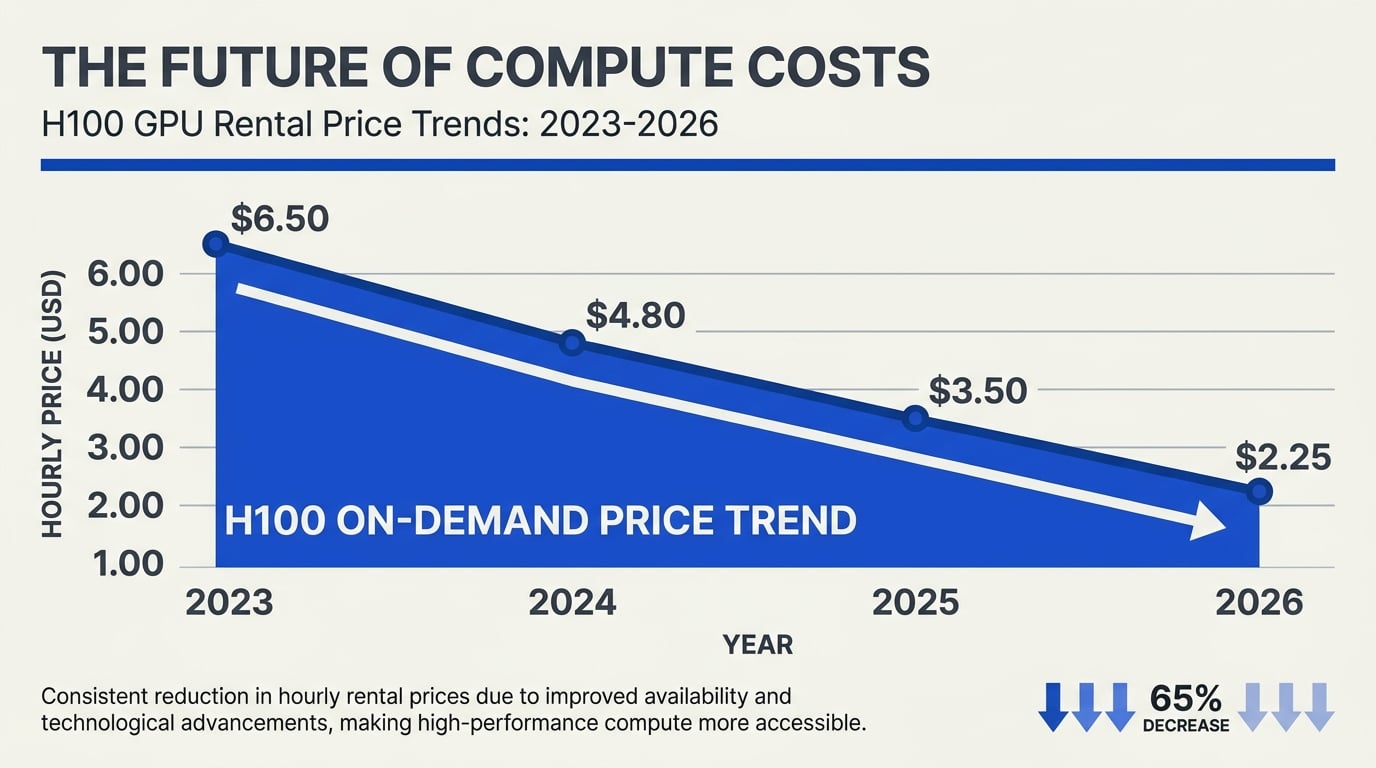
H100 is now broadly rentable and often the value choice in the GPU scarcity 2026 market, although pricing varies substantially by provider, region, commitment term, availability zone and PCIe versus SXM form factor. Public market guides in 2026 commonly place H100 purchases at roughly $25,000–$40,000 per GPU and rentals at about $1–$7.50 per GPU-hour, with some spot or preemptible offers below that range. These are market-guide ranges—not guaranteed quotes—and may exclude host systems, networking, storage, support or minimum commitments.
With 80GB of HBM and a mature CUDA and framework ecosystem, H100 remains well suited to production inference, fine-tuning and many training workloads. It is generally easier to source and optimize than newer accelerators, with broad support across clouds and GPU rental platforms. (NVIDIA H100)
H200 offers 141GB of HBM3e and greater memory bandwidth, while B200 raises capacity and performance further for memory-intensive models and large-scale training. (NVIDIA H200) (NVIDIA Blackwell) If a workload fits comfortably within H100’s memory envelope and does not depend on Blackwell-specific performance gains, H100 can deliver the better price-to-performance trade-off.
H200: the quiet workhorse
The H200 is essentially an H100 die paired with 141 GB of HBM3e memory and higher memory bandwidth. (NVIDIA H200 page) For LLM inference — which is bandwidth-bound, not compute-bound — the H200's larger HBM is often more useful than B200's raw FLOPS for models in the 70B–200B range.
H200 availability and pricing vary by provider, region, system configuration, and commitment term, so buyers should compare live quotes rather than assume one universal supply trend. For teams that need more memory than H100 but do not require Blackwell-specific gains, H200 can be a practical 2026 option.
B200: shipping but constrained
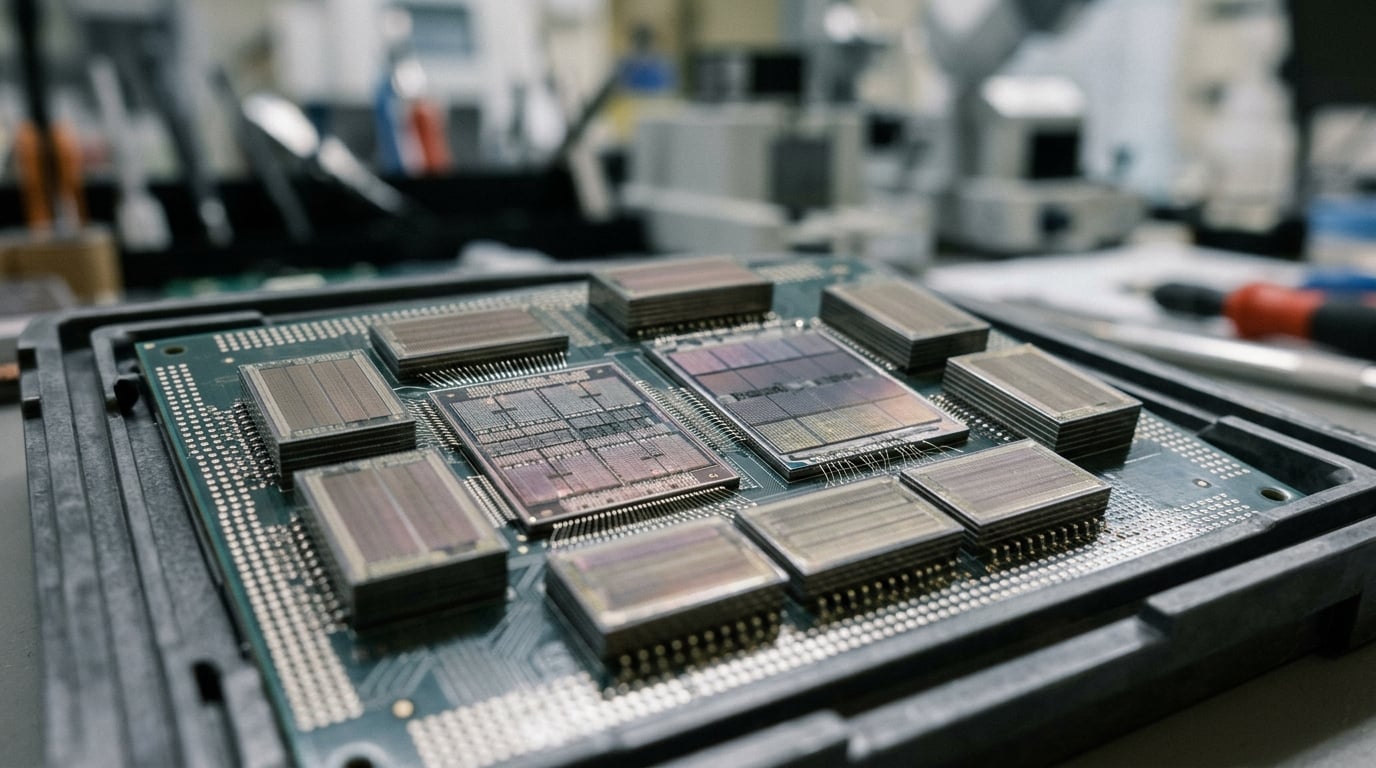
NVIDIA began production shipments of Blackwell systems in late 2024, not late 2025, but B200 capacity remains uneven in GPU scarcity 2026. Cloud availability has expanded through 2025–2026, although providers may offer either eight-GPU HGX B200 servers or GB200 NVL72 systems; those configurations are not interchangeable. (NVIDIA Blackwell overview)
The capacity and performance differences are substantial:
- B200 SXM: 180 GB of HBM3e, 8 TB/s of memory bandwidth, up to 9 PFLOPS FP8 and 18 PFLOPS FP4 Tensor Core performance, and up to 1,000 W per GPU.
- H200 SXM: 141 GB of HBM3e, 4.8 TB/s, and up to 700 W.
- H100 SXM: 80 GB of HBM3, 3.35 TB/s, and up to 700 W.
These are NVIDIA peak specifications; Tensor Core comparisons depend on precision, sparsity and workload support. B200 provides about 28% more memory than H200 and 125% more than an 80 GB H100, while its published peak FP8 throughput is more than twice that of H100/H200 SXM. Its native FP4 path can add a larger inference advantage when model quality remains acceptable at that precision. (NVIDIA B200 specifications, NVIDIA H200 specifications, NVIDIA H100 specifications)
Supply is constrained by more than GPU wafers:
- Two-die Blackwell package: B200 combines two large dies manufactured on TSMC’s customized 4NP process, increasing fabrication and advanced-packaging complexity.
- CoWoS capacity: Blackwell depends on advanced packaging, interposers and substrates whose capacity cannot be expanded as quickly as conventional server assembly.
- HBM3e: Each B200 requires six high-capacity HBM3e stacks, making qualified memory supply another gating component.
- Rack infrastructure: A B200 consumes up to 1,000 W, versus 700 W for H100/H200 SXM. NVIDIA specifies up to 14.3 kW for an eight-GPU DGX B200 before accounting for facility-level cooling and power overhead. Dense deployments often require liquid cooling, higher-current power distribution and network upgrades. (NVIDIA DGX B200 datasheet)
As of July 22, 2026, there is no universal B200 price. Public specialist-cloud price cards and capacity marketplaces generally place short-term B200 access at roughly $5–$10 per GPU-hour, with some scarce-region or fully on-demand offers above that range. Comparable advertised H200 capacity commonly falls around $3–$6 per GPU-hour, while H100 offers are often around $2–$5. Committed contracts can be lower, and hyperscaler instances can be materially higher once the full host, CPUs, memory, networking and minimum eight-GPU allocation are included. These are market ranges, not NVIDIA list prices; region, term, interconnect and availability can change the effective rate daily. (Lambda pricing, Nebius pricing)
Hardware pricing is equally configuration-dependent. NVIDIA does not publish a standalone B200 MSRP, and B200s are normally acquired in complete HGX or DGX-class systems. As of July 2026, public OEM and reseller quotations for eight-GPU B200 servers broadly span about $300,000–$500,000, before premium networking, racks, cooling, support and data-center work. Delivery can range from weeks for an integrator holding inventory to multiple quarters for large, customized orders—one reason GPU scarcity 2026 looks different by buyer and geography.
A higher hourly rate does not necessarily mean a higher workload cost. If a B200 instance costs 70% more per hour than an H200 but completes a supported job more than 1.7 times faster, the B200 has the lower compute cost per completed job. Savings can also come from fitting a model or larger batch on one B200 instead of sharding it across multiple H100s, reducing communication overhead and occupied GPU-hours. Conversely, workloads limited by CPU processing, storage, networking, unsupported kernels or FP32 performance may see too little acceleration to justify the premium.
For teams navigating GPU scarcity 2026, cloud rental or a reserved-capacity contract remains the quickest realistic route to B200 for near-term work. On-premises acquisition is more defensible for consistently high utilization and facilities already designed for the power and cooling load; otherwise, the server’s acquisition cost and infrastructure requirements can outweigh its throughput advantage. Availability should be confirmed for the exact region, GPU count, interconnect and start date rather than inferred from a provider’s general “B200 available” announcement.
What builders actually buy in 2026
[Inference] As of July 2026, builders comparing H100 vs H200 vs B200 rarely choose on specifications alone. The practical decision depends on available capacity, model memory requirements, deployment format, software readiness, and cost per useful result—such as cost per completed request, training run, or generated token—rather than the lowest hourly GPU price.
Memory figures below reflect common data-center configurations. Exact systems, interconnects, quotas, contract terms, pricing, and regional availability vary by provider.
| GPU | Memory profile | Best workload | Availability pattern in July 2026 | Cost behavior | Main caveat |
|---|---|---|---|---|---|
| NVIDIA H100 | Commonly 80GB HBM3; variants differ | Mature inference, fine-tuning, general-purpose training, and models that fit with acceptable quantization or parallelism | Generally offered by the widest range of hyperscalers and specialist GPU clouds, although large contiguous clusters can still require reservations | Often has a lower rental or acquisition premium than newer accelerators. Strong utilization and mature software can make it the best-value option | Less memory per GPU can increase sharding, communication overhead, or replica count for larger models and contexts |
| NVIDIA H200 | 141GB HBM3e in the common data-center configuration | Memory-bound inference, long-context serving, larger KV caches, large models, and jobs constrained by batch size or sequence length | Provider- and region-dependent; commonly available through reserved instances, dedicated nodes, or negotiated capacity | The hourly premium can be offset when additional memory and bandwidth reduce GPU count, sharding, or runtime | It may deliver limited economic benefit for smaller or compute-bound workloads that do not use the extra memory |
| NVIDIA B200 | 180GB HBM3e | High-throughput inference, large mixture-of-experts models, demanding training, and workloads optimized for Blackwell | Capacity and deployment format vary substantially. Large B200 or integrated GB200 clusters are often allocation- and contract-dependent | Usually carries the highest platform cost, but can win on cost per result when greater throughput or consolidation reduces total GPU-hours and infrastructure overhead | Power, cooling, networking, software qualification, and commitment requirements can outweigh the performance gain |
A lower hourly rate does not necessarily mean a lower production bill. An H200 can be cheaper overall than an H100 configuration if its memory allows a model to run on fewer GPUs, avoids costly tensor or pipeline parallelism, supports larger batches, or shortens runtime. B200 can make the same case where Blackwell throughput enables higher token output, faster training, or substantial node consolidation. Conversely, H100 can remain the economical choice when the workload already fits comfortably and receives little measurable benefit from newer hardware.
Workload decision matrix
| Workload | Practical first choice | When H200 or B200 can win | What to verify |
|---|---|---|---|
| Inference under 70B | H100 for mature, cost-conscious serving; H200 when long contexts, batching, or KV-cache size creates memory pressure | H200 can reduce sharding or support more concurrent requests. B200 is justified when measured throughput or consolidation produces a lower cost per completed request | Live instance price, minimum commitment, quantization support, latency at target concurrency, and available replica count |
| Inference, 70B–200B | H200 is often the practical middle ground because of its 141GB memory profile | B200 can win when additional memory and throughput reduce the number of GPUs or nodes required, particularly at sustained utilization | Whether capacity is available as individual nodes or only reserved clusters; NVLink topology, host memory, context target, and serving-stack support |
| Fine-tuning and smaller training runs | H100 for LoRA, supervised fine-tuning, continued pre-training, and episodic distributed jobs | H200 helps when memory limits batch size or sequence length. B200 becomes attractive when faster completion materially reduces total reserved time | Reserved versus interruptible pricing, preemption risk, checkpoint overhead, storage throughput, and cluster startup time |
| Large-scale training or frontier workloads | B200 clusters or integrated GB200 platforms when the software and facility are ready | H100 or H200 clusters can still be preferable when they are available sooner, require less platform qualification, or carry more favorable contract terms | Delivery dates, network topology, power allocation, cooling, support, expansion rights, and total contract value |
H100 remains a common baseline because its software ecosystem is mature and it is offered in many deployment formats. It is usually the safest starting point for teams whose models already fit, whose traffic is variable, or whose priority is avoiding long commitments.
H200 is the most direct upgrade when memory is the bottleneck. Its larger HBM capacity can accommodate larger models, contexts, KV caches, or batches with fewer GPUs. The important question is not whether H200 is faster in isolation, but whether it reduces parallelism and improves utilization enough to offset its provider premium.
B200 is most compelling for sustained, high-throughput serving and large training workloads that can exploit Blackwell’s architecture. It should be evaluated as part of a complete system: a B200 cloud instance, an HGX B200 server, and a GB200 NVL72 platform are not interchangeable products. Host CPUs, networking, local storage, GPU interconnects, rack power, cooling, and software support can materially change both performance and cost.
Pricing remains highly variable across on-demand, reserved, interruptible, dedicated, and purchased capacity. Before choosing an accelerator, obtain live July 2026 quotes from multiple providers and benchmark the actual model at the required context length, batch size, latency target, and availability level. Compare total cost per useful result—not GPU price per hour alone.
Alternatives: AMD, Trainium, TPU
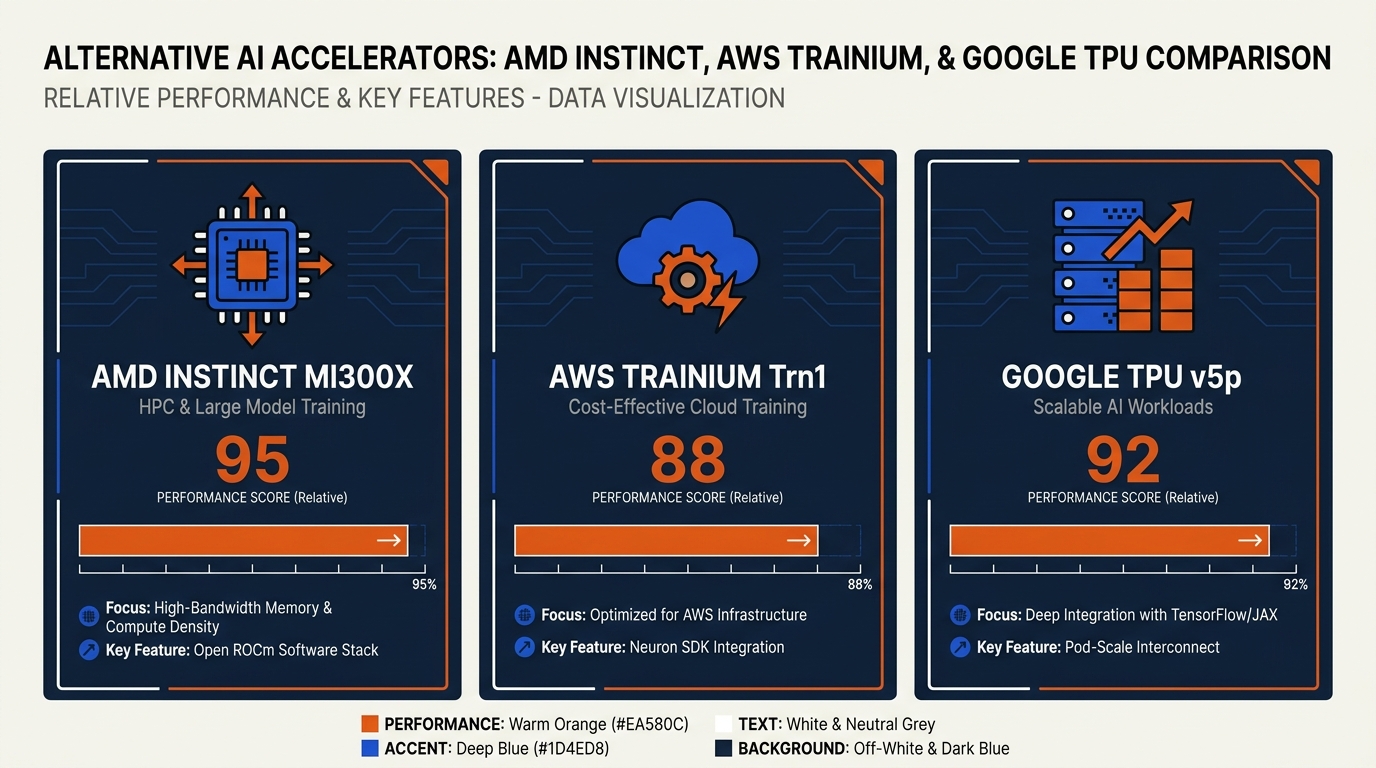
The "NVIDIA-only" world is loosening at the edges:
- AMD MI300X / MI325X — 192–256 GB HBM, attractive for very-large-model inference. ROCm support has matured but ecosystem is still narrower than CUDA.
- AWS Trainium 2 / Inferentia 2 — competitive on $/inference for Bedrock-served workloads, especially Anthropic models on Trainium clusters.
- Google TPU v5p / v5e / Trillium — strong for Gemini-class inference, available via Vertex AI.
- Groq, Cerebras, SambaNova — specialized inference hardware. Groq leads on absolute tokens-per-second for select models. [Unverified]
For most teams in 2026, NVIDIA is still the default. The alternatives are credible enough that single-vendor lock-in is the more interesting risk than "alternatives don't work."
Practical advice
- Use this July 2026 buyer checklist before choosing an accelerator. Under GPU scarcity, specifications matter less than deliverable capacity and cost per completed workload.
- H100: Prioritize mature, immediately available capacity when it supports the existing stack and produces the lowest cost per successful result. In periods of GPU scarcity, reliable utilization can outweigh newer hardware.
- H200: Benchmark it for memory-heavy inference, long-context serving, large models, retrieval workloads, and fine-tuning limited by H100 memory capacity or bandwidth. During GPU scarcity, confirm that its memory advantage actually reduces sharding, GPU count, or processing time.
- B200: Consider it when measured node-level throughput or Blackwell-specific capabilities justify the price and migration effort. A GPU scarcity label does not excuse skipping checks for software readiness, system delivery, power, cooling, and rental granularity.
- Commercial terms: Use spot for interruption-tolerant work, reserve only validated baseline demand, and retain an on-demand or mixed-fleet fallback.
- Live quotes: Request dated, configuration-specific quotes from multiple providers and confirm that capacity is physically deliverable within the required schedule.
| Option | Strong initial fit | Check before choosing |
|---|---|---|
| H100 | Mature inference, fine-tuning, and existing Hopper deployments | Delivery date, HBM variant, PCIe or SXM form factor, host configuration, interconnect, and cost per completed workload |
| H200 | Memory-heavy or long-context workloads that exceed practical H100 limits | Measured memory benefit, latency, throughput, software support, topology, and price premium |
| B200 | Compute-intensive workloads able to use Blackwell features and higher node throughput | Deliverable system type, minimum rental unit, stack maturity, migration work, power, cooling, and networking |
| Spot/preemptible | Checkpointed training, batch processing, and fault-tolerant inference | Eviction frequency, restart delay, replacement capacity, checkpoint cost, and fallback rate |
| Reserved/committed | Stable, measured baseline demand | Capacity guarantee, deposit, term, portability, substitution rights, and termination rules |
- Compare live quotes, not advertised starting rates. GPU scarcity makes public prices directional snapshots rather than dependable market rates. Ask each provider for the same GPU count, region, form factor, server topology, rental period, support level, and delivery window. Verify whether the quote covers one GPU, a full multi-GPU server, a virtual instance, or a managed endpoint. Also confirm setup fees, minimum billing periods, storage, networking, and egress. In a GPU scarcity market, a low list price has little value if the quoted configuration cannot be provisioned when needed.
- Match memory capacity and form factor to the workload. Build a representative test using production model versions, context lengths, batch sizes, quantization, concurrency, and latency targets. Test only configurations that can actually be purchased or rented. Distinguish PCIe cards from SXM-based systems and compare memory capacity, memory bandwidth, host RAM, CPU allocation, and GPU-to-GPU connectivity. Under GPU scarcity, substituting a different form factor or server design can materially change performance even when the GPU name appears identical.
- Measure interconnect and full-system performance. For multi-GPU or multi-node work, document the exact NVLink, NVSwitch, PCIe, and network topology exposed by the provider. Run collective-communication tests and the real application rather than relying on theoretical accelerator throughput. Include local NVMe, checkpoint storage, object-store operations, inter-zone traffic, and internet egress. GPU scarcity can encourage buyers to accept unfamiliar systems, but slow networking or underprovisioned hosts may erase an attractive compute rate.
- Calculate cost per completed workload. Compare cost per successful training run, million tokens, image, audio minute, or other business-relevant output—not GPU-hour alone. Include utilization, queue time, failed jobs, interruptions, compilation, cold starts, idle replicas, underfilled batches, data transfers, and output quality. During GPU scarcity, an available and well-utilized H100 may be cheaper per result than a newer accelerator with a higher rate or provisioning delay. H200 or B200 may win when additional memory or throughput measurably lowers GPU count, sharding, or completion time.
- Validate facility limits for owned or colocated systems. Confirm rack density, electrical feed, peak draw, cooling method, coolant requirements where applicable, cabling, network capacity, and installation lead time. For rentals, ask whether power limits or shared infrastructure can throttle the quoted system. GPU scarcity should not push a buyer into hardware that the target facility cannot power, cool, network, or service economically.
- Price commitment and migration risk explicitly. Compare on-demand, spot, and reserved terms side by side. A reservation discount does not automatically prove that physical capacity is guaranteed, so review deposits, minimum terms, regional restrictions, instance-family limits, substitution rights, start dates, service credits, portability, and early termination. Add the cost of CUDA and driver changes, framework upgrades, container rebuilds, kernel tuning, quantization validation, orchestration changes, monitoring, operator training, and possible output-quality regression. In GPU scarcity, flexibility can be worth more than a nominal discount if workload requirements or available hardware change.
- Run a limited production trial before committing. Test long enough to observe utilization, tail latency, failures, spot evictions, replacement delays, thermal or power limits, and operational overhead. Require written confirmation of the GPU model, memory variant, form factor, topology, delivery date, and capacity guarantee. Keep a fallback image and benchmarked secondary provider where practical. The safest response to GPU scarcity is a measured, portable deployment plan tied to completed-workload economics rather than a preferred GPU name.
Bottom line
The bottom line on GPU scarcity 2026: choose the H100 for mature value and broad availability, the H200 for memory-heavy inference, and the B200 for maximum throughput where capacity and budget permit. The best option is not necessarily the newest accelerator—it is the one you can deploy on acceptable terms and keep sufficiently utilized.
H100 remains a practical default for workloads that fit within its memory and meet target performance levels. Its mature ecosystem and wider availability can reduce deployment friction. H200 is better suited to large models, long context windows, and other memory-bound inference workloads that benefit from greater memory capacity and bandwidth. B200 should be considered when measured throughput gains justify higher costs, potentially tighter capacity, and any required infrastructure changes.
Before committing, use this buying checklist:
- Benchmark the workload: Test actual models, batch sizes, precision formats, latency targets, and expected utilization.
- Calculate total cost: Include rental or purchase pricing, power, networking, cooling, engineering, and idle capacity.
- Verify procurement terms: Compare delivery or activation timelines, minimum commitments, contract flexibility, and alternatives if supply changes.
Supply conditions may vary by provider, region, configuration, and contract size. A resilient GPU scarcity 2026 strategy therefore prioritizes time to useful capacity, benchmarked economics, and procurement flexibility over headline specifications alone.
Frequently Asked Questions
Does GPU scarcity still exist in 2026?
Should I choose the H100 or H200?
When is the B200 worth it?
Is it better to rent or buy GPUs in 2026?
Are AMD GPUs or cloud accelerators credible alternatives?
How should I compare H100, H200, and B200 quotes?
Should I accept the lowest-priced GPU offer?
How can I confirm which GPU is best for my workload?
Discussion
Related Posts



Ready to automate customer conversations?
Launch AI voice agents and WhatsApp bots with CallMissed — one API, 22+ Indian languages.