
AI Testing 2026: Test Generation, Mutation Testing and Coverage



AI test generation in 2026 — why coverage lies, how mutation testing tells the truth, and how to pair AI with property-based and mutation tools.
AI Testing 2026: Test Generation, Mutation Testing and Coverage
"AI generated my tests" was the 2024 selling point. By 2026 the conversation has moved on to a harder question: are those generated tests actually any good? Coverage numbers say yes; mutation testing says often no. The 2026 stack pairs AI generation with mutation analysis as the truth-teller — and that pairing is what turns AI-generated tests from theater into real defenses.
The state of AI test generation
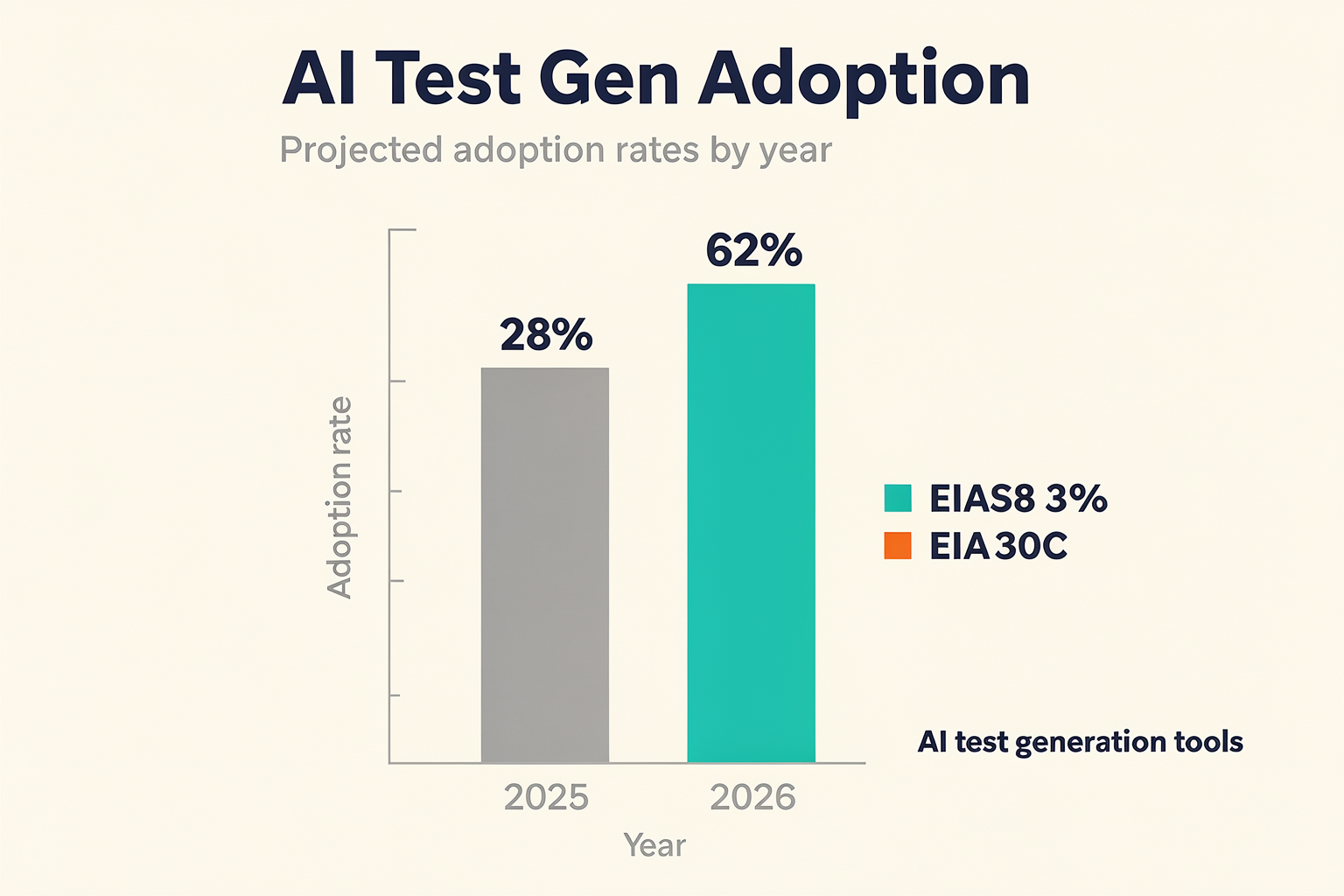
A 2026 industry survey reported that 62% of teams used AI to generate tests at least weekly, up from 28% the year before (OutSight, 2026). Most major IDE and code-review vendors now ship test-generation as a first-class action: Cursor, Copilot, Claude Code, Aider, plus standalone tools like CodiumAI/Qodo, Tabnine, and Diffblue.
The capability is real. AI can produce syntactically correct, executing, coverage-increasing unit tests for almost any function in seconds. The problem is that "coverage-increasing" and "actually testing the function" are not the same thing.
The mutation testing reality check
Mutation testing is the honest measure. The pitch:
- Take your code.
- Mutate it programmatically — flip a
>to>=, change a+to-, return null instead of the right value. - Run your test suite against each mutant.
- A "killed" mutant means at least one test failed. A "survived" mutant means your tests didn't notice the bug.
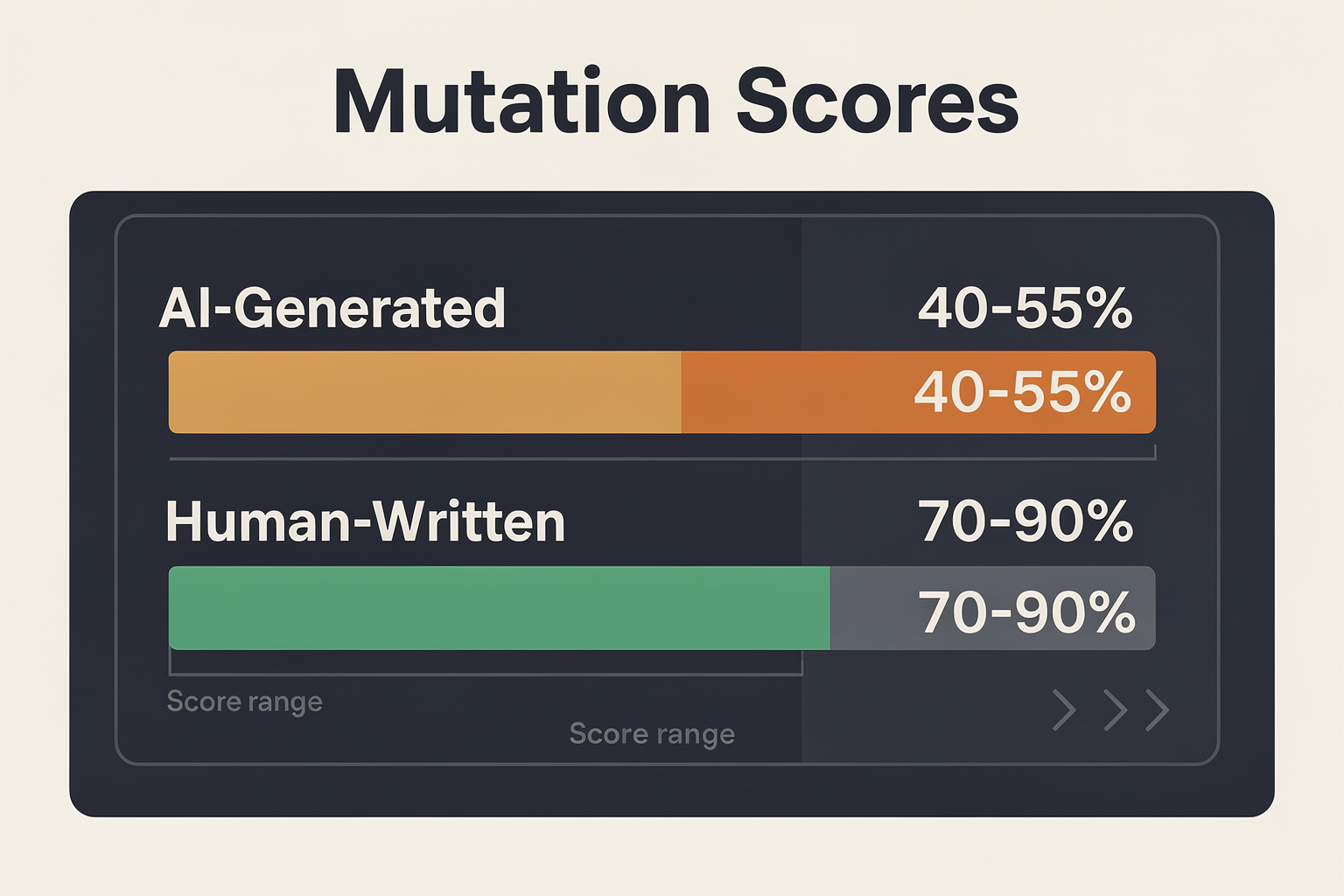
The mutation score (% of mutants killed) is a much harder bar than line coverage. AI-generated tests typically score 40–55% on mutation testing out of the box, versus hand-written human tests that often hit 70–90% (OutSight, 2026).
In other words: AI gives you tests that run, not tests that catch bugs.
The AI + mutation feedback loop
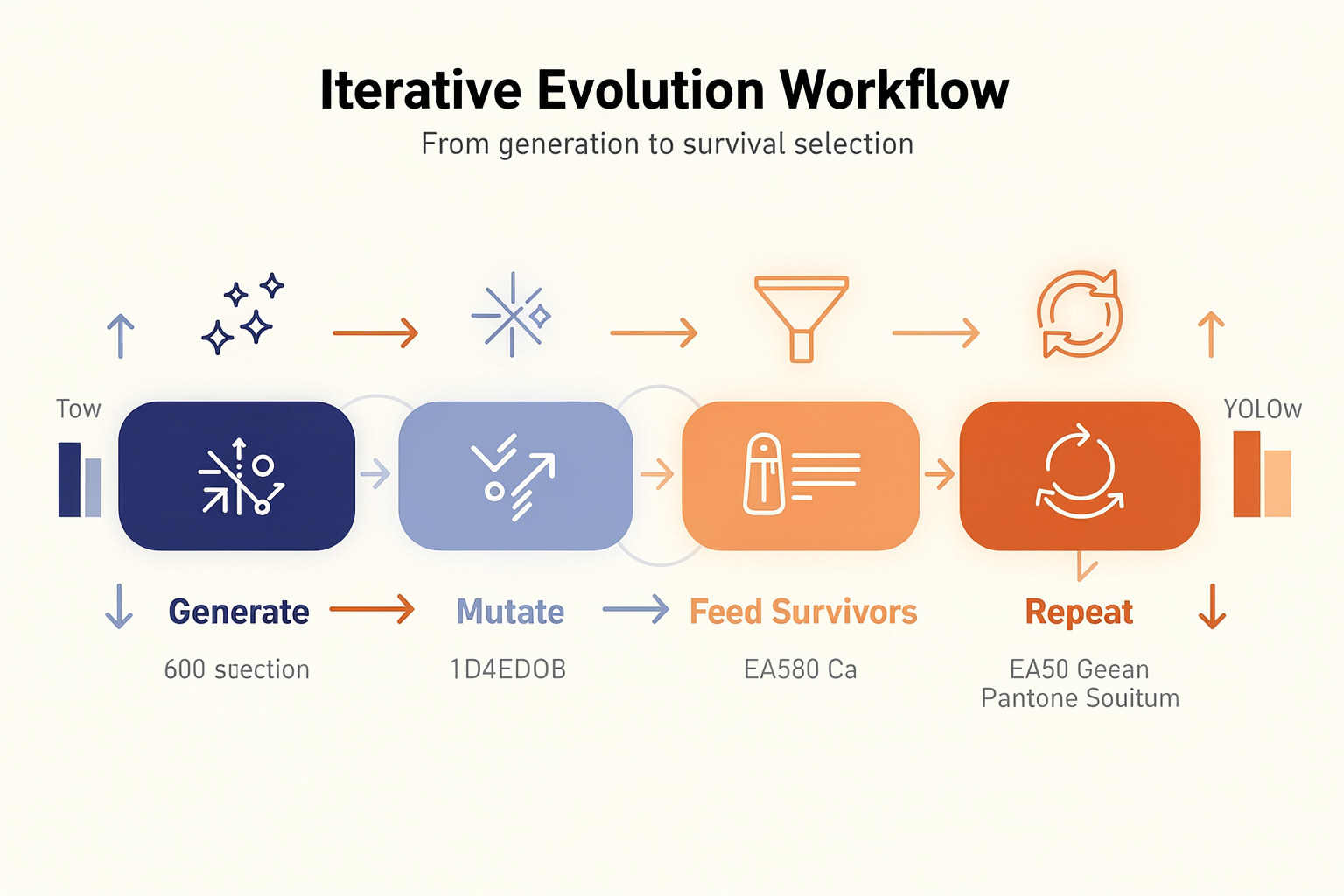
The interesting 2026 pattern: feed mutation survivors back to the AI as a constraint, and ask for tests that kill them.
1. Generate initial tests with AI                (~5 minutes)
2. Run mutation testing                          (~15 minutes)
3. Feed survivors back to AI as failing tests    (~10 minutes)
4. Repeat until mutation score plateaus          (variable)
This loop — described in detail in the OutSight writeup and several adjacent 2026 posts — pushes mutation scores from the 40–55% range into the 70–85% range, approaching hand-written test quality. Atlassian published their own version of this internally and reported similar gains (Atlassian engineering blog, 2026).
Meta's ACH: industrial-scale AI + mutation
The most-cited industrial example is Meta's Automated Compliance Hardening (ACH) — an internal system for mutation-guided, LLM-based test generation, deployed at scale across Facebook, Instagram, WhatsApp, and Messenger codebases (Meta engineering, 2025). The Meta team's framing: LLM test generation alone is not new, and LLM mutant generation alone is not new — but combining them is, and that combination produces meaningfully stronger test suites at production scale.
The ACH lesson for everyone else: the value isn't in either AI tests or mutation testing in isolation. It's in the closed loop between them.
Property-based testing + AI
The other 2026 pairing worth knowing about is property-based testing + AI. Property-based tests assert invariants (e.g., "the output list is always sorted," "the operation is idempotent") rather than specific input-output pairs. AI is good at generating example-based tests; property-based testing libraries (Hypothesis for Python, fast-check for JavaScript, ScalaCheck) generate hundreds of randomized inputs against an invariant.
A pattern from the 2026 OutSight writeup: deterministic AI-generated tests with controlled inputs that produce exact expected outputs plus property-based tests that assert invariants regardless of randomness. The combination catches both value/accumulation errors and structural property violations that single-input tests miss.
The 2026 tooling landscape
A practical map of AI testing 2026 starts with an important distinction: AI can generate test code, fixtures, assertions and scenarios, but generation is not verification. A generated test becomes useful only when an independent runner executes it and its assertions check meaningful behavior. Coverage tools, mutation testing, property-based testing, code review and CI remain essential because an AI assistant can produce tests that compile and pass while asserting the wrong outcome—or nothing significant at all.
The landscape is therefore better understood as a set of complementary layers rather than a contest to find one “AI testing tool.”
| Category | Examples | Strengths | Limitations |
|---|---|---|---|
| IDE assistants | GitHub Copilot, Cursor, JetBrains AI Assistant, Tabnine, Qodo, Aider | Quickly draft tests near the implementation; explain unfamiliar code; generate mocks, fixtures and parameterized cases; help translate tests between frameworks | Output depends heavily on repository context and prompting. Assistants may invent APIs, reproduce implementation details in assertions or optimize for line coverage rather than behavior. Human review and execution are required |
| Autonomous/agentic testing | Coding agents that can inspect a repository and run its test commands; commercial testing platforms such as mabl, Momentic and testRigor | Can iterate after failures, explore workflows, maintain broader context and perform multi-step tasks such as creating a test, running it and proposing a fix | Less deterministic than a conventional test runner; requires carefully scoped permissions, secrets and budgets. Generated changes can be noisy, and passing agent-created tests are not proof that requirements were understood correctly |
| Unit-test generators | Diffblue Cover for Java; Qodo test generation; IDE-assisted generation; EvoSuite as a search-based rather than LLM-based Java option | Useful for creating a baseline around legacy code, discovering inputs and producing repetitive setup code. Dedicated generators may integrate more deeply with language-specific build systems | Tests can become coupled to current implementation behavior. Generated suites may overuse mocks, preserve existing bugs or create high-maintenance assertions. Framework compatibility and licensing vary |
| Browser/E2E tools | Playwright, Selenium, Cypress, plus AI-assisted recorders and hosted browser-testing platforms | Validate user-visible behavior in a real browser. Playwright provides browser contexts, auto-waiting and a bundled test runner; Selenium offers a mature WebDriver ecosystem across languages; Cypress provides an integrated browser-testing workflow and interactive debugging | Browser suites are slower and more failure-prone than unit tests. AI-generated selectors and waits can be brittle. Playwright, Selenium and Cypress are execution frameworks—not inherently evidence that an AI-generated scenario or assertion is correct |
| Mutation frameworks | PITest/PIT for Java, Stryker for JavaScript/TypeScript and .NET, Stryker4s for Scala, mutmut and Cosmic Ray for Python | Measures whether tests detect controlled changes to production code. Surviving mutants reveal weak assertions, untested branches or tests that execute code without checking its effect | Mutation analysis consumes more compute than ordinary testing. Some mutants are equivalent to the original program or irrelevant to the risk being assessed, so the mutation score needs interpretation rather than use as an absolute quality target |
| Property-based tools | Hypothesis for Python, fast-check for JavaScript/TypeScript, jqwik for Java, FsCheck for .NET, ScalaCheck for Scala and QuickCheck-family tools for Haskell and Erlang | Generates many inputs from concise behavioral properties and often shrinks failures to a small counterexample. Particularly effective for parsers, serialization, numeric logic, state machines and invariants | Good properties can be harder to design than example-based tests. A weak or circular property merely validates itself, while external systems and complex UI workflows may require custom generators and careful isolation |
The browser tools deserve separate treatment because they appear frequently in searches for AI testing platforms even though their core role is deterministic execution. Playwright is a common choice for new cross-browser suites where teams value isolated browser contexts, tracing and built-in parallel test support. Selenium remains relevant when an organization needs the broad language support and infrastructure available around the W3C WebDriver ecosystem. Cypress offers a cohesive developer experience for web testing, although its execution and command model differs from both Playwright and Selenium. AI assistants can write code for all three, but teams should still prefer stable role, label or test-ID selectors, explicit business assertions and retained traces or screenshots for diagnosis.
Mutation tools provide one of the strongest checks on generated tests. PITest, often written as PIT or PITest, mutates Java bytecode and integrates with common Maven and Gradle workflows. Stryker is the best-known cross-ecosystem family, with maintained implementations for JavaScript/TypeScript and .NET and a Scala variant. mutmut is a focused Python option commonly paired with pytest-based projects, while Cosmic Ray provides another Python mutation workflow. These frameworks deliberately alter conditions, return values, arithmetic operations or other program behavior and then rerun selected tests. If the suite still passes, the mutant “survives,” indicating that the affected behavior may not be adequately checked.
That does not mean every surviving mutant requires a new test. Some mutations are behaviorally equivalent, unreachable in supported configurations or outside the project’s risk priorities. A practical policy is to review surviving mutants in changed or critical code rather than requiring a perfect repository-wide score. Incremental mutation testing in CI is usually more manageable than mutating an entire large codebase on every commit.
A sensible starting stack by language looks like this:
| Stack | Established runners and coverage | AI-assisted generation options | Mutation and property-based verification | Browser/E2E options |
|---|---|---|---|---|
| Java | JUnit 5 or TestNG; Mockito for test doubles; JaCoCo for coverage | Diffblue Cover, Qodo, Copilot/Cursor/JetBrains assistants, or repository-aware coding agents | PITest for mutation testing; jqwik or QuickTheories for generated properties | Playwright for Java, Selenium, or a JVM-integrated hosted platform |
| JavaScript / TypeScript | Vitest or Jest for unit tests; Istanbul/c8-based coverage where supported | Copilot, Cursor, Qodo, Tabnine and other IDE or agent-based tools | StrykerJS for mutation testing; fast-check for property-based testing | Playwright Test, Cypress, Selenium WebDriver or WebdriverIO |
| Python | pytest or unittest; coverage.py/pytest-cov for coverage; unittest.mock or pytest fixtures for isolation | IDE assistants, Qodo-supported workflows, Aider and repository-aware agents | mutmut or Cosmic Ray for mutation testing; Hypothesis for property-based testing | Playwright for Python, Selenium or pytest-compatible browser plugins |
| .NET | xUnit.net, NUnit or MSTest; Moq, NSubstitute or built-in fakes as appropriate; Coverlet for coverage | Visual Studio/GitHub Copilot and other C#-aware IDE or coding agents | Stryker.NET for mutation testing; FsCheck for property-based testing | Playwright for .NET or Selenium WebDriver |
For most teams, an effective adoption sequence is:
- Keep a conventional runner as the source of truth. AI-generated tests should run through the same JUnit, pytest, Vitest, Jest, xUnit, Playwright, Selenium or Cypress pipeline as human-written tests.
- Generate small, reviewable changes. Ask for tests around one behavior, bug or boundary at a time instead of accepting a large generated suite.
- Review the oracle, not just the setup. Check whether assertions express externally meaningful behavior and would fail if the implementation were subtly wrong.
- Measure coverage, but do not stop there. Line and branch coverage identify code that was not executed; they do not establish that executed behavior was checked.
- Run mutation analysis selectively. Start with business-critical modules or files changed in a pull request. Investigate survivors and improve assertions where the mutation represents a plausible defect.
- Add properties for input-heavy logic. Use Hypothesis, fast-check, jqwik or FsCheck for invariants that are difficult to cover with a short list of examples.
- Quarantine or repair flaky E2E tests. An agent that repeatedly retries an unstable browser test can hide the underlying problem rather than solve it.
The central lesson of AI testing 2026 is that generation and verification should remain separate concerns. AI can reduce the cost of creating candidate tests, but confidence comes from independent execution, meaningful assertions, mutation resistance, useful properties and evidence tied to actual requirements. The strongest stack is rarely a single platform; it is a layered workflow in which each tool checks the weaknesses of the others.
What actually moves the needle for a team
The first priority in AI testing 2026 is not generating more tests; it is learning whether the existing suite can detect meaningful defects. Line, branch, and function coverage show which code executed, but execution alone does not prove that assertions would catch incorrect behavior. Generated coverage can therefore rise while defect detection remains unchanged.
A practical AI testing 2026 workflow starts with a baseline:
- Run the current suite and record coverage, runtime, flaky tests, and known gaps.
- Run Stryker, PIT, or another mutation-testing tool on a representative module.
- Review surviving mutants and classify them: missing assertion, missing input case, equivalent mutant, or low-risk code.
- Improve the tests before asking an AI system to generate additional cases.
This process often reveals tests that execute code without checking the result closely enough. Delete redundant generated tests, strengthen weak assertions, and prioritize boundary conditions, error paths, state transitions, and business rules. Ten tests that distinguish correct from incorrect behavior are more valuable than hundreds that merely increase coverage.
Independent verification
For AI testing 2026, generated tests should be treated as candidate artifacts, not as proof that the implementation is correct. A generator may reproduce assumptions embedded in the source code, rely on mocks that bypass important behavior, or assert the current output rather than the intended output. Human-readable test names and passing status do not solve the oracle problem.
Treat AI testing 2026 as a draft-and-verify process:
- Require every generated test to identify the behavior or requirement it protects.
- Review assertions separately from setup and fixture code.
- Compare expected results with specifications, API contracts, production examples, or a trusted reference implementation.
- Avoid using the same model response to create both the implementation and its only acceptance criteria.
- Run generated tests against seeded faults or mutants to confirm that they fail for relevant defects.
- Add property-based tests for invariants such as sorting, deduplication, idempotency, reversibility, monotonicity, and authorization boundaries.
Independent verification does not require a second AI vendor. Mutation testing, differential testing, contract tests, property tests, and focused human review can all provide a separate signal.
Selective mutation testing
The economical pattern for AI testing 2026 is selective mutation testing rather than mutating an entire repository on every commit. Full mutation runs can be expensive, especially in large systems, so apply them where the feedback is most useful.
Start with changed files, critical modules, or code that handles money, permissions, customer data, scheduling, retries, and external integrations. Run a broader mutation job nightly or before a release, while using smaller targeted jobs in pull requests. Exclude generated code and carefully review long-lived equivalent mutants rather than repeatedly spending compute on them.
In AI testing 2026, mutation feedback should guide generation. Give the generator a surviving mutant, the relevant requirement, and nearby tests; ask for the smallest test that kills the mutant without coupling to implementation details. The OutSight workflow described above is one way to structure that loop, but the principle is tool-independent. Keep the new test only if it protects meaningful behavior and remains understandable to maintainers.
Metrics that reflect risk
A useful AI testing 2026 scorecard combines several signals instead of optimizing a single percentage:
- Mutation score for critical and recently changed code.
- Branch coverage for high-risk paths.
- Escaped defects and regression recurrence.
- Flake rate and test runtime.
- Percentage of generated tests retained after review.
- Requirements, contracts, or invariants covered by explicit assertions.
- Surviving mutants classified by business impact.
Do not compare mutation scores without documenting exclusions and equivalent-mutant handling. Likewise, do not present generated test count or raw coverage growth as evidence of quality. Those are activity and reach metrics; defect detection measures whether the suite can recognize incorrect behavior.
The goal of AI testing 2026 is a faster feedback loop: generate focused tests, challenge them independently, measure their ability to detect faults, and invest effort where failures would matter most.
What to ignore
- "100% coverage" claims. Coverage is a leading indicator at best, and AI-generated tests inflate it without doing the work.
- AI test "confidence scores" that aren't grounded in mutation analysis. The model doesn't know if its tests catch bugs.
- Marketing copy about "self-healing tests." Mostly the test framework is auto-updating selectors when the UI changes — useful for E2E flakiness but not the same as test quality.
A pragmatic 2026 setup
For most engineering teams, the pragmatic AI testing 2026 setup is not a single autonomous tool. It is a feedback loop in which reliable tests establish the baseline, AI accelerates test creation, mutation testing challenges the assertions, and engineers retain control over what reaches production.
- Establish a reliable baseline. Before generating more tests, make the existing suite trustworthy. Remove or quarantine persistently flaky tests, fix shared-state leaks, seed random generators where possible, and make test environments reproducible. Unit tests should run on every pull request and block merges when they fail. Keep slower integration and end-to-end suites separate so developers can identify failures quickly rather than rerunning the entire pipeline.
- Let AI propose tests, not approve them. Give the AI a bounded target: a changed function, class, module, or bug report. Ask it to propose happy-path, boundary, error-handling, and regression cases. Generated code should enter the pull request as a draft for review, not be committed automatically to a protected branch. Verify that your AI provider’s data-handling terms are appropriate for private code, credentials, customer information, and regulated data. Use approved enterprise deployments or local models when source code cannot leave your environment, and never place production secrets in prompts.
- Review assertions, not just execution. A generated test that runs successfully may still prove nothing. Reviewers should check that each assertion verifies observable behavior, would fail for the intended defect, and does not merely restate the implementation. Watch for tautological assertions, excessive mocking, snapshots that accept irrelevant output, and tests that validate an AI-invented requirement. Generated tests deserve the same code review as production code.
- Run mutation testing selectively. Mutate changed files or affected modules in pull requests instead of mutating the full repository on every commit. This keeps feedback practical while still revealing tests that execute code without detecting meaningful changes. Run broader mutation jobs nightly or on a schedule if the repository and build budget allow it. Exclude generated files, trivial accessors, and code for which mutation would provide little signal, but document exclusions so the score cannot be improved by quietly shrinking the scope.
- Feed surviving mutants back into the loop. Treat surviving mutants as specific prompts for better tests: “This conditional was inverted and the suite still passed; propose a test that distinguishes the original behavior.” The AI can then suggest new inputs or assertions, while a developer confirms that the mutant represents relevant behavior. Some mutants are equivalent to the original program or otherwise not useful, so do not require every survivor to be killed. Review, classify, and suppress such cases explicitly.
- Add property-based tests where examples are insufficient. For parsers, serializers, validation logic, state transitions, and numerical code, define invariants that should hold across many generated inputs. Useful properties include round-trip consistency, idempotence, ordering, conservation, and rejection of malformed input. Keep seeds and minimized failing examples so failures can be reproduced. AI can suggest properties, but engineers must verify that those properties reflect the actual specification.
- Enforce CI thresholds gradually. Start by reporting mutation score and test coverage without failing builds. Once the team understands the baseline, require that changed code does not reduce the agreed score, then introduce a modest threshold for high-risk modules. A figure such as 70% may be a useful starting discussion, but it is not a universal quality standard. Thresholds should reflect language, architecture, risk, runtime, and the quality of available mutation operators. Avoid optimizing for a single percentage at the expense of meaningful behavior.
- Measure outcomes, not only test counts. Track escaped defects, regression frequency, flaky-test rate, mutation score on changed code, CI runtime, time to diagnose failures, and developer effort spent maintaining tests. Compare these measures before and after adopting the workflow. If test volume rises while escaped defects remain unchanged, flakiness increases, or CI becomes unacceptably slow, revise the process rather than declaring success.
Use extra caution around nondeterministic systems. Time, concurrency, network dependencies, randomized behavior, and model-generated outputs can make exact assertions brittle. Prefer controlled clocks, seeded randomness, stable fixtures, contract checks, and bounded behavioral assertions. UI tests are especially prone to flakiness because of timing, rendering, selectors, and external services; keep a small set of critical-path UI tests, use resilient selectors and explicit synchronization, and avoid asking AI to generate a large browser suite merely to inflate coverage.
The resulting loop is straightforward: reliable tests establish trust, AI proposes focused additions, humans review the assertions, mutation testing exposes weaknesses, and surviving mutants guide the next iteration. It is not “AI replaces QA.” It is a disciplined system for giving AI honest feedback while keeping security, correctness, runtime, and engineering judgment in the loop.
Frequently Asked Questions
Will AI replace QA engineers?
What is the difference between code coverage and mutation score?
What is the best mutation testing tool to start with?
How long does mutation testing take?
How should teams test AI-generated code?
Is AI-based test generation safe for private code?
How should mutation testing be added to CI?
What should an AI testing 2026 strategy prioritize?
Discussion
Related Posts


Ready to automate customer conversations?
Launch AI voice agents and WhatsApp bots with CallMissed — one API, 22+ Indian languages.