
AI Documentation Tools: From Docstrings to Knowledge Bases



How AI changed documentation in 2026 — Mintlify, Documentation.AI, llms.txt, MCP-served docs, and why nearly half of docs traffic is now AI agents.
Documentation in 2026 has two readers, not one. Humans still scan headings, copy code samples, and search the FAQ. But the second reader — the AI coding agent inside Cursor, Claude Code, or Copilot — is now consuming docs at a rate that, on many sites, exceeds human traffic. That shift has reshaped what good docs look like, what tools they're built with, and what teams actually optimize for.
Docs are now an AI interface

The most-cited 2026 stat: Mintlify reports that nearly half of traffic to documentation sites now comes from AI agents (Cursor, Claude Code, ChatGPT, and similar) rather than human browsers (Mintlify blog, 2026). For API-first products, this number is sometimes higher.
The implications are concrete:
- Docs are now part of your developer-tooling integration. If your docs aren't readable by an LLM, your product is harder to use inside Cursor / Claude Code than your competitor's, even if the human-facing docs are equivalent.
- Search and chat-over-docs is now table stakes. Every modern docs platform ships an AI-powered search; the differentiator is accuracy, not presence.
- Conventions like
llms.txt,llms-full.txt, andskill.mdhave emerged as ways to expose docs to AI agents in agent-friendly form.
Mintlify: the category leader
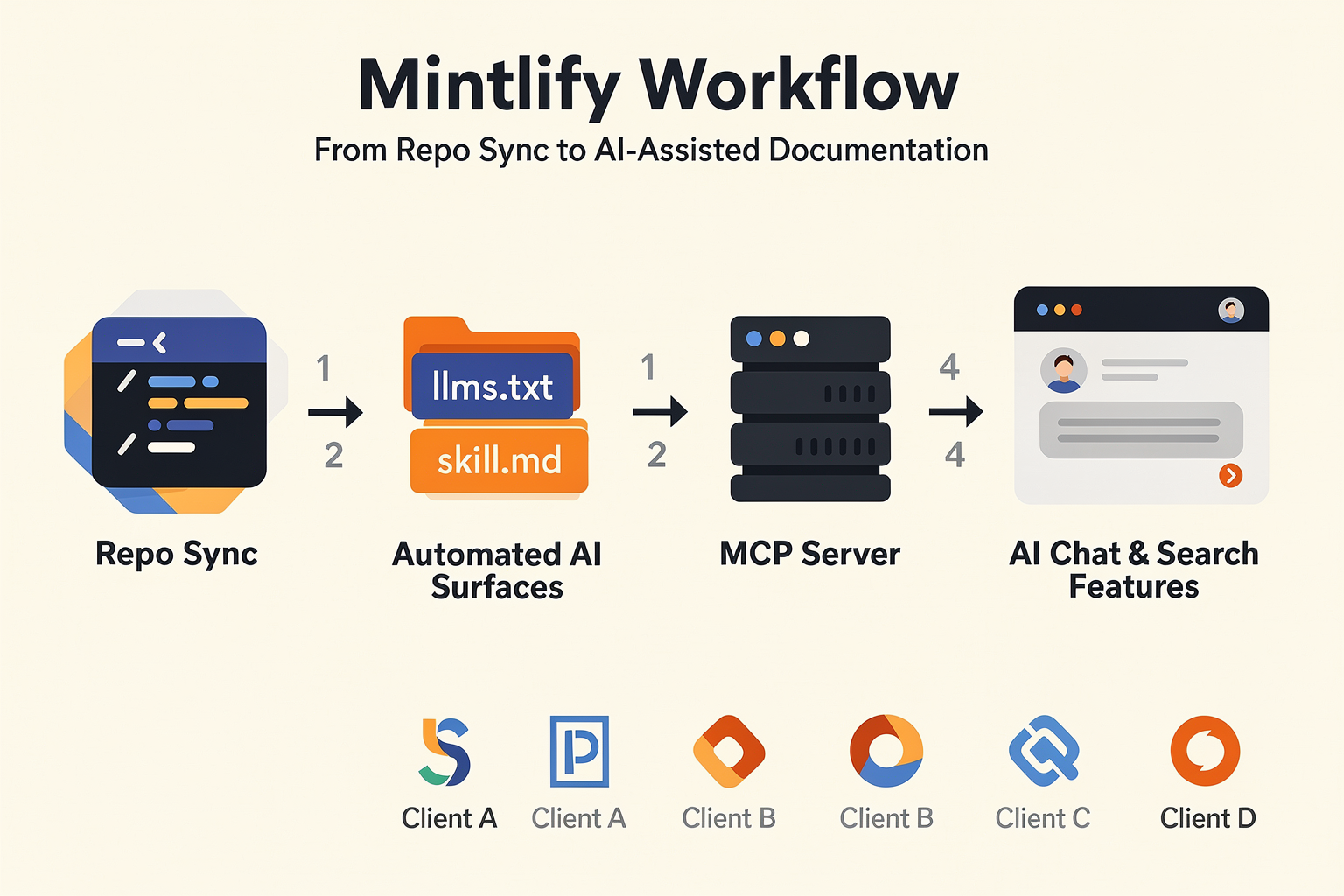
Mintlify is the most-deployed AI-native docs platform in 2026. Its differentiating decisions:
- Docs-as-code with bidirectional Git sync — content lives in your repo as MDX; changes in the web editor commit back to Git, and pushes to Git appear in the editor (Mintlify docs).
- Auto-generated AI surfaces — every Mintlify site auto-generates
llms.txt,llms-full.txt, andskill.mdat the root, plus serves clean Markdown via content negotiation for AI agents. - Built-in MCP server — Mintlify auto-hosts an MCP server for every docs site, so Cursor, Claude Code, and Windsurf can query current docs during a coding task.
- AI-powered chat and search — natural-language search trained on the docs, with citations back to source pages.
The customer list — Anthropic, Cursor, Perplexity — is the clearest proof of category fit. Mintlify is what AI-first companies use to document their AI products. [Inference]
Documentation.AI and the alternatives
Mintlify is the leader, not the only option. Some 2026 alternatives:
- Documentation.AI — newer entrant, positions on AI-driven generation from existing code/docs. The Documentation.AI vs. Mintlify comparison (documentation.ai blog) frames the difference as "Mintlify for managed quality, Documentation.AI for ground-up AI generation." [Inference]
- GitBook — long-established docs platform, added meaningful AI features through 2025–2026. Strong on internal-knowledge-base use.
- ReadMe — API-doc focused, AI-augmented authoring and AI-search. Heavy in API-first companies.
- Docusaurus + AI plugins — open-source default, with various AI-search and AI-chat plugins layered on. The free option for teams that want to host themselves.
- Mkdocs Material + AI plugins — same shape, Python ecosystem.
The platform choice in 2026 is mostly between managed (Mintlify, ReadMe, GitBook) and self-hosted (Docusaurus / Mkdocs / Starlight + AI plugins). Both can produce good docs; the managed platforms invest more in the AI-agent surfaces by default.
Auto-generated API docs
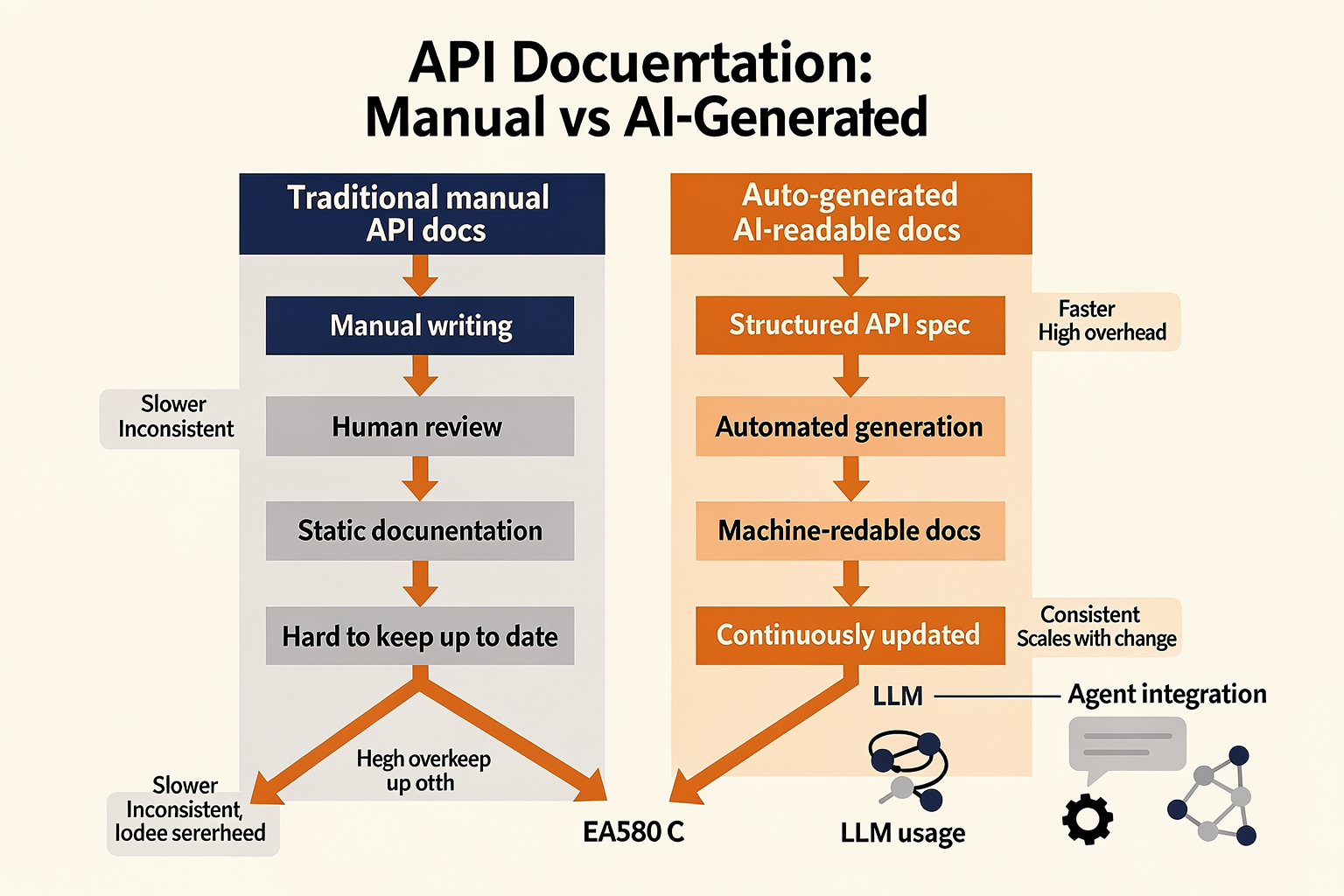
The 2026 standard for API documentation:
- OpenAPI / OpenRPC schemas as the source of truth. Hand-written API docs that drift from code are increasingly rare.
- Auto-generated reference pages with interactive try-it widgets, code samples in 5–8 languages, and AI-augmented descriptions. Platforms like Mintlify, ReadMe, and Stoplight handle this out of the box.
- AI-generated SDKs. Tools like Stainless and Speakeasy generate idiomatic SDKs in TypeScript, Python, Go, and others from an OpenAPI spec. The SDK docs become part of the docs surface.
- AI-augmented changelogs. Tools that summarize OpenAPI diffs into human-readable release notes.
llms.txt and the docs-as-AI-context pattern
llms.txt is the convention the AI-coding ecosystem coalesced around in 2025. The shape:
- A root-level
llms.txtfile athttps://yourdomain.com/llms.txtthat summarizes the docs site for an LLM, with links to the most-important pages. - A heavier
llms-full.txtthat flattens all docs into a single Markdown file an LLM can ingest. - Optional
skill.mdfiles that describe specific workflows the docs explain.
Cursor, Claude Code, Copilot, and Windsurf all bias toward consuming llms.txt when they discover a relevant docs site mid-task. Sites without llms.txt get "translated" by the agent, which is slower and less accurate. Mintlify's auto-generation of these files is one reason the platform is over-represented in AI-agent training data. [Inference]
What good AI-readable docs look like

A few practical conventions that hold up across 2026:
- One concept per page. AI agents do better with focused pages than with sprawling guides. Humans agree.
- Code samples first. Many agents copy the first code block as the canonical example. If your first code block is wrong, your downstream usage suffers.
- Explicit "Common errors" sections. AI agents reading docs in response to a user error are looking for exact error-message matches.
- Versioned URLs.
/docs/v3/...outperforms/docs/...because it lets agents pin specific versions and avoid version-drift bugs. - Up-to-date
llms.txt. Stalellms.txtis worse than nollms.txt— it actively misleads agents.
Internal knowledge bases
A parallel category with similar dynamics: AI-augmented internal docs for engineering, support, and operations. Tools include:
- Glean, Notion AI, Coda AI, Slack AI — over-the-top AI search and synthesis across internal docs.
- Confluence Atlassian Intelligence — AI features layered on the existing Confluence surface.
- Document360, Tettra, Slab — purpose-built internal-docs platforms with AI-search.
The pattern is similar to the public-docs case: the docs are now also for AI agents, and the platforms that expose the right surfaces (chunked content, semantic search, MCP integrations) get used inside coding agents and chat-with-your-knowledge-base flows.
What to do this quarter
If your docs are not yet AI-readable, three concrete steps:
- Generate or write a
llms.txtat the root of your docs site. Even a hand-written one beats nothing. Most modern docs platforms auto-generate this; Docusaurus / Mkdocs need a plugin. - Audit your top-10 most-trafficked pages for one-concept-per-page, code-sample-first structure. These are the pages AI agents are reading right now.
- Add an MCP server (or use a platform that auto-hosts one). The agent on your customer's laptop should be able to query your docs without round-tripping to a search engine.
The shift in 2026 is not that AI is writing your docs (though it can help). It is that AI is reading your docs at a volume that makes "AI-readable docs" a primary product attribute for any developer-facing tool. The docs themselves remain the bottleneck; the tools just make them easier to keep current.
Frequently Asked Questions
What is `llms.txt` and do I need one?
llms.txt is a root-level file (analogous to robots.txt or sitemap.xml) that summarizes a docs site for AI agents and links to its most important pages. If your product is consumed by developers using AI coding tools — and most are in 2026 — you should have one. Many docs platforms auto-generate it.Is Mintlify the best AI documentation tool?
How much of my docs traffic is actually from AI agents?
Discussion
Related Posts



Ready to automate customer conversations?
Launch AI voice agents and WhatsApp bots with CallMissed — one API, 22+ Indian languages.