
AI Data Privacy in 2026: GDPR, DPDP, and Real Risks



A 2026 guide to AI data privacy — GDPR, India DPDP timelines, training-data exposure, prompt-injection exfiltration, and the steps every AI company needs to take.
AI data privacy in 2026 is no longer an abstract concern. Two regulatory regimes — the EU's GDPR (paired with the AI Act) and India's Digital Personal Data Protection (DPDP) Act — now define the floor for any company using LLMs at scale. Plus the practical risks: training-data leakage, prompt-injection exfiltration, and the model-as-data-store problem. Here is the 2026 picture.
Where the regulations stand
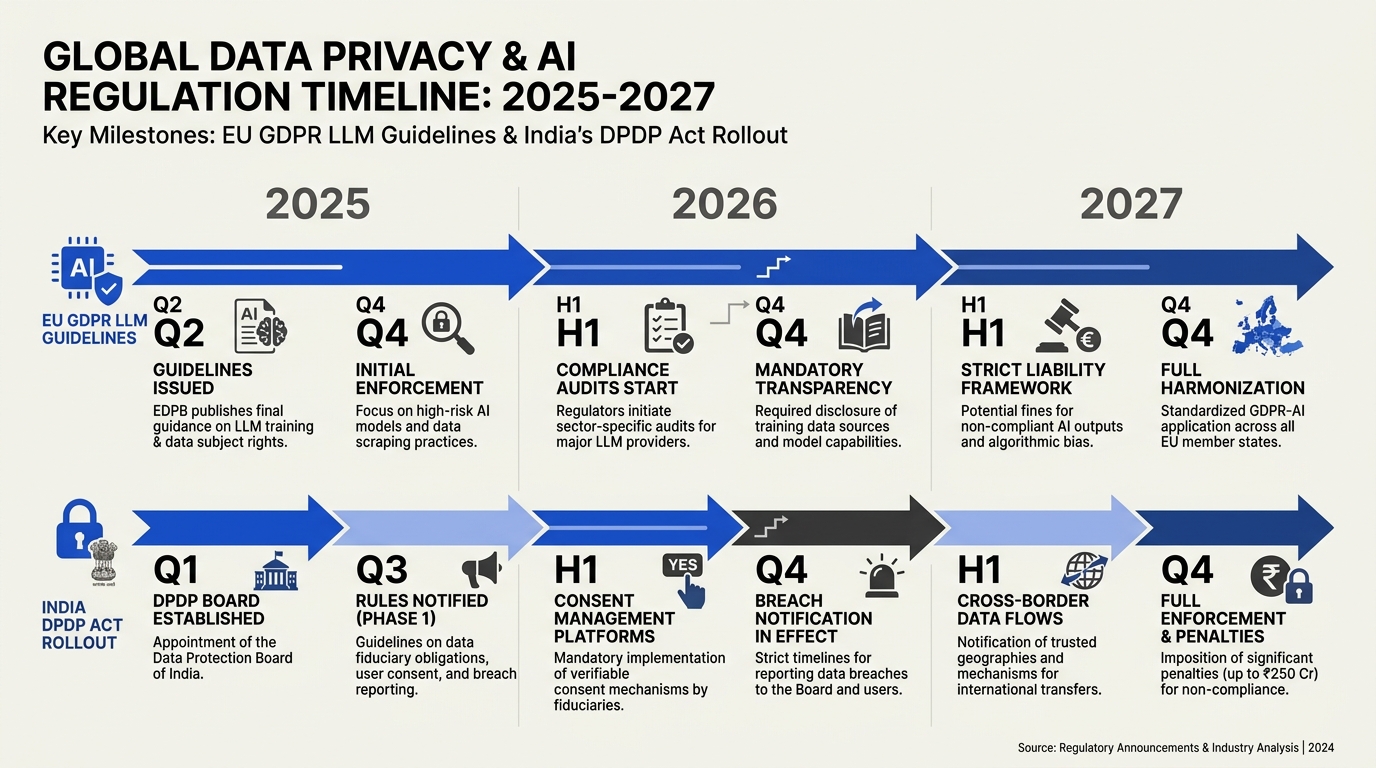
GDPR + LLMs
GDPR has applied to AI from day one — it is technology-neutral. The EU Data Protection Board has been issuing opinions specifically on LLMs since 2024, addressing whether training data containing personal data is lawful processing, whether model parameters themselves count as personal data, and whether right-to-erasure obligations cover model weights.
For builders, the practical takeaways:
- Personal data in training corpora needs a lawful basis (rarely consent at scale; often legitimate interest with extensive safeguards)
- Right-to-erasure obligations may extend to model weights in narrow cases
- Inference outputs about identifiable individuals are personal data and trigger downstream obligations
India DPDP
India's DPDP Act is in phased rollout. Per the IAPP timeline:
- November 13, 2025 — Phase 1: Data Protection Board provisions effective
- November 13, 2026 — Phase 2: Consent Manager provisions effective
- May 13, 2027 — Phase 3: Full substantive provisions effective
DPDP is consent-centric — unlike GDPR, it offers fewer alternative legal bases. Penalties run up to ₹250 crore (approximately $30M) for serious violations. Companies operating in India need to retool consent flows now, before May 2027.
Cross-border data flow
Both regimes constrain cross-border transfers. GDPR uses Adequacy Decisions, SCCs, and BCRs. DPDP currently allows transfers globally except to countries the government specifies; the list is expected to evolve. [Inference] Plan for a "data-residency dial" in your architecture rather than assuming any single regional default.
The practical AI privacy risks

Beyond regulation, four risk classes drive most 2026 incidents:
1. Training-data exposure
Models can regurgitate training data verbatim under specific prompts. Documented cases since 2023 show extraction of email addresses, phone numbers, code snippets, and copyrighted text from frontier models. For companies fine-tuning on customer data, this is an existential risk if the data ever leaves their tenant.
Mitigations:
- Don't fine-tune on raw customer data without aggressive filtering
- Apply differential privacy techniques where feasible
- Run extraction probes against your fine-tuned model before deployment
- Keep customer-data fine-tuning per-tenant, never shared
2. Prompt-injection exfiltration
Untrusted content (a webpage, an email, a PDF) can carry instructions that hijack the model into leaking earlier conversation context — including system prompts, RAG context, and other users' data in shared sessions.
Mitigations:
- Treat all retrieved content as untrusted; never put secrets in the system prompt
- Strip or sandbox tool-output that gets fed back into the model
- Monitor for instruction-pattern anomalies in retrieved content
- Don't share session state across tenants; ever
3. Logging and observability leaks
Most 2026 LLM platforms log full prompts and completions for debugging. If those logs include PII, they become a regulated dataset under GDPR/DPDP. The leak surface is large: exception traces, support-team access, third-party APM tools, vendor support cases.
Mitigations:
- Mask PII at the logging boundary, not after
- Separate "debug-with-content" logs (short retention, restricted access) from "metrics" logs (longer retention, no content)
- Get the logging architecture into the DPIA
4. Vendor-side training risk
If your provider trains on customer data by default, your prompts can leak into other customers' completions over time. Mitigation is contractual — confirm and re-confirm the no-training position, and use zero-retention API options where available.
Concrete steps for 2026
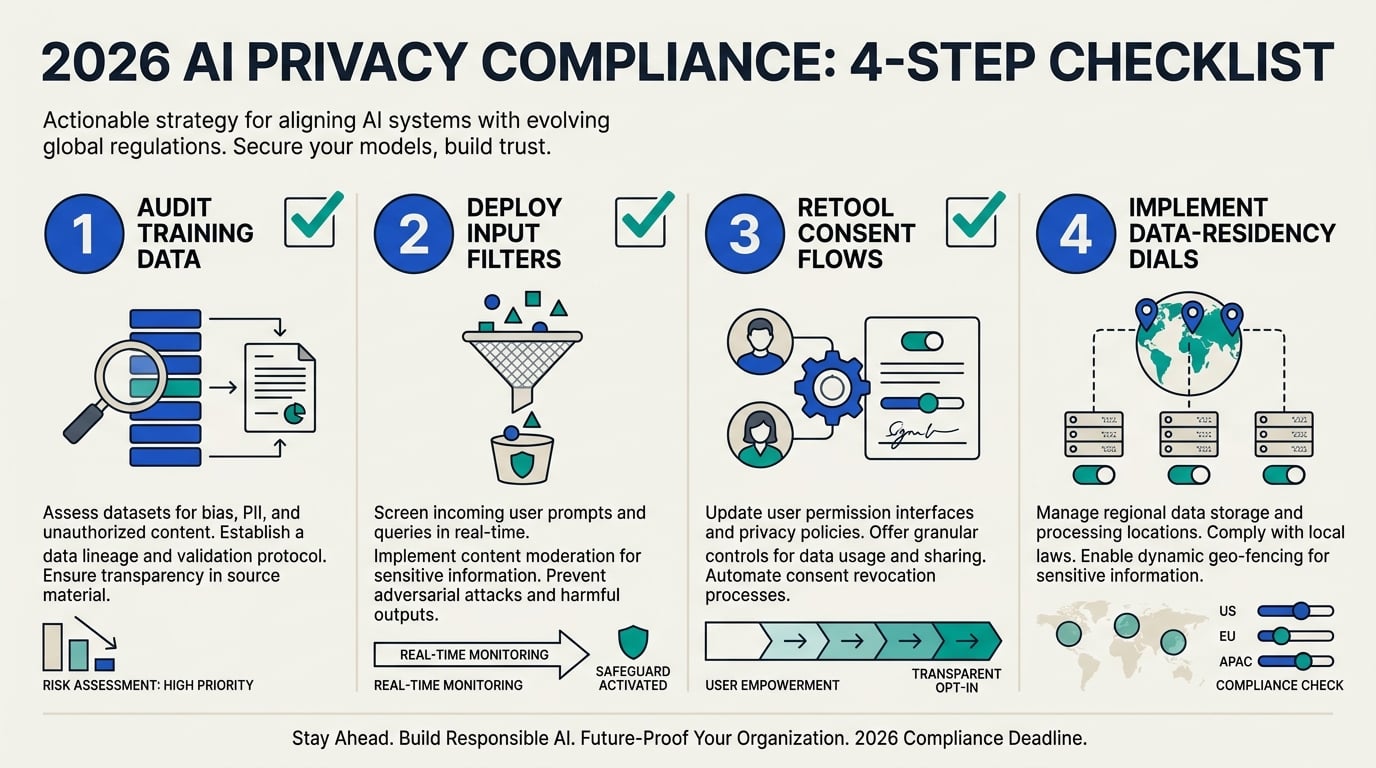
For an AI-using company, the 2026 privacy program should include:
- Data Protection Impact Assessment (DPIA) per AI use case. Mandatory under GDPR for high-risk processing; good practice everywhere.
- Vendor inventory and DPAs. Every model and tool vendor; explicit no-training and retention positions.
- Data-residency map. Where data lives at rest, where it flows in transit, what regions your providers run in.
- PII handling policy at the prompt boundary. Detect and redact before sending; reject or transform requests that ship raw PII to providers.
- Logging architecture review. Content vs. metrics separation; retention policy; access controls.
- Right-to-erasure runbook. When a data subject requests deletion, what must you delete from training-data, fine-tunes, RAG indexes, logs?
- Subject-access response for AI outputs. GDPR Article 15 covers profiling decisions made by AI.
- Incident-response playbook with AI-specific scenarios. Prompt injection, training-data extraction, hallucinated PII about real individuals.
What is genuinely new
A few risks that traditional privacy programs do not handle:
- Hallucinated personal data about real people. Outputs that invent facts about identifiable individuals carry GDPR liability even though no real data was processed.
- Inferred data from non-personal inputs. A model can output personal-grade attributes from anonymous inputs (e.g., predicting health status from public posts). The output is personal data even if the input wasn't.
- Cross-tenant context bleed. Shared embeddings, shared caches, and poorly isolated agent state can leak across customer boundaries.
- Vendor lock-in for compliance. Some vendors expose only US-region inference; that is a hard blocker for EU/India regulated workloads.
Where most companies are weakest

Across 2026 audits, the recurring weak spots:
- No DPIA for AI use cases (GDPR-required for high-risk)
- Logs containing raw PII with broad access
- Vendor contracts predating their AI rollout
- No right-to-erasure runbook covering model artifacts
- Engineering teams unaware of prompt-injection-as-exfiltration
Two of these are typically fixable in a quarter; the other three are projects.
Bottom line
AI privacy in 2026 is the intersection of a maturing regulatory landscape and a rapidly evolving threat surface. The companies handling it well treat it as an ongoing engineering program — mapped data flows, contractual controls, real incident-response — not a one-time legal exercise. The fines are real, the threats are demonstrated, and the bar will only rise.
Frequently Asked Questions
Do model weights count as personal data under GDPR?
When does India DPDP fully take effect?
How do I handle right-to-erasure for AI systems?
Discussion
Related Posts


Ready to automate customer conversations?
Launch AI voice agents and WhatsApp bots with CallMissed — one API, 22+ Indian languages.